Author Archives: John Paine

About John Paine

Unknown's avatar
This blog is topical and devotional--we post whatever interests us, whenever. If you want to follow in an orderly fashion, please see our Kaqexeß page.

Old Testament Fit To Hebrew History

The Old Testament


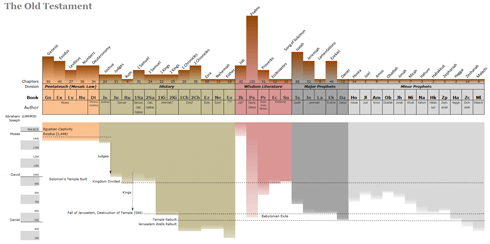
Here’s a simple graphical representation of the books of the Old Testament, tied to Hebrew history.

I recently came across Tim Challies’ Visual Theology series, and his Periodic Table of the Bible.  The notes about that table state that he and graphic artist Josh Byers decided not to include chronology or the relative size of the books in their depiction.  That was intriguing because for some unknown reason I always thought it would be nice to have a chart indicating the size of the books of the Bible—suitable for taping to dashboards or refrigerators for memorization.  Inspired by Challies and Byers, I started noodling around.  It seemed pretty straightforward, at first, until it was time to fill in the authors and dates.

Among reliable references there is a lot of disagreement about who actually penned the books of the Bible, and when they were written.  Take the debate a step further by tying the dates of writing to Hebrew history (about which there is also considerable disagreement), and we have a formidable academic can of worms to sort through. Continue reading


City of David

“Brothers, I can tell you confidently that the patriarch David died and was buried, and his tomb is here to this day.”
Acts 2:29

I love it when archaeologists dig the Bible out of the ground.  I’m cautious not to over-promote ancient artifacts, particularly when they have hazy trails through the antiquities market, but there are lots of recent archaeological discoveries in Israel that precisely fit the text in the Bible.  Since the excavation of the steps of the Pool of Siloam by Ir David Foundation archaeologists in 2004, digs in the City of David have produced an impressive, rapidly growing catalog of artifacts and discoveries.  Critics continue to debate the interpretation of these findings, but the preponderance of evidence is piling up rapidly.

The video below highlights recent finds in the City of David.  You may be amazed to learn just how strongly the archaeology matches the text in the Bible, and the text in extra-biblical sources, such as the writings of Josephus.  The video describes:

  1. A Phoenician capital that prominent archaeologist Eilat Mazar suspected must have rolled downhill from King David’s palace.  She started searching for the palace uphill from the capital’s resting place, and unearthed what many archaeologists agree are the remains of King David’s palace2 Samuel 5:11 states that King David’s palace was built by (Phoenician) King Hiram of Tyre.  What kind of capitals would Phoenician craftsmen put on the palace columns?  Makes sense to me.
  2. Jebusite pottery from the Iron Age, right where it is supposed to be in the stratigraphy. David captured Jerusalem from the Jebusites (2 Samuel 5).
  3. Two seals (bullae) that were found 30 feet apart containing the exact names of two officials, who in the same sentence of the Bible were part of a plot to kill Jeremiah (400 years after David and right where they should be in the layers of the excavation).
  4. A cistern that could be the muddy cistern recorded in Jeremiah 38:1-13, into which those officials threw Jeremiah.
  5. An underground tunnel leaving the temple area, where according to Josephus, the Roman 10th legion blocked escaping Jews headed to Masada in 70 CE, then opened the tunnel and butchered them.  Archaeologists found a sword in its scabbard from the Roman 10th legion in that tunnel, along with pottery that had food caked on it—indicating the last 2,000 fleeing Jews were indeed hiding or stuck in the tunnel for some period of time.  These artifacts match accounts in Josephus’ Jewish Wars.
  6. A golden bell that matches the raiment prescribed for Hebrew priests in the Bible.
  7. An incomplete inscribed depiction of the Jewish menorah from the Second Temple period, one of only three depictions ever found.

Continue reading


Biblical Tension

“It seems easier to go to a consistent extreme than to stay at the center of biblical tension.”
Robertson McQuilkin

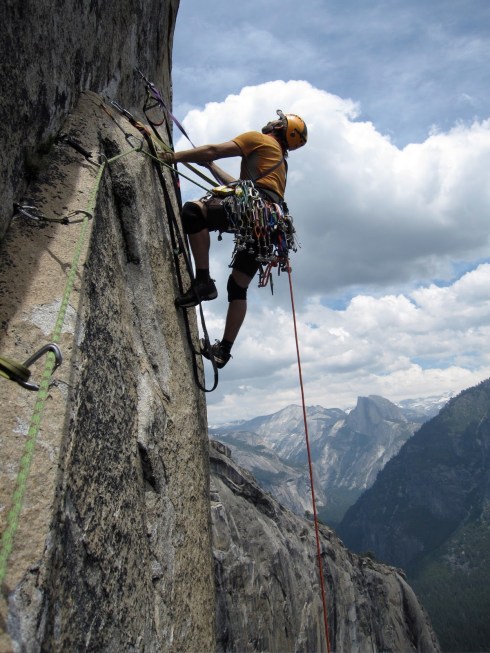
Scaling El Capitan, photo by Bronson Taylor Hovnanian, 2011


A sagacious Veracity reader recently served up the above quote while discussing perspectives on the role of women in church leadership.  I hadn’t heard it before, but it sounded profound and worthy of some quiet-time bird dogging.  I quickly traced it to Robertson McQuilkin, a man of great integrity.

The Christian faith inherently involves biblical hermeneutics—simply put, we have to interpret the text in the Bible.  In wrestling with our different interpretations there seems to be no limit to the chasms we create over issues large and small.

So this new quote from Robertson McQuilkin seemed to hold potential as a way to work though our differences.  Jesus was the master of big thinking, never getting lost in the details.  When we disagree, one tact is to find a higher principle, teaching, or value upon which we can agree.  We can use tension to elevate to a higher common ground.  Lots of things don’t work without tension.  Maybe biblical tension is prescribed for our health and well being.  The left versus the right, with peace in the middle.  No more getting stuck in the parking lots of our own arguments. Continue reading


Under the Hood

Head Gasket Repair

Push Rods and Rockers, 2008


I spent a couple of weeks writing this post, adding and removing parts, only to end up with an over-spiritualized, not-very-good penultimate result.  After some painful edits, how about I just get right to the point?

The original idea for this blog was to have a place for “Sharing resources that corroborate the Bible.”  While we remain quite committed to that theme, we’re finding our voice in a slightly different major chord.  Consequently we are changing the tag line for Veracity to “Sharing the Joy of Personal Discipleship.”

What is personal discipleship?  It’s an answer to the darkness of man we see all around us every day.  It’s keeping our eyes on the only thing that counts—faith expressing itself through love (Galatians 5:6b, NIV84).  We define personal discipleship as the process in which a believer or seeker takes personal responsibility for investigating the claims and content of the Bible. Continue reading


Things that Go Bump in the Night

“From goulies and ghosties and long-leggedy beasties
And things that go bump in the night
Good Lord, deliver us!”
Scottish prayer recorded in The Cornish and West Country Litany, 1926
Nightmare

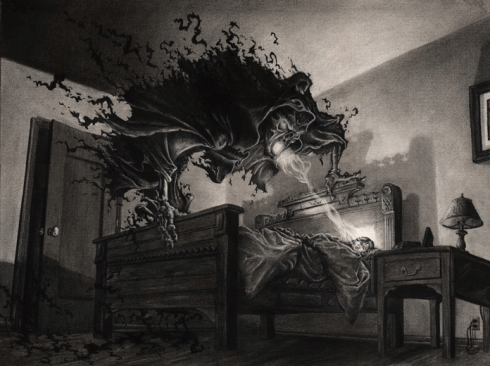
Nightmare by Paul Bielaczyc. Charcoal, 2005.


There was my dentist—a normally genteel man—in the back of a military cargo plane decked in an olive-drab Level A HAZMAT suit, gesturing me into his examination chair with long, gleaming, barbaric surgical instruments. I had a hard time making out what he was saying behind his face shield, but it sounded like, “Buckle up.” I’m pretty sure he was grinning.

I’m not one much for dreaming, nor am I particularly anxious, but it’s amazing what the anticipation of a minor dental procedure did to loose my subconscious this week.

Fear is powerful, and the Bible has a lot to say about it. The words fear, afraidanxious, and anxiety appear 541 times in the ESV.

  • The fear of the LORD is the beginning of knowledge; (Proverbs 1:7)
  • Be not wise in your own eyes; fear the LORD, and turn away from evil. (Proverbs 3:7)
  • Therefore I tell you, do not be anxious about your life, what you will eat or what you will drink, nor about your body, what you will put on.” (Matthew 6:25)
  • He said to them, “Why are you so afraid? Have you still no faith?” (Mark 4:40)
  • And he said to them, “Why are you afraid, O you of little faith?” (Matthew 8:26)

Need an anti-anxiety prescription?  Here you go: fear in the right channel is prescribed—throughout Proverbs and the rest of the Bible. The apostle Paul instructs believers in Philippians 2 to, “Work out your own salvation with fear and trembling.”  We’re not supposed to be free from fear. We’re supposed to live with fear in the right context—reverence and respect for the awesome power of our Creator. That’s what Dick Woodward’s 4 Spiritual Secrets are all about.

Ready for some good news? According to Jesus, fear has an anecdote: faith.

Fear is powerful. My loving mother, who hung that Scottish prayer just outside my bedroom door, was paralyzed by fear her entire life. So many times I wished I could have helped her think through her fear. But that’s not the way it works. Overcoming fear is not a matter of our intellect or will—it’s a matter of the heart. And no one gets out alive. Apart from the grace of God and a little faith we don’t stand a chance.

Here’s a link to Whom Shall I Fear? by Chris Tomlin that gets to the heart of the matter.

Peace.

HT: Paul Bielaczyc (Nightmare used with the kind permission of the artist.)