Author Archives: John Paine

About John Paine

Unknown's avatar
This blog is topical and devotional--we post whatever interests us, whenever. If you want to follow in an orderly fashion, please see our Kaqexeß page.

Predictable Christmas fare: Newsweek’s Tirade against the Bible

Dr. Daniel Wallace provides impressive scholarship to rebut Newsweek’s recent assault on Christians, Christianity, and the Bible. Read the Newsweek article first–it makes some interesting statements that are not without value. That they are out of balance with an informed and studied appreciation of the Bible is, however, the signature of a patently anti-Christian agenda. Snake handlers, Pat Robertson, Rick Perry, the GOP…talk about stereotypes! Really, Newsweek?!

Daniel B. Wallace's avatarDaniel B. Wallace

Every year, at Christmas and Easter, several major magazines, television programs, news agencies, and publishing houses love to rattle the faith of Christians by proclaiming loudly and obnoxiously that there are contradictions in the Bible, that Jesus was not conceived by a virgin, that he did not rise from the dead, ad infinitum, ad nauseum. The day before Christmas eve (23 December 2014), Newsweek published a lengthy article by Kurt Eichenwald entitled, “The Bible: So Misunderstood It’s a Sin” (http://www.newsweek.com/2015/01/02/thats-not-what-bible-says-294018.html?winst=1419500836501&of=2831396). Although the author claims that he is not promoting any particular theology, this wears thin. Eichenwald makes so many outrageous claims, based on a rather slender list of named scholars (three, to be exact), that one has to wonder how this ever passed any editorial review.

My PDF of this article runs 34 pages (!) before the hundreds of comments that are appended. Consequently, I don’t have space…

View original post 3,810 more words


How We Got the Bible (Part 3)

The Church no more gave us the New Testament canon than Sir Isaac Newton gave us the force of gravity. God gave us gravity, by His work of creation, and similarly He gave us the New Testament canon, by inspiring the individual books that make it up.”
J. I. Packer, God Has Spoken: Revelation and the Bible, 3rd ed.

“We should not imagine a committee of church fathers with a large pile of books and these five guiding principles before them when we speak of the process of canonization. No ecumenical committee was commissioned to canonize the Bible.”
Norman L. Geisler and William E. Nix, From God To Us Revised and Expanded: How We Got Our Bible

One of the great misconceptions about Christianity involves the canonization of the Bible (that is, deciding which books comprise the whole, inspired, holy Scripture). For whatever reasons, people tend to imagine some sort of ecumenical process—dragging out over several centuries—where well respected officials in the early and medieval church came together and decided which books were in and which books were out. But as we can see from the quotes above from three of the most conservative Bible scholars, church councils did not produce the Bible.

Ecumenical Councils

Conservative Christian scholarship disallows any notion that ecumenical councils somehow selected the Bible from a list of candidate documents. But there were ecumenical councils, lots of them, so what role did the councils play in the canonization of the Bible?

First, recognize that church councils were necessary for the governance and order of the church. The precedent was set at the Council of Jerusalem in Acts 15, attended by the apostles themselves. There were heresies and challenges to Christian doctrine. There were matters of church discipline and orderly worship that had to be addressed. There was confusion about Gnostic teaching and guidelines for living. Later there would be questions about which books and letters belonged in the canon of Scripture—and which did not.

Shortly after the legalization and state patronage of Christianity within the Roman Empire, the church began to hold ecumenical councils. The first was called by Constantine the Great on May 20, 325 at the Royal Palace in Nicaea. The focus of the Nicene Council was the divinity of Jesus and the clarification of the Trinity. It produced the Nicene Creed, which was later amended to be close to the Apostles Creed. (Sidebar—Did Jesus descend into hell? Here’s a brief discussion about this controversy.) Contrary to modern misconceptions—perpetuated by Dan Brown in The Da Vinci Code—Constantine did not determine the New Testament canon and the First Council of Nicaea did not even address the topic of the canon of Scripture.

Over the following centuries, there would be many more ecumenical councils and synods, continuing through to the present day. Which meetings are recognized as ‘ecumenical‘ depends largely upon denominational perspective. 19th century church historian and theologian Philip Schaff documented the canons of Seven Ecumenical Councils between 325 and 787 CE (which he defined as “councils which have always, and still do, receive the unqualified acceptance of both East and West”):

  1. The First Council of Nicaea,
  2. The First Council of Constantinople,
  3. The Council of Ephesus,
  4. The Council of Chalcedon,
  5. The Second Council of Constantinople,
  6. The Third Council of Constantinople, and
  7. The Second Council of Nicaea.
Philip Schaff - Ecumenical Councils

Philip Schaff meticulously documented the canons of the historic ecumenical councils of the Christian church.

However, history is replete with other councils that are not accepted as ecumenical by the Eastern and Western churches (‘Eastern’ meaning Eastern Orthodox, and ‘Western’ meaning Roman Catholic and other denominations that developed in Europe). For example, the Synod of Hippo (393 CE) and 3rd Council of Carthage (397 CE) produced authoritative lists of the sacred scriptures. Later, the Council in Trullo (also called the “Quinisext Council,” 692 CE) ratified the canons of these councils—but did not specifically state the list of books considered to be divinely inspired. So why didn’t everyone accept the canons of Hippo and Carthage as ecumenical? As you might imagine, church politics had a lot to do with it—and still does. Hippo and Carthage did not have wide representation from the church as a whole and were heavily influenced by Augustine of Hippo, as later critics would argue.

Page 885 of Schaff’s text contains the list of canonical scriptures from the Council of Carthage. This list includes the Apocrypha in the Old Testament but clearly identifies the 27 books of the New Testament. (We’ll explore the Apocrypha in a future post.)

The canons of the ecumenical councils make for dry reading in parts, not unlike reading the formal minutes from a business meeting where much discussion is reduced to a few statements. Nevertheless, check out the canons of these councils as recorded in Schaff’s monumental work. In addition to the seven ecumenical councils, he also documented the records from other councils, including Hippo, Carthage, and Trullo. Much of what these clergymen dealt with is now irrelevant. Troublesome heretics have long ago died, many of the controversial theological and doctrinal problems have faded in time, and frankly no one cares about how to handle “him who persuades a slave to leave his master under pretence of religion.” When you read the canons, it becomes clear how challenged the Christian church was over matters large and small—and how pious many of these councils must have been.

‘Orthodox’ Christianity

Over the centuries since the Ascension of Jesus Christ, the church found more issues to debate, and more reasons to divide. Rather than serving to unite believers, later ecumenical councils proved to be dividing mechanisms by laying out denominational distinctions.

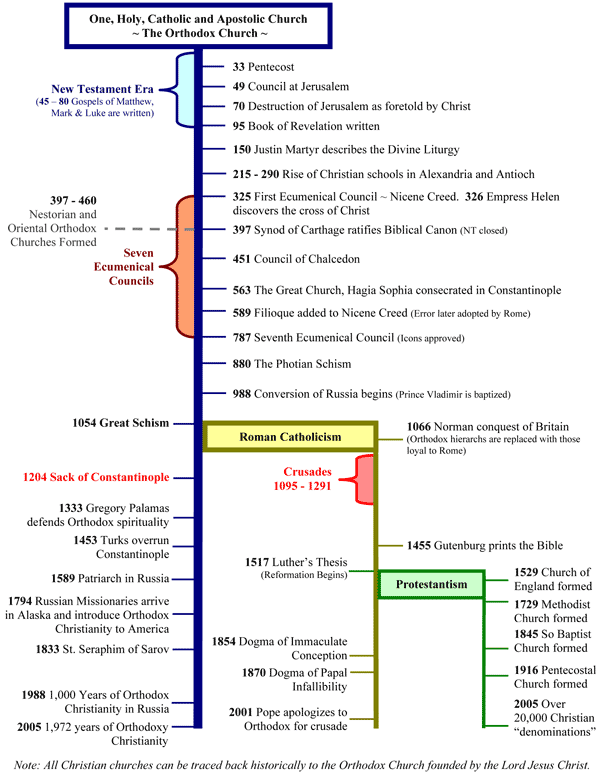
Church History Timeline (credit: http://www.stspyridons.org/timeline/)

Church History Timeline (credit: http://www.stspyridons.org/timeline/)

As shown in the timeline on the right, the Christian church remained essentially united through the early councils. Then, one word (Filioque) caused the Great Schism of 1054 and the ‘orthodox’ church began splitting into more and more denominations.

So…in all the deliberations of the historic synods and councils of the early and medieval Christian church, Christians cannot find agreement on the canon of Scripture. The scholars quoted at the beginning of this post seem to be justified in the strength of their statements. Church councils did not produce or canonize the Bible.

Think about it. Is it reasonable to believe that God would inspire holy Scripture and that it would then need to be ratified by church councils before being recognized as such?

If we rule out the deliberations of church councils as the deciding authority, how then can we know what books comprise the canon of holy Scripture? We’ll take that up in our next post on this topic…

Can We Trust the New Testament Canon?

…but in the meantime, here’s a brief interview with Dr. Michael Kruger that addresses that very important question.

HT: Philip Schaff, Norman Geisler, William Nix, Michael Kruger, Christian Classics Ethereal Library (CCEL)

Additional Resources

From God To Us
The Ecumenical Council

Politics and the Christian Faith

Political Family

“My opponent is a #^&@)*g.  You know he’s a #^&@)*g because here’s a picture of him frowning with his finger near his nose.  (Cue the pleasant music)  Here’s a picture of me smiling with my family and our dogs.  I will be good for you, and I will be good for your wallet.  You can tell I am a true patriot.  I am your non-#^&@)*g candidate, and I approved this message. (Smile)”

Welcome to the predominant success formula on the American political landscape. To get elected candidates discredit their opponent—by striking fear in voters that there is something really wrong with the other guy. Political handlers believe that American voters have short attention spans. There isn’t enough time in a 30-second spot to address substantive issues or ideas—but we can absorb short, memorable sound bites that leave horribly unfavorable impressions of the opponent.

After being bombarded with political rhetoric and campaign commercials in the month leading up to the midterm elections, I was hoping the election results would bring an end, at least for now, to this ugly parade of mudslinging.

But I received a troubling email this week. Not from a political candidate who caved in to his handlers, but from a seminary that, at the very least, has an increasing appetite to engage in political issues and debates.

So?! What’s wrong with that? Shouldn’t seminaries be engaged in the democratic process? After all, the right to free speech is protected in our constitution. The church is under increasing attacks from political figures and the culture in general. Shouldn’t seminaries prepare their graduates to engage and challenge the culture? Shouldn’t Christians be thermostats instead of thermometers? Why would anyone object to Christians being actively engaged in political processes? Some of these candidates are sincere Christians who truly want to serve their Lord and their country.

At the risk of disappointing family, friends and Veracity readers, there is something wrong with mixing politics and political agendas with the Christian faith.

Please hear me out. There are times when it is right—even necessary—to mix Christian values with politics. Consider the political activities of William Wilberforce (fighting slavery), Dietrich Bonhoeffer (fighting Nazism), or Martin Luther King, Jr. (fighting racism). These are three strong examples of when Christian activism was necessary and made an impact on our world.

But let’s be honest—it’s a long way from Wilberforce, Bonhoeffer and King, Jr. to the political candidates of the 21st century. So, how willing should we be to lock arms as Christians with political candidates or political agendas? Is that necessarily a problem?

The problem is that one institution (politics) is fueled by popular opinion, and the other (Christianity) is beyond popular opinion. Democratic politics is practiced successfully by appealing to the widest swath of voters, while negotiating compromises to build plurality positions. The objective in politics is to make a better world for ‘us’. The means are often ugly and combative. Christianity, on the other hand, is successfully practiced by appealing to God, who isn’t favorably impressed or swayed by popular opinion. The objective in Christianity is to develop a right relationship with God, by representing Him well and serving others.

An Argument from Silence

When we bring Jesus to the political arena, we risk equating our faith with our politics. The Christian faith compels us to maintain a certain integrity—by sharing God where it matters most, not necessarily in politics for political gain.

Jesus never attacked a government (although He certainly did attack religious leadership), and nowhere did He model that His followers should engage in any political debate, issue or cause. Jesus launched the ultimate revolution. He did call upon His followers to fight—not against individuals or governments—but against separation from God, darkness, evil and man’s own inhumanity to man. And what weapons did He prefer? Kindness, compassion, self-sacrifice, empathy and love. In fact, when confronted by Pontius Pilate at His trial, Jesus said, “My kingdom is not of this world. If my kingdom were of this world, my servants would have been fighting, that I might not be delivered over to the Jews. But my kingdom is not from the world” (John 18:36, ESV). When the apostle Peter drew his sword to defend Jesus in Gethsemane, Jesus said, “Do you think that I cannot appeal to my Father, and he will at once send me more than twelve legions of angels?” (Matthew 26:53, ESV). Jesus was fighting a different kind of war, for something far more important than political gain. And He never promised that anything would be better in this world—”In this world you will have trouble, but take heart! I have overcome the world.” (John 16:33, NIV84).

In the 1st century somewhere between 10 and 15 percent of the entire population of the Roman empire was enslaved. The Romans occupied Palestine and Jerusalem. Talk about political causes you could sink your teeth into! In fact, Jews expected their Messiah to be a king who would overthrow the Roman occupiers. So if Jesus wanted to gain the respect of the chosen people, all He would have had to do was take on the Roman government. But when Jesus said, “Give to Caesar what is Caesar’s, and to God what is God’s” (Matthew 22:21, Mark 12:7, Luke 20:25, NIV84), we see the ultimate example of a big thinker. If they were looking for a leader to free the slaves, Jesus was way ahead of them—You know that the rulers of the Gentiles lord it over them, and their great ones exercise authority over them. It shall not be so among you. But whoever would be great among you must be your servant, and whoever would be first among you must be your slave, even as the Son of Man came not to be served but to serve, and to give his life as a ransom for many” (Mathew 20:25b-28, NIV84). In John 8:34-36 Jesus answered them, Truly, truly, I say to you, everyone who commits sin is a slave to sin. The slave does not remain in the house forever; the son remains forever.  So if the Son sets you free, you will be free indeed.

The apostle Paul got it. Paul had a lot to say about slavery, particularly as he addressed the idea that we are all one in Christ. His letter asking a slave owner to restore a runaway slave as a brother in Christ is as poignant as his instructions to slaves and masters in Ephesians 6:9. Paul ends these instructions by noting that God is everyone’s master in Heaven. There’s that big-picture idea again.

In logic, this type of argument is termed an “argument from silence.” Can we infer from Jesus’ own words and deeds, and apostolic writings, that the Christian faith is dealing with more important matters than politics and political ideas? Is there a principle to be applied in our own lives about our approach to politics?

Ravi Zacharias on Christianity and Politics

Ravi Zacharias recently wrote an eloquent post about Christianity and politics.

“Only Christianity is strong enough to preserve our freedom and our dignity. Only the gospel of Jesus Christ gives us the enormous privilege of sacred freedom without imposing faith on anyone. Those who mock this faith will find themselves before long under the oppression of an ideological domination that uses religion to gain political and cultural dominance and will not tolerate the mocking of their beliefs without cruel responses.

“History is replete with examples that politics never has had and never will have the answers to ensuring the perpetuity of a nation and the freedom and dignity of our souls. From the feudal warlords of ancient Mesopotamia to the divine status of kings in Babylon and Persia, from the democratic and republican ideas of Greece to the empire building of Rome, from the theocracies of Islam and the state church of Europe to flirtation with the idea of freedom without responsibility in postmodern America and the materialism of Communism—what has remained? A world in turmoil.

“Political theories come and go. Nations and empires rise and fall. Civilizations wax and wane. For this very reason, Jesus resisted any efforts to make himself an earthly king. The allegiance he wants is that of the heart, for the ultimate universal battle is that of the will against God. In Him alone are we truly made free.”
Ravi Zacharias, Think Again–Freedom and Dignity

 So What?

Back to Lon Solomon‘s litmus test. Back to Jesus and the apostle Paul, and bring it through Ravi Zacharias. What would I say to the seminary president who introduces a politician at a national Christian apologetics conference, and who has specific ideas about which political parties have made certain mistakes, and which legislative bills should be passed and which should be defeated?

Simply this. Your faith is of far more consequence than your political views, and (with all due respect) your Savior deserves better treatment than your Congressman.

You have a right to your political opinions, and you have a right to speak out. In matters of highest import I sincerely hope you will. But when you take up one politician or political cause and promote them with your faith, you put Jesus in a position of lower integrity than He deserves, and you invite questions about your judgment and priorities. Be as shrewd as snakes and as innocent as doves.

So, promote the Gospel and promote Jesus Christ with all your heart, mind, soul and strength. Let your efforts affect the political system most importantly through the votes of the citizens that you counsel and teach. Prepare them to engage this world and our culture, but more importantly prepare them for the next. Prepare them to recognize the shortcomings in a political system that succeeds by following formulas built on disdain for people who think differently than we do.

As Ravi Zacharias wrote, “History is replete with examples that politics never has had and never will have the answers to ensuring the perpetuity of a nation and the freedom and dignity of our souls.” Christianity should remain above politics.

 Additional Resources

Relevant Magazine (yes, Relevant Magazine has fresh, insightful material) published a piece by contributing author Brian Roberts entitled 7 Things Christians Need to Remember About Politics that we would all do well to heed.


Discipleship Candy

The Promise and the Blessing

The Promise and the Blessing: a Historical Survey of the Old and New Testaments, by Michael A. Harbin

One of the really cool benefits of writing a blog like Veracity is all the backdoor sharing. People are constantly bringing things to our attention or sharing some thought, question or resource from their devotional lives.

This week I feel like a kid in a candy store. One of Marion’s coworkers loaned me her copy of The Promise and the Blessing: A Historical Survey of the Old and New Testaments, by Dr. Michael A. Harbin. I haven’t been able to put it down.

Dr. Harbin’s text is used in Old and New Testament ‘survey’ courses in colleges and seminaries. What makes it special is that it ties all the biblical text to the timeline of Judeo-Christian history while maintaining a brisk flow from Genesis to Revelation. The pieces are thoroughly connected. It’s packed full of illustrations and references and has no qualms about taking the reader off on interesting tangents with sidebars. Theological topics are introduced and adequately summarized, with fair treatment given to opposing doctrinal views.

One of my litmus tests for any resource is how much fresh and useful information it contains. I can’t seem to turn anywhere in this text that I don’t get new information or have the parts of the Bible presented in a fresh light.

Normally I advocate electronic versions of books, particularly when they can be accessed in the cloud with tools like Kindle Cloud Reader. Kindle puts all of my books in a library that I can access with any device, including my iPad, iPhone, and computer. The upshot of reading this way is that you can highlight and bookmark the text, and search it electronically. It makes books very portable and eliminates the need to flip through pages manually trying to find some passage you barely remember.

However…The Promise and the Blessing is such a beautifully composited book I recommend buying the hardcopy version, which you can do for minimal expense by clicking here. If you’d like to preview the book before you buy it, here is a link to the Browse Inside page.

Enjoy!


HT: Liz Marshall


How We Got the Bible (Part 2)

Christians believe that the Bible is the inspired word of God. In this post—the second in our series entitled “How We Got the Bible“—we will explore what biblical inspiration really entails (and what it does not entail). The Bible itself claims to be the inspired, special revelation of the one true God.

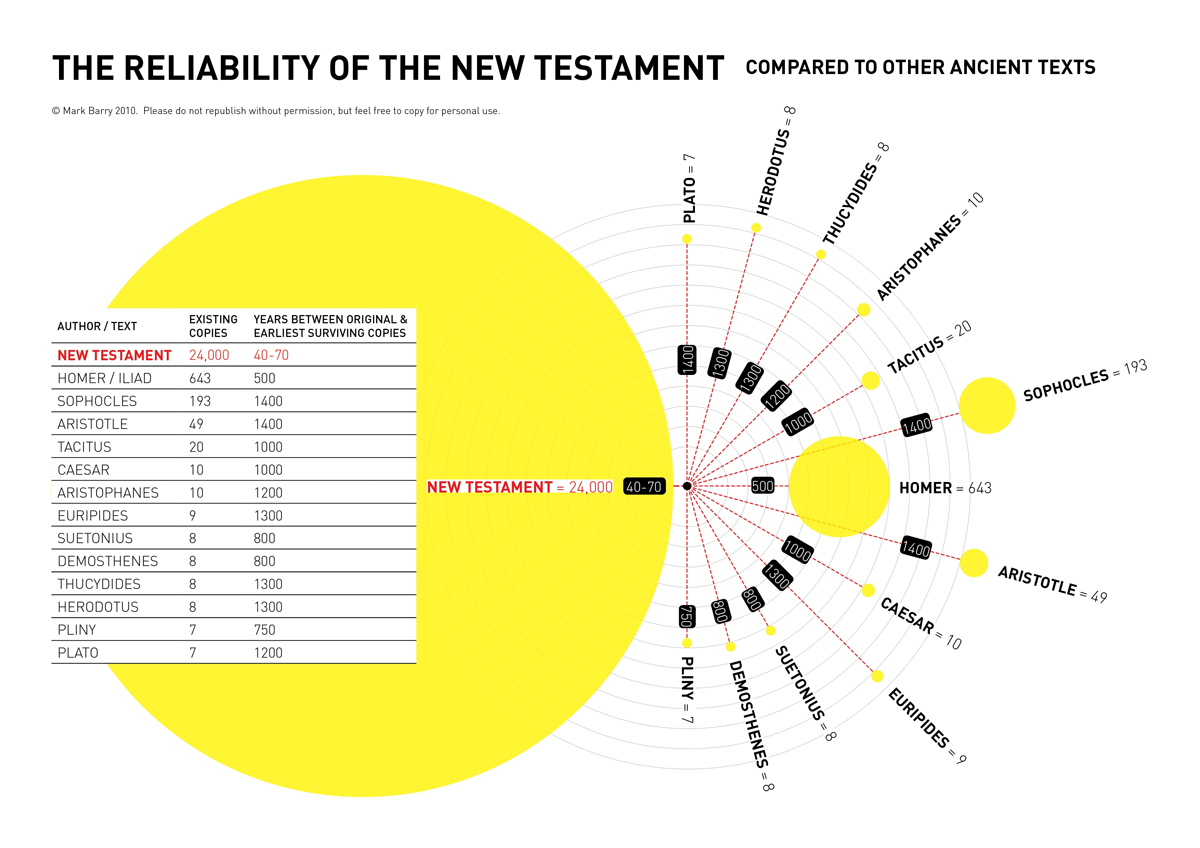
The Bible is completely unique. Not sure? OK, let’s make a list of all books that took over 1,500 years to complete. With parts dating back more than 3,500 years, in which the most recent contributions are 1,900 years old. Written by 40 or so authors who corroborate each other’s writings. Containing accurate historical accounts of ancient events that have shown up repeatedly in archaeology (don’t skip over the preceding hyperlink). Claiming to reveal the plan of a loving God for his creation. With massive amounts of self-deprecating text to condemn the authors. Predicting trouble and ostracism for those who live by its teaching. Containing specific prophecies, many of which have proven true over long periods of time. Dwarfing other ancient writings in terms of the number and quality of  surviving manuscripts.

How long is our list now?

Reliability of the New Testament

The Bible has no peers when it comes to the number and quality of surviving ancient manuscripts. (Infographic credit: Mark Berry, http://visualunit.me/)

When researching for this series I was primarily interested in focusing on how the biblical canon was developed—specifically how did we end up with the 66 books that comprise the Bible, what about the Apocrypha, why not other books, and so on. Biblical canon is an extremely interesting topic, but it rightfully fits in the context of a larger question:  How did we get the Bible? (We’ll get to the topic of biblical canon in forthcoming posts in this series—and by the way, there are lots of interesting, new publications on canonicity.)

Drs. Norman Geisler and William Nix wrote a comprehensive text entitled From God To Us Revised and Expanded: How We Got Our Bible that begins with the topic of inspiration. This post will follow that text, which should be required reading for every Christian and student of the Bible.

Whether you are died-in-the-wool biblicist or a Christian neophyte, it’s difficult to fully appreciate the implications of our understanding (or denial) of the inspiration of the Bible. Not just in terms of heaven or hell as an end result, but whether we can trust the Scripture. I just returned from the National Conference on Christian Apologetics, which included some strong rhetoric about the inspiration, inerrancy, and infallibility of the Bible (and a fantastic session on the biblical canon). Clarke attended most of the same sessions, so I won’t turn this series into a discussion about inerrancy. He will no doubt address many of the nuances and implications of the “battle for the Bible” in future posts. But consider these two questions:

  • Is it even reasonable that an all-powerful and perfect God would inspire the writers of the Bible to produce a text containing errors?
  • If God did not inspire the writing of the Bible, isn’t it just the product of human writers, and if that is the case why should we submit to its authority, teaching, and claims?

There are lots of corollary questions, and your answers would reveal a great deal about your understanding of the Christian faith. But for now let’s take a cue from Geisler and Nix and start with the topic of biblical inspiration.

My notes from reading their text are presented below. For a more robust and authoritative treatment of the topic I highly recommend reading From God To Us Revised and Expanded: How We Got Our Bible. Words in quotes are directly from Geisler and Nix (except where Scripture is being quoted). Continue reading