Author Archives: Clarke Morledge

About Clarke Morledge

Unknown's avatar
Clarke Morledge -- Computer Network Engineer, College of William and Mary... I hiked the Mount of the Holy Cross, one of the famous Colorado Fourteeners, with some friends in July, 2012. My buddy, Mike Scott, snapped this photo of me on the summit.

Resolving the Question of Women in Church Leadership: Who Bears the Burden of Proof?

15th in a multipart blog series.

How does one resolve the question of women serving in church leadership?

Well, surely, as discussed in the previous post, it is not a matter of churches inevitably following down some slippery slope, towards something like the adoption of same-sex marriage. To repeat again, just in case there is any confusion, a “slippery slope” is a logical fallacy. The adoption of female elders does not necessarily entail a betrayal of classic Christian sexual ethics or other fundamental truths. So, while such supposed slippery slopes do raise important questions, they do not fully help us to resolve the question at hand.

What then shall we do?

As we have surveyed, the Scriptural evidence examined thus far (and there is a lot more to consider), is complex, and in a number of cases, ambiguous. Complementarians have their prooftexts. Egalitarians have theirs. Plus, not all complementarians or egalitarians are exactly the same!

If there is no one, or two, “killer” Bible verses to settle the matter, what do you do? There are two things that I believe will help here, as least as starting points:

  • It is best to narrow down the question to the very crux of the issue. There are so many nuances and various positions one could take, but it helps the most to identify the real sticking point, the clearest area of disagreement,” as British Bible teacher Andrew Wilson put it. Should women serve as elders, assuming that the elders are those who take upon the function of pastoring in a local church? When it comes to things like the office of deacon, women teaching under the authority of elders in a mixed adult group, etc., complementarians are all over the map. But when it comes to elders, all breeds of complementarians will say NO, whereas egalitarians will undoubtedly say YES.
  • Build a cumulative case, that takes into account all of the available evidence. In this blog post series, I have tried to lay out some of the crucial arguments used to interpret various texts. Yet what I have set out is by no means exhaustive.

That is all very important, but in this blog post, we will examine still another, very important part of the discussion: the role of tradition.

Throughout the breadth of church history, there is good evidence to show that having women deacons in the church was considered to be uncontroversial, particularly prior to the medieval period. For example, before robes became common for adult baptism, Christians would at times be baptized in the nude, in the early church. As a result, women deacons assisted with baptism. Furthermore, women at various times throughout church history, have used certain teaching gifts, church planting gifts, and other leadership gifts, to the great benefit of other believers.

Granted, some in our day say that having women serving as deacons is still wrong, despite what the story from early church history shows. However, those who would suggest that women should not exercise their full range of ministry gifts, from various forms of teaching to administration, whether being “deacons” or not, simply do not have the force of tradition on their side. Such tradition reaches all of the way back to the New Testament, where we have the record that four of Philip’s daughters prophesied (Acts 21:8-9 ESV).

Evidence from Church History: Women Deacons, Yes, But Women Elders?? Not So Much.

But when it comes to elders and/or pastors, over the past 2,000 years, the story tends to work more against the egalitarian cause. Until relatively recently, women have not generally served in those capacities, as these offices have been, in a certain sense, associated with the exercise of spiritual authority, however it may be defined. Historically, there has been hardly any dispute about this, despite some limited evidence to the contrary.1

Even today, the overwhelming majority of church congregations throughout the world practice some form of all-male eldership, in their churches. However, within the past couple of hundred years, and particularly within the past few decades, in certain Protestant circles, having women ordained to positions of leadership, where spiritual authority is being exercised, as with elders or pastors, has become acceptable. Some see this as a good thing, believing that this is the work of the Holy Spirit, to unleash more ministry for the Kingdom of God.

Others think that the church has been going down the wrong track, with this newer practice of having women as elders and pastors, and the church needs to turn around. Compare this modern, innovative practice, with the chronologically broader practice and unified consensus for 2,000 years, among Roman Catholics and the Eastern Orthodox, that for priests, who perform the sacraments of the church, they are to be male and male only.

In other words, when it comes to the sacraments, particularly with respect to the celebration of the Lord’s Supper, and taking the long view of history, gender matters, reflecting a long standing consensus of what the New Testament teaches. As a well-informed commenter noted, in response to a previous post in this blog series, to think that modern Christians know better what the original Greek means, than did the early Greek fathers of the church, would be the “height of arrogance.”

So, why have Protestants, in comparison, been so relatively open to challenging the tradition?  Part of it is the commitment to sola scriptura. Scripture alone is the authority among evangelical Protestants, and this has led to a number of traditions and traditional interpretations of the Bible to be abandoned. As a result, certain texts, like Galatians 3:28, have been read in a particular way, that have led towards the acceptance of women as elders. But is the weight of the evidence sufficient enough to overturn the tradition?

C.S. Lewis. A theological dinosaur??

A Word From C.S. Lewis

There is much to be thankful for, in our modern world today, ranging from advancements in medicine, to instant communication across the world, over the Internet. However, in our world today, where we glorify the “new,” with our infatuation with the latest iPhone and the other near-daily improvements in technology, and despise the “old,” as worn-out or old fashioned, we tend to ignore the voices of those who held the long view, and embraced the riches of history. One such is the Oxford don, C.S. Lewis, who was greatly concerned by innovations, that would toss out the baby with the bath water, all in the name of “progress.”

Does this situation fairly apply to the question of eldership for women? For example, Lewis, in his 1948 essay, Priestesses in the Church, had this to say about the possibility of women serving as priests in the Church of England in his day:

To take such a revolutionary step at the present moment, to cut ourselves off from the Christian past and to widen the divisions between ourselves and other Churches by establishing an order of priestesses in our midst, would be an almost wanton degree of imprudence. And the Church of England herself would be torn in shreds by the operation. My concern with the proposal is of a more theoretical kind. The question involves something even deeper than a revolution in order.

Note that this was written in 1948. Women were finally ordained in 1994, in the Church of England, for the priesthood. Since then, despite some small gains, the Church of England has suffered an interesting type of decline. According to the Guardian, while the total number of parishioners who occasionally attend church has gone up, regular attendance at church continues to decline.

Is there a correlation? Was Lewis just a crusty old curmudgeon, an otherwise noble product of his own culture and his own time? Or is Lewis like a voice crying out in the wilderness?

But let us set such statistics off to the side: What concerns me about the more aggressive side of the egalitarian debate, is that by introducing women into such positions of spiritual authority, we do cut ourselves off of the Christian past, as Lewis contends. When we do something that furthers the divide that already separates Christians, this does not speak well of the unity of the church.

Roman Catholics and the Eastern Orthodox do differ from Protestants in many deep, deep respects. I am not suggesting that Protestants completely abandon the Reformation, though many of my Roman Catholic and Eastern Orthodox friends would be elated, if such steps were taken. Ah yes. I can hear them now, with their whispers of “Come Home! Come Home!,” as their voices cry out from across the Tiber and the Bosphorus, respectively.

Nevertheless, all three branches of Christendom share much in common as well, as an expression of the unity of Christ’s Body. To work towards further reconciliation, if possible, is a good thing, is it not?

Egalitarians who call for more opportunities for women to serve in leadership are right, and sadly, many complementarians are needlessly dragging their feet. But when egalitarians seek to push the point on church eldership, we enter dangerous ground. Are we not then driving the wedge in deeper, on issues that divides us, in the Body of Christ?

Christ has called us to be one body, and yet, much of the history of the Protestant movement has continued to pull us apart.

And that makes me sad.

A Deeper Mystery?

There is that last line I quoted from Lewis, that keeps bugging me: “The question involves something even deeper than a revolution in order.”  What is that “something even deeper” that Lewis is warning about?

Lewis goes on in his seminal essay, in response to those who argue for women eldership (Lewis uses the Anglican terminology of “priest,” which is an important and neglected issue in the discussion):

I have every respect for those who wish women to be priestesses. I think they are sincere and pious and sensible people. Indeed, in a way they are too sensible…. I am tempted to say that the proposed arrangement would make us much more rational “but not near so much like a Church”…..The Church claims to be the bearer of a revelation. If that claim is false then we want not to make priestesses but to abolish priests. If it is true, then we should expect to find in the Church an element which unbelievers will call irrational and which believers will call supra-rational. There ought to be something in it opaque to our reason though not contrary to it – as the facts of sex and sense on the natural level are opaque. And that is the real issue. The Church of England can remain a church only if she retains this opaque element.

Is Lewis right? Is something important at stake near to being lost?

As someone drenched in the riches of church history, Lewis knew of things that few of us in the 21st century can fully appreciate, particularly among Protestants. We have become so enamored by the great principle of the “priesthood of all believers,” that we forget that Israel had an all-male priesthood, in the Old Testament. Was that simply a cultural artifact of the Bronze Age, an excuse for misogyny that we are better off without? Or could it be that the Roman Catholic and Eastern Orthodox traditions are preserving something, that in that opaque sense, reveals the glory of God? Does an all male eldership speak to a profound mystery, that many Protestants have simply forgotten?

What about Jesus’ selection of twelve men, to be his original apostles? Does not the number twelve correspond somehow to the twelve tribes of Israel? Jesus broke all sorts of cultural customs, such as speaking directly to the woman at the well, and associating with female prostitutes. So, why did he start with these twelve men, when he could have mixed a few women into the bunch?

Was he simply holding back on his reforms, thinking that the Jewish community of his day, would not be able to handle having women as elders, yet? Or was this all-male pattern of spiritual leadership somehow mysteriously ingrained into the very revealed purposes of God?

I wonder.

The next blog post will explore this theme a little further, but let us for now consider the other side of the debate.

NEVERTHELESS!! TRUTH MATTERS!!

Still, I get the standard Protestant idea that we should not preserve the unity of the church, at the expense of truth. Truth is more important. C.S. Lewis could have been wrong.

A lot of egalitarian Christians believe this to be the case. Despite whatever good intentions C.S. Lewis might have had, there are a number of egalitarian Christians who already find the evidence from Scripture to be compelling for allowing women to be elders. To refuse women as elders threatens to be contrary to the impulse of the Gospel.

Some egalitarians even contend that there is a certain trajectory, inherent in Scripture, that make the full participation of women and men together, in all levels of ministry, an inevitable consequence of the following the Gospel!2

What then must be done, with respect to those who do not find the egalitarian case so compelling?

We should be open to go wherever the Holy Spirit takes us, and put our trust in God. Follow the evidence wherever it leads, but when the evidence is difficult to decipher, caution is in order. A few churches have done just that by not taking a position, one way or the other, regarding whether or not women may serve as elders. It can be a difficult position to take, but in my view, it would be a wise road to take, at the present time.

Who Then Must Bear the Burden of Proof?

What shall be done in the meantime, until further evidence comes in, to settle the matter? Here is my guideline: it is those who believe it best to overturn a traditional interpretation of the Bible, who bear the burden proof, not the other way around. To do otherwise threatens to be a recipe for chaos. Sadly, we live in an age when what is new is often assumed to be better. We reject the old…. well, because it is old, but not because we always have sufficient evidence to support the new, and reject the old.

Therefore, if we assume that the verdict is still out concerning having women as elders, the default position should be clear. Across the widest spectrum of Christian belief, a complementarian view has remained the standard. The presumption of complementarianism is the wisest path to take.

Nevertheless, this blog series has shown that there are at least some elements of the traditional view of women and church leadership that do need to be discarded. The biblical evidence marshaled to support the most extreme complementarian views has proven unpersuasive, and even contradicted by the Bible. For example, you would be hard pressed to find any Christian saying today that women are somehow inferior to men. Egalitarianism has surely helped all of us in the church with that.

Misogyny has no place within the mind and heart of the Christian, and to that extent, the egalitarian side of the debate has made their case, and met the burden of proof. Any perspective on this issue that denigrates women, in any way, shape, or form, does not pass the muster of the biblical standard. Hopefully, this much is clear.

Both sides of the debate deserve a full hearing, concerning the touchstone question of having women as elders (I am including pastors here, too). If the full force of the egalitarian argument meets the burden of proof, then we must be prepared to say that complementarianism should be rejected. If not, then it is best to let the complementarian view stand.

So, now is a good to time to ask the reader: With respect to having women serving in the office of elder and/or pastor, has the egalitarian side of the debate met the burden of proof, based on the evidence?


Notes:

1. Kevin Madigan and Carolyn Osiek’s Ordained Women in the Early Church: A Documentary History indicates that the practice of having women as deacons in the early church was known, though the practice was more common in the East than the West. Regarding women as elders, we have substantially less evidence for the practice, but ironically, for what evidence we do have, it is found more in the West than the East. Nevertheless, Madigan and Osiek tells us that, “As is so often the case in Church history, the sources do not tell us what we would most like to know” (p. 198). The terminology of female elder, or presbytera, could simply have referred to an elderly woman; that is, an older woman in the church, or it could have been to designate the wife of a male presbyter. It in no way implies that such women “elders” were in the position of necessarily presiding over the sacraments of the church. We simply lack the evidence to make a confident judgment as to what such female “presbyters” actually did. A 10th century witness in Italy suggests that women priests were known to operate with the blessings of their bishops, but that it is most likely do to the lack otherwise qualified male presbyters. So, while the existence of women deacons is clearly evident within the life of the early church, the existence of women presbyters, as understood within the context of how many evangelical churches today understand the role of elder, is difficult to establish. The practice of having women serving as presbyters, was normally condemned by early church authors, as such practices were associated with marginal groups, like the Montanists, whose orthodoxy in other areas were suspect. Were there exceptions, where orthodox groups had women serving as presbyters? Possibly, but these exceptions were rare, and we still know very little as to what type of spiritual authority was exercised by such women presbyters. Nearly all of the reports of the early church having women serve as presbyters come from the Middle Ages, several hundred years beyond the period of the early church, making it impossible to confirm such reports. Either way, the practice of having women serve in various offices, such as “deacon”, began to steadily decline by the end of the sixth century. In summary, in reading Madigan and Osiek it does beg the question as to whether or not the burden of proof for having women serve as presbyters today has been met.  

2. Such is the basic argument found in William Webb’s Slaves, Women & Homosexuals: Exploring the Hermeneutics of Cultural Analysis. Webb contends that just as slavery was eliminated, even though the New Testament allows for it, the same situation applies to women in ministry. The Gospel paved the way for the elimination of slavery. It also therefore paves the way for the elimination of gender discrimination in all levels of church office.  


Is Evangelicalism On A Slippery Slope Regarding Gender?

14th in a series.

If you are just joining in, I urge to go back to the first blog post in this series, and work your way forward, to get to where we are now, as this discussion will now take a different, broader turn, built on what was discussed previously….

Here is a hot potato to try to handle: If evangelical churches move in an egalitarian direction, regarding having women as elders, are they on a slippery slope towards accepting same-sex marriage?

For many conservative evangelical churches, that have chosen over the past one hundred years, or more, to ordain women at all levels of pastoral ministry, the answer would be a firm, “NO.” Consider these examples, and the dates when women first started to be ordained: Nazarenes (in 1908), the Assemblies of God (in 1914), the Free Methodists (in 1864), and various Pentecostal churches (in 1906), along with their charismatic descendants.

Despite a few exceptions here and there, these historic denominations have maintained a firm commitment to a classic, historic view of Christian marriage, as being between a man and a woman. They have held to other fundamental doctrines of Christian faith, too. Many have come to Christ, through the effectiveness and faithfulness of these ministries, and have held stedfast to the Gospel. Many egalitarian evangelical churches are indeed growing. Slippery slopes, therefore, are not automatic.

On the other hand, the story among mainline Protestant churches is quite different. The Episcopal Church USA began ordaining women as priests in the 1970s. Back then, it was unthinkable for many Episcopalians to consider the possibility of having same-sex marriage ceremonies held in their churches.

Fast forward to the first decade of the 21st century, when the Episcopal Church USA ordained an openly practicing gay man as bishop of an influential northern diocese. In 2018, the Episcopal Church passed a resolution, stating that same-sex couples will now be able to marry in their home parish, even if their local bishop has moral objections to same-sex marriage. The resolution stopped just short of fully integrating same-sex marriage liturgy into the Book of Common Prayer, but that has not stopped some Episcopal priests from secretly performing same-sex marriage ceremonies.

The story has been repeated a number of times over the years. Mainline churches that several generations ago began to ordain women, and promised to “hold the line” against same-sex marriage, are now finding themselves under increased pressure to allow for and even endorse same-sex marriages in their churches. The United Churches of Christ began ordaining women in 1957. In 2005, the United Churches of Christ affirmed “marriage equality” in their foundational documents. The same type of stories have been repeated, or are currently repeating, among more mainline Lutherans, Baptists, Presbyterians, and some United Methodists.

As a result, these once dominant, mainline bodies of churches have continued on towards a trajectory of decline. Mainline churches once boasted of 30% affiliation among Americans in the early 1970s. That number has dropped to around 10% affiliation among Americans in 2017. If the current trend continues, mainline churches may not be around anymore in about 20 years. Or at least, they will become a shadow of what they once were. Is the current trend reversible?

Furthermore, as the mainline has declined, the line between evangelical churches and the older mainline has grown fuzzier and fuzzier. The culture today is vastly different from the culture a hundred years ago. That being the case, what can prevent an evangelical church today, in the current cultural climate, from following the declining pattern already established by the older mainline?

Many egalitarian evangelicals unswervingly hold to the conviction that the practice of having women as elders and pastors is fundamentally unrelated to the question of same-sex marriage. I do not question this conviction. As stated above, plenty of evangelical churches who have been ordaining women to elder or pastoral ministry have remained firm in their commitment to classic Christian sexual ethics. In other words, an “inevitable” slippery slope is a logical fallacy.

However, what I am not sure about is why these issues are fundamentally unrelated. This question of why same-sex marriage is wrong, and why women as elders, for many, might be wrong as well, does not get thought about often enough. I know many fine egalitarian Christians who truly believe these issues are fundamentally unrelated. But it is not always clear as to why that is the case.

Give this some consideration: The main issue with having women as elders is not about competence nor ability. It is about gender. Likewise, the main issue about same-sex marriage is not about love, family, or commitment. It is about gender.

What then is our theology of gender all about? Do the gender distinctions between male and female really matter, and where is this to be applied? Only with respect to sexual behavior, or is there more to it?

The narrative of creation sets the stage for how we think about gender, what it means, how significant it is, and where the differences between male and female really matter:

So God created man in his own image,
    in the image of God he created him;
    male and female he created them.
(Genesis 1:27 ESV).

This is a complex issue, that requires thoughtful reflection, and no single blog post can easily resolve the discussion. To put it briefly, Genesis teaches us that men and women are created by God to be equal. But men and women are NOT interchangeable.1 The problem is, that in discerning what the practical implications are, requires a lot of thought and prayer, in our efforts to figure this stuff out.

Egalitarians must be willing to take a hard look at this: By promoting the idea that woman should be serving as elders/pastors, are they merely copying “what the world does,” or are they truly resisting “the world?” Is egalitarian theology really rooted in the Gospel? If not, then perhaps the gains of tinkering with church eldership will be offset by the dilution of a robust theology of gender.

Complementarians must be willing to take a hard look, too: By only permitting men to be elders/pastors, are they honoring women, or are they somehow denigrating women? Is complementarian theology really rooted in the Gospel? If not, then the hard line taken against women in those leadership roles will distort a truly robust theology of gender.

What Is The Positive Posture To Take on Such Matters?

A further problem to consider is this: When trying to “hold the line” on an issue, whether it be same-sex marriage, or for some, women as elders, are we neglecting to consider what might be a more positive way of approaching these issues? Are Christians to be known for what they are against, or for what they are for?

If a church is going to forbid same-sex marriage, it is imperative that a church consider how that community will serve and support those who wrestle with same-sex attraction. If someone in this latter category agrees with the position of the church, regarding marriage as being only between a man and a woman, or perhaps they are unsure, but who remain open to the teaching of the church, how will that person find love, support, friendship, healing, and encouragement, in their own journey of faith, in that community? With respect to ministry to the so-called “LGBTQ” community, what are Christians known to be for?

Likewise, if a church is going to forbid women from serving as elders or pastors, it is imperative that a church consider how that community will serve and support women, who have extraordinary gifts and skills for ministry. Will they be treated as mere “second class citizens,” in comparison to men? Or will women be fully supported and encouraged to use their gifts and skills? What are Christians known to be for?

Too often, churches will make statements concerning an issue, in an effort to “hold the line” against cultural trends invading the church, and completely neglect the pastoral implications that inevitably arise, due to making such statements. When such churches neglect such things, often their statements fall upon deaf ears. In other words, how we say something matters just as much, if not more, than what we say.

Are men and women flourishing together in your church?

Whew! There is lot more I could say about it, but I will leave it at that. For the remaining blog posts in this series, I will circle around the airfield a few more times, so to speak, and then try to “land the plane.”


Notes:

1. Sometimes, Galatians 3:28 gets thrown into the discussion: “There is neither Jew nor Greek, there is neither slave nor free, there is no male and female, for you are all one in Christ Jesus (ESV).” Some see this as breaking down the distinction between male and female, but one must be careful here, not to minimize Genesis 1:27 in the process. The more traditional interpretation of Galatians 3:28, adopted by most modern day complementarians, suggests that male and female are equal in Christ, with respect to salvation; specifically the work of justification. It does NOT mean that male and female can serve in equivalent roles, in the church. More recent egalitarian interpretations extend the application of Galatians 3:28 beyond the work of justification, to include how male and female are to relate together, in the order of the local church.   


Reviewing Patterns of Evidence: The Moses Controversy Movie

This past week, I went to see Timothy Mahoney’s new film, Patterns of Evidence: The Moses Controversy. Following the relative success of Mahoney’s first film on the Exodus, Mahoney has been able to raise enough funds to put out this second movie, that seeks to defend the idea that Moses wrote the first five books of the Bible.

On the good side, Mahoney demonstrates that there is a certain critical bias among mainstream scholars, that tends to pooh-pooh the idea, that a man named Moses really had that much do with the the transmission of Genesis, Exodus, Numbers, Leviticus, and Deuteronomy, down through history. A lot of Christians are surprisingly ignorant of the fact that doubting the Mosaic authorship of the Pentateuch, has been pretty much the standard teaching in nearly all institutions of higher learning in the United States, for decades. So, Mahoney gets brownie points for urging Christians to engage more with critical scholarship. If you send your kid off to college, allow them to watch TV, or allow them to surf the Internet, it behooves the Christian to become aware of the challenges that confront a young person’s faith.

But the down side of the movie is that Mahoney leans heavily on the contrarian, and highly disputed theories, of Egyptologist David Rohl, to make Mahoney’s case that God essentially inspired the human alphabet system, that allowed Moses to write the Torah. The movie was basically a 2-hour slog, through a rather complicated apologetic argument, to try to defend Moses’ involvement in writing the first part of the Bible. Even Gary Bates and Lita Cosner, Young Earth Creationist apologists for Creation.com, found Mahoney’s alphabetic writing system proposal as “both unnecessary and unsupported by Scripture itself.

Why Mahoney leans so heavily on David Rohl, the latter who admits that he is an agnostic, is beyond me. In contrast, Egyptologist Kenneth Kitchen, an outspoken evangelical Christian, and highly respected by many of his agnostic and atheistic peers, dismisses David Rohl’s speculation as pretty much total nonsense. Kitchen, author of the exhaustively learned On the Reliability of the Old Testament, champions the so-called “late date theory” of the Exodus, that the film maker Mahoney casually dismisses twice in the movie, as having “no evidence” to support it. Rohl makes some legitimate criticisms of “late date theory” proponents, but his alternative solution fails to convince most scholars, believer and non-believer alike. I will spare you the details and simply refer the Veracity reader to ‘s fair and balanced review of The Moses Controversy.

I do not mean to pile onto Tim Mahoney, as he seems like a really likable, sincere guy, and I do commend him for addressing the topic. I think that his experience with doubt, and his journey in trying to resolve such doubt, should be treated with respect and sensitivity. Mahoney plans to put out another movie, addressing the apologetics of the Red Sea crossing. Let us hope that this next movie will be an improvement over The Moses Controversy.

Despite its shortcomings, I am very glad and thankful Tim Mahoney has put out a thought-provoking film, that will hopefully spur thoughtful Christians to actively engage the issues behind The Moses Controversy. Nevertheless, I am concerned that an uncritical examination of Mahoney’s claims will only confuse Christians, when they actually encounter peer-reviewed scholarship on this topic, making it harder to defend the faith before an unbelieving world.


So, What’s the Deal With This Women “Will Be Saved Through Childbearing” Stuff, Anyway?

13th in a multipart, ultra-bonus blog series, with a cherry on top!…..

Now, we are in the thick of it. After Paul makes his controversial statement in 1 Timothy 2:12 (ESV), “I do not permit a woman to teach or to exercise authority over a man,” he explains his reasoning:

For Adam was formed first, then Eve; and Adam was not deceived, but the woman was deceived and became a transgressor. Yet she will be saved through childbearing—if they continue in faith and love and holiness, with self-control (1 Timothy 2:13-15 ESV).

Complementarian and egalitarian Christians typically diverge on how to best interpret this passage. They also diverge among themselves!

When I was a new believer, I always got stuck on verse 15, the “she will be saved through childbearing” part. I mean, I learned over and over again that we are saved by grace through faith (Ephesians 2:8-10), according to the Apostle Paul. Works will not get me into God’s presence in heaven. But it sure sounds like women will be saved by having children here, which is DEFINITELY a type of work (Right ladies???). However, we all know that women and men are saved the same way, through Christ and Christ alone!!

Is Paul backtracking and contradicting himself? Or is something else going on?

In 1 Timothy 2:13-15, Paul lays out three specific reasons why he is targeting “a woman” in 1 Timothy 2:12, for special treatment. Here I will point out each of these specific reasons, and how complementarian and egalitarian scholars address each.

DISCLAIMER: So, before some New Testament Greek expert screams in agony at something I say, I am only giving a summary here of perhaps the most widely held views, as I could write about twenty (!!!) more blog posts (but I will not) covering different nuances, argued by various complementarian and egalitarian scholars, on just these few Bible verses. But this will give you a flavor of the discussion, showing how and why biblical interpretation is not always easy:

VERSE 13: For Adam was formed first, then Eve

  • Complementarian view: Paul is making an appeal to the creational order of things. Because creation is universal in scope, Paul’s reasoning is universal in terms of application. This is therefore not a passage of Scripture that can be limited to a specific application to the church of Paul’s day in Ephesus. Since Adam was formed first, before Eve, it stands to reason that Adam has a certain priority before Eve, that has been carried down through the ages, whereby the husband is the head of the wife (1 Corinthians 11:3), and such order is also to be reflected in the order of the church, whereby women are not to teach or have authority over men, at least in terms of the eldership and pastoral leadership of the church.
  • Egalitarian view: The heresy of Gnosticism in the early church taught that Eve came first before Adam (we have good evidence for this in the 2nd century, but from the 1st?????). However, the Bible views this order to be reversed. Paul is therefore addressing particular heretical teachings being taught, presumably by certain women in the Ephesian church. Paul is concerned about stamping out a particular heresy (1 Timothy 1:3), and not by making some universal, timeless decree.

VERSE 14: Adam was not deceived, but the woman was deceived and became a transgressor.

  • Complementarian view: Here Paul goes from an appeal to creation to an appeal from the fall of humanity, which also has universal application (not local or limited). Both the man and the woman sinned, but the sin of the woman was not like that of the sin of the man. The man sinned knowingly while the woman sinned in ignorance, due to her deception. God has established a particular order of things in order to protect men and women from destroying one another, due to the devastating impacts of the fall. God has therefore put men as spiritual authorities in the local church, over women, in order to remind us of that order, without in any way denigrating either women or men.
  • Egalitarian view: Once again, Paul has a particular heretical teaching in view. The early church Gnostics taught that it was actually a good thing that Eve ate of the fruit of the tree, as it gave her spiritual wisdom. In contrast, Paul is reminding Timothy and his readers that according to the Bible, this is false teaching. Eve was not enlightened, in the manner of the Gnostics,, when she sought spiritual knowledge and wisdom. Rather, she was deceived. As a result, no particular ordering, hierarchy, etc. is intended by Paul here in terms of church leadership structure, which might be universal in its application. Women are not to domineer men, but neither are men to domineer women.

VERSE 15: Yet she will be saved through childbearing…

  • Complementarian view: The first two reasons above speak to creation and the fall. Now Paul turns to the promise of redemption, after Adam and Eve’s fall. But first, we must carefully learn to read the text in context to grasp the meaning of this difficult verse. Most translations ignore the fact that a definite article precedes the reference to childbearing. In other words, a more strictly word-for-word translation is reflected in Young’s Literal Translation, “she shall be saved through the child-bearing.” So, what is “the child-bearing?” Paul apparently knew of the teaching that it would be through Eve’s offspring that the Messiah would come to crush the head of the serpent, the Satan figure of Genesis 3 (Genesis 3:15, Romans 16:20 ESV), commonly referred to by scholars as the protoevangelium, which was well-known by the early church. In other words, women, as the daughters of Eve, will find salvation through the coming of the Christ-child. Jesus is our salvation. Paul is therefore giving the women of Ephesus a timeless reminder, of woman’s participation in God’s redemptive purposes. This truth would have had a poignant meaning in the Ephesian church, in contrast to the teaching in the Ephesian temple of Artemis, that women would be somehow “saved” through childbearing, by offering sacrifices in the pagan temple. In other words, this verse in 1 Timothy is not about works-salvation. Instead, this verse is about the liberating message of Christmas!!
  • Egalitarian view: Yet again, we have another reference to another false teaching that was creeping into the Ephesian church. Women in the church may have been secretly offering sacrifices in the temple of Artemis, in order to assist them through the process of childbirth. When Paul speaks about being “saved” in this verse, it is not about salvation to enter God’s presence. Rather it is about being “kept safe,” through the pains and risks of childbirth, which was quite risky for women in the premodern era. Paul wants to remind the Ephesian women that the God revealed in Jesus will protect them in childbirth. They do not need to go to the temple of Artemis.

Mmmmm… There is a lot going on here, is there not?

In short, complementarians typically appeal to Paul’s understanding of creation, fall, and redemption, as a timeless paradigm, that designates the order of men and women in the life of the church. Egalitarians, on the other hand, typically appeal to 2nd century evidence for Gnosticism, as a heretical movement that Paul wishes to stamp out. However, egalitarians are dependent on assuming that such 2nd century evidence can be safely extrapolated back into Paul and Timothy’s 1st century context, for which we have little to no direct evidence for support. 1

For Those Who Want to Pull Their Hair Out at This Point…

Trying to arrive at the best interpretation of the Bible is not always easy. Some forms of reasoning will appeal to some people, and not appeal to others. But the importance in doing this is to help gain an appreciation of why different Christians might read the Bible differently. It is so easy to separate ourselves off into our own theological silos, and fail to really learn why another follower of Jesus might think differently than we do.

Nevertheless, this should not be an excuse for simply throwing up our hands, and giving up on trying to interpret the Bible. There are consequences to any particular doctrine being promulgated in the church. Sometimes these consequences are easily visible, but most of the time, they are not, upon first reflection. Such doctrines may have consequences that can only be seen down the road, perhaps in terms of future generations, far removed from us, in the lives of our children and grandchildren. Some consequences can be devastating, having an eternal impact.

Perhaps taking a few steps back, would be a good thing to do at this juncture….

A good rule of thumb for me, when thinking about a controversial issue, and I happen to lean a particular direction, is to consider this: “What if I am wrong? What if I end up going the wrong way on a matter? What type of impact will that have in my life, the lives of those around me, and the lives of those I have not even met yet?”

In the last four posts in this series, I want to look briefly at some fundamental, theological questions, that have helped me sort through the issues, that have led to me to where I am on the complementarian/egalitarian question.  The four questions are: (1) What is our theology of gender, and what does it mean?, (2) How does the relationship between men and women, with respect to eldership, impact the unity of God’s church, across time, culture, and denominational tradition?, (3) Is there a sacramental character of eldership, that points towards the mystery of male and female being made in the image of God?, and (4) How does our understanding and practice of “women and eldership” impact the church’s witness in the world? Specifically, how important is it that we have godly spiritual fathers in our churches, who are teaching boys and young men how to become and be men, and that we have godly spiritual mothers in our churches, who are teaching girls and young women how to become and be women?

As these questions are explored, a potential solution I hope will emerge, that might make peace between complementarians and egalitarians, without compromising biblical truth.

Stay tuned….

Notes:

1. British pastor and Bible teacher Andrew Wilson has a blog post that succinctly lists out all of the various interpretations of the “women will be saved by childbearing” passage. Contrary to Wilson, I tend to favor the “Christmas” interpretation above, as it fully accounts for the presence of the definite article, “the,” when referencing childbirth, whereas all of the other interpretations tend to gloss over this detail. But then, I am not a Greek scholar, and Wilson is. 


The 1 Timothy 2:12 Conundrum: I Do Not Permit a Woman to … (????) AUTHORITY….

12th in a series.

This one is a bit tricky. So bear with me.


Compare how two different Bible translations translate 1 Timothy 2:12(a):

I do not permit a woman to teach or to exercise authority over a man…. (ESV).
I do not permit a woman to teach or to assume authority over a man…. (NIV).

So, which is better? Which is more correct? To “exercise authority” or to “assume authority?” The first has a rather positive view of authority. The second? Well, I am not sure.

It could be “assume authority” in the sense of what is rightfully yours to have. In other words, “authority” is a good thing. However, it could also mean to “assume authority” in the sense of what is not rightfully yours, to “have your own way over somebody else,” by force or trickery perhaps, something that is quite negative. Either way, Paul does not want a woman to possess that kind of authority, whether that kind of authority be positive or negative.

But which kind of authority is it? Positive or negative?

If it is positive, then that pretty much rules out any legitimate case whereby a woman can have authority over a man. If it is negative, then it means that a woman should not exercise authority in a wrong, or otherwise overbearing manner. But is the reverse true, that there might be a case where a woman is permitted to exercise authority in a good and positive way, over a man?

Mmmmm…..

Why is this idea of authority, so…. well, uh…. vague, when you compare these two translations? As it turns out, the Greek word behind our English “authority” is this controversial word: authenteo. It looks sort of like the word for “authority” in English, but when the Bible normally talks about “authority,” in the most positive sense possible, you find different Greek words, like exousia, that clearly has a positive connotation, and exousia is used multiple times in the Bible.

But when it comes to authenteo, many Bible scholars get stuck. The reason is because authenteo only appears this one, single time in the whole of the Bible (authenteo is a verb, authentein is the noun). So, to figure out what it means, Bible scholars have to search through Greek writings, outside of the Bible, for how to properly translate it. This is where the current debate flairs up.

What follows is a little tour through Bible translation history, as it shows just how difficult it has been to translate this unique word. This might be a bit difficult to follow, so do not stress out too much, if you get lost here. This is mainly a prelude for something that needs to be said, towards the end of this post…So you can just skim down towards the end, if you find yourself scratching your head too much….

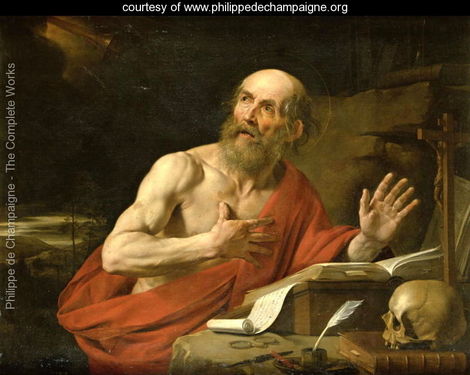
Saint Jerome (347-420 A.D.). Translator of the Latin Vulgate.

In Search of the Authentic “Authenteo!”

Back in about the late 4th century, the early church father and Bible translator, Jerome, used the Latin word dominare, when translating this word in this verse, in the Latin Vulgate.  The Latin Vulgate translation has pretty much been the most well-known and authoritative Bible translation in the Western world, until the time of the Protestant Reformation, and has remained highly influential among Roman Catholics, until the last few decades. In the Latin Vulgate translation of 1 Timothy 2:12, this dominare typically has a rather positive meaning, as in to “exercise authority,” though in some admittedly limited contexts, it has a negative meaning.

At the start of the Protestant Reformation, the Catholic scholastic Bible translator, Erasmus, used the Latin word usurpare, instead of dominare, according to the Latin dictionary he used, when translating this verse. This usurpare is what eventually made its way into the classic King James Version (KJV) of the Bible:

But I suffer not a woman to teach, nor to usurp authority over the man… (1 Timothy 2:12a KJV).

In other words, Erasmus, and consequently, the KJV translators who followed him, gave us a translation that delivers a different sense of the meaning of the text. Many would say that “authority,” rightly belongs solely to the man. Therefore, for a woman to make a claim of “authority” would be an usurpation of true and proper authority.

On the other hand, women preachers, and those who supported them, over the past few hundred of years, who knew nothing but the King James, often interpreted the passage something like this:

” Well, I am teaching/preaching, but I am not doing so in a manner that ‘usurps authority,’ since the whole idea of ‘usurping authority’ is a bad thing, and teaching/preaching the Gospel is always a good thing! To usurp authority is to try take something that really does not belong to you. Of course, Paul would condemn that. But if God gives the gift of preaching to a woman, this is not the usurpation of authority, but rather, the granting of genuine, good, and proper authority.”

Okay. So, what does this word authenteo really mean?

You would have to go back further than either Erasmus or Jerome to figure that out, back to the world of the New Testament, as close as possible. Unfortunately, the examples of its usage in classical Greek texts, within a few hundred years of when the New Testament was written, shows a wide variety of meanings.

For example, one possible, though somewhat rare meaning, is that of to “murder” someone. Okay. Let us try that out, in this passage:

I do not permit a woman to teach or to murder a man…. 

Wow! That is pretty pejorative!! I am so glad that Paul would condemn that.

Well, the context really does not work for that here, but the wealth of alternatives requires biblical scholars to dig deep into finding out the most viable, responsible answer.

Desiderius Erasmus of Rotterdam (1466-1536), by Holbein. Influential scholar of medieval Christian humanism (credit: Wikipedia)

Complementarian and egalitarian scholars, who know Greek literature of the New Testament period and surrounding, land on different sides of the debate, once they have done all of the lexical analysis. The discussion among scholars in recent years appears to be favoring a complementarian approach, though egalitarians beg to differ.

The egalitarians think that Erasmus largely got it right, but that Erasmus did not go far enough in demonstrating that authenteo/authentein is primarily a negative concept. Paul was instructing women not to usurp authority that was not properly hers. But it did mean that women can, in the right circumstances, have authority in an appropriate way. What are those “right circumstances” for us today? For most egalitarians, the same circumstances would apply equally to men as well as women.

Complementarians tend to side with Jerome. Paul did not intend for women to exercise authority at all. Only men designated as overseers, or elders, can do that (though some say that men more generally exercise such authority, but this distinction is heavily debated among complementarians themselves).1

A lot folks are probably somewhere in between.

An Illustration to Consider

If you got lost following anything above, you can tune back in now…..

Let me take a moment to get to the real meat here, and highlight an illustration that parallels something I said in the previous blog post about “teaching,.” This is something that really needs to be focused on, for complementarians to think about, and for which might help some egalitarians out.

It has to do with what follows 1 Timothy 2, for in 1 Timothy 3:1-7, Paul specifically lays out the qualifications for elders, or overseers. It would be reasonable to conclude that what Paul means by “authority” in 1 Timothy 2:12 has to deal with the office of elders, or overseers, and not just about any joe-shmo guy who strolls into church any Sunday morning.

Yet some complementarians believe that 1 Timothy 2:12 argues that women should not be in any church leadership position, where they might be giving direction to a man. It does not matter who this man is, nor who the woman is. This reasoning assumes that such leadership implies the exercise of “authority,” which would be pretty much along the same lines as the idea, that women should never be in a position, whereby they are “teaching” in a mixed setting; that is, when men are present.

There is a problem with this thinking that needs some critical analysis. Consider a military analogy. Suppose an army general tells his field commander, to get the troops together, to “take that hill to the north.” Then the field commander gets the troops out there, but then decides, “You know, I want to change tactics, and take that hill to the south instead.”

If the field commander does this, he could be charged with insubordination, and acting on his own authority. But if the field commander follows the instructions of the general, and takes the north hill, then that field commander is not acting on his own authority, but rather on the authority of the general, the field commander’s elder.

Likewise, if a man or woman in church leadership, who is not an elder, acts in a manner contrary to the teaching and/or authority of the elders, then that man or woman is acting on their own authority, and should be disciplined. However, if that man or woman in church leadership, who is not an elder, executes their talents in a manner consistent with the authoritative direction of the elders, then they are acting on the authority of the elders, and not on their own authority.

Is this not true? I know many complementarians who might argue against the point of my illustration, but it might be worth rethinking their objection. If it is the elders, who ultimately hold the spiritual authority in a local church, then should we not be grateful for those men and women who faithfully serve under that spiritual authority, with their many gifts and talents, and leadership gifts? To assume that a woman, who is being faithful as a leader in the church, under the authority of the elders, is somehow acting out on their “own authority,” whenever men are present…. well…. that just seems like a really strange way of reading 1 Timothy 2:12.

Can someone convince me otherwise that I am in error?

You see, this stuff can get really complicated, which is why we need to show a lot charity with one another in our discussions.

Over the last few blog posts, we have examined three of the most difficult words in just one verse, 1 Timothy 2:12. But the real clincher, depending on how you look at it, deals with why Paul makes this statement, in this verse. We find his reasoning in the following few verses of this passage, which we will examine next time….

Notes:

1. The whole debate centers around a person’s understanding of “authority,” which can be an exceedingly elusive topic to nail down, which is quite reminiscent of the discussion of what constitutes “teaching,” also addressed in 1 Timothy 2:12. For the egalitarian, the way to resolve the debate over “authority” is by saying that 1 Timothy is only addressing a particular, unique situation in Ephesus, that is not applicable for today, namely that women were misusing their authority to promote false teaching within that particular church in Ephesus. Therefore, anyone, male or female, can exercise authority in the church, as long as it is not overbearing, etc. For the complementarian, the discussion is a lot more complicated. Who is it then who exercises authority in a local church? For Daniel Wallace, whom I highly esteem and respect, men in general exercise authority,  and women simply do not. A woman may teach only women, or they may teach a mixed group of young people. A woman may even teach a group of college students. But beyond the age of college students, a woman may not teach any older men. Well, how does one exactly determine the cut off, as to what is the appropriate age? Why the college age? On what grounds? We hear the same type of argument promoted by pastor John Piper. For Piper, even if the elders affirm a woman’s teaching gift, they are not to use it in a mixed setting (men and women) in a church. British pastor Andrew Wilson disagrees, arguing that Scripture allows for cases whereby a woman may address a mixed gathering, to exhort the people, as long as the elders bestow their blessing. Southern Baptist theologian Tom Schreiner offers two different responses, one whereby he endorses the idea of women addressing a mixed-group, on occasion, and another response, whereby he favors John Piper’s approach contra Andrew Wilson. Wilson then responds and summarizes the issues at stake. Complementarians are not in agreement. So, what is “teaching?” And what is “authority?” Elusive topics indeed.