Clarke Morledge -- Computer Network Engineer, College of William and Mary...
I hiked the Mount of the Holy Cross, one of the famous Colorado Fourteeners, with some friends in July, 2012. My buddy, Mike Scott, snapped this photo of me on the summit.
Our third installment blogging about Sarah Osborn’s world (previous postings #1 & #2).
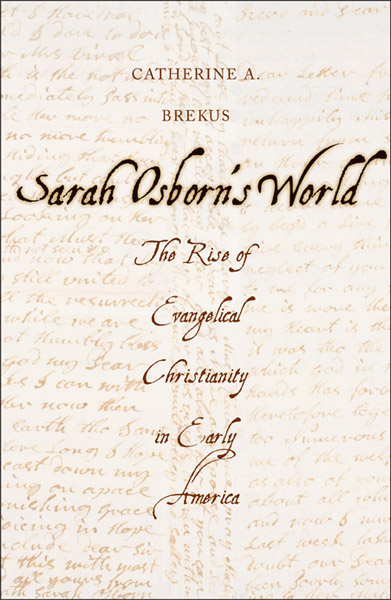
Within a few years after experiencing her conversion to Christ, Sarah Osborn completed her set of diary entries that would serve as the basis for her published work. Harvard Divinity School religious historian, Catherine A. Brekus, weaves these diary entries into her biography of this remarkable woman: in Sarah Osborn’s World. Sarah Osborn continued to write other letters and other diaries, that Brekus also highlights in her research, giving us insight into the life of this 18th century, American, evangelical Christian woman.
Sarah Osborn lived an exceedingly difficult life. One of those difficulties was having to bury her one and only son. When her son, Samuel, was only twelve years old, he had been sent off to learn a trade, serving as an apprentice to a tailor, which was a typical way of providing an education for young boys at the time. However, Samuel contracted what was most probably tuberculosis. In an age before the development of contemporary medicine, Sarah Osborn held the hand of her pale and dying son, for several days. Unfortunately for Sarah, who had only a few years previously come to faith in Christ, she agonized over the spiritual state of her son, as he had never given his own testimony as to having a faith in Jesus. Continue reading
We Believe in Dinosaurs is an independent documentary chronicling the story of the Ark Encounter museum in Kentucky, and will be featured as part of PBS’ Independent Lens programming in February, 2020.
Ten years ago, the world’s most well-known Young Earth Creationist ministry, Answers in Genesis (AiG), announced that they would build a full-scale replica of Noah’s Ark, as a Christian theme park, in Kentucky, deep in the heart of the American Midwest. Ken Ham, the president of AiG, envisioned that along with the AiG Creation Museum, the Ark Encounter would inspire a new generation of Christians to rethink how they read the Bible, to show how the story of a global flood, as taught in the Bible. according to Ken Ham, provides a better explanation of earth history, as the most Scripturally faithful alternative to a secular worldview, the latter which is currently undermining morals and other Christian values in the Western world today.
A full size replica of Noah’s Ark!!? Many Christians look to the work of Answers in Genesis as a way of supporting their belief and confidence in the Bible, whereas other Christians have the opposite reaction, and struggle with doubt, as to how accurately Answers in Genesis portrays science and faith. Others are curious and not sure what to think.
Ken Ham has envisioned the possibility of “seven billion people” coming to the Ark Encounter. Given the record breaking attendance, over the past few years, Ken Ham maybe on the way to see this vision becoming a reality.
Humans existing side-by-side with dinosaurs, at Answers in Genesis’ Creation Museum, in Kentucky, in stark contrast with the narrative nearly every public school educated child learns from the modern scientific consensus, namely, that the dinosaurs died out millions of years ago before modern humans entered the scene.
Since the opening of the Ark Encounter in July, 2016, I have known dozens of my Christian friends who have visited the museum. Regardless of how my friends view the Scriptural accuracy of Young Earth Creationism, everyone I know who has seen the exhibit has walked away overwhelmed with the top quality and workmanship of the park. The Ark Encounter makes for quite an impressive visit, though it does represent a significant development away from the version of the Young Earth Creationist story that I learned during my years in college, at my college church.
Back some 35 years ago, the Institute for Creation Research (ICR) was one of the premier Young Earth Creationist groups in the world, as the American version of Answers of Genesis, did not exist in those days. The Young Earth Creationists at ICR could not imagine how evolution could work, to account for the biological diversity we see today, except at the micro-evolutionary level, a biological process generally found within species. For example, Young Earth Creationists readily accept that the flu virus mutates every year, requiring a new flu vaccine on a yearly basis. This is a type of micro-evolution, which is compatible with a biblical view of history. The version of Young Earth Creation I was taught in my college church, as promoted by ICR, did not allow for any case for evolution beyond that.
So, what has changed over the years? Well, one big challenge for the Young Earth view of Creation, is in demonstrating how the placement of the animals on the Ark, in a global flood model, can adequately explain the great wealth of biological diversity we see in our world today, less than 6,000 years after the global flood occurred. Today, at Answers in Genesis, the solution has been to propose that Darwinian natural selection took place after the great flood event, but at a greatly accelerated rate.
Instead of the standard Darwinian view, which sees all of biological life within a tree of life, where all living organisms share a common ancestor, the Answers in Genesis view proposes an orchard of life, whereby the diverse animal populations on-board the ark, represent different trees within the orchard, that are responsible for generating all of the future diverse animal populations we find on planet earth today.
Old Earth Creationists do not accept a global flood, but rather say that the message of the Bible is consistent with a large local flood. Such Old Earth Creationists, who accept the standard view of a 4.34 billion year old earth, as being compatible with Scripture, are skeptical of the Answers in Genesis orchard of life proposal, in that it assumes that the animals on-board the Ark, were somehow genetically supercharged to accomplish this amazing feat. But Old Earth Creationists maintain that such genetic “supercharging” could never have been sustainable, in such a short period of time, in less than a few thousand years. That is part of the reason why a large local flood makes more sense, wiping out only a part of the earth’s creaturely world, at least from a scientific perspective, compatible with Old Earth Creationism.
While biology informed by the scientific consensus affirms a “tree of life,” the Christians with Answers in Genesis believe in an “orchard of life.” Yet other Christians believe in a “lawn of life.” What diagram of life do you affirm, and why?
It all makes for a confusing situation, for those who try to examine the details of Young Earth Creationist views of the Bible, and how they relate to science. Which version of Young Earth Creationism is correct?
One of those avid Young Earth Creationist thinkers, who has since had serious second thoughts about Young Earth Creationism, is David MacMillan. MacMillan was interviewed by independent filmmakers, Monica Long Ross and Clayton Brown, to create the documentary We Believe in Dinosaurs. MacMillan was interviewed by Christian apologist, Randal Rauser, detailing how he got involved in the making of the film.
Though several Christians are interviewed in the film, Christian viewers of We Believe in Dinosaurs might feel uncomfortable about the film’s secularized approach to the topic of Creation. The film sides clearly on the side of promoting evolutionary science, but its stance towards biblical Christianity is undecided, offering multiple Christian viewpoints in the film’s interviews.
Yet regardless as to how Christians might think about this documentary, one think is for sure: Christians themselves today are divided about how to think about the relationship between Creation and the Bible, and this division threatens to have a profound impact on the Christian witness for the Gospel, in an increasingly non-believing world.
Some Christians are quite content to believe in a 6,000 year old earth, and never give it that much thought. Other Christians have wrestled with the Scriptural text, and have come to different conclusions as to how God might have created the world, and how long that process took place. Even other Christians are aware of such problems, that face the Christian believer today, but who are wholeheartedly convinced that the scientific argument is still there, waiting for us to discovery it in nature, and that argument will eventually win over, even the most skeptical scientists, towards a more traditional, six-24-hour day interpretation of the opening chapters of Genesis. And yet, sadly, there are also others, for whom the cognitive dissonance between the Bible and science is so great, and so disturbing, that they walk away from the faith, in disbelief.
As a Bible-believing Christian, with an interest in sharing my faith with others, I tend to steer clear of such topics, like the age of the earth, or evolution, unless the discussion of such topics would provide an opportunity to talk about Jesus. I want to stay focused on the Gospel, and not get sidetracked by conversations, that would leave Jesus off to the side. Nevertheless, science-based topics can be a real stumbling block for those, who wonder how the Bible and science fit together. With that in mind, We Believe in Dinosaurs might give some good food for thought.
Anne Hutchinson was a Puritan. She and her husband, William, left England in the 1630s, to follow their pastor, John Cotton, to New England, to help establish what Governor John Winthrop called “a city upon a hill.”
The visionaries of the Massachusetts Bay Colony were hoping to build a Christian community, an embodiment of the true church, that would call the Church of England, back in their homeland, to return to the pattern as revealed and described in the pages of the New Testament. New England would become a beacon of light, living out a biblically grounded establishment of Christendom, that all the world could see. Through the combined efforts of both church and state, God would be glorified, as his people sought to be obedient. But by admitting Anne Hutchinson into their midst, the Puritan fathers of New England faced a severe challenge, more than what they bargained for.
Anne Hutchinson on Trial
Mrs. Hutchinson, a midwife, who herself bore 15 children, became well-known in the Massachusetts Puritan community, offering assistance particularly with her skills in handling pregnancy and parenting. But she became dismayed by some of the preaching in the Boston churches.
Anne Hutchinson formed a meeting in her home, designed to help other women in the colony process what was preached about the previous Sunday. Her command of Scripture was impressive, as she had vigorously studied and memorized Scripture, since she was a young girl. Her father, yet another Puritan clergyman back in England, had been put on trial for heresy, for criticizing his Anglican superiors, for their overly Roman Catholic-like, traditionalist errors. Anne Hutchinson shared her father’s disdain for the lax practices of the Church of England, and sought to ground her theology with a comprehensive knowledge of the Bible.
Word soon got out that Anne Hutchinson disproved of what she thought was a covenant of works, being taught by some of Boston’s preachers. Like most Puritans, Anne Hutchinson believed that Adam was under a covenant of works, whereby Adam was required to satisfy the demands of divine law and human order. But she also believed that after Adam’s sin, a new covenant of grace was promised by God, and given to humans by faith, through the finished work of Jesus Christ’s death on the Cross.
According to Ephesians 2:8-10, the works performed by a Christian were to be considered as a fruit, or byproduct, of God’s free act of grace, given to the believer. But whereas most Puritan preachers insisted that such works were merely a means of giving evidence of God’s grace at work, of giving assurance that one is indeed a member of God’s elect, Anne Hutchinson was not convinced that Boston’s preachers understood this correctly. The colony’s rules, enforced by the magistrate of the state, requiring everyone to attend church every week, only reinforced her view that Massachusetts had fallen into legalism. She was convinced that Boston’s preaching establishment had lapsed back into Roman Catholic-like thinking, sneaking human works back in, as a condition of one’s salvation.
Curious men began to appear at the Bible studies in Anne Hutchinson’s home, and the civil authorities became alarmed by the dissension caused by her teachings. Her sharpest critics accused her of “antinomianism,” of teaching against God’s purpose for the law and morality. Charges were drafted by Governor John Winthrop and other governing authorities, and Mrs. Hutchinson was brought up for trial.
When challenged by her accusers, Anne Hutchinson responded back, inquiring why the biblical model for dealing with such cases, according to Matthew 18:15-18, had not been followed. Why had she not been confronted in private, before being brought before a public trial?
When charged with violating 1 Timothy 2:12, that a woman was forbidden from teaching or exercising authority over a man, and thus requiring that woman to remain quiet, Anne Hutchinson shot back by quoting from Titus 2:3-5, that the older women were encouraged by Paul to teach the younger women. Her meetings were designed for women, and not for men. The men that came to Anne Hutchinson’s meetings came of their own free will, and not by any encouragement made by her.
The Puritan fathers of Massachusetts had met their match in Anne Hutchinson, and the authorities feared a breakdown in church conformity, perceiving a threat to the unity of the colony. But when pressed further by the authorities, as to why she felt she was confident that her understanding was correct, as opposed to the majority of Boston’s ministers, Anne Hutchinson stepped on a theological landmine.
She replied with a question to her accusers: “How did Abraham know that it was God that bid him offer his son, being a breach of the Sixth Commandment?” When her interlocutors answered by admitting that Abraham had heard “an immediate voice,” she too claimed that God had given her “an immediate revelation.”
A direct revelation from God? Was this what Anne Hutchinson was claiming? Did this not go beyond the authority of Sacred Scripture? Would this not threaten to undo the social cohesion of the “city upon a hill?”
Anne Hutchinson was now trapped, by her own theological rigor. Even John Cotton, her beloved pastor, whom she adored, and followed to New England, turned against her. She was forced to recant and repent of her theological errors. But the Massachusetts authorities were not convinced that Anne Hutchinson had truly repented, believing that she was lying. As a result, Anne Hutchinson was banished from the Massachusetts Bay Colony.
Anne Hutchinson and her husband were forced to flee from Boston. After a stay for several years in Rhode Island, her husband died. The remaining Hutchinson family then settled in New York. A few years later, a wave of anti-colonist fervor arose from among nearby Native Americans. Anne Hutchinson pledged to put her trust in God, and refused to leave. Tragically, a massacre by these Indians led to her death. Five of her children were scalped to death, along with Anne Hutchinson. Then her home was burned down. Back in Boston, critics of Anne Hutchinson looked upon her death, and the others in her family, as a sign of judgment by God, against her heretical opinions.
Though often thought of today in secular history as a prototypical “feminist,” and even a type of free-thinker, Anne Hutchinson was far from being an egalitarian of any sort, and surely not a radical. She firmly remained committed to affirming the principle of men, and men only, serving in the position of being elders and/or overseers in the local church. But such spiritual authority would only be respected if such leaders were truly submitted to the teachings of God’s Word.
Though much of the 17th century’s, Puritan theological context remains unfamiliar to many Christians now, it might be fair to say that Anne Hutchinson’s theology aligns well with the contemporary “Free Grace Movement,” that rejects the so-called concept of “Lordship Salvation.” Advocates of “Lordship Salvation” contend that you can not accept Jesus as your Savior, without also accepting Jesus as your Lord. In other words, you either accept Jesus as both Lord and Savior, or you have failed to accept the true Gospel. Reminiscent of Anne Hutchinson, advocates of “Free Grace” today believe that “Lordship Salvation” is somehow smuggling a salvation by works theology into salvation. However, “Lordship Salvation” critics of the “Free Grace Movement” maintain that this approach diminishes the Gospel, by failing to call others to repentance from their sins.
So, did Anne Hutchinson truly fall within this theological error? No matter how one answers this question, the testimony of history shows that such theological disputes can be very difficult to resolve amicably, when the interests of the church become deeply intertwined with the interests of the state.
This blog post was inspired by reading John M. Barry’s, Roger Williams and the Creation of the American Soul, chapter 21 (p. 243ff), where Barry discusses the story of Anne Hutchinson, a key figure during the early American Puritan era.
John C. Whitcomb Jr., one of the early pioneers of the contemporary Young Earth Creationist movement, died on February 4th.
John C. Whitcomb, Jr. 1924-2020
In 1961, John Whitcomb teamed up with a hydraulic engineer, Henry M. Morris, to write The Genesis Flood, the foundational book that launched today’s Young Earth Creationist movement. Whitcomb was a theologian at Grace Theological Seminary, and he sought out Morris, who was then the chair of the civil engineering program, at Virginia Tech, in Blacksburg, Virginia. Combining Whitcomb’s knowledge of the Bible and Morris’ knowledge of science, the two collaborated in articulating the now, well-known thesis, that a global flood, as described by a traditional interpretation of the Book of Genesis, could sufficiently explain the existence of the fossil record, in an attempt to show that science could be synchronized with a traditional understanding of the Bible.
Other leading evangelical thinkers, such as Edward John Carnell, the president of Fuller Theological Seminary, were determined to persuade Whitcomb and Morris, that their project was ill-advised, and at one point, the preferred publisher, Moody Press, refused to publish the book. But Whitcomb and Morris persisted with tenacity, and so the idea that the earth was only 6,000 years old, and not 4.34 billion years old, as maintained by the scientific consensus, took off in the imagination of thousands of Bible believing Christians.
In subsequent years, organizations such as Ken Ham’s Answers In Genesis would expand on the themes articulated by the Whitcomb/Morris “flood geology” thesis, proposing that dinosaurs lived together with humans, in recent earth history, before the great flood. Such ideas have stood to be contrary to the reigning contemporary scientific consensus, that dinosaurs lived millions of years ago, long before the appearance of humans on planet earth.
The Genesis Flood. The 1961 classic text that upset well over a century of sophisticated evangelical views supporting “millions of years” of earth’s history in favor of a radical concept of “flood geology,” in attempt to bring back an appeal to a literal, 24-hour day view of a Young Earth Creation.
I first made an attempt to read The Genesis Flood during my years as a mathematics major in college, while studying other scientific disciplines as electives. While I was attracted to Whitcomb’s appeal to the Bible’s authority, I remained unconvinced by his thesis. It was not until 20 years later that I actually began a written correspondence with Dr. Whitcomb. In his letters, between the two of us, over several months, I was impressed by his earnest appeal, and even more impressed by his gentle piety, in commending his ideas towards me. In particular, Dr. Whitcomb was clearly tenacious in holding his interpretation of the Bible, despite my attempts to encourage him to consider other alternatives.
“Agreeing to disagree,” on non-essential matters of the Christian faith, can lead to having some difficult conversations. But in my interactions with Dr. Whitcomb, I came to treasure his candor and gentle demeanor when engaging in controversial subjects. God used that time of correspondence with Dr. Whitcomb in my life, to help me to have a greater love for others, and encourage an interest in building bridges with other believers, even when agreement in sensitive matters, is not always easy to be had.
While I am open to the possibility of Dr. Whitcomb’s thesis, I am still not convinced that his understanding of Scripture, nor his understanding of the science, is correct. Nevertheless, I consider Dr. Whitcomb as a dear brother in the Lord, who genuinely desired that others may come to know and love the Creator of the universe, and so I grieve his death, yet knowing that he is surely with the Lord Jesus now. One day, I hope to be able to have a conversation with Dr. Whitcomb, where we will both surely learn the exact extent of what the flood really was, and exactly how old the earth really is.
Predestination. This is one of those really thorny topics that can send any small group Bible study into a spiraling, out-of-control tailspin.
Many people reject the concept of predestination completely out-of-hand, but this is difficult to do, as there are direct statements in the Bible that affirm the principle. Romans 8:28-30 is a classic text:
“And we know that for those who love God all things work together for good, for those who are called according to his purpose.For those whom he foreknew he also predestined to be conformed to the image of his Son, in order that he might be the firstborn among many brothers.And those whom he predestined he also called, and those whom he called he also justified, and those whom he justified he also glorified.” (ESV)
On the positive side, the idea of predestination, for believers in Christ, tells us that God has the deck stacked in our favor, so to speak. As we are unable to save ourselves, God steps in to make sure that we finish the race, that God has set before us, so that we might live forever, with Him.
But some are concerned that if God predestines some to salvation, what becomes of everyone else? Nowhere in the Bible is the concept of predestination ever used to describe the eternal destiny of those who are separated from God. Yet some are concerned that a number of Christians believe in a so-called doctrine of double predestination, whereby some are elected to glory, and the others are elected to be damned into hell forever. For many, this does not seem fair.
What is a Christian, who believes in the authority of Scripture, to think?
First, and foremost, one must recognize that various Christians, in good faith, differ on this point of doctrine. A measure of humility is required when discussing predestination.
Secondly, the key to understanding predestination comes from understanding what is means to say that God foreknows those whom he predestines, when it comes to interpreting Romans 8:28-30. One school of thought, championed by many Calvinists, suggests that to foreknow means to know someone out of love. We see this sense of “foreknowing” in Romans 11:2, as in “God has not rejected his people whom he foreknew.” (ESV). God’s divine foreknowledge is therefore the first part of a “Golden Chain of Redemption,” as the New England Puritans would say, that leads to predestination, and ultimately towards glorification.
Another predominate school of thought, championed by a number of Arminians, suggests that divine foreknowledge is not so much about knowing someone personally, but more in the sense of knowing what someone will do in the future. In other words, God foreknows what a person will do, and therefore, on that basis, God then predestines that person towards their eternal destiny.
There are other possibilities of understanding divine foreknowledge, but the main point here is that Christians have been divided over the question of predestination for centuries. Churches have split over these things. Whole denominations have been founded championing one idea over and against another. I am under no illusion that this current blog post will decide the matter, once and for all.
Might it not be a good idea for Christians, with different views, to be able to sit down together, and share their different viewpoints, with an attitude of love and respect, in hopes of possibly learning something new from the other?
A third point is in order. It might help to actually spend some time, digging into God’s Word, verse-by-verse, to get at the answer, praying all the while that the Holy Spirit might teach us.
The following are two videos, roughly 11-12 minutes each that explore the interpretation of Romans 8:28-30 in detail, from different viewpoints, in hopes of helping us all to learn more about what God is saying in His Word. The first is by John Piper, a well-known Calvinist Bible teacher. The second is by Leighton Flowers, an Arminian Bible teacher. I hope you might find these videos edifying:











 Veracity