Author Archives: Clarke Morledge

About Clarke Morledge

Unknown's avatar
Clarke Morledge -- Computer Network Engineer, College of William and Mary... I hiked the Mount of the Holy Cross, one of the famous Colorado Fourteeners, with some friends in July, 2012. My buddy, Mike Scott, snapped this photo of me on the summit.

Is There a Difference Between a Carnal and Spirit-Filled Christian?

As a young Christian in my college years, I wrestled a lot with what it meant to be a “spirit-filled” Christian. I had a lot of trouble trying to figure out why I was not always living a more “sanctified” life. (SPOILER ALERT: I still struggle with sin and temptation, of course, all these years later. But hopefully now, I have a more theologically sound way of approaching this!)

I read a number of books written by Christian authors who sought to address this topic of living a “spirit-filled” life. Yet the most memorable thing I read was a small tract put out by Campus Crusade for Christ (now CRU), “Have you made the wonderful discovery of the Spirit-filled life?You can still find it, in a more contemporary form, at CRU’s website.
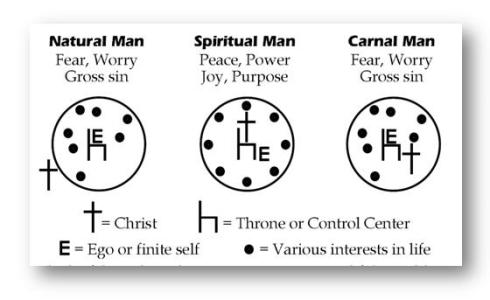
It had something very much like the above diagram on it, showing the difference between a natural man (a non-believer, essentially, who puts the finite self/ego on the throne of their life, and leaves Christ outside), a spiritual man (a “Spirit-filled” Christian who put Christ on the throne, and has everything in order, in their life), and a carnal man (a Christian, who still has the finite self/ego on the throne, with Christ set off to the side, and disorder in their life).

It was a very gripping image. As a Christian, I knew that I was not a natural man, but I really was not sure if I was a spiritual man. I struggled with sinful impulses all of the time. Based on that illustration, I concluded that I must have been a carnal man.

Well, I was not entirely sure, but that seemed like what the tract was teaching.

Nevertheless, I can say that the idea behind it encouraged me to take my walk with Jesus more seriously. God certainly used that little tract in my life, to get my attention, and spur me on towards a greater depth of spiritual maturity. I know of countless other believers who have benefited from this type of teaching, albeit to varying degrees.

However, after reading this several times over, at various times, I was always left with the nagging question: Have I really crossed the threshold from being a carnal Christian to becoming a spirit-filled Christian, from a carnal man to a spiritual man? How would I know when I had successfully made that jump to that next level, in my spiritual journey?

For some reason, that crucial moment, whereby I could have this life-changing experience, that would give ultimate victory over persistent sin in my Christian life, remained elusive. What was wrong? Was it my lack of faith? My failure to properly surrender everything in my life, and hand it over to God? What was the problem?

Well, it turns out that there was a fundamental error in how I was reading my Bible. While this idea of a “carnal vs. spirit-filled” Christian was well-intended, it failed to accurately interpret the Bible passages that address this issue.

The key passage to look at is 1 Corinthians 2:6-3:4. Drilling down on 1 Corinthians 2:14-15, Paul is describing people as being either “natural” or “spiritual.” The “natural” are the non-believers, whereas the “spiritual” are the believers in Christ.

Paul then chastises the Corinthians for not acting like who they are, as taught in 1 Corinthians 3:1-4. As Christians, the Corinthians were supposed to be “spiritual.” Yet Paul finds the Corinthian Christians to be “people of the flesh” or “carnal.” But was Paul really teaching that the “carnal” were of some third category; that is, “carnal Christians?”

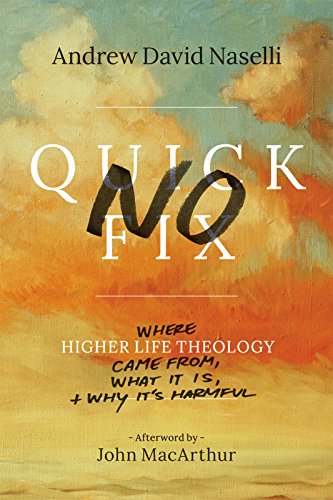
In his exceedingly helpful and short book on the topic, No Quick Fix: Where Higher Life Theology Came From, What It Is, and Why It’s Harmful, Andrew Naselli explains what Paul is getting at:

“Based on the way the Corinthians were acting, Paul could not address them as who they actually were. Although they were people who had the Spirit, they were acting ‘as’ … or ‘like’ people not having the Spirit because people having the Spirit characteristically live a certain way. That is why Paul addresses them this way. He is not laying out three categories into which all people fall: natural, carnal, and spiritual.” (Naselli, Kindle location 1031)

Paul is perfectly aware that Christians can sometimes drift back into old ways of thinking, and fall back into lifestyle choices that discredit their Christian witness.  Naselli continues:

“Believers may temporarily live in a fleshly way but believers by definition live in a characteristically righteous way” (Naselli, Kindle location 1031)

Rather, Paul is calling out the Corinthians to remember who they really are, bought with a price, by the Savior’s blood. If someone who calls themself a “Christian” persists in thinking and living carnally, then there is a strong possibility that such a person is no “Christian” at all. There is no room in Paul’s mind for someone to be in some awkward third category, a “carnal” Christian who is somehow “saved,” but who really is not following after God.

All Christians, at various times in their lives, temporarily lose their focus on Christ. This is not unusual. But the answer to this is to recall what it truly means to be Christian, and not settle for some halfway spot as a “carnal” Christian, convincing themselves that they can somehow squeeze their way into God’s heaven, despite a persistent rebellion against the things of God.

Many people who are drawn to call themselves “carnal Christians” may feel a certain anxiety as to whether or not they really are Christians. The convenient label of “carnal Christian” could be a way to avoid such anxiety.

But perhaps that experience of anxiety is the very thing we need: Am I truly a Christian?

Many have called themselves “Christians” for years, only to spiritually wake up years down the road to realize that they knew nothing about what it meant to truly trust in the Lord, for His saving work in our lives. We can be “religious” for a very long time, with all of the outer trappings to convince others of our spiritual acceptability, and still not not truly know Jesus.

Likewise, there are many who are, in fact, genuine Christians, but who have convinced themselves that they have not yet crossed that threshold from being a “carnal” to a “spirit-filled” Christian. God can surely give us remarkable experiences, where we can give testimony to particular “fillings of the Holy Spirit,” that move us towards greater depths in our walk with Jesus. We can indeed be thankful for such gracious interventions in our lives by God, to spur us onward.

However, at the same time, there are both ups and downs to the Christian life. This is to be expected. Paul’s experience with the Corinthians shows that believers can sometimes take two-steps forward, only to then take three-steps back. But if we truly know that the Holy Spirit is within the believer, sanctifying the believer, slowly and gradually, but nevertheless towards that ultimate goal of being glorified, then we can be comforted that temporary lapses in our spiritual walk do not signal ultimate defeat. Rather, these moments are to give us the opportunity to realize that God has not given up on us. We can turn from our sin, accepting God’s forgiveness, and move on. He will give us the Victory, but it will be according to His timing and His purposes.

Leaning upon God, step-by-step, day-by-day, spending time in God’s Word, over the long haul, brings greater long term fruit than always seeking after some crisis-moment experience, when one can fully “surrender unto God,” that always seems somehow elusive.

As Paul wrote to the Colossians:

To them God chose to make known how great among the Gentiles are the riches of the glory of this mystery, which is Christ in you, the hope of glory. Him we proclaim, warning everyone and teaching everyone with all wisdom, that we may present everyone mature in Christ” (Colossians 1:27-28 ESV)

May we all trust that the Holy Spirit is working in the life of every true believer, that we may all be presented as mature in Christ, as we walk with Him. AMEN!

This tract, published by the then Campus Crusade for Christ, made the rounds in Christian circles for decades, since the mid-1960s. Many have benefited from its simple message. Others have been confused by it. I was one of those in the latter category.

So, Where Did This Idea of a “Carnal vs. Spirit-Filled” Christian Come From?

My purpose for highlighting this problem over a “carnal vs. spirit-filled” Christian is not to throw anyone else under the bus. This type of teaching has been well-intended over the years, but upon closer scrutiny, it does not deliver what is ultimately promised. This type of teaching was a staple of the Holiness movement, that captivated thousands and thousands of Christians, beginning in the late 19th century, and was prominently featured at the then well-known Keswick conferences, large Christian gatherings held at a beautiful lake district in England, beginning in 1875. Over time, the Keswick Convention began to eventually de-emphasize these teachings, and it is no longer associated with such “early Keswick” ideas today. But some ideas do linger on, in the minds of many Christians. While a variety of these insights may still be of benefit for some, they can be debilitating to others.

This teaching that originally came out of those early Keswick conferences emphasized the importance of being “spirit-filled” as the key to living the so-called “higher life,” or “victorious” Christian living. But the Apostle Paul only mentions being “spirit-filled” once in all of his New Testament letters, Ephesians 5:18. So it seems really out-of-balance to make “spirit-filled” THE crucial factor for “Victorious Living,” as a Christian, when other more common themes of the Apostle Paul are minimized by “Higher Life” teachers. As Andrew Naselli points out, before the 19th century Holiness movement, Christians never placed that much emphasis on being “spirit-filled” (Naselli, Kindle location 1086). For example, many Puritan Bible teachers of the 17th and 18th century, such as the English Puritan, John Owen, commonly understood being “spirit-filled” as a life-long process, and not as a result of some definitive, post-conversion crisis experience.

Thankfully, most modern Bible translations have moved away from the language of a carnal Christian. For example, just look at 1 Corinthians 3:1.  The venerable King James Version has:

“And I, brethren, could not speak unto you as unto spiritual, but as unto carnal, even as unto babes in Christ.” 

There is nothing fundamentally wrong with this, but it could be confusing. On the other hand, the NIV takes some of the confusion away:

“Brothers and sisters, I could not address you as people who live by the Spirit but as people who are still worldly—mere infants in Christ.” 

That is, the problem with the Corinthians is that they are still thinking in the manner of being non-believers. They have not matured enough in their faith, to fully understand the impact of what it means to be truly spiritual. There is no special category of a carnal Christian, as taught by late 19th century Keswick theology. Rather, this is simply Paul’s way of saying that the Corinthians are still worldly in their thinking, having not fully grasped yet the depths of their faith.

Sometimes, novel ways of reading the Bible are indeed superior to older ways of understanding Scripture. Christians in the past were surely not perfect, and they did get the Bible wrong at times, on certain matters. But the burden of proof should be on those with such novel interpretations, who might challenge the wealth of tried-and-true interpretations of the Bible, that have stood the test of time.

No Quick Fix: Where Higher Life Theology Came From, What It Is, and Why It’s Harmful, by Andy Naselli, examines why the “carnal vs. spirit-filled” Christian idea fails to adequately reflect the teaching of Scripture.

For a helpful, deeper exploration of this topic, particularly for those who might be still confused about this whole “carnal vs. spirit-filled” Christianity stuff, I would highly recommend Andy Naselli’s No Quick Fix. Andy Naselli blogs at his own website. He also wrote a great book on the Christian conscience, another book I highly recommend and that I reviewed last year.


Houston, We Have A Problem

Fifty years ago today, the crew of Apollo 13 safely landed in the Pacific ocean. The ordeal was incredibly stressful, but following an oxygen tank explosion, that crippled the space craft, it was truly amazing that they made it back. The New York Times reports that luck played a major role, in the astronauts safe return. If the explosion had happened much later in the mission, there would have been a much greater chance that a successful return would have been impossible.

But I am not so convinced about that “luck” assessment. Theologically, providence had that role to play. What really stands out is the incredible effort, that the astronauts and the ground crew had, in working together, to solve the problem, and get the astronauts safely back home. That, in and of itself, is a lesson we can all learn.

A fascinating website chronicles the journey of Apollo 13, moment by moment.


Sarah Osborn’s World #6

The last in this series of blog posts about the life of the 18th century diary writer, Sarah Osborn. I hope you have enjoyed them (Previous posts: #1, #2, #3, #4, #5).

By the eve of the American Revolution, Sarah Osborn’s health had declined so much that she was largely unable to write. Furthermore, the war severely disrupted Sarah’s ministry, as when the British first lay siege to the city of Newport in late 1775 and then finally occupied it for about three years, the city was emptied of over one-third of its inhabitants. This devastation combined with a hurricane and several harsh winters, and the loss of her husband Henry, brought Sarah once again to the brink of destitution. If it were not for the generosity of her Christian friends remaining in Newport, as practically an invalid she would have surely starved or froze to death. Continue reading


Christians Behaving Badly

I do a lot of face-palming these days, during the COVID-19 scare (even though I am not supposed to touch my face!). It seems that some Christians can do and say some downright awful things (particularly when it comes to science), that give the Gospel a bad reputation. But I think that there are some lessons to be learned here.

A few weeks ago, I was greeted by the following headline in an op-ed for the New York Times.

The headline was so offensive that even the normally secular-liberal New York Times later toned down the headline to read, “The Religious Right’s Hostility to Science Is Crippling Our Coronavirus Response.”  It was still a pretty scathing article, that went over the top at crucial moments. Nevertheless, the article sadly had some cogent and sobering points to make.

When I read stuff like this, I either get really mad at the journalist, or I get upset with the folks being criticized by the writer, depending on the validity of the evidence being presented and on the perception of bias. Sometimes I do both. But I think it is worth taking a deep breath, and think carefully through what is going on here.

The author, Ms. Katherine Stewart, clearly has no love for Child Evangelism Fellowship, an evangelical ministry my wife and I support, as a few years ago she wrote a scathing, one-sided critique in a book, The Good News Club: The Christian Right’s Stealth Assault on America’s Children. If you want to see an example of journalistic bias gone mad, read Ms. Stewart.

But in her NYT op-ed, she wrote about a Baton Rouge, Louisiana pastor who refuses to abide by the federal health guidelines. He will not close his 1000+ member megachurch from meeting on Sundays, as he believes this whole COVID-19 lockdown thing is merely a cover for politically-motivated, government-sponsored religious persecution. In a recent Reuters piece, grabbing the international headlines, the Reverend was reported as saying that “God will shield us from all harm and sickness.”

This is the prosperity gospel at its very worst, but before anyone freaks out too quickly, there are about ten things to note about this:

  • First, a lot of folks read articles like the NYT op-ed and they inform their opinion of what Christianity is like. It bears remembering that we should draw people’s attention to Christ, first and foremost. If we draw too much attention to Christians, and not Christ Himself, then the “Christians behaving badly” will tend to lodge in the minds of non-believers. We should focus our attention where our attention is due, in our witness: to Jesus Christ.  Therefore, my intent here is not to narrowly criticize particular persons, but rather to take a step back and reflect on how we think about such matters more broadly. “Be wise as serpents and innocent as doves” (Matthew 10:16 ESV). Ignorance in these matters is not bliss.
  • Secondly, about the author of the op-ed: A lot of Christians will simply dismiss an article like this completely out of hand. Insert the name of whatever “demonic” political party you want, and go from there. We can decry that this is yet another piece of evidence that our nation has “forgotten God,” and that the American Christian church is in serious need of repentance, etc. But here is the thing. I obviously do not know the spiritual status of Ms. Stewart. But more than likely, she is not a Christian.  So, it is not simply that she has “forgotten God.” Rather, it is more likely that she has never heard the Gospel winsomely presented to her, in such a manner that she even knows who this “God” of the Bible really is, much less how to “forget” such a God. The bottom line:  You simply can not expect a non-Christian to think and act like a Christian… Why? …. Well, at the risk of stating the obvious, because that person is not a Christian. Rather, we need to pray for a person like this, that they may winsomely hear the Gospel! A good verse to memorize that teaches this is Colossians 4:5, “Walk in wisdom toward them that are without.”
  • Thirdly, most Christians are abiding by the federal social-distancing guidelines. In fact, the overwhelming vast majority of evangelical Christians are taking COVID-19 seriously. We should remind our non-believing friends of that. So, when someone reads something like this NYT op-ed piece, hopefully that person has a relationship with a Christian who can demonstrate for them, in living color, that Ms. Stewart’s description of a typical “evangelical” does not square with the actual evidence.
  • Fourthly, about the Louisiana pastor, making those international headlines. He has some information-source problems. Like the Louisiana pastor, journalist and editor of The American Conservative, Rod Dreher, and the author of the provocative The Benedict Option, is from Baton Rouge. According to a Rod Dreher essay, which towards the end is quite gut-wrenching, the Louisiana pastor believes that COVID-19 has a “99.3 percent recovery rate.” I do not know where the pastor gets his information from, but this is completely incorrect.  According to the WHO, the mortality rate, according to research done in early March, is about 3.4%, not 0.7% as is claimed. Of course, we know a lot more about COVID-19, as of mid-April, than we did back in early March. By collecting more data over time, we will get a better handle on the mortality rate. That rate varies depending on what part of the world you are in, and how much testing has been done. Nevertheless, we should continue to do what we can to minimize that rate. If the eventual rate, over the long term, becomes greatly lower than 3.4%, it would mean that “social distancing,” and other public health measures (more ventilators, better testing, etc.), have proven to reverse the earlier trend. Would that not be awesome?? But the pastor is not alone here in passing on incorrect information. I have Christians friends who contend that COVID-19 is no worse than the flu. The problem is that the mortality rate for the flu is 0.1%. Even allowing for some margin of error, the math used by those who think that COVID-19 is just like the flu, just does not add up. Some even suggest that the current lower-than-expected death rate in the United States is all due to political misinformation. Yet perhaps there is a simpler answer: As of mid-April 2020, most Americans are abiding by the federal social-distancing guidelines, and perhaps those efforts are actually working to reduce the amount of fatalities! I do not like it when non-believers misrepresent the Christian faith, but we do not do anyone any favors when we pass on misinformation, particularly when we call ourselves Christians, for whom the truth should matter more than anything else.
  • Sixthly, here is a particular objection to how this pastor handles the Bible: The Louisiana pastor’s interpretation of Romans 13 is badly misinformed. He believes that when Romans 13:1 says “Let every person be subject to the governing authorities,” what Paul really meant to say is “Let every person be subject to the governing church authorities…. not political authorities.”  I do not know any New Testament scholar who reads the text in the original Greek who would concur with that particular reading…… Furthermore, we must seek to know the whole of Scripture well enough to compare Scripture with Scripture. In this case, it would be important to recall 1 Peter 2:12, “Keep your conduct among the Gentiles honorable, so that when they speak against you as evildoers, they may see your good deeds and glorify God on the day of visitation.”
  • Seventhly, because this is a Pentecostal church, other Christians should take note. Pentecostal churches, like this one in Louisiana, are highly-integrated, multi-racial churches. This church represents the cultural and ethnic diversity in Baton Rouge in such a way that they put the vast bulk of evangelical churches, across America, to shame. In particular, this church is reaching out to the poor and disenfranchised, with greater effectiveness, than most evangelical churches. These are very difficult days for many people, who are out-of-work, due to the COVID-19 crisis, and this pastor is feeling the effects of this crisis on his people first hand, unlike a lot of wealthy evangelical churches, who can probably ride out this crisis without that much suffering. So, before you completely throw this Pentecostal church under the bus, for how their pastor is handling the COVID-19 crisis, it bears to keep that in mind.
  • Eighthly, many Christians and non-Christians alike will be tempted to look down upon this controversial Louisiana pastor and conclude that he is “in it for the money.” The desire to draw this conclusion is understandable. After all, he is part of the prosperity gospel movement. But I would caution against this. Arrogant self-promotion is one thing, but greed is a different animal. Many of this pastor’s congregants are on the worst receiving end of the devastating economic consequences millions of Americans are experiencing, due to the COVID-19 crisis. Those most likely to throw stones his way probably are not experiencing the dire consequences experienced by those who could not make their rent payment this past month, because the restaurant or retail store they worked in laid them off indefinitely. I do not agree with the pastor’s decision, but I am willing to give him the benefit of the doubt that he is acting with the greatest amount of sincerity. Some things are worth a lot more than $$$ … but it does not mean that you make well-informed decisions. It is quite evident that this pastor’s recklessness in ignoring public health concerns tells us how his own inflated sense of self-importance is blinding his sense of moral judgment.
  • Ninthly, I will give the Louisiana pastor some credit when it comes to church attendance. He is obviously concerned that once the COVID-19 crisis is over, that some people might find the habit of not going to church a hard habit to break. It will be interesting to see how many people will stop going to church, once the crisis is eventually over.  On the other hand, the current “stay at home” orders provide a good opportunity for others to rethink their relationship with God, or lack thereof. Pray that we see new faces coming to our churches, at the end of this crisis, and that we know how to receive them.
  • And finally, if you view this YouTube video interview with the controversial pastor, you will get the sense that he is mostly concerned about the freedom of religion. He does a have a point here about the threat of government coercion, and respecting the right of a person to act upon the convictions of their conscience. It is kind of odd to think that a liquor store is considered an “essential business,” when a church meeting is not. Point well taken. But is the real issue here about religious persecution? No, it should be evident that religious persecution is not in view here. Christians are not being singled out for their beliefs. If anything, this pastor’s grandstanding about “religious liberty” only trivializes freedom of conscience, and gives opponents of the Christian faith cause to attack genuine religious liberty.  During a public health crisis, Christians should do the right thing, not ultimately because the government tells them to do it, but because it is the right thing to do. We should not allow a persecution complex to become an excuse for not being properly informed, and thus not acting in a way that demonstrates how a Christian might best love their neighbor.

So, why is it that there is this perceived hostility towards science, that encourages people to think that either (a) Christians are “anti-science,” or on the flip side, that (b) the claims of modern science today are simply a part of a deceitful, politically-biased narrative?

I believe that the answer comes down to trust.

Take the example of how a number of ultra-orthodox Jews have been dealing with the COVID-19 crisis in Israel. During the early period where Israeli authorities were trying to warn their citizens about COVID-19, and encouraging them to abide by “social distancing” techniques, many ultra-orthodox Jews eschewed such public health directives.  Such conservative Jews do not accept the New Testament as authoritative, yet they do accept the Hebrew Scriptures (the “Old Testament” for Christians) as the Word of God. Their allegiance to the Scriptures far outweighs their respect for government-issued directives.

But in recent days, Israel’s ultra-orthodox community is beginning to take the public health warnings seriously. Israeli authorities are trying not so much to be heavy-handed in their approach, but are focused more in building relationships of trust.

It can be really hard to build relationships of trust, particular among people with whom you have serious disagreements with. I know from personal experience that such efforts at making friends, and breaking down barriers takes a lot of hard work, and a lot of humility. But to see how the Jewish ultra-orthodox community is starting to come around to “do the right thing” is an encouraging sign that such relationship building is really worth the effort.

It may not be so much an issue of there being a supposed conflict between science and the Bible, as the New York Times revised op-ed title put it , the so-called “Religious Right’s Hostility Towards Science.” Rather, it is more likely a sense of distrust of scientists and medical doctors, in conservative religious communities, that drives what appears to be an “anti-science” antagonism. Building a sense of trust between religious conservatives and scientists (including medical doctors) will go a long way in addressing the so-called “warfare thesis” behind science and the Bible.

I missed worshipping in physical proximity with other believers this past Easter Sunday, celebrating the Resurrection of our Lord together. “Virtual” worship was better than nothing, but it is not the same thing. I pray that current public health crisis will end soon, and life can return to normal.

But the blatant distrust of science that some Christians feel compelled to accentuate is harming the witness of the faith. We need to do better in reaching out to our fellow misinformed Christians for the sake of protecting the reputation of the Gospel, as we proclaim the Good News to an unbelieving world.

(For a more in-depth response to the Louisiana pastor defying the “stay at home” order, I have included the video of Rod Dreher making his analysis of the controversy)


The Resurrection Gave Us Christianity

What gave us Christianity? The New Testament, or the Resurrection?  In 90-seconds, apologist Frank Turek tells us why it is all about the event of the Risen Jesus (a re-post from Easter last year).