Clarke Morledge -- Computer Network Engineer, College of William and Mary...
I hiked the Mount of the Holy Cross, one of the famous Colorado Fourteeners, with some friends in July, 2012. My buddy, Mike Scott, snapped this photo of me on the summit.
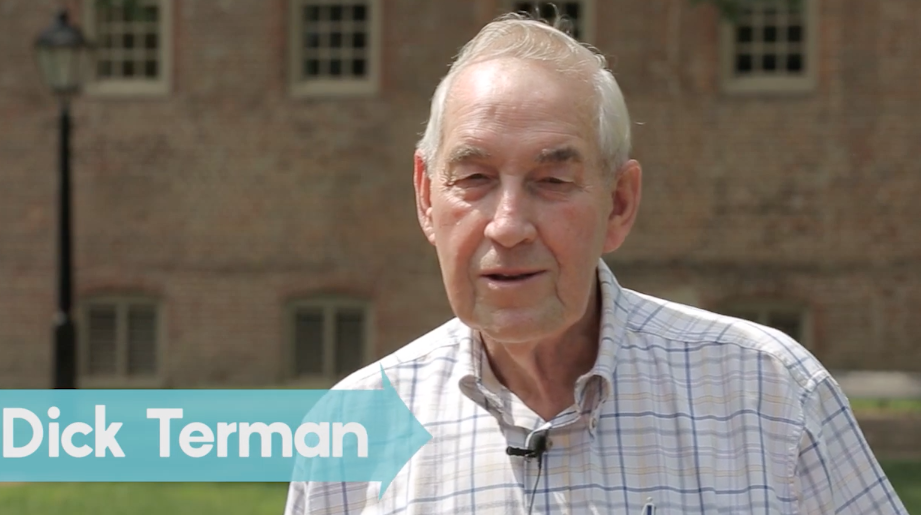
In just a few weeks, Dick Terman, a dear friend and mentor of mine, will be moving away from Williamsburg, Virginia. I want to tell you about him.
Dick Terman grew up in the Midwest, in a Christian family. His grandfather was a Free Methodist pastor, and strict promoter of “Prohibition,” the 18th Amendment, that sought to ban alcohol in America. Dick describes his grandfather as a caring man, but boy, could he be strict. Dick remembers his grandfather (rightly) scolding him once, from the pulpit! As a kid, Dick took only a casual interest in spiritual matters.
When Dick was in high school, he was active in the Boy Scouts. However, he had trouble. Another boy in the troop loved to pester and irritate Dick. One day, on a troop hike, the boys were hiking the perimeter above a steep gravel pit. The thought crossed Dick’s mind that he could push this pestering boy off this high ledge. It would only take a few seconds, a strong shove, and Dick’s problem would be gone.
Dick restrained himself. But the angry temptation that filled his heart, scared the wits out of Dick Terman. He could have gotten rid of this bothersome boy, by pushing him over a hundred foot drop, to the boy’s death.
Dick could have been a murderer.
Dick had come face to face with his own sinful nature. He knew he had to get right with God. So, Dick kneeled in prayer before his Maker, admitted his need for a Savior, and gave his life in submission to the Lordship of Christ. Continue reading
(Editor’s Note: I have been trying to get an avid Veracity reader to write this blog post for several years, as he has personally been to Scotland to see “Parking Space 23.” But alas, in this, the 500th anniversary of the start of the Protestant Reformation, I could wait no longer…)
If you go to Edinburgh, Scotland, today, you might have trouble finding the grave of Scotland’s greatest Protestant Reformer of the 16th century, John Knox. Hidden away, underneath the asphalt of parking space 23, lies the body of one John Knox, who paved the way for the Reformation to transform the country of Scotland. A plaque embedded in the pavement reads:
“The above stone marks the approximate site of the burial in St Giles graveyard of John Knox, the great Scottish divine who died 24 Nov 1572.”
Why would John Knox’s grave be found in a parking lot? Just imagine if the Jefferson Memorial in Washington, D.C. were bulldozed over, and converted into a parking garage.
In much of secular Scotland today, the Christian faith of the Reformation era is largely forgotten. Yet John Knox is unquestionably the founder of modern Presbyterianism, as he resolutely preached his way throughout Scotland, moving this northernmost segment of the British Isles away from Roman Catholicism towards a Protestant faith. Within a few centuries, the Scottish church would become one of the greatest missionary sending communities of all time, establishing Christian witness over all the world.
Was there something about Knox himself that contributes to this historical neglect? Though a fiery evangelist, with a great love for the Gospel, John Knox was also known to be rather severe. Was it because he acted as a bodyguard to another Scottish preacher, for a time? Was it because he suffered for two years of oppressive prison labor, aboard a French galley ship? Was it because he actively opposed the idea of having a woman as a secular ruler?
Yet it might be time to restore John Knox, Scotland’s greatest Reformer, from this historical neglect.
The film Knox explores these questions, and tells his story. Here is the trailer:
A Dutch Anabaptist, Dirk Willems, was chased across a frozen pond, by one of his persecutors. When his persecutor fell through the ice, and feared for his life, Willems had compassion on the man, and pulled him out of the frozen waters to safety. Willems was then apprehended, and days later, was executed for his Anabaptist beliefs…. So, who are these Anabaptists? A brief look at one of their prominent leaders, Menno Simons, tells their story.
Menno Simons, the founder of the “Mennonites,” was enjoying the “good life” of a typical medieval priest, in the 16th century. Yes, he had his religious duties, performing baptisms and the Mass, but he also had a “good time” drinking with his friends, and partying into the wee hours of the night.
But his conscience had gripped him, when he knew of neighbors who had died as martyrs, clinging to a belief in the Bible, as the true source for what it really meant to be a Christian. Menno, even though he was indeed a priest, knew nothing of the Bible.
“[My friends] and myself spent our time daily in playing, drinking, and all manner of frivolous diversions, alas! as it is the fashion and way of such useless people; and when we were to treat a little of scripture, I could not speak a word with them without being scoffed at; for I did not know what I asserted. Thus concealed was the word of God to my understanding. At length I resolved that I would examine the New Testament attentively.”
Menno eventually became convinced of “Believer’s baptism,” a key feature of the “Anabaptist” movement. He embraced the discipline of a scholar, spending several years, in trying to understand the Bible. But some of his new Anabaptist friends had gone down the wrong track, embracing the error of violence. The Holy Spirit was still working on Menno’s hardened heart:
“I could find no rest in my soul. I reflected upon my carnal, sinful life, my hypocritical doctrine and idolatry, in which I continued daily under the appearance of godliness. I saw that these zealous children willingly gave their lives and their estates, though they were in error, for their doctrine and faith. And I was one of those who had discovered some of their abominations, and yet I myself remained satisfied with my unrestrained life and known defilements. I wished only to live comfortably and without the cross of Christ.”
After seeking after the Lord, and through his study of the Scriptures, Menno Simons finally discovered the grace of God:
“Thus have I, a miserable sinner, been enlightened of the Lord, converted to a new mind, fled from Babel, entered into Jerusalem, and finally, though unworthily, called to this high and arduous service…..He who, purchased me with the blood of his love, and called me, who am unworthy, to his service, knows me, and knows that I seek not wealth, nor possessions, nor luxury, nor ease, but only the praise of the Lord, my salvation, and the salvation of many souls.”
Many of the Anabaptist leaders of the Radical Reformation were killed during the 16th century. Menno Simons survived, preaching and teaching from the Scriptures, and those who have been drawn to his teachings are now scattered all over the world. We know these particular Anabaptists today as “Mennonites.”
Some Christian friends of mine are all abuzz about Genesis: Paradise Lost, a new movie being shown in select theaters across America, November 13 and 16, 2017. Should Christians go see this film? (SEE MY DISCLAIMER at the bottom of the post, updated AFTER I first published this post).
In a promotional video for the movie, Dr. Charles Jackson, a professor of Creation Science at Liberty University, explains that the Big Bang Theory, of how the universe expanded from a single point, some 13 billion years ago, is part of a secular mythology, at odds with the Bible. As Dr. Jackson goes onto say, “there are all of these ‘dog ate my homework’ stories” that “atheist evolution theory” proposes to explain how stars were formed, in the wake of the Big Bang. Jackson argues that such explanations are “impossible” and “can not happen.”
The conclusion? Christians should reject Big Bang cosmology. Instead, they should embrace a Young Earth proposal, that the universe was created only some 6,000 years ago, based on a particular interpretation of the Bible. The film’s primary concern is to help Christians have a greater confidence in their Bibles, and to win those who have doubts, to have a saving relationship with Jesus Christ, which are critically important aims, that all believers can boldly affirm. Genesis: Paradise Lost is endorsed by Answers in Genesis, the apologetics organization behind the Creation Museum and the Ark Encounter, located in Kentucky. Just based on this brief presentation, without any further knowledge, Dr. Jackson’s argument might sound fairly compelling.
But is what Dr. Jackson saying true?
Does Big Bang cosmology really contradict the Bible? It seems like the modern scientific consensus agrees with the Big Bang. If the Bible is out of step with the Big Bang, what does that mean?
What if, indeed, the opposite were the case? What if the Bible, written a few thousand years before scientists in the 20th century confirmed the evidence, aligns with the Big Bang? What if the Bible, accurately describes the scientifically-observed expansion of the universe? What is the likelihood of ancient, pre-modern Israelite prophets, perfectly articulating the precise nature of the universe, in a manner that exactly coincides with what modern scientists, have only recently seen in nature?
Is this merely a coincidence? Do Christians need to come up with other “dog ate my homework” stories, to explain features like this in the Bible, or are there better explanations that exist? Think about it.
Should a Christian go see Genesis: Paradise Lost? Sure, consider the evidence that the film presents, as Dr. Jackson does raise some good questions, and the film makers have a genuine, rightly-motivated interest, in presenting the Gospel message to non-believers. Amen to that! But do yourself a favor, and also consider a different viewpoint, from another Christian perspective.
As Proverbs 18:17 says, “The one who states his case first seems right, until the other comes and examines him.”
Below is the Dr. Charles Jackson clip, from the Genesis: Paradise Lost film, being used to promote the movie, then followed by an 8-minute presentation by Jeff Zweerink, an astronomer with Reasons To Believe , explaining what the Bible has to say about the Big Bang. Zweerink is part of the scholar team, along with Hugh Ross, at Reasons to Believe. Genesis: Paradise Lost should not be confused with an earlier film this year, Is Genesis History?, by Del Tackett and Thomas Purifoy, Jr. The earlier film has pretty much the same message, but the outdoor cinematography in Is Genesis History?, is spectacular, whereas Genesis: Paradise Lost relies more on 3D computer-generated graphics.
UPDATE (November 11, 2017): Though I published the above post a few days ago, I just learned something about “Doctor” Charles Jackson. Yes, Charles Jackson does have a doctorate. This is true. However, it is not in any particular science field. Rather, he earned his doctorate in the field of education, from the University of Virginia (UVA). He is not a practicing scientist, but rather he is a grade school science educator. This type of sleight of hand is not outright deception, but it is not entirely truthful either. At least, Is Genesis History? featured credentialed PhD-level scientists, having done doctoral work in their specific scientific field. Genesis: Paradise Lost relies on experts, that lack the level of expertise, as comparatively found in Is Genesis History?. Eric Hovind, the producer of the latest film, should be embarrassed. Let the viewer of the film beware!!
When people think of “the Reformation,” typically the name of Martin Luther comes to mind. After all, it was in 1517, 500 years ago, when he began his campaign against the sale of indulgences. But Luther was not the only player. In fact, there were a number of other key personalities, that made the Reformation happen.
I have taken a list of twelve historical figures, four of them prior to the Reformation, and eight of them during the 16th century, that interested Christians need to know about, in order to understand the story of what the Reformation was all about, and why it happened (Links and images via Wikipedia).
If you want to discover more about some of the other leading players, of the Protestant Reformation, I would highly recommend listening to the Here We Stand podcast, by DesiringGod.org, for a 31-day set of short, podcasts, six-minutes long each, for a different Reformer each day. Continue reading








 Veracity