
From the Christianity along the Rhine blog series….
Martin Luther once delivered a sermon on Good Friday, where he said this:
“Until the present we have been in the Passion week and have celebrated Good Friday in the right way …. Cast your sins from yourself upon Christ, believe with a festive spirit that your sins are His wounds and sufferings, that He carries them and makes satisfaction for them…..Press through all difficulties and behold His friendly heart, how full of love it is toward you, which love constrained Him to bear the heavy load of your conscience and your sin.”
A lot of ink has been spilled on Martin Luther… and I have read a few pages of it!
One of my closest friends from high school, Thomas Coyner, died a few years ago due to a debilitating life-long illness. Eight years before Thomas died, his father, Boyd Coyner, a retired professor of history at the College of William and Mary (where I work as an IT engineer), died as well.
The Coyner family loved books.
When Dr. Coyner died, my friend Thomas gave to me his dad’s collection of books on Martin Luther. It was a bunch of books! Thomas’ dad was apparently an expert on the life of Martin Luther, the famous German Protestant reformer of the 16th century. This made sense in that Dr. Coyner had grown up in a Missouri Synod Lutheran Church, named after Martin Luther himself.
I have heard it said that there are more books written about Martin Luther than any other figure in Western history. I can believe it! Some of Dr. Coyner’s collection are tomes, including Martin Brecht’s three volume set, with some 1400 pages total…. and that is not counting the endnotes!!
I deeply treasure these books on Luther, though I confess that I hardly have read them all. The standard, recommended biography of Luther, which is nicely short and compact, is Roland Bainton’s Here I Stand: A Life of Martin Luther. Bainton’s book got me hooked on Luther, not just as a pivotal Protestant theologian, but as a shaper of Western culture more broadly.
So, when my wife and I embarked on a cruise on the Rhine River, in October, 2025, I was determined to check out some of the spots where Luther made his mark in Germany, during those crucible years of the Protestant Reformation movement. A day-long bus tour scratched my church history itch.
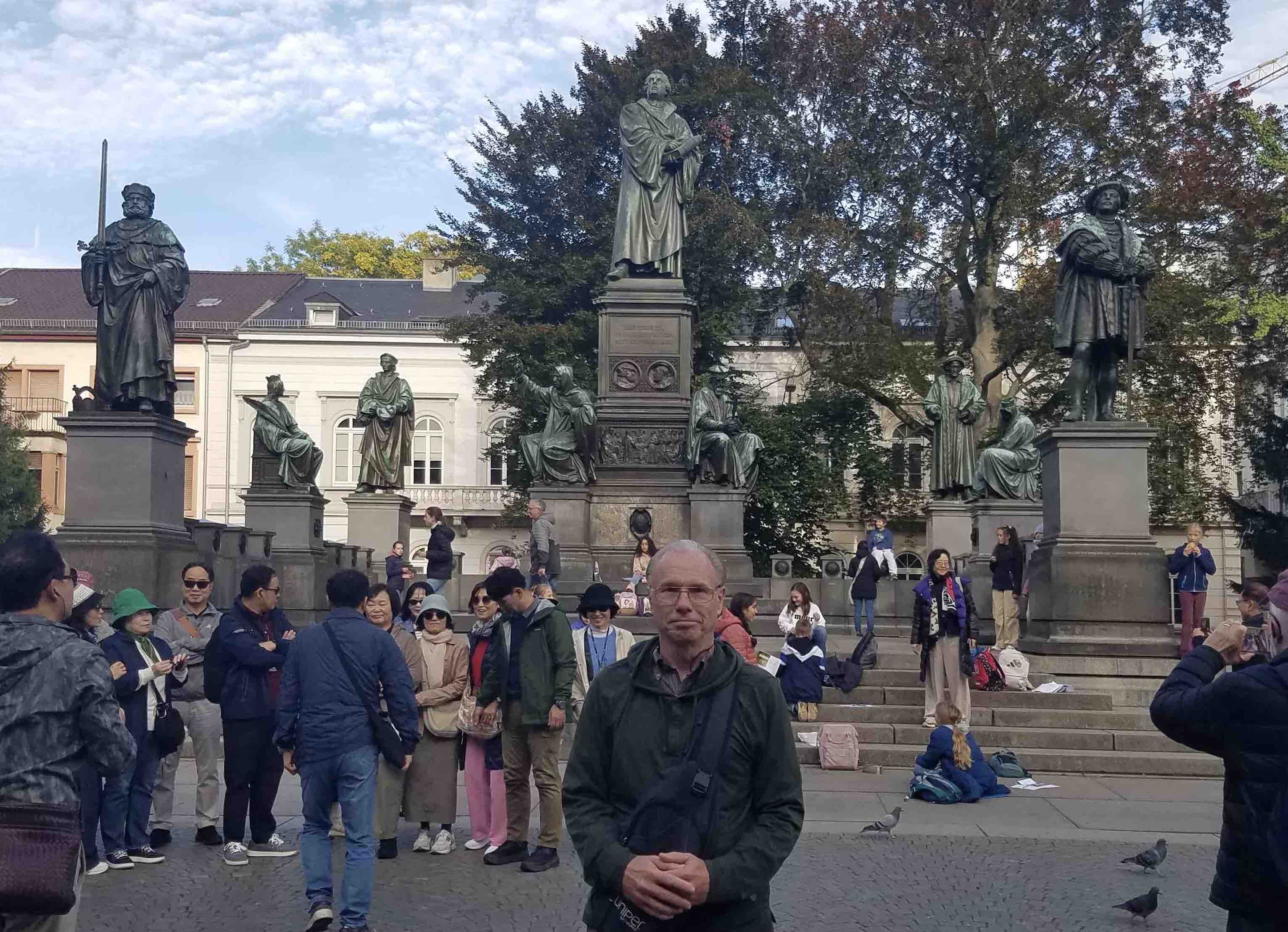
The Reformation Monument in the city of Worms, Germany, where Martin Luther (statue in the middle) made his famous “Here I Stand, I Can Do No Other” speech before the Holy Roman Emperor Charles V. I had to navigate around the Japanese tourists who surrounded the monument, to get my friend to snap a photo of me!
Walking the Streets of Worms, Germany
First up was a visit to the city of Worms. As a seminary professor still in his thirties, Martin Luther had been summoned to Worms to appear before Charles V, the emperor of the Holy Roman Empire, in the year 1521.
Historians call this the “Diet of Worms,” which has nothing to do with some sort of creepy health fad to help you lose weight. A “diet” is an antiquated reference to a meeting of a legislative body, and “Worms” is simply the name of the city where this meeting was held. So, it was at this “Diet of Worms” where Luther uttered (at least, it is commonly told that way) the famous saying, “Here I stand, I can do no other.”
Four years earlier, in 1517, Martin Luther had published a criticism of the medieval practice of the sale of indulgences, which crudely put would allow a dead relative to lessen their time in purgatory, if a living relative were to hand over some cash to the medieval church authorities. This got Luther into some hot water with the church establishment, which only emboldened Luther to publish criticisms of other medieval Catholic practices and doctrines.
At the Diet of Worms, Luther had been asked to recant his writings. What prompted Luther to get into so much trouble?
Back in 1453, the great Christian city of Constantinople had finally fallen to the Turks. Intellectuals from that city fled towards the West, bringing ancient copies of the New Testament with them. Luther had been impressed by a newly researched version of the Greek New Testament, published by the Dutch scholar, Desiderius Erasmus, who spent several years researching some of those ancient copies of the New Testament from the East. From that version of the New Testament, Luther had felt compelled to challenge the Western medieval doctrine of purgatory, among other doctrines, putting his ideas into book form.
The printed book, using the newly acquired technology of the printing press in Germany, was like the Internet of the 16th century. Luther was a master in using this 16th century form of “social media” to broadcast his ideas to the world. The likes of Taylor Swift may rule the world of Instagram today, but in the 16th century, it was Martin Luther dropping a stack of papers at the door of the Wittenberg printing shop, to be converted to movable type, which shook up the medieval world.
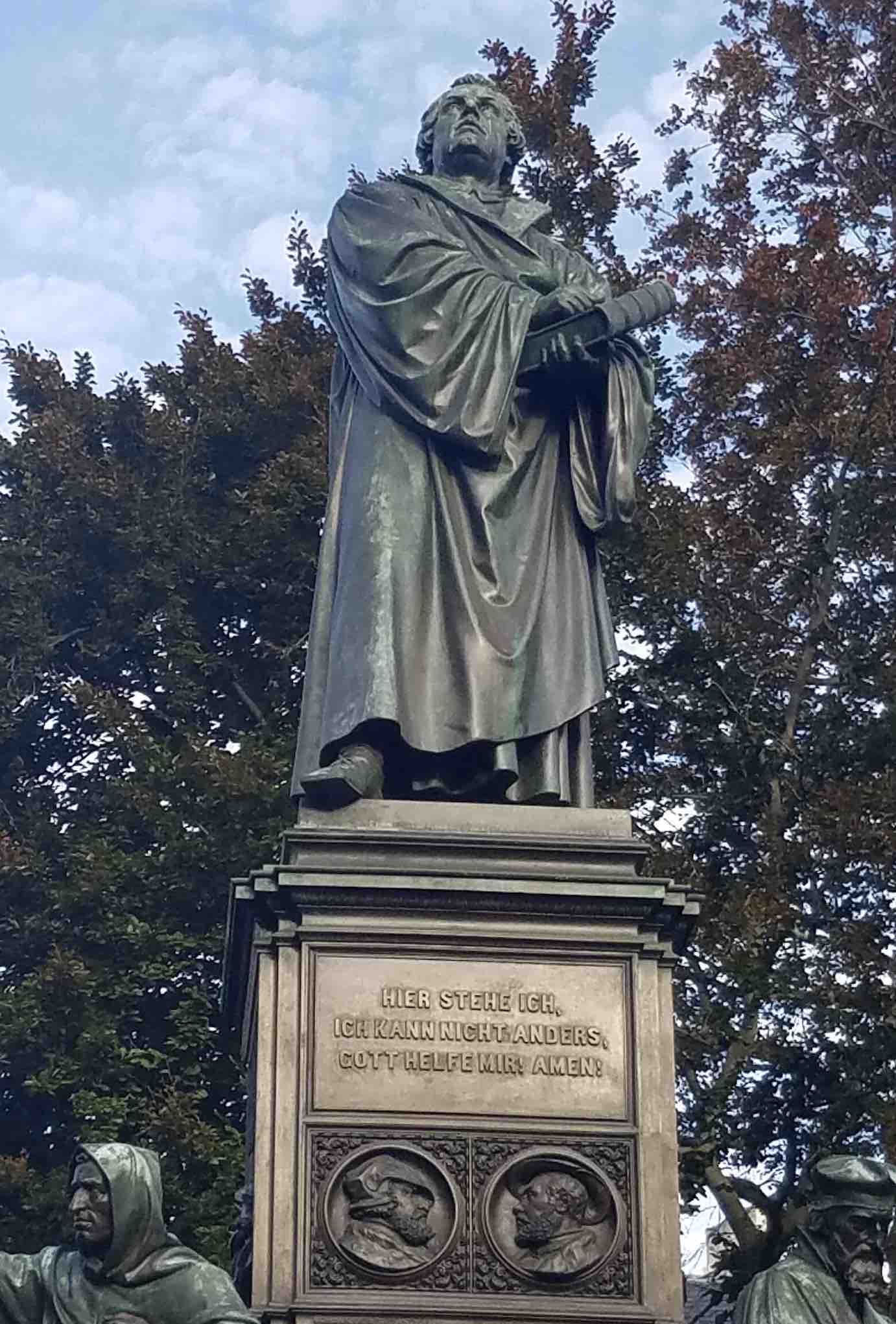
A statue in Worms, Germany, of Martin Luther, the hero of the Reformation…. and a thorn in the flesh to the medieval church establishment. My photo, October, 2025.
Luther had set off a firestorm of controversy, engulfing his whole life, thus starting a conversation which set the intellectual course of the West for the next 500 years. Along the way, millions have experienced spiritual joy resulting from his fresh look at the basic essentials of the Christian faith, and what it means to be a Christian. Nevertheless, on the downside, thousands, if not millions of people have tragically lost their lives through wars and persecutions, partly related to the controversy which Luther ignited.
Luther himself dodged the fate of almost certain death, by the hands of authorities, in the wake of his appearance before Charles V. After refusing to recant his writings, Luther was able to leave Worms safely, before being kidnapped by those who sought to protect Luther’s life. Luther would go on and translate the Bible into the common language of the German people.
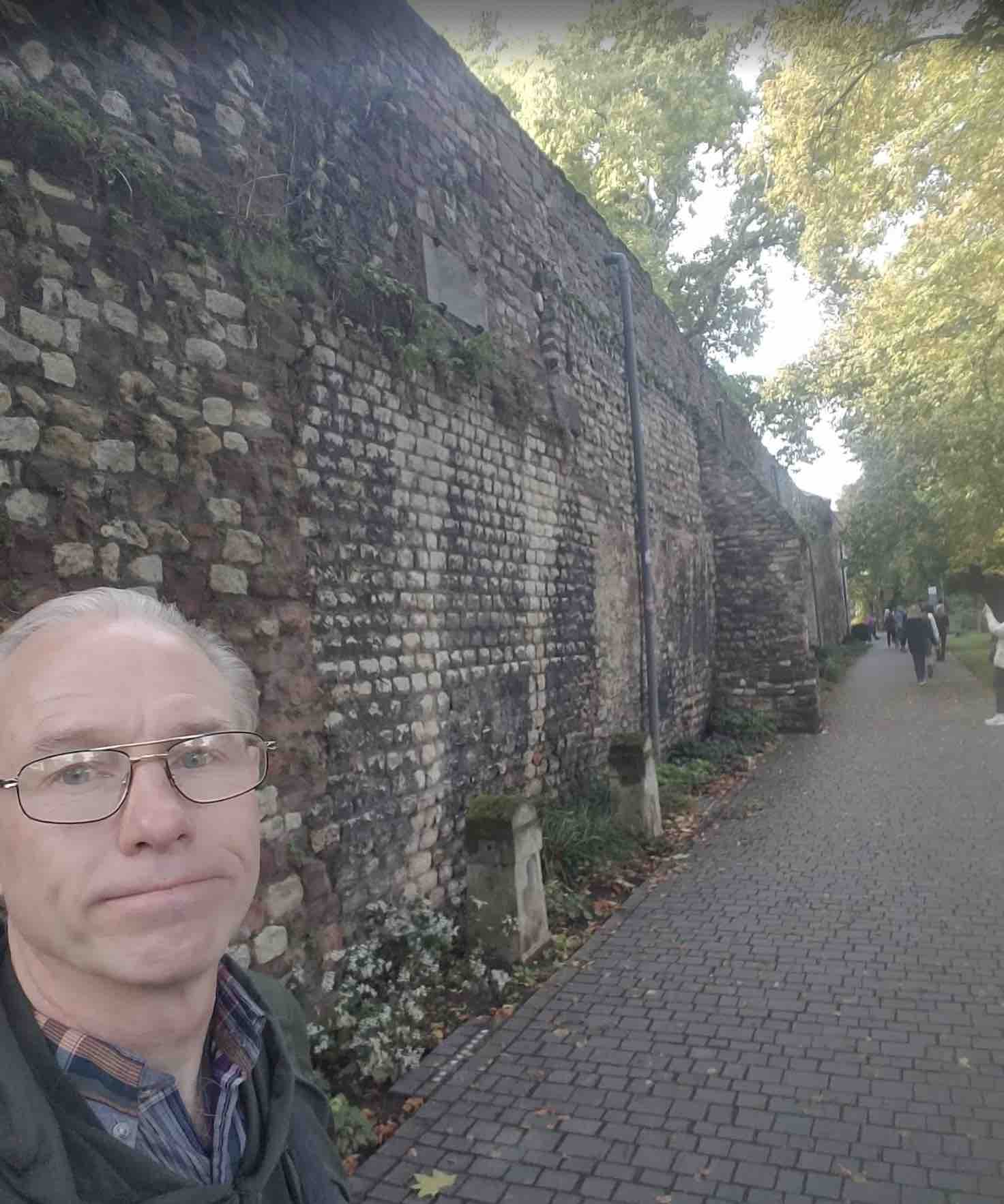
Ancient city wall of Worms, Germany, built by the Romans, about the time of Christ. A moat surrounded the city, fed from the waters of the Rhine. But now it is just a sidewalk and a city street. My photo, October, 2025.
Worms, Germany, is a remarkable city to visit. During the period of the ancient Roman empire, Worms had been an outpost along the Rhine River. What is weird today is that the Rhine River is actually a few miles away from the city now. The Romans had built a wall around the city at the shore of the Rhine, to protect against Germanic invaders. For centuries, the Rhine was marshy and difficult to navigate, particularly for larger boats. In the 19th century, the Rhine was dredged to make for a deeper, straighter channel, thus eliminating the more marshy areas.
The city had been mostly flattened during World War 2, as Americans chased the German army out of the city. The oldest cathedral in the city was spared the artillery barrage of the Americans. Nearby that cathedral is the spot where Luther appeared before Emperor Charles V, to make his bold defense of the Reformation, just less than 400 years before American tanks entered the city. The layers of history across the centuries in Worms makes anything in America look rather piddly!
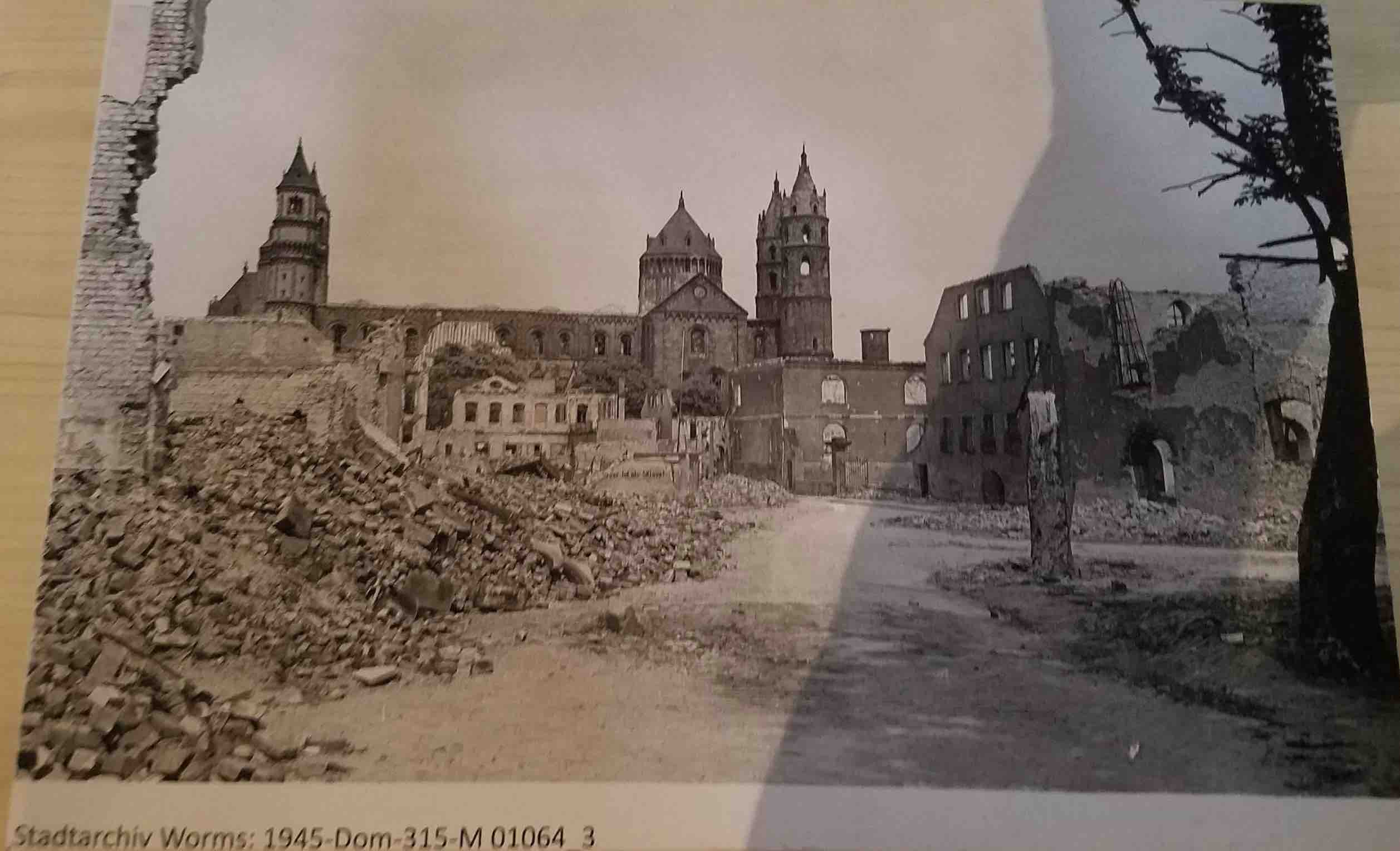
The area around the cathedral in Worms, Germany, not long after the American bombing raids towards the end of World War 2. Photo preserved inside the cathedral, where I took a snapshot of it.
From Worms, Germany, to Heidelberg
Thankfully, there was a restroom near where the bus stopped to pick our group up. This was one of the few restrooms that did not cost me a Euro coin to use it!
Europe travel tip: Keep a few Euro coins in your pocket as you travel across the continent. They will come in handy.
After visiting Worms, the next stop was in the city of Heidelberg, at the eastern edge of the Rhine River valley. Heidelberg is known for its great castle, looking over the Neckar River. A good part of Heidelberg, including part of the castle, was destroyed by the “Sun King,” Louis XIV of France, in the late 17th century. For decades after World War 2, the American military had a significant military presence there, as the city was largely spared of the destruction from the war.
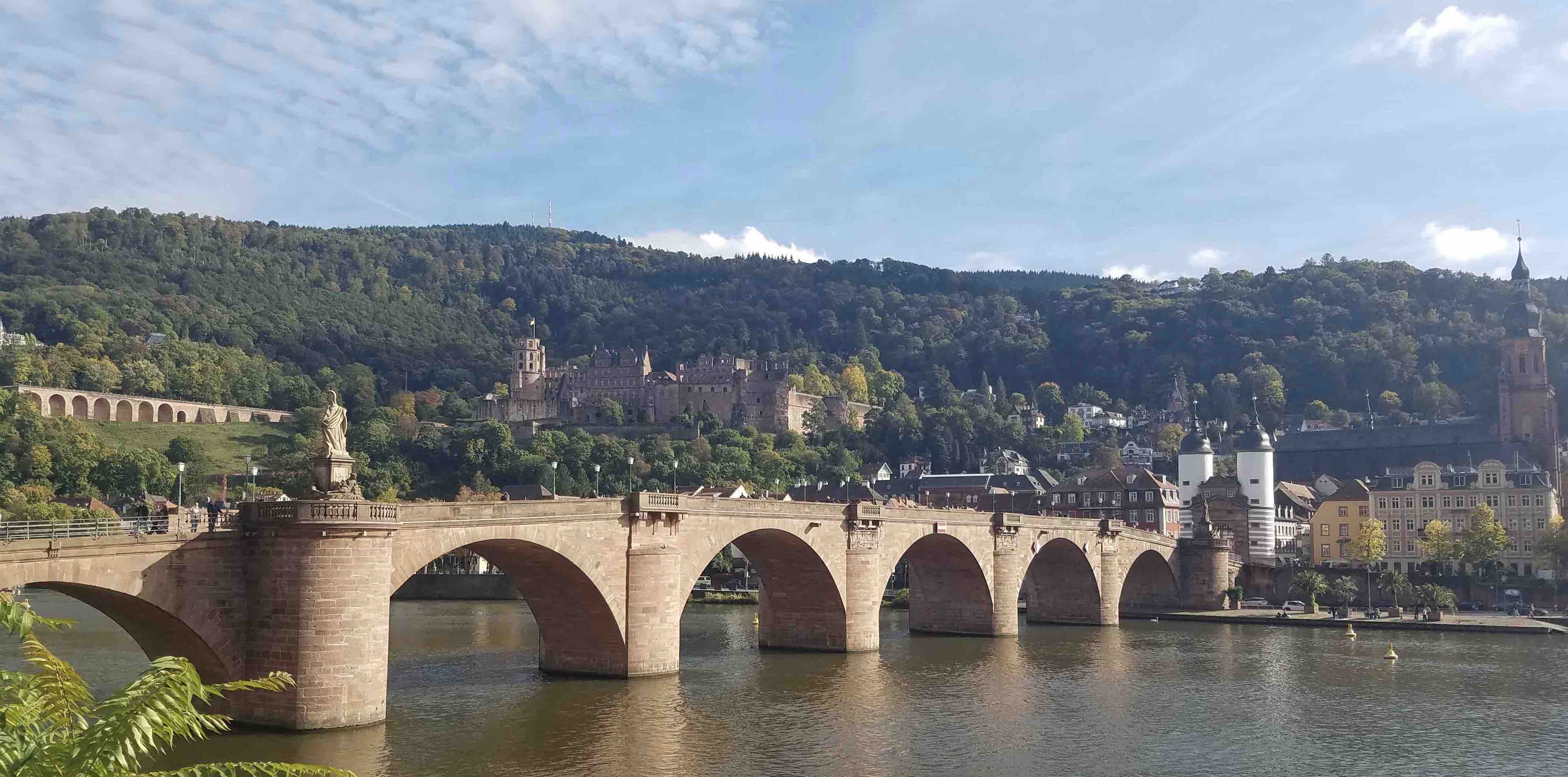
The old bridge crossing the Neckar River, in Heidelberg, Germany, with the famous castle above.
But my main interest with Heidelberg was in finding the spot where Martin Luther participated in the “Heidelberg Disputation,” a defense he made of his theology in 1518 at an Augustinian seminary, where the University of Heidelberg is located today. Luther managed to persuade at least some of his Augustinian monastic colleagues of the validity of the theological principles he championed at Wittenberg, where he served as a professor of the Bible. This was just three years before his fateful meeting before Emperor Charles V in Worms.
It was at this Disputation in Heidelberg where a young Dominican monk, Martin Bucer, heard Luther speak for the first time. Bucer became a follower and friend of Luther, and a pivotal figure in his own right, though his influence today is overshadowed by theological giants like Luther and later, John Calvin. The life of Martin Bucer will be a topic of a future Veracity blog post.
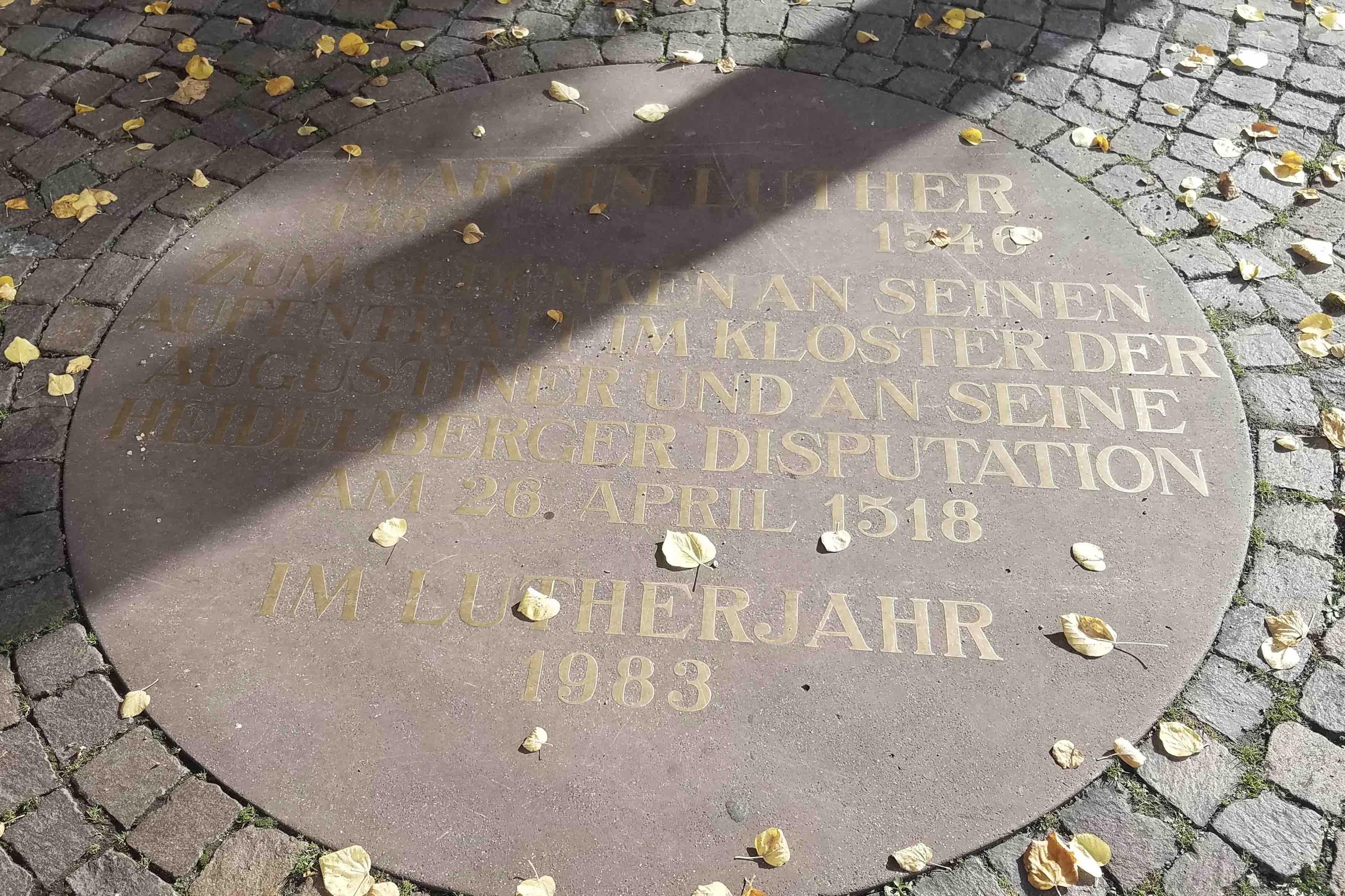
The spot where Martin Luther delivered his Disputation in Heidelberg before fellow Augustinian monks, in defense of the Reformation.
An Educational Dinner Conversation at a Wedding Reception…
One more little anecdote….
At a wedding reception a few years ago, I sat next to Philip Cary, a theologian at Eastern University in St. David’s, Pennsylvania. Cary has done several recorded classes for The Teaching Company, as he is an expert on both Saint Augustine and Martin Luther. It was an unexpected surprise to be at a sit-down wedding reception, having dinner with a world-class scholar like Philip Cary. The Bible-geek in me enjoyed the conversation just as much as the food! I kept Dr. Cary talking so much with all of my questions, I do not think he ate hardly anything!
Cary believes that Augustine and Luther are the two most influential thinkers in the Protestant Christian West ( I have written two blog posts about Augustine earlier this year). Interestingly, Martin Luther was an Augustinian monk, about the time he triggered the revolution of the Protestant Reformation.
Martin Luther has been one of my theological heroes (as well as Augustine), but like Augustine, he had his faults, too. Luther’s legacy is enduring, but it has been tarnished by some of his anti-semitic writings of his later years, prompting a deficiency in Protestant thinking which is being corrected by scholars over the last few decades. I will be writing more about this in the future. In the meantime, it is worth celebrating the man’s positive side, as Luther pretty much gave us the Five Solas of the Reformation:
- Sola Scripture (Scripture alone)
- Solus Christus (Christ alone)
- Sola Fide (Faith alone)
- Sola Gratia (Grace alone)
- Soli Deo Gloria (Glory to God alone)
Luther’s Good Friday sermon focused on the cross, but he also reminded his listeners about the resurrection:
“If we deal with our sins in our conscience and let them continue within us and be cherished in our hearts, they become much too strong for us to manage and they will live forever. But when we see that they are laid on Christ and He has triumphed over them by His resurrection and we fearlessly believe it, then they are dead and have become as nothing.”
On this Good Friday, as we remember what Jesus accomplished for us and our salvation on the cross, it is good to recall the message of the Gospel that Martin Luther risked his life to guard, to protect, and to proclaim to the whole world.
My favorite podcast (still) is The Rest is History, narrated by historians Dominic Sandbrook and Tom Holland. Here is the episode where they talk about Martin Luther’s encounter with Charles V at Worms, nearly 500 years ago. Standing in that spot where Luther uttered his memorable defense really brought the story alive to me!!



 Veracity