
Saint Augustine of Hippo is the most influential early church father of the Western church. Numerous church doctrines, such as original sin, have the indelible stamp of the late 4th / early 5th century North African bishop imprinted upon the minds and hearts of millions of Christians down to the present day.
Roman Catholics look to Augustine for understanding the theology of sacraments, while all of the major magisterial Protestant leaders of the 16th century owe a debt to Augustine. Martin Luther himself was an Augustinian monk when he nailed his famous 95-theses to the Wittenberg church door. Even the Eastern Orthodox look to Augustine as one of the primary doctors of the church.
During his long tenure as the bishop of Hippo, Augustine was known to be a writing machine. At one point he employed two full time secretaries which allowed him to dictate the books he was writing. To date, there are still works by Augustine that have not been translated into English. The man was a towering intellect, impacting a great deal of Western thought that even non-Christian scholars and other readers come back generation after generation to study.
Pope Boniface VIII in the 13th century named him one of the four great Doctors of the Church, alongside Ambrose, Jerome, and Pope Gregory the Great. Augustine wrote what many believe is the first Western autobiography, the Confessions, chronicling his journey as a rebellious teenager and libertine, to become a stalwart defender of historic orthodoxy Christianity.
Augustine almost single-handedly shifted all nearly all of Christendom away from the doctrine of a literal 1,000 year future millennium, following Christ’s return (the premillennial return of Christ) to a more symbolic view, which essentially equated the millennium with the church age, a view which remained supreme unit the era of the Reformation. Practically all of Christendom accepted his view of infant baptism for that same time period, lasting ironically about one thousand years. In the early church debate regarding the afterlife, Augustine’s specific perspective known as the doctrine of eternal conscious torment, became the dominant view of hell until the modern era.
Much of what many Christians today take for granted as to “what the Bible says” stems back to the life and mind of this North African Christian. How did this former sex-addict turned bishop of the church become so influential?
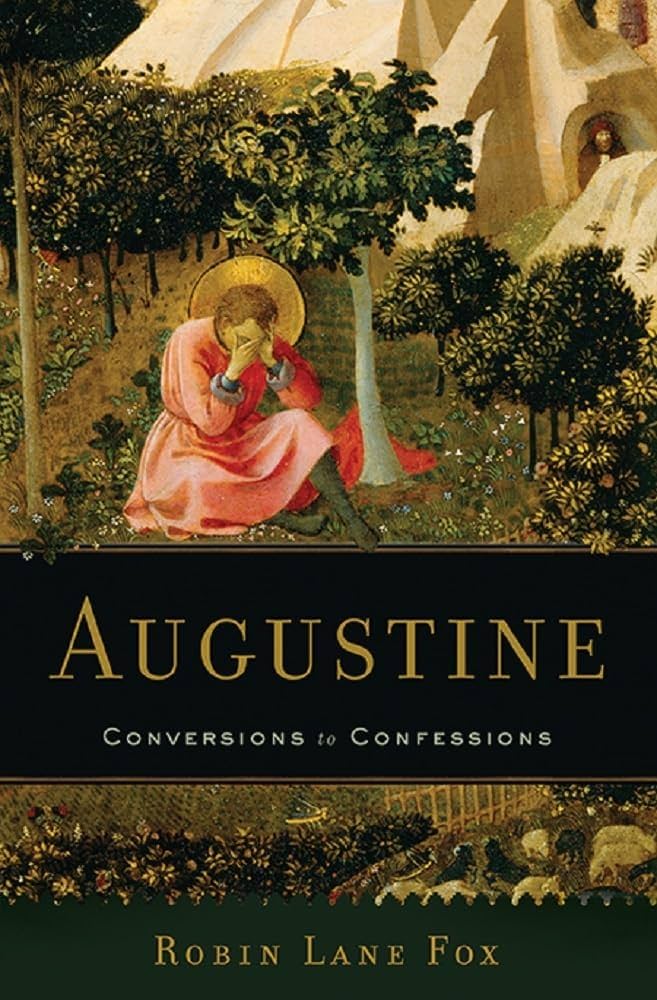
Robin Lane Fox’s Augustine: Conversion to Confessions examines roughly the first half of the great Christian saint’s life, leading up the Augustine’s most famous written work, Confessions.
A Biography of the First “Half” of Augustine’s Life
When I learned a few years ago that the prominent U. K. historian Robin Lane Fox wrote a biography of the first half of Augustine’s life, I took notice. Fox is a classicist and not a professing Christian, so Fox takes a different approach than many other biographers of Augustine. Fox’s book, Augustine: Conversion to Confessions, covers Augustine’s life as a boy, up through the period of his Christian conversion in 386 C.E., to when he wrote his most well known work, Confessions, probably written at the very end of the 4th century. Augustine: Conversion to Confessions has remarkable insights into the life and thinking of the single most influential Christian in the West. This blog post is the first of a two-part series covering this significant part of Augustine’s life.
Fox compares much of Augustine’s early life to that of a contemporary pagan scholar, Libanius, who shared a similar background to that of Augustine. Both Augustine and Libanius received their education in order to become rhetoricians, though Augustine’s conversion to Christianity eventually took him down a different path. Libanius remained a pagan throughout his life, but he was known to be an influential teacher in what we now know as modern day Turkey. The famed Christian preacher, John Chrysostom, was one of Libanius’ students.
Fox also compares Augustine to a fellow Christian and philosopher of his era, Synesius of Cyrene. Synesius, who like Augustine was also from North Africa, in nearby Libya, was popularly chosen to be bishop in Ptolemais, Libya. Synesius’ popularity was such that as bishop he was even granted permission to retain his wife, which even at that stage in Christian history was quite rare, as most bishops in that day were not married.
When it comes to studying the life of Augustine, Peter Brown’s biography of Augustine remains the standard work. But Fox’s Augustine: Conversion to Confessions takes a deep dive into certain areas of Augustine’s thought and life that many biographers of Augustine often skim over.
Augustine’s Early Life
Augustine was born in 354 C.E., in Tagaste, which is now known as Souk Aghras, Algeria. His father, Patricius, was a local Roman official responsible for collecting taxes, though Patricius owned very little property. Patricius was known for his fits of anger, and remained a pagan until he received Christian baptism just prior to his death, when Augustine was still a teenager.
Though raised mostly by his Christian mother, Monnica, Augustine had parted ways with the faith of his mother as a young student in rhetoric. The young Augustine went with some friends to steal pears from a neighbor’s orchard, not because they were hungry, but for the thrill of the sinful adventure. Augustine and his friends nibbled on some of the pears, and then tossed the rest to a group of pigs, a moment that later demonstrated to him the sinful propensity of the human condition.
Monnica was grieved that her son had abandoned his Christian upbringing, but she never stopped praying for him. At one point, he tricked his mother and fled to Italy to become a teacher in rhetoric himself, though Monnica eventually met up with him later in Milan.
Augustine fits the stereotype of a teenager raised by a Christian mother, who rebelled from his childhood training. But God was not finished with Augustine yet!
Like many students who sought to pursue a career in rhetoric, Augustine never officially married, though he took in an unnamed concubine, who bore Augustine a son. The concubine lived with Augustine until their son, Adeodatus, turned thirteen years old. Augustine’s prayer at that point in his life, “Oh God, give me chastity, but not yet,” pretty much summed up his obsession with carnal pleasures, despite the desperate prayers by his mother for his conversion.
It is quite unsettling that Augustine never even divulged the name of his concubine, for whom we have no other record about her life except through what Augustine tells us in his Confessions. To try to further his career as a teacher of rhetoric in Milan, Augustine sought to find a reputable, wealthy wife. So, he sent his concubine away, though he does admit that in sending her back to Africa that he grieved for her, and in that separation he felt “torn from my side.”
His mother, Monnica did help to find him an eligible wife, though Augustine soon learned that the girl was underage. Augustine was thirty, while the girl was perhaps only ten or eleven. Augustine would have to wait several years before they could legally get married. So in the interim, Augustine found yet another adult concubine to enjoy sexual pleasures with.
Augustine the Manichaean
If you want to learn about Augustine’s period as a Manichaean, Fox is a very detailed source (Fox, p. 139ff). Before Augustine’s conversion to historic Christian orthodoxy, and before going to Italy from Africa, Augustine followed the teachings of the 3rd century Persian philosopher, Mani.
Mani grew up among a group of Jewish Christians, what Fox describes as “Baptists.” Mani eventually broke away from the “Baptists,” despising the Jewish elements of his background. He considered himself to be a true Christian, in alignment with Buddha and also the Zoroastrians, upholding a strict vegetarian diet, preaching against the killing and eating of animals, and abstaining from sexual practices. As an aside, the sexual abstinence part of Mani’s message was not something Augustine could honestly embrace.
Manichaeism was loosely based on Christianity, but it had a distinctive dualist framework, pitting good and evil as equal forces in conflict with one another. Mani considered historically orthodox Christians to be “semi-Christian.” In his own teachings, Mani essentially syncretized Christianity with a version of Zoroastrianism, earning disdain from Mani’s fellow Persians. Mani had believed that he himself had received revelation from his heavenly “twin,” based on the “twin” of Jesus’ disciples, Thomas the “twin” (John 11:16).
Mani considered himself to be the true alternative to the Apostle Paul, sending his own version of “the Twelve” across the Roman empire as missionaries. While historically orthodox Christians believed that the “paraclete” of the New Testament was the Holy Spirit, Mani thought of himself as the promised Paraclete.
The Manichee faith continued on after the death of its founder. Manichaeanism flourished for several hundred years, and was just “Christian” enough to earn the disdain of the Roman pagan elite. Roman pagan authorities persecuted the Manichaeans of Augustine’s day, but that did not dissuade the young Augustine.
The ever curious Augustine eventually met Faustus of Mileve, the most prominent bishop of the 4th century within the Manichaean movement. Faustus taught that the New Testament was corrupt, filled with “Jewish” additions that obscured the real message of Jesus. The Manichaeans rejected the Old Testament as divine revelation (Fox, p. 513). There was no incarnation of God through Jesus Christ, nor did Christ suffer on the cross, the latter in particular which was a belief that became part of the teachings of Islam a few centuries after Augustine.
Augustine embraced the Manichee faith, thinking that though he was raised by his Christian mother, that he had somehow discovered what true Christianity was all about, who “had the truth about Christ whose name he had imbibed with his ignorant mother’s milk” (Fox, p. 151). However, Augustine ultimately became disillusioned with Faustus, having questions that Faustus was not able to answer to Augustine’s satisfaction.
Augustine Meets Ambrose
While in Milan, the prayers of his mother were eventually answered, albeit very slowly. Through Monnica’s encouragement, Augustine encountered the Christian preaching of Ambrose of Milan, and it changed his life. As a Manichaean, Augustine wrestled with Genesis 1:26, which teaches that humans were created in God’s image and likeness. Did this mean that God was shaped like a man, as the Manichaeans taught? This idea is not that much different from what 19th century Mormonism taught, and still is taught in various Mormon circles today.
For Augustine, he viewed this kind of anthropomorphism as ridiculous, but he pretty much assumed that this is what historically orthodox Christians believed. Listening to sermons given by Ambrose helped him to see that there were more sophisticated ways of reading such passages of the Bible. According to Ambrose, the “image and likeness of God” was about the human soul, and not some crass literalism about the physical body.
Ambrose also taught that Genesis 1 was specifically about the creation of the soul, whereas Genesis 2 was about the creation of the body (Fox, p. 282). While Ambrose probably assumed that the age of the earth was relatively young, as most everyone who believed in creation ex nihilo thought in the 4th century, he would not make for a typical “Young Earth Creationist” today. Long before Charles Darwin ever came along, Ambrose apparently recognized some of the difficulties in trying to harmonize Genesis 1 and Genesis 2, difficulties which are often obscured by even the best of today’s English bible translations.
Ambrose was an advocate for allegorical readings of the biblical text when the need called for it. Apparently, according to Ambrose, there were ample instances where such a need seemed to be required. For example, whenever one encountered differences in the Gospels, Ambrose taught that it was right to look for an underlying harmony, instead of trying to resolve discrepancies at the surface level (Fox, p 270). While such allegorical readings are often dismissed today in various circles, including both historical critical scholarship and among very conservative Christians, the approach of Ambrose was something that helped Augustine get past what he thought were the rather crude aspects of the Bible. Augustine’s spiritual journey at this point was primarily intellectual, and the teaching of Ambrose assisted him to get past the barriers erected by his adoption of Manichaean philosophy. Many Bible scholars today would be scandalized by Ambrose’s broad appeal to allegory, but for Augustine it was a bridge to help him get through his doubts as a Manichaean about the Bible.
The Source of Ambrose’s Allegorical Reading of Scripture
As a digression, it is worth considering where Ambrose got his allegorical interpretation of the Bible from, which impressed Augustine so much. Like many other thoughtful Christians of his day, Ambrose got his allegorical method of reading of Scripture from the early 3rd century Alexandrian Christian, Origen.
Origen, one of the most talented thinkers of his day, wrestled with what he thought were discrepancies in the Gospels which were difficult, if not near impossible to resolve or harmonize. Origen wrote:
There are many other points on which the careful student of the Gospels will find that their narratives do not agree; and these we shall place before the reader, according to our power, as they occur. The student, staggered at the consideration of these things, will either renounce the attempt to find all the Gospels true, and not venturing to conclude that all our information about our Lord is untrustworthy, will choose at random one of them to be his guide; or he will accept the four, and will consider that their truth is not to be sought for in the outward and material letter.” Commentary on John (10.2)
Origen preferred the latter method, what might be called the “inward” or “immaterial” letter of the Gospels, in order to work through how best to interpret difficulties in the Gospels. Some have suggested that Origen’s view of the “inerrancy” of the Bible pertained to this spiritual meaning, as opposed to a kind of strict literalism.
A good example of Origen’s thinking popped up recently as I was reading John 1:28, which discusses where Jesus early in his public ministry met up with John the Baptist, who had set up his ministry headquarters, near the Jordan River. John the Baptist was baptizing people there, and many traveled from far off to hear the preaching of the Baptist. In the text, most Bible translations read that “These things took place in Bethany across the Jordan, where John was baptizing.”
The problem here, as Origen noted his Commentary on John, Book VI, 24, is that there is no “Bethany” located “across the Jordan.” Many were traveling from Jerusalem or Galilee, which both are on the west side of the Jordan, in order to be baptized by John. But as Origen learned from a trip to Israel himself, the only “Bethany” is on the west side of the Jordan, near Jerusalem, and not on the east; that is, “across the Jordan.”
Scholars have noted, just as Origen did, that there are various spellings for “Bethany,” as there was not a uniform standard for spelling place names in the world of ancient Israel. Origen preferred a somewhat obscure manuscript of John’s Gospel, which has the name of the area/town in John 1:28 as “Bethabara” instead of “Bethany,” which is preserved in the KJV translation of the verse.
Origen understood the word “Bethabara” to mean “house of preparation” whereas “Bethany” meant “house of obedience.” Bethany was the location of Jesus’ last great miracle in John’s Gospel, the raising of Lazarus (John 11), prior to the passion of the Christ. In Origen’s allegorical method of interpretation, the Gospel of John is associating the beginning of Jesus’ ministry, with John the Baptist, as the “house of preparation” culminating in the final great act of Jesus’ public ministry (prior to Christ’s own death and resurrection) at the “house of obedience.”
Most conservative scholars today have an allergy to Origen’s solution, suggesting that some other spelling similar to “Bethany” is a reference to the area/town where John the Baptist was headquartered, a place which is now lost. For example, D.A. Carson links this “Bethany” to a close spelling of “Batanea,” which in the Old Testament is named or spelled “Bashan,” which is an area “across the Jordan,” though the exact borders of the region of “Bashan” is subject to some debate. In modern times, the area associated with “Bashan,” or least one part of it, is known as the Golan Heights.
But Origen seemed pretty satisfied with his allegorical reading, an approach which fit also in the mind of Ambrose, which in turn enamored Augustine. While many contemporary scholars chafe at the prospect of overzealous allegorical interpretations of Scripture, neither Origen, nor Ambrose, nor Augustine had twenty centuries of academic reflection on biblical interpretation behind them to give them other choices, in the face of understanding difficult passages of Scripture.
What is interesting here, yet not addressed by Robin Lane Fox, is that Augustine later on in his life tended to shy away from Origen’s allegorical approach to so-called “Bible discrepancies.” But that is another topic for another time, so we can get return back to the story which leads to Augustine’s eventual spiritual conversion to Christ.
Augustine’s Philosophical Conversion to Christianity (But Not Yet Spiritual)
Nevertheless, in many ways Augustine was still not yet a converted Christian. Augustine discovered the writings of Plotinius through a Milanese friend, Theodorus. Plotinus was a 3rd century Egyptian philosopher who took great interest in the writings of the famous ancient Greek philosopher Plato. Plotinus has been thought to be the founder of the school of Neo-Platonism, and Augustine was attracted to the Neo-Platonist school and saw how Christianity could be understood as sympathetically compatible.
As an influential philosopher, Plotinus taught Porphyry, another pagan and ironically a late 3rd century skeptic of Christianity. Augustine also read Porphyry. Yet it was in reading Plotinus where Augustine was able to find a way to marry together philosophy and Christianity, to discover a way “inwards and upwards” to God.
Fox reports that Augustine fashioned his own history to show how the Bible gave rise to the best of Greek philosophy, largely based on sermons he heard Ambrose preached. For Ambrose and therefore Augustine, in Egypt Pythagoras learned the one true wisdom from the biblical prophet, Jeremiah. Pythagoras then shared this “hidden wisdom” with Plato. Christianity therefore gives the world the one true philosophy, despite the fact that Pythagoras probably never knew Jeremiah (Fox, p. 359ff).
Nevertheless, despite Augustine’s philosophical conversion, there was still one area where Augustine was still caught in his own inner turmoil, and that was in his addiction to sex. “Sex was the ‘tightest chain’ by which he was bound” (Fox, p. 369). He had his new concubine, but to sustain and legitimize his career, he needed to get married into the reasonably wealthy family of his very young fiance, so his sexual habits were complicated by the ambitious pursuit of that career. All of these areas of Augustine’s life were intertwined with one another.
When he had sent away his long time, previous concubine, the one who gave Augustine his son, the woman had pledged never to have sexual relations with any man again. Augustine wondered whether he should pursue that same path of celibacy as well. His situation was further complicated due to an illness in his chest which affected his speaking voice, a professional liability as a rhetorician.
Augustine had read passages in the New Testament, like Paul’s encouragement for celibacy among those who could stand for it in 1 Corinthians 7, as well as reading in Matthew 19:12 about those who became “eunuchs for the kingdom of heaven.” Some of Ambrose’ preaching also lauded the celibate life. But it could also be argued that Augustine appreciated the sexual ideal of his experience in Manichaeism, whereby elders of the Manichaean movement advocated for abstinence from sex as spiritually superior. Eventually, Augustine became convinced that bodily passion and sexual pleasure pulled the soul away from God, and it was God whom Augustine ultimately wanted.
It could fairly be said that Augustine was a sex addict, and his insatiable lusts were that final impediment to his ultimate conversion to Christianity. Augustine had read his own personal struggle into Romans 7:22-25, originally believing that Paul was writing about what it was like to wrestle with sin prior to becoming a Christian. Paul felt “led captive by the law of sin which was in my members” (Fox, p. 388ff).
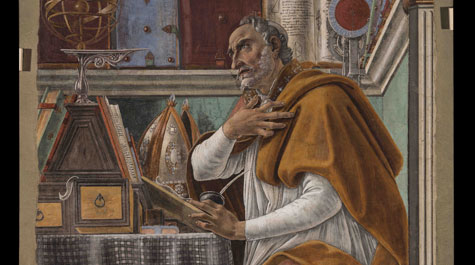
Sandro Botticelli, Sant’ Agostino nello studio (Saint Augustine in the studio), Fresco, Chiesa di San Salvatore in Ognissanti, Florence.
“Tolle Lege” : Augustine Converts to Christianity (Spiritually)
But unlike his view as a Manichaean, which stressed this cosmic battle between essentially two equally opposing forces of good and evil, Augustine was now wrestling “between two wills which weakened one another” (Fox, p. 389). It was at this juncture whereby Augustine had a mystical experience. He found himself one day weeping in a garden. He then heard a voice of a child coming from the other side of the garden wall saying, “tolle lege, tolle lege.” Augustine understood those words to mean “pick up and read.” He then picked up and read a Bible passage that he immediately turned to, which was Romans 13:13-14.
Let us walk properly as in the daytime, not in orgies and drunkenness, not in sexual immorality and sensuality, not in quarreling and jealousy. But put on the Lord Jesus Christ, and make no provision for the flesh, to gratify its desires (ESV).
This was the turning point in Augustine’s life. Hereafter, Augustine would resolve to live a celibate life, and totally dedicate himself to God. He sent away his fairly newly acquired concubine as well as reneging on his decision to take on his promised young bride. Augustine was 31-years old at his conversion.
He was also turning his back on worldly ambition, prompted by his illness which kept him from public speaking as a rhetorician. From then on, Augustine would withdraw with a group of like-minded Christians to form an intentional Christian community, in pursuit of true philosophy. His mother Monnica, and Augustine’s son, Adeodatus, joined him.
Augustine’s health eventually recovered. He also came forward to be catechized, and then Augustine was baptized by Ambrose. Civil unrest in that part of Italy soon prompted Augustine and his party to move south, away from Milan and closer to Rome. They were in the port city of Ostia, where Augustine planned to move back to North Africa. But before his group was able to depart, his mother Monnica became sick and died.
Augustine’s mother had ambitions for her son’s life, when it came to his career. Such worldly ambitions were not to be realized. But that was not what mattered the most. Monnica’s prayers for her son’s conversion to Christ had been answered. But the death of his mother left a hole in his life.
Augustine’s move back to North Africa was delayed by more civil unrest, so Augustine’s remaining party stayed in Rome. With his mother gone, Augustine believed in the need to create a monastic community, the origin of the Augustinian order, which centuries later would play a pivotal role in the reformer Martin Luther’s life.
Augustine’s commitment to celibacy was personal. According to Fox, Augustine still affirmed the benefits of marriage and sex, despite the fact that modern interpreters of Augustine often see him as viewing sex as being inherently sinful, as though Augustine was an “implacable ‘enemy of sex‘” (Fox, p. 506). Marriage was still part of God’s good design, but it just was not the path for Augustine.
Unlike other interpreters of Augustine, Fox also believes that Augustine’s views of original sin started to come together during his time in Rome. Augustine sought to resolve the question as to why infants needed to be baptized. Fox acknowledges that the language of “original sin” did not start with Augustine. Others before him, like Cyprian, also discussed original sin (Fox, p. 510ff). At this early stage in his theological development, Augustine probably viewed original sin as a disposition towards sin, as opposed to a necessity (Fox, p. 511).
Original sin was part of human free choice (Fox, p. 597). Yet as Augustine’s views of original sin began to mature, especially in his later years with his polemics against Pelagius, he recognized that this choice for sin is something which all humans inevitably choose (Fox, p. 67). For much of Augustine’s Christian life, at least at the earlier stages, he took the view common among other Christian thinkers that original sin was something that all inherit from Adam, which could rightly be described as “inherited sin.” Nevertheless, it was in his later years that Augustine moved beyond that, as he eventually considered babies to be “guilty” of Adam’s original sin. (Fox, p. 110).
Augustine Returns to North Africa: Debating the Donatists
Augustine returned to Tagaste in North Africa, where he could build his monastic community, when tragedy struck him once again. He had lost his mother, Monnica, back in Italy. Now it was his son, Adeodatus, who unexpectedly died, at age 17. Losing the two was not simply a family tragedy. The double loss was compounded by the fact that both his mother and his son were spiritually and intellectually partners and friends in his quest for authentic Christian spirituality.
Meanwhile, the schism caused by the Donatist sect was dividing the church in North Africa. The Donatists, named after the popular bishop in Carthage identified with the movement, were Christians who only accepted the sacraments administered by priests who had not succumbed to pressures brought on by the “Great Persecution,” instigated by Emperor Diocletian early in the 4th century. Other “Catholic” Christians were willing to forgive those priests who had compromised their faith during the persecutions, assuming those priests had demonstrated remorse and contrition for their failures. For these Christians, the reception of the sacraments were not diminished by the purity status, or the lack thereof, of the priest who administered them.
The Donatists, on the other hand, were purists. They refused to acknowledge baptisms administered by whom they thought were compromising priests. In Augustine’s North Africa, the Donatists outnumbered the Catholics. In Hippo, the bishop there, Valerius, had heard of Augustine’s rhetorical capabilities in service of the Catholic cause against the Donatists and the Manichaeans, as in Italy his mentor Ambrose opposed both the Donatists and the Manichaeans. Valerius saw in Augustine a talent that could be used to address heresy and call distracted Christians back to the historic orthodox faith. Valerius hatched a plan to force Augustine into the role of a great Christian apologist.
Towards the end of the 4th century, Christianity was emerging as the dominant faith in the Roman Empire. But heresies were threatening to unravel the Christian movement. Beleaguered by the Donatist faction, Valerius sought to make Augustine a priest when the latter came to Hippo for a visit. Augustine had not sought the position out, as he felt compelled to focus on building a monastic community.
Augustine asked Valerius, “Are you ordering me to die Valerius?” (Fox, p. 571). Nevertheless, Augustine survived this crisis, becoming a priest, while still seeking to build a kind of monastic community. In Augustine’s sermons, he put his rhetorical skill at work to push back against both schismatic movements, the Donatist and the Manichaeans.
His big opportunity came when Augustine met an apologist for Manichaeism, Fortunatus, in a public bath house for a debate. Fortunatus argued for a cosmology of dualism, whereby the entire material universe is evil by its very substance, and opposed to goodness. Humans sin out of necessity. But Augustine argued differently, saying that God created creation to be good, but that the human soul has the freedom of choice. Nevertheless, the human soul will often choose badly (Fox, 597). Though Fortunatus was a formidable opponent, Augustine’s skill as a orator won many admirers. Fortunatus was left embarrassed by the debate, and soon left Hippo.
Augustine’s reputation excelled as he engaged Manicheans and Donatists alike. Augustine had become one of the most prolific defenders of historic Christian orthodoxy. Much of what we know about Augustine, outside of his books and sermons, is from the correspondence he maintained with other Christian leaders of his day. For example, though the two never met personally, Augustine began a friendly correspondence with Paulinus, a bishop of Rome, who helped to disseminate Augustine’s writings all across Europe. Even in his own day, Augustine had become a force to be reckoned with.
By now, Augustine was just beginning to hit his stride as a Christian leader and intellectual. What would come next for Augustine? Stay tuned to part two, the last part of this series reviewing Robin Lane Fox’s Augustine: Conversions to Confessions.




 Veracity
What do you think?