
I have been in the middle of reading Jared Ortiz and Daniel Keating’s book, The Nicene Creed : A Scriptural, Historical, and Theological Commentary, in honor of the 1700th anniversary of the Nicene Creed, and I ran across the following insight from Saint Augustine about his rationale for infant baptism. A lot of Christians have thought that Augustine encouraged infant baptism merely as a means of trying to save a baby from original sin. But his actual comments on baptism are more thoughtful than that, and are worth quoting in full:
To believe, however, is nothing else than to have faith. And for this reason when the answer is given that the little one believes, though he does not yet have the disposition of faith, the answer is given that he has faith on account of the sacrament of the faith and that he is converted to the Lord on account of the sacramentof conversion, because the response itself also pertains to the celebration of the sacrament. In the same way the apostle says of baptism, We were buried together with Christ through baptism into death (Rom. 6:4). He did not say, “We signified burial,” but, “We were buried.” He, therefore, called the sacrament of so great a reality by the word for the same reality.
And so, even if that faith that is found in the will of believers does not make a little one a believer, the sacrament of the faith itself, nonetheless, now does so. For, just as the response is given that the little one believes, he is also in that sense called a believer, not because he assents to the reality with his mind, but because he receives the sacrament of that reality. But when a human being begins to think, he will not repeat the sacrament, but will understand it and will also conform himself to its truth by the agreement of his will. As long as he cannot do this, the sacrament will serve for his protection against the enemy powers, and it will be so effective that, if he leaves this life before attaining the use of reason, he will by this help for Christians be set free from that condemnation which entered the world through one man, since the love of the Church commends him through the sacrament itself (Augustine, Letter 98.9–10, in Letters 1–99, ed. Roland Teske, WSA II/1 (Hyde Park, NY: New City, 2001), 431–32).
I have had to meditate on it, but I think this best explains what this great African bishop of the late 4th / early 5th century was trying to communicate: There is no such things as “self-baptism” in the Bible. No one baptizes themselves. You must be baptized by someone else.
The same can be said about salvation. We can not save ourselves. Only God can save. God saves by the gift of his grace, and we can not save ourselves by our religious works.
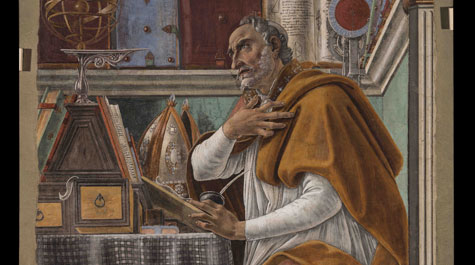
Sandro Botticelli, Sant’ Agostino nello studio (Saint Augustine in the studio), Fresco, Chiesa di San Salvatore in Ognissanti, Florence.
The Sacrament of Baptism: What Baptism Does Is a Mystery
Augustine sees in this the mystery of what makes the notion of sacrament so powerful in Christian theology. As Augustine reads Paul in Romans 6:4, baptism actually does something, despite the fact that Paul does not go into extensive detail about it. Baptism is not merely a symbol. It pertains to a reality that goes beyond what our feeble minds can grasp.
There is no prooftext that says “baptism is a sacrament,” but historically this is how those like Augustine understood baptism. The English word “sacrament” is derived from the Latin sacramentum, which is a translation of the Greek word mysterion, from which we get the English word mystery. There are several concepts, like baptism, which Christian theologians have described as a mystery, explaining why those like Augustine thought of baptism as a sacrament.
Like many other advocates of infant baptism, Augustine considered baptism to be the New Testament counterpart to the Old Testament’s insistence on circumcision as the primary identity marker for being an Israelite. As male infants were circumcised in ancient Israel, so are male and now female infants baptized as Christians. See Galatians 3:27-28:
For as many of you as were baptized into Christ have put on Christ.There is neither Jew nor Greek, there is neither slave nor free, there is no male and female, for you are all one in Christ Jesus.
A sacrament like baptism enacts reality for us. I got this idea of enactment from a book by Thomas Howard, the brother of the famous missionary Elisabeth Elliot, On Being Catholic. But the point is that the sacrament of baptism enacts the reality that only God can save the human being, and it is Augustine’s contention that baptism can in this sense “save” the infant, when they are not yet at the stage whereby they can exercise reason, and rationally comprehend ideas like “salvation by grace,” etc. Instead the infant can experience it through the act of baptism.
It is hard for us modern people living in the West to appreciate the impact Augustine’s theology has had over the long history of the Christian movement. Throughout most of human history, the infant mortality rate has been extremely high as compared to what the typical American family experiences in the 21st century. Even if you lived in the early 19th century in the United States, and in many parts of the world developing world today, there was/is a high probability that your child would not survive infancy. Yet today in much of the West, due to the benefits of modern medicine, the opposite is the case. Now, it is relatively rare for a child to die in infancy (though, obviously, it still happens tragically).
The Augustinian idea that baptism is connected to the salvation of the infant can bring great comfort to a mother and father grieved to the loss of a child, knowing that their deceased child is with the Lord. The same can be said for a family with a child (or even a young adult) that is mentally and/or emotionally challenged in some way, where the young person lacks the cognitive abilities to adequately grasp even basic concepts of Christian theology.
Augustine has not been without his critics. Many proponents of credobaptism; that is, the teaching that only a believer’s baptism is a valid form of baptism, and that infant baptism (otherwise known as paedobaptism) is not to be practiced, typically reject Augustine on this point. In other words, someone needs to demonstrate that they have genuinely come to know and believe in Jesus before they would be eligible for baptism, not after. They would generally argue that Augustine’s belief that infant baptism can wash away the taint of original sin makes baptism into a kind of work which actually undermines the theology of grace.
Instead, many credobaptists adopt the practice of “baby dedication” (some call it “family dedication,” “parent dedication,” “baby thanksgiving,” or something along those lines), whereby a pastor of the local church will publicly pray with a family that comes forward with their newborn, dedicating themselves to raise the child in a Christian home, and asking the congregation to join the parents in helping to raise the child in a discipling, Christian community, in the hope that when that child is old enough to exercise human reason the child might come to confess faith in Jesus, and then at some point become baptized (believer’s baptism) as an act of Christian obedience.
This has become standard practice in much of the world of American megachurch evangelical Christianity. It has become like a half-way mediating solution between credobaptism and paedobaptism, with respect to infant children. It has only become a common feature in American evangelical Christianity for about a hundred years or so (though how far back the practice actually goes is highly debated).
The problem is that such “baby dedication” is not the same as infant baptism. For if a child who has been a part of a “baby dedication” and not infant baptism then dies still in infancy, this could create (and indeed has created) a theological crisis for the parents in their grief. For what comfort would such parents have about the eternal destiny of their child?
Perhaps such parents could reimagine “baby dedication” to be somehow efficacious in the same way as infant baptism, but that would probably take a lot of theological creativity on the part of the parents, and probably more that one session of grief meeting with a church pastor to work things out.
Some hold to a doctrine of baptismal regeneration, which suggests that infant baptism actually saves the infant, and that this act of baptism somehow suggests an irrevocable salvation status regarding baptism. There are bunch of good debates on YouTube about baptismal regeneration, though I would recommend this conversation between Baptist apologist Gavin Ortlund and Roman Catholic apologist to be among one of the more helpful discussions.
Confusion About Infant Baptism
Most evangelical Christians reject such a theology of baptismal regeneration, as it can confuse a person, leading someone who has been baptized as an infant to wrongly believe that since they were baptized as an infant, this somehow gives them an irrevocable ticket to heaven. Some then rationalize that they can live a life completely contrary to any Christian commitment, and still be somehow “OK” with God. Again, this makes the sacrament of baptism into a kind of work, an example of “works-righteousness” which is completely contrary to a right-minded understanding of the Gospel.
However, it would be good to note that not every tradition commonly associated with “baptismal regeneration” accepts this irrevocable understanding of infant baptism. Eastern Orthodox priest Stephen De Young, in his incredibly helpful book The Religion of the Apostles: Orthodox Christianity in the First Century, (read my four-part review of De Young’s theologically and yet remarkably accessible book), might surprise Protestant evangelicals regarding what is entailed in an Eastern Orthodox understanding of baptism, including infant baptism.
“Saint Paul goes to great pains in 1 Corinthians 10 to argue that baptism does not necessarily entail salvation (1 Cor. 10:1–6)” (De Young, p. 163).
This passage talks about Old Testament Israelites being “baptized into Moses,” through the passing through the Red Sea, and the experience under the cloud in the Wilderness, but that most of them did not survive to make it into the Promised Land, due to disobedience.
In other words, infant baptism is not an irrevocable indication of someone’s status regarding salvation. For a person baptized as an infant, that person must still reason through and reflect on the meaning of their baptism, in order to make good on it, which appears to be consistent with what Augustine says as quoted above.
Augustine would reject the idea of getting re-baptized, something that a lot of evangelical Christians tend to do; that is, despite having been baptized as an infant (if they were), they go on and go through a “believer’s baptism” now that they finally understand what it means to be a real Christian. For Augustine, such re-baptism would be a needless attempt to “repeat the sacrament,” and completely miss the reality of what the sacrament is in the first place.
Needless to say, sacramental theology is still very much highly controversial in our churches today, whether it be about baptism, or the Lord’s Supper, or other matters related to the concept of sacrament. Some churches reject the language of “sacrament” altogether, preferring to categorize baptism as an “ordinance,” as opposed to being a “sacrament.” Some local churches try to take an “agree-to-disagree” posture regarding the credobaptism versus paedobaptism controversy, but they do so with mixed success.
Navigating Baptism as a Second-Rank Doctrine
However, most Protestant evangelical churches either go one way or the other, either they baptize infants or they do not. There is no middle ground, but rarely do churches split over the baptism issue nowadays. Many just try to muddle through the controversy somehow. But at least someone visiting the church will eventually figure out where that church lands on the issue. In his wonderful book, Finding the Right Hills to Die On, theologian Gavin Ortlund, reviewed here on Veracity a few years ago, argues that when navigating theological issues which divide churches, one must do what he calls “theological triage,” ranking different issues into four distinct categories:
- first-rank issues: some doctrines are essential to properly defend and proclaim the Gospel. Ortlund puts something like the doctrine of the Virgin Birth in this category. For without a belief in the Virgin Birth of Jesus, our understanding of the Gospel is at stake.
- second-rank issues: some doctrines are not essential to the Gospel, but they are urgent issues, in that they can and often do have an impact in how a church practices its mission. For these doctrines can lead to “divisiveness, confusion, and violations of conscience” (Ortlund, p. 95). Two common examples include (1) whether to allow certain charismatic gifts, like speaking in tongues and prophecy, to be publicly displayed during a worship service, and (2) whether to have women serve as elders in a local church (the so-called “complementarian” verse “egalitarian” issue).
- third-rank issues: some doctrines are not essential to the Gospel, but are nevertheless still important issues to resolve. Nevertheless, Christians with different convictions in good faith can still participate in such a local church, while taking an “agree to disagree” posture. Two common examples include (1) different understandings of the age of the earth, and (2) different understandings of the “End Times” regarding the millennium and the rapture of the church.
- fourth-rank issues: some doctrines are not essential to the Gospel, and they not important in terms of how Christians in a local church can work together to accomplish Gospel mission.
My classic example of a fourth-rank issue comes from a conversation I have had with a pastor friend of mine. He is convinced that the Apostle Paul wrote the so-called “prison letters”, like Ephesians, Colossians, and Philemon from a jail in Rome. I believe Paul wrote these letters from a prison cell in Ephesus.
How many people really care about where Paul wrote these letters from? Aside from a few Bible nerds like me, basically no one!!
Interestingly, Gavin Ortlund adds the doctrine of baptism as a common third example of a second-rank issue. Ortlund himself grew up in a church that practiced infant baptism, but when he took to studying the issue in-depth, he came to the conclusion that infant baptism was an improper form of baptism, and thus became a credo-baptist. Nevertheless, Ortlund looks to Saint Augustine, perhaps the most influential proponent of infant baptism in the history of Christianity, as one of his greatest theological heroes!!
Augustine has surely been the most influential Christian theologian in the Christian West, outside of the Bible itself, but Christians will still chafe against some of the theological positions he took hundreds of years ago. One may still reject the validity of infant baptism, as many evangelical Christians emphatically still do, but the purpose of this blog post has been to aid in having a more informed understanding of what infant baptism, as classically understood by Saint Augustine, actually is, and what it is not.



 Veracity