
It is said that the Book of Leviticus is where Bible reading plans typically die. You start off reading Genesis and then Exodus, as they are filled with compelling narratives. True, reading the genealogies can be slow going and the precise details about the tabernacle in Exodus can drag along. But the next book in order, Leviticus, is where people often get stuck and give up: Page after page of offering procedures and bloody sacrifices with bulls and goats. Not only does it seem repetitive, it sounds downright gross to modern readers.
Let us be honest. Leviticus can be a real sleeper….. ZZZZZZZZZ……
I have read through Leviticus several times, but I must confess that I have tended to skim read it. As a Christian, it is very easy to be dismissive of Leviticus, with all of its gory details, and multiple uncomfortable references to blood and semen. After all, the atoning work of Jesus on the cross has made the Levitical sacrificial system unnecessary. Jesus took care of everything. Next topic, please!
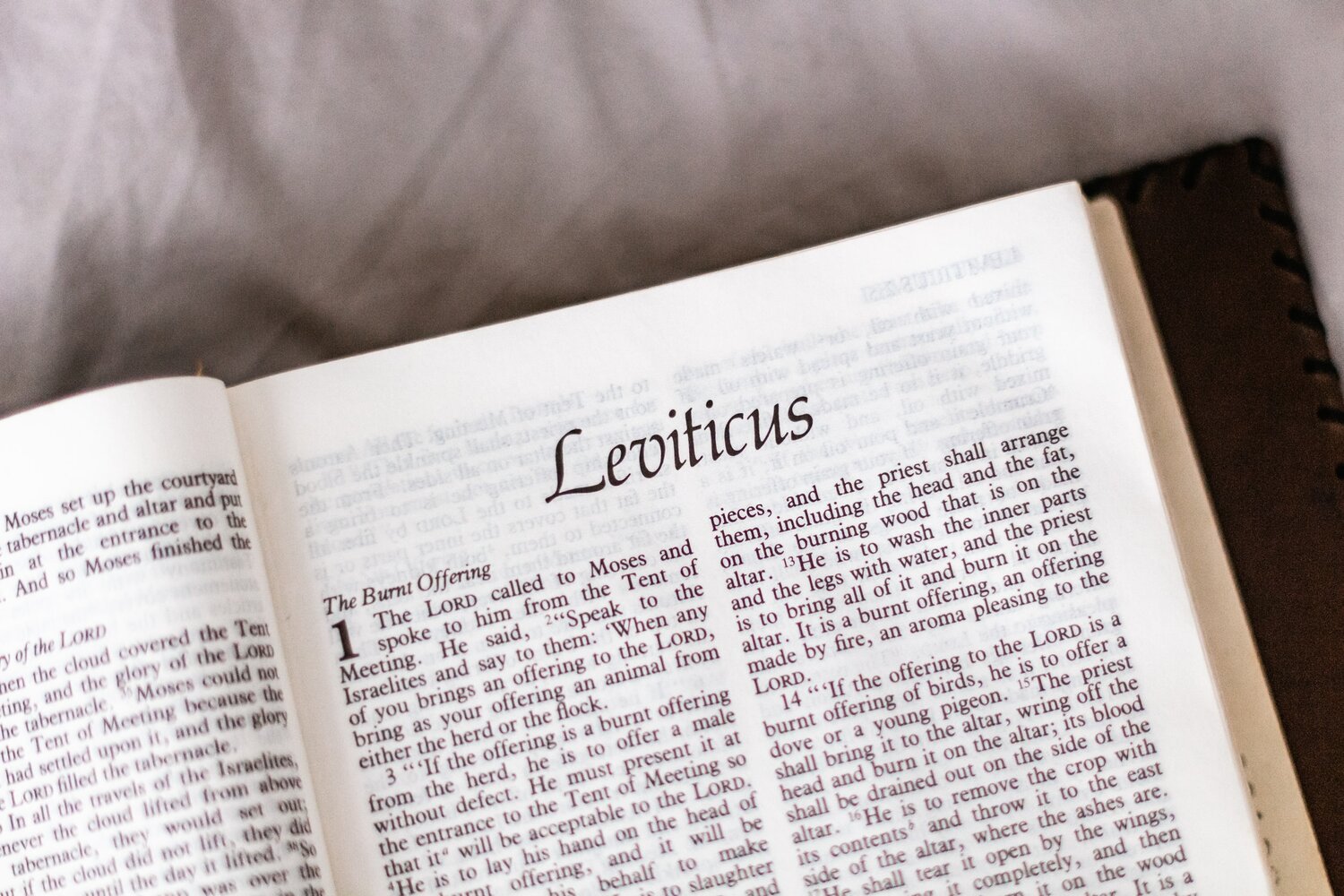
On the late Michael Heiser’s Naked Bible Podcast, this Old Testament scholar brings out important highlights, accessible to everyday Christians, who want to have a better grasp on Leviticus, one of the least studied, least understood, and least read books in the Old Testament.
Diving Into Leviticus…. and Really Learning Something!
Unfortunately, this all too common attitude towards Leviticus robs us from having a better understanding as to what the Levitical system was all about, according to the late Dr. Michael Heiser, an evangelical Old Testament scholar who has been very popular on YouTube, who sadly died of cancer in 2023. For Michael Heiser, it is very tempting to simply read Leviticus through the New Testament lens of Jesus’ atoning work on the cross, and conclude that Leviticus has no more relevance for the New Testament Christian. This would be a mistake.
Michael Heiser, on the other hand, wants us to get the ancient Israelite way of thinking into our heads. By understanding what Leviticus meant in its original context, we get a better sense of how the death of Jesus on the cross actually works for the Christian believer. Early on in his Naked Bible Podcast series, Heiser did a detailed study of Leviticus where the book simply came alive to me for the first time (A YouTube audio version is found here, in three parts: #1, #2, #3). This Naked Bible Podcast book study was transcribed and released in book form as Notes on Leviticus: From the Naked Bible Podcast.
Wow. Was I missing a lot of powerful stuff when I basically did a skim read of Leviticus!!
There is so much here, that I added two additional blog posts (the second, and the third) to this current exploration of Leviticus, following Michael Heiser’s Notes on Leviticus: From the Naked Bible Podcast.
One mistake that Christians often make about Leviticus is in thinking that the Levitical system is all about the atonement for sin, for the ancient Israelites. Unfortunately, this assumption is simply not true. While there is quite a bit in Leviticus about atoning for sin, there are a lot of details about offerings and sacrifices that have nothing to do with dealing with sin.
Atonement: Clean Versus Unclean?
If you are a bit skeptical, as I was when I first read Heiser, then consider Leviticus 8:15. There we have the altar being cleansed and “atoned” for. But it would be really odd to conclude that the altar had somehow “sinned” and that this required the altar to be atoned for in some way. Human beings sin but inanimate objects do not.
Heiser observes that the Hebrew word for “atonement” has a broad range of possible meanings, but that in general, atonement had to do with “purging,” or “decontamination.” Sin can indeed contaminate something, but ritual impurity could also contaminate, creating a situation which required a purging and/or decontamination, without necessarily implying some moral quality to it. This explains why inanimate objects, like an altar, or even walls on a house becoming infected with some type of mold or mildew (see Leviticus 14:33-53), can become ritually unclean, thereby requiring atonement in order to decontaminate the object.
Another set of verses right next to one another illustrates how confusing this can be:
“You shall not approach a woman to uncover her nakedness while she is in her menstrual uncleanness. And you shall not lie sexually with your neighbor’s wife and so make yourself unclean with her” (Leviticus 18:19-20 ESV)
The second verse seems pretty straight forward in condemning adultery as sin. But what about the first verse? If a husband has sexual relations with his wife, while she is having her period, is this really a sin? Both verses talk about being “unclean.” So, what on earth is going on here?
Unlocking Leviticus: The Concept of Sacred Space
Heiser brings out the best of modern scholarship to observe that Leviticus makes an important distinction between moral purity and ritual purity. The former addresses what we would call “sin.” The latter deals with what an Israelite needed to do before entering “sacred space.” But the latter was not meant to deal with any particular sin, or sin in general. The tabernacle in the wilderness, and later with the temple in Jerusalem, was considered to be the sacred space where God dwells with his people. Because God was a holy God, it would be a dangerous affair to try to enter sacred space if one possessed ritual impurity.
This concept of “sacred space” can be a difficult idea to grasp for many modern, evangelically-minded Christians. The idea that one needs to be fit in order to enter sacred space saturates the thought world presented in the Book of Leviticus. You can get a sense of this in certain liturgical, historically-conscious Christian traditions, such as when one visits some of the great Christian cathedrals in Europe. The awe inspiring architecture of these majestic buildings, which rise above the neighboring landscape in many European towns and cities, is meant to draw a distinction between that which is common, normal everyday space, and the sacred space of entering a house of prayer and worship. Men are encouraged to take off their hats when entering a great Christian cathedral and women are discouraged from wearing skirts that are too short. Why? Because entering a worship area like this was designed to mirror what it might have been like for an Israelite to approach the sacred space of the tabernacle or the temple.
This is quite a different feel from entering many contemporary evangelical churches today, where people typically think of a church building as not much different from any other ordinary building, where people feel the casual freedom to bring their mugs of coffee into the worship room, something which still seems awkward to do when entering a great European church cathedral. Granted, things like whether or not to wear shorts to a church worship service are more about cultural concerns and not Scriptural concerns.
Still, having a sense of how we present ourselves in a worship setting can help the Christian to somehow imagine how it might have felt for Moses to approach the burning bush, where a voice beckons from the bush: “Moses… Do not come near; take your sandals off your feet, for the place on which you are standing is holy ground” (Exodus 3:4-6). If someone can capture this idea of “sacred space” in their mind, it can greatly aid in one’s understanding of something so foreign as the Book of Leviticus.
Like the concept of “sacred space,” ritual impurity is a conceptually intricate category which seems very foreign to modern peoples today, having to do with such things as reproductive fluids, like blood, which symbolizes life. So if a woman gave birth to a child, she would become ritually impure. For another example, in certain cases if you touched a dead person, that would make you ritually impure. Back to Leviticus 18:19, a woman in menstruation, as explained in further detail in Leviticus 15:19-24 where there is a release of blood, is in a ritually impure condition. Because the Old Testament taught respect for life, you could not bring death into God’s sacred space. In all of these examples, Leviticus provides a way of cleansing so that a person can become pure again, in the ritual sense.
But what is important to emphasize is that ritual impurity per se has nothing to do with a person’s sin. Giving birth to a child (Leviticus 12:1-8), a menstrual cycle, or touching a dead person (Numbers 19:10-22) are simply things that are part of normal human experience. Furthermore, having a certain kind of skin disease (Leviticus 13:1-14:32) can also make someone ritually unclean, but having a skin disease does not necessarily imply sin. None of these events describe any particular sin committed by a person at all. Nevertheless, one can not enter sacred space where God dwells without becoming ritually clean.
The closest thing relevant to contemporary life might be the taboo against eating food inside a restroom. Even modern people think that such activity would be regarded as unclean. In my mind at least, that does sound a bit gross. Likewise, the Levitical system in ancient Israel had serious concerns about ritual uncleanliness when someone sought to enter God’s presence, his sacred space, in the tabernacle (or later on in the Jerusalem temple).

Michael Heiser. Semitic languages and Old Testament scholar. Teacher on the Naked Bible Podcast.
The Sacrifices/Offerings of Leviticus
The first few chapters of Leviticus describe different types of offerings, or what some call “sacrifices.” Leviticus 1 discusses the burnt offering, which Heiser describes as a gift offering to the Lord, very similar to something like a gift of wine you might offer to someone who invites you over to have dinner with them in their home. The burnt offering is like a way of “breaking the ice,” whereby the worshipper wants to enter God’s presence to spend a little time with God. The worshipper offers a gift, in hopes that all will go well with such a meeting with a holy God, who has the power over life and death.
Leviticus 2 is about the grain offering, whereby someone offers some portion of grain, accompanied with salt, in order to remember the preserved covenant that God has established with his people. Leviticus 3 is about the peace offering, where a meal is shared together with God in sacred space. God has no need of food himself, but the idea of sharing a meal together is a sign of peace and fellowship. These first three offerings, the burnt offering, the grain offering, and the peace offering have nothing to do with making a sacrifice for sin.
Leviticus 4 and the first part of Leviticus 5 is about the “sin offering” and the latter part of Leviticus 5 into Leviticus 6 is about the “guilt offering.” In these two offerings, these rituals deal with unintentional sin, though Heiser argues that the case of the “sin offering” is actually a bit more complicated. The guilt offering goes a step further than the sin offering, as it describes a way for the worshipper to make restitution for the wrong which was done. In the guilt offering, the worshipping offers something that will help to make amends for the wrongdoing, and even add 20% beyond that as restitution for the wrong. For example, if your neighbor’s farm animal was accidentally killed by you, you would offer to replace that animal, and then add 20% on top of that as part of your restitution.
An unintentional sin is different from an intentional sin. While there was a means for atonement with unintentional sin, there was no atonement possible for intentional sin. For example, if you killed someone intentionally, the only remedy was the death penalty. A guilt offering would be insufficient to deal with this type of sin, as no restitution would have been possible. For once a person was killed and died, there was no way for an Israelite to bring that person back to life and restoration. Generally speaking, intentional sins could only result in the offender being “cut off,” either through exile or death.
Believers in Jesus Are Sacred Space
With this background in mind, it should help us to better frame how the message of the New Testament was first received. In Ephesians 3:12, Paul writes that it is through Jesus Christ, “in whom we have boldness and access with confidence through our faith in him.” All of those things which an Old Testament Israelite had to work through with the Levitical system was now, in the new covenant, unnecessary for the believer in Jesus. Burnt offerings were no longer necessary as Jesus himself was the gift, making any other gift to “break the ice” unnecessary. Peace offerings were done away with as Jesus himself provided that peace with God.
The New Testament radically changes the Levitical system approach to sacred space. For the Old Testament Israelite, one had to do things in order to maintain and keep ritual purity, in order to properly enter sacred space. But for the New Testament believer, who has faith in Jesus, that person now becomes that sacred space. In 1 Corinthians 3:16, Paul teaches: “Do you not know that you are God’s temple and that God’s Spirit dwells in you?” No longer do we need to undertake some kind of preparation to enter sacred space, as when an Old Testament Israelite approached the tabernacle, or the temple.
Now, according to the New Testament, the presence of the Holy Spirit in the believer signifies that believers are actually dwelling inside that sacred space in their physical bodies. Hebrews 4:16 encourages the believer that one can boldly enter God’s presence with confidence, as a result of the work of Christ. Not only does Jesus take care of our sin, with respect to moral impurity, Jesus also takes care of our ritual impurity, by transforming us into becoming the sacred space where God dwells.1
But with that understanding of the believer becoming sacred space comes a responsibility. Paul urges us not to engage in those things which would be inappropriate for being God’s sacred space. We are not to take the holiness of God too lightly.
In Leviticus 10, two of Aaron’s sons in priesthood, Nadab and Abihu, approached the tabernacle of God with “strange fire.” While there is some debate as to what that “strange fire” actually was, the results are clear. God struck them both down as a warning to the people not to trivialize or trifle with what it means to enter into God’s sacred space. The God of the Bible is a holy God. Do not trifle with God!
The incident with Nadab and Abihu illustrates that it is not always so clear as to where the line between ritual impurity and moral impurity can be drawn. For example, Heiser is uncomfortable with most translations of “sin offering,” as it suggests a moral failure. In Leviticus 12, when a woman gives birth, she becomes ritually unclean. But the text also prescribes that the woman present a “sin offering” as a way of restoring ritual purity.
Because there is no moral offense here (Heiser, p. 65ff), Heiser suggests that the traditional translation of “sin offering” is inadequate as it has more to do with “decontamination” than it does with rectifying some moral failure. What matters most is that this “sin offering” deals with unintentional acts, and that Leviticus provided a method for restoring purity.2
Ritual Versus Moral Impurity: More Questions
A few critical comments are warranted here: Frankly, I wish Michael Heiser had explored the topic of “sin offering” some more, as it is not always clear how ritual impurity relates to moral impurity in other situations regarding the “sin offering,” with respect to “unintentional sins.” There is a line between violations of ritual impurity, which is not sin, and violations of moral impurity, which is sin, but the line in certain cases is not always readily apparent.
I am inclined to think that “unintentional sins” includes both certain kinds of ritual impurity as well as moral impurity, or what in Christian theology has classically defined as “sin.” The word for “sin” simply means “missing the mark,” so it is possible that the “sin offering” described in Leviticus originally had a broader meaning than what Christian theology classifies as sin, which is essentially a moral category and less of a ritual purity idea.
Nevertheless, we are reminded that the work of Jesus Christ deals with both ritual and moral impurity, and both unintentional and intentional sins. In Christ, there is a purging of all of these things, so that we can have unhindered fellowship with God. Jesus does more than just decontaminate us before the presence of God. We are also made right with God, with respect to our moral failures, as Heiser observes (Heiser, p. 75). This is why the Book of Hebrews has such an important message in the New Testament, as it makes the argument that Jesus is better than the Levitical system. “The blood of bulls and goats could not take away sin” (Heiser, p. 70). But Jesus does.
Even with the guilt offering, which required restitution, the Good News in the New Testament is that Jesus himself makes restitution for us where we ourselves can not. At least that is what I would immediately conclude. However, other scholars have objected, saying that the sacrifice of Jesus on the cross was only a sin offering and not a guilt offering. That is, what Jesus did on the cross does not explicitly make restitution. At least, we have no specific verses in the New Testament which describe Jesus’ sacrifice as a guilt offering, whereas we have several New Testament texts which explicitly describe Jesus’ sacrifice as a sin offering. Apparently, the Greek word for “sin” can also be translated as “sin offering,” as in Hebrews 9:12 which references the Day of Atonement described in Leviticus 16, which explicitly mentions a sin offering, but not a guilt offering.
Likewise, in 2 Corinthians 5:21 reads “He who had no sin became sin, so that we might become the righteousness of God,” could also be read as “He who had no sin became a sin offering, so that we might become the righteousness of God.” See Leviticus 4:3, and Romans 8:3. (UPDATE April 9, 2025: After writing this blog post, I did find at least one scholar who does see at least an Old Testament reference for the Suffering Servant who offers himself as a guilt offering (Isaiah 53:10). Since the New Testament sees Isaiah 53 as being fulfilled by Jesus, we could easily infer that Christ’s death on the cross was a guilt offering as well). 3
Where Ritual Impurity and Moral Impurity Can Overlap
What is clear is that ritual impurity could indeed overlap moral impurity, as when someone had a defiant attitude and refused to take ritual impurity seriously. Defiance in the face of ritual impurity would indeed indicate moral impurity. The consequences of ritual impurity which bleeds over into becoming moral impurity could indeed be deadly.
Heiser suggests that this might help explain a difficult New Testament passage like 1 John 5:16-17:
If anyone sees his brother committing a sin not leading to death, he shall ask, and God will give him life—to those who commit sins that do not lead to death. There is sin that leads to death; I do not say that one should pray for that. All wrongdoing is sin, but there is sin that does not lead to death.
This passage has been interpreted in the West during and since the medieval era to illustrate a distinction between venial sins; that is, sins which do not lead to death, and mortal sins; that is, sins which do lead to death. In traditional Roman Catholic dogma, this suggests a difference between venial sins, which can wound our relationship with God, and mortal sins, which can destroy our relationship with God. A venial sin which remains unconfessed before someone dies can be taken care of through purgatory in the intermediate state, whereas a mortal sin which remains unconfessed before death, probably can not be purged in purgatory, thus potentially leading to permanent separation from God.4
Heiser suggests that a more robust understanding of Leviticus can help to better interpret that passage. First, note that John is writing to believers in 1 John. Secondly, there are sins which do not necessarily lead to physical death, but there are sins, which are committed in a grave and defiant way, that will prompt God to conclude that a believer is causing more harm, “enough is enough,” and that God will take that person out of this world as an act of mercy. That Christian is still a believer but that Christian is removed from this life in order to reduce further harm in the church. The episode of Ananias and Sapphira in Acts 5:1-11 might be a good example of a particular type of deadly sin, where God takes extreme measures in dealing with that sin. In other words, the episode of Ananias and Sapphira would be the New Testament parallel to the incident with Nadab and Abihu in Leviticus 10.
The New Testament and the Fulfillment of the Ritual Purity Aspects of Levitical Law
The most important takeaway from this initial exploration into Leviticus is to acknowledge that the concept of sacred space, along with concepts of ritual purity and moral purity, are essential to understanding how the ancient Israelite would have thought about the meaning of the tabernacle and the temple, under the Old Covenant. But under the New Covenant, as believers in Jesus, the story has changed. Moral impurity is still an issue Christians have to deal with, but the questions surrounding ritual impurity have been radically reframed. As the Apostle Paul taught in Ephesians 2:14-16, the work of Christ has broken down the “dividing wall of hostility” which tended to keep Gentiles out of God’s presence; that is, sacred space. Now, the universal church of Jesus Christ has become that sacred space where God dwells, as the Holy Spirit permeates the heart of Christian believers. What was once reserved for ancient Israelites has now been opened up to include all peoples, from every tribe and nation. That is really Good News!!
Michael Heiser’s teaching on this largely reflects the scholarship of the conservative Jewish scholar, Jacob Milgrom, who is well known in the field of Old Testament scholarship. Nevertheless, there are still some Christians who take a different approach to Ephesians 2:14-16, particularly those associated with the Hebrew Roots Movement, a discussion reserved for the appendix below.APPENDIX
Learning From Jewish Scholarship How to Better Understand Leviticus
In principle, this distinction between the ritual purity regulations and the moral purity regulations of Leviticus helps us to frame how certain aspects of Torah are applicable to the Christian today, particularly the Gentile Christian, but not others. During the Protestant Reformation, certain Reformers like John Calvin championed a three-fold distinction in the Law of Moses, namely the moral law, the ceremonial law, and the judicial law (or what some call the “civil law”). The moral law more or less corresponds to the concept of moral purity as Heiser presents it, which is sin for both Jews and Gentiles, and this is carried forward from the Old Covenant into the New Covenant for Christians. The ceremonial law corresponds roughly to the concept of ritual purity, rules which have been abrogated by the coming of Christ.
It is in this sense that when Jesus accomplished his work through his life, death, and resurrection, that the Law of Moses was “fulfilled” (Matthew 5:17-18), something which Paul affirms by saying that Christ was the “end” of the Law (Romans 10:4), though scholars debate the exact meaning of this today. The judicial or civil law was unique to Israel’s position as a theocratic nation, during the period of the Old Testament, and was not binding on non-Israelite nations. While the ceremonial and judicial laws are no longer directly applicable today, they do possess principles which can be applied more generally today.
In Judaism, with the destruction of the Second Temple in 70 CE, along with losing their national sovereignty, the application of Leviticus had to drastically change. Without a temple, a lot of the practice of purity law (what Calvin thought of as “ceremonial” law) had to change. Without a means of enforcing civil law, the judicial aspect of Leviticus was effectively lost as well. Even in the modern nation/state of Israel, the Levitical civil law has been secularized, due to the forces of modernity. Ultimately, the destruction of the Second Temple compelled the Jewish community to essentially reinvent Judaism, in a post-temple age.
As I dug more into Leviticus and continued listening to Heiser’s Naked Bible Podcast covering this ancient book of the Bible, and read the transcripts preserved in Heiser’s book Notes on Leviticus, I discovered a lot more impactful stuff, too much to write about in a single blog post. There is still a lot going on in Leviticus, but hopefully this introductory blog post covers the basics. The biggest challenge I see is that drawing the line between that which pertains to ritual impurity versus moral impurity can get blurred, or else is not immediately obvious without careful consideration to the historical context for Leviticus. Stay tuned to the next installment in this series.
A great summary of the Book of Leviticus as a whole has been done in video at The Bible Project:
For more in-depth teaching from Dr. Michael Heiser, he recorded a 7-hour session discussing “Thinking Like An Israelite: Learning the Supernatural Worldview of the Biblical Authors,” which addresses several elements from Leviticus.
———————-
Notes:
1. Most modern English translations of 1 Corinthians 3:16 obscure the fact that the “you” of the verse is plural. Among English translations, the King James Version is among the few translations which preserves the second person plural pronoun, the “you” of Elizabethan English, as opposed to the singular “thou,” which is archaic in comparison to modern English. This demonstrates that God’s temple in New Testament thought is the church universal, the entire community of believing Christians, as opposed to singular individuals.↩
2. As a side note, Heiser observes that Protestants often use a misunderstanding of the purification ritual regarding the birth of a child as a polemic against Roman Catholic understandings of Mary, the mother of Jesus. After Jesus was born, Mary and the family went to the Temple, to observe the Temple purification ritual specified in Leviticus 12. The polemic argument maintains that Mary needed purification because of her sin. However, the uncleanliness of the birth was simply a part of natural life and not due to some moral infraction. In this case, the “sin offering” is for ritual impurity, not moral impurity. On the other hand, this does not necessarily mean that Mary had no sin. Roman Catholics would need to base the doctrine of the Immaculate Conception on something other than an appeal to ritual impurity described in Luke 2:22-24.↩
3. Biblingo has a very interesting discussion about what kind of sacrifice did Jesus make for us, exploring how the Levitical concept of “sin offering” has relevance to believers today. UPDATE: April 9, 2025: After the Biblingo video below, biblical scholar Chad Bird shows how Christ’s death on the cross was a guilt offering for sin (Isaiah 53:10), while also being a sin offering (Romans 8:3). Christ “is our everything offering.” Good stuff! .↩
4. A longer discussion of this I John 5:16-17 passage can be found in this previous Veracity blog post. ↩
APPENDIX↩
An Analysis of a Hebrew Roots Movement Critique of a Traditional Interpretation of Ephesians 2:14-16
As I was writing this blog post, I stumbled across some critiques of the position championed by Dr. Michael Heiser in his teaching series on Leviticus. Heiser follows the prevalent scholarly opinion that the ritual law aspects of Torah, generally associated with classic Jewish identity markers, like circumcision, the kosher food laws, etc., are no longer binding on New Testament believers. So I was surprised to learn that a growing movement today take issue with this conclusion, a position which warrants an appendix to Heiser’s introduction to Leviticus.
Some Christians involved in the Hebrew Roots Movement, or other similar groups, object to the interpretation of Paul I offer of Ephesians 2:14-16. which states that Jesus has…:
“…broken down in his flesh the dividing wall of hostility by abolishing the law of commandments expressed in ordinances, that he might create in himself one new man in place of the two, so making peace, and might reconcile us both to God in one body through the cross, thereby killing the hostility” (ESV).
They claim that the “law of commandments expressed in ordinances” is not a reference to Torah in general, or any particular aspect of Torah, but rather is Paul’s reference to distorted interpretations of Torah, which misuse or otherwise should be rejected by both Jews and Gentiles.
For example, David Wilbur of 119 Ministries, in this linked video, and this essay, notes that the term “commandments” could also be interpreted as man-made ordinances or commandments, as determined by the “orders” of the Pharisees in John 11:57, and not what God commanded in Leviticus. The same term was used by Paul to “command” Silas and Timothy to come and meet him in Acts 17:15. Likewise the term “ordinances” in Ephesians 2:14-16 is almost exclusively used to describe decrees made by earthly rulers ( Luke 2:1; Acts 16:4; Acts 17:7).
Wilbur furthermore claims that the Torah never forbids Jews from eating with Gentiles, but that certain other Jewish texts, like the Book of Jubilees (22:16) did. Since Jubilees is not considered to be Scripture, this would indicate that a man-made command or ordinance wrongly interpreted the Torah on this point. Some of the early Christians also wrongly adopted the same misinterpretation promoted by Jubilees (Acts 11:3; Galatians 2:11-14). In addition, Wilbur claims that God did not command the wall that physically separated Jews and Gentiles in the Temple to be built, yet another example of a man-made commandment, which itself violated Numbers 15:11-16. Those who built this wall in the Second Temple period were misapplying Numbers 1:51. This wall was likely the “wall of hostility” which Paul references in Ephesians 2:14-16.
Responding to a Hebrew Roots Interpretation of Ephesians 2:14-16
There are numerous problems with Wilbur’s position. First, while Wilbur is correct to cite instances where the Greek word entole, translated as “commandment(s),” can indeed be referencing a man-made commandment, there are multiple occasions where the same word refers to commandments made by God; such as when Paul speaks of such commands in places like 1 Corinthians 7:19, 14:37, Romans 7:12, and 13:9. Furthermore, the term for “ordinances,” from the Greek word for dogma, which is often associated with a human decree, is translated differently as a declaration of “debt“, or “legal indebtedness,” in Colossians 2:14, which is determined by God, and does not necessitate a human decree. There is nothing in Ephesians which explicitly requires the “commandments” or “ordinances” to be understood as man-made decrees or commands; that is, contrary to God’s decrees or commands.
I do not see where Wilbur addresses this, but another view common to Wilbur’s takes issue with a traditional interpretation of 1 John 2:4:
Whoever says “I know him” but does not keep his commandments is a liar, and the truth is not in him.
Here we see this word again, “commandments.” Those who argue similar to Wilbur will say that Jesus’ commandments are to obey the whole of Torah, including the regulations with respect to ritual purity. However, a careful examination of the context of 1 John indicates otherwise. In 1 John 3:23-24, in the very next chapter, we get that careful definition:
And this is his commandment, that we believe in the name of his Son Jesus Christ and love one another, just as he has commanded us. Whoever keeps his commandments abides in God, and God in him. And by this we know that he abides in us, by the Spirit whom he has given us.
In this text, John is explicitly telling the reader exactly what the “commandments” are, which John refers to, namely to believe in the name of God’s Son, Jesus AND to love one another. To expand this notion of “commandments” beyond what John explicitly says in his letter is not warranted by any evidence in the text.
Secondly, Wilbur’s examples of distorted interpretations of the Law of Moses only demonstrate the point that in Second Temple Judaism, there were a wide variety of Judaisms which interpreted Torah differently. Wilbur’s preferred interpretation he adopts would have been easily contested by other Second Temple Jews in Jesus’ day. So while some Jews did not understand Jubilees to be Scripture, there were undoubtedly some Jews who did consider it to be Scripturally authoritative. Even if Jubilees was not considered authoritative, a single quotation from Jubilees might have been considered to be the correct interpretation of Jewish Law. The Jewish community did not arrive at a settled Hebrew canon, which permanently excluded Jubilees, until the 2nd century CE at the earliest, well after the writings of the New Testament. While Wilbur’s judgment that the physical wall in the Jewish temple separating Jews and Gentiles was an accretion among the Jews is indeed possible, there is no secure means of demonstrating that this is what Paul had in mind as distorted interpretations of the Torah, in Ephesians 2.
Thirdly, Wilbur appeals to a New Testament scholarship to support his case. However, there is no univocal consensus among scholars to buttress Wilbur’s position. For example, Lionel Windsor is appealed to in support for Wilbur’s view that Paul in Ephesians 2 was only addressing distorted interpretations or applications of the Law of Moses, not the Law itself. However, numerous other evangelical New Testament scholars, like Lynn Cohick, disagree with those like Windsor and Wilbur ( See Lynn Cohick, Ephesians: New International Commentary on the New Testament, p. 148: The Gentile believer’s “new life includes forgives and fullness and is not characterized by observance of typical boundary markers of Judaism, for example, circumcision, food laws, and Sabbath“).
Also, prominent Jewish non-Christian scholars, such as the scholars who wrote the notes for The Jewish Annotated New Testament, disagree with both Windsor and Wilbur (See David Kramer, notes in Ephesians 2:14-16, in The Jewish Annotated New Testament, p. 391: “By abolishing those laws that differentiate between Jews and Gentiles, such as the separating mark of circumcision, Gentiles may be “brought near” (v 13) and a divided humanity made one.”)
Fourthly, if Paul was not introducing some kind of supersession of ritual purity obligations for Gentiles, it is difficult to understand why Paul would have been so upset with the Judaizers described in Galatians. In generosity to David Wilbur, he is an example of a “pronomian” apologist for the Hebrew Roots movement, who actually engages with Scriptural arguments, in contrast with other Hebrew Roots enthusiasts who seem more than willing to misrepresent more traditional Christians who believe that certain aspects of Torah have been abrogated in the New Testament, at least for Gentiles. Wilbur’s pronomian case for Gentile Christian obedience to typical Jewish identity markers is difficult to sustain. For if the apostle Paul was actually as “pronomian” as Wilbur claims, it is difficult to perceive that Paul was only interested in misapplications of Torah for Gentile followers of Jesus, as opposed to a theology of supersession for the ritual purity aspects of Jewish law.
Early church history demonstrates that marginal Christians groups, such as the heretical Ebionites, considered Paul to be an apostate to Judaism, for his opposition to the Law of Moses. They did not simply dismiss Paul because Paul had merely a different interpretation of the Law of Moses. They rejected Paul as genuinely antinomian. See Epiphanius’ Panerion(30:16:8-9).
Michael Heiser makes a more compelling case that since believers in Jesus are “sacred space,” as the body of Christ now constitutes the Temple of God, through the indwelling presence of the Holy Spirit, in which strict adherence to the ritual purity aspects of Levitical law are no longer required for Gentiles. Christians may continue to follow such practices, to the degree which they can be practiced without a tabernacle/temple, but they are no longer obligatory for the Gentile believer in Jesus. This is in keeping with what we observe in the New Testament, where Jewish Christians, such as Peter and Paul, appear to have sought to follow Torah while among fellow Jewish Christians.
What David Wilbur and 119 Ministries Gets Right
Where David Wilbur has a point is that there is better evidence to support the proposition that Jesus was a fully Torah-observant Jew, even if he insisted on his own particular interpretation of Torah, in contrast to the oral tradition of the Pharisees. We also have good evidence that the earliest Jewish Christians continued to be Torah-observant until the destruction of the Jerusalem Temple in 70 CE, which disrupted the keeping of Torah for all Jews.
But Wilbur does not recognize that Paul’s calling as an apostle to the Gentiles, along with the Book of Hebrews, initiated a new stage in progressive revelation, which lowered the bar of entry among the people of God for Gentiles, by insisting that the particular Jewish-specific ritual purity obligations had been superseded for Gentiles. Paul emphasized believing in Jesus as God’s Messiah to all peoples, as the primary criteria for belonging to the people of God, which is not limited to just Jews.
It is understandable why some Christians shy away from thinking that Paul might have added something to the teaching of Jesus in the New Testament. But if Jesus indeed had selected Paul to be his spokesperson to the Gentiles, there is no reason to conclude that Jesus could not have imparted additional revelation to Paul, post-Ascension.
Most scholars today also recognize that not only Jesus, but probably Paul as well, continued to keep Jewish Law, particularly when he was among his fellow Jewish Christians. Second Temple Jewish practice was not essentially linked to legalistic formalism and ceremonialism, as many Christians today often think. Accepting Jesus as Messiah did not necessarily require Jewish Christians to discard their ritual purity practices. (See Lynn Cohick, Ephesians: New International Commentary on the New Testament, p. 137ff, and p. 347ff, notes 374 to 387).
A Final Note About the Hebrew Roots Movement
The “Hebrew Roots Movement” is not a monolithic movement among Christians. There are very thoughtful “Hebrew Roots Movement” people, like David Wilbur with 119 Ministries, with whom I am interacting with in this appendix. There are some genuinely Messianic Jewish congregations, which vary in terms of their adherence to “Hebrew Roots Movement” teachings. Oddly enough, most “Hebrew Roots Movement” advocates actually have a Gentile background.
There are more extreme folks like Jim Staley, with Passion for Truth, discussed before here on Veracity, who rely on misinformation about church history, particularly with respect to the Roman Catholic Church, in order to advance their ministry efforts. There are variations within the Seventh Day Adventist movement of the 19th century, which overlap with “Hebrew Roots Movement” teachings.
Yet for many people, they get involved with the “Hebrew Roots Movement,” simply because they want to learn more about the Jewish roots of the Christian faith. They attend Jewish seders, celebrate Hanukkah etc., because they know little about these Jewish roots, and they want to learn more. So, it would not be fair to lump everyone who leans in a “Hebrew Roots Movement” direction as being strictly part of that movement.
Many of those in the Hebrew Roots Movement undoubtedly mean well. But they would do better to take a fresh look at both Scripture and church history. To overturn the traditional view, that Gentile Christians are not required to embrace classic Jewish identity markers, such as circumcision, Saturday Sabbath, kosher food laws, etc., it is necessary that a substantial amount of evidence needs to be presented from both Scripture and historical context, in order to succeed in such a challenge.
The primary issue that the Hebrew Roots Movement does not adequately address is an historical one. For if the early church had embraced the theology advocated by those like 119 Ministries, it is difficult to conceive how Christianity would have become a worldwide movement. To continue to insist that Gentile believers must somehow embrace all of the classic identity markers associated with Judaism; like circumcision, Saturday Sabbath observance, kosher laws, etc., Christianity would simply have remained a subset within Judaism, and not the global, intercultural movement it is today.
In my view, what attracts people to the Hebrew Roots Movement, at least for Gentile believers, is a desire to take God’s commandments more seriously, particularly in an age when many churches tend to downplay verse-by-verse expository preaching, deemphasize having a deeper and broader knowledge of Scripture, and promoting a less disciplined approach to Christian living. The downside to this movement is the opposite tendency towards a self-righteous posture of many otherwise earnest Christians, to think of themselves as better Christians than others who know little about the Hebrew roots of the Christian faith. In the most extreme cases, followers in the Hebrew Roots Movement will break fellowship from other Christians, claiming that other Christians are “lawless” Christians. This opinion is based on my experience, as I have observed this play out in the lives of some friends of mine and some of their family members.
In summary, it is reasonable to therefore conclude that the historic position of the Christian church, in particular in the letters of Paul, abrogates the Jewish ritual purity obligations for Gentile believers in Jesus, while maintaining that the moral purity obligations for Gentile believers remain in force. Paul’s understanding is not an abrogation of the Law of Moses entirely for Gentiles. Instead, it is an abrogation for Gentiles, of only those ritual purity elements distinctive to Jewish identity. This does not address the question of whether or not ritual purity obligations still apply to Jewish believers in Jesus today, which is a different topic altogether. See an early Veracity blog post which asks the question: Did Jesus Keep Kosher?




 Veracity
What do you think?