
It is said that the Book of Leviticus is where Bible reading plans typically die. You start off reading Genesis and then Exodus, as they are filled with compelling narratives. True, reading the genealogies can be slow going and the precise details about the tabernacle in Exodus can drag along. But the next book in order, Leviticus, is where people often get stuck and give up: Page after page of offering procedures and bloody sacrifices with bulls and goats. Not only does it seem repetitive, it sounds downright gross to modern readers.
Let us be honest. Leviticus can be a real sleeper….. ZZZZZZZZZ……
I have read through Leviticus several times, but I must confess that I have tended to skim read it. As a Christian, it is very easy to be dismissive of Leviticus, with all of its gory details, and multiple uncomfortable references to blood and semen. After all, the atoning work of Jesus on the cross has made the Levitical sacrificial system unnecessary. Jesus took care of everything. Next topic, please!
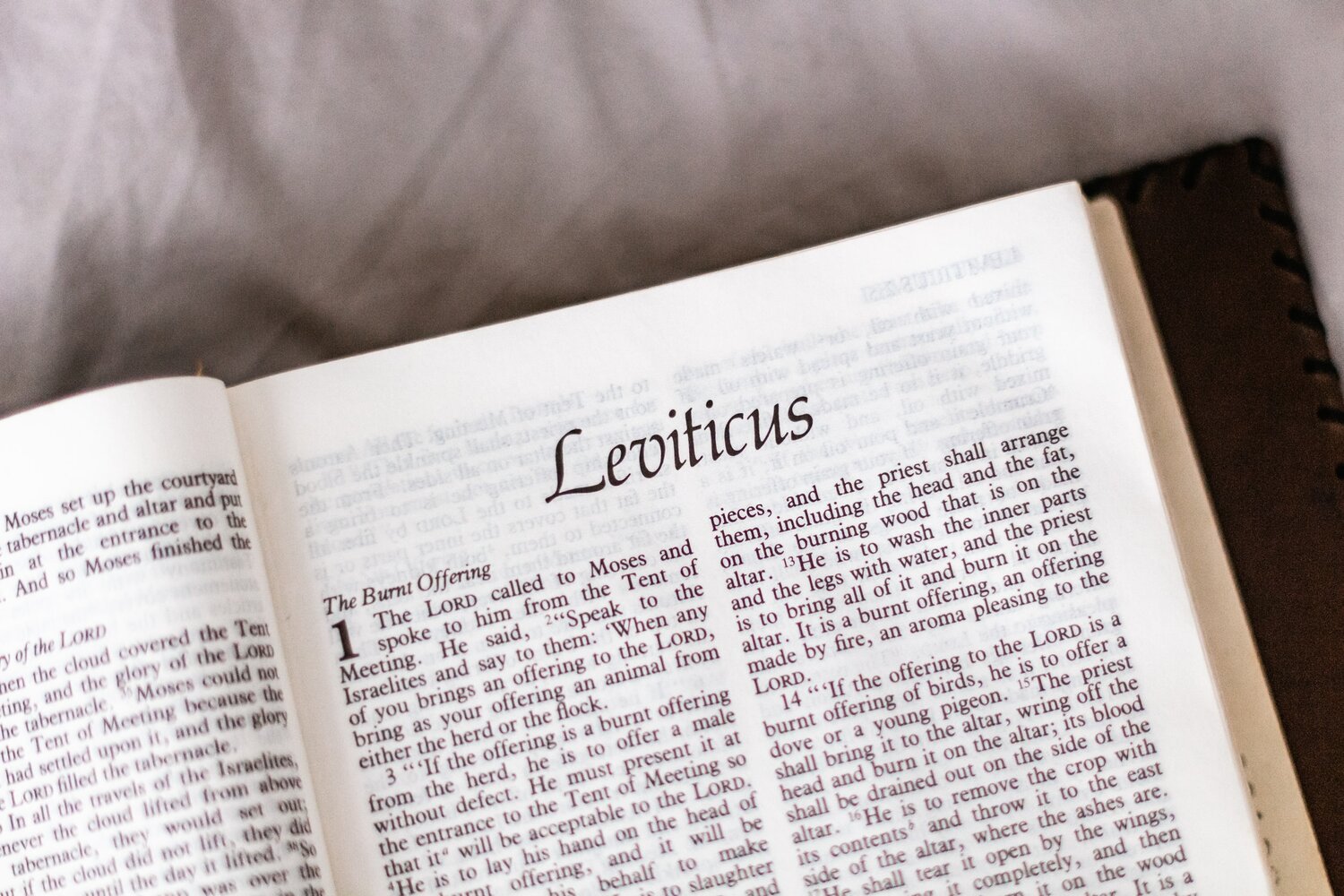
On the late Michael Heiser’s Naked Bible Podcast, this Old Testament scholar brings out important highlights, accessible to everyday Christians, who want to have a better grasp on Leviticus, one of the least studied, least understood, and least read books in the Old Testament.
Diving Into Leviticus…. and Really Learning Something!
Unfortunately, this all too common attitude towards Leviticus robs us from having a better understanding as to what the Levitical system was all about, according to the late Dr. Michael Heiser, an evangelical Old Testament scholar who has been very popular on YouTube, who sadly died of cancer in 2023. For Michael Heiser, it is very tempting to simply read Leviticus through the New Testament lens of Jesus’ atoning work on the cross, and conclude that Leviticus has no more relevance for the New Testament Christian. This would be a mistake.
Michael Heiser, on the other hand, wants us to get the ancient Israelite way of thinking into our heads. By understanding what Leviticus meant in its original context, we get a better sense of how the death of Jesus on the cross actually works for the Christian believer. Early on in his Naked Bible Podcast series, Heiser did a detailed study of Leviticus where the book simply came alive to me for the first time (A YouTube audio version is found here, in three parts: #1, #2, #3). This Naked Bible Podcast book study was transcribed and released in book form as Notes on Leviticus: From the Naked Bible Podcast.
Wow. Was I missing a lot of powerful stuff when I basically did a skim read of Leviticus!!
There is so much here, that I added two additional blog posts (the second, and the third) to this current exploration of Leviticus, following Michael Heiser’s Notes on Leviticus: From the Naked Bible Podcast.
One mistake that Christians often make about Leviticus is in thinking that the Levitical system is all about the atonement for sin, for the ancient Israelites. Unfortunately, this assumption is simply not true. While there is quite a bit in Leviticus about atoning for sin, there are a lot of details about offerings and sacrifices that have nothing to do with dealing with sin.
Atonement: Clean Versus Unclean?
If you are a bit skeptical, as I was when I first read Heiser, then consider Leviticus 8:15. There we have the altar being cleansed and “atoned” for. But it would be really odd to conclude that the altar had somehow “sinned” and that this required the altar to be atoned for in some way. Human beings sin but inanimate objects do not.
Heiser observes that the Hebrew word for “atonement” has a broad range of possible meanings, but that in general, atonement had to do with “purging,” or “decontamination.” Sin can indeed contaminate something, but ritual impurity could also contaminate, creating a situation which required a purging and/or decontamination, without necessarily implying some moral quality to it. This explains why inanimate objects, like an altar, or even walls on a house becoming infected with some type of mold or mildew (see Leviticus 14:33-53), can become ritually unclean, thereby requiring atonement in order to decontaminate the object.
Another set of verses right next to one another illustrates how confusing this can be:
“You shall not approach a woman to uncover her nakedness while she is in her menstrual uncleanness. And you shall not lie sexually with your neighbor’s wife and so make yourself unclean with her” (Leviticus 18:19-20 ESV)
The second verse seems pretty straight forward in condemning adultery as sin. But what about the first verse? If a husband has sexual relations with his wife, while she is having her period, is this really a sin? Both verses talk about being “unclean.” So, what on earth is going on here?
Unlocking Leviticus: The Concept of Sacred Space
Heiser brings out the best of modern scholarship to observe that Leviticus makes an important distinction between moral purity and ritual purity. The former addresses what we would call “sin.” The latter deals with what an Israelite needed to do before entering “sacred space.” But the latter was not meant to deal with any particular sin, or sin in general. The tabernacle in the wilderness, and later with the temple in Jerusalem, was considered to be the sacred space where God dwells with his people. Because God was a holy God, it would be a dangerous affair to try to enter sacred space if one possessed ritual impurity.
This concept of “sacred space” can be a difficult idea to grasp for many modern, evangelically-minded Christians. The idea that one needs to be fit in order to enter sacred space saturates the thought world presented in the Book of Leviticus. You can get a sense of this in certain liturgical, historically-conscious Christian traditions, such as when one visits some of the great Christian cathedrals in Europe. The awe inspiring architecture of these majestic buildings, which rise above the neighboring landscape in many European towns and cities, is meant to draw a distinction between that which is common, normal everyday space, and the sacred space of entering a house of prayer and worship. Men are encouraged to take off their hats when entering a great Christian cathedral and women are discouraged from wearing skirts that are too short. Why? Because entering a worship area like this was designed to mirror what it might have been like for an Israelite to approach the sacred space of the tabernacle or the temple.
This is quite a different feel from entering many contemporary evangelical churches today, where people typically think of a church building as not much different from any other ordinary building, where people feel the casual freedom to bring their mugs of coffee into the worship room, something which still seems awkward to do when entering a great European church cathedral. Granted, things like whether or not to wear shorts to a church worship service are more about cultural concerns and not Scriptural concerns.
Still, having a sense of how we present ourselves in a worship setting can help the Christian to somehow imagine how it might have felt for Moses to approach the burning bush, where a voice beckons from the bush: “Moses… Do not come near; take your sandals off your feet, for the place on which you are standing is holy ground” (Exodus 3:4-6). If someone can capture this idea of “sacred space” in their mind, it can greatly aid in one’s understanding of something so foreign as the Book of Leviticus.
Like the concept of “sacred space,” ritual impurity is a conceptually intricate category which seems very foreign to modern peoples today, having to do with such things as reproductive fluids, like blood, which symbolizes life. So if a woman gave birth to a child, she would become ritually impure. For another example, in certain cases if you touched a dead person, that would make you ritually impure. Back to Leviticus 18:19, a woman in menstruation, as explained in further detail in Leviticus 15:19-24 where there is a release of blood, is in a ritually impure condition. Because the Old Testament taught respect for life, you could not bring death into God’s sacred space. In all of these examples, Leviticus provides a way of cleansing so that a person can become pure again, in the ritual sense.
But what is important to emphasize is that ritual impurity per se has nothing to do with a person’s sin. Giving birth to a child (Leviticus 12:1-8), a menstrual cycle, or touching a dead person (Numbers 19:10-22) are simply things that are part of normal human experience. Furthermore, having a certain kind of skin disease (Leviticus 13:1-14:32) can also make someone ritually unclean, but having a skin disease does not necessarily imply sin. None of these events describe any particular sin committed by a person at all. Nevertheless, one can not enter sacred space where God dwells without becoming ritually clean.
The closest thing relevant to contemporary life might be the taboo against eating food inside a restroom. Even modern people think that such activity would be regarded as unclean. In my mind at least, that does sound a bit gross. Likewise, the Levitical system in ancient Israel had serious concerns about ritual uncleanliness when someone sought to enter God’s presence, his sacred space, in the tabernacle (or later on in the Jerusalem temple).




 Veracity