
Can we please make Paul weird again?
Many of us know the standard story of Paul. At one time, Paul (then Saul) was the most feared opponent of the fledgling Christian movement, bent on destroying such a pernicious heresy. The followers of Jesus had foolishly embraced the idea of a crucified now-risen Messiah, and Paul was dedicated to stamp the movement out.
God soon stopped Paul on the road to Damascus. Confronted by the Risen Jesus himself, Paul realized that he had been championing the very wrong side. Shortly thereafter, Paul reversed his course entirely, proclaiming the Resurrection of Jesus. It took some time for the other Christian leaders to fully trust him, but Paul was eventually to become the great apostle to the Gentiles. Paul had rejected the Jewish commitment to the Law of Moses, with all of its “works-righteousness.” Instead, Paul embraced and proclaimed a message of faith, that of having trust in the Risen Messiah. In contrast with those unbelieving Jews obsessed with trying to earn their own salvation, Paul’s new gospel was a message of grace towards those who believe, receiving a salvation that could never be earned by human effort alone.
While much of this story has staying power, it has a serious weakness when it comes to analyzing the following question: When Paul became a Christian, did he really cease to be a Jew?
Such is the question at the very heart of Matthew Thiessen’s A Jewish Paul: The Messiah’s Herald to the Gentiles.
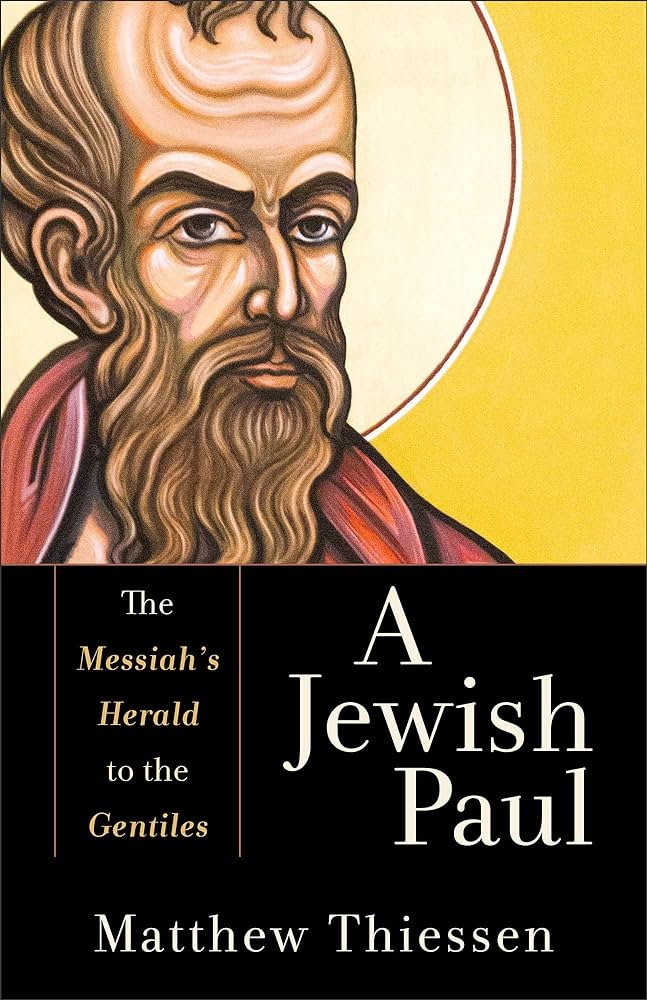
A Jewish Paul: The Messiah’s Herald to the Gentiles. Matthew Thiessen makes Paul weird again.
What Was At the Heart of Paul’s Message?
Matthew Thiessen acknowledges many of the virtues associated with the standard story of Paul, but he contends that this standard story begins to break down when trying to consider Paul’s real relationship to Judaism as a professing Christian. In essence, Thiessen maintains that Paul never ceased being a Jew when he became a follower of Jesus. Instead, he became a very particular kind of Jew. While this may sound weird to Bible readers today, this is the very point Thiessen is trying to make: We need to make Paul weird again.
Matthew Thiessen is a New Testament professor at McMaster University, in Canada. Coming from a Mennonite background, he is part of an intellectual movement to try to rethink and recover who the real Paul the Apostle was. Sadly, layers of anti-Jewish sentiment following the break between Judaism and Christianity in the early church period have distorted the historical picture we have of Paul. While Jesus is surely the founder of the Christian faith, Paul is indeed his greatest and most influential interpreter. Agree or disagree with Matthew Thiessen on particular matters, one thing Thiessen says sticks out for sure is this: Paul is indeed weird. We would do well to remember this.
What? Paul remained a Jew, while still becoming a Christian? I have to admit, this did sound pretty weird when I first heard this. But Thiessen makes a compelling case for Paul’s weirdness. Some of Paul’s weirdness goes against the norm of Western, Educated, Industrialized, Rich and Democratic people today (WEIRD!), as Jonathan Haidt popularized in his absolutely brilliant The Righteous Mind: Why Good People are Divided by Politics and Religion. But perhaps that is a point as to why thinking about Paul’s weirdness is so important. It shows us just how “weird” we are today, and perhaps why our weirdness gets in the way of situating Paul in his original first century context as a Jewish follower of the Risen Messiah.
In A Jewish Paul: The Messiah’s Herald to the Gentiles, Thiessen offers a succinct overview of the history of Pauline studies over the past few hundred years. First, the traditional reading reflected in the standard story above stems from Martin Luther and other leading Protestant Reformers. In this traditional reading, the main problem faced by Paul was legalism, the attempt to earn one’s salvation through good works. Paul linked this legalism with Judaism itself, and rejected it for the message of grace found by having faith in Christ, superseding Judaism as a whole.
What many Christians do not realize is that a reexamination of this standard story has occupied the attention of New Testament scholars for at least a good forty years now, among both non-evangelical and evangelical scholars. In the world of academic scholarship, it seems like a new study with new insights into the Apostle Paul gets published about once a month.
The thrust of this new line of scholarly research is known as the “New Perspective on Paul” founded by the late E.P Sanders, but popularized the most by writers like N.T. Wright and James D.G. Dunn. Unlike the traditional view, the “New Perspective on Paul” says Paul was not concerned about legalism and correcting it with the “imputed righteousness” of Christ championed by Martin Luther (which is N.T. Wright’s way of saying it). Instead, with the “New Perspective on Paul,” the problem faced by Paul was ethnocentrism. To borrow from N.T. Wright at times, the message of Paul was about “grace, not race.” The Judaizers of Paul’s day wanted gentiles to become Jews by embracing circumcision and the rest of Torah law. But Paul insisted that the death and resurrection of Christ is what makes people right before God and joined together as God’s people, not the ethnically cultural customs which have been part of keeping the Torah.
Thieseen observes yet a third way of looking at Paul, having its origins in the “apocalyptic” theology of the early 20th century German scholar-turned-missionary doctor, Albert Schweitzer. In this apocalyptic view, the coming of Jesus ushers in a radical break with the Jewish past. Schweitzer had written about the “mysticism” of the Apostle Paul, with all of Paul’s statements about being “in Christ,” and Schweitzer’s followers like the 20th century German theologian Ernst Käsemann, have suggested that the death and resurrection of Jesus relativizes the Torah completely. All of the old structures of order: Jew and Gentile, male and female, and slave and free, have been dissolved (Galatians 3:28).
Thiessen acknowledges that each of these three views have certain strengths to them, but they also fall short in other ways. For example, Paul is clearly teaching that one can not earn one’s salvation by works, so Luther was absolutely right here. But the New Perspective on Paul offers an important corrective by showing that at least some, if not most forms of ancient Judaism were not promoting a works-based righteousness. For example, the Old Testament announces that “there is no one who does not sin” (2 Chronicles 6:36 ESV), and “Surely there is not a righteous man on earth who does good and never sins” (Ecclesiastes 7:20 ESV). This hardly coheres with the standard, old Protestant view that all Old Testament Jews believed that you could simply earn your own salvation on the basis of performing good works. Even Abraham, the father of the Jewish people, received God’s favor due to an act of God’s graciousness, and not by superior Law-keeping.
This Old Testament theme of grace is echoed in the Paul of the New Testament: “Yet we know that a person is not justified by works of the law but through faith in Jesus Christ, so we also have believed in Christ Jesus, in order to be justified by faith in Christ and not by works of the law, because by works of the law no one will be justified” (Galatians 2:16 ESV). Everyone from the Old Testament Jew to the New Testament Gentile stands in need of God’s grace.
But according to Thiessen, the New Perspective on Paul has faulted by insisting that Paul’s problem with the Jewish resistance to the Christ message was ethnocentrism. For Paul himself could also be accused of ethnocentrism, just as anyone else could: Paul’s message was “first to the Jew, then to the Gentile” (Romans 1:16 NIV). Why put the Jew first? Was Paul placing the Jew as being more important or superior to the gentile?
Thiessen’s critique continues with another target: While the “apocalyptic” view rightly announces a radical proclamation of something new, that view tends to suggest a break with Judaism that Paul never really had. Paul believed that the Mosaic Law had its goal and purpose fulfilled in the coming of Christ: “For Christ is the end of the law for righteousness to everyone who believes” (Romans 10:4 ESV).
Instead, what Matthew Thiessen proposes is yet a fourth view that might be called “Paul within Judaism,” though Thiessen is not wholly satisfied with that description. Nevertheless, it is a label that a scholar such as Paula Fredriksen agreeably aligns with, in her Paul: The Pagan’s Apostle. First and foremost, this “Paul within Judaism” view acknowledges that the Judaism of the Second Temple period, to which the Apostle Paul lived in, was not some monolithic belief system. Someone who was Jewish in Paul’s (and Jesus’) day could have held beliefs that sharply differed from another Jew. For example, even Acts 23:8 tells us that the Sadducees and the Pharisees held contradictory views about a future resurrection, the Sadducess being dismissive of such an idea whereas the Pharisees embraced it. It is better to think in terms of multiple “Judaisms” of Paul’s day as opposed to a single “Judaism.”
“Paul was one ancient Jew living and thinking and acting within a diverse Jewish world that sought to be faithful to Israel’s God and Israel’s law“(Thiessen, p. 8).
Yet what makes Paul so important is that Paul is the most prolific and deepest thinker we encounter when reading the pages of the New Testament. But to miss the essential Jewishness of the Apostle Paul is to completely miss the message from him we read about in the New Testament.
Paul’s Unique Contribution to New Testament Christianity
Along the way in reading A Jewish Paul, we learn that:
“…It is simply wrong to believe that all or even most Second Temple Jews thought that gentiles needed to become Jews. Such a commonly held view is the result of Christian interpreters who have reconfigured Judaism into the image, albeit inevitably an inferior image, of Christianity” (Thiessen, p. 18).
Yet Thiessen’s contention is contrasted with the very mission of Paul to be Christ’s apostle to the Gentiles, compelling Paul to travel across the Roman empire to share the Good News with all he encountered. While most Jews did not “evangelize” their faith, Paul in his own understanding of Judaism was exactly opposite, a feature of Paul’s ministry which Thiessen acknowledges.
Paul did not in any way think that Judaism was somehow deficient as a whole. Rather he specifically came to believe that Jesus Christ was the once dead but now Risen Messiah, and that gentiles can be brought into the community of God’s people by having faith in Jesus.
Some might argue against Thiessen that Paul spoke of his “previous way of life in Judaism” (Galatians 1:13-14 ESV), suggesting that Paul had given up his Jewish way of life. However, later in Galatians 2:15 Paul tells his readers that he is very much still a Jew, and in Romans 11:1 and Philippians 3:5, he embraces his Benjamite identity. Therefore, it is better to think of Galatians 1:13-14 as saying that Paul gave up one form of Judaism for yet another form of Judaism (Thiessen, p. 41 and pp. 54ff).
It might be fair to say then that Paul’s “conversion” to Christianity was not a “conversion” away from Judaism. Rather, Paul was converted from one form of Judaism to a different, particular Jewish vision of acknowledging Jesus as God’s promised Messiah.
Paul is not against circumcision per se, for he does not believe the Jewish Christians need to have the marks of circumcision removed. But he is emphatic on insisting that gentile Christians not be required to undergo circumcision in order to become followers of the Messiah.
To demonstrate Paul’s very point, it is crucial to understand how the Book of Acts functions in its placement within the New Testament. Sandwiched between the Gospels and Paul’s letters, Acts shows the reader that Paul was very much still a Torah-observant Jew (Acts 21:23–24; 25:8; 28:17), getting along well with other apostles, like Peter. But even in Acts, Paul preaches that complete Torah observance was not required for the Gentile follower of Jesus (Acts 13:38-39). It was this insistence that circumcision be not required of the believing gentile which stirred up Paul’s opponents within the Jesus movement in Jerusalem. For there is nothing in the story of Jesus from his earthly ministry prior to his Resurrection, as we find in the Gospels, which would indicate that Jesus had removed the circumcision requirement from the gentiles. We only get that from the post-Resurrection story of the apostle Paul.
So, it would be too strong to say that Paul was the founder of Christianity. Jesus himself took that role. But it was through Paul’s unique calling, as the apostle to the gentiles, that Christianity became a universalizing faith, intended for everyone, and not just one particular group of people.
Christians who contend that they “love Jesus” while “having problems with the Apostle Paul,” need to seriously rethink such an attitude. For while Paul does believe that he got his message straight from the Risen Jesus, nevertheless, if it were not for Paul, Christianity probably would never have made the in-roads which it did into the gentile world.
If all we had was the teaching of Jesus in the Gospels, we would never have had a Christian message with the universal impact it had. While Paul does not go as far some would like in stimulating social change, we might never have had the eradication of racial-based slavery without Paul, nor the reconfiguring of roles for women in leadership without Paul, in the Western world. Why Jesus waited to impart through the Holy Spirit the full Gospel message until after the Ascension, perhaps somewhere on that road to Damascus, so that Paul could unpack it all out for us, is a question I hope to to get answered some day. Without Paul, Christianity might have remained a peculiar Jewish sect, where the only Jesus followers would be those who accepted circumcision, and other distinctives of the Law of Moses.
Rethinking Paul’s Message in Light of His Jewishness
Much of contemporary New Testament scholarship has tried to show that the narrative of Paul’s life, as told through his letters, conflicts with the narrative of Paul given to us in the Book of Acts. This has led many scholars to dismiss the historical reliability of Acts. But Thiessen argues that much of this conflict comes from misunderstanding Paul from his own letters (Thiessen, pp. 27ff).
Thiessen suggests that part of our misunderstanding about Paul comes from misleading ways of reading the book of Romans. For example, many Bible translations of Romans 1:18-32 employ subtitles like the ESV’s “God’s Wrath on Unrighteousness” or the NIV’s “God’s Wrath Against Sinful Humanity.” Only a few translations, like the CSB, with “The Guilt of the Gentile World,” more accurately convey the intent of Paul’s message. The primary thrust of Romans 1:18-32 is to critique the sin of idolatry and its consequences in the gentile world, problems that do not normally appear in the Jewish world.
Much of Paul’s writing is focused on how his message of inclusion regarding the gentile believers meshes together with honoring circumcision among believing Jewish followers of Jesus. In contrast, Thiessen refutes someone like N.T. Wright, who redefines circumcision as taught in 1 Corinthians 7:19 as something “spiritual,” and therefore physical circumcision is no longer important to Paul, for the Jewish Christian. Thiessen suggests that this spiritualizing of circumcision would be akin to a Christian today rejecting baptism or communion as unnecessary, and that we should only listen to God’s words instead (Thiessen, p. 31).
While Paul has the gentile in mind in Romans 1:18-32, Paul has the Jewish Christian in mind in Romans 2. Nevertheless, some Bible translations tend to miss this focus, as did the older NRSV in Romans 2:28-29:
“For a person is not a Jew who is one outwardly, nor is true circumcision something external and physical. Rather, a person is a Jew who is one inwardly, and real circumcision is a matter of the heart—it is spiritual and not literal. Such a person receives praise not from others but from God.”
(The new NRSVue translation fixes this). Thiessen notes that this older translation is misleading as there is no mention of “true” or “real” in the original Greek. Instead, Thiessen offers this alternative translation:
For it is not the visible Jew, nor is it the visible in-flesh circumcision, but the hidden Jew, and the circumcision of the heart by the pneuma [spirit], not the letter, whose praise is from God, not from a human.
Paul still acknowledges the importance of physical circumcision for the Jewish Christian. Paul’s inward “circumcision of the heart” in no way invalidates the outward circumcision of the Jew. God’s desire was for the Jew to be both outwardly circumcised and inwardly circumcised in the heart (Thiessen, p. 91).
Rethinking the “Allegory” of Galatians 4:21-31
Paul’s use of the “allegory” of Abraham’s son Ishmael versus his son Isaac, in Galatians 4:21-31 can be puzzling. For years, I have thought that in this passage Paul is treating the story about Ishmael and Isaac as an allegory that actually flips the roles around filled by Ishmael and Isaac. Ishmael represents the Jews who rejected Jesus, whereas Isaac represents Christian believers. In other words, the descendants of Abraham through Isaac, the Old Testament Jews, have now become the Ishmaelites, separated from the promise of God. In turn the Ishmaelites, those who embrace Jesus, including the gentiles, have now become the inheritors of the promise given through Abraham’s son, Isaac.
But there are several problems with this interpretation according to Thiessen. First, Matthew Thiessen notes that Paul is not simply treating or interpreting the Genesis narrative regarding Ishmael and Isaac as an allegory. Rather, the Genesis story IS an allegory, according to Paul. Some translations, such as the ESV, take the wrong approach at translating Galatians 4:24:
Now this may be interpreted allegorically: these women are two covenants. One is from Mount Sinai, bearing children for slavery; she is Hagar.
In contrast, the NASB 2020 is more direct:
This is speaking allegorically….
Or better the NRSVue:
Now this is an allegory: these women are two covenants. One woman, in fact, is Hagar, from Mount Sinai, bearing children for slavery
The implications of this claim by Thiessen go beyond what he comments on in A Jewish Paul. But the lesson for how Paul reads the Old Testament is evident: “The trick, then, was to learn to recognize which texts were originally allegorical and then to figure out how to read them accurately” (Thiessen, p. 95).
However, the clarifying insight in A Jewish Paul suggests that my old way of reading Galatians completely misses the original context of the letter, which is about Paul’s efforts to encourage his gentile followers of Jesus to not fall into the trap a listening to the Judaizers who want these gentile Christians to undergo circumcision to become fully Jewish. In the allegory, we learn that both Ishmael and Isaac undergo circumcision. However, only Isaac is the one who receives the promise. The covenant will be fulfilled through the line of Isaac, and not Ishmael. Isaac is circumcised correctly, whereas Ishmael was not, an idea that Theissen draws from the apocryphal Book of Jubilees, a popular Jewish text from the Second Temple period (Theissen, p. 97). Therefore, in and of itself, circumcision itself does not guarantee membership within the covenant people. The very fact that in the Genesis narrative that Hagar and her son Ishmael are eventually expelled from Abraham’s household demonstrates the failure of circumcision done for the wrong reasons.
Paul does not want the gentile Christians in Galatia to follow along the Ishmaelite path, for to do so would be accepting a false gospel, and lead to spiritual peril. Much of this explains why Paul encouraged Timothy to get circumcised, though having a gentile father, was also born of a Jewish mother (Acts 16:3), while explicitly rejecting the idea that Titus, a pure gentile, should get circumcised (Galatians 2:3-5).
The correct interpretation of Galatians 4:21-31 then is as follows:
“You gentile men want to keep the law, but you haven’t read it carefully enough. You want to be Abraham’s sons through circumcision. But Abraham had two circumcised sons: Ishmael (a slave) and Isaac (an heir). By undergoing adult circumcision, you imitate Ishmael, not Isaac. Consequently, you will share in Ishmael’s fate. You, like Ishmael, will not inherit. Instead, you will be cast out of Abraham’s house altogether. Only those who are like Isaac, born according to the pneuma [spirit] and promise, will inherit” (Thiessen, p. 98).
While this does not solve the gentile problem of how gentiles can become inheritors of the promise, it does show that “gentile circumcision is nothing more than a cosmetic effort to look like Abraham, but it is one that results only in a superficial, fleshly connection, something too tenuous to be of eschatological, and therefore lasting, value” (Thiessen, p.99).
For me, this insight alone is worth the price of A Jewish Paul.
Stay Tuned for Part Two of This Book Review: Pneumatic Gene Therapy?
However, the best and most provocative part of A Jewish Paul comes towards the second half of the book. This is where Matthew Thiessen dives into a core idea in Paul’s thinking, which Thiessen cleverly calls “pneumatic gene therapy.” The concept is so intriguing that it is best to cover this in a separate blog post, where I will also give some critique, pushback, and summary conclusions to A Jewish Paul. Stay tuned!




 Veracity
What do you think?