Monthly Archives: January 2017

For Those Living in a “Post-Truth” Society: A New Book Co-Authored by Ravi Zacharias

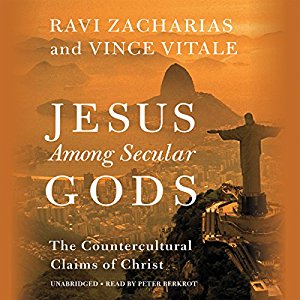
Jesus Among Secular Gods, by Ravi Zacharias and Vince Vitale.

Jesus Among Secular Gods, by Ravi Zacharias and Vince Vitale. Addresses issues that were missed in Zacharias’ earlier work, and geared towards today’s college student.

(December 8, 2017): PLEASE READ THE VARIOUS UPDATES ON the ENTIRE POST BELOW. Thank you….

When I first read Ravi Zacharias’ book, Jesus Among Other Gods, published in 2000, others and I were encouraged by what we considered to be a very readable exploration into why Jesus Christ is so fundamentally different, in a society that is constantly exposed to conflicting and competing truth-claims. So impressive was the book, that our church made a united effort to bring Ravi Zacharias to our church, and the campus of the College of William and Mary, for a weekend of messages, followed by dynamic public question and answer sessions.

Though I still highly recommend Jesus Among Other Gods, I personally felt that the book lacked something important. Zacharias was great at showing the contradictions between various religious worldviews, but he did not adequately address the question of how one is to live in a world, where such conflicting truth-claims exist in the first place. It is one thing to consider the particular truth-claims of different religions. But why even chose any particular worldview at all? Why not just accept them all?
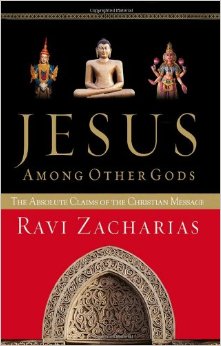
Jesus Among Other Gods, by Ravi Zacharias, 2000.

Jesus Among Other Gods, by Ravi Zacharias, 2000.

For example, so many Christians enter into a relationship with someone who is a professing Muslim, Buddhist, or Hindu, with the idea that the other person is “Evil Incarnate.” However, these Christians are often confused when they soon realize that their new Muslim, Buddhist or Hindu friend, is often really a nice person. Are then all religions somehow “true?” An informed response is needed to this question.

Oxford Dictionaries named the term “post-truth” as the 2016 word of the year. So, it is absolutely crucial that Christians begin to more clearly think through the relationship between “truth” and the Gospel, and start having better conversations with our neighbors about these issues.

That is why I am really excited by a new book co-authored by Ravi Zacharias, and fellow associate apologist, Vince Vitale, Jesus Among Secular Gods. With chapter titles such as “Atheism,” “Scientism,” “Pluralism,” “Humanism,” “Relativism,” “Hedonism,” and “Love the Truth,” Jesus Among Secular Gods has great potential to be a great discussion starter among our neighbors.

Ravi Zacharias and Vince Vitale travel the world, speaking before audiences, sharing their faith and answering objections to the Gospel of Christ, through Ravi Zacharias International Ministries.  Zacharias is featured on a weekly syndicated radio program, Let My People Think. Below is a 12-minute discussion about the new book. I have not read the book yet, but if you have, please share your review in the comments section below!

UPDATE: December 7, 2017. I am sorry to say that I did not adequately review the video below, before posting. For if I did, I would have caught the fact that Vince Vitale introduces his fellow co-auther as “Dr. Ravi Zacharias.” This is most unfortunate, as I knew that Ravi Zacharias, though clearly a gifted speaker and writer, and a most intelligent, Christ-loving man, has never earned the doctoral equivalent of a PhD, in any field. Ravi has received Honorary Doctorates, but this does not qualify anyone to be called a “Doctor,” especially when one’s ministry field is to students and professors in higher education. I would hope that this was simply an oversight, an honest mistake, on both Dr. Vince Vitale’s (who truly is a “Doctor”) and Mr. Ravi Zacharias’ part. I still have not read the book, but given what I have read before from Ravi, I still think it would be most helpful. Nevertheless, I regret the error on my part. For more information, please read this more recent blog article about this issue.

UPDATE: December 8, 2017. For those who have been following this, as someone who values the work of RZIM, I have had trouble sleeping, and I thought it best to try to reach out to someone at RZIM (this is the biblical way to do it). So, I contacted Vince Vitale directly and expressed my concerns, as this whole episode has been terribly frustrating to me. Thankfully and graciously, Dr. Vince Vitale took the time out of his day, and called me from Oxford (how many times does that happen?). We had a great conversation and I was thoroughly impressed by his integrity.

Vince deeply loves Ravi, and greatly respects him, so it was only natural to address him, in a manner, that would befit showing such respect, to a fine Christian leader.  However, Vince also told me that RZIM recognizes that using “Doctor” in this way is contentious in some circles, especially in academia, and that they desire to aim for complete clarity. From our conversation, it appears that he, and RZIM as a whole, are taking steps, in good-faith, to hear the concerns of me and others and to make sure that the way they speak about credentials is both accurate and unambiguous.

Admittedly, people outside of academia might not care one bit about stuff like this, but when you are trying to minister to faculty and students, like we have in our local community, in a college town, it is important for ministers of the Gospel, to stand above reproach. So, I am very, very glad Vince Vitale personally is taking the right steps forward, and that he has been so generous with me. That is a mark of great character. Thank you, Vince!!!

UPDATE: May 20, 2020.  Ravi Zacharias died yesterday, from a short battle with bone cancer. Since this blog post was updated on December 8, 2017, RZIM finally took down the controversial video from YouTube, promoting the Jesus Among Secular Gods book.  Kudos to RZIM for eventually setting the record straight….. Speaking of McGrath (above), Alister McGrath has a very fine remembrance essay posted at The Gospel Coalition.

UPDATE: December 23rd, 2020. Review of the sexual impropriety charges at a spa, partly owned by Ravi Zacharias, conducted by a law firm hired by RZIM, releases a preliminary report indicating that Ravi did act inappropriately.


A Visit to a Mega-MegaChurch

You might think this is secular rock concert, but it it is not. This is worship time at Flatirons Community Church.

You might think this is a secular rock concert, but it it is not. This is worship time at Flatirons Community Church, near Denver, Colorado (photo credit: me!!).

I attend what many sociologists call a megachurch, generally a church where weekly attendance is around 2,000 or more. According to a 2014 survey done at Old Dominion University, the Williamsburg Community Chapel ranks just barely as a megachurch, of the 14 identified churches in this category in the greater Hampton Roads, Virginia area.

For the most part, megachurches are a uniquely modern phenomenon. They appeal particularly to families, looking for good youth programs for their kids, that smaller churches might not be able to provide. They offer a wide range of ministry activities for outreach to the poor and hurting, have typically a talented music ministry, and draw in gifted staff with good preaching and administrative skills.

Megachurches have their drawbacks as well. Despite the size of the crowds, it can be difficult to connect with people on a personal level. In my case, I can go for weeks without seeing longtime friends, simply because they sit in a different part of the worship room from me. Our church works to overcome this problem by emphasizing small groups. But that can be a hit or miss affair. It can be really intimidating walking into someone’s living room, among people you know very little, if anything, about. Questions flood our minds: Is this group the right fit? Are there people in the group who think like me, and share the same values? Finding the right small group can be difficult, and all it takes is one awkward encounter with one rough person in the group to scare one away from small groups.

I want to tell you about a visit that my wife and I took this past summer to a much bigger church, a “mega” megachurch in Colorado. I learned a lot of new things, about myself and about the state of evangelical churches in America. Continue reading


Huston Smith and the Doctrine of Religious Pluralistic Experimentalism

Huston Smith (1919-2016), pioneering scholar in the field of comparative religious studies, died on December 30, 2016.

Huston Smith (1919-2016), pioneering scholar in the field of comparative religious studies, died on December 30, 2016.

Anyone who has an interest in the “religions of the world” remembers Huston Smith. For well over fifty years, Smith’s The Religions of Man has remained as the standard textbook in secular universities for the study of comparative religions. Republished in the 1990s with the more friendly title, The World’s Religions, Smith’s work has had a profound impact on the religious outlook of millions of Americans, directly and indirectly.

Huston Smith, remembered in this New York Times article, grew up in China, the son of Methodist missionary parents serving in that country. Early on, he hoped to follow in his parents’ footsteps, but his years in college back in the United States redirected him towards the scholarship of world religions, a growing field in the wake of World War II.

Smith had become enamored with the variety of human religious experience, making him a 20th/early-21st century version of the late- 19th/early-20th scholar of the field, William James, the Harvard author of The Varieties of Religious Experience. Smith’s work has indeed proven helpful over the years, particularly for those who have known little about the diversity of global religious expression. But Smith went much further. He was not content in merely obtaining academic knowledge. Rather, he wanted to experience the world’s great religious traditions in all of their profound mysticisms. He studied under a Buddhist Zen master, lived in a Hindu ashram, and sought after the wisdom of Sufi Islam.

Huston Smith befriended British author and mystic, Aldous Huxley, mythologist Joseph Campbell, and Harvard psychologist Ram Dass, among other religious celebrities. As a professor at M.I.T. in Boston, in the early 1960s, Smith met with Timothy Leary to experiment with acid, or L.S.D., for the inducement of mystical experience. He publicly defended the use of peyote as a sacramental drug, for use in Native American religious rituals. He studied Buddhist monastic chanting in Tibet and introduced the Western world to the Dalai Lama. Though hidden in academia for years, journalist Bill Moyers made Smith famous in a popular PBS multipart series in the 1990s, ” The Wisdom of Faith with Huston Smith.”

By his own admission, Huston Smith saw the dangers of spreading oneself religiously too thin:

I liked what a teacher in India once said to me. If you are drilling for water, it’s better to drill one 60-foot well than 10 6-foot wells. And generally speaking, I think a kind of smorgasbord cafeteria, choosing from here and there is not productive (NPR remembrance, an interview with Terry Gross, 1996).

Not “productive?” As cautionary advice, which Smith hardly seemed to have taken himself, this is a vast understatement. For if there was one doctrine that Smith himself clung to tightly, it was the doctrine of religious pluralistic experimentalism. The lure of diversity in world religious mysticism was too difficult for Smith to resist. Huston Smith was the academic, respected face of the New Age Movement.

Huston Smith's classic on comparative religion studies: The Religions of Man.

Huston Smith’s classic on comparative religion studies: The Religions of Manfirst published in 1958.

Though Smith said that he had never forsaken his Methodist Christian identity, he rejected any Christian exclusivist claim to truth. Biblical statements such as that of Jesus, “I am the way, and the truth, and the life. No one comes to the Father except through me” (John 14:6), or Peter, “And there is salvation in no one else, for there is no other name under heaven given among men by which we must be saved.” (Acts 4:12), are to be understood in Smith’s mind as merely symbolic metaphors to the extreme. Contrary to the context of these Biblical statements, and the original intent of the New Testament authors, Smith sought to ground any notion of Christian exclusivist truth claims in some alternative, broader truth claim undergirding the whole of human, world religious experience. Smith was strangely optimistic, believing that particular, conflicting religious truth claims can be sidestepped. Smith would also contend that religious mystical experience is not the goal, in and of itself, but rather, it is through such mysticism that the development of character springs forward.

This is a noble aim, but did Huston Smith represent the teaching of the Bible rightly? Upon his recent death, where is his soul now? Can that question even be answered, from the perspective of those who take Smith’s view? After reading Smith’s 2005 book, The Soul of Christianity: Restoring the Great TraditionGospel Coalition blogger, Trevin Wax, responded with this critical observation: I was left wondering if Smith understands Christianity as well as he thinks he does.

These are my thoughts exactly.

According to friends and admirers, Huston Smith was a really nice and likable man. But I also know of other really nice people who believe some rather strange things, masking the presence of darker elements of the human experience. Is it possible that the spiritual diagnosis of the human condition, offered by the prophet Jeremiah, is more profound than we think?

The heart is deceitful above all things, and desperately sick; who can understand it?” (Jeremiah 17:9)

It should also be noted that Smith’s antagonism towards the particularity of evangelical faith is also extended towards disbelief in God, as well. In one of his last works in 2009, Why Religion Matters: The Fate of the Human Spirit in an Age of Disbelief, Smith condemns “scientism,” the elevation of science to the status of a final metaphysical truth claim, a judgment that evangelical Christians can find some agreement with. Attempts to explain the whole of the world scientifically, without talk of God, is rejected as a modern ideology. I sincerely doubt that Huston Smith would find too many friends among disbelieving atheists. Yet despite the differences between Christian faith and atheism, both hold to an objective notion of truth that remains elusive to the religious, pluralistic relativism championed by Smith.

It is as though Biblically-informed, evangelical faith is sandwiched between these two contrasting doctrines: the doctrine of a world without God, promoted by secular atheism, and Huston Smith’s doctrine of religious, pluralistic experimentalism.

However, Huston Smith’s years of teaching do point out a great deficiency in how many people reared in a familiarity of the Bible come up short:

Many of my students, they’re – I have come to call them wounded Christians or wounded Jews, meaning that what came through to them from their traditions was two things – dogmatism – we’ve got the truth, everybody else is going to hell – and moralism – don’t do this, don’t do that (NPR remembrance, an interview with Terry Gross, 1996).

If Christian faith is anything, it is more than a set of dogmatic beliefs or a set of moral rules. Rather, it is about having a relationship with the Creator and Redeemer of the Universe. But unlike the mysticism of the world, that looks to religious experience as a form of human achievement and seeking, authentic Christian faith is instead a response to the advances of a loving God, a God who seeks to heal that which is wounded in every person, regardless of religious background. This “scandal of particularity,” a scandal that Huston Smith sought to transcend through a broadly defined mysticism, lies at the very center of Biblical Christianity.

My greatest concern with Smith is that he set up a false dichotomy: Either embrace the pluralism of world religions as all true, at least the more mystical or friendly elements, or be stuck in your arrogance. Huston Smith rarely addressed the dark side of religion, particularly the problem of religious violence, whether it be Buddhist, Hindu, Muslim, or otherwise. But if we truly follow the example of Jesus, it is possible to cling to the uniqueness of Christ as the only means of salvation… and still not be a jerk to other people.

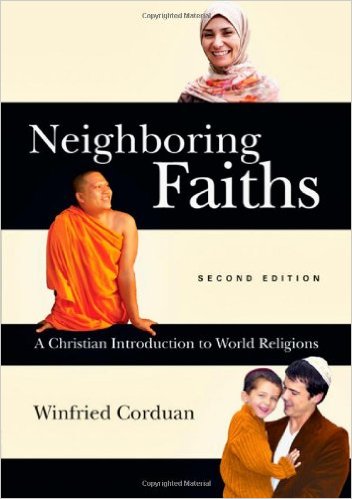
Winfried Corduan's Neighboring Faiths: A Christian Introduction to World Religions, is a great alternative to Huston Smith's textbook, The Religions of Man.

Winfried Corduan’s Neighboring Faiths: A Christian Introduction to World Religions, is a great alternative to Huston Smith’s textbook, The Religions of Man.

My well-worn copy of Huston Smith’s The Religions of Man still serves as a valuable, helpful resource on how not to be jerk when dealing with people who have different religious experiences. Smith’s work remains an invaluable contribution in helping people understand one another, appreciating those aspects of others’ spirituality that seem foreign to us at first, but that are often closer to our own experiences, upon further inspection. However, the cognitive dissonance in The Religions of Man ultimately forces the reader to make choices that are not necessarily helpful. I am more inclined these days to recommend Winfried Corduan’s Neighboring Faiths: A Christian Introduction to World Religions, which presents the same type of accurate, sensitive material that Huston Smith does, but Corduan accomplishes his work in a manner that does not betray the fundamental conviction regarding the uniqueness of Christ, and the imperative to share the Gospel with a hurting and wounded world.

Christian faith, in this respect, ultimately comes down to a commitment to a Person as Truth. To fail to grasp this is to fail to grasp the Christian message. You can still be fully committed to Jesus, and His mission to the world, without being a jerk. Just as it is possible to be married to one person, and still have deep, abiding friendships outside of that marriage, so it is possible for a committed follower of Jesus to love Hindus, Buddhists, Muslims and others for the sake of the Gospel. Let is us not treat our attitude towards the world religions as those who would rather endlessly “date” a myriad of people, seeking after a variety of religious experiences, forever experimenting, without ever making an exclusive commitment to a single person. A Biblical understanding of marriage shows us what this type of genuine commitment looks like. Let the follower of Jesus stay true to Christ, and love others around us with that love that only Jesus Christ can give.

For a more detailed look at the problem of religious pluralism from a Christian perspective, read this Veracity four-part series, #1, #2, #3, and #4.