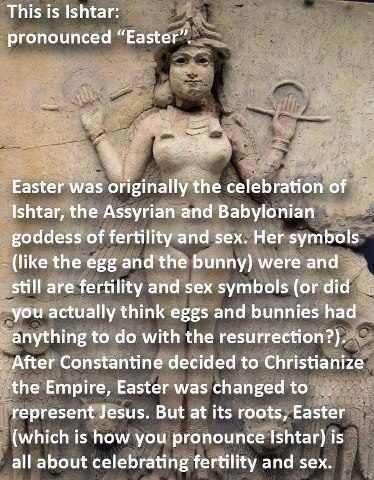
A few years ago, this image linking the celebration of Easter with the goddess Ishtar made its rounds on the Internet on various atheistic websites. Is there any truth to such claims? In short, this is complete nonsense. But sadly, some Christians propagate these ideas, too.
So, is the Christian celebration of Easter originally derived from a pagan holiday?
Just yesterday I overheard the idea that Christians are dishonoring Jesus by being involved in a celebration that involves the painting of eggs. This otherwise sincere believer understood that Easter eggs are associated with the pagan practices of child sacrifice.
I just about fell out of my chair.
Sadly, a lot of folks get their information these days from random Internet websites, rather than credible, researched resources. Much of the “free” content available on the Internet on these subjects today come from public domain sources where the copyright has expired, such as some scholarly works written in the 19th century. For example, a Scottish theologian, Alexander Hislop (1807–65) wrote a pamphlet in 1853, The Two Babylons, where Hislop lays out his theory of the connections between Easter, as celebrated traditionally among Roman Catholics, and Ishtar, an ancient goddess of fertility and sex. But more modern research has shown that such theories are without historical foundation. To make a long story short, Easter has its roots in the Jewish celebration of the Passover and Christ’s resurrection, not ancient fertility rites.
In his day, apologists like Hislop were very interesting in writing polemic works designed to criticize Roman Catholicism in an attempt to promote a more Protestant understanding of faith. But today, these same type of arguments are used by atheists to attack Christianity in general. To complicate matters even more, as traditional religions associated with European paganism are being revived in the West, you will find various groups, such as modern day Druids and Wiccans, who use the same type of pseudo-scholarship folklore to justify their practices as a polemic against Christianity!
Unfortunately, there are some evangelical Christians today, mainly associated with the Hebrew Roots movement, introduced briefly here on Veracity, that thrive on such supposedly convincing theories. It is true that many evangelical Christians are basically ignorant of the Old Testament and the Jewish roots of the Christian faith. So while the modern trend to have church-run Passover Seders in an attempt to make up for this deficiency could be a step in the right direction, mishandling of such practices might do more harm than good. In other words, if you think that a once a year church-run Seder is enough to ground the Christian believer in an understanding of authentic Jewish belief and Old Testament theology, then you are probably short changing yourself. If you really want to understand the Old Testament, there is simply no shortcut other than actually taking the time to read and study the Old Testament, or the “Hebrew Scriptures,” as many Jewish people would prefer to say. Furthermore, developing a friendship from an actively practicing Jewish person is probably the best education you can get!
The problem with much that goes on with the “Hebrew Roots” movement is that in their enthusiasm to get back to the Jewish roots of our faith, they inadvertently toss “the baby out with the bathwater,” all based in ignorance as they appeal to the conspiracy theory logic of those like Alexander Hislop.
Now, I am not much into painting Easter eggs, and if avoiding such practices help you to distinguish Christian faith from the revival of neopaganism, then that is perfectly understandable. But please do not take away my chocolate Easter bunny. Yum! Yum!
The main point here is that we should not allow atheists and pagans to hijack Easter. Our confidence in the Gospel is not grounded in conspiracy theories. Instead, it is about the celebration of our Risen Lord from the empty tomb!! Arm yourself with a knowledge of what the Bible teaches and credible scholarly research. Here are few recommended resources online for correcting some of the misconceptions about Easter:





 Veracity