Tag Archives: women in ministry

Head Coverings: The Hairstyle View

The fifth in the summer blog series on head coverings in 1 Corinthians 11:2-16…

Is 1 Corinthians 11:2-16 really about cloth head coverings…. or something else?

The Traditional, Hyper-Conservative, and Symbol of Protection views discussed thus far all suggest that the head coverings referenced in 1 Corinthians 11:2-16 are about some type of cloth covering the head. Or perhaps a hat of some sort? But what if the hair covering is simply the hair itself? The basic idea behind the so-called “Hairstyle” view of 1 Corinthians 11:2-16 is that whenever you see something like “head covering” in this passage you should think “hairstyle” or “hair length” instead.
Everything about head coverings in 1 Corinthians 11 (well, maybe not “everything,” but we try to hit the highlights here at Veracity)


Hair as a “Head Covering?”

This may over-simplify the argument for some, but there are two fundamental premises that underline this view. First, nowhere in 1 Corinthians 11:2-16 does Paul tell us the exact nature of this extra head covering that women are to wear. Readers often assume a type of cloth or hat, but Paul never explicitly says that.

Second, the key to unlocking this view is found in the concluding statement Paul makes about head coverings in verses 14-15:

Does not nature itself teach you that if a man wears long hair it is a disgrace for him, but if a woman has long hair, it is her glory? For her hair is given to her for a covering.

Paul says that a woman’s longer hair IS the head covering. There you go. Therefore, Paul is only talking about hairstyle when he is talking about head covering. Mystery solved!… (well…. sort of…. I will explain below).

Nevertheless, how this is all worked out in the rest of the passage requires a good amount of unpacking. Here is an outline used by egalitarian scholar Philip Payne as to how his interpretation of the hairstyle view works in 1 Corinthians 11:2-16:

  • 11:2 Praise for upholding the traditions Paul had taught them
  • 11:3 Theological introduction, establishing the basis for respecting for one’s source/head
  • 11:4-6 Critique of hairstyles which symbolize inappropriate sexual freedom in the Corinthian church
  • 11:7-10 Theological basis for not adopting these hairstyles symbolizing sexual freedom
  • 11:11-12 Affirmation of the equal standing of woman and man in Christ
  • 11:13-15 Argument from nature against adopting hairstyles symbolizing sexual freedom
  • 11:16 The churches do not have a custom of displaying sexual freedom through wild hair

To avoid getting too far into the weeds, we can just hit some of the main issues: For example, in what sense is hair itself a head covering? Some suggest that when the hair itself is “done up” in a particular way that this is the head covering. Others simply say that keeping a woman’s hair long is the head covering. The main point is to say that the Hairstyle view rules out the need to have some type of cloth or other means to cover the head.

Philip Payne suggests that verses 4-6 are primarily about discouraging sexual immorality. For a man in Corinth, long hair was a sign of him trying to be effeminate, and possibly leading to homosexual practice; that is two persons of the same sex engaging in physical intimacy with one another, which Paul definitely did not agree with. For a woman in Corinth, loose hair hanging down was a sign of sexual promiscuity, and abuse of the Christian’s freedom. Paul does not come out directly and say that sexual immorality is the problem, because he is trying to be discrete and not be crude, in his rebuke of the Corinthians.

The bottom line, as briefly noted in verse 16, concludes the passage by suggesting that in all of Paul’s churches men wear their hair short and women wear their hair long (or “done up”). Paul therefore wants the Corinthians to follow the same practice as found in all of the other Christian communities, and not argue about it.

What is interesting about this view is that there are egalitarians like Philip Payne, and even some complementarians, who agree that this passage is about hairstyles and/or hair length, and not a cloth hair covering. Furthermore, to make the discussion even more spicy, a lot of the research available today suggests that we have evidence for both men and women wearing cloth head coverings as part of pagan worship practices. But there are other cases where cloth head coverings were not to be worn. Mmmmmm…… The implications for how all of this should illuminate what is going on in 1 Corinthians 11:2-16 is disputed among scholars.

Is 1 Corinthians 11:2-16 teaching about a woman’s “head covering” with respect to the hairstyle, as opposed to a piece of cloth? Is long hair itself a “head covering?”


Hair as Long or Hair as “Done Up?”

But which perspective is Paul advocating for women?  Wearing the hair long, or wearing the hair “done up? Regarding the Hairstyle view, if one drills down a little deeper in verse 15, you can get at the heart of the debate between the “long hair” for women position and the hair “done up” position. Let us quote the verse again (ESV):

…but if a woman has long hair, it is her glory? For her hair is given to her for a covering.

Compare with the NIV 2011:

…but that if a woman has long hair, it is her glory? For long hair is given to her as a covering.

Note that the NIV 2011 interprets a bit more for us by repeating the reference to “long hair,” despite the fact that “long” is not actually in the second half of the verse. In that second half, it simply reads “hair” in the Greek, which is ambiguous, thus the ESV simply leaves the ambiguity in there, thus omitting the reference to the hair being “long.” Some then read this to say that having “long hair” is sufficient to indicate that having long hair is the covering.

However, those who say that the hair needs to be “done up,” so as to deter sexual immorality for the woman, wrestle with that word “covering” at the end of the verse, in Greek peribolaion , a peculiar word which will become VERY important to yet another perspective we will consider later in this blog series.

The generally accepted definition of peribolaion is “that which is thrown around.” Those who argue for the cloth head covering view contend that this should not be taken figuratively, since it makes sense to say that a cloth is what can be thrown around the hair. But the hair “done up” proponents say that it should be taken figuratively, in that hair that is “done up” on top of underlying hair should be best understood as “thrown around.” Proponents of this view, particularly Philip Payne, argue therefore that the “thrown around” aspect of wearing the hair “thrown around” itself, rules out the idea that Paul would approve of women wearing long hair by itself. Instead, a woman’s long hair should be “thrown around” itself, in much the same way a woman might wear a cloth covering.1

The details do get a bit tricky.

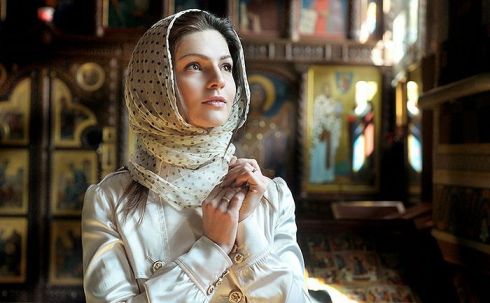
An example of a woman’s hair being “done up” consistent with the Hairstyle view of 1 Corinthians 11:2-16

No Cloth Head Covering?

It is helpful to note that the question of hairstyle versus a cloth head covering is fairly irrelevant for even certain complementarian interpreters of the passage. For them, cloth or no cloth, the issue has to deal with male headship, which involves either a more top-down view of authority, or a milder understanding having to deal with preeminence or prominence in the male-female relationship.

Nevertheless, the main idea associated with the Hairstyle view should be evident. In the Hairstyle view, this passage is not about a cloth hair covering. Rather, it is something about hair, either the hair length or how the hair is worn.

In our next installment in this summer blog series, we will look at the Quotation/Refutation view of 1 Corinthians 11:2-16. Listen up and buckle up, because the Quotation/Refutation view gets very, very interesting. Stay tuned!!

Notes:

1. In the Mike Winger video referenced in this first blog post of this series, Mike indicates that the evidence favors that it is cloth head coverings that Paul has in view. For a different approach that favors the hairstyle view, I would suggest investigating Andrew Bartlett’s study in chapter 7 of his Men and Women in Christ, reviewed recently on Veracity. Andrew Bartlett primarily follows the research by Philip Payne to conclude that cloth head coverings are not in view, thus favoring the hair “done up” position.  See this discussion for an elaboration of Philip Payne’s Hairstyle view on his website.


Head Coverings: The Symbol of Protection View

After a hiatus for the past few weeks, we continue with the fourth in the summer blog series on head coverings in 1 Corinthians 11:2-16….

Both the Traditional and Hyper-Conservative views of 1 Corinthians 11:21-6 generally assume that the women in Corinth were in some sort of rebellion, which prompted the Apostle Paul to issue some instruction to require the use of head coverings.

But is this “women in rebellion” assumption accurate? Another perspective, the “Symbol of Protection” view, as I call it, seriously questions that assumption, actually flipping it on its head.

Instead of admonishing the women of Corinth to put on a head covering, this perspective suggests the situation was ironically just the opposite. Women in Corinth were being encouraged to ditch the head covering, even though the women were hesitant to do so. Instead, the women of Corinth looked upon the head covering as a sign of protection, and Paul was chastising the Corinthians (mainly the men) for discouraging the women from wearing their head covering.

Everything about head coverings in 1 Corinthians 11 (well, maybe not “everything,” but we try to hit the highlights here at Veracity)

So, what was that all about? Like the Traditional view, this Symbol of Protection view takes the honor and shame principle seriously, but frames the idea very differently.1

Continue reading


Head Coverings: The Hyper-Conservative View

Announcing the third post in our summer blog series….

When you read 1 Corinthians all the way through, you run into a big problem trying to reconcile 1 Corinthians 11:2-16 with a quirky, often overlooked passage in 1 Corinthians 14. In 1 Corinthians 11:2-16, Paul is saying that women are praying and prophesying in church. He wants to urge these women to have some type of head covering, but the point is “mostly” accepted that the women are not silent in church. They are active participants in the communal worship experience.

The problem is that 1 Corinthians 14:34-35 on the surface says the exact opposite: “the women should keep silent in church….” concluding with, “….For it is shameful for a woman to speak in church.”

It looks as though Paul is contradicting himself. Critics of the Bible easily jump on this to say that the Bible can not be trusted because of its internal contradictions. I wrote a blog post a few years ago that explores this “Corinthian Conundrum” in detail, that hopefully makes better sense of this difficult passage, so I will not repeat the discussion here, other than to conclude that most interpreters have discovered that a completely flat reading of 1 Corinthians 14:34-35 does not fit the evidence at hand.1

Everything about head coverings in 1 Corinthians 11 (well, maybe not “everything,” but we try to hit the highlights here at Veracity)

However, there is a school of thought that goes about reconciling 1 Corinthians 11:2-16 and 14:34-35 in a completely different direction. It might be called the “Hyper-Conservative” view of 1 Corinthians 11:2-16, or just simply the “John MacArthur View.” The reason why I call it the “John MacArthur View” is because I first saw this in John MacArthur’s Grace Community Church in Los Angeles about 25 years ago.

Continue reading


Head Coverings: The Traditional View

Here is the second post in our summer blog series….

The Traditional view regarding the head coverings passage of 1 Corinthians 11:2-16 actually has a lot of parts to it. This blog series is not an exhaustive study, as there are bulky doctoral dissertations and commentaries that explore this passage in-depth. But here in this Veracity blog series, we will try to hit the highlights in bite-size pieces.

Everything about head coverings in 1 Corinthians 11 (well, maybe not “everything,” but we try to hit the highlights here at Veracity)

Continue reading


What About Head Coverings in 1 Corinthians11? — The New Testament’s Weirdest Passage?

A summer blog series….

If you had to take a vote, what would you say is the weirdest passage in the New Testament? Some might raise their hand and immediately say “The Book of Revelation.” Ok, that is a whole book, so how about something shorter?

What about Paul’s teaching on “baptism for the dead” in 1 Corinthians 15:29? Ok, that’s pretty weird, and yes, Veracity covered that about year ago. How about Jesus and that thing with the fig tree in Mark 11:12-21? Yes, that is a bit weird, too. But if I had my pick, it would be Paul’s teaching about head coverings in 1 Corinthians 11:2-16.

I mean, when I first tried to read the entire New Testament cover-to-cover back in high school, this one just jumped out at me: What in the world is Paul talking about? Here is the whole disputed passage from the English Standard Version:

2 Now I commend you because you remember me in everything and maintain the traditions even as I delivered them to you. 3 But I want you to understand that the head of every man is Christ, the head of a wife is her husband, and the head of Christ is God. 4 Every man who prays or prophesies with his head covered dishonors his head, 5 but every wife who prays or prophesies with her head uncovered dishonors her head, since it is the same as if her head were shaven. 6 For if a wife will not cover her head, then she should cut her hair short. But since it is disgraceful for a wife to cut off her hair or shave her head, let her cover her head. 7 For a man ought not to cover his head, since he is the image and glory of God, but woman is the glory of man. 8 For man was not made from woman, but woman from man. 9 Neither was man created for woman, but woman for man. 10 That is why a wife ought to have a symbol of authority on her head, because of the angels. 11 Nevertheless, in the Lord woman is not independent of man nor man of woman; 12 for as woman was made from man, so man is now born of woman. And all things are from God. 13 Judge for yourselves: is it proper for a wife to pray to God with her head uncovered? 14 Does not nature itself teach you that if a man wears long hair it is a disgrace for him, 15 but if a woman has long hair, it is her glory? For her hair is given to her for a covering. 16 If anyone is inclined to be contentious, we have no such practice, nor do the churches of God.

Some of the things that Paul says sound fairly straightforward, but certainly not all of it. Frankly, if you are like most Christians I know, you probably just gloss over this passage and move onto something else. Better to pretend that something this weird in the Bible did not exist, right?

Everything about head coverings in 1 Corinthians 11 (….. well, maybe not “everything,” but we try to hit the highlights here at Veracity)


Well, we probably know that if you really believe the New Testament to be God’s Word, then it might be important to try to make some attempt to understand this chunk of Paul’s letter to the Corinthian church. God’s self-disclosure in Holy Scripture is not just some random exercise where we can pick things we like and toss out the rest. For that would dishonor the Lord Jesus. Plus, every book of the Bible is its own literary unit. Simply picking out parts of the Bible and forgetting the rest is not a good recipe for really understanding the Bible. However, if most American Christians are honest, we would prefer to ignore this passage, and if you were even to ask Bible scholars about it, they might agree with you as to how difficult this passage is. It is one of the most hotly debated passages in New Testament scholarship.

In this series of blog posts, Veracity will attempt to make some sense about this passage. The significance of this passage is that it plays a vital role in the on-going debates regarding how men and women are to relate to one another in the church; in what sense are husbands to be “head” of the home, should women serve as elders in a local church, etc. This is part of the rather controversial discussion between so-called “complementarians” and “egalitarians” that has continued to divide believers from one another, resulting in church and denominational splits, particularly within the last sixty years, and more intensely within the last couple of decades. I have written about this debate at length on Veracity, in another blog series, but because 1 Corinthians 11:2-16 is just so weird, it really deserves special treatment all on its own.

This passage brings up a number of questions. Here is a sample:

  • What does “head” mean in this passage?
  • Is this passage about a physical head covering, or is it about the length of hair, comparing a man and a woman?
  • Is the teaching merely cultural, applicable only to Paul’s first century context, or does it have relevance to 21st century Christians?
  • Why does Paul bring up the topic of creation here?
  • Why does Paul talk about God’s relationship to Christ?
  • What does Paul mean by “image”, “glory,” and “nature” in this passage?
  • Does this passage contradict with what Paul says just a few chapters ahead, in 1 Corinthians 14, about women speaking (or not speaking) in church?
  • What is Paul’s mention about “no such practice” in verse 16 referring to?
  • Does this passage even belong in the Bible?
  • Is Paul refuting, instead of teaching, much of what we read here?
  • What is this whole thing about “because of the angels” in verse 10?
  • How do we apply this passage to us today?

As we head into the summer, over the next group of blog posts, I will write about different views that various scholars take regarding this passage, one by one. My wife often tells me that I typically just lay out different views about difficult parts of the Bible and I do not really land anywhere, and it frustrates her to no end! So, to try to make her a little happier, I will summarize each viewpoint in the successive blog posts, and then you can figure out where I might land in the final analysis. We can discuss different interpretations of the Bible, but in the end, there is a right and wrong way of understanding the text:

  • The Traditional View (well, at least it summarizes some of the main points that many Christians have agreed with for centuries).
  • The Hyper-Conservative View (otherwise known as the “John MacArthur” view)
  • The Symbol of Protection View (challenges the idea that head coverings signify something about authority)
  • The Hairstyle View (in other words, this is not about head coverings per se, but rather about male vs. female hairstyles)
  • The Quotation/Refutation View (Paul is refuting a Corinthian false teaching)
  • The Interpolation View (Someone stuck this passage in the Bible later on, or Paul himself put it in there, and then just ran away….. yeah, seriously)
  • The Supernatural Sexual Modesty View (otherwise known as the “PG-13” view…. that is, keep this away from young children)
  • Applying 1 Corinthians 11:2-16 Today (what do we do with all of this?)

It will take nearly the whole summer of 2023 to get through this, so I will try to make it more digestible in bite-size pieces. I will probably take a few breaks along the way, to spice things up.

I am not trying to say that I have the infallible perspective, but I do think that at least one viewpoint is far superior than others. If you do not want to read anything further in this series, and just want to watch a video, I would highly recommend the work of Christian apologist Mike Winger. Mike has done an excellent, thorough YouTube study of all of the relevant passages regarding the complementarian/egalitarian controversy, even if you do not find all of his arguments convincing. I have previously linked to most of his prior videos on this topic in my review of Kevin DeYoung’s book on this topic, from 2022. While Winger is not a Biblical scholar by trade, he has done quite a bit of homework, and his YouTube talks are high in quality.

However, his longest video is on this particular passage, 1 Corinthians 11:2-16. It comes in at a whopping 6 hours and 46 minutes. WOW!! I can not endorse everything Mike says in nearly 7 hours, but he is thorough. See the video below.

So, if you just want to read a much shorter summary of what Mike Winger says, in Veracity style, stick around for the following blog series. I land at a different place from Mike, but I do appreciate his work. Please feel free to follow on Veracity by clicking one of the “Follow” buttons on the right and/or enter your email address, then click “Follow.” Feel free to comment along the way, too.

Oh….and one more thing…. the reason why I am doing this series…. : About four years ago, my local church held a discussion about the complementarian/egalitarian controversy. The overall presentation was well done, but the discussion stirred up a lot of emotions that rippled through the entire church body, generating a lot of confusion and even frustration.

This particular passage on head coverings was mentioned in a period of just five minutes. Five minutes. That’s all.

I left the discussion having more questions than answers. Since then, not a single sermon, Bible study group, question and answer session, or anything else in our church has attempted to address this passage in a meaningful way. In defense of our church leaders, our church was not obligated to uncover every stone on this. But it still bothered me to have these questions and very few answers. So, since our church leadership decided to bypass this passage, I felt that I had no choice but to dig into this myself, if I was going to understand what Paul was teaching.

As an evangelical Christian, I believe that I have the opportunity and the obligation to share with others the Good News as presented in the Bible. But it is pretty difficult to share my confidence in what the Bible teaches to others who need to hear the Gospel when we effectively gloss over, or even skip, certain weird parts of the Bible, especially a passage that is partly responsible for dividing many, many churches and denominations in our current day. Here, I offer to you, my research into this vexing passage…. a passage that most Christians would rather ignore than talk about.

Veracity is different. Here at Veracity, we want to talk about it. We want to dig into the Scriptures. Why? So we can better handle God’s Word.

So stay tuned!!