Here we wrap up this review of Stephen De Young’s The Religion of the Apostles: Orthodox Christianity in the First Century, with an assortment a various topics, and some critical reflection.
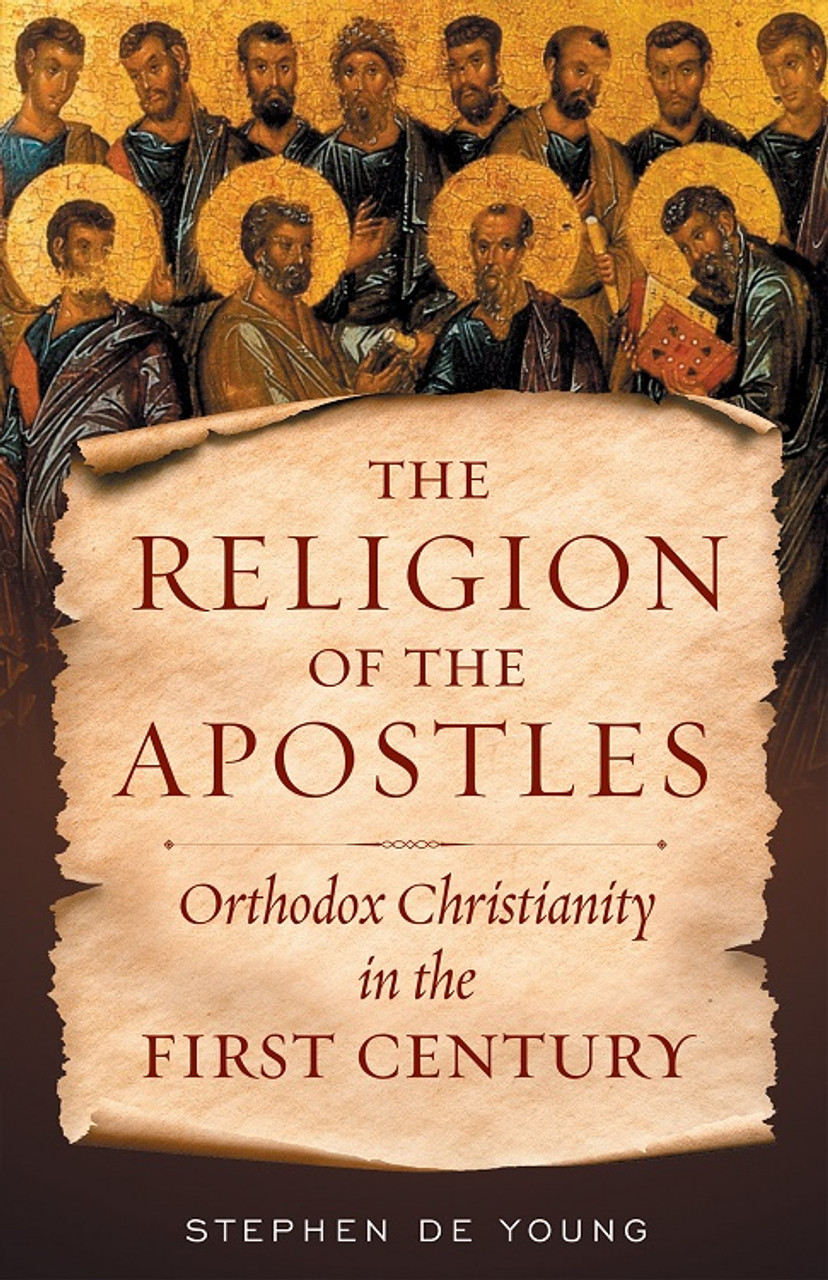
The Religion of the Apostles, by Stephen De Young, shows how the beliefs and practices of the early church connect with the world of Second Temple Judaism, the historical context for Jesus of Nazareth and the New Testament.
The most important parts of The Religion of the Apostles cover the Trinity, the Divine Council, and the Atonement. But after the chapter on the atonement we have a grab bag of topics that I will just toss into this last post of this book review, looking an Eastern Orthodox perspective on the earliest Christians, by Father Stephen De Young.
The Ten Lost Tribes …. and the Gentiles
The next chapter examines what took place to transition the Old Testament people of God, Israel, to that of the New Testament church, made up of both Jew and Gentile alike. De Young makes much of the mystery of what happened to the Ten Lost Tribes of Israel, who were conquered and deported by the Assyrians, about 150 years before the destruction of Jerusalem and the Southern Kingdom, by the Babylonians. The message of the prophets was to promise that not only would the Jews of the Southern Kingdom be restored to the land following the Babylonian exile, but that the Ten Lost Tribes associated with the Northern Kingdom would be restored as well.
De Young argues that the process of cultural assimilation of the Ten Lost Tribes meant that “the northern tribes could be restored only from among the Gentiles” (De Young, p. 230). While some might consider this as controversial, we see this in the Jewish “apocryphal” tradition preserved in Eastern Orthodoxy and Roman Catholicism: “The Hasmonean Kingdom, after the Maccabean revolt, formed a treaty with the Spartans in which they are said to be descendants of Abraham (1Mc 12:21)” (De Young, p. 230).
How else could these Spartans be considering descendants of Abraham if they were not somehow connected to the Ten Lost Tribes? While there is legitimate criticism that a kind of “replacement theology” unfortunately played a negative role in the early church after the destruction of Jerusalem in 70 C.E., De Young’s argument shows that the Scriptural treatment of the Ten Lost Tribes reveals just how “nonsensical” such a replacement theology really is, going back to a Second Temple Jewish context (De Young, p. 237).
This opens up a way of reading Paul’s enigmatic statement in Romans 11:26, “all Israel will be saved.” This may not sound like a big deal to most readers of the Bible, but it serves as a clue as to what Paul was really getting at in the Book of Romans, particularly Romans 9-11, by demonstrated that Paul was appealing to a known tradition within Second Temple Judaism, about the relationship between the Ten Lost Tribes and the Gentiles, as opposed to just making something up out of his own head.
Was Paul inventing his own weird interpretation of the prophet Hosea in Romans 9:22-26, as some critics of the Bible claim, like Rabbi Tovia Singer? Perhaps not!! The original context for Hosea 2:23 is a reference to Israelites conquered by the Assyrians, but Paul sees this as a reference to the Gentiles. Stephen De Young’s analysis offers a defense of Paul’s reading grounded in the thought world of Second Temple Judaism.
The Law of Moses and the Gentiles
The chapter on “The Law of God” argues that Christ indeed came to fulfill the Law, but that more recent developments in theology, particularly since the Protestant Reformation, have divided the Law of Moses into three categories: the civil, ceremonial, and moral commandments. It is generally thought that Christ fulfilled both the civil and ceremonial aspects of the Law, and yet the moral aspect is still binding on the Christian. However, De Young argues that this three-fold classification is not found in Scripture, as there are no divisions in the text regarding the meaning of the Law (De Young, p. 257ff).
The whole Law of Moses is fulfilled in Christ. The best way of understanding the fulfillment of the entire Law of Moses is through the Sabbath. “The first day of the week, then, becomes the Lord’s Day.” God’s people “now participate in the Resurrection of Christ in anticipation of their own resurrection and eternal life in the world to come” (De Young, p. 264).
The Council of Jerusalem, found in Acts 15, helps us to comprehend the relevance of the Law of Moses in the life of the New Testament church. An appeal to portions of Leviticus were made at the council as the means by which Gentiles can be brought into the community formerly made up of Israel alone, by instructing Gentile believers to follow four commands: to abstain from food dedicated to idols, sexual immorality, from meat with blood still in it, and from blood. It is in this sense that the Law of Moses still applies to all Christians.
Therefore, all four commands of these commands are binding among Christians today. Refusing to eat food offered to idols is still to be followed, as well as the prohibition against sexual immorality, which has been challenged in recent years by certain Christian groups. The author does mention that the eating of blood, and the eating of meat with blood still in it is connected to the context of pagan worship in Leviticus 17:10-14 (De Young, pp. 264-265).
But he does not go into detail on the specifics of how this should be applied today, a significant drawback in this particular chapter. Nevertheless, De Young insists that Eastern Orthodoxy consistently seeks to apply these four commands even today, as well as holding to more ancient worship practices more closely associated with the “ceremonial law,” whereas both Protestant and Roman Catholic Christians have shifted away to varying degrees from such practices, which were standard in the first century church (De Young, pp. 264-275).
As an evangelical Protestant, I am not wholly persuaded that the three-fold distinction of the Mosaic Law, as articulated by John Calvin in his The Institutes of the Christian Religion lacks the Scriptural basis that De Young says it does. But he does make a good argument that the Acts 15:19-20 ruling for accepting believing Gentiles among the people of God is still in force. However, I am inclined to think that the restrictions against eating food from animals still with blood in them, and against eating strangled animals generally, are really admonitions to stay away from practices associated with idolatry. In most Western contexts today, as opposed to theologically-oriented customs in the Ancient Near East, the eating of animal blood has little to do with idolatry.
In the Ancient Near East, animals that were strangled still had blood in them, and since blood has been understood as the symbol of life, and the surrounding pagan cultures around the Israelites used such blood in their worship practices, the Old Testament instructs the people to stay away from such idolatrous worship practices. But while the use of blood is generally not common in idolatrous worship practices today, at least in the Western secular world, there are plenty of idolatrous worship practices that Christians in a secular world context should still stay away from.
Baptism Fulfills Circumcision
De Young closely associates the practice of baptism with being a fulfillment of circumcision. In this way, just as infant Jewish boys were circumcised, so in Christ’s church both infant boys and girls are to be baptized. This is not that far from a covenant theology approach dating back to the Protestant Reformation, which affirms infant baptism, without getting bogged down in certain aspects of baptismal regeneration, which most Protestants vigorously reject; that is, the idea that the very act of baptism in and of itself in some sense saves the person.
“…baptism, like circumcision before it, was never an individual act or pledge. Rather, it has always been, from the very beginning, a communal act of family, clan, tribe, and nation; the new nation that is called by Christ’s name, the Church” (De Young, p. 284).
The emphasis on baptism as a communal act, and not an individual one, is a pretty foreign idea to Western Christians. Baptism is about drawing the believer into the life of the covenant community, just as circumcision identified the Old Testament Jew as a member of national Israel. I wish Stephen De Young would have explained this communal sense of baptism some more.
Linking the Presbyteriate of the Church to the Elders of Israel: The Sacramentality of Eldership
This is a bit of a rabbit trail, but it is an important one. De Young defends the origins of the clerical orders of the church by connecting them back to practices in ancient Israel and Second Temple Judaism. The dominant scholarly narrative has been that the development of church order did not arise until the late first century at the earliest, or even into the second century. This scheme of church order, as articulated primarily in the Pastoral Epistles (1 Timothy, 2 Timothy and Titus) sought to domesticate Paul’s message to make it more palatable to the social standards of Greco-Roman culture:
“This narrative has been put forward with such force that it has been used to argue for a later dating of any book of the New Testament that mentions the Church or her orders. In the case of the Pastoral Epistles, it is used to argue that they must be minimally sub-Pauline, reflecting later developments after the end of the apostle’s life” (De Young, p. 288).
In other words, this common scholarly narrative suggests that some admirer of Paul forged letters (the Pastoral Epistles) to make them sound Pauline, but in doing so, changed Paul’s message to make his teaching appear to inline with the cultural standards of the day.
In contrast, according to De Young, Paul really did write the Pastoral Epistles, and he did so with a genuine reason in mind going back to the Old Testament. The great apostles of the early church functioned much like the elders selected by Moses, the seventy, who assisted him in governing the Israelite people in the wilderness (Numbers 11:16-17). Paul then describes what this apostolic ministry looked like in 1 Corinthians 4.
Once the original apostles begin dying and are removed from the scene, the “episkopos,” or “overseers” or “bishops,” take upon themselves the continuation of the unfulfilled apostolic task. The “episkopos,” sometimes translated as “herdsman” in the Greek Old Testament, are often interchangeably associated with the “presbyters,” the elders of the church. These overseers/elders are charged to maintain continuity with the original apostolic ministry. In addition to the episcopate and presbyterate (made up of qualified men), an additional level of ministry leadership was added and fleshed out by the second century, to include both a male and female diaconate (De Young, pp.290-291).
It is interesting that De Young ties the New Testament concept of elders to the elders of ancient Israel, and not to the Levitical priesthood. For many Protestant Christians today, it is still somewhat confusing when the concept of “elder” (“presbyter,” in Greek) is often interchanged with the notion of “priest.” But when one realizes that the term “priest” is simply the shortened version of “presbyter,” this should be less problematic to those Protestants who are wary of connecting “elder” and “priest” together. In other words, a “priest” in the early church did not strictly correspond to a Jewish Temple “priest,” if it did at all.
We know this from the New Testament as the Book of Hebrews (Hebrews 7:13-17) mentions that Jesus is a priest, not in the order of Aaron, but rather in the order of Melchizedek, a point that De Young brings out (De Young, p. 286). De Young does not connect the dots here, but this would suggest that the concept of New Testament “elder” is tied back to this earlier notion of priesthood, and not the priesthood of the Second Temple. The Levitical priesthood, associated with the ritual of the temple, which no longer physically exists, has now been superseded by the final sacrificial ministry of Christ. But the concept of priesthood more generally, as with the priesthood of Melchizedek, still has relevance.
There is, of course, the “priesthood of all believers” which suggests that Christ is the sole mediator between believers and God. Nevertheless, there is still a kind of continuity that the New Testament concept of presbyter (elder) has with the Old Testament, demonstrating that the office of elder by the early Christians was not simply some invention without precedent. Elders are not “above” other believers, as though they are members of a superior class, but they do serve a specific sacramental function in the life of the local church.
Many Protestants tend to miss this, ignoring the sacramental function of New Testament “elder,” however ill-defined this might be, for fear that this might be confused with the more medieval sacerdotal practice of Roman Catholicism. Granted, there is no explicit teaching found in the New Testament which links the Old and New Testament concepts of “elder” and “sacrament” together, but De Young makes a strong case that the early church did understand it this way. When “elder” is understood without a sacramental sense standing behind it, then the notion of “elder” in Protestant circles tends to get relegated to the sense of the person or persons “in charge,” or a purely administrative “board of directors,” which does not carry the proper sense and function of the New Testament word.
Presbyters (Elders)… And “Women in Ministry” in the Early Church
Furthermore, while De Young also does not mention this, his reasoning would further explain why Jesus only selected men to be his twelve apostles, despite the fact that women figured prominently in Jesus’ earthly ministry, several of whom effectively bankrolled the itinerant movements of the wandering band of Jesus’ disciples, and who were the first witnesses to the Resurrection.
Some have suggested that Jesus only selected men to be among “the Twelve” in order to be sensitive to the cultural norms of the day. But this argument is highly problematic. For example, this type of egalitarian apologetic does not seem consistent with the Jesus who made mincemeat of other cultural norms of the day, by publicly rebuking Pharisees, challenging normative interpretations of the Sabbath laws, throwing out the money changers in the Temple, and even challenging the very Temple system itself. Why would Jesus be so forceful in challenging those cultural norms of the day while being so timid with the question of women being possible candidates among the Twelve?
Instead, it is apparent from reading The Religion of the Apostles that the Paul’s establishment of the office of elder (presbytery) is meant to continue the apostolic ministry that he, and other apostles, original represented, to ensure that the Christian movement would stay on the right track, after that original group of apostles were dying off and leaving the scene. In the pastoral letters in particular, Paul is greatly concerned about false teachers corrupting his own teaching that he was trying to pass on. This is why Paul charged the elders of the church in Ephesus to properly stay in alignment with his teachings and to protect the people (the sheep) from being led astray from false teachings, as Paul was quite clear that he would not return to them (Acts 20:17-38).
It follows then, that it would be consistent that Paul would restrict the office of elder/overseer in 1 Timothy to be only for qualified men, while still affirming the leadership roles of women in other areas, like deacon. If Paul believes that the office of elder/overseer was meant to carry on the role of the original apostles, once the apostles were dead and gone from the earthly scene, as was evidently the case in the early church, then it would make sense for Paul to only designate qualified men to serve as elders/overseers, consistent with how Jesus designated those who were among the Twelve.
De Young’s treatment of the development of the presbytery (office of elders) resolves a number of lingering questions in my mind. For if Paul indeed did follow Jesus’ model for selecting the twelve male disciples to be the original group of “elders,” and copy Jesus in establishing the presbytery to continue the apostolic ministry of that first generation of Jesus’ inner circle, it does raise the question as to why both Jesus and Paul had only men in mind for this, considering that women were also highly valued as disciples and in exercising leadership functions themselves.
Yet De Young demonstrates that it was not the Aaronic line and its association with the Jewish temple priesthood that Jesus or Paul had in mind to emulate. Rather, it was the position of Jewish elders grounded in the twelve patriarch fathers of Jacob’s sons that served as the model. Jesus’ selection of twelve Jewish men as apostles was therefore not simply a one-time, one-off fulfillment of some Old Testament prophecy, but rather, it set a pattern for the early church moving forward beyond the lifetimes of those original twelve.
We might also add that the priesthood in the order of Melchizedek is relevant. De Young associates the celebration of the Lord’s Supper as being an imitation of the priesthood of Melchizedek (De Young, p. 287). The office of elder can be thought of as a sacramental reminder that the local church is a kind of expression of the twelve tribes of Israel, extending back through history, preserving a long line of family lineage. I am only guessing, but it would have been more helpful if Stephen De Young could have “tied off the bow” with the discussion, as this seemed to be where he was aiming.
All of what has been noted above concerning the office of elder is hotly contested within Protestant evangelical circles today. The debate among complementarian and egalitarian Christians continues to divide Protestant evangelicals, as to the roles of women and men in church leadership. Complementarians insist that Paul’s directive in 1 Timothy 2 & 3 has a universally binding character, while disagreeing amongst themselves as to how the distinction between men and women in church office is to be applied. The main feature common among most complementarians has been that only qualified men are to serve as elders in a local church, whereas there are no gendered restrictions anywhere else in the New Testament church. In other words, women may lead in the church in various ways, but that the office of elder has been reserved for qualified men.
Alternatively, egalitarians, at least the most exegetically sensitive ones, say that Paul’s teaching regarding men and women in 1 Timothy suggests a different context, focusing on the particular issue of female false teachers in Ephesus specifically. Many such Protestant egalitarians reject any sacramental function served by local church elders, preferring a more secular-type role for elders in terms of Christian leadership. Yet this egalitarian perspective is inconsistent with a more general, universalizing design for church offices, a view classically held by Eastern Orthodox thinkers, including Stephen De Young.
Is the New Testament Canon of Scripture Fixed? In Eastern Orthodoxy, the Answer is Yes
The charge of misogyny against the early church in terms of women in local church leadership is a highly sensitive matter in today’s culture. Much of the controversy stems back to how early church history is interpreted. Yet as I have suggested before, if it could be successfully argued that the pastoral letters of Paul, including 1 Timothy, were indeed outright forgeries, then this would most simply settle the matter in favor of the egalitarian concerns, without the complex exegetical gymnastics often associated with those egalitarians who try to defend Pauline authorship.
But there is no indication that such a revision of the canon would ever be accepted in Eastern Orthodoxy. Nor does there seem to be any significant felt need to attempt such a revision. I doubt that such a re-evaluation of the canon of the New Testament will take place in other branches of Christianity, like Roman Catholicism or Protestantism (except for perhaps progressive Christian Protestants). While many modern scholars have their doubts about the authenticity of 1 Timothy, Eastern Orthodox tradition solidly affirms 1 Timothy as genuinely Pauline, and started to do so fairly early within the history of the early church. As indicated by De Young, the whole array of Eastern Orthodox church offices depends upon the entirety of the tradition drawn from the pastoral letters, primarily including 1 Timothy.
Yet while Stephen De Young sees a certain kind of continuity between the Paul of 1 Timothy and his Second Temple Jewish forebears regarding relations between men and women in the worship assembly, there is also a discontinuity. Some, though not all, Second Temple Jewish texts do suggest a kind of misogyny. For example, the pseudepigraphical Apocalypse of Moses, which scholars date as a Jewish writing from the time period of Jesus, reads a completely different twist into the Genesis narrative. According to the Apocalypse of Moses, Eve and the serpent had a sexual relationship with each other, at the instigation of the devil. A plot was then conceived to cast Adam out of the Garden of Eden. In contradiction to Genesis, Adam was not even present when Eve and the serpent had their discussion about the forbidden fruit, thereby deceiving the innocent Adam in the process.
Nevertheless, the early church rejected this particular narrative, in favor of a different tradition within Second Temple Judaism. In other words, it is better to speak of “Judaisms” in the plural as opposed to “Judaism” in the singular when when we think of the Second Temple Jewish tradition.
The early church followed certain strands of Judaism, or certain “Judaisms,” while rejecting others. Some of these rejected “Judaisms” helps us to explain how certain Christian heresies became popular in the early church. For example, the Gospel of Thomas, probably dated to the second century, was deemed not worthy of inclusion in the New Testament canon, in part because of its teaching that women must somehow become men in order to find salvation, a view which historic orthodox Christianity, in both the East and the West, flatly rejected. If there is ever clear evidence of misogyny in the early centuries of the Christian movement, it was surely in the kind of Gnostic heresy reflected in the Gospel of Thomas.
Paul’s push towards having a female diaconate, most exemplified by the example of Phoebe in the Book of Romans, shows clear evidence of being accepted within early Christian communities. The common assumption that women never had leadership positions within the early church is without foundation, as the ministry of the diaconate served a vital role in the early centuries of the Christian church. Nevertheless, the practice of having a female diaconate faded out in later years of Eastern Orthodoxy. It suggests to me that given the evidence at hand, Scriptural and historical, that Eastern Orthodoxy might be open towards re-establishing a female diaconate…. or at least they should.
Critical Evaluation of The Religion of the Apostles: MORE FOOTNOTES PLEASE!!
One other observation to note in Religion of the Apostles is the lengthy discussion regarding the peculiar reference in 1 Corinthians 15 about the “baptism for the dead” in the chapter about redeemed humanity’s role within the Divine Council (De Young, pp. 161ff). But this must be saved to a future blog post.
While The Religion of the Apostles is very thorough and helpful, there are some drawbacks with the book. The most troubling is the unevenness regarding De Young’s footnotes. Sometimes De Young pinpoints the ancient Second Temple sources he uses to make his case. But too many times De Young fails to adequately cite his sources, leaving the reader with incomplete footnotes. To me this explains why some other reviewers of The Religion of the Apostles have concluded that De Young is over promising what he actually delivers in the book.
Perhaps De Young opted to try to keep his footnotes to a minimum in order to make his book more accessible to his intended audience. I can imagine that if De Young would have fleshed out his footnotes it might have doubled the size of the book, and he did not want to do that. If this is the case, then perhaps De Young should consider a second edition of The Religion of the Apostles with more extensive footnotes, enabling readers to better see for themselves what sources he is using.
Some claims are even made by De Young that lack any source citation whatsoever. “The four rivers that flow from Eden are the Tigris, the Euphrates, the Nile, and the Danube” (p. 174). Those last two rivers are typically found in English translations of Genesis 2:10-14 as the Pishon and the Gihon, which are not the same as the Nile and the Danube, at least to my knowledge. So, where does De Young get the Nile and Danube from? De Young is assuming certain details as common knowledge among his readers, which is not the case.
Eastern Orthodox Apologetic Stumbling Blocks
The apologetic purpose of Stephen De Young might serve as a stumbling block for those who might benefit the most from his book. There is plenty in The Religion of the Apostles which will ruffle the feathers of those outside of the Eastern Orthodox tradition. Evangelical egalitarians will bristle against the idea that the concept of a male-only presbyteriate goes back to Jewish sources grounded in the Old Testament, and perhaps even Jesus’ selection of twelve men as the original apostles, as opposed to some adoption of Greco-Roman misogyny which supposedly crept into the early church, as some evangelical egalitarians imagine.
Evangelical Protestants of all stripes will find offense at the suggestion that Protestants have erred by leaving a deep hole in the history of God’s revelation, by ignoring various books of intertestamental literature (known as the “Apocyrpha” in Protestant circles), which the Eastern Orthodox consider to be Scripture (De Young, p. 14). Roman Catholics will be chagrined at charges of unwarranted accretions in the Catholic Mass, and other areas of Roman Catholic doctrine (De Young, p. 285), for which the Eastern Orthodox see as innovations away from the original religion of the apostles.
As might be expected from an Eastern Orthodox theologian, De Young cites evidence from the Old Testament which affirms the veneration of Mary, as the “Theotokos,” though not certainly not as dogmatic as what you can find from some Roman Catholic writers. De Young cites 1 Kings 2:19 to show that Solomon had a second throne placed on his right hand for his mother, Bathsheba, as queen, establishing the precedence for Marian devotion which arose during the early church period (De Young, p. 152). Protestants probably will not find such evidence to be convincing. Along with a variety of other Eastern Orthodox distinctives, there will be Roman Catholic and Protestant readers who will not be persuaded by particular arguments made here and there.
The Religion of the Apostles of the First Century: Tied to Certain Second Temple Judaic Traditions
However, the greatest value of The Religion of the Apostles is not in its apologetic for Eastern Orthodoxy, but rather in its tying the earliest beliefs and practices of the Christian church back to beliefs and practices associated within Second Temple Judaism. Stephen De Young may or may not present arguments which will ultimately sway readers to embrace Eastern Orthodoxy. For example, I remain currently unpersuaded by Stephen De Young’s apologetic, but I appreciate the challenge he brings to some of the deficiencies of evangelical Protestantism. Nevertheless, De Young challenges the evolutionary notion that much of the early church beliefs and practices were pure innovations disconnected from the Second Temple Judaism that preceded it. This insight is worth the price of the book alone.
As one can probably tell from the length of this review, over multiple blog posts, The Religion of the Apostles is a remarkably substantial book coming in at about 320 pages. But while the topics covered are many, the argumentation is concise, dealing with fundamental matters of doctrine, and answering many, many questions about the Bible along the way.
Much of what Stephen De Young writes about, particularly as that which pertains to theological strands within Second Temple Judaism and the Divine Council, will be new to some readers. But De Young’s book should sufficiently demonstrate that the contribution of contemporary scholarship which seeks to retrieve significant elements within Second Temple Jewish thought is far from being “new,” as some uninformed critics have wrongly claimed. As a reminder, it is important to repeat that Second Temple Jewish thought was wide-ranging, and that the teachings of the New Testament fall in line with certain particular elements of Second Temple Jewish thought, and not the whole range of Second Temple era ideas. In summary, the thematic content addressed in The Religion of the Apostles goes back to the early church era, and even beyond that, back to particular strands of Judaism in Jesus’ day, which is also the main point made by the late Protestant Old Testament scholar, Michael Heiser, in his book The Unseen Realm.
In many ways, The Religion of the Apostles is the Eastern Orthodox version of Michael Heiser’s work found in The Unseen Realm. (Father Stephen De Young is also pleasant to listen to, as his narrates himself the whole of the Audible audiobook version of The Religion of the Apostles).
Stephen De Young’s treatment of the development of the doctrine of the Trinity stands out as a particularly helpful apologetic for Nicene orthodoxy. The same could also be said regarding the doctrine of the atonement, offering a bridge where common ground can be held for Western and Eastern Christians alike.
I can engage with at least one friendly critic briefly at the end of this review here. Kaspars Ozolins, a research associate at the Tyndale House in Cambridge, England, and a thankfully informed, sympathetic, and competent reviewer of efforts to educate the church about Divine Council theology, still says that an emphasis on the Divine Council “is sometimes imbalanced and suffers from a deliberate attempt to downplay the church’s historical engagement with Scripture.” Yet readers of The Religion of the Apostles will find a cogent argument which does the exact opposite, emphasizing the church’s historical engagement with Scripture to make its case for continuity between historic Christian orthodoxy and Second Temple Judaism. Evangelicals would do well to take such Divine Council theology more seriously as an apologetic answer to those critical scholars, going back to the German higher critical movement of the 19th century, to say that early Christianity, and even the New Testament itself, was primarily a product of syncretism with Hellenistic philosophy and theology.
Those who are skeptical about the theology of the Divine Council would do well to read The Religion of the Apostles, to show just how much various early church fathers accepted certain Second Temple Jewish interpretive traditions into their reading of the New Testament. I just wish that Stephen De Young would have beefed up his footnotes and interacted more with critics. Hopefully, such criticism will get back to De Young, and spur him on in writing an expanded future second edition of this important work. But if footnotes do not matter to you, you will still benefit from Stephen De Young’s expert combination of scholarship grounded in Second Temple Judaism and the teachings of the early church.





 Veracity