Tag Archives: Wayne Grudem

2 Corinthians 5:21 — The Heart of the Gospel Message, or A Defense of Paul’s Apostolic Ministry?

2 Corinthians 5:21 is one of most memorable verses in the Bible. In the NIV translation, it reads: “God made him who had no sin to be sin for us, so that in him we might become the righteousness of God.”

But it is also one of the most controversial verses in the Bible. Who knew?!

For Martin Luther, the greatest voice of the Protestant Reformation, 2 Corinthians 5:21 succinctly summarizes the heart of the Gospel message, that a “great exchange” has taken place:

“That is the mystery which is rich in divine grace to sinners: wherein by a wonderful exchange our sins are no longer ours but Christ’s and the righteousness of Christ not Christ’s but ours. He has emptied Himself of His righteousness that He might clothe us with it, and fill us with it. And He has taken our evils upon Himself that He might deliver us from them… in the same manner as He grieved and suffered in our sins, and was confounded, in the same manner we rejoice and glory in His righteousness”  (Martin Luther, Werke (Weimar, 1883), 5: 608).

Many Protestant theologians argue that 2 Corinthians 5:21 best articulates the concept of imputation, which describes the mechanics of how the doctrine of justification by faith “works” (no pun intended). To “impute” something in common everyday English usage often has a purely negative connotation, as in “to impute guilt to somebody,” but in Christian theology, there is a lot more going with “imputation.” This theological concept of “imputation” comes from a bank accounting metaphor, as in to “credit” something to someone’s bank account. Essentially, every human being has a debt that we can not pay on our own, because of sin. The good news of the Gospel suggests that Christ has paid that debt by means of a credit to our spiritual banking account.

2 Corinthians 5:21 has what has been described as a “double imputation.” First, it says that Christ who had no sin had sin imputed (or credited) to him, when Jesus died on the cross. Secondly, the work of Christ then results in imputing the righteousness of Christ to the believer. As a result, a believer in Jesus, who is guilty of sin, has the verdict of guilt exchanged with the very righteousness of Christ, a verdict of “paid in full,” something we do not deserve. In other words, because of this “great exchange,” when God looks at a believer in Jesus, God no longer sees our sin, but rather God sees the righteousness of Christ instead. This is the heart of the Gospel message.

However, not everyone agrees that this concept of the imputation of Christ’s righteousness is being taught in 2 Corinthians 5:21. This is “fightin’ words” in some circles as 2 Corinthians 5:21 is often regarded as THE definitive, “go-to” verse teaching the imputation of Christ’s righteousness, more than any other verse in the New Testament. Christians who look to great historical figures of the Reformation, like Martin Luther and John Calvin, cling to this understanding of 2 Cornthians 5:21 as foundational to our understanding of salvation. Others however are convinced there is no concept of imputation to “go-to” in 2 Corinthians 5:21.

Herein lies the focus of the controversy.

Are you ready to rumble???  Reformed theologian Wayne Grudem is: …. (Read on to learn more about the controversy)

Continue reading


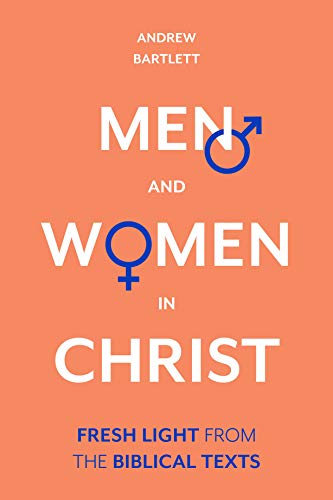
Men and Women in Christ, by Andrew Bartlett. An Extended Review.

Engaging in an online discussion can lead to some interesting outcomes.

In early 2022, I corresponded with a Christian author from the U.K., Andrew Bartlett, about the complementarian/egalitarian debate. Earlier I had heard of a book written in 2019, Men and Women in Christ: Fresh Light from the Biblical Texts. Little did I know that my online interlocutor had written this thorough examination of the Bible’s teaching regarding men and women in the family and the church.1

I promised Andrew that I would read his book, only to discover that while 100 pages into his 648 page book (according to Kindle…. 430 pages in the hard copy version), that this really is a big book!  Andrew is a lawyer and arbitrator, with a background in theology, so it really should not have been a surprise. I had to put the book down and try to come back to it, every now and then, over the past year and a half. Then an email from Andrew a few months ago convinced me that I should finish the book and offer a review. By the time I finished, I ended up with the following article that best summarizes my reflection on the men/women debate in the church to date, after four years of research and blogging. So, you might want to go grab a beverage, a nice chair to sit in, and perhaps even a Bible before I go on…

The length of the Men and Women in Christ: Fresh Light from the Biblical Texts will be a drawback to some readers, who simply will not have the patience to wade through many pages of detailed analysis and argumentation. This is unfortunate since there are many, many rewards the book has for the reader, filled with insights, and being exceptionally thorough, without getting overly technical.  In other words, mere human beings without a PhD can read this book, and walk away with an understanding why this issue is so complex. Men and Women in Christ: Fresh Light from the Biblical Texts interacts with a vast array of literature on the topic, published over the last several decades, which makes it essential reading for anyone desiring to dig deep into the debate. Regardless of what one ultimately thinks of Andrew Bartlett’s thesis, Andrew is a great dialogue partner, and he has done the Christian church an invaluable service with his thorough and careful analysis. So, thank you, Andrew (assuming you read this)!!

Continue reading


THEOCAST (Evangelical Discretion Is Advised)

In his Veracity video interview, Clarke Morledge described his theological leaning as, “Reformed with a small ‘r’.” What in the world does that mean? Is it about the mode of baptism, or is there more to it than that? Clarke?

Our church is currently working through Wayne Grudem’s foundational   Systematic Theology.  Grudem describes his theological perspective as ‘Reformed.’ The glossary in his indispensable text defines Reformed as, “Another term for the theological tradition known as Calvinism.” Who am I to disagree with one of Evangelical Christianity’s foremost 21st Century theologians, but I’m not sure that Reformed = Calvinism.

These and many other potentially thorny topics are the subjects of a new blog and YouTube channel. Theocast is, “Four broken men and their humble attempts to explain infinite grace with finite minds. Simply just adding to the ongoing (2,000-year) conversation about biblical and theological matters from a reformed perspective.”

Theocast

These four pastors are sharp. If you watch their About Us video, they describe their goal to give everyone access to discussions you don’t hear in ‘normal’ conversation. They have gone to great pains to do so, and they do it very well.

If you’re a little worn out listening to shallow conversations, give these guys a try. You may not agree with their perspectives and opinions, but you will probably learn something interesting.