How does an evangelical Christian respond to all of this? In defending the Unconditional Conference sponsored by Embracing the Journey, Andy Stanley has got some things right, while also getting some other things wrong.
Megachurch pastor Andy Stanley. Promoter of Biblical truth… or compromiser?
What Andy Stanley Gets Right
First, let us consider what Andy Stanley got right. Aside from the confusion experienced by many young people themselves today questioning their sexual and gender identity, the trauma that many Christian parents of such children face, trying to figure out how best to respond and love their children, can be extremely difficult and bewildering. Aside from a few pockets here and there, a long history of full-blown hatred against LGBTQ+ persons is finally starting to disappear, but there are still problems with the emerging, hopefully more-compassionate, less-combative approaches.
Unfortunately, there seems to be two paths currently taken in certain evangelical circles these days. One path might best be called the “stick your head in the sand” approach. Many such Christians simply want the LGBTQ+ discussion to go away. But that simply will not do. The data is not fully in yet, but some suggest that as many as one out of four young people today, growing up in the age of social media, wrestle with either a sense of sexual attraction to the same sex, or experience a sense of discomfort or anxiety about their own gender identity. Do the math. At least one out of five, but perhaps even one out of four. The sheer numbers are staggering. The LGBTQ+ discussion is not going away anytime soon.
The other path is to at first write into a church’s statement of faith or covenant a commitment for membership to only support traditional marriage, between one man and one woman. While this honorable stand for 2000 years of church teaching is taken, the church then sadly provides very little in terms of helping young people work through these questions of sexual and gender identity, as well as not providing sufficient resources for parents and other family members of such young people to work through their questions and struggles.
In this sense, Andy Stanley was right to break out of both the “stick your head in the sand” approach as well as the purely moral posturing approach, which offers little to no practical help. Andy Stanley was right to sponsor a conference intended to offer pastoral help and assistance for parents who want to know what to do when their son or daughter does not know if they are a “son” or a “daughter,” or if their son or daughter finds themselves attracted to members of the same sex. Parents need a safe space where they can share their stories, and listen and learn from one another, so that they can better know how to support their children.
According to a Sean McDowell video posted below, Alan Shlemon of Stand to Reason attended the conference and reported that some of the sessions were very helpful in creating that kind of safe space, which is so desperately needed today. Thankfully, there are more and more resources available today that can help parents be equipped to better deal with these issues in their parenting. One that I can recommend is the Center for Faith, Sexuality and Gender. I was able to convince just a few of the staff at my church to attend such a training event a few years ago. I wish I could have gotten a few more to attend, but a few is much better than nothing!
Andy Stanley’s most knee-jerk critics should keep these positive points in mind before piling on against Andy.
What Andy Stanley Gets Wrong
On the other hand, there are some other things that Andy Stanley got wrong. I will note one thing in particular. Some of the speakers at the Embrace the Journey conference affirm a traditional, historically orthodox view of marriage and gender identity. That is great. However, not all of the speakers do so.
According to Shlemon, two of the speakers were gay men already participating in what is commonly known today as same-sex marriages. While there was no overt attempt to try to argue against a traditional view of marriage by the speakers, promotional material written by such speakers at the conference was made available to participants, seeking to challenge the traditional view of marriage.
In a Sunday sermon, Andy Stanley offered a response to critics, noting that North Point Community Church still teaches an historic view of marriage as being between one man and one woman, while still defending hosting the Embracing the Journey conference. As he put it, the Embracing the Journey conference was not a theology conference. Rather, it was a pastoral conference.
Here is the problem which Andy Stanley faces. On the one hand, theologically, Andy Stanley appears to be saying that his church still affirms an historic orthodox view of Christian marriage in its teaching. So far, so good. At the same time, the church is hosting a conference where several of the speakers hold a position on marriage which is out of step with the official position of the church. This is confusing.
Was North Point Community Church offering a conference where the speakers were being “platformed” by the church? Or was the conference simply an invitation to “have a conversation?”
I am all for the idea of dialogue. I am all in support of having conversations with people with whom I disagree. Churches should not be afraid to sponsor such conversations. But there is a huge difference between “having a conversation” and actually giving a platform for a speaker, who holds views which are contrary to the teaching of the church. Even if the speaker is not expressing their contrary views at such a speaking event, it really lacks a sense of clarity and transparency as to what the purpose of the event actually is. The outrage over the Embracing the Journey conference, given such lack of clarity and transparency, is not surprising. It might prove to be very difficult for Andy Stanley to recover from this situation.
Where were the elders of North Point Community Church when the decision was made to host the Embracing the Journey conference? Did they know if they were simply sponsoring an event, “having the conversation?” Or did they know that they might be platforming controversial speakers, who have publicly let the world know that they hold theological positions which go against the teaching of the church?
Chances are, even if Andy Stanley and the elders of North Point had effectively communicated beforehand that the conference was a only a conversation with contrary voices, and not a platforming event, Andy Stanley would probably still have his critics. There is not much you can do about that. However, when churches like North Point fail to follow sound-principles of discernment they only generate a sense of mistrust of their leaders.
The irony of all of this is that Andy Stanley is known for hosting a Leadership podcast. Well, with all due respect, the way the Embracing the Journey conference was handled was not good leadership.
Andy Stanley means well, but this is one specific area where Andy Stanley got things wrong.
Grace and Truth in the LGBTQ+ Conversation
Not all Christian leaders who hold to an historic, orthodox Christian sexual ethic offer the same type of assistance to Christian parents. Voices ranging from Rosaria Butterfield and Christopher Yuan to Gregory Coles and Wesley Hill handle the pastoral issues quite differently, but they all recognize the consistent witness of Scripture regarding the definition of marriage held throughout the centuries. I lean towards approaches advocated by authors like the latter Gregory Coles and Wesley Hill, as the former voices tend to view “same-sex orientation” as some type of modern myth, which is hard to comprehend why they see the issue that way. Nevertheless, regardless of the approach, it is important that churches handle LGBTQ+ concerns with both grace and truth. The controversy at Andy Stanley’s church is not the first time confusion like this has shaken Christians. Nor will it probably be the last. Nevertheless, we can do better.
Andy Stanley is a high-profile Christian leader in evangelicalism, pastoring one of the largest churches in the United States. He is basically a household name in evangelial Christianity. If local churches can follow the positive trend set by Andy Stanley, to offer better resources to parents wrestling with LGBTQ+ concerns in their family, then this would be a very good demonstration of grace. However, there is a negative side. For if local churches do not sufficiently uphold truth with clarity, then more confusion will inevitably result, with the unintended consequence of making grace less accessible, to where it is needed most.
Discerning the nature of the conference is crucial; that is, was this an invitation to “have a conversation,” or was it a platforming event offering an implicit endorsement of views contrary to North Point’s stated position? Many have already concluded that this was a platforming event, and I can understand why. Many have already written off Andy Stanley as a false teacher.
I do wish more churches would provide conferences and support for parents of LGBTQ+ as North Point has tried to do. But sadly the confusion over the nature of the conference, and even some points raised by Andy towards the end of his sermon, will potentially discourage families who need help the most to avoid churches that are trying ways to stay true to Scripture while simultaneously creating those safe places for sharing deep personal struggles. Church leaders need to communicate clearly when they are platforming a speaker, and by association, the message they stand for, versus hosting a conversational dialogue with those who do not subscribe to the teachings aligned with that church. I have seen this scenario of confusion played out in other contexts that need not be discussed here.
Have a listen to the Sean McDowell and Alan Shlemon discussion, as well as Andy Stanley’s sermon, and decide for yourself what Andy Stanley got right, and got wrong.
As we end off the summer of 2023, I wanted to first write something more personal. It was a great summer. The highlight for me was a trip to Colorado, where my longtime friend, Mike Scott, and I hiked South Arapaho Peak, a near 13,400 foot mountain about an hour west of Boulder, right on top of the Continental Divide. God’s Creation is pretty awesome. Standing at near 13,400 feet and looking across the Rockies is amazing!
I had not done a hike like this in seven years, yet we had a total blast! As I am getting older, I am not sure if I have any more “14’ners” left in me, but I sure hope I still do! Behind us is North Arapaho Peak:
…………..
Cambridge House at the College of William and Mary
This Labor Day weekend inaugurates the THIRD year for the Cambridge House at the College of William and Mary, a ministry that I am fully excited about, which continues to grow. As a staff member at the College, it is great to have a place where followers of Jesus, from a wide cross-section of Christian traditions, can come together as students, faculty, staff, and friends in the community, to share in stimulating conversation about the beauty of historical orthodox Christian faith.
Cambridge House has brought on a full-time intern to help staff the study center this year, and has a “Fellows” program, where about a dozen students participate in growing deeper both spiritually and intellectually in their journey with Christ. This is our director, Jon Thompson’s, second year and I could not be more thrilled to see how God is moving on the campus. Small beginnings, for sure, but very encouraging for me to be a part of this on a secular college campus.
The Cambridge House, at the Crossroads, at 930 Jamestown Road, in Williamsburg, Virginia. With close proximity to the campus of the College of William and Mary, the Cambridge House is one of the newest Christian study centers.
…………………
Some Fun History…..
I also have something fun in mind that has to do with history. After all, my interests here on the Veracity blog are mainly Christian apologetics, and Christian history. But this little bit of history is broader in scope, as it has to do with Colonial Williamsburg.
Years ago, I worked as an usher for showing The Story of a Patriot, the famous Colonial Williamsburg 1957 Paramount film production recalling the events of Williamsburg’s roll in the American Revolution of 1776. Here is the film, starring a young Jack Lord, of the old TV series, Hawaii Five-O. Then after that is a “Quest Capsule” video comparing the filming locations of the movie in 2023, a “Then & Now” trip through history:
….
The Death of Pat Robertson
One of the events this summer that has had an impact on the Christian world was the death of television evangelist, Pat Robertson.
Pat Roberston was definitely a controversial figure in evangelical Christianity, and the culture at large. In the New York Times story remembering his life, I got a strong whiff of negative comments about him. Here is just a sample:
“I will not mourn his passing. He was a mean-spirited man whose objective was the fouling of democracy. He is one of many high-profile preachers who give Christianity a bad name.”
“Pat Robertson was truly one of the most destructive and divisive religious leaders this country has ever known and there have been many. When one passes another crops up with the same message of personal intolerance packaged for sale as the word of God. Like most pestilence, there is no getting rid of them.”
“Robertson was on the leading edge of the Christian alt-right political machine which has wreaked so much damage on the nation over the last thirty years.”
Yikes! Pat Robertson’s reputation did not fair very well in the national media. Robertson’s campaign for President amplified the vitriol levied against him. These attitudes towards him should give Christians pause whenever we try to mix the Gospel with an overtly political message. As Christians, we are called to pray for our political leaders, act as good citizens, and participate in the political process for the common good of our neighbors. But if our involvement in political matters overshadows our efforts to share the Gospel with a lost and hurting world, we might end up alienating the very people around us who so desperately need to hear a word of hope and comfort that the Good News of Jesus Christ came to bring.
As an aside…. I have known of misguided fans of Pat Robertson who would do well to heed this warning: There is a lot of talk about “Christian Nationalism” these days, placing the importance of certain political alignments ahead of Jesus’ call to evangelize and make disciples of all of the nations.
As YouTuber Inspiring Philosophy argues, many of the most active adherents to so-called “Christian Nationalism” are people who profess a form of Christian belief, but who are ironically little involved in the life of healthy Christian communities. Such advocates of “Christian Nationalism” are pursuing something other than a genuine devotion to Christ, a growing knowledge of Scripture, and a sense of accountability within a local church…. assuming that such people even participate in a local Christian church at all!
You might be thinking that I am targeting certain people on the political “right,” and to a certain extent, that would be true. But there is just about as much mischief, if not more-so, on the political “left.” For everyone I know who is enamored by Q-Anon-type conspiracies on the right, there are plenty of supposedly Christian people who repeat worn-out tropes of the “woke” movement, and supposed champions of “social justice,” which is just as bad, and just as self-righteous, in my view.
I am looking forward to the 2024 political season just as much as I am looking forward to having a tooth-ache….
Now, back to Pat Robertson….. I do recall a news story back in 1985 when Hurricane Gloria was approaching Virginia Beach, and Pat Robertson publicly prayed that God would steer that hurricane away from Virginia. When that hurricane did veer off from Virginia, to slam into New England instead, many Americans were annoyed by that kind of prayer. Furthermore, Pat Robertson’s association with extreme elements of the Charismatic Movement, some radical political figures in other parts of the world, and certain other shady television evangelists did him no favors among more mainstream evangelical Christians.
However, there was another side to Pat Robertson that has been overlooked by all of that negative publicity. Robertson grew up in Lexington, Virginia and went to college at Washington and Lee University, where I obtained my undergraduate degree decades later. As the son of a well-known Democratic United States congressman and senator, Absalom Willis Robertson, and coming from a family of Baptist preachers, young Pat was known to be a renegade and a “black sheep” within his family.
There is a well-worn anecdote about Pat Robertson in college. Who knows how much truth there is to the story, but it sure fits. One night, his fraternity at Washington and Lee University was getting ready to have a big party, and bring in a lot of girls from the surrounding women’s colleges. Suddenly, a fire broke out in the fraternity house. Several of Robertson’s fellow frat brothers escaped the burning building, including Roger Mudd, who later on became a well-respected television journalist, and John Warner, who later became a multi-term Virginia senator and husband to the famed movie star, Elizabeth Taylor.
But after the fire was put out by the local fire squad, and thankfully sparing much of the building, Pat Robertson was nowhere to be found!! Had he perished inside the frat house during the fire?
Frantic fraternity brothers looked for him high and low. There was no sign of him. A sense of despair rippled through the despondent party goers.
Then just a few minutes later, a fancy convertible with its top down drove up in front of the house. Pat Robertson hopped out of the car safe and sound. He had gone off to get another beer keg for the party and missed the fire altogether!!
That story chimes in well with what we know of Robertson after college. Though he had joined the Marines, he avoided combat in the Korean War, rumored to have been because of the influence of his senator father. He married his wife in 1954, but years later, when Robertson ran for President, it was discovered that the birth certificate for his first son was dated just 10 weeks after the wedding.
It was after those early years of being a young father and married that Pat Robertson’s life changed dramatically, when depression settled in and he considered suicide. He met a Christian evangelist and soon gave his life to Christ.
By 1960, Pat Robertson sensed a calling to start a Christian television station, which became the Christian Broadcasting Network, in Virginia Beach, Virginia. I remember watching Channel 27 on the television every now and then, mostly out of curiosity, as Robertson made an effort in the 1960s and 1970s to make something out of television evangelism. Most famously known as the host of the “700 Club,” Pat Robertson became not only a talented religious broadcaster, he developed into becoming a very capable businessman.
Despite a lot of the negative controversies surrounding Pat Robertson, I actually grew to appreciate a lot of the good things he had done over the years. I even took several classes at Regent University in order to obtain my seminary degree, so I can say I am a direct recipient of the notable vision that Pat Robertson had within the Christian church.
Other Notable Deaths
There have been other notable deaths from the summer of 2023. Daniel Fuller, son of radio evangelist Charles E. Fuller, died at the age of 97. Daniel Fuller taught biblical interpretation at Fuller Theological Seminary, for forty years: 1953-1993. This was where I did graduate work, but unfortunately I never had a class with him. Daniel Fuller was the most influential intellectual figure in the life of evangelical preacher John Piper.
I recently picked up a Kindle copy on sale of Thiselton’s Puzzling Passages in Paul, Forty Conundrums Calmly Considered. I thought about writing a separate blog review, but I have to confess that while the book is illuminating, it is also terribly infuriating. Thiselton goes to great lengths explaining the controversies surrounding various passages from the Apostle Paul, but he tends to be gun-shy about making conclusive judgments of his own. Unless you are a hopeless Bible geek, you would be better off with a good study Bible.
Then there was the death of popular singer/songwriter Sinéad O’Connor….. you know, the musician who ripped up a photo of pope on live television on Saturday Night Live, in 1992. Sinéad O’Connor was protesting sexual abuse within the Roman Catholic Church, but she did not articulate why she was protesting Pope John Paul II in her Saturday Night Live appearance. Therefore, many viewers simply took her unexpected action to be an anti-Catholic, if not, anti-Christian expression of speech. It is hard to believe that some 30 years later, Sinéad O’Connor’s expression of speech would pale in comparison to what people often view almost everyday on social media.
This story just fell under the wire of much of the international news media this year, but I am hoping that there might be greater attention drawn to it in the coming years.
I believe in the non-binary God whose pronouns are plural.
I believe in Jesus Christ, their child, who wore a fabulous tunic and had two dads and saw everyone as a sibling-child of God.
I believe in the rainbow Spirit, who shatters our image of one white light and refracts it into a rainbow of gorgeous diversity.
I believe in the church of everyday saints as numerous, creative, and resilient as patches on the AIDS quilt, whose feet are grounded in mud and whose eyes gaze at the stars in wonder.
I believe in the call to each of us that love is love is love, so beloved, let us love.
I believe, glorious God. Help my unbelief. Amen.
There have been numerous critiques of the “Sparkle Creed,” coming from evangelical Protestants, Eastern Orthodox, and Roman Catholic alike. I have no desire to “pile on” with additional criticism, as it should be plainly evident that this progressive Christian creed departs radically from any historically orthodox Christian creed, across the widest diversity of Christendom.
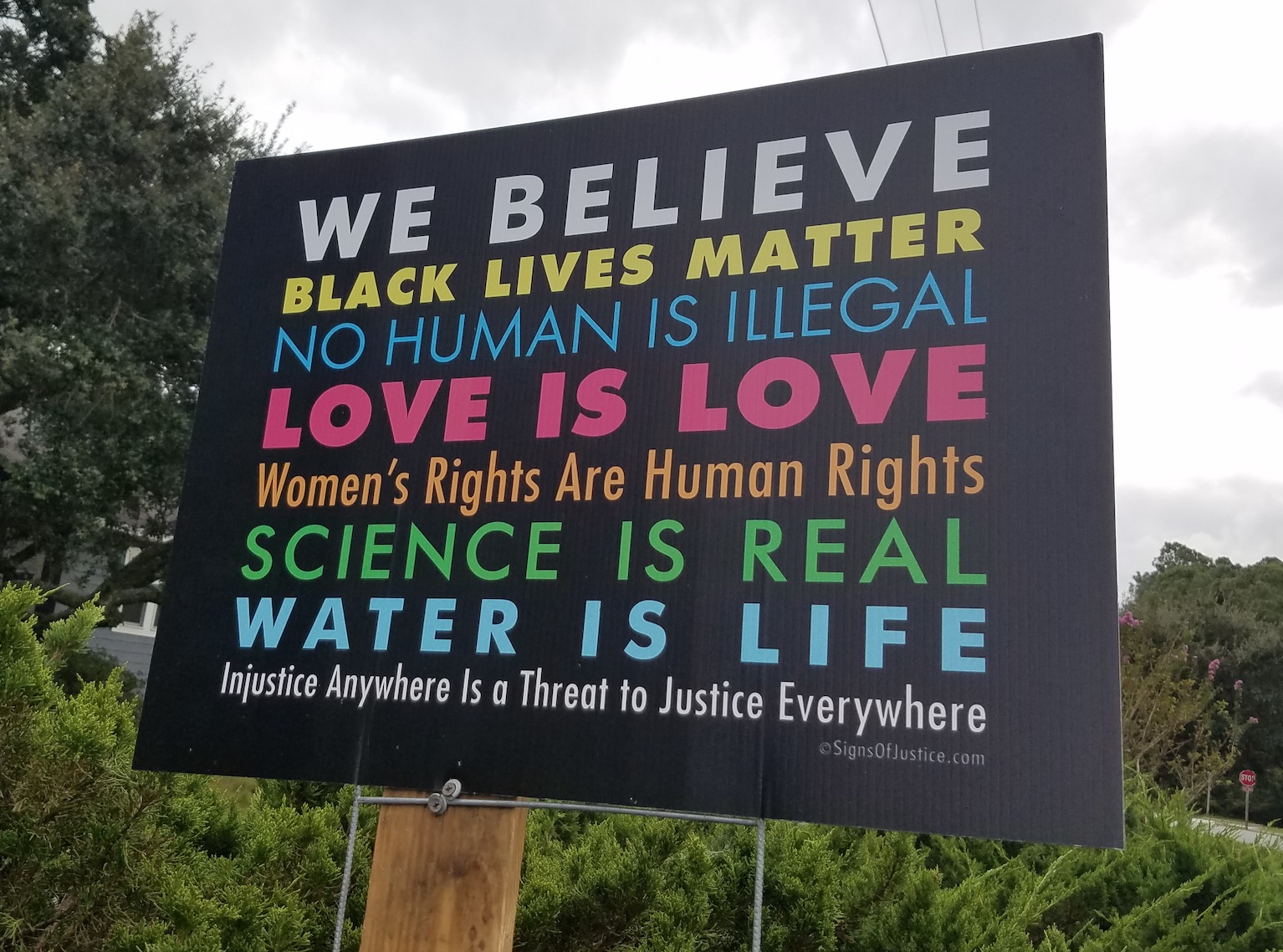
A secular creed, from sign displayed on a suburban front yard in Kill Devil Hills, North Carolina, October 3, 2020. …. But now we have the Sparkle Creed.
However, the “Sparkle Creed” does present a challenge for historically orthodox-minded Christians: We need to do a better job of articulating an imaginative, beautiful vision of God’s intention and purposes for human gender and sexuality, which is both winsome and Scripturally grounded. We need to extend compassion towards others, particularly young people, who wrestle with complex questions regarding gender and sexual identity. It is a lot easier to poke fun at something like the “Sparkle Creed,” and ridiculing those who support it, than it is think through how our churches can more effectively reach out to those with genuine questions and confusions, building relational bridges instead of blowing up those bridges and needlessly alienating those who desperately need to hear Good News.
If you are looking for a very practical way to implement a kind of positive ministry focus in your church, I would suggest checking out The Center for Faith, Sexuality, & Gender. They sponsor webinars, online courses, and events, grounded in supporting a traditional sexual ethic, that helps people work through questions about gender and sexual identity, as well as parents and other friends looking for resources to help them better love their LGBTQ family members and friends. With endorsements by various Christians leaders, like Francis Chan, Matt Chandler, and Karen Swallow Prior, The Center for Faith, Sexuality, & Gender can offer a lifeline for folks who find themselves wrapped up in confusion and doubt regarding such sensitive, personal issues.
Veracity in the Fall of 2023
I read several books over the summer that I am excited to review here on Veracity, that I hope will be helpful to readers. I am almost finished reading another Bart Ehrman book, and I am planning on offering an extended critique over a series of blog posts over the fall. Bart Ehrman is one of the most prolific writers and influential New Testament scholars, who rejected Christianity several decades ago, but who continues to draw in a lot of media attention…… In the meantime, there is one more blog post in the 1 Corinthians head covering series left, to come out in September. Look for it in a few weeks.
“Who am I?” A profound yet difficult question. How does one go about trying to answering it?…. and what does this all have to do with “Mr” and/or “Mrs” Potato Head?
A generation ago, the thought of “a woman being trapped in a man’s body” was commonly rejected as unthinkable silly talk. Such a thought was judged to be simply incoherent.
Today, the idea that anyone can simply define their own gender, as an expression of one’s self, is quite normal, in many social, political, business, and educational institutions. Three examples come to mind to illustrate this:.
Among ordinary Americans: A 2020 Gallup poll shows that 1 in 6 Americans, between the ages of 18 and 23, consider themselves to be somewhere in the “LGBTQ” category, as opposed to 1 in 50 Americans, ages 56 and older.
In politics: In the month that I am writing this post (March, 2021), the U.S. Senate is considering a bill, already passed in the House of Representatives, called “The Equality Act,” that would enable sweeping changes in current law, regarding how schools, employers, religious-affiliated institutions, and even parents of children handle such questions of self-identity.
In business: A book that features testimonies from trans-persons who later regretted pursuing gender reassignment surgeries, or other medical procedures, Ryan T. Anderson’s When Harry Became Sally, was delisted from the world’s largest book seller, Amazon.com, as Amazon says that the book violates their company policy, which prohibits them from selling books that “frame LGBTQ+ identity as a mental illness.“
That first example alone blows my mind every time I think about it. So, how did this radical perception of the self change so rapidly within such a short period of time?
The Roots of Our Current Crisis Regarding the Self
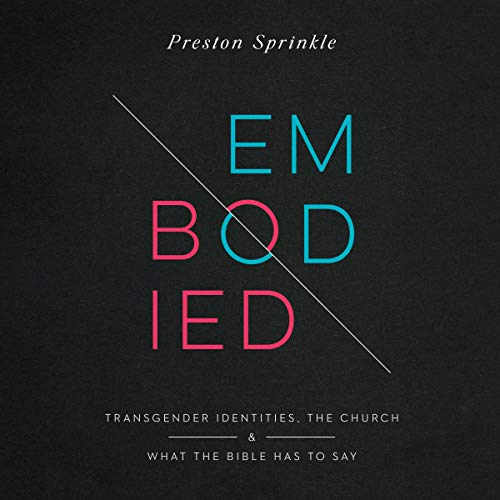
Before going any further, it is important to say that gender dysphoria; that is, having a sense that one’s personal experience of gender is not congruent with one’s biological sex, is a real phenomenon, involving real people, with real confusions and real consequences. We should never be quick to brush off the difficulties facing by people, particularly youth, who struggle deeply with troubling, and often painful experiences related to gender identity. (See my review and personal reflections on Preston Sprinkle’s marvelously helpful book, Embodied: Transgender Identities, The Church, & What the Bible Has to Say ) But aside from such personal and pastoral issues, as important as they are, there is the broader question of how such fluid understandings of gender have emerged in the larger cultural conversation, in the secular West. Where did this sudden emergence of gender identity questions come from?
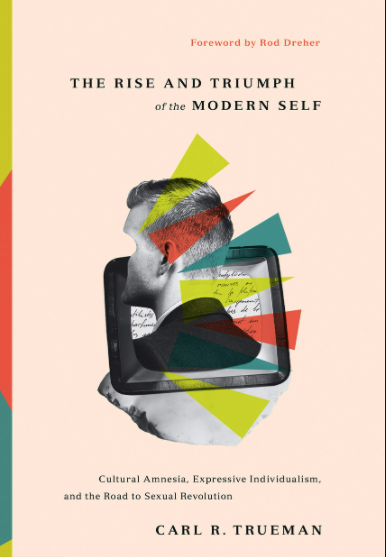
If you consider yourself to be a thinking Christian, and the current wave of interest in all things “trans” concerns you, then I know of THE book that you need to read: Carl Trueman’s The Rise and Triumph of the Modern Self: Cultural Amnesia, Expressive Individualism, and the Road to Sexual Revolution is a long awaited attempt to frame the historical and philosophical factors that have led to our current, cultural moment. Trueman currently serves as a professor of biblical and religious studies at Grove City College, but he has had a distinguished career as a Fellow at Princeton University, and in teaching church history at Westminster Theological Seminary, in Philadelphia, Pennsylvania. Born and raised in England, Trueman is what can best be described as a confessional Protestant, a member of the Orthodox Presbyterian Church, holding fast to an unabashedly Reformed and Puritan mode of evangelical faith, and a cohost of the Mortification of Spin podcast, an intellectually and spiritually invigorating podcast I listen to from time to time. But as Trueman articulates so well in The Rise and Triumph of the Modern Self, he is fully conversant with the best of modern and post-modern philosophy and historical studies. His work is lucid, insightful, and inviting, all at the same time. In fact, you really do not learn of Trueman’s confessional convictions as a Christian, until towards the end of the book, but he does so in a thoughtful and irenic fashion, without shying away from the challenges of today’s controversies.
How Did We Get Here, to This Cultural Moment?
Back to the original question: “Who am I?” The question of one’s self-identity has undergone a cosmic shift over the past few centuries, argues Trueman. The touchstone on which Trueman places his analysis comes from the thought of the Canadian Roman Catholic philosopher, Charles Taylor, author of the highly acclaimed The Secular Age. But for Trueman’s purposes, he zeroes in on Taylor’s work as to how the concept of the self has changed during the modern and post-modern eras. In particular, Taylor argues that the shift in answering the question, “Who am I?,” has increasingly moved towards an inward, introspective direction. In the premodern world, the concept of self-identity was wrapped up in what some external, objectifying source said about you, such as a parent, a feudal lord, or a priest or other spiritual guide expressing a body of church teaching. The quest to understand one’s self-identity is grounded today in a therapeutic mindset, by “looking within.”
Reinforcing this point, Trueman highlights the thought of American sociologist, Philip Reiff, who says that today we have a “plastic” view of the self, whereby we can fashion our own-self conception to be whatever we like it to be. Together with that, Trueman adds Roman Catholic philosopher Alasdair Macintyre as yet a third voice, who suggests that today’s language of self-expression is primarily “emotive,” namely that today’s ethical “values” are essentially the products of “expressive individualism.”
Trueman contends that this bend towards “expressive individualism” is inescapable now. The Christian church is caught in the thick of it all. Diagnosing how we arrived at this “expressive individualism” is the set of historical ideas that Trueman seeks to unpack in The Rise and Triumph of the Modern Self.
Owing largely to the influence of Sigmund Freud, all of these trends find their biggest impact in the areas of human sexuality and gender: Someone is “gay” because they “feel” that way, and that tells them a lot about “who they are.” Or, as has emerged in recent years, we have the idea that someone can define themselves as being a “man” or a “woman,” simply on the basis of how they “feel.” The language of identity has moved, in small increments, from the objective to the subjective.
Far be it for me to try effectively lay out the full framework of The Rise and Triumph of the Modern Self. I can best refer the reader to consult either the summary reviews written by Regent College theologian Paul Helm, at his website, or at MereOrthodoxy.com. Let it suffice to say that Trueman does a masterful job weaving in the thought of Marx, Freud, and Darwin to buttress his thesis, along with some erudite analysis and critique of the Romantics, like William Blake and Percy Shelley, as well as an engagement with other seminal thinkers like Rousseau and Nietzsche. In particular, I once had a particular fascination for William Blake’s view of Christian spirituality, but Carl Trueman has convinced me that such a warm appreciation has been sorely misplaced, due to Blake’s advocacy of “free love” in his early years. Among a host of other insights, Trueman gave me the most succinct analysis of ethicist Peter Singers’ rationale for accepting abortion that I have ever read, due to Singer’s attack on orthodox Christianity (readers interested in pro-life concerns should read The Rise and Triumph for that reason alone!)
The sexual revolution of the 1960s, and the consequences that have been born out in terms of the legalization of same-sex marriage and widespread public acceptance gender re-imagination, is all the fruit of cultural trends in the past few hundreds of years that Trueman brings to light. While readers may know very little about Rousseau and Nietzsche, in particular, the thought patterns they championed have seeped into all levels of society, from pop-culture to the halls of academia.
Book reviewer Mark Ward callsThe Rise and Triumph of the Modern Self an “excellent — though long and at times tedious — book.” I would not characterize it as “tedious“, but it does assume at least some familiarity with a number of the world’s greatest thinkers since the 18th century age of Enlightenment, which might be daunting for the uninitiated. But Ward is right to point out that far too often Christians will dismiss the uncomfortable ideas of the Sexual Revolution in a very glib fashion as being “from Satan,” as though that should settle the matter. This is naive.
All ideas, including evil ones, do not spring up from nowhere. They have a history. There is a path that such ideas follow. At first, these ideas appear to be ridiculous. But then slowly over time, they gain more and more traction, until whole societies will adopt them as perfectly acceptable. For Westerners in the 21st century, this is including not simply mainline liberal Protestant churches, but even evangelical churches, to varying degrees. Today, we see the growth of such ideas being slowly cultivated, which eventually bears the fruit that we see all around us. Reviewer Andrew T. Walker likewise has other helpful insights, as well as does this interview with Trueman by Fred Zaspel.
One particular application has to do with how poorly Protestant evangelicalism, in general, does at presenting a truly sacramental expression of distinguishing between male and female, in the life of the church. Far too often, evangelical churches will get sidelined with questions about whether or not women can serve as elders/pastors in a local church, thereby missing the deeper question as to how churches can effectively model what it means to be Fathers and Mothers, in an age where understandings of gender and human sexuality owe more to cultural stereotypes, as opposed to reflecting on the great theological truths of the Christian faith. We live in age when differences between male and female are often reduced to something merely having to do “with the plumbing,” and even that can be altered, with the appropriate medical procedure.
Calling All Christians To Think Theologically… and Imaginatively
Trueman admits that diagnosing the problem is one thing. The harder part comes in trying to come up with an adequate solution. The chaos resulting from this therapeutic revolution appears to have no end in sight. Furthermore, this reconceptualization of the self has political consequences. It is not enough to merely tolerate inward expressions of the self. They must all be recognized as morally valid. This explains why the ratcheting up of the culture wars, over the previous few decades, have now reached such a high, fever pitch. The advocacy for the “Equality Act” is no historical accident. It is the culmination of years of culture pressure, building up slowly over time.
Trueman does suggest that the answer for Christians, in how to respond to this movement, lies in the importance of community. As Christians grapple with these issues, they need to do so within the context of a worshipping community, in submission to the study of the Scriptures, as opposed to working out their angst on their Facebook and Instagram social media pages.
Comparatively, the so-called LGBTQ community, though it is hardly a monolithic entity, has enjoyed strong bonds of community, over the past few decades. Such bonds are in many ways as supportive, if not more supportive, than what you find in many Christian churches. But the communal cohesion of the LGBTQ movement has been its primary engine for success, and orthodox-minded Christians have much to learn from this strong sense of community bonding.
As far as the “Potato Head” brand goes, the idea of mixing and matching “Mr” and “Mrs” Potato Heads, with presumably interchangeable parts, to produce different varieties of families and gender transitions, is merely one of the many ways Philip Reiff’s concept of the “plastic” self is being integrated into the norms of post-modern society. Critics of those who are concerned about this transformation of the self will surely dismiss such criticism as being hyper-over-reactive. But it is the up-and-coming generation of young people who will be left trying to figure all of this stuff out.
What To Do About It?
Is the answer to try to boycott Hasbro? Probably not, at least not in the long run. Neither is trying to return to some “golden age” of Christendom the answer either, through trying to control and takeover the machinery of civil government. At least, that is my take, and from reading The Rise and Triumph of the Modern Self, I gather this is Carl Trueman’s perspective as well. Applying such cultural pressure might accomplish something in the short run, but it will surely just enrage proponents of such cultural shifts, causing them to double-down against Christian “intolerance.”
Thankfully, Christians are not alone in their anxiety about all of this. There are also secular liberals, and other thinkers, who are deeply concerned about such fluid understandings of the self. Consider best-selling author Abigail Shrier, from her appearance before Congress arguing against the proposed Equality Act. Her testimony that the Equality Act would encourage great harm against women and girls, in our society. But Christians need to go further than this, with a more transformative outlook upon contemporary Western culture.
What it does take is for Christians to learn how to think about the Bible’s view of the self, and how that is contrast with today’s view of the self. Christians ranging from plumbers and construction workers to soccer moms to college professors need to be able articulate an evangelical theology of the self. This is not a job just to be left with pastors and Christians public intellectuals. It is something that must be cultivated in Christian small groups meeting in living rooms, Bible classes meeting in church buildings, and in one-on-one get togethers for coffee and lunch.
Every Christian believer needs to be a theologian able to articulate a theological anthropology that adequately describes a Scriptural view of the self. Christians can then help their non-believing neighbors understand the beauty of what God intended for humanity, without flaming the passions of the culture wars. Christians need to rediscover the value of natural law, and think creatively to stir the imagination with a genuine picture of what the Kingdom of God really looks like, that our secular neighbors might find attractive. We must recover the art of persuasion. Thinkers like G. K. Chesterton and C.S. Lewis did this in their generations. We need new Christian voices to do the same in ours. Carl Trueman sets out the task before us.
The Rise and Triumph of the Modern Self is surely to be one of the most, if not “the” most, important and reasonably accessible intellectual history of the West to date, that bears consequences in the marketplace, the voting booth, and in the world of education, that shapes our children. Christians need to be conversant in these matters, so that we can be better persuaders of the truth of the Gospel, as opposed to automatically going to the “you must be Satan” line of attack, and thus stopping the conversation. The Rise and Triumph of the Modern Self will help the thoughtful Christian to engage these new and revolutionary ideas, that appear to be going mainstream, so that we might be able to have thoughtful and meaningful discussions, even where there are sharp points of disagreement. This is a must-read for Christian pastors and thought leaders, or any Christian committed to thinking deeply about the rise and triumph of the modern self.
A number of excellent interviews with Carl Trueman are available on YouTube, but I found this discussion between Southern Baptist Seminary president Al Mohler and Trueman to be particularly engaging. You may not agree with every aspect of the discussion, but if you are on the sidelines about whether or not to read this book, I would urge you to listen to an interview like this, and I believe you will agree that the topic is perhaps one of the most timely and important ones Christians, as well as non-Christians, need to have together.
First, let me start off with a personal story. I am a biological male who feels quite comfortable with being gendered as masculine. But it was not always that way.
I was never much of an athlete growing up. In elementary school, I was shorter and smaller than the other boys, and I was always the last one to get picked on a side for kickball. I especially dreaded it when girls played with us, and the girls got picked first over me. I was generally consoled when there was at least one or two girls left, after I got picked. But it still was not a great feeling.
That began to change as a 12-year old, when I discovered the sport of tennis. I learned from my coaches that I was actually pretty good at it, compared to a number of the other kids. I won match after match with other boys in a local municipal league, throughout an entire season. Having grown up thus far, playing in the dirt, building dams in the small creek behind our house, and being fascinated with dump trucks and bulldozers, I was finally beginning to feel comfortable with my “boy-ness.” My tennis experience with other boys seemed to confirm it.
Then, I was lined up to play a girl my same age in the girl’s league. It went like this: 6-0, 6-0, 6-1. I was completely devastated by the loss. At least I got one game in the victory column. But it cemented in my mind the same type of feeling I had being chosen for kickball in elementary school…. at the bottom of the list.
Well, as it turned out, this girl who destroyed me in tennis was the daughter of the president of the local university in my hometown. She probably started taking tennis lessons at age 5, for all I knew. For when she got to high school, she ended up being a Virginia State Champion in tennis, with an almost unbroken victory record. I do not know if she actually went to the Olympics or not, or played professionally, but she could have. She was definitely THAT good.
I put the tennis racket away after that.
I never touched it again until my years in college, and then only briefly. I was never able to fully enjoy the sport until I hit my 30s. I was completely sandwiched in by social expectations, formed by traditional stereotypes, that I was somehow “less than” a boy, because I was completely humiliated by a girl in sports. Sure, you could call it “sexist,” on my part (Though for being a kid just out of 6th grade, that seems like a heavy trip to lay on someone). As for me, a growing adolescent, I thought it was confusing. For if I was really a boy, why was I such a poor athlete compared to girls my age? What does it mean to be a “boy” after all?
What made the experience worse is that I hit puberty rather late. Plus, I received little to no sexual education, even in school. As an only child, who was rather shy to begin with, figuring out how I fitted in socially was difficult. I was a bookish nerd, intimidated by the athletic boys, and I generally felt less threatened around girls than with boys. It was not until probably late in my freshman year, that I finally settled on the answer: “Yes, I really was a boy.” The biggest factor was in realizing that I was attracted to girls, in a way that I never really felt before. Yep, that was DEFINITELY the game changer.
But it took a while. And I had more than a few doubts along the way. Without going into further detail in this online forum of a blog, let me just say that there was a period of time, perhaps a few months or so, where I was really confused about my gender status.
I look back on those experiences as a kid, as though they are part of a distant land and distant time, particularly the gender crisis I went through in my early high school years. Frankly, this has become one of those life stories that I would rather just forget about.
But the world has vastly changed since then. Vastly.
Today, I am a so-called “typical male,” in that I am a single-task operating system, who can not multitask as women generally do. I have a big love for sports and playing sports, my biggest love being for playing soccer. I still like playing in the dirt. I pretty much fit all of the culturally assumed norms being masculine. But back in those childhood and teenage years, I had no one to talk to about my gender insecurities.
Not friends…. (except for perhaps one awkward conversation with one girl I knew in my gym class, so I am not sure if that counts).
Not parents.
Not teachers.
Not someone in my mainline Protestant church. No pastor. No Sunday School teacher. No youth group leader.
No one.
Fast forward decades later to 2021: The concept of transgender is now relatively commonplace in colloquial discussion. It is certainly freely talked about in social media, as there is less social stigma. There is a sense that this can be a good thing, as sweeping difficult conversations under the rug is never a good thing.
However, there is another side to this. The rise of what has been described by some as “Transgender-ISM” has become an extremely volatile and politically charged topic. In some alarming cases, government overreach has dictated to people what they can and can not say, a direct threat to free speech (Just ask Jordan Peterson).
What was once such a personal matter has now triggered a whole culture, set on edge. Struggling people, who would rather not be left exposed in the middle of a culture war, are caught in the crossfire.
One of my nieces coaches girls soccer. Just a couple of years ago she was told to admit to her team a boy who was transitioning to becoming a girl, to play in the position of goalie. “She” became the best player on the team. Something like that would have been unthinkable, just a generation ago. The culture has changed so rapidly within the past decade.
The Transgender Conversation in Today’s Post-Modern, Post-Christian Culture
How do Christians today navigate the transgender conversation going on today? Is being male or female a fundamental characteristic of human identity, or is gender merely a social construct? How should one address another person transitioning from one gender to another? What type of pronoun should you use, without compromising your Christian beliefs? These type of questions dominate the minds of Christian believers who work with, go to school with, or who have family members who wrestle with some type of transgendered identity (whatever that really means)…. it also, quietly, keeps a lot of young people, who are confused about their gender, awake at night…. like it did me, back in 9th grade.
But can you do me a favor here? Can we hold off just a bit on the whole Target’s bathroom policy-type stuff? I want to get back to that before the end of this post, but let me lay down some groundwork first.
I first read Andrew T. Walker’s 2017 God and the Transgender Debate: What does the Bible actually say about gender identity?a few years ago, as an introduction into the transgender conversation. It offers a good approach, from a conservative evangelical theological viewpoint, that offers nuanced wisdom in how to effectively love someone who is deeply impacted by confusion regarding their gendered experience, while maintaining a theological integrity in affirming that God created every human being in his image, male and female.
However, there is a weakness in Walker’s book in that it does not provide sufficient enough insight into the stories and experiences of persons who personally wrestle with such deep and disturbing questions. Furthermore, while Walker’s book does cover the general science outlook on gender dysphoria, it does not really dive into some of the more complex scientific issues surrounding gender. As wonderful a book God and the Transgender Debate: What does the Bible actually say about gender identity? is, I still was looking for something with more depth, and even more nuance, that would help me in my conversations with those who have anxiety about their gender…. along the lines of what I experienced as a kid, or way more intense than that.
In Preston Sprinkle’s Embodied, the author sets up the book very well in that it emphasizes a variety of stories of persons whom Preston knows, who fall all over the spectrum of transgendered experiences. This is critically important to understand because there is simply no one, single category that defines transgendered experience. Psychologists will typically call transgendered experiences an expression of gender dysphoria, which the American Psychiatric Association defines as “psychological distress that results from an incongruence between one’s sex assigned at birth and one’s gender identity.”
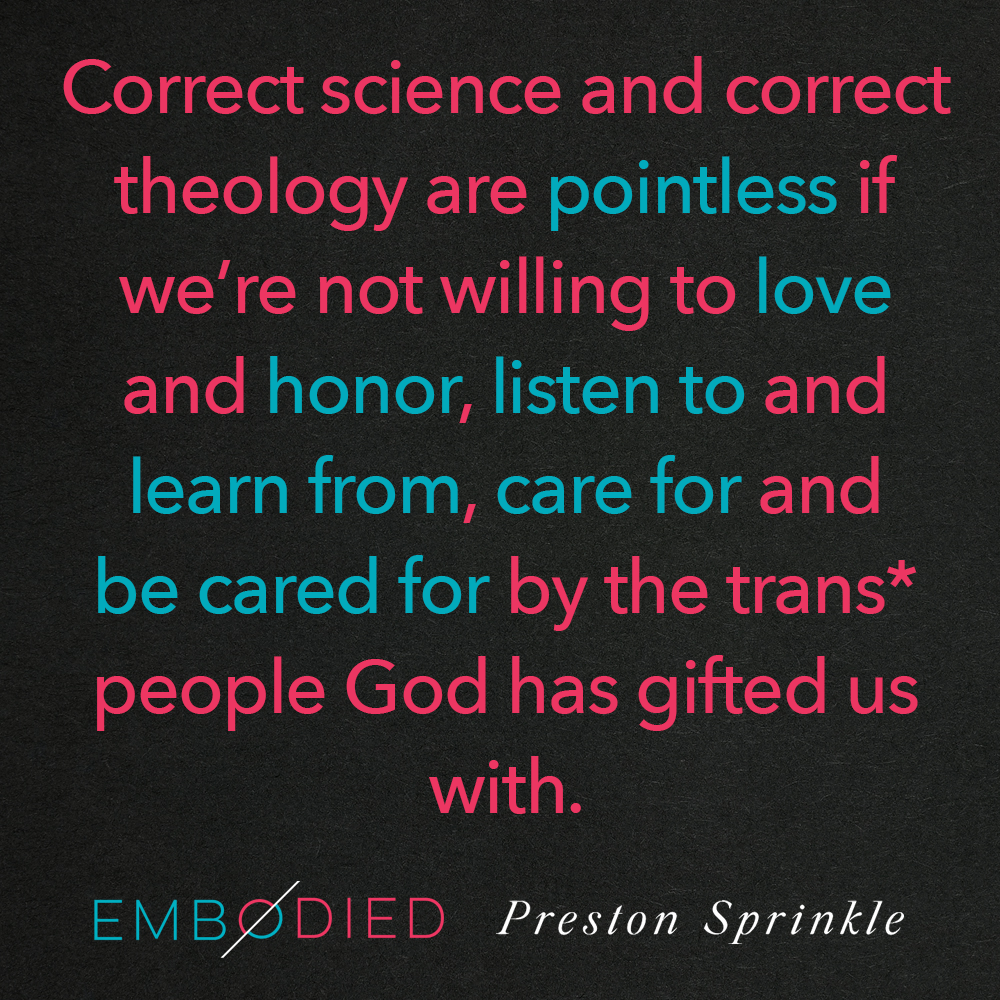
The first step that Preston encourages every Christian to cultivate is an attitude of listening, and learning to know and better understand the experience of someone with gender dysphoria. The second step that Preston encourages is to realize that transgendered experiences are complex, they differ greatly from person to person, and the definition of terms is critically important in an effort to have good conversations with others.
The Problem with Words: How Do You Even Start a Conversation?
The problem of words, and their definitions, and how those definitions can change over time, can not be underestimated. What is the difference between male and female? What is the difference between sex and gender? The list goes on, but thankfully, Preston takes great care to define terms, acknowledging that not everyone even accepts his definitions. For example, Preston prefers the term “trans” over “transgender.” Who knew there was a difference? Though primarily a theologian, and not a scientist, Preston does a good job interacting with the science, and explaining different points of view, as expressed in the scientific literature, that is accessible to the general public. But the problem of words and their meanings remains…… And this is not just about pronouns.
Here is a good example of the problem. Preston has a chapter about “intersex,” which involves the problem of persons at birth possessing some of sort ambiguity regarding their sex identification. Doctors will put the “sex” of the child on the birth certificate. But what if there is some biological confusion, that makes it difficult to assign one’s “sex” with a high degree certainty?
When I was discussing this with my wife, I told her that this “intersex” condition is “rare.” It sometimes requires surgery to resolve, but not always. Different authoritative resources regarding intersex will agree that calculating the frequency of intersex conditions assumes that there is a spectrum of difficulties in making a clear determination of a person’s sex. I told my wife that one particular estimate of at least some possible condition on the intersex spectrum impacts roughly 1 out of 2000 babies (some of the more rarer conditions rank 1 out of 100,000 or more).
In my mind, that type of ratio, 1 out of 2000, means that intersex is “rare.” But my wife objected. In her mind, 1 out of 2000 is not some statistic that could be trusted in that it implies that intersex is rather “common.” As a result, she is suspicious of such statistics, as she believes that such “scientific” estimates are more informed by political concerns, and less by science. She believes that such “science” is being used to push an anti-Christian, anti-biblical agenda in the cultural sphere.
Well, 1 out of 2000 still sounds “rare” to me. I mean, compare that to the relatively much more “common” condition of someone on the autism spectrum, which in 2016 has been calculated to be 1 out of 54, by the American Center for Disease Control. But the debate I had with my wife just shows how difficult it can be to navigate such discussions about such a complex topic. How we define words in our conversations make a big difference.
Preston includes some thought provoking chapters on other topics, such as “what about the eunuch?,” as Scripture talks about; the ongoing debate about the “material” body versus “immaterial” soul, and how that all relates to gender identity; brain science and sexual differentiation; and the recent explosion of rapid onset gender dysphoria, that is producing intense anxiety for many teenagers today. The overriding theme is that Christians should become better informed about these topics, and when doing so, should exhibit some caution towards coming to premature conclusions.
For people in the workplace, or in school, surely the most difficult question, over the use of words, and their meanings, comes down to what pronoun you should use when talking with a transgendered person: “He?” “She?” “Surely not ‘it.’ “But what then?” “By using a certain pronoun, am I implicitly endorsing an alien belief system?” “How can I let someone know that I want to be their friend? “
This is a complex topic, with concerns about ideological dogmatism, when it comes to enforcing language codes, which is an affront to free speech, on the one side, versus concerns over offering hospitality to the other person, for the sake of maintaining a friendly relationship. Preston offers an excellent chapter in Embodied, dedicated primarily to this one issue, which is worth the price of the book, on its own.
What Does the Bible Say about Transgender?
The most important chapter in Preston’s book is regarding what the Bible says about how being male and female is related to God’s good creation. The footnotes alone for this chapter will stimulate the student of Scripture to dig deeper and deeper into God’s Word. The bottom line is that according to what is taught in the Bible in Genesis, we are all created in the image of God, male and female. Therefore, fundamentally, sex and ultimately gender are not social constructs. Biological sex plays the much larger definitive role in determining what is male versus female, as opposed to culturally defined expectations of gender characteristics. Someone’s gendered experience may not match up with social stereotypes, as it did for a relatively short period of time in my youth.
Large swathes of our society give us very culturally-bound ideas of gender, some that are uniquely Western. For example, American men typically do not hold hands with one another, though women holding hands together is a lot more common. Compare that with the fact that in many developing countries, men will often hold hands with other men. This does not mean that such men are gay, or that they are having some transgendered experience. This simply means that men holding hands with other men are but one cultural expression of gender, a sign of showing affection in male to male friendship. But these varying cultural stereotypes do not mean that being male and female are simply products of culture, in every respect. Instead, the fundamental Christian claim, according to the Bible, is that being created male and female matters to God, and that such differences in being male and female ultimately transcend culture.
Preston does interact with theological viewpoints that do not line up with historically, orthodox Christianity, making a good faith attempt to be as generous as possible with critics. I would probably give Embodied a fully deserved 5-star review, if it were not for the fact that Preston sometimes is overly cautious to a fault, when landing on a firm theological footing (I would give Embodied a 4.5, but Amazon does not allow for fractional reviews, so I decided for a more conservative evaluation and round down slightly). Now, let me be clear here, in case a potential reader might be nervous: Preston does eventually get to and affirm an historical, orthodox theological perspective. But in the process of getting there, through pages and pages of back and forth, yet rightly thorough analysis, Preston may leave some readers puzzled as to why he is as cautious as he is. He puzzled me in a couple of cases.
For example, Preston briefly addresses the question of whether or not intersex is a product of the fall. He has generally opted to say that intersex is indeed a product of the fall of humanity, but that in researching for the book, he has become more cautious in making such a conclusion.
I understand why Preston brings out some caution, and he clearly acknowledges that one of his intersex friends firmly acknowledges that the intersex condition is indeed part of “the fall,” and that this knowledge provides a form of comfort. But if that is the case (and I would agree with the viewpoint of Preston’s intersex friend), I am puzzled as to why Preston is so cautious as he is. Perhaps it comes down to one’s definition and understanding of what “the fall” entails.
How Our Theology of “The Fall” Can Guide Us Through the Transgender Conversation
Going back to my own experience, I grew up also with a significant speech impediment. I stuttered quite frequently during my elementary and middle school years. Thankfully, my stuttering eventually subsided somewhat, and I learned to gain more confidence when I speak with other people. One of my greatest joys in my college years was that I even became a disc jockey for about a year and half, hosting a jazz music program on my college’s radio station. I would never have been able to do anything like that, if I had continued stuttering as severely as I did in elementary school.
But I would definitely say that my speech impediment was (and still is) a product of the fall of humanity. I do not believe that God would intentionally create me with a speech impediment, as part of his good design for creation. I look forward to that Resurrection Day, when I will no longer have to worry about how my verbal speech with come out, and embarrass me in front of others.
Nevertheless, God has given me a type of gift, due to that experience of the fall. I am more hesitant to speak, because I am sometimes self-conscious about messing up with my words and syllables in public. As a result, I often find myself more inclined to listen. In a world where so many people want to be heard, I have realized the gift that God has given me to use my hesitancy towards speaking, in learning how to better effectively listen to others, thus gaining more empathy with them.
I would think that experiences of intersexed persons, and transgendered persons (otherwise known as simply “trans”), who go through periods of gender dysphoria, would best frame their experiences in such a theological framework. The experience of being “trans” for a follower of Jesus would lead to the realization that such consequences of the fall also provides opportunities for God to give good gifts to such a person, that most other people will never, ever have. Sin does have consequences, and can impact people through no obvious fault of their own. But God is a God of redemption, who can turn what the Evil One meant for evil into something good. In the process, God’s children are given gifts that bring God the most glory possible…. and that is Good News! I think Preston Sprinkle would still agree with me here. I just wish he had come out more firmly on this with less hesitation.
Listening with Compassion, with Theological Clarity
With that caveat in mind, please do not let that deter any reader from picking up Preston Sprinkle’s Embodied. The author does a fantastic job giving the reader encouragement, that having experiences of gender dysphoria does not disqualify anyone from being a genuine follower of Jesus. Preston is quite frank in admitting that he has friends, having a “trans” background, who are often some of the most loving and Christ-like persons he has ever met. One need not follow the secular culture, in order to be fully human. No one needs to be dismissive over what Scripture teaches regarding being created in the image of God, as male and female. Instead, we are all challenged to enter in the mystery of celebrating our differences as male and female.
My experience of gender dysphoria, as a young teenager, was pretty mild and short-lived. I rarely ever think about it any more. Others though, have had severe problems, that persist into adulthood, ultimately leading such persons to pursue transitioning into a gender identity contrary to their birth, sexual identity, through various types of medical procedures, such as hormonal treatments, or even surgery. An alarming, growing number of such transitions happen among children. Sadly, many have gone through such experiences, only to ultimately regret such decisions to go through with such hormonal treatments and/or surgery. Preston rightly points out that the mental health risks for those who transition to another gender identity, through surgery, are significantly higher than for those who do not transition. It is a lot more difficult to transition back, than it is to transition in the first place. Sometimes transitioning back is medically impossible. Those reasons alone are important enough, simply from a medical perspective, for those considering transitioning to not take that step of transitioning in the first place, or at least to delay it as much as possible. In many cases, such gender dysphoria disappears over time, assuming a person has a loving environment that supports them.
What about people who have already transitioned? Preston admits that this is a really difficult situation to deal with, for a Christian befriending someone else who has transitioned, whether that other person is a Christian or not. In such situations, it is really best to walk alongside those people who have taken that step, first and foremost as listeners and as a friends, and trust that God will intervene in such a way to bring about healing, according to God’s own timing and purposes.
More and more people who have transitioned to the opposite of their birth sex, have been transitioning back, and Preston observes that this number is continually growing, despite the social pressures against transitioning back. But in the final analysis, Prestron rightly affirms that it should be the truth of Scripture that should guide us, and not concerns over what is practical or not.
The Failure and Opportunity of the Church to Model Biblical Masculinity and Femininity
One big problem in many churches today, particularly Protestant evangelical ones, is that many have not figured out a way to model what Christian masculinity and Christian femininity look like. Some fall back on traditional cultural stereotypes. Some Christians are so freaked out by the rise of radical feminism, that women are almost completely marginalized in the use of their God-given gifts for ministry. Others go for the stereotype where the women pretty much do 90% of the “spiritual” work, and the men are just dragged kicking and screaming to church.
Other churches, on the less traditional side of things, have become too quick to show how men and women, particularly in church leadership, are simply interchangeable, whereby there is no real fundamental difference theologically between men and women. Sadly, the whole debate between complementarians and egalitarians, tends to narrowly focus on whether or not women can serve as church officials; particularly as elders, thus missing the more fundamental theological reality, of distinguishing between male and female, within the context of corporate worship (I have written extensively about this particular topic elsewhere on Veracity).
As a result, the sacramental expression of what it means to be a man, and what it means to be a woman, in the life of the church, gets cast aside. Children growing up into adulthood suffer the most, as few young people have an effective means to work through their anxiety, as to what it means to be male and female, in the sight of God, as opposed to simply following cultural imposed patterns of what masculinity and femininity look like.
Rapid changes in Western culture are only making the problem worse. Preston Sprinkle highlights the shocking statistic, just from one study in the United Kingdom, where the number of males questioning their gender has risen by 1460%, and the number of females questioning their gender has risen by 5337%, just in the last ten years.
1460%. 5337%. Those are real numbers. Experiences with gender confusion among American teenagers are not too far behind, as such startling statistics appear to be becoming part of the norm. Christian parents trying to raise their children in today’s anxiety ridden culture do not have the luxury of ignoring these massive cultural shifts.
Strangely, the silence of evangelical churches, when it comes to discussing this transgender identity crisis, has become deafening. And when it does get mentioned, if at all, such as in a sermon, it is typically either within the context of just how rotten the culture has become, or chiding less “enlightened” people for their “bigotry.”
The idea of men mentoring men (and boys) and women mentoring women (and girls) has become a lost art, in too many churches. How many churches still have men’s groups, where they talk about what it means to be a Christian man? How many churches still have women’s groups, where they talk about what it means to be a Christian woman? If we want to stem the tide against efforts by the culture to aggressively “normalize” ideologically driven concepts of “transgenderism” (a pejorative label, for some), churches need to do better in modeling what it means to be male and female, even in how we conduct worship services. No matter what churches do, cultivating the art of listening is essential, in figuring out ways to give young people permission to talk about their doubts and experiences.
Our Western culture today has made it socially acceptable to discuss issues related to “trans” people. That is a good thing. Evangelical churches tend to be behind the eight-ball on this, but at least, the secular world offers a variety of counseling, medical, and psychotherapy options for young people to process their anxieties.
On the other hand, the growing rate at which young people are considering themselves to be somewhere on the “trans” spectrum is particularly alarming. The drive to somehow “normalize” such “trans” experiences, even in psychological counseling, is particularly outrageous. We hear stories of concerned parents who want to immediately rush to give their child sex hormone therapy, if the child begins to experience even the mildest form of gender dysphoria. The shocking rise of rapid onset gender dysphoria, particularly among girls, over the past decade is horrifying….. and yes, there are legitimate concerns that Target’s bathroom policy might invite “fake” trans-people to take advantage of such policies and invade the private space of women. Who will speak out for the protection of women, who feel threatened by cultural shifts like this? Or will they experience the disdain of “cancel culture,” that the Harry Potter author, J.K. Rowling experienced?
But as Preston Sprinkle reminds the reader, fits of outrage and horror do not lead to healing and real change. Instead, it is through the expression of the love of Christ, through listening to others, that real change happens. We need less of our love for outrage and more outrageous love.
Listen.
Take a deep breath.
Be a part of the conversation, instead of always rushing to pontificate on just how awful the culture has become…. or how closed-minded others on your Facebook page appear.
One simple (though perhaps still expensive) suggestion for churches, would be to offer single-person-use bathrooms in church facilities (what some might call “family restrooms”). That one act, of providing a restroom where a “trans” person can discreetly take care of business, is an excellent way to offer hospitality to someone who is new to your church, that might lower the anxiety and stress level of a visitor. Installing signage, that indicates that a single-person-use restroom is just down the hall, is a great way of saying to a “trans” person that they are welcome to visit your church.
Extending Outrageous Love to Trans-Persons
Preston tells one story that really stands out to me, that of Lesli, who was biologically born female, but who went through a confusing, difficult period of gender dysphoria. When she confided her struggles with her pastor, the pastor escorted her out the church back door, and told her never to come back again. She left the Christian faith at that point. She ended up becoming a lesbian, and married another woman. But when her same-sex marriage partner died, she wanted to find some way for her spouse to have a decent funeral. Lesli finally worked up the courage to call some church office, out of the blue, and ask if the pastor there could perform the funeral for her deceased partner. Instead of giving Lesli a knee-jerk theological justification for condemning homosexuality and the transgender “lifestyles”, the pastor simply said, “We would be honored to [help out, and perform the funeral service].” It was that loving expression by that Christian pastor that eventually led Lesli to return to the Christian faith.
That is a challenging message. Yet that is the challenging message that undergirds Preston Sprinkle’s excellent Embodied. We need to land somewhere between oversimplifying the growing transgender awareness in our culture, as merely a Satanically-inspired political conspiracy, and on the other side, a fear-based resolve that we must choose between transitioning and suicide, as the only alternatives for moving through transgender conversations.
Sadly, some of the folks I know who would probably benefit the most from reading Embodied are most likely those ones who will not read it. I am just as horrified, as are many other Christians, as to how aggressively “transgenderism”, as a negative ideological category, has become a forceful cultural, even an activist, political movement. Likewise, I am also deeply concerned about the connection between suicide rates and gender insecurities.
But what this is ultimately about is people. People who wrestle with some form a gender dysphoria are people whom Jesus sought to die for, that they might be reconciled to God and find healing. What is really needed is a way for Christians to trust Jesus enough to give them the wisdom necessary to know how to best extend the hand of Christian friendship, to someone who wrestles with transgendered experiences.
In the following discussion between Preston Sprinkle and Christina Beardsley, an openly transgender person, who is also a priest in the Church of England, I found the conversation to be difficult to follow at times, but it just shows how complex the cultural conversation is. One of the best ways we can love a transgender person is to try to figure out how people define the words they use in conversations.
Unless you have been living under a rock for the past twenty years or so, you will know that some elements of Western culture have been chipping away at the classic, historical Scriptural distinction between male and female. Some well-meaning, well-intentioned folks, even in the church, have been encouraging this movement along, in some unfortunately unhelpful ways.
Granted, for the past hundred years, many evangelical egalitarians have sought to restore a sense of balance, by advocating for more women in church leadership, at the local church level, by citing Paul’s “magna carta” passage Galatians 3:28. In general, most Christians support this understanding, at some level:
“There is neither Jew nor Greek, there is neither slave nor free, there is no male and female, for you are all one in Christ Jesus”
The original context for Paul’s writing in Galatians is to address who can and can not be baptized, in the church. For Paul, gender is no prohibition to baptism, as opposed to something like circumcision, which was just for Jewish males. But many Christians today have appealed to Galatians 3:28, as having a broader application, advancing causes, such has encouraging women to serve as elders in the local church. Such proponents of this interpretation contend that Paul is eliminating the distinction between male and female, when it come to exercising spiritual authority, in the local church.
Yet it is amazing to see how many corners of the church manage to find creative ways of sliding here, anyway. At one level, it is understandable. There is still sexism in the church. Correcting past wrongs is something all Christians need to pursue, and Galatians 3:28 has an appropriate application here. Affirming the gifts of both women and men, for ministry, is essential. But it is also very easy to go too far with Galatians 3:28, and get caught up in extremism.
For example, quite a few in the church now appeal to Galatians 3:28 as sanctioning same-sex marriage, and a growing number are now affirming transgenderism, in such a way, as to go beyond the traditional understanding of gender dysphoria, as a psychological condition. Such a broad range of advocates all agree, in putting forward the thesis, that gender is no big deal to God, though the applications differ. Along with the surrounding culture, such advocates now treat gender as merely being a social construct, even to the point of denying the traditional basics of human biology, which is an attack on modern science.
Here is the crucial passage, that Paul is supposedly contradicting:
“So God created man in his own image, in the image of God he created him; male and female he created them.” (Genesis 1:27 ESV)
Has gender really become irrelevant today?
Regardless of how this question is answered, what it clearly has become, is a free speech matter, in the surrounding culture. Consider the “cancel culture” attempt to silence Harry Potter author J. K. Rowling. Rowling voiced her concerns that some elements of the transgender movement are harming women, and she paid dearly for making such statements. Yet Rowling is not alone.
Instead, we should encourage women to use their gifts for leadership and ministry in the church. We should affirm justice in society (including those areas pertaining to race). We should encourage those who experience same-sex attraction to have a solid network of supportive friendships, as they seek to honor God regarding their sexuality. We should also have compassion on and extend grace towards those who are experiencing gender dysphoria.
But let us also be united in affirming the teaching of Scripture: We were created in the image of God, male and female. This means that while male and female are indeed equal, they are not interchangeable. This is a mystery that reflects the very character of God. It is vital for the church to uphold a means of honoring that distinction, within the structure of corporate worship, and the Christian life.
Affirming the unity of our baptism into Christ’s church does not go against the rest of Scripture. So, let us stop misusing Paul’s statement in Galatians 3:28 in a misguided effort at supposedly “contradicting” Genesis.
Canadian psychologist and Harvard professor Steven Pinker is now among the latest to have experienced threats from the “cancel culture” mob. While I do not share professor Pinker’s atheism, nor his missteps regarding history, as a Christian I fully support his efforts to protect free speech. As Christians, we should honor those values that encourage open debate and wide ranging discussion, without fear of retribution:









 Veracity