
Robin Lane Fox is one of the world’s preeminent historians of the classical world. A few years ago, I read his The Classical World: An Epic History from Homer to Hadrian, which I would recommend reading, if you want an in-depth epic history of that cultural time period. I kept turning back to Fox’s work on a trip to visit friends in Sicily, back in 2022. I was in Sicily for only a few days, but I visited both the Valley of Temples and Syracuse, two ancient sites from the classical world which Fox covered in his book.
Having an interest in Saint Augustine, I grabbed a copy of Fox’s Augustine: Conversion to Confessions, and finished reading it not too long ago. Though captivated by Fox’s story of the classical world, I was curious to know of his take on Augustine, considering the fact that Fox is a professed atheist, with little interest in Christianity aside from scholarship. I was bracing myself for some occasional crudities in Fox’s writing style. To be sure, Fox is as entertaining as he is erudite. In describing Augustine’s pre-Christian life as a follower of the Persian philosopher, Mani, Fox whimsically and colorfully concludes:
Manichaeism is the only world religion to have believed in the redemptive power of farts (Fox, p. 180).
Here is the second of a two-part blog series covering Robin Lane Fox’s book, which examines roughly the first half of Augustine’s remarkable life. We pick up the story after Augustine returns to North Africa. A few years earlier, Augustine had become a Christian, under the preaching of bishop Ambrose in Milan. In North Africa, Augustine’s career as a rhetorician had started to gain him an audience when he debated opponents of the historically orthodox Christian church. In this latter part of Fox’s work, we learn more about how Augustine read, and at times, misread, certain passages of the Bible…. and why…. glimpsing into how such readings/misreadings have reverberated throughout later Christian history, particularly in the West.
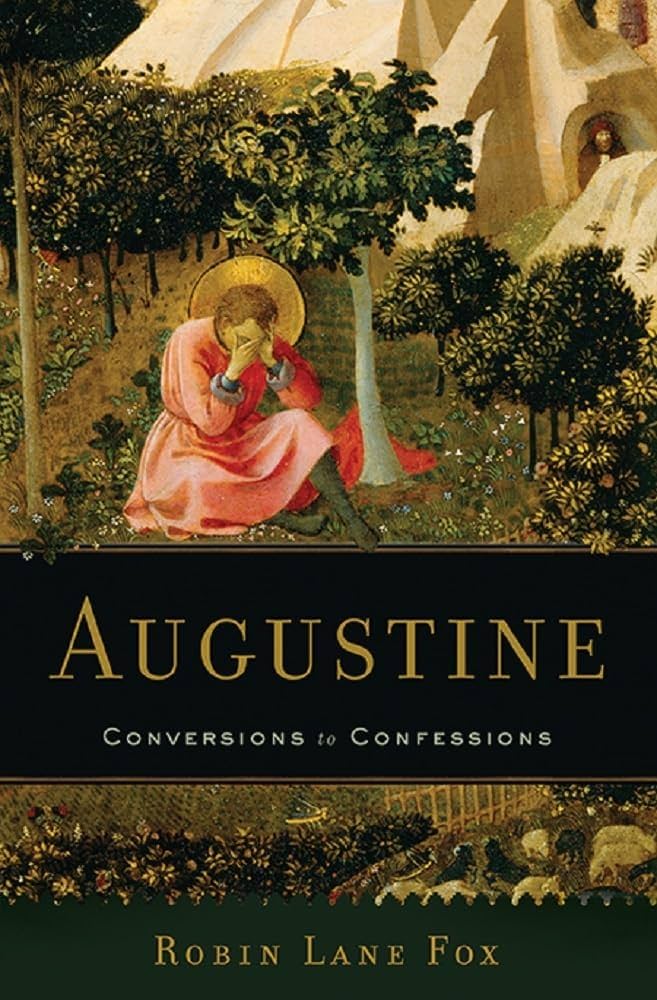
Robin Lane Fox’s Augustine: Conversion to Confessions examines roughly the first half of the great Christian saint’s life, leading up the Augustine’s most famous written work, Confessions.
Augustine as a Parish Priest
Augustine had survived becoming a priest in 391, after having only received baptism four years earlier. Augustine’s career as a churchman was now in full swing. This was ten years after the second great ecumenical council met, the Council of Constantinople (381), where the Nicene Creed, which was originally drafted in 325, was finally completed. By the end of the decade, Augustine is thought to have finished his most well-known work, the Confessions.
Among the other great church leaders Augustine corresponded with, Augustine wrote Jerome, the polyglot ascetic scholar a few years older than Augustine, who was working on a new translation of the Bible, the Vulgate, from the Hebrew where it was warranted, into Latin. Augustine quarreled with Jerome primarily over two subjects. First, Augustine was not in favor of Jerome’s efforts to translate the Old Testament directly from Hebrew, preferring the Greek Septuagint instead, the primary Old Testament translation used by Greek-speaking Christians. Augustine was concerned that various Latin translators had difficulty trying to render the Hebrew into Latin accurately, and Augustine wondered if Jerome would make the same kinds of errors. Jerome, who certainly knew the ancient languages much better, was not impressed with Augustine’s objection.
Augustine also was concerned with Jerome’s interpretation of Galatians 2:11-21, where Paul in his anger rebuked Peter. Peter had refused table fellowship with Gentile believers, preferring to eat only with Jewish Christians, an act which infuriated Paul.
Jerome was persuaded that Paul was merely pretending to be angry with Peter. Jerome did not find an “angry Paul” to be consistent with his image of a pious Paul at such odds with Peter. Jerome supposed that Paul employed a display of an “angry Paul” in order to teach to the Galatians a theological point. Augustine, on the other hand, believed that Jerome’s view suggested that Paul was being deceptive, and that this was unbecoming to think that this form of lying could be found within the text of God’s Word (Fox, p. 667ff).
Augustine’s engagement with Jerome on this helped to spark what would become Augustine’s last book he wrote as a priest, On Lying. The Bible has several incidents whereby people lie, but then are praised for their deception. Fox notes that in Exodus, the Egypt midwives told lies in order to protect newborn sons of the Hebrews, and yet God caused them to prosper (Fox, p. 653). Rahab in the Book of Joshua lies to her fellow Jericho people, telling them that the Hebrew spies left a long time ago, all while they hid in her house, and yet Rahab is praised as a hero of faith in Hebrews 11:31. In John 7:8-10, Jesus himself says to his brothers that he was not going up to the festival, but later on he went anyway in private.
Fox observes that Augustine believed that “if lies and pretence are once admitted in the scriptures, they will spread far and wide. Like destructive moths or worms, he now says, they will consume whole chests of clothing until nothing but shreds remain” (Fox, p. 757). But considering that Augustine acknowledged that even Jesus did not tell the whole truth to his disciples, Augustine reread his text and found it “thorny,” and so never published it with his other works (Fox, p. 653). Augustine was perhaps right to call out Jerome on his peculiar view of Paul’s dispute with Peter in Galatians, but even Augustine never felt completely satisfied with his own answer to Jerome on the question of deception in Scripture.
Augustine was continuously wrestling with other challenges he found within the text of Scripture. Until 395, Augustine had pretty much accepted the common view based on the Book of Revelation that a one thousand reign of Christ on earth will follow Christ’s return, prior to God’s final judgment. Christians today would call this view of the future “premillennialism,” that the return of Christ will precede an earthly millennial kingdom. However, Augustine changed his mind on this, believing that there would be no such earthly millennial period. This millennial period was more figurative, and that the peace and rest a believer would experience would be delayed until after God’s final judgment (Fox, p. 670). This gave birth to the idea that the reign of Christ, symbolized by the millennium, was actually the age of the church, a view typically known today as “amillennialism.”
Augustine also wrestled with how to interpret God’s hatred of Esau and love for Jacob in Romans 9. Originally, Augustine believed that God simply foreknew whether Esau and Jacob would freely choose faith. But Augustine came to reject this interpretation, thinking that this still made salvation dependent to a certain degree on human effort, something that went contrary to his understanding of the workings of God’s grace (Fox, p. 675). Yet Fox acknowledges that Paul’s treatment of Esau and Jacob in Romans 9 had to deal with the calling of Israel and the Gentiles. It had nothing to do with Esau and Jacob as individuals and their relationship to Adam and the fall. Fox believes that Augustine misread Paul in Romans 9, as Augustine was preoccupied with questions about grace and human freewill, in his wrestling with his Manichee past (Fox, p. 678). A number of believing Christian scholars today concur with Fox’s conclusion.
Augustine as the Bishop of Hippo
Bishop Valerius saw that Augustine was more than quite capable in his rhetorical skills, and Valerius had become quite elderly and needed someone to succeed him. So he had Augustine promoted to bishop as well there in Hippo in 396. Less than a year later, Augustine began working on his most famous and influential literary work, Confessions.
The Confessions of Saint Augustine serve as the terminus for Fox’s biographical narrative of Augustine’s life. In the Confessions, Augustine admits of his sins which had kept him from knowing God. Much of the Confessions is an exploration into the deeper meaning behind one of Augustine’s most memorable quotes:
“Great You are, O Lord, and greatly to be praised… You have made us so as to turn to You and our heart is restless until it finds rest in You” (Quoted in Fox, p, 710-711).
In the Confessions, Augustine finds deeper meanings found within the opening chapters of Genesis. For example, whereas the text of Scripture teaches that humans are to “be fruitful and multiply,” this was difficult for someone like Augustine who was now committed to his celibate ideals. Instead, he interprets Genesis on this point to command that one should “multiply” fruitful meanings while pondering on Scripture (Fox, p. 740). Instead of holding to the help of Mani, the “Paraclete,” his former mentor, to reveal the meaning of the Scriptures, he holds to “the true Holy Spirit,” in discerning the “allegorical meanings in the text” (Fox, p. 748).
Augustine continued to be troubled by Manichaean attempts to dismiss what was considered to be rather crude statements found in the Bible, particularly in the Old Testament. As a result, Augustine continued to accept Ambrose of Milan’s allegorical method of interpretation as a satisfying apologetic for Christianity. But such allegorical readings have had their downsides, as in Augustine’s belief that the closure of a gate in Jerusalem spoken of by the prophet Ezekiel symbolized the perpetual virginity of Mary.
Augustine as a Biblical Interpreter
Fox points out that Augustine had a habit of overreading certain allegorical interpretations into biblical texts in ways that strain at credulity. Augustine took the “tunics of skins” (Genesis 3:21) which Adam and Eve were given after the fall in the garden to symbolize human mortality. When Genesis 1:1 says that: “In the beginning, God made heaven and earth,” Augustine read this as saying that this “in the beginning” should be read as “in Christ” (Fox, p. 543).
But such allegorical and other misreadings were not entirely his fault. The Latin translations of the Bible Augustine were depending on were flawed at certain points. Psalm 4:8 reads like this in many modern translations:
“In peace I will both lie down and sleep; for you alone, O Lord, make me dwell in safety” (ESV).
Yet in Augustine’s Latin translation, it read as:
“In peace in ‘it itself‘ I will go to sleep and take my slumber. You, O lord, set me in hope.”
The phrase “it itself” was a Latin mistranslation of a Hebrew word often omitted in modern translations to simply mean “at once” (the Lexham English Bible being a notable exception which includes the phrase: “In peace I will lie down and sleep at once“). But Augustine took the Latin rendering to be a reference to God, to make it read as “In peace, in God I will go to sleep and take my slumber.” Augustine uses this interpretation of the Latin mistranslation to mean “God” some 1700 times in his writings.
This just goes to show you that simple, inconsequential misreadings of the Bible can have a ripple effect in how we read the Bible. Let that be lesson for all of us who read and take the Bible seriously!
Furthermore, the last word of the verse in Augustine’s Latin, “hope,” was yet another Latin mistranslation of a Hebrew word preserved in our modern translations as “safety.” “Hope” and “safety” can have overlapping meanings, but the two concepts are not identical. Fox comments that if Jerome, who undertook a major effort to produce an authoritative Latin version of the Bible, the Vulgate, had read Augustine’s commentary, “he would have acidly dismissed it as based on a Latin translator’s cluster of errors” (Fox, p. 458-459).
The three lusts, an important part of Augustine’s theology of sin, are described in 1 John 2:16:
“For all that is in the world, the lust of the flesh and the lust of the eyes and the boastful pride of life, is not from the Father, but is from the world.” (NASB).
The Greek word translated as “boastful,” in the third lust, was mistranslated in Augustine’s Latin Bible as “curiosity.” But Augustine’s Latin better fit the three lusts which delayed his own conversion: “the pleasure of the flesh, misplaced curiosity and worldly ambition.”
Augustine was certainly “curious” in his sinful misdeeds, but to be “curious” is not the same as to be “boastful.”
Another example of Augustine working with poor Latin translations of the Bible is found in Romans 7:24-25a. In an modern translation like the ESV, we read:
“Wretched man that I am! Who will deliver me from this body of death? Thanks be to God through Jesus Christ our Lord!”
However, in Augustine’s Latin translation, which Augustine never bothered to check in Greek because his knowledge of Greek was so poor, the “thanks” at the beginning of verse 25 was rendered “grace,” as in the “grace of God through Jesus Christ” would deliver him from this body of death (Fox, p. 557). This was a case of the right teaching derived from the wrong verse.
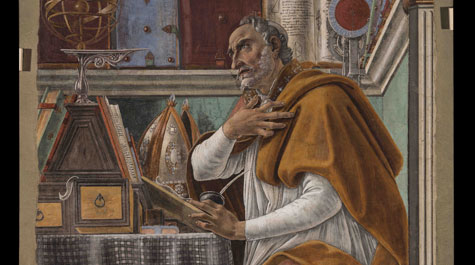
Sandro Botticelli, Sant’ Agostino nello studio (Saint Augustine in the studio), Fresco, Chiesa di San Salvatore in Ognissanti, Florence.
Augustine’s Misstep on Original Sin
The most egregious example is from Augustine’s Latin mistranslation of Romans 5:12, which has led other interpreters astray as well. In certain modern translations, like the ESV, the text correctly reads:
“Therefore, just as sin came into the world through one man, and death through sin, and so death spread to all men because all sinned—”
Correctly translated, “death” is the subject of the phrase “death spread to all men because all sinned.”
Augustine’s Latin version which he used mistook the “because” to be “in whom.” In this mistranslation, the subject is misplaced and thought to be a reference to the “one man,” namely Adam, “in whom all sinned“:
“Therefore, just as sin came into the world through one man, and death through sin, and so death spread to all men in whom all sinned—”
This gives the wrong impression that not only do we inherit a proclivity towards sin, due to Adam’s example, we are also declared guilty of Adam’s sin. Augustine’s dispute against Pelagius depended a lot on this notion of imputed guilt, not simply a proclivity towards sinful actions, being bestowed on all humans following Adam. Not only are we responsible for our own sin, we are also made responsible for Adam’s sin, a misinterpretation of the Bible which has been passed down through the ages (Fox, pp. 667, 677).
When coupled with Augustine’s belief about the sacraments, in his dispute with the Donatists, Augustine’s doctrine of original guilt has cast a shadow over the Western church. The Donatists had made it a habit to rebaptize orthodox Catholics who had received their original baptism from a discredited priest. Since the Bible taught that there is only one baptism (Ephesians 4:4-6), to be rebaptized by anyone was considered a grave sin.
Anyone growing up in a Christian tradition where infant baptism is normally practiced will surely wrestle with this if they encounter friends who hold to the doctrine of “believer’s baptism;” that is, baptism should only be administered to someone who has made a profession of faith, which therefore excludes infants from being candidates for baptism. This issue can trouble the conscience of a believer, whether or not any teaching on “baptismal regeneration” is in view.
Augustine’s response was that the moral disposition of the priest performing baptism could not invalidate the sacrament of baptism, assuming the baptism was done correctly: if it was administered by water, if it was performed in a Trinitarian matter of being baptized in the name of the Father, the Son, and the Holy Spirit, and if it was done with the intention of performing the sacrament.
So if a Donatist were to baptize someone, who had not been baptized before, and that person was received back into the orthodox Catholic church, that person need not undergo a rebaptism. It was the act of baptism that mattered, not the one administering the baptism, which corresponds to the Latin formula: ex opere operato. However, in conjunction with the doctrine of original sin/guilt, as Augustine understood it, this meant that any unbaptized child would effectively be damned if that child died before they received baptism. For Augustine, baptism was considered to be the means by which grace was given to the person, a fundamental idea in Augustine’s theology of sacraments, which eventually became a flashpoint in the 16th century dispute between Protestants and Roman Catholics.
Augustine developed much of his doctrine of grace in his later years with his dispute with Pelagius. However, since the dispute with Pelagius came after writing of the Confessions, Fox does not explore this in Augustine: Conversion to Confessions.
Critical Reflection on Fox’s Augustine: Conversion to Confessions
Veteran evangelical scholar Gerald Bray assesses Fox’s work on Augustine in a manner similar to how I portray it in my own blogging about the book:
Lane Fox knows an enormous amount about the ancient world and brings his vast learning to bear in an eloquent and fascinating way. Digression is his strength, as whole chapters are taken up with studies of Manichaeism, Neo-Platonism, and the like. These descriptions are worth the price of the book.
In reading Fox’s Augustine: Conversions to Confessions, you will discover a wealth of information about the ancient world, a treasure that has helped to get me hooked on learning more about ancient history. This is spectacular. Nevertheless, Bray concludes that Fox’s work on this first half of Augustine’s life is not without fault:
But it’s when we come to the heart of the matter that Lane Fox lets us down most. His account of Augustine’s conversion contains an extended examination of the possible meaning of “tolle lege,” which led Augustine to take up Paul’s letter to the Romans. This is followed by an equally lengthy examination of the possible meanings of the text that moved his heart to turn to Christ. In the end, he concludes Augustine got it all wrong but remained convinced God had spoken to him anyway. His life was turned around, but only by mistake!
I read that section of Fox’s narrative and walked away from it like Bray has done. Fox offers some cogent critiques of Augustine’s interpretations of the Bible, but not all of his critiques work as well. As a committed non-believer, Robin Lane Fox’s presentation of Christianity as articulated by Augustine in his Confessions is vulnerable to critique.
For example, Fox claims that Augustine “evades the word ‘all’” in 1 Timothy 2:3-4, which says that “God our Saviour… wills that all men should be saved.” For Augustine, this “all” means “many” or “all sorts,” as in “all kinds” of people will be saved (Fox, p. 674).
Presumably, Fox’s assertion that when Augustine “evades the word ‘all’,” Fox means that the plain reading of 1 Timothy 2:3-4 is teaching a doctrine of universal salvation, a doctrine that Augustine does not accept. After all, Augustine was one of the most influential of the church fathers to teach the doctrine of eternal conscious torment. In Augustine’s mind, the experience of an eternal hell was not simply a psychological or sociological kind of torment, but it was a physical one as well. As New Testament scholar Paula Fredriksen says in her epic work, Augustine and the Jews, reviewed elsewhere on Veracity, Augustine actually envisioned that the number of the saved within the whole of humanity would actually be very few.
But leaving aside those weightier concerns about the ultimate fate of non-believers, Augustine’s interpretation of 1 Timothy 2:3-4 is not necessarily an evasion as Fox argues, as other contemporary commentators suggest that Augustine might be at least somewhat correct here, even if the text itself is not entirely clear. Many translations today take the forceful edge off of God being the one who “wills” that all individuals be saved and indicate that it is God’s “desire” that all individuals be saved, a less deterministic posture. Here is how the ESV renders the passage:
This is good, and it is pleasing in the sight of God our Savior, who desires all people to be saved and to come to the knowledge of the truth.
Fox’s assumptions about what the Bible actually teaches does not end there. Fox dismisses the story of creation as told in Genesis is “untrue,” from the viewpoint of modern science (Fox, p. 224). Fox claims that the Old Testament “predicted nothing about Christianity” (Fox, p. 228). Fox adds that “critical readers nowadays recognize no such harmony in the Gospels,” which reconciles the differences between those Gospels (Fox, p. 270).
These claims are no surprise as coming from an author who in 1991 wrote the book, The Unauthorized Version: Truth and Fiction in the Bible, where the publisher’s description of the book says Fox :
“….introduces us to a Bible that came late to monotheism, propounded a jumble of conflicting laws, and whose authors wrote under assumed name.”
Robin Lane Fox: Historian vs. Biblical Interpreter
While Fox, as an historian, has read enough biblical studies to offer some various fair and accurate critiques of Augustine, he apparently has not read enough to address some of these more broad-minded claims he makes against historic orthodox Christian faith in general. The evolutionary model of an Old Testament that morphs from polytheism into monotheism over time falls short when compared to the careful analysis of how progressive revelation actually works in the Bible. Scholarship on the Book of Leviticus, and other priestly material in the Old Testament, over the last fifty years, demonstrates a type of coherency of laws that is often missed by casual readers of the Bible. And finally, various claims made about forgeries existing in our New Testament have been met with resistance by other capable scholars.
This should suffice to say, that not all biblical scholars engaged in historical criticism come to the same conclusions Fox finds so compelling, as readers of the Veracity blog will know (see particularly the review of Jesus Contradicted, by Michael Licona). Augustine sought to harmonize discrepancies which he acknowledged existed in the Bible. But as New Testament scholar Michael Licona has shown, Augustine saw some limits to common harmonization techniques. When Augustine ran into such difficulties, he would look for a deeper spiritual meaning found within the text of Scripture.
For example, according to Michael Licona, Augustine recognized a discrepancy between Mark’s version of Jesus’ baptism and Matthew’s version of Jesus’ baptism. When the voice from heaven speaks, Mark 1:11 reads:
And a voice came from heaven, “You are my beloved Son; with you I am well pleased.” (ESV)
Yet in Matthew, the same verse reads (Mathew 3:17):
And behold, a voice from heaven said, “This is my beloved Son, with whom I am well pleased.” (ESV)
It is as though in Mark the voice is speaking to Jesus himself, whereas in Matthew the voice is speaking to the crowd that was listening in.
A persistent harmonizer might conclude that the voice said both of these statements, once to Jesus and then once to the crowds, or vice-versa. But Augustine thought that this was a more improbable way to interpret the text, and taking harmonization way too far. For some might be tempted to say that the entire narrative about Jesus’ baptism happened multiple times. However, such a judgment would be far fetched, as the Gospels consistently portray Jesus’ baptism as a once in time event.
Instead, Augustine concluded that perhaps Mark is giving us a verbatim account of what was said, whereas Matthew is reframing the heavenly speech in order to instruct the crowds, suggesting a more spiritual dimension. The meaning of what the text is saying is preserved across the Gospels, regardless of how the Gospel author articulates the exact verbiage of the voice. Augustine’s approach to this text offers an improvement over his typical Ambrosian tendency to look for an allegorical interpretation, when faced with such difficulties.
As Augustine put it in his Harmony of the Gospels, the Gospel authors intentionally introduced such differences, while preserving the meaning:
…. At the same time, while preserving the sense intact, they use different modes of expression in reproducing the terms of the voice which came from heaven.
While Augustine at times shook off a strict kind of harmonization as unnecessary, he nevertheless found the Gospels to be compatible with one another, sharing the same essential message, even with a more nuanced understanding of what constitutes “harmony.” This would go against Fox’s inclination towards skepticism, which suggests that there is “no such harmony” between the Gospels.
While I do not share in Dr. Fox’s ultimate conclusions regarding Christianity, I still find him to be a compelling and fascinating writer. I have the Kindle version of Augustine: Conversions to Confessions, but I was primarily engaged in the Audible version, read by Michael Page. On a long road trip to Indiana last year, Augustine: Conversions to Confessions, clocking in at 25 1/2 hours, made for a good companion that kept me alert the whole way.
It remains to be seen whether or not Robin Lane Fox will continue with another book examining the life of Augustine following the Confessions. Augustine was roughly 43 years old when he worked on the Confessions. He would go on to live another 33 years of service as a Christian bishop in Hippo, until his death. After enjoying Augustine: Conversions to Confessions, I hope that Dr. Fox might continue on and complete this biography of this extraordinary and influential Christian leader and thinker of the early church.
For other Veracity blog posts about Augustine, see the following:
- Augustine on Infant Baptism
- Augustine on Learning to Disagree Well, among other Christians with differing views
- Augustine and the Jews, pushing back on at least some of the prevailing anti-Jewish views of his day
- Why Augustine Changed His Mind on the Millennium
- Augustine on the Literal Interpretation of Genesis



 Veracity