
Who was ultimately responsible for Jesus’ crucifixion? Theologically, all of us as humans have played a role in the death of Jesus, while believers in Christ mercifully receive its atoning benefits. But historically speaking, was it Pilate or the Jewish leaders who consigned Jesus to die on the cross? This is a thorny question which requires a careful answer.
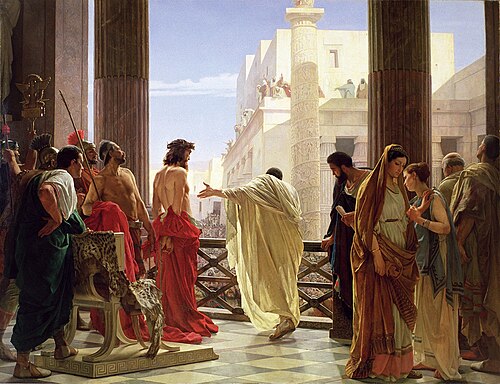
Ecce Homo (“Behold the Man”), Antonio Ciseri’s depiction of Pilate presenting a scourged Jesus to the people of Jerusalem. It took Ciseri twenty years, from 1871 to 1891, to complete the painting (from Wikipedia)
Pilate’s Hands Washing: From Mick Jagger to a Cathedral in Regensburg, Germany
The Rolling Stones lead singer, Mick Jagger, imprinted a passage from the Christian New Testament on the minds of a generation, when in 1968 he first sang “Sympathy For The Devil,” as a personification of Satan:
“And I was ’round when Jesus Christ
Had his moment of doubt and pain
Made (expletive) sure that Pilate
Washed his hands and sealed his fate”
What was the washing of Pilate’s hands all about? In Matthew 27:1-2, the Jewish chief priests and elders judged that Jesus should be put to death, but they sent him to Pontius Pilate, the Roman governor of Judea anyway. Later in Matthew 27:24-26 we read of the aftermath of Pilate’s interview with Jesus:
So when Pilate saw that he was gaining nothing, but rather that a riot was beginning, he took water and washed his hands before the crowd, saying, “I am innocent of this man’s blood; see to it yourselves.” And all the people answered, “His blood be on us and on our children!” Then he released for them Barabbas, and having scourged Jesus, delivered him to be crucified.
All four of the Gospels note that Pilate had a role in Jesus’ crucifixion, but there are some differences in how Pilate is portrayed. What is peculiar about this passage in Matthew is that none of the other three Gospels record the incident of Pilate washing his hands. Neither do the other Gospels tell of the specific response of the people, “His blood be on us and on our children!”
Was Matthew putting the blame for Jesus’ crucifixion on the Jews? Or is something else going on here?
On a trip to Europe my wife and I took in 2022, I was stunned to see so much historical evidence of antisemitic sentiment preserved in what was once the very heart of Christendom, central Europe. In Regensburg, Germany stands a great cathedral, where one side looks over the remains of what once was the city’s only Jewish synagogue. Prior to becoming an Anabaptist in the early 16th century, Balthasar Hubmaier, who was then a firebrand medieval priest at that cathedral, preached a pogrom against Regensburg’s Jewish population, leading to the expulsion of Regensburg’s Jews and the destruction of their synagogue. Regensburg’s Jews had been labeled as “Christ-killers,” whereby the blame for Jesus’ death had shifted from Pilate to the Jews, and the label got stuck there.
A memorial to the destroyed old synagogue stands in its place now, overshadowed by the towers of Regensburg’s St. Peter’s Cathedral. On the side of the church is engraved a “Judensau,” an image of several Jews sucking from the teats of a female pig, a disgusting vilification of Judaism. I do not even want to post an image of this on this blog post! Some 48 towns across Germany have “Judensau” engravings on their Christian churches, dating back to medieval times. Why were church authorities so willing to allow such degrading carvings on their cathedrals?
Some have tried to have these Judensau engravings removed. But I am in a sense grateful that they are still around, as it helped to convince me that antisemitism is real, deeply embedded in the psyche of many, and we should leave reminders of the past around in order to educate younger generations.
Walking around the streets of Regensburg, and other European cities, like Prague and Munich, and seeing the evidence of centuries of antisemitic propaganda advertised by those claiming to be Christians was quite a shock to me. How could so many people call themselves Christians and do such repulsive things towards Jewish people?
That question haunted me as I wandered the streets of Regensburg.
When I reviewed two books on Veracity a few years ago, Augustine and the Jews, by Paula Fredriksen (a convert herself from Roman Catholicism to Judaism), and Future Israel: Why Christian Anti-Judaism Must Be Challenged, by Australian evangelical bible scholar, Barry E. Horner, I felt a lot of discomfort reading about the history of antisemitic acts perpetrated by so-called “Christians.” I got another taste of that discomfort in reading When A Jew Rules the World, by Bible prophecy teacher Joel Richardson, showing that some of my heroes in the early church voiced a kind of anti-Jewish sentiment at times in some sermons. But that visit to Europe two years ago convinced me that the history of antisemitism was worse than I had previously thought.
This blog post goes on multiple rabbit trails, but I want to address several issues:
- Answering the charge by critics that the New Testament is antisemitic.
- Thinking about why the Gospel of Matthew portrays Pontius Pilate the way Matthew does.
- Showing how the Gospels use Greco-Roman compositional devices to frame their narratives.
- Comparing modern compositional devices with the way first century literature like the Gospels were written.
- Making the case that a nuanced understanding of biblical inerrancy increases our confidence in the Bible.
- How Christian “Fan Fiction” has shaped the way we have thought about Pontius Pilate down through the ages.
- Christians have been both “Bullies” and “Saints” in church history, and why it is important to wrestle with this.
Christians should be able to share the Gospel with our Jewish friends without stepping on mines filled with anti-Jewish prejudice. Journey with me on this exploration of Christian apologetics through the lens of church history!
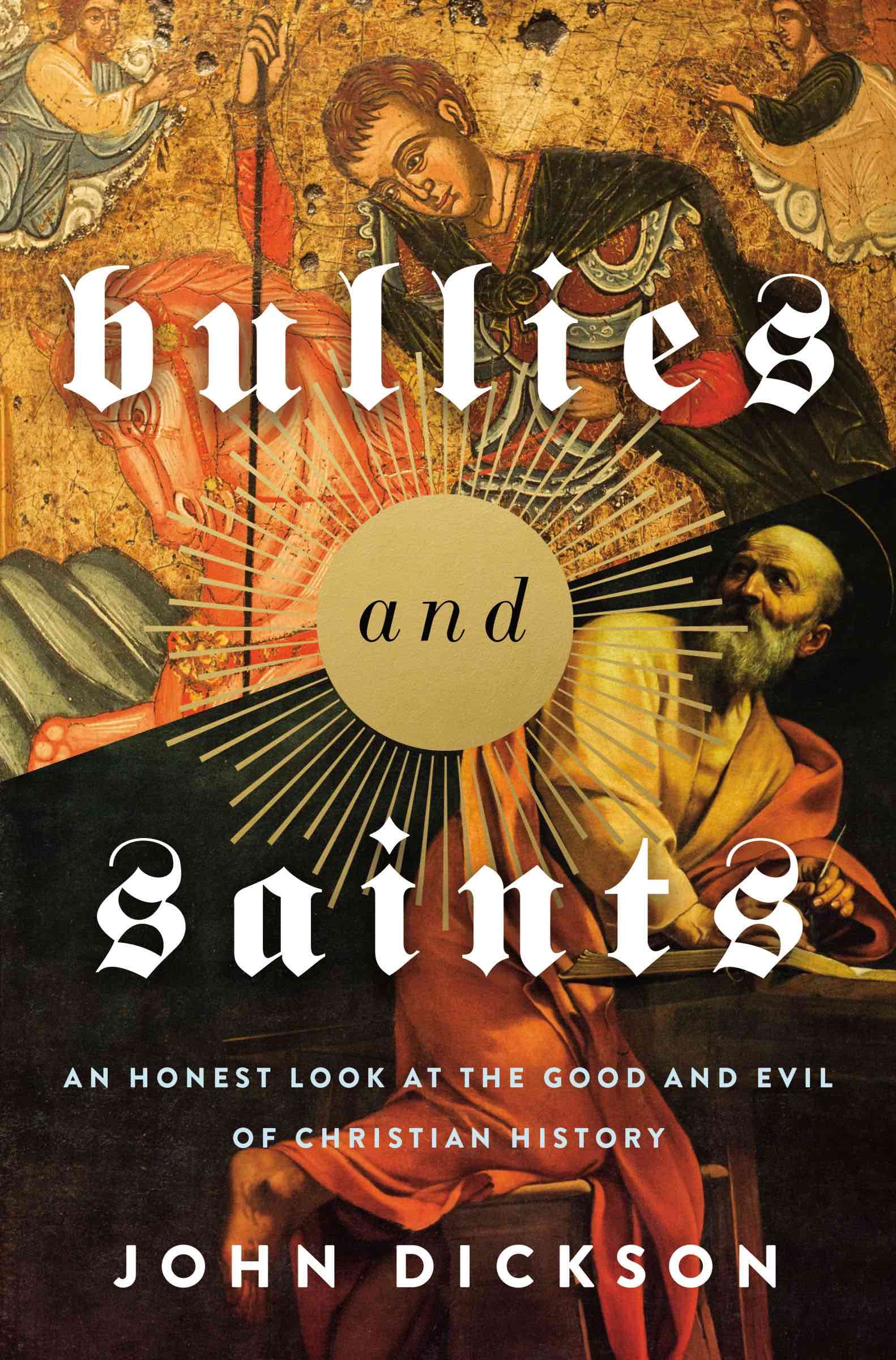
Bullies and Saints: An Honest Look at the Good and Evil of Christian History, by John Dickson, explores many of the good contributions of Christianity to the world, while also casting a light on a number of the more unsightly episodes of church history, that as a Christian I would rather forget. Celebrating the goodness of the Gospel’s impact on society while simultaneously acknowledging failures of the church along the way is vitally important, in a day when many in Western culture are skeptical about the value of organized Christianity.




 Veracity