
My wife and I spent an afternoon in Washington, D.C. this summer at the Museum of the Bible. If you have not been, it is definitely worth the visit.
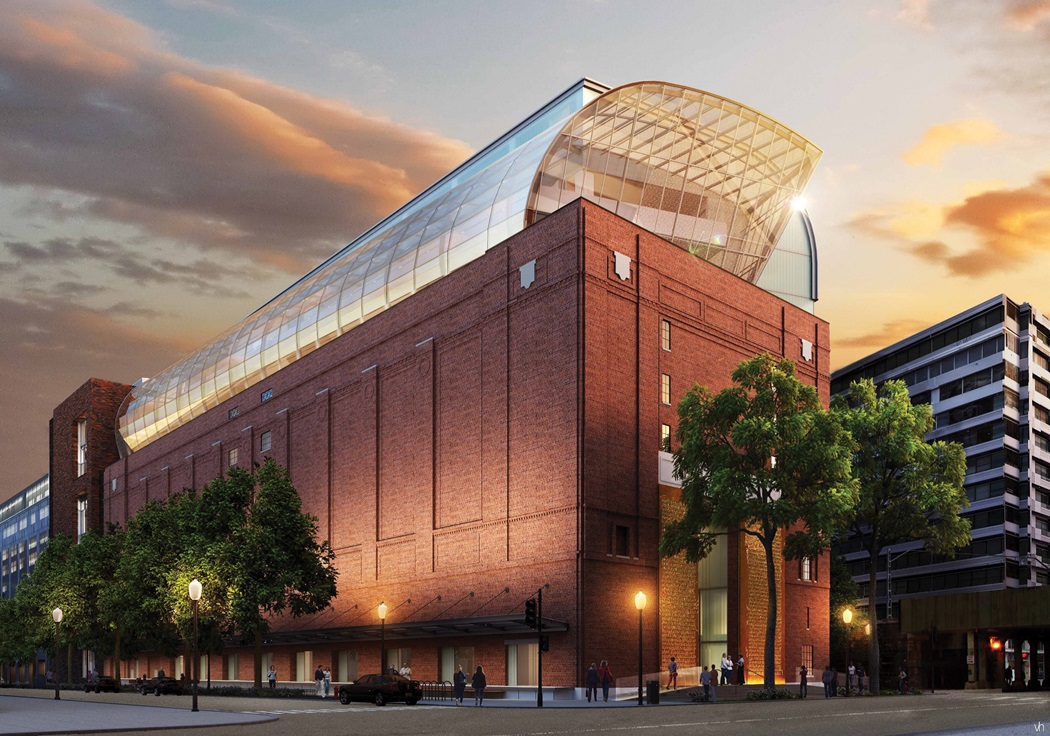
The Museum of the Bible, in Washington, D.C., opened November 17, 2017
Situated just a few blocks southwest from the U.S. Capitol, the Museum of the Bible can easily take a full afternoon, or even a full day (as that is my wife’s pace) to explore everything. Or you could just go to watch people.
The afternoon we were there, I saw a group of Amish families, speaking Pennsylvania Dutch with a bunch of baby strollers in tow. There were, of course, white Anglo-Saxon Americans, like myself, but plenty of African Americans, and African visitors from across the ocean…. and even a few Southeast Asians. What a mix!
The idea of having a Museum of the Bible was ambitious, and it had a rough start. The Green family, founders of the Hobby Lobby arts and crafts store chain, carried the vision of the Museum of the Bible to reality. But along the way, the Greens ended up acquiring certain artifacts to place in the museum that had questionable provenance. This has happened with other museums of various types, as sometimes inexperienced museum collectors do not always know who to trust when you try to collect artifacts for a collection. In the case of the Museum of the Bible, some objects had to be returned to their rightful owners. As it turned out, all of the supposed Dead Sea Scrolls that the Museum had acquired were discovered to be fakes.
The good news is that the Museum of the Bible has since learned its lesson, setting more careful standards for antiquities acquisitions. Also, the Museum has managed to address concerns that it might be effectively captured by particular Protestant evangelical interests. The Museum has worked hard to include scholarship from Roman Catholic, Eastern Orthodox, and Jewish sources to round out the interpretation of the Museum’s displays. The Vatican Library in Rome has given the Museum of the Bible some things to display, and I learned a lot about the history of Jews in colonial America. The Museum of the Bible appears to have a good mix of standard museum fair, with objects and written signage for adults and older students to read and see, along with immersive activities for kids and families.
Hey, there is even a display with Elvis Presley’s Bible! Elvis was known for being the king of “rock-n-roll” music, but he also recorded Gospel music, too. The Museum of the Bible rotates items in and out of its collection for public viewing, but you can also see it online, along with a history of how the Museum acquired Elvis’ Bible.
Here are just a few of the other things I saw that caught my eye, from the display about the history of the King James Bible. Back when the King James Bible was first printed, there was a discrepancy regarding how to interpret, much less print, Ruth 3:15. The ESV translation reads it like this:
And he said, “Bring the garment you are wearing and hold it out.” So she held it, and he measured out six measures of barley and put it on her. Then she went into the city.
But the King James scholars behind the KJV translation were befuddled by some confusion between the various Hebrew manuscripts available to them in order to produce the English translation. Did “she,” meaning Ruth go back into the city, as the ESV has it above, or should it be “he,” as in Boaz, who “went back into the city?” Different printers varied in their printings of 1611:
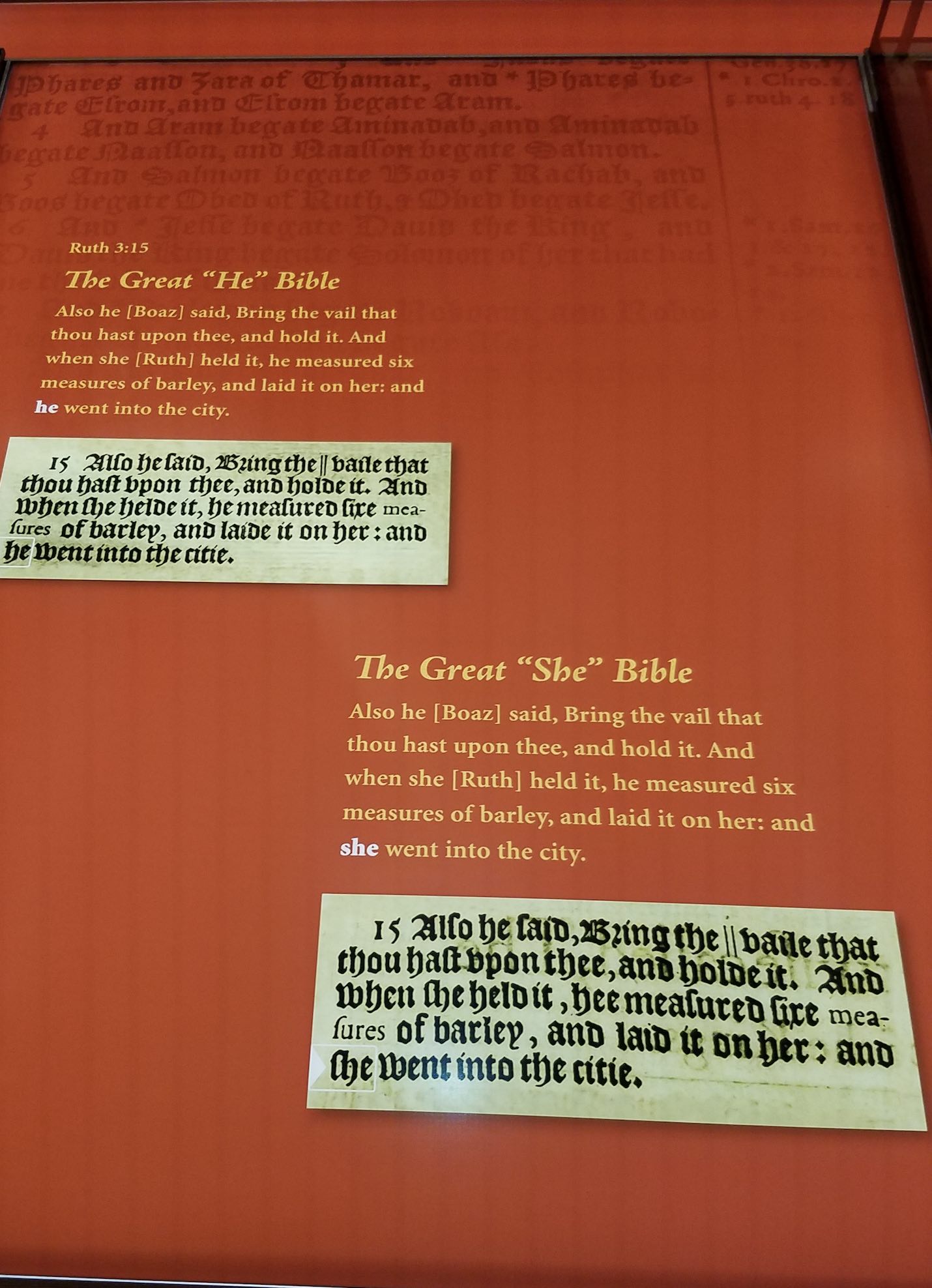
The “she” in the last line of the printing, on the bottom, is a little hard to make out as the English printers of the day would often print the so-called “long s” at the beginning of the word much like the letter “f”. You can see the same practice in the word “mea-sures” broken across two lines in this verse, where it looks like “mea-fures”. See this video on “The 7 Forgotten Letters of the Alphabet” for an explanation.
There were also a number of Bible printings of the King James Version over the years that had some glaring errors in them. One printing, nicknamed the “Killer” Bible, from the 1795 printing by R. Bowyer and J. Fittler of London, accidentally misspelled the word “filled” in Mark 7:27 as “killed.” This printing has Jesus saying, “Let the children first be killed.” Oooops! The Museum of the Bible has a copy of this Bible on display (zoom into the photograph to see the error at the top of the left hand page, in the right hand column):
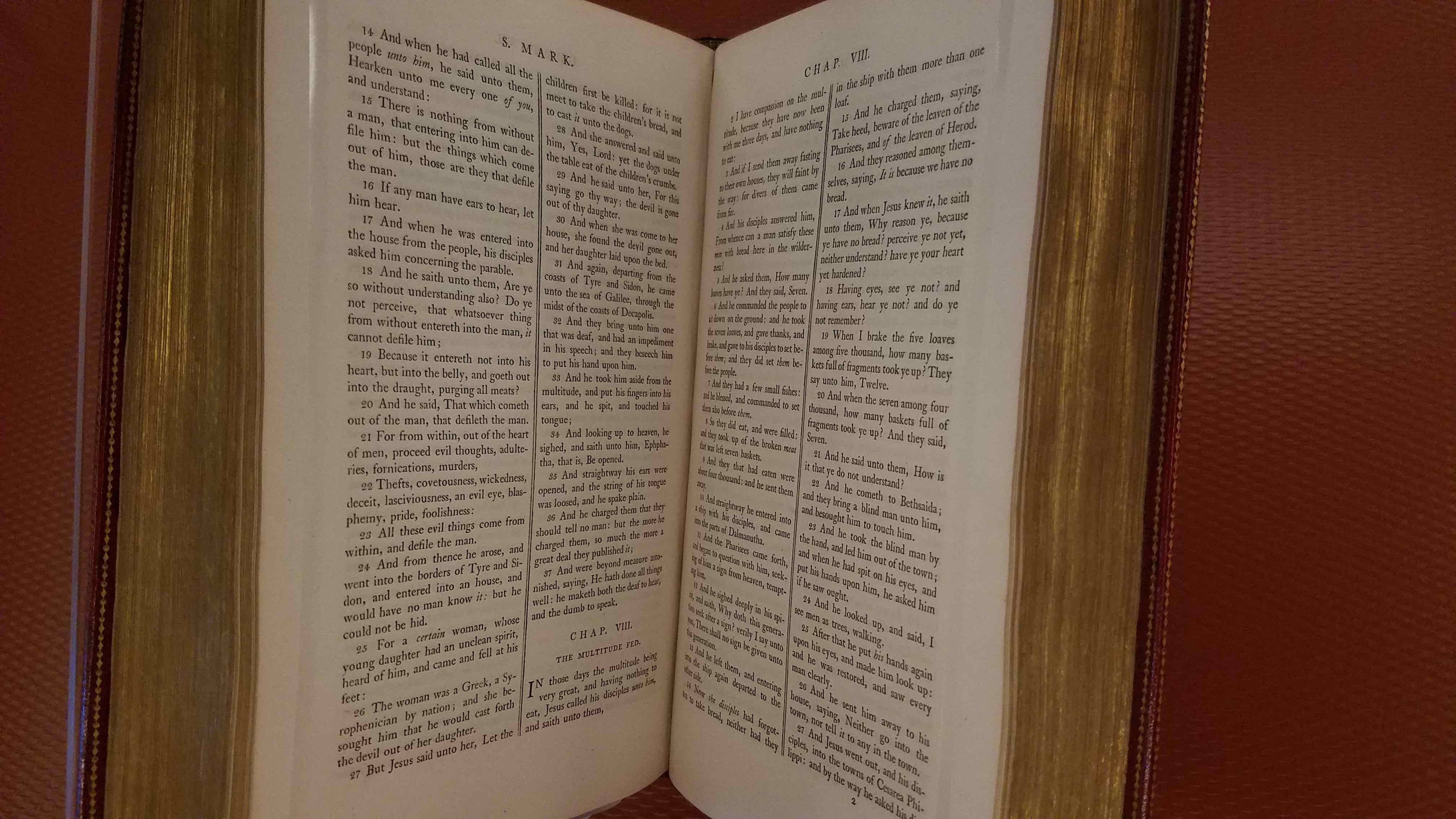
The Killer Bible.
Now here is something I have always wanted to see for myself. In 1631, the printer Robert Barker of London printed a Bible with a terribly embarrassing error in one of the Ten Commandments found in Exodus 20:14, “Thou shall commit adultery.” The printer left out the word “not.” Now, that is a big OOOOPS! They call it the “Wicked Bible.” It is a collectors edition now, as most copies of that printing were either corrected or destroyed. But the Museum of the Bible has their own rare copy!
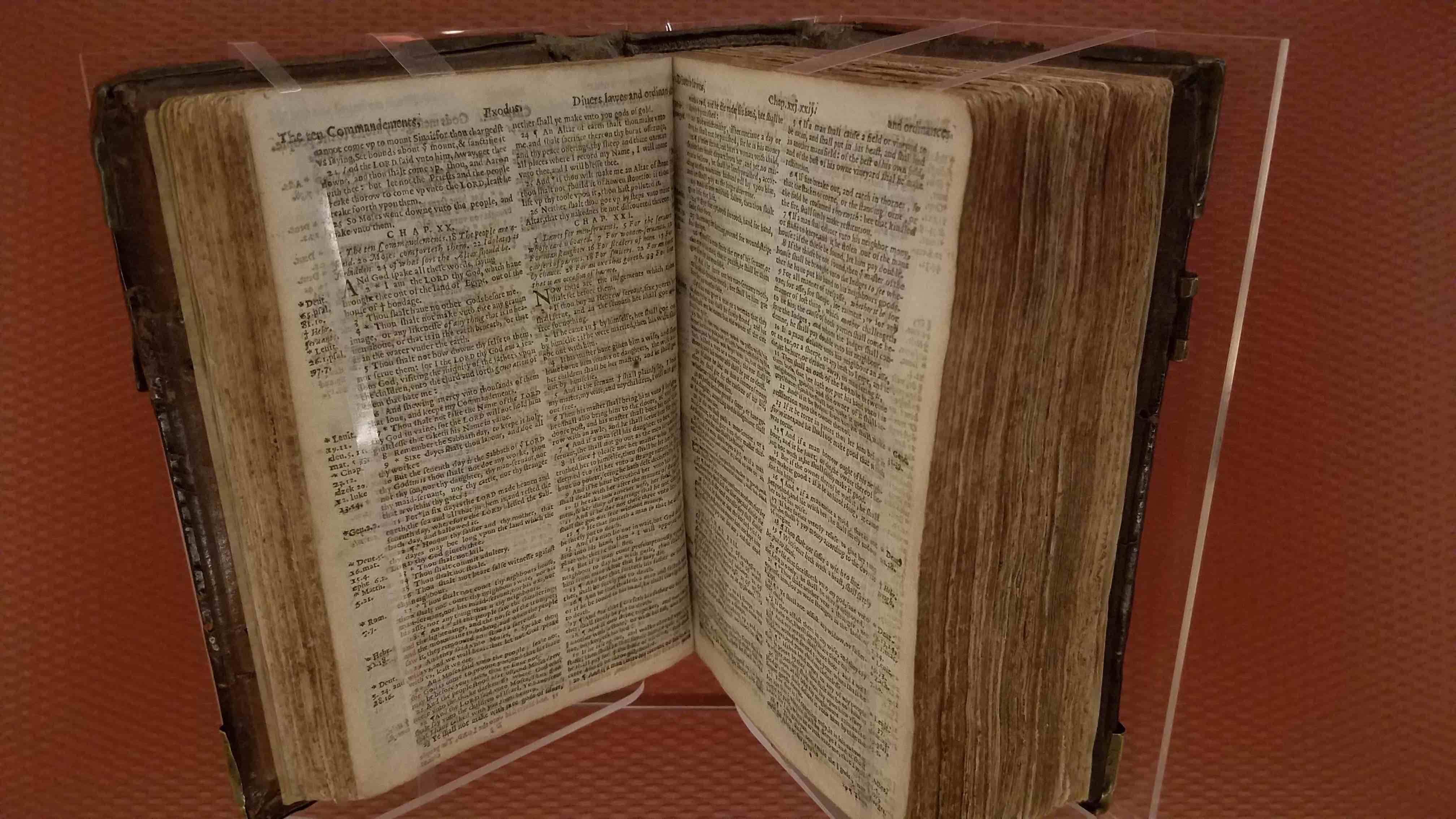
The Wicked Bible
If there was one thing I was disappointed with, it was that the displays often had a lot of facsimiles instead of the real documents on display. A perfect example is a fragment from the Oxyrhynchus collection discovered in Egypt in the late 19th century of the so-called Gospel of Mary. The Oxyrhynchus collection is from an ancient garbage dump in Egypt where many of the unearthed fragments are still being analyzed over a century later.
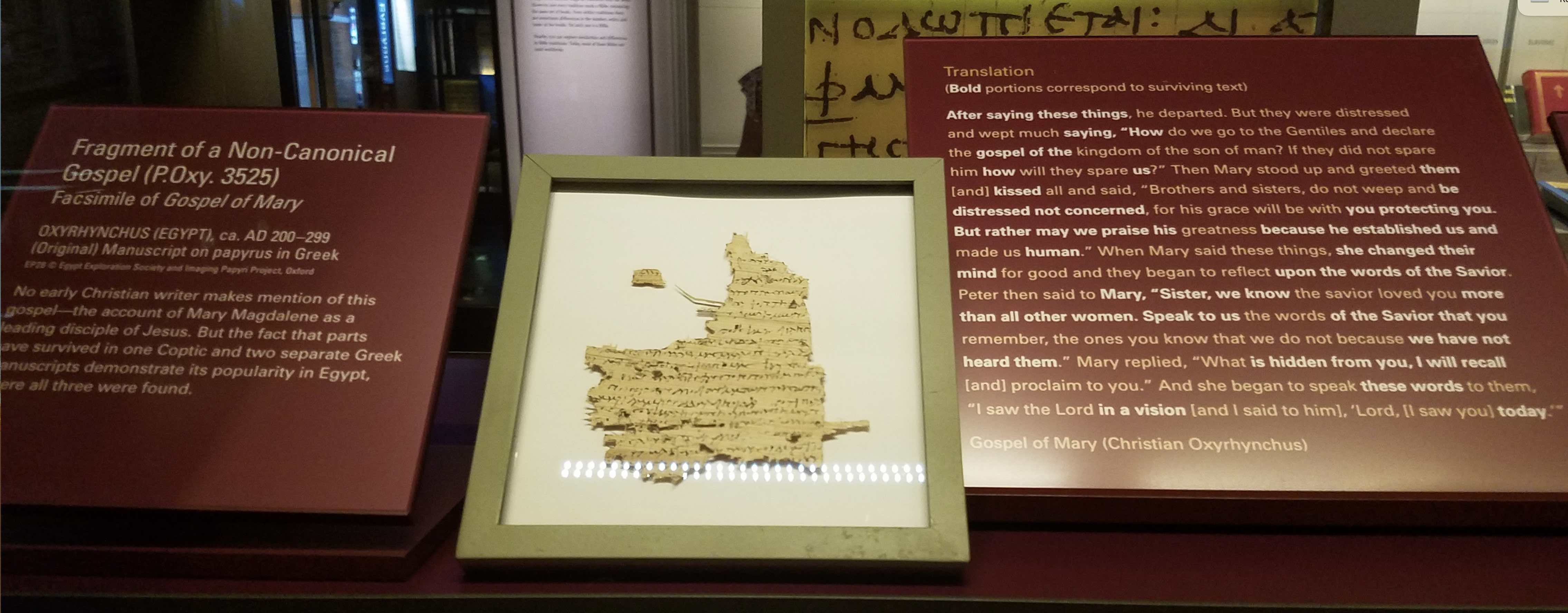
The Gospel of Mary.
The Gospel of Mary is not found in our canonical Bibles, but it was a popular text among the Gnostic Christians, particularly in the 3rd century. In the Gospel of Mary, Mary Magdalene was featured has having a unique relationship with Jesus, whereby Jesus is said to have revealed things to Mary that Jesus did not reveal to the twelve male disciples/apostles. Some of what Jesus supposedly revealed secretly to Mary is strange, to say the least. A number of Gnostic Christian groups during the early church era had the rough equivalent of female presbyters in their churches (along with male presbyters), as opposed to the male-only presbyteriate in the orthodox communities. The display for the Gospel of Mary was quite informative, even though the fragment on the display was only a facsimile and not the real thing.
Was the Gospel of Mary facsimile on display simply because the Museum of the Bible does not possess the real thing? This was not clear to me. The Museum of the Bible seems like it is on good enough footing now that it might be able to acquire other artifacts for display without having to resort to so many facsimiles. Let us hope this happens!
Overall, there is a lot to explore at the Museum of the Bible. It is perfect for families and large groups to visit. In a day and age when biblical illiteracy is at an all time high, it is great that Americans and visitors to America have the Museum of the Bible available where the history and influence of the Bible on Western (and world) civilization can be surveyed. Go visit the Museum of the Bible!!



 Veracity