Tag Archives: Martin Luther

The Haunted Legacy of Martin Luther

A warehouse at Auschwitz, storing clothes of camp victims, after liberation in January 1945. How much did Martin Luther’s rhetoric lead to the Holocaust? (Credit: National Archives)

Martin Luther is one of my theological heroes. But like any other fallen human, Luther was far, far from perfect. He was the Reformation’s chief champion of salvation by faith, and faith alone. But he also had a dark side…  (NEWS FLASH)… just like you and me.

As we remember the 500th anniversary of when this obscure monk, turned bible professor at a university in Wittenberg, famously nailed his Ninety-Five Theses to the church door, on Halloween, we mainly think of Luther’s attack on the abuses of the medieval Western church, a corrupt institution that instilled fear and anxiety among the people, and financially profited from such abuses. We also think of Luther’s famous stand for the Scriptures alone (sola scriptura), as the ultimate source of truth. I could go on with praises for Luther. We all owe an immense amount of gratitude to God for raising up a Martin Luther.

Luther was also a man who enjoyed life. He enjoyed good food, and having a good time with friends and family. He was comparatively more jovial than his later Reformed counterpart in Geneva, John Calvin. You could count on having a fun night, out on the town, with Martin Luther. With John Calvin? Well, you would probably be in bed before 9pm.

Luther preached a Gospel of grace, and grace alone…. and for the most part, he lived it.

I am a Martin Luther guy.

But this does not tell the whole story about Martin Luther. Luther had his blind spots, his dark side, if you will. To ignore these shortcomings is to fail to tell the whole story. There are possibly three elements to Luther’s legacy that still haunt the great German Protestant Reformer. Continue reading


Crisis at Marburg

The Reformation gave the church a renewed confidence in the authority of the Scriptures. However, the Reformation also shows us that the interpretation of God’s Word requires diligent study, a hunger for truth, a love for our fellow believers, and humility. Here is why…

Clarke Morledge's avatarVeracity

"This is my Body... This is my Blood." Matthew 26:26-27. Literal or symbolic interpretation? “This is my Body… This is my Blood.” Matthew 26:26-28. Literal or symbolic interpretation?

Zwingli, with tears in his eyes, extended the hand of fellowship, but Martin Luther steadfastly refused: “Yours is a different spirit from ours“. Luther walked out.  The split was final. The unity of the Protestant Reformation movement was in tatters.

Marburg, Germany. 1529. Martin Luther’s attempt to reform the Roman Catholic church and restore confidence in the Bible “alone” was in full swing. Years earlier, he had nailed his famous 95 theses to the Wittenburg church door, protesting abuses within the church. Four hundred miles away, in Zurich, Switzerland, a young renegade priest, Huldrich Zwingli, was beginning to do the same thing Luther had started in Germany. Both Luther and Zwingli felt that the Church of Rome had lost its way. Christianity needed to return to the Holy Scriptures as the pure…

View original post 1,419 more words


What Was the Reformation All About? (In Three Minutes)

Ligonier Ministries R.C. Sproul gives a quick rundown of what the Reformation was all about, and what it means for Christians today, in less than three minutes. For more on the 16th century Reformation at Veracity, just search for the keyword “reformation,” and explore various blog posts on relevant topics.


Eric Metaxas on Martin Luther


October, 2017 is a big month for Christians, as we remember the 500th anniversary of Martin Luther’s nailing of the Ninety-Five Theses to a Wittenberg church door, kickstarting the Protestant Reformation.  In a secular world, where spiritual topics are often taboo, talk of Martin Luther can be a great conversation starter for Protestants, Roman Catholics, and Eastern Orthodox… even with unbelieving friends, co-workers and family members. Luther is big everywhere. Even though Germany is mostly nominally Christian now, Luther is still recognized as a national hero. For Westerners in general, Luther is a prominent historical personality, regardless of one’s religious identification (or lack thereof).

But, if you are clueless about Martin Luther, where do you start to learn more?

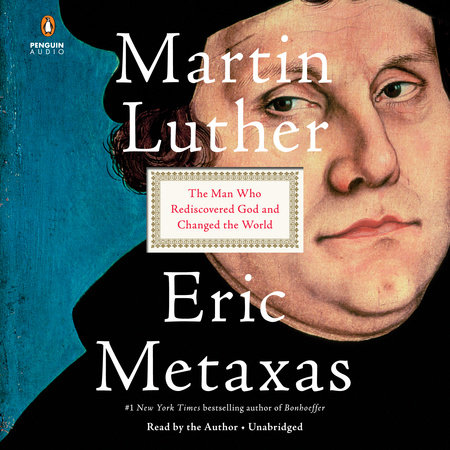
Eric Metaxas is a popular Christian author and talk show host. He is a type of public intellectual, who keeps things down on “the bottom shelf.” Plus, he is funny. As author of bestselling books on William Wilberforce and Dietrich Bonhoeffer, Eric Metaxas writes in a very accessible style. His latest book, Martin Luther: The Man Who Rediscovered God and Changed the World, would be a good introduction to those who look upon the Protestant Reformation as an unfamiliar, foreign country. Though I do not agree with everything Metaxas writes, his popularization of scholarly research is nevertheless very engaging.

Roland Bainton’s 1950s classic, Here I Stand, is still my favorite biography on Luther. But if I get a chance to dip into Metaxas’ new book, I might revise that. In the following video, Eric Metaxas, who comes from an Eastern Orthodox background, gives a talk summarizing his new book on Luther, at a recent National Religious Broadcaster’s meeting. As Metaxas says, Luther “rediscovered God and changed the world.” For a cheery take on Luther, please enjoy!


Imputation: The Chocolate Chips in Luther’s Theological Cookie

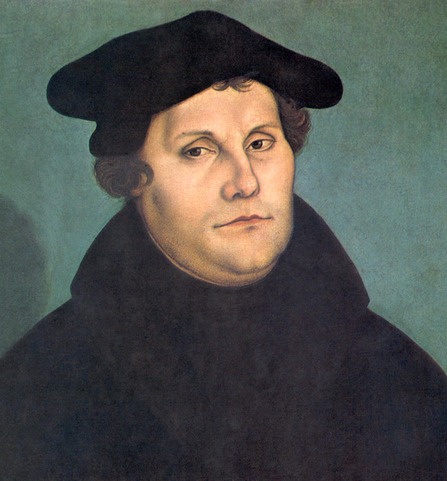
Martin Luther (1483-1546), by Cranach (credit: Wikipedia). “Imputation” was the core theological concept behind Luther’s thinking. So then, what is “imputation?”

Imputation. Have you ever heard of that word? We do not use it in normal conversation. But in the 16th century, imputation became a battleground idea for the Reformation. This crucial theological concept helps us think through a true understanding of the Gospel, even today.

Theologian Michael Horton, one of the scholars interviewed in the film documentary This Changed Everything, about the Reformation, likens imputation to a cooking analogy. If you try to make chocolate chip cookies, but leave out the chocolate chips, then you have pretty much left out the main ingredient. Likewise, many Protestants would argue that if you talk about the Gospel, but leave out imputation, then you end up with a chocolate-less cookie. Before we get at the definition of imputation, let us see why this might be so important. Continue reading