Tag Archives: Jonathan Haidt

The Anxious Generation, by Jonathan Haidt. A Review

I could see this coming at least 17 years ago…. Well, sort of. When Steve Jobs announced Apple’s bombshell product, the iPhone, in 2007, I knew this would change the way people lived their lives. What I did not know was just how detrimental smartphones would become for children’s mental health… and finally, just as of June, 2024, the U.S. Surgeon General has issued a warning about the indiscriminate use of social media among children and teens.


I have worked in the Information Technology industry for about 39 years, and the pace of technology change has been breathtaking. “Overwhelming” is another word to describe it. But the smartphone revolution has probably had the most profound impact of anything in our information age.

I must confess that I have been part of the problem. The Internet revolution has changed the way we as humans exchange information, and get things done. Expedia makes travel easier. I like my Amazon Prime. Who needs physical road maps when you have Google or Apple Maps on your phone?

But Internet technology has also transformed how we handle relationships, and this impacts our mental health. Though I had been building computer networks during my entire professional career, it took me a while to get my first smartphone, probably about twelve years ago. I was hesitant to get one since my trusty flip phone served me quite well.

A Confession to Make

However, my first experience with a smartphone got me sucked in. It was cool. Everything was at my fingertips.

I remember bringing that smartphone into a church worship service, looking up a song lyric as our church had run out of paper bulletins to hand out to people, so that they could follow along with the service. How convenient it was to have everything I needed in my hand on this backlit screen! I had that song lyric on my phone screen, while the choir was singing a rather somber melody while the lights dimmed within the sanctuary..

Nevertheless, I was absolutely clueless as to how distracting my shiny smartphone was to other worshippers. Finally, the lady next to me kindly asked me to turn off my phone as my screen was flashing in her eyes. To my embarrassment, I shut my phone down. But it did get me thinking. I was part of the smartphone misuse problem, and was not even fully aware of it, until someone pointed it out to me.

Over the years, I must admit that the “Like” button on so many social media apps produced some of my own anxiety. But I was an adult, so I pretty much knew how to handle it. Yet the story is quite different for children.

Jonathan Haidt, author of The Anxious Generation: How the Great Rewiring of Childhood is Causing an Epidemic of Mental Illness, who had previously authored The Righteous Mind: Why Good People Are Divided by Religion and Politics, makes the case that our phone-based culture has been responsible, at least in large part, for the tremendous rise in teenage and preteen mental health issues.

Jonathan Haidt teaches at New York University, where his research is on morality. His earlier book, The Righteous Mind, was perhaps the most important book I read during the decade of the 2010s (Read my review on Veracity). Though a secular Jew who considers himself as an atheist, Haidt has a very generous appreciation towards the Christian faith, as you might discover below. This new book, The Anxious Generation, has plenty of research analysis like The Righteous Mind, but it is also a plea for a return to sanity in how we as a culture, Christians included, need to rethink our usage of the Internet.  In this new book, Haidt says: “Social media use does not just correlate with mental illness; it causes it.

I think he is right.

How We Lost a Generation of Children to Social Media

What I could not figure out is that even twelve years ago friends in my church were buying these smartphone devices for their preteen and teenage children. Why were they being so willing to buy in so quickly into the smartphone craze? As a technology advocate who worked in the information technology industry, I should have spoken up more. But to my chagrin now, I kept far too quiet.

We as Christians talk about training up our children in the ways of the Lord, offering guard rails to children, incrementally exposing them to things they must deal with as an adult, and resisting peer pressure. For the most part, conservative Christians broadly speaking have done fairly well at that.

But when it came to technology, Christians, just like most other people, have taken nearly all of it in with very few guard rails. Now as these kids have become college students and even young adults, some of these kids and former-kids show signs of severe anxiety and depression which many of us never saw so much in previous generations.

Haidt likens this to a grand scientific experiment where a whole generation of parents sent their children off to live on Mars, despite the fact that Mars is a very dangerous place for even adults to be. Little did we all know that the use of smartphone technology itself, not simply visiting certain websites, would become a problem.

My liberal-mainline-Christian Episcopalian parents had enough concern to keep me away from adult bookstores when I was a kid. But even in the most conservative Christian households today, for the past decade, children have been given hand-held devices which enable unfettered access to adult-only explicitly sexual content that I never would have dreamed of having access to in the 1970s. Nevermind the exposure to worldviews that seek to undermine one’s Christian faith and witness. Even up through the 1980s, one would need to go visit your local library in order to fact-check a sermon. Now on a smartphone, you can fact-check a sermon in under 30 seconds. Furthermore, who knows if the “fact-checking” online via the Internet is going to be accurate?

The sad truth is that smartphones are difficult enough for adults to control. Use of them can be quite addictive, despite how useful they can be in making telephone calls, listening to audiobooks (something I do quite a lot), and in checking my email. What I try to resist as much as possible are social media apps. But it even becomes more difficult when employers essentially require you to be less than a step away from your cell phone.

So far, I have resisted the urge to sign up for Facebook, despite how useful Facebook Marketplace is for selling things online. I stay away completely from Tik Tok and Instagram. But the story is different for teens and preteens, and the scientific results that Haidt reports are startling. High-tech social media companies have exploited the psychology of adolescents, such that they get hooked on social media via their smartphones. The impact is worse for girls than boys, but girls and boys suffer from a highly sensitive “Defense Mode,” as Haidt calls it, in that smartphone usage, which can easily surpass the hourly usage of watching television that kids like me in the 1970s experienced, just has skyrocketed since the early 2010s.

As a result, kids are stressed out. Many find it difficult to have face-to-face conversations with physically present human beings. Depression and anxiety disorders have practically become the norm among many teenagers. Anxiety has become the worst, with a 134% percent increase of diagnosed anxiety disorders among college students since 2008. Then there are also increases in ADHD, bipolar, anorexia, substance abuse, and schizophrenia.

Boys Versus Girls

The differences in how social media impacts girls versus boys is disturbing. Girls suffer the most. Girls who become exposed to social media apps that are highly visual, like Instagram, end up comparing themselves with other girls in terms of physical beauty. Cyber-bullying is particularly bad for girls, as shaming girls on the basis of their looks is so easily done on social media. Young teenage girls who aspire to become “influencers” are particularly vulnerable to exploitation from adult men and even otherwise supposedly “reputable” corporations.

Boys on the other hand, while less impacted in general than girls, suffer from social media in other detrimental ways. Boys tend to delay launching into the adult world more than girls, and they tend to isolate themselves more. Boys are less likely to succeed academically when compared to girls. Such problems are exacerbated among boys who lack respected male role models in their life, whom they can emulate. Haidt does not report any such particular findings with respect to role models for young girls.

(Churches which seek to diminish the role of adult male leaders who interact with boys would do well to take note of this report of the scientific data. The bottom line: young boys need to see positive male role models in positions of leadership in order for them to succeed in making it successfully to adulthood).

Even in Christian households, with mature Christian parents, the plague of teenage anxiety has stunted growth and made it even more difficult to pass on the faith to that next generation. As a Christian, this has really puzzled me, as many Christian parents have been quite diligent with policing how their kids spend time with others, enforcing curfews, and the like. But when it comes to smartphone usage, setting enforceable limits has become a fantasy for many families.

It is important to say that it would be wrong to blame parents as wholly responsible. Christian leaders, social media companies, and a whole host of other players alongside parents have made it difficult to figure out how to navigate the smartphone revolution. Even when efforts to rein in smartphone usage are attempted by parents, they often do not work as well as hoped. The addictive power of social media among young people makes it difficult for parents to effectively limit use of such technology, once kids get their hands on smartphone devices at an early age. GenZ, young people who were born in the late 1990s and early 2000s, have had the greatest risk, and now even younger kids are vulnerable. Reliance on communications technology during the COVID epidemic just made matters worse. Haidt shares all of the relevant statistics to show just how severe the problem is.

And it is really bad.

Other Factors, Plus the Specific Features of Social Media Which Harm Children

In fairness, Haidt does not blame everything on smartphones. Overprotective parenting, otherwise known as “helicopter” parenting, has ironically played its own role. In Haidt’s argument, children need to be gradually exposed to challenging situations in order to gain better resilience. Parents who keep their kids indoors too much are taking away from their child’s ability to go into “Discover Mode,” where they can learn to adapt to new situations, where the risk for hurting themselves is still present, but that the risk factor is not extreme.

Kids need time to play, and interact with other kids on a physically present basis. Neighbors need to stop freaking out whenever they see a child out on their own without their parents present, fearing that some parent MUST be neglecting their child and exposing them to potentially dangerous, physically-present strangers. Kids need to be allowed to explore the outside world, at age appropriate times, without their parents hovering over them. Otherwise, kids will be all too glad to hide in their bedroom to binge out on Instagram videos, etc., hoping that their friends, and even perfect strangers online might click that “Like” button, and give them that dopamine rush, which serves as the hook for how social media companies can lure young people into their orbit.

As Haidt puts it, social media for young people before their brains have matured has devastating effects. Young people can have their brains rewired by their smartphones to be on a chronic “Defense Mode” almost all of the time. We all need to have a healthy “Defense Mode” in order to handle acute, short lived threats. But exposure virtually to the following combination characteristic of social media has a detrimental impact on mental health:

  • Asynchronous as opposed to synchronous interactions with others
  • Disembodied versus embodied interactions with others
  • One-to-many interactions versus one-on-one interactions
  • Joining communities with a low-bar to entry versus a high-bar to entry

All of these factors have coalesced together work to give young people an oversensitive, chronic “Defense Mode” that can cripple a young person’s ability to successfully navigate relationships in the real world. Frankly, it can probably also have a negative impact on adults, too!

What Can Be Done About the Anxiety Crisis Among Children and Teenagers

Haidt gives us all of the bad news, but he does offer some solutions for resolving this teenage anxiety crisis:

  • No smartphone before high school (flip-phones are okay, with limited applications)
  • No social media before the age of 16
  • Phone-free schools.
  • Allow for more unsupervised play and childhood independence

Some critics of Haidt’s proposals have complained that they are too draconian. But Haidt is not a Luddite. Instead, he favors rites of passage in terms of how kids get exposed to such technology, so that they can incrementally adjust to them at age appropriate times.

Even some of the founders of the Internet revolution, like Bill Gates and the late Steve Jobs, were vigilant in limiting screen time for their kids. Gates did not allow his kids to get cell phones until they turned 14. Steve Jobs would not allow his kids at home to use iPhones or iPads until he died in 2012. The oldest teenager in that family at home was 17 at the time and the youngest was 14. Haidt’s proposals are anything but draconian.

The current age for Internet “adulthood” is 13 years old, younger than Haidt’s recommended age of 16, and that age limit is rarely, if ever, enforced by social media companies. Some balk at the idea of setting age limits for social media, citing the argument that some kids mature faster than others. But we do not that with setting age limits on obtaining a driver’s license, or obtaining alcohol.

Much of the challenges parents face in enforcing their rules for their own kids is because not every parent holds to the same rules. Being a part of a community with shared values makes it much easier to enforce restrictions on children. Family small groups, home schooling groups, and neighborhood associations can all help to keep peer pressure off of both children and parents to lower the age for initiation into the world of social media before young people are ready for it. So if the social group you and/or your kids belong to do not share the same values about limiting smartphone and social media usage, and they are not open to change, then perhaps it might be time to look for a different community which does share your values.  Or at the very least, look to be a part of a community with a critical mass of people who do share your values, such that neither you nor your children will feel socially ostracized for not “fitting in” to an unhealthy norm.

Christian parents in particular should seriously consider these solutions, if they are really serious about trying to pass their faith onto the next generation…. not just for simply mental health reasons. Interestingly, Jonathan Haidt is a secularized Jew, but he advocates for faith communities to offer substitutes for the lure of social media by offering better rites of passage for the journey from childhood to adulthood. Haidt dedicates an entire chapter on the important role that religious communities can play in pushing back against the damaging effects of social media among young people.

Local churches might consider implementing such rites of passage for their youth groups. What would it look like if parents in a Christian community were all committed to having 16th birthday parties where families could celebrate their kids getting their first social media accounts? Perhaps Christians can lead the way in setting good examples for how to raise resilient children, in a world where Christian values seem to be declining among the younger generations.

I am not sure if The Anxious Generation is the best book I have read this year, but it is undoubtedly the most IMPORTANT book I have read within the last two or three years. I listened to it as an audiobook on Audible and I highly recommend that you and everyone you know gets the book and reads it.

It is one thing when you hear a preacher decrying the corrosive impact of the world infecting the minds of children. One could easily dismiss such teaching as mere legalism. But when a secular Jewish intellectual who does not believe in God, like Jonathan Haidt in The Anxious Generation, is telling us the same thing, we would do well to heed the message.


Russell Moore has an interview with Jonathan Haidt, sponsored by Christianity Today magazine. Some good news from the Russell Moore interview, based on research done by Haidt after the book was released, is that children in conservative Christian churches have done better during the last 15 or so years of the social media-induced mental health crisis than children from liberal Christian and secular environments. Below is another interview, focusing on the mental health issues from a more secular perspective.
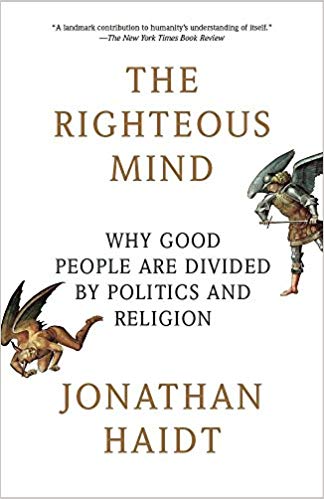

The Righteous Mind: Why Good People are Divided by Politics and Religion: A Review

Here is my big book review for the best book I read in 2019….

Why can’t we all get along?

This is the question of our age. Societies are divided. Schools are divided. Politics makes us divided. Churches are divided. What can we do about it?

Do I have a book recommendation for you!

The Righteous Mind, by Jonathan Haidt. Best book I read this year. Though written by an atheist, Haidt makes sense of why different Christians (and people in general) think so differently.

If I could ever get my fellow Christians to read just one book written by a secular-thinking atheist, this would be it. Jonathan Haidt, the author of The Righteous Mind: Why Good People are Divided by Politics and Religion, is a social psychologist at the New York University, Stern, in their School of Business. Haidt grew up as a secular Jew, and rarely ever met any evangelical Christians, until he taught a few years ago at the University of Virginia. But that encounter with evangelical Christians at UVA changed his approach to scholarship, and it really shows in The Righteous Mind.

The Righteous Mind is the best book I read this year. I can not believe I waited this long to read it!

Jonathan Haidt specializes his research in an area known as “moral psychology,” which probably sounds like a bunch of academic “hooey,” to many Christians I know. But I was stunned to find out that The Righteous Mind, actually has a lot of lessons to be learned by evangelical Christians.

I mean, a lot.

Haidt’s experience with evangelical Christians at UVA helped him to realize, to his astonishment, as a secular Jew, that conservative evangelical Christians can be moral, too. This will make more sense as the review below unfolds.

Haidt is most recently known as a co-author for The Coddling of the American Mind: How Good Intentions and Bad Ideas are Setting up a Generation for Failure, examining how college campuses across American have become insulated in a world of liberal theological and liberal political ideologies, mentored at times by overly-enthusiastic, extreme proponents of “intersectionality” and “critical theory.” Along with co-author Greg Lukianoff, Haidt argues in Coddling that with a well-intentioned motivation of promoting multiculturalism, today’s university system is inadvertently creating an atmosphere void of discomfort and distress, sheltering students from hearing opinions different from their own, whereby young people are becoming increasingly unable to engage other people with civility. Coddling contends that such suppression of robust dialogue, among others with different points of view, is having a negative impact on the moral development of young people.

But in 2012, Haidt wrote The Righteous Mind, a book that evangelical Christian leader, Russell Moore, described as being “the most important book in years.” I just finished the Audible audiobook version of this title, and I could not agree any more strongly with Moore’s assessment.

Here is a nugget right near the outset of the book:

If you think that moral reasoning is something we do to figure out the truth, you’ll be constantly frustrated by how foolish, biased, and illogical people become when they disagree with you. But if you think about moral reasoning as a skill we humans evolved to further our social agendas – to justify our own actions & to defend the teams we belong to – then things will make a lot more sense. Keep your eye on the intuitions, & don’t take people’s moral arguments at face value. They’re mostly post hoc constructions made up on the fly, crafted to advance one or more strategic objectives.

The brief question, at the beginning of this post, “Why can’t we all get along?,” though slightly altered, is often attributed to Rodney King, an African-American man, who was almost beaten to death by police officers, triggering the Los Angeles race riots of 1992. I remember vividly watching the events unfold on live television, as neighborhood after neighborhood went up in flames. Following six days of violence, Mr. King made his appeal for peace, after a videotape of him being beaten a year earlier, failed to convince a jury, of the wrong that was done to him.

Jonathan Haidt begins The Righteous Mind reflecting on this incident, asking that very difficult question, and exploring why it is so hard for people to answer it. As a Christian, I ask that very same question, as I find it puzzling and frustrating that so many followers of Jesus, who know that love is the very hallmark of the Christian life, can find it so difficult to express that love. On the one hand, we do want unity, but Christians also want to be people of the truth. So, while unity is vitally important, we also know, that sometimes, the quest for unity can subtlety become a cloak for an imposition of uniformity, whereby truth is sacrificed. And conscientious Christians simply can not abide by a compromise of the truth.

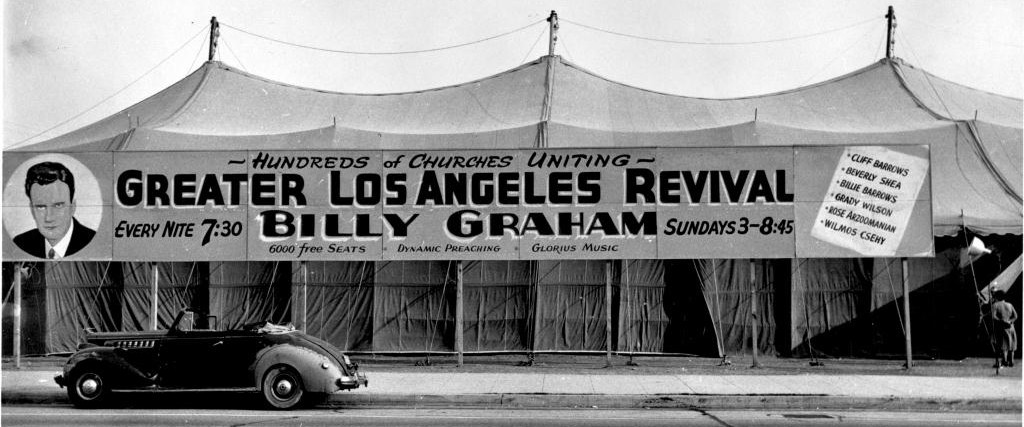
Is “big tent” evangelicalism, the kind inspired by Billy Graham, fading away? Perhaps the scientific research and insights, counter-intuitively coming from a secular, atheistic moral psychologist, can help Christians figure this out.

Why Christians Should Read The Righteous Mind

I had The Righteous Mind on my “to-be-read” list for several years, but I was prompted to read it a few months ago, when I became aware of the anti-vaccine movement, that has picked up momentum in recent years, among some modestly-well educated evangelical Christians I know. It just seems like much of the reason why some Christians refuse to vaccinate their children is because they simply do not trust medical doctors, and the medical profession, and/or the government, and/or the pharmaceutical industry. Perhaps they have some justification for their lack of confidence in those institutions, due to some type of tragic vaccine injury encountered by a family member, or some other disappointment with medicine, or doctors.

This makes a reasonable amount of sense to me, but what has exasperated me the most is the strange, unfamiliar theological and/or ethical justification that some Christians then go onto rationalize why they think vaccines cause more harm than good. Such Christians see no problem in pulling verses of Scripture completely out of context. I really did not understand that type of thinking, and so I thought reading The Righteous Mind might help… and yes, it really is!

Then, there is the Flat Earth movement, popular among some Christians, that suffers from the same level of mistrust of science and scientists, and bizarre ways of reading the Bible, as we find with the anti-vaccine movement. The same type of moral justifications and rationalization strategies apply, as demonstrated by their so-called appeals to “science,” or whatever they think counts as “evidence.”

The Flat Earth movement runs in popularity with the belief that NASA faked the 1969 moon landing… and the interest in these sets of beliefs has been growing in the age of the Internet and social media. Twenty years ago, in 1999, a Gallup poll revealed that 6% of Americans believe that NASA faked the moon landing. A smaller, independent survey of 500 Americans, conducted this year, 2019, indicates that perhaps as many as 10% of Americans believe that the moon landing was actually filmed on some desert, Hollywood-style movie set. The same survey indicates that among younger people, between the ages of 18 and 34, up to 18% reject the moon landing, compared to only 3% of those over the age of 54. This is an astounding increase of conspiracy-style beliefs, in the Internet, social-media age.

Why do so many people, including a growing number of Christians, buy into this sort of nonsense? The Righteous Mind has helped me make sense of why so many, otherwise, well-meaning Christians (not to mention, a good number of non-believers as well!!),…. do not make much sense. Most of the crazy beliefs that others around us hold are post-ad-hoc constructions, designed to help them further their social agendas, to lessen the strain caused by living in a post-modern world, and justify their actions.

Conflicts in Beliefs Among Evangelical, “Bible-Believing” Christians

On less crazy matters, Christians struggle with division among themselves. It is no mystery to understand that even in Protestant evangelical Christianity, the efforts to maintain unity, among Christians, who hail from different denominational traditions, is exceedingly difficult. I remember twenty-five years ago when the theme of “unity in the midst of diversity,” was a welcome catchphrase, among many evangelicals, weary of denominational bickering and infighting, that inspired a generation of Christians, in the footsteps of a Christian leader, like a Billy Graham, to find an expression of Christian faith that majored on the majors, and minored in the minors.

This expression of evangelicalism, what historians typically classify as Neo-Evangelicalism, was a “big tent,” following an image from the great Billy Graham Crusade rallies, and classic revivalist tradition, whereby communities of churches, from different denominational backgrounds, would gather under one “big tent,” and preach a single, simple Gospel, that would encourage the listener to come forward down the aisle, and receive Christ as their Lord and Savior.

But those days appear to be fading behind us. Today, talk of “diversity” in more than a few evangelical churches, is an invitation to dissension and discontent. “Big tent” evangelicalism has become a victim of its own success. Instead of being an oasis that rose up from the chaos of a mainline Protestant liberalism, or the liberating alternative to a narrow-minded fundamentalism, today’s evangelicalism is fraught with claims of compromise from within the evangelical fold. The future of “big tent” evangelicalism is tenuous, as many Christians believe that the size of the tent has gotten too big and unmanageable, and stretched to the breaking point.

In The Righteous Mind, Haidt observes that the large chasm created by the culture wars, that have given Americans a dysfunctional society, divided by politics and religion, can be explained by studies done in the area of moral psychology. The scientific research done by Haidt, and others in this field, is immensely fascinating. Haidt draws upon such studies, that follow the framework of evolutionary psychology, to make conclusions that sound eerily familiar to what many Christians experience. More than a few Christians, who might be tempted to brace back a bit, whenever they hear the “E” word; that is, “evolution,” might be really surprised to discover what researchers like Haidt have actually learned, from their research.

The Primary Research Results Discussed in The Righteous Mind

Haidt’s first big idea is that intuitions come first, strategic reasoning comes second. Christians and non-Christians alike follow their intuitions at first, and only later apply reason in an attempt to justify those intuitions.

Haidt employs the image of the Rider and the Elephant. It may look like the Rider (reason) is in charge. But in reality, it is the Elephant (intuition) that mainly guides and orients. The Rider can do some important things, like explain what the Elephant is doing, and even trying to change the direction that the Elephant is moving, in small increments, though it can be a slow and awkward process to do that.

As book reviewer and British pastor Andrew Wilson summarizes, “People don’t reason their way to which things are right and wrong; they sense emotionally and intuitively that they are right or wrong, and then use their reason to explain why. In that sense, to switch metaphors, moral and ethical decision making is more like a politician looking for votes than a philosopher looking for truth.” This relationship between intuition and reasoning applies to believer and non-believer alike.

Haidt then argues that humans have a tongue with six moral taste buds. But for most people strongly influenced by a secular culture, whether they be Christian or not, they are primarily influenced by two of these moral taste buds, namely (1) Care vs. harm, and (2) Fairness vs. cheating. Haidt cleverly describes these people as W.E.I.R.D.:

  • W: Western.
  • E: Educated.
  • I: Industrialized.
  • R: Rich.
  • D: Democratic.

For such W.E.I.R.D. people then, the basis for making a moral decision comes down, almost exclusively, to two criteria:

  • (1) Care vs. harm: Is something not harmful to someone?
  • (2) Fairness vs. cheating: Is something not discriminatory or unfair?

However, not everyone is so W.E.I.R.D. Haidt’s studies show that among non-W.E.I.R.D. people there are four other moral foundations, or moral taste buds, that complement the two above. These six moral foundations together create a type of balanced, ethical reasoning system for the non-W.E.I.R.D.:

  • (3) Loyalty vs. betrayal: Is something loyal to the tradition or the leader?
  • (4) Authority vs. subversion: Is something submissive to the appropriate authority?
  • (5) Sanctity vs. degradation: Is something respectful to the sacred?
  • (6) Liberty vs. oppression: Is something promoting freedom?

The last moral foundation (6), the liberty vs. oppression foundation, is a bit slippery. Moral foundation (6) can still be found, at times, among W.E.I.R.D. people. But for most of the time, the other three moral foundations, (3), (4), and (5), can be difficult to find, among W.E.I.R.D. people. W.E.I.R.D. people are generally less concerned about loyalty, authority, and sanctity as are non-W.E.I.R.D people.

Case Study: How Conflicting Moral Matrices of the Righteous Mind Apply to Discussions Among Evangelical Christians about “Women in Ministry”

Here is a helpful example, of a case study, to see how this works out among evangelical Christians, when the topic of complementarianism vs. egalitarianism comes up; otherwise known, in general terms, as the topic of “women in ministry,” or more specifically, addressing this question: Should women be permitted to serve as elders and/or pastors in a local church, where both women and men are present?

Shortly put, egalitarians answer the above question in the affirmative. The complementarians, on the the other side of the debate, answer in the negative. But why do some Christians lean towards being egalitarian, whereas others lean towards being complementarian? Jonathan Haidt’s taxonomy of moral foundations explains the answer beautifully.

The egalitarian side of the debate, who argue that women should be permitted to serve as elders and/or pastors in a local church, are W.E.I.R.D. people. They focus almost exclusively on moral foundations (1) and (2), though it could be argued that in some cases, moral foundation (6) might apply as well.

W.E.I.R.D. people; that is, egalitarians, believe that prohibiting women from serving as elders and/or pastors would be harmful to women. Therefore, it is more caring, and therefore, more moral to have women serving as elders and/or pastors in a local church. This corresponds to moral foundation (1).

W.E.I.R.D. people; that is, egalitarians again, also believe that prohibiting women from serving as elders and/or pastors would be discriminatory, and therefore, unfair. This corresponds to moral foundation (2).

In some cases, W.E.I.R.D. people appeal to moral foundation (6), believing that a prohibition against women serving as elders and/or pastors is inherently oppressive. In defense of liberty, W.E.I.R.D. people would support having women as elders and/or pastors in a local church, if women were to choose to assume such responsibilities.

Non-W.E.I.R.D. people have a different moral matrix to work with. Non-W.E.I.R.D. people; that is, complementarians, would reject the idea of women serving as elders and/or pastors, because such a position would betray nearly 2,000 years of Christian tradition. Restricting the office of elder and/or pastor to men only would therefore emphasize loyalty. This is moral foundation (3) at work.

Non-W.E.I.R.D. people would oppose the idea of women serving as elders and/or pastors, as this would be an act of subversion, seeking to undermine what they see as the apparent authority of the Bible. The principle of spiritual “headship,” whereby man is the head of woman, would be an example of what might be defended here, an indicator that moral foundation (4) is active, having an emphasis on authority. This is in contrast with W.E.I.R.D. people, who are more generally concerned about “getting the job done,” as in “reaching more people for Jesus,” instead of having an emphasis on respecting the authority of a centuries-old tradition.

Non-W.E.I.R.D. would also oppose the idea of having women as elders and/or pastors, as it would degrade the sacred purposes of God, and thereby profaning God’s good order. This is grounded in moral foundation (5). W.E.I.R.D. Christians, on the other hand, are less likely to be concerned about the sanctity principle treasured by non-W.E.I.R.D. Christians.

Interestingly, non-W.E.I.R.D. people will also apply moral foundation (6), but they do so in a manner that is completely at odds with how W.E.I.R.D. appeal to moral foundation (6).

In contrast to the moral analysis done by W.E.I.R.D. people, non-W.E.I.R.D. people would oppose the idea of having women serve as elders and/or pastors, as it would be inherently oppressive, but in a completely different orientation. Having women serve as elders and/or pastors would force non-W.E.I.R.D. people to submit to an authority structure which would be contrary to the revealed purposes of God. To force someone, whether they be a man OR a woman, to submit to such authority, under the realm of a local church, is to try to compel a person to act contrary to God’s will; which for them would be an act of disobedience.

Nevertheless, non-W.E.I.R.D. people in the church still hold to the care vs. harm, and the fairness vs. cheating, moral foundations, numbers (1) and (2), in a more balanced way, with respect to the other moral foundations, than W.E.I.R.D. people in the church. Non-W.E.I.R.D. people, when evaluating complementarianism and egalitarianism from a moral psychological angle, are still concerned about making sure women are not being harmed, and that women are being fairly treated, that even if women are not permitted to serve as elders and/or pastors. In other words, women are still encouraged to use all of their God-given gifts for ministry, where they are indeed permitted to do so.

Of course, in the real world, the binary opposition of W.E.I.R.D. versus non-W.E.I.R.D. people is not absolute and clear cut. Moderates are those who are partly W.E.I.R.D and partly non-W.E.I.R.D.

My example above was not specifically tested by Jonathan Haidt, but it is consistent with similar forms of analysis that he studied. What is truly fascinating about Jonathan Haidt’s research in this area of the six moral tastebuds, and the differences between W.E.I.R.D and non-W.E.I.R.D. people, is backed up by study after scientific study. Truly remarkable.

More Research Results from The Righteous Mind

Haidt then goes onto describe what he calls “the Hive Switch.” Morality both binds and blinds. Haidt’s metaphor to describe this is that humans are 90% chimpanzee and 10% bee. We spend most of our time acting like chimpanzees, selfish individuals who seek to maximize our own chances for survival, comfort, legacy, and security. But in certain cases, the “hive switch” gets turned to “ON,” whereby we behave like bees, working together in community, in selfless and apparently irrational ways, and valuing the benefit of the group over our own.

The “hive switch” is triggered to go “ON” when we engage in team sport, commonly agreed-upon mission, tragedies (9/11, hurricanes, tornadoes, etc.), and especially, religion. Those religious traditions that make the most demands on their participants are the most successful, ironically, in  triggering that “hive switch” to flip to “ON.”

For example, churches that make less demands on their members are less likely to trigger the hive switch to go “ON,” for their members. In contrast, when a crisis comes, or a desire to engage in a common mission is embraced, churches that emphasize community and commitment are more likely to shed their chimpanzee-mode and enter into bee-mode, in order to address the crisis, or participate in the mission.

Haidt’s thesis suggests that the apparent conflict between W.E.I.R.D. people and non-W.E.I.R.D. people explains why American society is divided in the “culture wars,” why Republicans are at such odds with Democrats, and vice-versa, and conservatives (non-W.E.I.R.D.) and liberals (W.E.I.R.D.) in politics. The same paradigm follows in the area of religion, which would explain much of the tensions experienced in evangelical Christianity.

W.E.I.R.D. Christians tend to emphasize the moral foundations of care vs. harm, and fairness vs. cheating so much, that they do so at the neglect of the other four moral foundations (though the liberty vs. oppression moral foundation does play a role, but in a much different way, when compared to how non-W.E.I.R.D. Christians think of it).  Alternatively, non-W.E.I.R.D. Christians, while still considering the importance of both the care vs. harm, and fairness vs. cheating moral foundations, tend to mute the value of those two moral foundations, in an attempt to balance with the other four moral foundations.

The challenge in contemporary society, whether it be in the realm of politics, or in the realm of religion, including the life of evangelical churches, is that we all tend to live in chimpanzee-mode about 90% of the time. Our natural inclination, most of the time, is to act in our own personal interests, at the expense of the needs of the greater community. This leaves us with a chasm that separates W.E.I.R.D. and non-W.E.I.R.D. people from one another, in our normal, everyday lives.

The only way to heal this wound between W.E.I.R.D. and non-W.E.I.R.D. people, and bridge the gap, is to try to find ways to trigger this “hive switch” to flip “ON,” thus encouraging people to find ways to work together to behave more like bees, and foster community.

Therefore, Christians who are concerned about maintaining “unity in the midst of diversity,” in a local church context, would do well to consider what conditions might be required to trigger this “hive switch” to activate. The activation of the “hive switch,” in church communities, is essential to maintaining a sense of unity among believers, who often hold to such strong and conflicting opinions, that would otherwise drive such believers apart.

Christian critics of Jonathan Haidt’s work might contend that while such insights and conclusions are fascinating, there is a profound worldview conflict separating Haidt’s fundamental perspective and an orthodox Christian perspective. But it does bear noting that Haidt’s research did move him personally from being a stubborn atheist, strongly antagonistic towards religious faith, before he began his research, to becoming more positive and appreciative of the value of religious faith, including Christianity, by the time he concluded his research for this book. And that really says something about the power of scientific inquiry, as an ally for the Gospel, for those who believe that God has truly revealed himself in Creation, such that both believer and non-believer can study Creation together, and be both drawn towards the glory of God together, if their hearts and minds are open.

What Christians Can Learn From The Righteous Mind

British pastor Andrew Wilson again has some some “lessons learned” from reading The Righteous Mind that would indeed help evangelical Christians find ways to better minister to others more effectively, and build more community among fellow believers. First, we should learn to speak more to the Elephant, if not more, than the Rider.

For example, when doing evangelism, or when engaging other Christians, who do not share your theological perspective on important matters, it is important to first diagnose the intuitions of your partner in conversation, instead of focusing primarily on rational argumentation. You can have all of the apologetic arguments lined up neatly in your head (which really is not a bad idea, by the way), but you can still lose people, and lose friendships in the process. Wilson says that “if the people you’re speaking to have their intuitions and emotions against you, then it is almost impossible to win over their minds.” Following Pascal’s pithy logic in Pensees, we must “make good men wish it were true” before we “show that it is.” We should therefore endeavor to acknowledge emotional objections, make use of stories, use humor, and finding early points of agreement, in an effort to win our audience. Dick Woodward, the late pastor emeritus of my church, was simply a master at doing this.

Secondly, we must understand that differences in theological perspective may result from different moral foundations. Frustration often happens in conversation when we fail to clearly and carefully lay out the moral foundations that guide our thinking. If we merely assume that the other person shares our moral foundation, when in reality, they do not consider it, or only consider it in a token measure, then that can become a real discussion killer real quick.

For example, if a non-W.E.I.R.D. person is engaged with a W.E.I.R.D. person in conversation, then appealing to the Bible as God’s authoritative Word, first and foremost, without much explanation, will probably fall on deaf ears. Since a W.E.I.R.D. person may not value authority as much as a non-W.E.I.R.D. person, it will help to lay out the moral framework as to why authority is so important in the first place, before launching into “thus sayeth the Lord.”  Speaking of “thus sayeth the Lord” is much more effective if a person is willing to acknowledge the concept of spiritual authority.

I particularly appreciate how pastor Andrew Wilson considers this in another example: “It occurs to me that, in the abstract at least, one of the most important changes wrought by the sexual revolution is the profound weakening of three of these six moral foundations, to the extent that many WEIRD people no longer know how to use them. (Gay sex harms nobody, goes the argument, so it can’t be wrong; your appeals to authority, loyalty and sanctity, as vital as they are for you, do not have any purchase in the other person’s moral framework.) This doesn’t mean proving that all our moral imperatives are somehow about harm, because that would concede that WEIRD morality is all there is. But it probably does mean laying out these frameworks, and explaining where they come from, rather than assuming them.

Wilson’s third point then follows from the second: “Go beyond telling people what the Bible says is right or wrong; explain why it is right or wrong.” It is difficult to speak of holiness to people in a world without temples. It is difficult to speak of the kingdom of God in a world without kings. The Bible lays out the building blocks for describing why something is true, good, or beautiful. The challenge for sharing the Christian faith in a post-modern age is trying to find ways for explaining why the Bible says something that it says, and not merely in saying the Bible says something is wrong. For example, it is important, not simply to say that gay sex is wrong, but to say why it is wrong.

Here is Wilson’s fourth point: “Continue to call people to lives of sacrifice and commitment.” Making demands on people seems counter-intuitive, whereas giving people an easy path seems more logical. But packaging the message along the easy path, is not only unbiblical, it really does not work. Following Jonathan Haidt’s terms, you need to place great demands upon people, because otherwise, it will not flip the “hive switch.”

Here is an added gem from Wilson’s application of Haidt’s research: ‘And don’t be fooled into thinking that lower commitment to the church, in time and money, will increase people’s activism outside it. As Haidt explains, “Common sense would tell you that the more time and money people give to their religious groups, the less they have left over for everything else. But common sense turns out to be wrong. Putnam and Campbell found that the more frequently people attend religious services, the more generous and charitable they become across the board.”’

Another way of putting it? The more demands you make upon people to invest in understanding and grappling with the truth of God’s Word, the more they will be inclined to engage in the mission of the church. Or to get “out of the Ark,” so to speak, to borrow a metaphor from Noah’s emergence from the Ark to repopulate and steward the earth, following the great flood taught in the Bible.

Wilson’s final point of application: Learn to disagree well. One of the insights gained from Haidt’s book, based on his analysis of peer-reviewed research, is that moderates are reasonably good at being able to explain what those they disagree with actually believe. Conservatives are less good at being able to do this, to accurately articulate what someone else really believes. Liberals are at the very worst of being able to accurately describe the beliefs of those, with whom they disagree.

In my mind, this fully explains why liberals are the most annoying in the things they say on social media, and why conservatives are only slightly less annoying, and why moderates hardly ever get heard, because they are not annoying enough.

As Tim Keller puts it, describe your opponent’s view in such a way that they would say, “that’s better than I could put it.” If you can not do that, then it is best not to critique the perspective of the other person.

There is an interestingly element in Roman Catholic thought, where a parallel can be found to Jonathan Haidt’s work, comparing the rider and the elephant. In his The Grammar of Assent, John Henry Newman argued that there is a difference between notional assent and real assent, when it comes to Christian conversion. Notional assent deals with the abstract, rational arguments that can be presented to someone, when presenting the Gospel, which is parallel to the Haidt’s rider. Real assent deals with concrete experience, the sacramental expression of notional assent, that appeals more to the senses and to human intuition, corresponding to Haidt’s elephant.

What does this look like in practice? Consider the phenomenon of revivalism, in evangelical faith, as best exemplified by the Billy Graham Crusades of the 20th century. Billy Graham was an expert communicator, able to effectively appeal to the mind of his listeners, with abstract, rational arguments, inviting notional assent to Graham’s message, targeted towards Haidt’s rider. But Graham’s abstract arguments were not enough to eventually trigger conversions. Graham was gifted in his oratory, along with his approach to giving an invitation to his listeners, to come forward to receive Christ, while “Just As I Am” was being played, all while “the buses will wait.” This does not downplay the work of the Holy Spirit. To the contrary, this was the mechanism the Holy Spirit used to appeal to Haidt’s elephant, thereby joining the notional to real assent, leading the evangelical conversion to Christ, in Graham’s Crusade meetings.

Earlier in this post, I observed that it appears that the idea of a “big tent” evangelicalism is slowly fading away into the past. After reading The Righteous Mind, I am a lot more optimistic that the current trend can be altered. Defining those specific boundaries that constitutes “evangelicalism” is still an extremely difficult, and yet necessary, task. The voices of moderates are still there, but they do not speak up much above the din of other voices. Haidt’s book reminds me that while the most conservative elements within evangelicalism appear to be the most dogmatic, they are also counter-intuitively, strangely more open to embracing a “big tent” approach to the evangelical church. The supposedly more open-minded, progressive elements of evangelicalism, that tend to push the boundaries to the breaking point, are actually the most dogmatic and resistant to fully realizing a vision of a robust, “big tent” evangelicalism.

A Caveat Regarding The Righteous Mind (Which Should Be Obvious)

Up to this point, it is quite easy to see that I have written a rather glowing review of Jonathan Haidt’s book. But there is a catch to his overall argument, and the catch is a most serious one.

While Haidt brilliantly explains how moral reasoning functions among humans, The Righteous Mind does not address the question as to why morality matters, or why be moral in the first place. Or to put it differently, does a moral standard genuinely exist, or is morality simply an evolutionary mechanism to advance the human species? Sure, Jonathan Haidt believes that such a moral standard exists. But nothing in The Righteous Mind clarifies how we as humans are supposed to know what this is. In contrast, Christians believe that God has truly revealed Himself in Jesus Christ, and that sets the standard for morality in our universe.

Christians can and certainly do debate what exactly constitutes God’s moral standard. But that such a moral standard actually exists is part and parcel of a Christian view of the world. An atheist has no actual recourse to ultimately address this question, apart from some existentialist appeal of some sort. So, for such a otherwise brilliant and immensely rewarding book, it ultimately falls short at trying to answer such fundamental questions.

Nevertheless, despite this caveat, I still walk away from reading The Righteous Mind as the most important and best book I read this year. For more blog articles, YouTube videos and other resources that engage with Jonathan Haidt’s most important book, from various Christian perspectives, check out Haidt’s website for the book here. If only more atheists were as irenic and evidenced-based as Jonathan Haidt!!

New York City evangelical pastor Tim Keller, and Jonathan Haidt, participated together in a Veritas Forum discussion, suggesting that Christians and atheists, despite their fundamental disagreements, can work together towards building a truly pluralistic society.