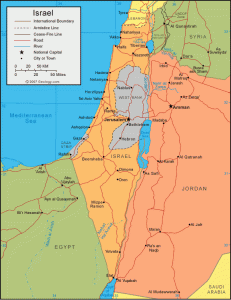
Israel today (credit: geology.com)
Years ago when I first started my Christian journey and studying the Bible, I was saturated with the idea that the modern nation-state of Israel was a fulfillment of Bible prophecy. It seemed reasonable and straight-forward enough. In my church in college, it was pretty much a given that this was a clear Scriptural truth: God’s people, the Jews, had finally come home to worship their God. What could be a more obvious demonstration that the Bible is true? However, while I still find a measure of this to be compelling, I became aware that the situation was a lot more complicated than I had earlier thought. When I made a trip to the Holy Land in 1994, I discovered that Zionism, the quest for a Jewish homeland in the Middle East, was not quite what I thought it was. Here are some of the things that I learned… and the discovery of these things sent me searching.
Before going to the Holy Land, my impression was that Israel was filled with an overwhelming majority of devoutly spiritual, dedicated Jews. Every Israeli citizen was taking their turn praying by the remaining Western Wall of the old Temple, or so I thought. But during my visit there, I learned that most of the people living in Israel then were, at best, nominally Jewish.
The situation is not terribly different today. Yes, most citizens of Israel have some ethnic association with Judaism, but very few believe in the actual, traditional God of Judaism. In many ways, modern day Israel is about as secular as are countries in modern day Europe. The majority of Israelis consider themselves to be mainly atheistic or agnostic. Statistics vary, but only somewhere between 10% and 25% of the population consider themselves to be “orthodox Jews,” with even smaller percentages of other, less theologically-conservative Jews.
The Jewish people may have finally returned to their homeland, but they have done so mostly in a state of unbelief. These facts raise some difficult questions concerning Zionism.1
Continue reading








 Veracity