Tag Archives: Islam

Basic Islam – Part 2

In our previous post on the basics of Islam, we noted that Islam is defined by:

The Quran is believed by Muslims to be the word of God dictated by the angel Gabriel to Muhammad. The Hadith are the recorded sayings and actions of Muhammad. There are thousands of them, and many have questionable authenticity, so there is a grading system. The biographies of Muhammad, or sīra, are considered by some to be part of the Hadith. Muslims believe that Muhammad is the exemplar of their faith and they aspire to imitate him. The sīra provide information that helps in their practice.

All Muslims accept the authority of the Quran. As you get more into the Hadith, the faith divides into sects with differing interpretations and beliefs (not unlike Christian denominationalism). The authority framework is all important, and shapes the derivative interpretations of Islam.

If you’re going to understand the basics of Islam, you must know something about Muhammad, the early history of Islam, how the Hadith came into being and how they are used today, and how Sharia law forms the framework for Islamic jurisprudence.

If you want to get an overview in less than an hour, here is a very informed presentation by Nabeel Qureshi that can help. I appreciate Dr. Qureshi’s empathy for Muslims—too many Christians take the terrorism we see reported in the news and never get beyond those horrifying impressions to develop even a modest understanding of Islam. I’m not in any way suggesting that the world should empathize with the violence that is carried out in the name of Islam, but we cannot address what we refuse to understand. After all, if you want to share the Christian faith with Muslims, wouldn’t it help to know something about their faith?


Basic Islam – Part 1

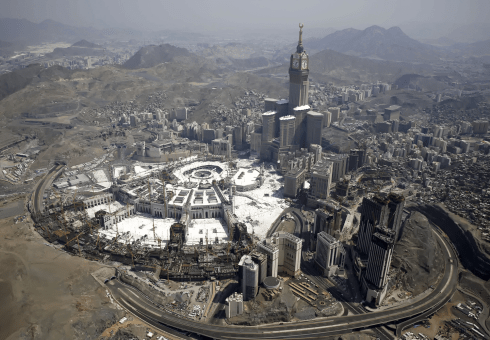
Mecca

Mecca, 2015
(Photo credit: Ahmad Masood / Reuters)

At a recent apologetics conference, one of the speakers I was most interested to hear could not finish his presentation on Islam. He was thoroughly prepared, but the audience interrupted him with so many questions that he only got through a few slides. It was clear they were eager to know more about Islam.

Most Christians, myself included, have spent little time studying Islam. Don’t agree? Did you recognize the photo above without reading the caption? I’ve heard about Mecca all my life, but can’t recall ever seeing a single photograph of it—as if it were a mythical place. The Atlantic Monthly did a recent photo essay showing the development of Mecca over the past 128 years. The development has caused quite a bit of controversy, even within the Islamic world.

Truth be told, our ignorance can be a barrier to understanding why there is so much strife between Christians, Jews, and Muslims throughout the world, and to sharing our faith. This new blog series on Islam will lay out the basics—without being disrespectful and without being naïve. (This is Veracity after all.) The posts will be short, in the hope that you will follow the hyperlinks to learn more about Islam.

One caveat before we start. If you asked someone to explain Christianity, consider how the answer might be shaped by the person answering the question. Depending on whom you asked, you might get an informed, orthodox answer or a completely off-the-wall distortion. To get the essence of Christianity, you have to get the Bible right. So for these posts on Islam we will focus on the orthodoxy of the Quran, the Hadith Collections, and the biography of Muhammad—the foundational documents of Islam. There are profound contradictions in these documents, ranging from peaceful and passive teaching to calls for extreme violence. Much of the material in these sources is contradictory, so we’ll spend some time on the Islamic Doctrine of Abrogation as well.

What is Islam?

Islam is a monotheistic religion that traces its roots all the way back through Abraham and Ishmael in the Book of Genesis. Islam is defined by:

Adherents of Islam are called Muslims, and believe that the Quran was dictated to Muhammad by the angel Gabriel. Muslims are taught to accept the authority of the Quran. The word ‘Quran’ means “the recitation.”

The small building at the center of Mecca is the Kaaba, which is considered to be the “House of God.” The Kaaba is considered the holiest site in Islam. Muslims must pray their Salah five times each day facing the Kaaba. The Salah is part of the Five Pillars of Islam, which are mandatory for Muslims.

Start with the Quran

The Quran can be found online here. (This site loads the Arabic script with the English translation and individual pages can take some time to load, so be patient; their legacy Quran version seems to load faster.) There are many English translations. If you prefer to have it read to you, Audible has an English version of the Quran in three volumes (that will take 19 hours to hear). The only authoritative version of the Quran is in Arabic, although today 85 percent of the Islamic world does not speak Arabic.

The Quran is organized into 114 chapters, called suras, roughly arranged in descending length (not chronological or thematic order). Each surah is divided into verses, the smallest having three and the largest having 286. Of the 114 suras, 86 are classified as Meccan, while 28 are Medinan. Each surah has a name, and how each name was ascribed is unclear, although some were named directly by Muhammad.

Most Christians will never read the Quran. Even if that’s true for you, at least read Surah 1 and Surah 2. One of the keys to Islam is Surah 2:106. It might help to understand while reading these suras that Muslims believe Christians—by way of belief in the Trinity—are ‘polytheists.’ They also believe that the Christian Trinity consists of God the Father, Jesus, and Mary (not the Holy Spirit).

So why study Islam? Why take the time to read the Quran? Maybe we can gain some insight into the religious strife that grips our world. Well, maybe. Reading the Quran and studying Islam won’t give us credentials, but it does take away the rejoinder, “Have you ever read the Quran?

More importantly, maybe by first reading the Quran we can then have informed, empathetic, civil discussions about Christianity with Muslims.


Were the Crusaders Medieval Terrorists?

Beheadings. Torture. Kidnappings. Execution-style murders. Unspeakable acts of barbarism. Rape as a weapon of war.

Today’s headlines are filled with atrocities, many of them associated with radical Islam. For example, my initial reaction is that the masked faces behind ISIS are clearly the “bad guys”and people in the West are the “good guys.” And then something mind boggling like the execution-style murders of three Muslims in Chapel Hill, North Carolina happens. It can get really confusing.

Examples of violence in history across the religious spectrum are invoked by journalists and political leaders in order to give us perspective. For many, the actions associated with extreme Islamic jihad are comparable to the aggressive militancy of the Crusades waged by Western Europeans in the Middle East during the medieval era. Countless readers of history, both from Christian and Islamic backgrounds, accept the narrative made famous by 20th century medieval historian Sir Steven Runciman that the Crusades remain the classic example of unprovoked, religious intolerance and unbridled fanaticism.

So, is this a fair comparison? Did the offensive actions of those medieval Crusaders provoke modern day extreme Islamic jihad? Or were the Crusades primarily intended to be an act of defense against the juggernaut advance of militant Islam over the preceding centuries?

Let’s face it. History can get really complicated, particularly when talking about violence, especially religiously motivated violence. How do we sort these things out?

Thomas F. Madden is a professor of medieval history at Saint Louis University. He is one of the leading academic historians on the Crusades. Many of the things Madden talks about regarding common misunderstandings of the Crusades may surprise you. Madden gave the following talk before a Catholic audience (here is a summary of his main points):


Controversy at Duke University: Islam and Religious Plurality

Duke University is probably best known for its legendary college basketball team, but perhaps now it will be remembered in a different way. Though founded by Methodists and Quakers in Durham, North Carolina, Duke recently announced that the Muslim student group would be allowed to chant their weekly call-to-prayer from the Duke Chapel bell tower on Fridays. Even though the Chapel also rings its church bells for Christian services on Sundays, the controversy over the chanting of the adhan led the University to rethink its decision to allow the Islamic call-to-prayer in such a demonstrably public manner.

The folks at Duke probably should have contacted some folks at the College of William and Mary before making their initial decision. Alas, the intendedly noble desire to promote religious pluralism and stand against discrimination yet again runs afoul of honoring the historically Christian heritage of these now secularized institutions of higher learning.

If you are not familiar with the adhan you might be interested in hearing it and reading an English translation of the Arabic.

I asked a Jewish friend of mine if there was a rough Jewish equivalent to Christian church bells (not as popular as they once were) or the Islamic adhan. The closest thing he could think of was the practice of some orthodox Jews to employ air raid sirens to signal the start of the sabbath.

I recently finished reading Philip Jenkins’ The Lost History of Christianity, and the incident at Duke made me think of Jenkins’ recounting of historically Christian lands in Africa and Asia having church bells ringing for hundreds of years before the Islamic invasions that began in the late 7th century. Over the centuries, the dhimmi status of the Christian population eventually led to the de-Christianization of these areas. The bells that announced the Christian call to worship were becoming less and less while the Islamic adhan soon dominated the soundscape, as formerly Christian communities were converting to Islam.

Is the situation different now? Duke University surely has a relatively small yet active evangelical Christian presence, but officially the school is only nominally connected to its Methodist and Quaker roots. Do that many Duke students, faculty and staff pay attention to the bells that ring on a Sunday morning? What difference would the Islamic call-to-prayer make on a Friday?

UPDATE: Friday, January 16

This was supposed to be the first day that the Islamic call-to-prayer would be made from bell tower of the historic Duke Chapel, but the university announced that the call-to-prayer will be moved to a different part of campus because of the controversy.  Sadly, part of the university’s decision was due to a credible threat of violence.  These type of threats should be greatly troubling to the followers of Jesus.

As an aside, the update news article linked above notes that most students at Duke were supportive of the university’s original policy proposal. Is the student support for the call-to-prayer from the Chapel bell tower primarily an indicator of a commitment to religious plurality in public life, or is it partly due to an ignorance of Christian history? I wonder.
