
Have you ever been troubled by what might appear to be contradictions between the four Gospel accounts? If so, then Dr. Michael Licona’s Jesus, Contradicted will help you to tame the doubts in your mind, and have a fresh look at the trustworthiness and reliability of the Bible.
I know because I have been there. Having not grown up in an evangelical church, I never heard of the concept of “biblical inerrancy” until my years in college in the 1980s. Growing up in a liberal mainline church instead, the Bible only had a secondary role in spiritual formation. As a teenager though, I read through all of the New Testament (except for Revelation), and I was wrestling through the things I read in the Bible. One of the first things I noticed is that there are differences between the four Gospels and how they report various speeches and events.
The idea that there were differences in the Gospels really did not bother me. If anything, the differences in the Gospels only intrigued me to look more closely at the New Testament. As Christian apologist and former cold-case detective J. Warner Wallace has said, the very fact that the Gospels DO have differences lends credibility to the authenticity of their accounts. For if all four Gospels said exactly the same thing, this would be evidence of collusion, which would raise suspicions about the integrity of the New Testament. Instead, because there were opportunities to smooth out the differences and the Gospel writers did not do so, this gives us greater confidence in the truthfulness of the Christian story.
But apparently, not every Christian is convinced that having differences in the Gospel is a good thing. Some argue that we should do whatever we can to harmonize the Gospels, even if some of those harmonizations come across as unconvincing, embarrassingly ad-hoc, otherwise severely strained.

Mike Licona, a New Testament scholar, is one of most able defenders of the bodily resurrection of Jesus, having debated Bart Ehrman, the world’s most well-known skeptic, on several occasions. Now, Michael Licona is arguing for a more robust view of biblical inerrancy, in Jesus, Contradicted:
My Faith Crisis Over Inerrancy
Michael Licona, author of Jesus, Contradicted: Why the Gospels Tell the Same Story Differently, has struck a chord with me. But I need to set up the story a bit more before I offer a review of this new book.
In the mid-1970’s, Harold Lindsell, who had been a professor at Fuller Theological Seminary, had popularized an idea to try to resolve the apparent contradictions in the various accounts of Peter’s denials of Jesus, on the night Jesus was handed over to the authorities to face trial and eventually to be crucified. Mark 14:72 and Luke 22:61 has Jesus saying that a cock would crow twice after Peter denies Jesus three times. But in Matthew 26:74-75 and John 18:27, a cock crows once after Peter denied Jesus three times. Matthew has Jesus predicting one cock crow, while John says nothing about Jesus predicting anything about a cock crowing.
Lindsell’s solution was to say that Peter denied Jesus a total of six times: three times before the first cock crowed, and then three more times before the second cock crowed. Other strict inerrantists arrive at similar conclusions, arguing that Jesus’ differing prophecies in all four Gospels must align together in all incidental details.
While this type of harmonization sort of “works,” it still really confused me. After all, all four Gospels explicitly state that Peter denied Jesus three times, not six times as Lindsell’s “inerrantist” interpretation suggested. I reasoned that if this type of convoluted logic is required to make sense of “biblical inerrancy,” then I simply could not accept it. I really wanted the Bible to be “inerrant,” but as a mathematics major in college I just could not force my mind to accept the idea that 3 equals 6.
I pretty much shoved the idea off of my mind, visiting it every once in a while, but I just could not get past the problem. It was not until I read Five Views of Biblical Inerrancy ( introduced and reviewed here on Veracity,) a multi-views book highlighting the perspectives of five different biblical scholars holding separate and distinct definitions of what constituted “biblical inerrancy,” that I finally had some peace about the matter. Not every proponent of “biblical inerrancy” holds to the rather strict version championed by Harold Lindsell.
This was quite a relief. I could now hold to a version of “biblical inerrancy.” My problem was that I still was not sure what that version of “biblical inerrancy” really looked like.
A few years ago, I got a copy of Michael Licona’s book Why Are There Differences in the Gospels?, oriented towards scholars, to try to help me. So far, I have only gotten part of the way through it until Dr. Licona came out with a shorter, more accessible revision of the book this year, Jesus Contradicted: Why the Gospels Tell the Same Story Differently. I am so glad I read this new book!
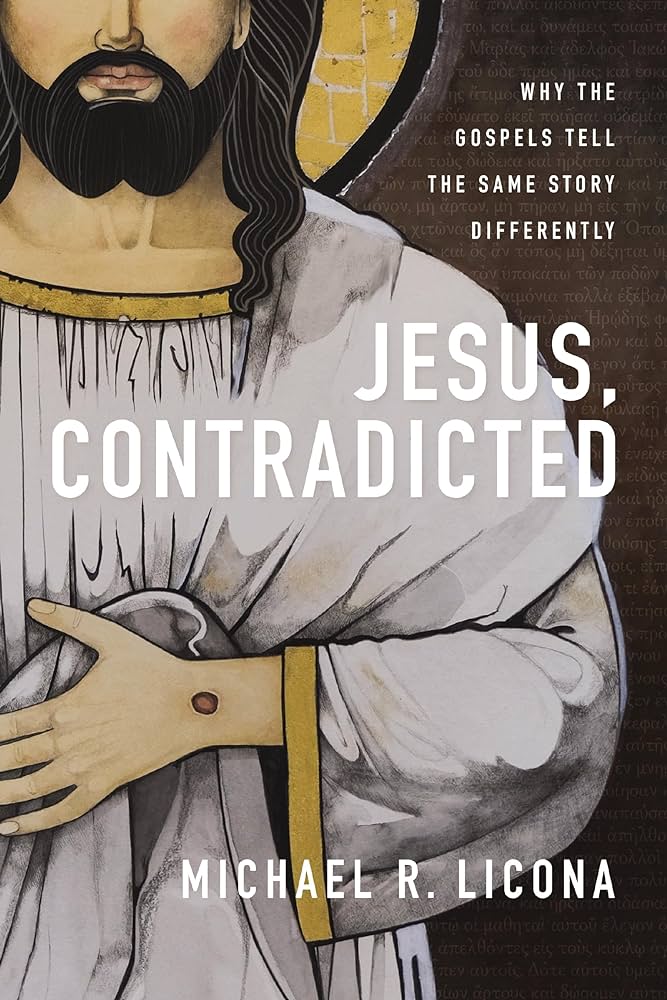
Jesus, Contradicted: Why The Gospels Tell The Same Story Differently, by Michael Licona, offers a more evidenced-based approach to handling differences in the Gospels, without resorting to tortured harmonization efforts concerning incidental details.



 Veracity