Talk about a dysfunctional family! Cain and Abel, 15th-century by an unknown German artist, from Speculum Humanae Salvationis (credit: Wikipedia). Is it not the story of every family?
So, where did Cain get his wife?
This question is a real head scratcher, a favorite of skeptics and a longtime puzzle for those who want to understand the Bible. The difficulty in trying to resolve this question is that the Bible does not give us an obvious answer. We have to look at different clues from within the text to try to figure this out. Nevertheless, the question of Cain’s wife allows us to explore some of the challenges when trying to interpret difficult passages within the Bible. Continue reading
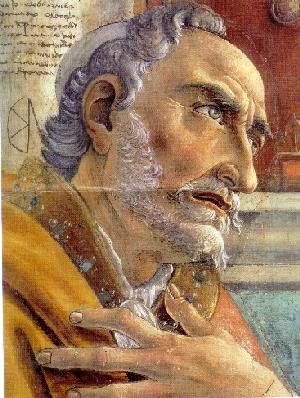
The modern concern is genuine, and it should not be taken lightly. The idea of injecting philosophies that are at odds with Christian faith should indeed be rejected by those who care for the absolutely supremacy of God’s Word. Nevertheless, such an argument with respect to materialist evolution would have been completely incomprehensible to the early church scholar and Bible teacher, Saint Augustine.
For the great African Christian intellectual of the early 5th century, Augustine had other concerns. An atheistic, “Darwinian evolution” could not be anachronistically inserted into his thought or vocabulary. In his classic work, De Genesi ad litteram, known in various ways in English as “On the Literal Interpretation of Genesis,” Augustine wrestled with the most appropriate way to interpret God’s Word faithfully. For Augustine, to interpret something “literally” means to interpret “in the sense intended by the author.”
Studying the history of the church is a neglected task in today’s evangelical Christianity, which is obsessed with the supposed virtues of “newness,” continually reinforced by rapid changes in technology (would you have read this blog on your phone ten years ago??). But church history can tell us a lot about ourselves today. Do we have the courage and discipline to learn from our forebears?
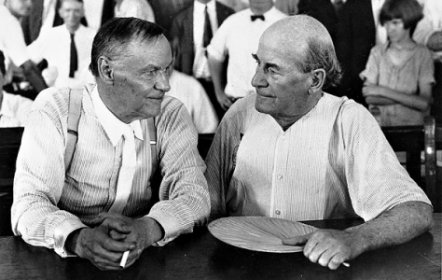
20th century cultural icons: cigarette smoking, agnostic advocate for science, Clarence Darrow vs. defender of the Bible, anti-evolutionist, populist politician, William Jennings Bryan, in the heat of a Tennessee summer.
Where I live here in Virginia today, it is blisteringly hot.
It reminds me of an event that happened exactly ninety years ago today in Dayton, Tennessee. It was July 20,1925, and the famed political statesman, William Jennings Bryan, had taken to the witness stand, to be scrutinized by one of America’s most famous trial lawyers, Clarence Darrow. At stake was a relatively minor case, where a young, substitute biology teacher, John T. Scopes, had been charged with breaking a Tennessee law prohibiting the teaching of evolution in a state funded school. But the case soon became a media circus, as reporters from all over the country flooded the small courtroom facilities in this rural town, forcing the proceedings to be held outside in the intense summer heat.
Bryan, an evangelical Christian, had assumed the challenge to defend the law, while Darrow, an avowed agnostic, was determined to defeat it. But when Bryan went forward to be examined by Darrow, to warn against the cancer of Darrow’s evolutionary philosophy, the events that unfolded would shake the nation. Darrow, an unrepentant skeptic, peppered Bryan again and again with questions about the Bible. In the end, Bryan was able to successfully defend the law, but Darrow proved to win the cultural sentiment, leading to a spread of anti-Christian ridicule across the country at large. Thus marked the moment where American Christianity divided into the “fundamentalist/modernist” controversy. The “fundamentalist” wing sought to defend that “old time religion,” demonstrating the wisdom of the Bible over and against the false “wisdom” of modern science. The “modernist” wing reacted in the other direction, by essentially cutting the supernatural aspects of the Christian faith out of the Bible, in an effort to supposedly “save” Christianity. During the past ninety years, evangelical scholarship and apologetics have sought to break through the impasse caused by this controversy, thereby moving the conversation forward to persuade a lost generation of the Truth of the Savior.
Unfortunately, much of America’s cultural memory of the Scopes Monkey has been shaped by the subsequent play and movie, Inherit the Wind, that took many liberties in the retelling of the story. For example, Inherit the Wind overlooks the fact that William Jennings Bryan took great interest in the case because he saw that the type of evolution being promoted in Scopes’ biology textbook advocated for eugenics, which he understood to be utterly immoral. Furthermore, the textbook, Hunter’s Civic Biology, contained the following statement that would hardly pass muster in today’s classrooms: “At the present time there exist upon the earth five races or varieties of man, …These are the Ethiopian or negro type, originating in Africa; the Malay or brown race, from the islands of the Pacific; the American Indian; the Mongolian or yellow race, including the natives of China, Japan, and the Eskimos; and finally, the highest race type of all, the Caucasians, represented by the civilized white inhabitants of Europe and America.” Also, William Jennings Bryan was not an advocate of Young Earth Creationism, as he generally thought that the “days” of Genesis 1 referred to long periods of time, not literal 24-hour periods.
As I read the transcript of Darrow’s interrogation of Bryan, I admire Bryan’s intended desire to defend the truth of the Bible. However, I am not very impressed with all of Bryan’s answers. I Peter 3:15 teaches, “Always be prepared to give an answer to everyone who asks you to give the reason for the hope that you have. But do this with gentleness and respect.” I would hope that if I were in Bryan’s shoes on that witness stand, I would do better. But would I really be prepared to do so, as the Apostle Peter admonishes?
If you were there on that witness stand instead of Bryan, burdened by the summer heat, and the heat of the skeptic’s questions, how would you respond? See the transcript of the proceedings below, and tell me what you would say differently. More on the Scopes Monkey Trial at ChristianHistory.org:
When Christians are discussing difficult topics, such as the “how” of creation, a number questions come to the forefront. For example, we may be talking about something like the problem of animal death before the Fall of humanity, but I often wonder if there are other issues lurking below the surface.
Our lead pastor, Travis Simone, and I discuss this topic in general in the latest installment of TableTalk during our summer Bible study series on Genesis 1-11. What do you think? Is there a question behind the question here? Have I correctly identified the right question, or is there something else?
Technical note: because of a glitch in the beginning, the audio is present throughout, but the video only shows up 3 minutes (3:00) into the session. So, please be patient!
For still the vision awaits its appointed time; it hastens to the end—it will not lie. If it seems slow, wait for it; it will surely come; it will not delay (Habakkuk 2:3).
A lot of people, particularly atheists, ridicule Young Earth Creationists as being idiotic and stupid. I find this to be most uncharitable. Though I was not able to meet Terry Mortenson personally during his time in Williamsburg, I nevertheless found him to be quite charming, likable, and very articulate.
Terry Mortenson believes that modern science, even as practiced by Old Earth and Evolutionary Creationists, is built on inherently anti-biblical assumptions. Therefore, Christians should reject the concept of “millions of years” because it threatens to undermine the Bible. Science, as generally practiced today, can not be relied upon to give us true, genuine knowledge of the world that reflects God’s glory. In other words, God’s creation is NOT the 67th book of the Bible.
I would assume that Dr. Mortensen would take issue with how I understand the teaching of Psalm 19. My questions for Terry Mortenesen are not based on science, per se. That is a very involved discussion that would require me cracking open those dusty textbooks from my days in college. My concern is about the Bible. How would he read passages like Romans 1:18-23 (ESV)?
For the wrath of God is revealed from heaven against all ungodliness and unrighteousness of men, who by their unrighteousness suppress the truth.For what can be known about God is plain to them, because God has shown it to them. For his invisible attributes, namely, his eternal power and divine nature, have been clearly perceived, ever since the creation of the world,in the things that have been made. So they are without excuse. For although they knew God, they did not honor him as God or give thanks to him, but they became futile in their thinking, and their foolish hearts were darkened. Claiming to be wise, they became fools, and exchanged the glory of the immortal God for images resembling mortal man and birds and animals and creeping things.
Here, the Apostle Paul, is talking about pagans who have no access to God’s Law as set forth in Holy Scripture (he addresses the Jews who have God’s Law in Romans 2). Paul’s main message is that the pagans have looked at the evidence for God in creation and then rejected God, worshipping creatures instead of the Creator. A lot of atheists and other skeptics probably fit in this category rather well today. But as I have highlighted above, Paul seems convinced that what can be known of God as Creator can be seen in the things that have been made. Not only that, but this knowledge from the created order has been clearly perceived, ever since the creation of the world. Paul makes no mention of the pagans having a Bible to give them knowledge of God as Creator. Rather, it would appear that Paul assumes that general knowledge of God can be truly known by people because He has made it plain to them. If I take this literally, it would imply that there is a Christian basis for doing science simply by observing nature, expecting that as a different source of information, it essentially will not and cannot conflict with what we read in Sacred Scripture.
How does this square with Terry Mortenson’s view that you must first look to the first few chapters of Genesis to establish the basis for building science? Dr. Mortensen is quite correct that it is easy for scientists to misinterpret the scientific data that God leaves us in Creation. Good point!
However, those who hold to more of an “Old Earth” perspective contend that it is possible for people to misinterpret the Bible, as well, thereby creating an apparent conflict between modern science and Christian faith that need not exist. According to this perspective that accepts the general narrative of modern science, misinterpreting the Bible can actually create an unnecessary barrier to having faith in God.
Every “Old Earth” scientist I know who loves Jesus is persuaded that “millions of years” is correct, not because they are uncritically consuming “anti-biblical” assumptions. They accept “millions of years” because, in their observations, the evidence God has placed there demands it. If convincing evidence could be demonstrated to overthrow “millions of years,” they would accept a “young earth” in a heartbeat.
So, is Dr. Mortenson correct? Tell me what you think in the comments section below after you view this short video.





 Veracity