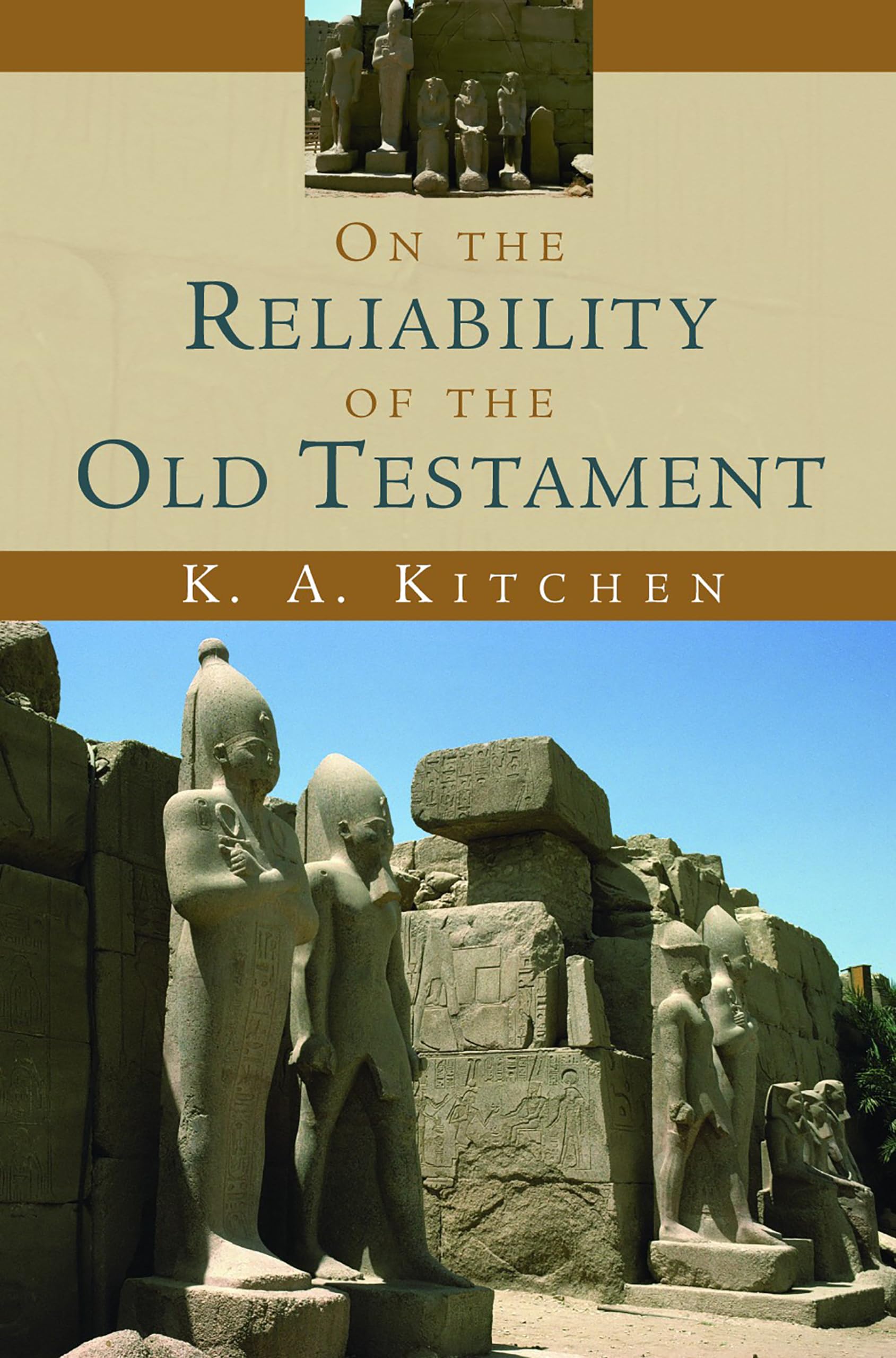
I just read today that one of the world’s most recognized Egyptologists, Kenneth Kitchen, died Thursday, February 6, 2025, at age 93. Kitchen was an idiosyncratic legend, an archaeologist who studied the Ancient Near East, specializing in ancient Egyptian history, and who upheld the Old Testament as a reliable source for understanding the history of the ancient world. In my mind, he was the “real Indiana Jones.”
Few today would be dazzled by Kitchen’s study on The Third Intermediate Period in Egypt. But for the Christian interested in the intersection between the Bible and archaeology, his 2003 erudite defense of the Bible, On the Reliability of the Old Testament, stands squarely in the maximalist tradition, affirming the historicity of the Exodus and the biblical Patriarchs. I read his book almost twenty years ago and was blown away by the breadth and depth of his scholarship.
While many scholars today tend to be skeptical of the story of Moses and the flight of Israel out of Egypt, spending forty years wandering the Sinai desert, Kenneth Kitchen was resolute in marshaling detailed evidence to support the testimony of the Bible. Kitchen was careful not to say that the biblical stories of the Patriarchs could be “proved” by the archaeological record, but he likewise stressed that archaeology has not “disproved” this history as presented in the Bible either.
Kenneth A. Kitchen’s On the Reliability of the Old Testament is a modern classic defending the historicity of the Old Testament. Kitchen begins with the most recent period in Israelite history, working his way backwards towards the earliest Patriarchs, showing that figures like Moses and Abraham line up with what we read in the archaeological record.
Born in Scotland, the life-long bachelor Kitchen was a contrarian in several ways, and not afraid of being combative in his research. Not only did he take on minimalist colleagues, such as Ronald Hendel, who concluded that the historical Moses was a fictional product of Israelite imagination at least four or five centuries after the traditionally dated Exodus period, Kitchen was critical of even conservative Old Testament scholars for not reading the text carefully enough. He rejected the traditional, early date for the Exodus, in the mid 15th century BCE, around the year 1446, while Amenhotep I, Thutmose I, or Thutmose III served as Pharaoh, an interpretation which has been based on a non-metaphorical reading of the years described in 1 Kings 6. Archaeologists like Bryant Wood continue to hold to this traditional view.
Instead, Kitchen favored a late date alternative, about 200 years later in the 13th century BCE, when Rameses II served as Pharaoh. Kitchen argued that the early date has lacked sufficient archaeological support. Instead, the city of Rameses in Egypt was known in the 13th century, corresponding to what has been read from Exodus 1:11, and that archaeological evidence for the destruction of Hazor in the 13th century matched what has been described by Joshua’s conquest of the Promised Land in Joshua 11:10-11.
Kitchen also chided Old Testament scholars who insisted that the large numbers associated with texts like the census in Numbers 1-2, following a non-metaphorical interpretation of such numbers, did not match the archaeological data, which has supported a smaller, yet still sizable group of Israelites wandering the Sinai wilderness for some 40 years.
Kitchen’s views even went against the idiosyncratic proposal by atheist and fellow Egyptologist David Rohl, who has argued that a new chronology for Egyptian history should be adopted, which pushes the possible date for the Exodus earlier than what the late date proposes. David Rohl’s innovative hypothesis has been popularized by Tim Mahoney’s Patterns of Evidence franchise of documentary filmmaking. Kitchen rejected this view as “100% nonsense.”
What helped to win me over to the late date for the Exodus was the argument regarding the location of the slave city near a residence for the Pharaoh. The ancient city of Thebes, located near modern day Luxor, Egypt, was the primary residence for the Pharaohs during the Late Bronze Age. However, we have evidence that in the 13th century the city of Rameses, thought to have been a residence of a Pharaoh of the same name, was located in the Nile delta area. Rameses was in the northeast region of Egypt not that far from the modern city of Cario, and was built by slaves living in a nearby slave city, Avaris.
The journey from that slave city to Rameses would have been less than a few hours by foot, which makes sense of the many meetings that Moses would have had with Pharaoh mentioned in the Book of Exodus. However, any look at the map shows that a journey from the Nile delta to Thebes took at least 6 days to walk, which makes the late-at-night journeys that Moses took from the slave city to Pharoah’s residence rather ludicrous. Unless the Hebrews had built some nuclear-powered speed boat for Moses to travel quickly up the Nile to visit Pharaoh in Thebes, it is hard to imagine how Moses could have made such a relatively quick visit in the middle of the night to Pharoah.
Advocates for an early date for the Exodus might respond by saying a 15th century Pharoah might have built a residence within close walking distance near the 15th century slave city or encampment, but that we simply do not have evidence for such a residence…. at least not yet. But why appeal to evidence we do not currently possess when we actually have evidence that supports a different date, and that still affirms the testimony of Scripture? In my mind, this is a case of having a bird in the hand is worth two in a bush. It is better to hold onto the evidence you already have than it is holding out for evidence which you may never find. Kitchen was that type of evidentialist who opted for the former.
What I did not know about Kitchen was just how idiosyncratic he really was. As Tyndale House scholar Peter J. Williams puts it:
His abode was a small three-bedroom terraced house, without central heating or any modern appliance. [Kitchen] was very proud that nothing was connected to the internet so there could be no possibility of a virus destroying his work…..
Ken Kitchen basically didn’t have a kitchen: it was a tiny box room. Ken lived all his life without a refrigerator. He had milk delivered fresh, and had no need for the complexities of unnecessary equipment. He lived in the utmost simplicity….
Despite his great learning, Ken Kitchen was a man of a deep and simple faith in Jesus Christ as his Saviour and Lord. Though he knew a lot, he was also humble and aware of his own fallibility and frailty. He would want us in remembering him to think of the One he served. As I think about Ken’s life, as a bachelor living a life of ascetic discipline and dedication to scholarship, I find myself challenged by his work ethic and his incredible focus, even as I recognise that Ken was one of a kind. We will not see the like of him again.
Actually, in his later years, Kitchen finally was forced to get a refrigerator after he contracted food poisoning. His doctor strongly advised him to a get refrigerator, for his own safety.
We are almost a month away from April Fool’s Day, but one of the latest viral videos on YouTube ain’t no joke. Satan’s Guide to the Bible points to the need for having Christian apologetics in our churches.
Satan’s Guide to the Bible is the work of independent filmmaker, Zeke Piestrup. The premise of the documentary film (mainly cartoon) is actually quite clever. Here you have a Sunday school class, with kids gathering around singing “This Little Light of Mine,” waiting for their Sunday school teacher to arrive. But the real teacher is not in class today, so a substitute arrives as the new teacher: SATAN!
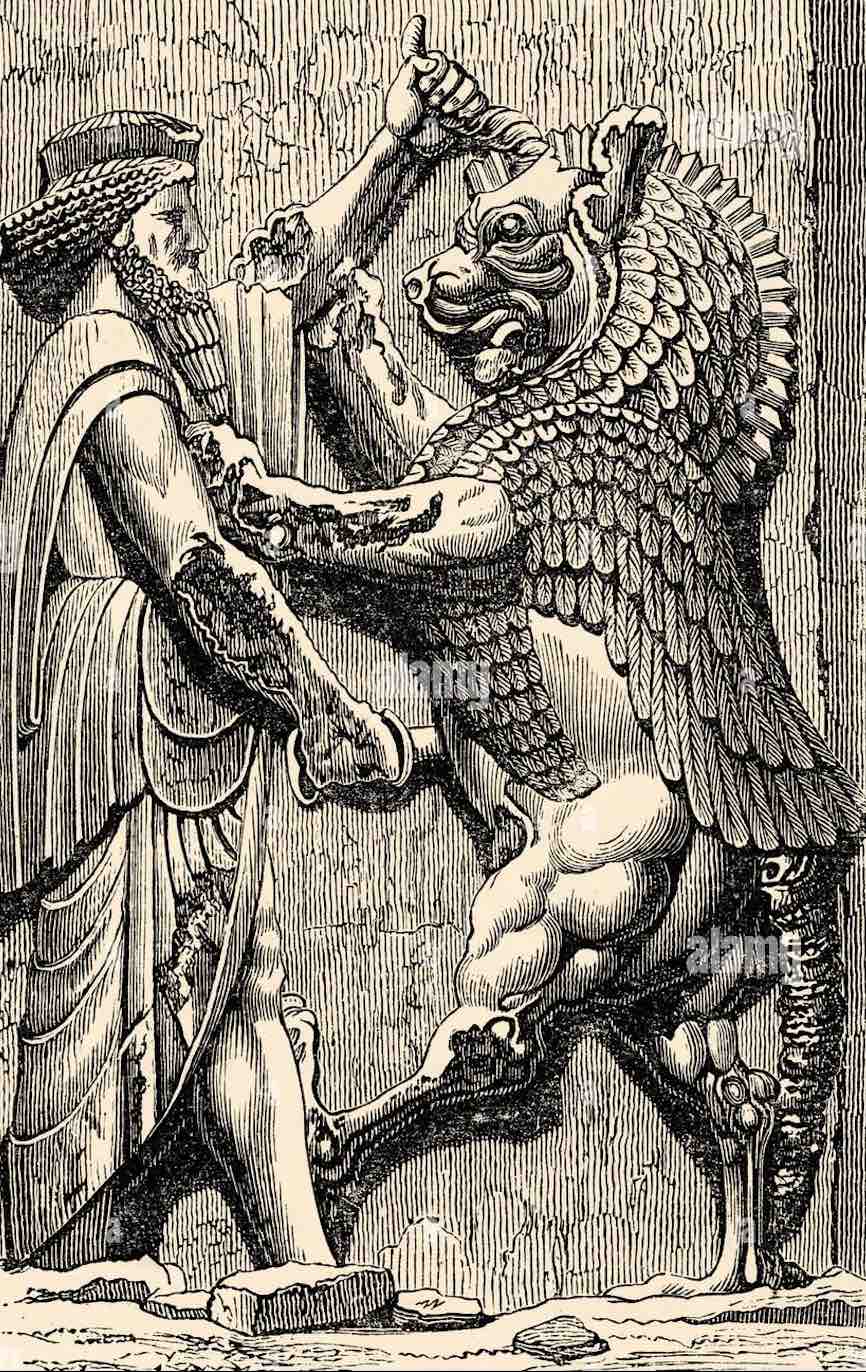
SATAN??? Where did he come from? …. In Persian Zoroastrian mythology, Ahura Mazda (the good diety on the left) was locked in combat with Ahriman (the evil deity on the right). Many scholars suggest that the concept of “Satan” was “borrowed” from this dualistic Persian mythology when the Jews were sent off to Babylon after the destruction of Jerusalem and its first Temple. The Persians, who conquered Babylon, allowed the Jews to return to Jerusalem, taking incipient ideas about “Satan” with them. However, a better answer to this is to say that the Jewish encounter with Persian religion served as the opportunity for the Jews to search their own Scriptures, for the source of angelic rebellion against the one True God: Yahweh. There was no need for Jews to “borrow” anything from Zoroastrianism. They had everything they needed in their Scriptures. But they did need to connect the dots to make sense of who “Satan” really was. Progressive revelation regarding the identity of the true rebel against God, “Satan,” the personification of evil, eventually emerged in the writings of the Christian New Testament. See Veracity review of Anthony J. Tomasino’s Judaism Before Jesus, for more background.
The Plot Line of Satan’s Guide to the Bible
Satan proceeds to instruct the children that today he will reveal to the student “Bible secrets.” These “Bible secrets” are secrets that the children’s pastor (“Mark”) knows, which he learned in seminary, but which he keeps hidden from the children, for fear of losing his job. For about the next hour and a half, Satan reveals these “Bible secrets” to the kids, ranging from the idea that the Exodus out of Egypt with Moses splitting the Red Sea never happened, to the controversy that many of the documents in our New Testament are in reality forgeries, meant to deceive the unknowing Bible reader. Here is the video (but skip on down if you want to get the response):
Satan’s Guide to the Bible uses a lot humor along the way, to keep the viewer engaged. Perhaps the most memorable line is when Jen, one of the kids who is the most skeptical about what Satan is saying, shouts, ““I rebuke you Satan!”
Satan’s response? : “Thanks, Jen. Noted.”
I have not worked my way through the entire video yet, but what makes the film so effective is the recorded interviews with leading critical Bible scholars, some of whom are atheists (like Bart Ehrman) and some of whom are progressive Christians (like Dale Allison). Zeke Piestrup has his interview-ees read from their published scholarly books, to reinforce the message. Plus, he pretty much hits just about every major controversial topic regarding the integrity of the Bible and Christian faith claims in general.
A lot of Christians will find the film frustrating, but it is worth asking the question: “What does Satan’s Guide to the Bible get right?” Well, it does point to a real problem, in that while some churches do offer educational opportunities regarding Christian apologetics; that is, learning how to develop an informed defense of the Christian message, many churches do not. Most Christians are woefully unprepared to answer the criticisms raised in this documentary, what the film calls “standard stuff.” But as more and more churches prioritize small group ministries at the expense of structured Christian education, the opportunities to talk about this “standard stuff” in many evangelical churches are few and far between.
It is true that much of what the documentary touches on is “standard stuff” discussed in mainline seminaries. More and more conservative evangelical seminaries also discuss this “standard stuff” today. But you do not have to go get an advanced degree to hear about this “standard stuff.” Most religion departments at secular universities expose their undergraduate students to such “standard stuff”…… And then there are social media platforms, like short Tik-Tok videos, and YouTube, which makes such “standard stuff” readily accessible to any teenager with a smart phone.
Part of what the Veracity blog tries to do is to fill in the gap often left by churches, and offer resources to try to address the criticisms raised in Satan’s Guide to the Bible. Here is a sample list of previous blog posts that address some specific criticisms highlighted in the video:
The YouTube world of Christian apologetics has responded to Satan’s Guide to the Bible. One of the first one’s to appear is by Mike Winger, which I will highlight below at the bottom of this blog post. Some of Winger’s critics say that Winger overuses the rhetoric of “propaganda” when describing Satan’s Guide to the Bible. Mike has a few technical problems in the first few minutes, and he probably does go overboard with the “propaganda” rhetoric a bit too much, but it is still worth considering what Mike has to say, and I agree with a good majority of Mike’s pushback.
Satan’s Guide to the Bible pokes fun at evangelical Christians, both scholars and apologists with day jobs (like me), so I had to take some jabs with watching the parts that I had gotten through the film already. But if Christians watch something like the Inspiring Philosophy response video above, or the Mike Winger video below, or keep reading Veracity, then this will help equip you to respond to such common criticisms of the Bible, as presented by skeptical non-believers like Zeke Piestrup. As a work of satire, the film provocatively gets its points across, quoting a lot of my favorite Christian scholars out-of-context along the way multiple times, leaving a lot of things left off in a rather one-sided manner.
This summer was amazingly hectic for me with my job at the College of William and Mary. One phrase summarizes my summer: Supply chain delays. But now that students are back on campus, things are starting to settle down.
What follows is my attempt to recap some things that have made me think a lot, so far this year…. Bart Ehrman, “women in ministry,” where do you get your news, David McCullough, Roe vs. Wade, Jordan Peterson, Alex Jones and Sandy Hook, what is the best argument for the Resurrection, the “Late-Date” theory for the Exodus, Henry Emerson Fosdick 100 years later, “progressive Christianity,” divine hiddenness, and analytic philosophy.
A bit disjointed for sure, but all very important. I have a bunch of thoughts, but instead of individual blog posts about each topic, I will try to keep things fairly short, and include the summaries below. Read on!! ….
Blogging Recap… Featuring Bart Ehrman
I have written several blogs this year that I put quite a bit of thought into, after reading several books on my bike ride commutes to work. The longest series is on the “historical criticism” of the Bible, some of its history dating back to the 17th century philosopher Baruch Spinoza, how “historical criticism” has both positively and negatively impacted the church, and offering a sample of Bible passages, with a model of doing “historical criticism” in a nuanced way, that appreciates the value of allowing historical method to inform our interpretation of the Bible, without slipping into unnecessary skepticism of the Bible’s divine inspiration.
My fundamental claim, in a nutshell, is that the most common methodology employed by historical critics like Bart Ehrman, as well as “Progressive Christians” who adopt the same methodology, is that they believe that you can only do proper historical research on the Bible by treating it like any other piece of human literature, which in their minds, implies that you must bracket off claims regarding the inspired nature of the Scriptural text as being the very Word of God, at least temporarily. If you fail to bracket that off, you ironically risk distorting the interpretation of the text. Historical critics like Bart Ehrman says the Bible is inherently contradictory, and so he dismisses attempts to try to harmonize Scriptural texts, even in the most nuanced way, as actually obscuring what the Bible is trying to tell us.
I am increasingly concerned that the negative impact of “historical criticism” that in the 20th century wrecked havoc in mainline Protestantism is now creeping into certain areas of less denominationally oriented evangelicalism, in a way that most evangelicals are completely unaware of. I will just leave it at that.
The most substantial book review was for Bart Ehrman’s Heaven and Hell. I had not read through a Bart Ehrman book before, with such detail. I can see why Ehrman has so many followers. I am just surprised that there have not been any Bart Ehrman fans who have jumped down on me and made critical comments on the blog yet. I strongly disagree with Bart on many points, but I have to concede that he articulates probably the most cogent critical view that I have read attacking the reliability of the New Testament, which partly explains why he is such a popular author. Plus, I would describe him as an honest non-believer, who does not try to pretend that he is a Christian. His interest in Christianity is primarily historical, trying to make sense of Jesus of Nazareth, the single most influential person in the world who has ever lived. If you want to understand why so many educated people reject the Bible as being authoritative, you better read Bart Ehrman. The chances are high that some highly educated “former” Christian you know, or someone who is going through a faith “deconstruction,” has read some Bart Ehrman.
.
An Update on the Complementarian/Egalitarian Divide in Evangelicalism
Nevertheless, I still hold high regard for evangelical Christians who are egalitarian in their convictions. My main concern is not in the specific conclusions that are drawn, but rather, I am concerned about the hermeneutical methods that some use to draw their conclusions. A faulty hermeneutic in one area of reading the Bible can lead to other distortions of Scripture in other areas.
.
So, Where Do You Get Your News?
We do not live in the 1970s anymore. Gone are the days of three major television news outlets, CBS, ABC, and NBC nightly news programs, and the hegemony of newspaper publications like the New York Times and the Washington Post. For most of the 1990s, I narrowed down the options even more: The only time I bothered with listening to the news was on my evening commutes with NPR’s All Things Considered playing on the radio. Today, we get our news from various sources, which all give us conflicting and contradictory views of the world, which pretty much makes civil discourse in society today near to impossible.
I try to steer clear of exclusively of heavily biased news sources. Occasionally, I will read longer pieces by liberal outlets like the New York Times, but I try to balance it out with stories from the much more conservative Wall Street Journal. My wife likes listening to The World and Everything In it, the daily news podcast put out by WORLD News Group, which styles itself like a conservative evangelical alternative to NPR’s All Things Considered. WORLD has gotten better over the years, but recent staff upheavals at WORLD make me a little leery as to its future.
I pretty much stick with Ground.News, a secular outfit that ranks the bias of various news organizations when reporting stories, which I find quite helpful. But I have decided to try the PourOver email newsletter and podcast, as it offers to give a Christian perspective on the news while trying its best to steer clear of heavy bias, without flooding your brain, as it only comes out three times a week. So far the PourOver is a very refreshing approach to the news.
.
The Late David McCullough
While the bulk of what is posted on the Veracity blog is an Christian apologetics, my other love is for church history ( and history more broadly). Not too long ago the popular American historian David McCullough died. For me he models what a good historian does. He was the author of various best sellers, including 1776 and John Adams.
At the risk of being a little controversial, blogger Samuel D. James has some insightful thoughts regarding what Christians can learn from McCullough. James points out that some recent Christian books criticizing evangelicalism historically have fallen into a bad habit. In the most memorable quote by James, one particular author “wanted me to see the subjects of her history the way she sees them, not as how they saw themselves. How they interpreted their lives and beliefs was of little consequence. How the generations after them interpreted them was everything. This is the kind of history that gets people angry and eager to deconstruct whatever they sense is tainted by moral failure…. What renews my soul about reading David McCullough’s work is that it doesn’t do this.” Now that is provocative, but I am inclined to think that James is right, based on some other writings I have read along the same lines.
.
The Overturning of Roe vs. Wade
Like a lot of people, I was really surprised when the U.S Supreme Court overturned Roe vs. Wade, earlier this year. On the other hand, I am not convinced that the court’s verdict will have a lasting impact on public opinion about abortion, though I could easily be wrong. By putting the issue back in front of the states, the legislative debates will surely continue and get really complicated on a state by state basis. Perhaps the only solution will be something like an amendment to the federal constitution to ultimately settle the matter, and I do not see that as happening anytime soon. The main reason for thinking this is that even if extensive anti-abortion laws get passed, it might be almost impossible to enforce them. Without public support, passing unpopular laws will probably achieve little.
Marvin Olasky, an outspoken pro-life journalist, agrees citing what we know from history: “From the 1840s through the 1940s, public opinion concerning abortion was more negative than it is now, but even during that era, enforcement of abortion bans was rare. Millions of abortions occurred during that century, but only a tiny percentage of doctors did prison time. It was hard to get police to arrest, juries to convict, or judges to support jury decisions and turn down appeals.” As the subtitle of his article in Christianity Today declares, “Looking ahead, Christians should focus less on enforcement than on changing cultural attitudes.”
In the meantime, I am grateful for friends who work in or otherwise support crisis pregnancy centers that offer assistance to those in need. In my area of Williamsburg, Virginia, the closest center is CareNet Peninsula. They do great work there. It is through such efforts that perhaps there will be a day when abortion becomes an unthinkable option for people faced with such difficult decisions.
The “right to life” cause, in the political sphere, is primarily an effort led by Christians, as Bible readers seek to make their moral convictions known within the public arena. There are notable exceptions to this, as the late and famed New Atheist Christopher Hitchens opposed abortion. But by and large, I doubt if we will see a remarkable surge in support of the “right to life” until we have a massive wave of Christian spiritual revival in the West. That can only come about by prayer and evangelization, which means in part engaging in the type of apologetics being promoted here on the Veracity blog. Interestingly, history shows us that as more and more people came to Christ in the Roman Empire, in the first 500 years of the church, that this shifted public opinion away from promoting abortion. As more people embraced the Gospel, the less support there was for abortion. Perhaps this can be a lesson for us in the 21st century.
I just recently ran across a short, Tik-Tok type video, put out by one of my favorite YouTube apologists, Michael Jones, at Inspiring Philosophy, who addresses the objection that the Bible actually sanctions induced abortions, based on Numbers 5:27. I have been hearing the Numbers 5:27 pro-abortion argument a lot lately, and really did not know how to respond to it, until I saw Jones’ video. Jones argues that the NIV translation is unlikely, and explains what might be a much better translation. Worth checking out:
.
The Return of Jordan Peterson
While the world was swirling in the midst of the COVID-19 pandemic, the outspoken Canadian psychologist, Jordan Peterson, had a close brush with death of another kind. As a result of a successful nation hoping medical tour, Peterson finally made it out of this crisis and is back on the public stage. Many have described Jordan Peterson’s teachings as a “gateway drug” to Christianity, and I believe this is correct.
The following video by Peterson is perhaps the best short video supporting a psychological apologetic for complementarianism, urging Christians to stop downgrading men with constant talk about “toxic masculinity” and instead challenging young men to step forward and take responsibility, as a matter of Christian virtue. As Peterson argues, by supporting young men this will have a positive impact on young women as well. Plus, I believe that taking seriously Peterson’s argument will go a long ways towards trimming back the number of mass shootings, which are almost universally committed by young, disaffected and lonely males, longing for a sense of visionary purpose in life…. and that ranges from the Uvalde, Texas elementary school shooter, who had no father figure in his life, to the May 2022 racist shooter in Buffalo, N.Y. where as a child, he felt he did not have “that much importance” to his family, and that “my parents know little about me,” despite outward appearances that he had a nice, balanced family life.
I know that as Peterson, as an agnostic, does not have the best command of certain particulars of Bible translation, and that he should “stay in his lane,” so to speak. This video has sparked numerous, thoughtful reflections by Christians, pointing out the things that Peterson got right in the video, while acknowledging his shortcomings. With that in mind, I commend the effort the Peterson is putting forward, and I am befuddled as to why so many believing Christians find his message so off-putting. Perhaps it is because we as Christians are at times too prideful? Sometimes it helps to receive the rebuke from someone outside of the church, like Jordan Peterson, as a prophetic challenge to Christians to wake up out of our slumber.
Nevertheless, we should not define doctrine based on what Jordan Peterson says, but rather we should look to the Bible as our final authority. Jennie Pollock, a blogger in the U.K., has a nice short essay summarizing what she says, “Why I love my complementarian church.”
As a bonus, I found a really provocative approach to the issue of having “women as elders” by Dr. Gerry Breshears. In the following video interview by Preston Sprinkle, Breshears argues as a “soft” complementarian that only qualified men are to serve as local church elders, but interestingly, this has NOTHING to do with hierarchy. In fact, Breshears contends that neither Paul nor Timothy would have qualified to become church elders, even though Paul was an apostle and Timothy was the undisputed leader of the church in Ephesus. Agree or not, Dr. Breshears’ presentation will turn your head upside down on this (as it did mine!):
.
Alex Jones, Sandy Hook, and Conspiracy-Theory Driven “Christianity”
There is just some absolutely crazy stuff going on at the fringes of the evangelical Christian world. The story of Alex Jones, the conspiracy theorist who was recently sued by parents of a child killed by the Sandy Hook mass shooter, says that he is a “Christian.“
Author Elizabeth Williamson has written a whole book about this, An American Tragedy and the Battle for Truth, something I want to put on my reading list. Here is part of the promotional flyer on the cover for the book: “On December 14, 2012, a gunman killed twenty first-graders and six educators at Sandy Hook Elementary School in Newtown, Connecticut. Ten years later, Sandy Hook has become a foundational story of how false conspiracy narratives and malicious misinformation have gained traction in society….One of the nation’s most devastating mass shootings, Sandy Hook was used to create destructive and painful myths. Driven by ideology or profit, or for no sound reason at all, some people insisted it never occurred, or was staged by the federal government as a pretext for seizing Americans’ firearms. They tormented the victims’ relatives online, accosted them on the street and at memorial events, accusing them of faking their loved ones’ murders. Some family members have been stalked and forced into hiding. A gun was fired into the home of one parent.”
As Williamson argues, the professing “Christian” Alex Jones was propagating this conspiracy theory, repeatedly using his InfoWars platform to spread these lies, influencing his followers to threaten some of those Sandy Hook parents. Over time, Jones eventually started to back off on such claims, but it took a number of years before he finally emphatically admitting that the killings were real, during this summer’s trial. Why it took Jones so long to admit his errors is baffling. Was it all just for show? Why he continues to propagate further lies and just plain odd behavior is even more troubling.
The testimony of this mother of one of the kids murdered at Sandy Hook, confronting the lies that Alex Jones continues to spread is heart-wrenching:
How is it that so many other professing “evangelical Christians” appear to be taken in by this stuff? Well, it appears that there is some research now that might help to explain what is going on.A growing number of professed “evangelical Christians” have been leaving the church. Some estimates indicate that such “unchurched” evangelical Christians now make up the largest religious group in the American South, an absolutely stunning statistic.
You read that right: the largest religious group in the American South are unchurched people claiming to be evangelical Christians.
Effectively, we have a steadily growing number of people who are leaving churches, while still claiming to be Christian, who are no longer being discipled by churches but who are instead being discipled by right-wing media outlets, that claim to promote Christian values. Historian Daniel K. Williams summarizes it like this: “Data suggests that, when their attendance drops, these nominal Christians become hyper-individualistic, devoted to law and order, cynical about systems, and distrustful of others.”
I can believe Williams because I know of a several professing Christians who have pretty much given up on going to church. They are not Sandy Hook conspiracy promoters, but they follow the same pattern that Williams summarizes.
As a reaction against this, I also know of several professed “Progressive Christians” who have a negative view of conservative evangelical faith, particularly that which often carries the label of “Christian nationalism.” But it might help such friends of mine to consider that perhaps what they are reacting against is not actual Christianity being practiced in our churches, but rather, they are reacting against a kind of fake Christianity practiced by professing “Christians” who would rather stay home and watch conservative media outlets on television instead of going to a vibrant Christian fellowship on Sunday mornings, and otherwise actively becoming part of some community, where they might get discipled in the faith.
Just something to think about.
.
Dispute over the Minimal versus Maximal Facts Argument for the Resurrection
Christian apologist and YouTuber Mike Winger is a bit simplistic here, but he has a decent short summary of each approach:
The minimal facts argument, articulated best by Gary Habermas and Michael Licona, suggests that we limit the evidence used in our argument to those facts that the widest spectrum of biblical scholars and historians, ranging from conservative to liberal, will most reasonably accept. For example, many scholars and historians today believe that the Apostle Paul only wrote 7 of the 13 letters in the New Testament attributed in him. Also, many scholars suggest that a good deal of the material we have in the Gospels is historically unreliable, much of it being the product of the early church placing ideas and words on the lips of Jesus. For people who are to some degree aware of what such scholars and historians say, the minimal facts approach will probably meet the least amount of resistance. Nevertheless, the goal is to try to persuade people that Christians can be thoughtful and still believe in the Resurrection at the same time, so that inquirers might consider taking further steps in having a deeper understanding of what the implications of the Resurrection are, so that they might embrace the whole of the Christian message.
Alternatively, the maximal facts approach suggests that we use the entire arsenal of evidence from the New Testament to make our case for the Resurrection. My thought is that we should use whatever approach makes sense, based on the assumptions made by the audience with whom we are engaging. If someone follows the broad scholarly opinion, I would lead with the minimal facts argument. If someone is willing to accept the whole of the New Testament as historically reliable, or is at least fairly open to it, then I would use the maximal facts approach instead.
In other words, Christians should invest the necessary time to be able communicate both arguments, both the minimal facts and the maximal facts approach in their evangelistic conversation. Since in my experience, most Christians I know are not familiar with the minimal facts approach at all, and that they tend to fumble their way through some variation of the maximal facts approach, it would be the most wisest thing to learn both approaches, with their pluses and minuses.
The key is this: Know your audience. Adjust your argument accordingly so that you keep the discussion on track, in hopes that your friend will take a closer step to knowing Jesus. Pretty straightforward, to me, at least.
I have come to conclude that the so-called “late date” theory of when the Exodus occurred is probably the best explanation of both the Scriptural archaeological data, as YouTuber apologist Michael Jones, and his Egyptologist consultant, Dr. David A. Falk, suggest. Here are some of the latest and best YouTube videos that dig into the details. I am still open to changing my mind on all of this, but to date, this position seems to be the best argument to make to support the historicity of the Exodus:
Lest anyone think I am being unfair here, you might want to listen to the following interview that Sean McDowell did with archaeologist Dr. Titus Kennedy, who favors an early date (15th c. BCE) versus Jones/Falk’s late date (13th c. BCE) proposal. Jones was previously an early date advocate, like Kennedy, but was convinced on the late date (as I am) by Dr. Falk. If you are still persuaded by the early date proposal, let me just say that the late date proposal, in my view, is easier to defend with non-believers, regarding the historicity of the Exodus. At some point, I hope to do a whole blog series regarding the historicity issue of the Exodus, but that’ll be some time far off into the future!!
I could be wrong about the “Late-Date” (13th century). The “Early-Date” (15th century) could be correct. Whatever I am, I am not impressed by chariot wheels stories passed around by Ron Wyatt. No Christian archaeologist is either.
As a bonus, here is another cool video from Inspiring Philosophy about the stopping of the sun moving in Joshua 10:
.
Shall the Fundamentalists Win? – Harry Emerson Fosdick 100 Years Later
On May 21, 1922, Henry Emerson Fosdick, a Baptist serving in a New York City Presbyterian Church, preached a most (in)famous sermon entitled, “Shall the Fundamentalists Win?” Fosdick’s sermon was a tipping point in the fundamentalist-modernist controversy in the early 20th century, that led to the split between liberal mainline Protestants and conservative evangelical fundamentalists in America, during the 1920s. One hundred years later, church historian Darryl Hart discusses the impact of this sermon on the church today.
.
The Debate over Defining “Progressive Christianity”
The problem with “progressive Christianity” really is about definition of terms, but it also points to the difficulty in being able to know where to draw the line between essentials and non-essentials of Christian faith. In the 20th century, the line between liberal mainline Protestantism and conservative evangelicalism was pretty clear. Here in the 21st century, this is not the case any more, as the term “evangelical” gets played around with a lot. In my view, it is better to err on the side against progressive Christianity.
In defense of Alisa Childers, I must say that in the various videos that I have seen, Childers is actually quite honest and revealing that “progressive Christianity” is indeed a very loose and difficult concept to define, as various “progressive Christians” will often contradict one another. For some reason, Randal Rauser does not see this. Perhaps this is because Alisa’s book comes across as less nuanced, and I will admit that I have not read her book, so Randal might be right. Still, I think she has a good approach to this, even when I do not completely agree with every particular position she takes on certain issues. I would say that her journey away from egalitarianism to complementarianism is a perspective that does not get discussed that much.
To her credit, Alisa Childers has a quite revealing interview with Bobby Conway, the One-Minute Apologist, who actually went through his own deconstruction process a few years after he started his One-Minute Apologist YouTube channel. As he describes in the video, the destructive behavior that resulted from his deconstruction process cost him his job as a church pastor, but thankfully he has been in recovery since then.
.
The Problem of Divine Hiddenness
If there was one area where I think that both atheists and even progressive Christians raise a good question, that I personally struggle with, it has to do with the problem of divine hiddenness. To put it briefly: “Why doesn’t God seem to reveal himself to people who are open and seeking him?” This is something I have to do some more thinking about, so I am not making any claims here. Many Christians tell me that the reason why God sometimes seems silent in a person’s life is because that person has some sort of sin impeding their ability or receptibility to actually hear from or see God at work. I am not so sure about that at this point, but I am willing to learn more. Justin Brierley at “Premier Unbelievable?” invited atheist Alex O’Connor (aka Cosmic Skeptic) and Christian apologist Lukas Ruegger to discuss the issue on the Unbelievable? YouTube channel and podcast. This (and the following) video I probably need to listen to a few times before I finally have some remedial grasp:
Philosopher Liz Jackson was also interviewed a couple of years ago on this very topic:
…. and then there is this…..
.
And Finally….. A Christian Approach to Philosophy
I want to introduce you all to a fairly new friend of mine. Dr. Philip Swenson teaches philosophy at the College of William and Mary. I met Philip through the ministry of the Cambridge House, a Christian study center serving the campus community at William and Mary, here in Williamsburg. Dr. Swenson, as you will see below, has interests in the area of free will and responsibility, where he talks about stuff like Monism and compatibilism, and other fancy ideas that I can barely pronounce. Frankly, philosophy at this level is not really my area, but I still enjoy learning things from Philip. You may agree or disagree with him, but the main thing is that Philip loves Jesus!
Recently, Philip told me that he has a few interviews up on a Christian apologetics YouTube channel. So, if you think that Christians are dumb anti-intellectuals, the following videos will cure you of that misguided notion (HA-HA!!). Philip has an interesting background, having grown up in a charismatic church but currently attends a Missouri Synod Lutheran church. What a combination. He was recently interviewed a couple of times on the Analytic Christian YouTube channel (the last video is response by another Christian philosopher, Justin Mooney at Denison University, in defense of Molinism). I will probably have to listen to these a few times myself to get everything, but for those who appreciate analytic philosophy from a Christian perspective, here ya go!!
.
…. For the Rest of 2022….
I have started reading a couple of other books which I hope to complete when my wife and I go on vacation later in the Fall. For example, I am near the end of reading a book on “Divine Violence” in the Bible, which has been very helpful to think through during this age of the ongoing war in the Ukraine.
Also, I FINALLY got around to reading C.S. Lewis’ Mere Christianity, which I have been putting off for about 40 years, and that is no joke. Why did I wait so long? Mere Christianity is really an excellent book, one of the best apologetic books I have ever read. Look for a book review coming out fairly soon. Stay tuned!!
.
…. Oh, and Just For Fun….
Found the following video, from a bluegrass band, Southern Raised, performing (oddly enough) the song “Thunderstruck” as an instrumental. Their YouTube channel describes them as a Christian band, but I must say that their version of this well-known song by the Australian heavy-metal rockers, AC-DC, is much better than the original. Lot’s of fun… just wait ’till mid-way towards the end!
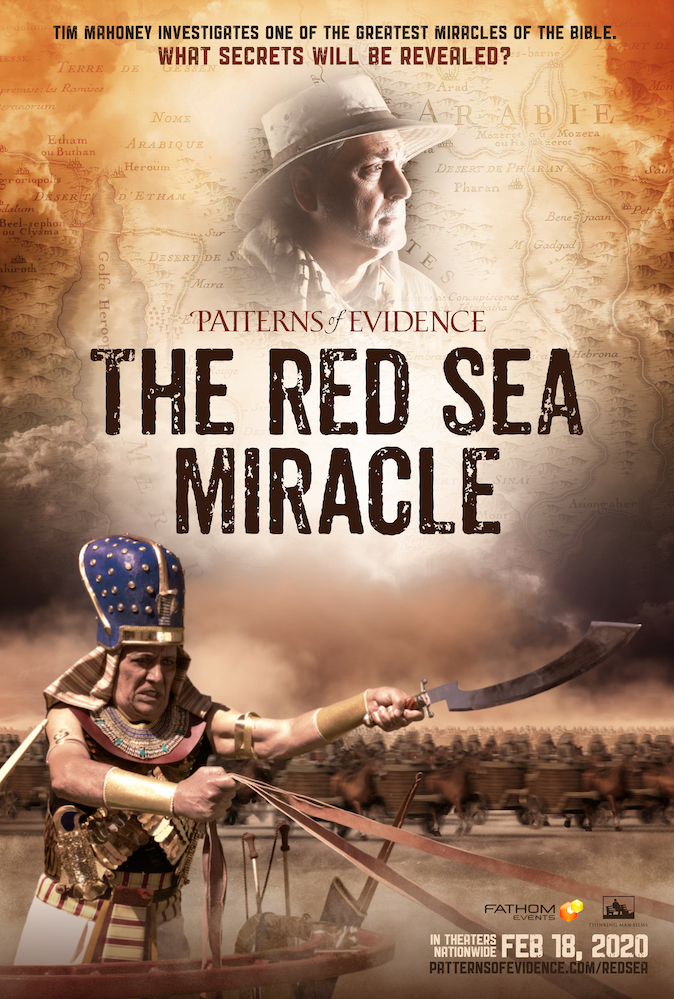
In general, The Red Sea Miracle was ambitious, even for a 2 1/2 hour movie, but the storyline held together better than his last film, The Moses Controversy, which explored the possibility of how Moses might have been able to write the first five books of the Bible. Like the original film, The Exodus, which considered the chronology of Moses, and the timing of Joshua’s conquest of Canaan, this first part of the third film series, The Red Sea Miracle, looked at yet another controversial question, regarding the historicity of the Exodus, namely where the crossing of the “Red Sea” might have taken place. Overall, I found the newest film quite fascinating and encouraging, despite a few noticeable drawbacks.
First, let us consider the good parts of the film. The Red Sea Miracle does a very good job at giving a helpful overview of the questions that archaeologists, Old Testament specialists, and other scholars are asking, when they try to determine where Moses might have led the Israelites across the “Red Sea.” The amount of data to work through, both biblically and archaeologically, is quite a lot, and numerous interpretation challenges remain. So for a 2 1/2 hour film, Tim Mahoney is to be commended for his honesty, his warmth, his sincerity, and his determination, in helping viewers understand the complex issues involved. He also produced a cinematically pleasing movie to look at, a highly professional piece of film making that helped me to focus on the topic being addressed.
Tim Mahoney also rightfully exposes viewers to a wide range of scholarship, in considering the question of where Moses might have parted the Red Sea. Anyone who has shown serious interest in Bible archaeology will know that the majority of archaeologists today are highly skeptical about the presence of Israelites in Egypt, much less who believe the traditional account of the Red Sea crossing. Mahoney interviews some of these scholars, but interestingly, he interviews one scholar, Manfred Bietak, one of today’s leading Austrian Egyptologists, who now believes that there is at least some evidence, that is consistent with the story of Israelites being slaves in ancient Egypt. When Mahoney interviewed Bietak, over a decade ago, for the first Patterns of Evidence film, The Exodus, it was Bietak’s skepticism regarding the historicity of the Exodus story, that first discouraged Tim Mahoney in his film making journey.
In addition to some skeptical scholars, Mahoney also interviews a wide range of evangelical Christian scholars, who hold various, and even conflicting views, as to where the Red Sea crossing might have occurred. Mahoney divides these scholars into two broadly-defined camps: those who favor the “Egyptian” view, and those who favor the “Hebrew” view. The “Egyptian” view, generally speaking, favors a crossing of the “Reed” Sea, through the shallow lake region, within a few dozen miles of Egypt, with perhaps as few as 20,000 or so Israelites. The “Hebrew” view favors a crossing at the Gulf of Aqaba, over 200 miles away from Egypt, on the eastern side of the Sinai peninsula, with over 2 million Israelites. The “Egyptian” view favors the traditional location of Mount Sinai, on the Sinai peninula, whereas the “Hebrew” view favors Mount Sinai being in Saudi Arabia.
I was surprised to discover, that unlike the two previous Mahoney films, Mahoney is now less enamored with the ideas proposed by Egyptologist David Rohl, who Mahoney tends to elevate highly in the first two films. David Rohl, who considers himself to be an atheist, is a genuine, peer-reviewed scholar, but his unconventional revision of Egyptian chronology has yet to gain significant support from his other historian and archaeologist colleagues, from within the scholarly guild. This is important, for a viewer of the first two films might be erroneously drawn to conclude that David Rohl’s proposals carry far greater weight, in academic circles, than is actually the case. One can not simply dismiss David Rohl’s ideas out of hand, but a lot more work needs to be done before Rohl’s proposals gain broader acceptance. Interestingly, I found it quite telling that David Rohl is highly skeptical of the “Hebrew,” Gulf of Aqaba crossing view. He tells Mahoney that he would need to see an actual chariot wheel dug up from the floor of the Gulf of Aqaba, before he would accept a “Red Sea” crossing, at that location.
Despite the film’s many strengths, there was one aspect that stuck out as a major criticism of The Red Sea Miracle. Mahoney clearly favors the “Hebrew” over and against the “Egyptian” view of the crossing. He believes that a shallow lake crossing, with a relatively smaller number of Israelites, is somehow less “miraculous” than a Gulf of Aqaba crossing.
This is really peculiar, as it assumes that the bigger the miracle, the more miraculous it would be, and therefore, the more Scripturally faithful it would be. I get the point that Tim Mahoney is trying to make, but it is not necessary to make such a point, in the interest of defending the Bible. Sure, if Moses took over 2 million Israelites across the Red Sea, Cecil B. DeMille-style, even somewhere relatively deep, like the Gulf of Aqaba, then God can do anything. Who are we to put limits upon God?
Yet even if a more naturalistic explanation could be found for the Red Sea crossing, the timing of such an event, such as a large wind separating the waters, at just the right time, is still miracle enough, and thoroughly demonstrates the power of God. Did Moses simply get lucky that the sea parted, just when he got to the water’s edge? Or was this, too, evidence that points to the providence and power of God?
Consider the story of the Risen Jesus: If God really wanted to show a grand miracle of Resurrection, he could have Resurrected thousands upon thousands of people on Easter morning. That would have been a much more impressive miracle. But it was sufficient for God to demonstrate his overwhelming power and victory over sin and death, by Resurrecting the one God-Man, Jesus Christ. Does not God have the right to demonstrate his miraculous power, however God wishes to do so?
To be fair, while Tim Mahoney still appears to favor what he calls a “Hebrew” view, he rightly acknowledges that different evangelical scholars hold some widely differing perspectives, in good faith, on this most interesting topic.
The last half hour of the film was a panel discussion, held at the Answers in Genesis Ark Encounter, in Kentucky, where some Christian leaders reflected on the film, including Truett McConnell University Old Testament scholar Jeremy Lyon, radio talk show host Janet Mefferd, Precepts founder Kay Arthur, and Answers in Genesis’ Ken Ham. What was interesting about this panel is that all four participants interviewed are all Young Earth Creationists. Yet perhaps the larger majority of scholars interviewed in The Red Sea Miracle do not hold a Young Earth Creationist interpretation of the Bible. Is this perhaps a sign of a rapprochement between advocates of Young Earth Creationism and Old Earth Creationism? It made me curious.
The traditional Sunday School image shows Joshua leading about 600,000 armed Israelites into the land of Canaan, across the river Jordan. But was that really the size of Joshua’s army?
When we read about the nation of Israel crossing the river Jordan to enter the Promised Land, in Joshua 4, something stands out, if you read very carefully. Joshua 4:13 tells us this:
About 40,000 ready for war passed over before the Lord for battle, to the plains of Jericho (ESV).
From this verse alone, you might think that there were a total of 40,000 soldiers in the army of Israel, set to conquer the land. The problem is that according to a census taken prior to the crossing of the river Jordan, of all of the Hebrew men of fighting age (Numbers 26:1-4), the census gave a total number of 601,730 (Numbers 26:51). A previous census taken near the beginning of the wilderness journey, just after the Exodus from Egypt, reveals about the same number, 603,550 (Numbers 1:45-46). The second census is different in that the first generation in the wilderness had perished, replaced by a new generation, leaving only Joshua and Caleb from the first generation still among them, but the numbers are in the same ballpark. Clearly there is a problem lining up the 40,000 armed men that crossed the Jordan with the some 600,000+ recorded in each census.
Nevertheless, the problem is more difficult than this: Assuming a 600,000+ army, this would give you a much larger population total, if you include women and children, at least around 2 million.
That is a lot of people.
In Deuteronomy 7:1-7, we read that God was sending the Israelites into a land to clear away seven different nations of people, each nation being larger than Israel herself. That means at least 14 million people were living in the Promised Land that Israel was to possess, in Canaan, which would be greater than the current population of the corresponding land in the Middle East now. Considering that Gaza alone is one of most densely populated places on earth, it is difficult to comprehend such large numbers of people in the ancient near east, particularly when the current archaeological data shows that the land of Canaan was far less populated then than it is now.







 Veracity