Does the Bible teach that women should serve as elders in a local church?
This is a question which has become one of the most divisive issues in evangelical churches today. It is also a question filled with assumptions which begs for other questions. What is an “elder” in a local church? What is the “local church?” Then there is the question which has plagued American society culturally for at least the last ten years: What is a “woman”?
Preston Sprinkle on the Complementarian/Egalitarian Debate
Preston Sprinkle taught New Testament at Eternity Bible College, at an extension campus in Boise, Idaho, before it downsized in 2016. As a New Testament scholar, with a PhD from the University of Aberdeen (Scotland), Preston Sprinkle has written about and spoken on a number of issues relevant to the study of the New Testament. Eternity Bible College was founded by popular Christian author and speaker, Francis Chan. Francis and Preston even wrote a book together, Erasing Hell, a response to the universalism-leanings of Rob Bell, a controversial former evangelical pastor, back in 2011. After leaving Eternity Bible, Preston founded the Center for Faith, Sexuality, and Gender, providing resources for churches, parents, and other individuals, in order to more effectively care for people who struggle with questions about sexuality and gender, while upholding a traditional view of human sexuality and marriage; that is, a one-man to one-woman covenantal relationship intended for life.
As one might expect, entering any conversation regarding sexuality and gender will probably generate controversy, and Preston is no stranger to it. Preston’s previous books on these topics, such as People To Be Loved: Why Homosexuality is Not Just an Issue (reviewed here on Veracity), and Embodied: Transgender Identities, the Church, and What the Bible Has to Say (reviewed here on Veracity), have sparked very lively discussion and criticism from all sides. I have not always agreed with every element Preston puts forward in his writings, but I appreciate his willingness to tackle tough questions, doing so with a commitment to follow the Scriptural text, wherever it leads, to find answers.
What other controversy could Preston address?? Well, Preston had put off doing a deep dive into the question of “women in Christian leadership” for years, knowing that he had other scholar friends whom he highly respected, who landed on different conclusions to the question. But Preston finally took the time to read a stack of books for several years in order to write his book, as a way of bridging the gap between ordinary Christians, without seminary training, and those in the academy.
Preston’s newest book was one of my best reads of 2025 (and early 2026), having received an advanced copy of the book. Though I do feel compelled to write this rather long, critical review, as I will explain below.
Elisabeth Elliot was widowed now for a second time. Elisabeth Elliot was forty-six years old when her husband, sixty-four year old Addison Leitch died after a nearly year long difficult battle with cancer.
Almost exactly half of her life was over, with another half remaining by 1977. Going through another period of grief reinforced the reality of suffering, a theme which recurred several times in her extensive writing career. This last period of Elisabeth Elliot’s life catapulted her even further into the public eye, with her advice directed mainly towards women through her radio program “Gateway to Joy,” and more books. Yet it is arguably the most controversial period of her life as well.
Here in this final blog post reviewing several biographies of the life of the iconic 20th-century missionary and author, Elisabeth Elliot (previous blog posts here and here), we examine this last period of her life as told by her biographers.
Elisabeth Elliot’s Mid-Life Crisis
Towards the end of Addison Leitch’s life, Elisabeth began to take on boarders in her home, initially to assist her as she nursed her husband in his final days. Little did she know then that two of these boarders would eventually occupy major roles in her life.
Walter Shephard was a son of missionary parents serving in the Democratic Republic of the Congo. Upon returning to the United States, Walter Shephard as a young adult lived a prodigal life, quite far away from the Christian life modeled by his devout parents. A near deadly car accident got his attention and he eventually gave his life over to Christ. He ended up at Gordon-Conwell Seminary, and took a room in Elisabeth Elliot’s home. He got along extraordinarily well with Elisabeth Elliot, but he soon developed a close friendship with young Valerie, Elisabeth Elliot’s daughter, when she was home from college one semester. The two were married shortly after Valerie graduated from Wheaton College.
Lars Gren was in many ways quite far apart from Walter Shephard. A former salesman who in mid-life decided to go to seminary to become a hospital chaplain, Lars Gren never knew anything about Elisabeth’s fame as the wife of the martyred missionary, Jim Elliot, until after he became a boarder in Elisabeth Elliot’s home. Unlike Walter Shephard, Lars was not a great conversationalist. He did not have the most exciting personality. But what he did have was a sense of faithfulness and loyalty to Elisabeth, having a strong desire to please her, and he seemed always available. He was always there.
Lucy Austen’s Elisabeth Elliot: A Life, a one-volume biography of Elisabeth Elliot’s life. Along with Ellen Vaughn’s two volume work about Elisabeth Elliot, both authors have some surprises towards the end their work about Elisabeth’s third marriage to Lars Gren.
As a female author and speaker, Elisabeth Elliot stands as one of the most well-known and influential evangelical women in the 20th century. It was after her service for a little over a decade in Ecuador when Elisabeth Elliot returned to the United States in 1963, to her family home in New England, to pursue her work as an author and missionary speaker.
Upon returning to New England, she wrote her first and only novel, No Graven Image, and a biography about Kenneth Strachan, the founder of the Latin American Mission, titled Who Shall Ascend: The Life of R. Kenneth Strachan of Costa Rica. Her 1968 book about her ten weeks in Israel right after the Six-Days War, Furnace of the Lord, sparked controversy, but as she would put it, she was only concerned about “telling the truth,” and letting consequences follow. She would eventually write several other books on various topics, and even becoming a contributor to the New International Version Bible translation project.
Her speaking career gave her opportunities to travel widely, appearing before church gatherings, college student meetings, and other settings where she was asked often to talk about her life as a missionary in Ecuador. Elisabeth Elliot could be quite harsh in her criticism of certain practices by some evangelical missionary agencies, such as the tendency to inflate the number of converts in distant lands in order to raise more money. On more than one occasion, she had conflict sharing the stage with insecure men, who were bothered with the idea of sharing a speaking platform with a woman. Nevertheless, her speaking engagements became a significant component for much of the rest of her life.
But perhaps the most important event in her life during this period was her marriage to a college and seminary professor, Addison Leitch, the focus of this second of a three part series reviewing her life through the lens of her biographers, primarily Lucy Austen and secondarily Ellen Vaughn.
If you could name just one woman as the most influential evangelical Protestant “saint” since World War 2, Elisabeth Elliot would probably be her.
Elisabeth Elliot was the wife of martyred missionary, Jim Elliot, who along with four other men, died in their attempt to share the Gospel with Ecuador’s reclusive Waorani tribe in the 1950s. After her husband’s death, heavily publicized by Henry Luce’s LIFE magazine, Elisabeth wrote the evangelical classics, Through Gates of Splendor (1957) and Shadow of the Almighty: The Life and Testament of Jim Elliot (1958), catapulting her to be one of the most sought after authors and speakers in the evangelical publishing and speaking world.1
One of the biographies by Ellen Vaughn, about Elisabeth Elliot, which I read for this Veracity blog post series. Becoming Elisabeth Elliot covers the early years of Elisabeth’s life.
Before she died in 2015, Elisabeth Elliot had been a regular speaker at InterVarsity Christian Fellowship’s national conferences. In fact, in the 1970s, she was the first woman to be highlighted as a plenary speaker at the Urbana Missions conference, which InterVarsity holds every three years for college students. Her 1984 Passion and Purity: Learning to Bring Your Love Life Under God’s Control influenced the courtship movement popularized particularly in the 1990’s. Elliot was also a staple in the world of evangelical radio, with her syndicated “Gateway to Joy” program, which ran for 13 years. Elliot was practically minded in her teaching, and yet an intellectual at the same time.
My wife still listens to daily reruns of “Gateway to Joy” on the Bible Broadcasting Network. The tag line in each episode is permanently etched in my mind: “This is your friend, Elisabeth Elliot.”
Fascinatingly complex, Elisabeth Elliot was both an inspirational and polarizing figure. She championed the cause of missionary work, a direct influence on me as I read Shadow of the Almighty back in my college days, a recollection of her first husband and missionary, Jim Elliot. I marveled at the courage and conviction of Jim and Elisabeth Elliot, their mutual heart to reach lost people with the Good News of Jesus, and their willingness to do difficult things for the sake of following Christ.
One of Jim Elliot’s quotes was, “He is no fool who gives what he cannot keep to gain what he cannot lose,” from a journal entry Elisabeth preserved and shared to readers as an author of more than 30 books. She was a profound influence on the lives of many evangelical thought leaders, like Joni Eareckson Tada, and Timothy and Kathy Keller. In her later years, she regularly spoke at homeschooling conferences and Bill Gothard’s Institute in Basic Life Principles events. A young author, Josh Harris, wrote the 1990s evangelical blockbuster I Kissed Dating Goodbye, with a prominent endorsement given by Elliot, one of the primary texts in that decade promoting “purity culture.”
Elisabeth Elliot was a household name for about 50 years for many American Christians until her radio broadcast ended in the early 2000’s. Yet despite her influence, there are still many Christian young people growing up today who know nothing about Elisabeth Elliot.2
It is a complicated legacy, but one worth telling, acknowledging that Elisabeth Elliot was a remarkable, exemplary Christian figure, while still possessing very human faults.
If you think “progressive Christianity” has no relevant impact on evangelical churches, then you really need to pay attention to this blog post…. I hope you stay with me until I get to the Richard Dawkins point at the end…
Most Christians probably have no clue who Richard B. Hays is. But when it comes to the Bible, Hays is big news. Think the Tim Tebow of the National League Football, or the Caitlin Clark of women’s basketball, or the Taylor Swift of pop-music, ….. or the John Piper of evangelical pastors. Richard B. Hays is THAT big when it comes to New Testament studies. He is a rock star.
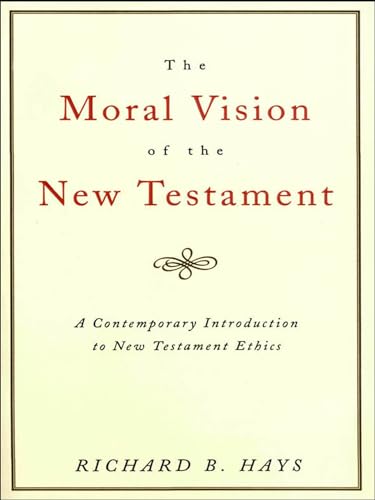
I read Richard B. Hays’ influential The Moral Vision of the New Testament back in the 1990s, when I was a seminary student. I had several dear Christian friends who were wrestling with same-sex attraction. I wanted to know how best to walk with them in their struggles, and help them navigate through a lot of the harmful messages being heard in some conservative evangelical churches, while still being faithful to Christ and Scripture.
To be honest, I was conflicted inside: What do you do and say when a friend tells you that they are “gay?” But in reading Hays’ book, it encouraged me that one could have compassion towards those who wrestle with same-sex attraction, while still embracing a traditional sexual ethic, with the time-honored doctrine of marriage between one man and one woman consistent with historic orthodox Christianity. Hays’ The Moral Vision of the New Testament: A Contemporary Introduction to New Testament Ethicsis still regarded as one of the seminal texts affirming what is now sometimes known as a “Side B” approach to human sexuality. In that book, Richard B. Hays recounts a moving conversation he had with a friend who was nearing death, who for years had wrestled with same-sex attraction while living a celibate life out of obedience to Christ. That conversation gripped me as I have had several conversations like this myself with friends over the years.
Richard B. Hays. One of the top New Testament scholars on the planet. Has he changed his mind on what the Bible teaches about human sexuality?? What type of impact might this have on evangelicalism?
Rethinking the Moral Vision of the New Testament?
The Moral Vision of the New Testament covers a number of topics, taking certain positions which might not sit well with some readers. For example, The Moral Vision of the New Testament takes a more pacifist approach to the question of non-violence and war. But this is not what the book is most known for. In The Moral Vision of the New Testament, Hays tackles a lot of the revisionist scholarship championed by John E. Boswell, a 1970’s graduate of the College of William and Mary. Boswell eventually became an influential scholar at Yale, advocating an ethical position in support of same-sex marriage in the church and society at large. Just a few years ago, William and Mary named a building in Boswell’s honor. In a previous essay which served as the impetus for much of what Hays wrote in The Moral Vision, Hays had this to say:
“John Boswell’s influential interpretation of Rom 1:26-27 is seriously misleading in several important particulars. A careful exegesis of the passage shows that Paul unambiguously describes homosexual behavior as a violation of God’s intention for humankind. Responsible interpretation must first recognize that Paul condemns homosexuality and then ask how that condemnation bears upon the formation of normative ethical judgments.”
Now, almost thirty years later, it appears that Richard B. Hays is now backtracking on what he wrote back in 1995/1996. Get the full story from Ian Paul’s Psephizo blog, but here is a summary: Advanced promotion from the publisher, Yale University Press, has announced a new book, co-authored with his son, Christopher Hays, The Widening of God’s Mercy: Sexuality Within the Biblical Story. The book is not even out yet, but as of April, 2024, it ranked as the “#1 New Release in Gender & Sexuality in Religious Studies” on Amazon’s website. If the news reports are accurate, a shift in the thought of the senior, Richard B. Hays, is nothing short of earth-shattering. Richard B. Hays is thought by many to be the American equivalent of the British New Testament powerhouse scholar, N.T. Wright. The fact that Richard B. Hays and N.T. Wright are not just colleagues but good friends is even more significant.
Generally, one should not comment about a book without reading it. But the following endorsement blurb from another scholar who has read an advanced copy of the book is both telling and astonishing:
“This book is an event of historic significance. Senior New Testament scholar Richard Hays here renounces his very widely-quoted (and exploited) non-inclusive treatment of human sexuality from thirty years ago. His son, Old Testament scholar Christopher Hays, of Fuller Theological Seminary (!), here clearly and boldly embraces LGBT+ inclusion, surely at the risk of his employment. Their case is made based on biblical materials, notably a trajectory-type vision emphasizing the ever-widening range of God’s mercy across the canon. Traditionalists will not be convinced by the exegesis. Those who have been wounded by the church’s rejection, and their allies, will see this book as occasion for celebration.”—David P. Gushee, Mercer University
Over the recent decades, David Gushee moved away from his conservative evangelical upbringing to embrace a more progressive Christianity. Today, he is one of the most outspoken ethicists to embrace the acceptance of same-sex marriage within the church. So, if Gushee is going to endorse a book, you can pretty much guarantee it is not going to endorse a traditional view of marriage as being between only one man and one woman.
Crisis in Mainline Protestantism…. Coming Towards More Towards Evangelical Spaces?
In one sense, despite the recognized stature of Richard B. Hays among conservative evangelical Christians, I am not surprised that Hays has rethought his earlier position. Hays is ordained in the United Methodist Church (UMC). Over the past couple of years, the United Methodist Church has gone through perhaps its worst split in its 200+ year history. Roughly one out of four churches left the United Methodist Church to join the Global Methodist Church, aligned more with the rapidly growing Methodist church outside of the United States, notably in Africa. There are still conservative United Methodist Churches out there, while others try to promote an “agree-to-disagree” posture, but the situation has dramatically changed within the last few years. At one time, the Methodist church was the largest denomination movement in the United States.
Now, the controversy over the doctrine of marriage has reduced the footprint of the UMC in the United States significantly. Miracles do happen, but if the UMC follows the well-worn path of other major denominations changing their doctrine of marriage, then it is simply a matter of time before the UMC ceases to exist as an American Christian institution. The current situation will raise a lot of questions about the future of the Methodist seminary system, with schools like Duke Divinity School in North Carolina and Candler School of Theology in Atlanta. Technically, the UMC bans their clergy from performing same-sex weddings (well, at least until this past week). But the ban has never been effectively enforced, which explains the exodus of churches out of the UMC towards the Global Methodist Church over the past few years.
If Hays desires to stay within the UMC, there will be a lot of pressure put on those like him to rethink their views on human sexuality. In contrast, colleges and seminaries either loosely or closely affiliated with the more conservative Global Methodist Church are seeing revivals (like Asbury College) and/or increased enrollments (like Wesley Biblical Seminary), situations which you do not even find in moderate interdenominational or non-denominational evangelical institutions, which are downsizing. The UMC is meeting in a General Conference in the current weeks to flesh a lot of these issues out. (UPDATE June 17, 2024: The UMC has within the past month reversed course on supporting traditional marriage between one man and one woman. Over a million Methodists in Africa have since left the UMC, and more across the globe are expected to leave. The fallout from the UMC change of direction is nothing short of catastrophic).
It is one thing to see issues like these raised in mainline Prortestant churches, which have tended to tilt in a progressive direction anyway, over the past half a century. It hits a bit closer to home for me when you see this in evangelical institutions like Fuller Seminary.
Perhaps David Gushee has not read his advanced copy of the new Hays and Hays book accurately. We must wait and see if this is the case. But if Gushee is right, then it is difficult to see how the Hays will be able to effectively backtrack from a statement like “Paul unambiguously describes homosexual behavior as a violation of God’s intention for humankind.” More likely, the “trajectory-type vision” ascribed to the new book means that somehow the Hays will acknowledge that Paul unambiguously rejects same-sex relationships of all kinds as permissible within the will of God. But then they must follow the “trajectory” somehow to say that Paul is hopelessly antiquated with out-dated moral values associated with the Bronze age, or just plain wrong, nevertheless. That would be the honest way to go about it.
But to say that the Apostle Paul got his doctrine of human sexuality and marriage wrong is quite an extraordinary claim. The ramifications of such a claim are significant.
The “trajectory-type vision” mode of interpretation has a lot of appeal among some. It assumes that just as God changed his mind regarding making circumcision a requirement for becoming a follower of Jesus, then God can easily change his mind regarding other matters that followers of the Judeo-Christian tradition have held for thousands of years. Here is a quick sketch of the “trajectory-type vision.”
Some have suggested that because Jesus never condemned slavery, that Jesus was in some sense wrong, but that the trajectory of the Bible message puts an end to slavery, indicating that God has changed his mind. Some have made arguments that the early church wrongly marginalized women in terms of restricting the office of elder to only qualified men, thus saying that the trajectory of the Bible message suggests that God has changed his mind for the future of the church, in our day and age. The same type of argument has been used to say that Paul did condemn certain types of same-sex relationships, but he remained silent about the concept of same-sex marriage. The latter idea never entered Paul’s mind. The trajectory argument is then employed to say that the “wind of the Holy Spirit” has been moving today to affirm same-sex marriage as being a legitimate expression of God’s purposes for human sexuality, despite how certain so-called “clobber passages” in the Bible against all same-sex relations have been used in previous generations of Bible-believing Christians.
The “wind of the Holy Spirit” is a “go-to” feature of a “trajectory-type vision” hermeneutic. However, it is a pretty bold claim to know how the Holy Spirit is moving in such an extraordinary way, 2000 years beyond the apostolic era of the first century.
The “Trajectory-Type Vison” Hermeneutic at Work
Some have looked for support for this “trajectory-type vision” in the Bible by appealing to the story of the daughters of Zelophehad in Numbers 27. In summary, Zelophehad had no sons, only five daughters. The inheritance law at the time made no provision for inheriting the estate of the father, when there were no sons in the picture. The five daughters of Zelophehad petitioned Moses and the other Israelite leaders to say that without a male heir, none of the five daughters would receive any of the father’s inheritance, and that this was not fair to the daughters. God then instructed Moses to say that the daughters of Zelophehad had a point to make, and provision was made for the inheritance of the father’s estate to be distributed among the daughters of Zelophehad.
An evangelical scholar, like Gordon J. Wenham, in his commentary on Numbers, says that the episode with the daughters of Zelophehad served the purpose of showing the Israelites how case law developed in the early Israelite period. However, other scholars see something more to the story. Such scholarly adherents to a “trajectory-type vision” of biblical morality suggest that the case of the daughters of Zelophehad establishes the idea that God can change his mind on moral matters. So while same-sex relations were forbidden not only in the era of the Old Testament, but also in the era of Paul and the New Testament, the situation has changed today. Perhaps God has changed his mind regarding the sanctity of same-sex marriage.
To be fair, this brief sketch of the “trajectory-type vision” is vastly over simplified. For example, there are certain evangelical scholars today who make no use of a “trajectory-type vision” to argue for having women serve as elders in local churches today. See my friendly (and in-depth) dialogue with Andrew Bartlett, author of Men and Women in Christ,hosted here on Veracity, in several parts. Bartlett refreshingly and wisely rejects the “trajectory-type vision” approach. I have difficulties with some of the argumentation Bartlett uses to arrive at his conclusions, which appear idiosyncratic to me. But thankfully at least he avoids the temptation to embrace a “trajectory-type vision” hermeneutic.
Those who favor same-sex marriage as permissible for the Christian, coming from this interpretation perspective, are typically making their appeal based on an argument from silence. You could say that while the New Testament does not endorse same-sex marriage, it is not necessarily condemning it either. For example, the evidence from early church history shows that the earliest Christian communities paid relatively little attention one way or the other to what we would today call “same-sex marriage.” This is a claim advanced by John Boswell in his influential Christianity, Social Tolerance, and Homosexuality.
Arguments from silence are difficult to sustain. Advancing such arguments where there is no long-standing tradition opposing the position being argued for is one thing. But advancing an argument from silence regarding a 2,000 year tradition upholding marriage as being only between one man and one woman is something different.
But in the case of Richard B. Hays, readers like me who have looked to Hays’ The Moral Vision of the New Testament have concluded that Paul makes no exegetical room for arguing for same-sex marriage as a valid Christian option. The argument from silence approach gains very little traction here. The only real alternative is some type of “trajectory-type vision” briefly mentioned by David Gushee in his endorsement of the upcoming book. It will be very, very interesting to see how the new book will be received.
The life of a single, gay Christian, who wants to honor Christ with his/her life, can be a lonely journey. More than anything else, people who struggle with same-sex desires need friendships, people who will simply listen to their stories (credit: image from Christianity Today‘s review of Single, Gay and Christian). Such is the ethical theme found in Richard B. Hays 1996 work, The Moral Vision of the New Testament.
Why the Situation with Richard B. Hays Matters
The debate over same-sex marriage within the church has been going on for several decades now. For most of the Protestant mainline churches, the debate has swung over into the favor of a progressive Christianity, though you still find holdouts in these once much-larger denominations. It is doubtful that this new book will have much of an impact in those circles. To many theological progressives in these circles, Richard B. Hays’ book on The Moral Vision of the New Testament has been thought to cause great harm within the LGBTQ circles. The Widening of God’s Mercy: Sexuality Within the Biblical Story probably will not change the suspicions many progressives have about Richard B. Hays.
Neither will this new book due to be released this fall have a big impact in more solidly theological-minded evangelical churches, which have worked to try to craft a vision of traditional marriage in their churches. Some of these churches support those who wrestle with same-sex attraction well, while many do not. Either way, the Hays book will unlikely sway these types of churches.
Where the impact might be felt the most is in those non-denominational or inter-denominational churches where LGBTQ concerns are often rarely discussed, at least publicly. Many of these churches have pastors and other church leaders who have looked up to the esteemed Richard B. Hays as a more moderate voice, upholding a traditional position on marriage while making a sincere effort to offer a compassionate voice and listening ear to those somewhere along the LGBTQ spectrum. For if someone as highly revered as Richard B. Hays backtracks on what he wrote nearly 30 years ago, it might prompt some within the evangelical fold to follow suit.
Most evangelical Christians will never bother to read Richard B. Hays, focusing more on trying to make ends meet, running a taxi service for their kids’ athletic programs, providing food in the refrigerator, and keeping the grass cut. But chances are, many of these evangelical Christians attend churches where Richard B. Hays has been a theological “North Star” for their pastors in their seminary education. A big shift in such a “North Star” scholar may cause some pastors and/or elders in a local church to rethink for themselves matters of sexuality.
Has the esteemed American New Testament scholar, Richard B. Hays backtracked on what he wrote in this book from some 30 years ago? What might the ramifications be?
A Reflection… With Some Help From Another Richard…. Richard Dawkins
There is a good reason to explain this phenomenon of churches in decline. As certain churches move away from historically orthodox theological and moral positions, people begin to realize that while the outside veneer of these churches still look Christian, what is going on underneath the hood of these churches is falling apart. Some people have no problem with this, as the “trajectory-type vision” which typically undergirds the theological shifts is fine with them. In other words, it is fine to say the Bible can be horribly wrong about something, and that is okay. We can still salvage some semblance of Christianity by saying that the trajectory of the Bible’s message gets rid of some of the supposed “crud” endorsed within its own pages in order to retain some worthwhile gem in its core. We can peel off what we think is rotten in the Bible in order to preserve a vital kernel, and say “hey, it is still all about Jesus.”
I get the motivation behind what attracts people to the “trajectory-type vision” in interpreting the Bible. Some people are trying hard to rebuild and retain their faith when a certain part of their theological construct crashes and burns. Yet I am convinced that much of what is behind this deconstruction process is from those who have grown up in some particular strand of Christianity, which has essentially butchered the interpretation of the Bible, passing itself off as orthodox when it is nothing of the sort. One easy example to cite are those “KJV-Only” movements which teach that all modern Bible translations, like the ESV and NIV, are “tools of the devil” bent on corrupting the pure truth supposedly found in the KJV alone. The message is this: “Only the KJV-Only people are right. Everyone else is wrong.” That is quite a head trip. My heart goes out to people like that. I had my own close brush with that in my teenage years.
But the “trajectory-type vision” hermeneutic can take a much deeper cut. Because once you adopt a “trajectory-type vision” hermeneutic, its application often knows no boundary. Try this on for a thought experiment: Perhaps the Bible does teach that Jesus is the only way of salvation. But we can rest easy to say that while the Bible has been wrong about that, the trajectory of the Bible’s message affirms that all expressions of religion outside of Christianity are perfectly acceptable to God. Perhaps the Bible does teach that there is a hell which can separate people eternally from God. But we can rest easy to say that while the Bible has been wrong about that, too, the trajectory of the Bible’s message affirms that universalism is true, and everyone will ultimately be saved in the end (Hitler and Stalin, too).
I could go on about the dangers of a “trajectory-type vision,” despite the appeal, but hopefully you get the point. A slippery-slope is a logical fallacy, for sure. But in the affairs of life, a lot of folks slide rather easily down a slipper-slope.
Almost Done… But Hang in There… This is The Most Important Part
OK. I am bound to get flack for saying this, but this really needs to be said and considered carefully. This pretty much nails where I am at on topics like these, though I am sure others are at different places. I welcome the conversation feedback 🙂
A more insidious way of applying the “trajectory-type vision” hermeneutic is to say that we really can not determine what the Bible says with much confidence about the uniqueness of Jesus regarding salvation, the existence of hell, the role of men and women in the church, God’s view on marriage, how we view our sexual identity, or a whole host of other significant issues. An approach like this is spiritually treacherous: It insists that the Bible just is not clear on such issues, the vocabulary is vague, the debates seem confusing and endless, and so we really can not come to an accurate understanding of what the original apostolic leaders who stood behind the New Testament were really saying. With that type of ambiguity, we can simply choose an interpretation which fits what we want to believe, and leave it at that.
Christians do indeed differ regarding how old the earth is, the exact timing and order of events associated with the Second Coming of Christ, or any number of these type of issues. We can hold to certain informed opinions, while grasping them loosely while we converse with one another. But these nitty gritty debates, while still important, do not always have immediate impact with how we live our lives as Christians. However, there are these other issues which do impact how we organize our churches, structure our family life, raise our kids, relate to our neighbor, etc. To simply throw up our hands and say, “The Bible is not clear on such matters. So just choose what you want to believe, and do that,” can be a recipe for confusion.
Frankly, in my view, when you get to that stage of thinking, which seems more and more common these days, you do not have much of a Christian faith left. I have more respect for people who ditch the faith altogether, whether they call themselves atheists or agnostics, than I have for people who persist in hanging onto some watered-down substance of Christianity, which is effectively no different than the secular world around them. While in principle the idea of being free to “agree to disagree” in the Christian church is not only correct but admirable as well, there are limits to that for holding congregations together. The million dollar question comes down to figuring out where those boundaries and limits can be drawn. What hills are you willing to die on, and why?
Deconstructing one’s faith need not lead to a full deconversion from Christianity. But at some point, deconstructing too far leaves not much ground to stand on in keeping one’s Christian faith. Faith then becomes more like fantasy, an escape from reality.
I would much rather embrace the truth, even if it could be shown that Christianity was false, instead of trying to convince myself that I could make Christianity into something I want it to be, sticking my head into the sand to keep from considering that I might be wrong, or at the very least succumbing to wishful thinking. There is nothing wrong with wanting Christianity to be true. But sticking one’s head into the sand to try to avoid one’s doubts is not very satisfactory for me… and not very healthy either.
In comparative terms, I have much more admiration for people who do not find Christian faith to be believable, but who appreciate the moral values traceable back to Christianity and/or the aesthetic value of Christian music, art, architecture, and Christmas carols. In many ways, I have more in common with them than I have for those who go to great lengths to pretend Christianity to be true, while trying to ignore elements of Christian faith that do not fit the narrative they want their Christian faith to have.
My response is to say that I seek to trust that what God says in Scripture, (rightfully interpreted, mind you), to be true, even when there are things in Scripture which I do not fully understand. I simply must trust in God and his goodness, that God knows what he is doing, and will ultimately do the right thing, even when from my time bound, 21st century American limited perspective, it looks like something is way off at the present time. If I was in charge of writing the Bible, I probably would have said certain things differently. But God did not put me in the position of writing inspired Scripture. I do not have that kind of authority. Neither do I think that famous 21st century New Testament scholars have that authority either. That takes a lot of chutzpah I simply do not have. Therefore instead, I must put my confidence in what the apostolic authors of the New Testament have given us, and go with that.
I am a believing evangelical Christian, who wrestles with big questions, but I very much still believe. Perhaps this is just the way I am wired, but I have more in common with the “cultural Christianity” of the scientist Richard Dawkins than I do with those progressive Christians who have effectively diluted faith to being something totally innocuous. By “believe” I mean that I take the witness of the early church regarding the Resurrection to be true. I “know” Christianity to be true in that I hold the evidence for the Resurrection to be the best explanation for what happened with Jesus on Easter morning, given all of the alternatives. Everything else regarding the truthfulness of the Christian faith flows from the reality of the Resurrection.
The following discussion between Richard Dawkins and a U.K. journalist has been on my mind for weeks. Richard Dawkins is naive to think you can really have “cultural Christianity” for long without having genuine Christianity undergirding it, but he makes more sense than the progressive Christianity which tries to pretend something is Christian when it really is not. While I do not hold to Richard Dawkins’ skepticism about Christianity, he seems a lot more authentically genuine than the vicar who could not answer the question posed by the 2-year-old son of the journalist:
So, if the endorsements behind the new Hays book turn out to be correct, it will be disappointing. Progressive Christian readers of Veracity will probably be ticked off at me for urging for a renewed look at the ethical vision of The Moral Vision of the New Testament, upholding marriage between one man and one woman, described by Richard B. Hays back in the 1990s. Others on the extreme conservative side will be ticked off at me for not being somehow “tougher” enough with LGBTQ. I guess that comes with the territory when you write a controversial blog post like this.
We just have to wait until The Widening of God’s Mercy: Sexuality Within the Biblical Story comes out in print in the fall to know how the father and son team of Hays and Hays approaches their topic.










 Veracity