
In 2025, Christians can celebrate 1700 years of the most influential and famous summary of Christian belief, the Nicene Creed. I grew up in a church where we recited the Nicene Creed once a month during worship services. Sadly, a lot of evangelical churches today rarely, if ever, recite the Nicene Creed in public worship, despite the fact that for hundreds of years Christians have historically recited the Nicene Creed (or a shortened version of it, the Apostles Creed) on a regular basis, to remind them of basic Christian truths.
The Nicene Creed has served as a summary of what Christians connected to historically orthodox Christianity have believed and confessed through much of the long history of the Christian movement. It really strikes me as odd that so many conservative evangelical churches, who claim to be concerned with upholding centuries-long-held truths, tend to downplay the creed. Thankfully, with the 1700th anniversary of the first version of the creed, there are a bunch of good books available now that go into detail about the history behind the creed, and what it means for us today.1
I decided to pick up a copy of a book written by a pair of Roman Catholic scholars, who write for an ecumenical audience, from a C.S. Lewis-type “Mere Christianity” perspective. Jared Ortiz and Daniel A. Keating, the authors of The Nicene Creed: A Scriptural, Historical & Theological Commentary, have written a relatively accessible introduction to the creed, making an argument for its importance. Ortiz even teaches at a Protestant evangelical Christian college, Hope College, in Michigan. As Ortiz and Keating put it:
Because we live in an age that doubts the very reality of truth, and because we are trained to go our own way and encouraged to craft our “own truth,” we need more than ever an anchor of Truth—given, tested, and secure—not just as individuals but together as the Church. To our culture, the creeds implicitly say, “These things are true and real. Here is the genuine narrative of our world. And this is true for everyone.” (Ortiz & Keating, The Nicene Creed, Introduction)
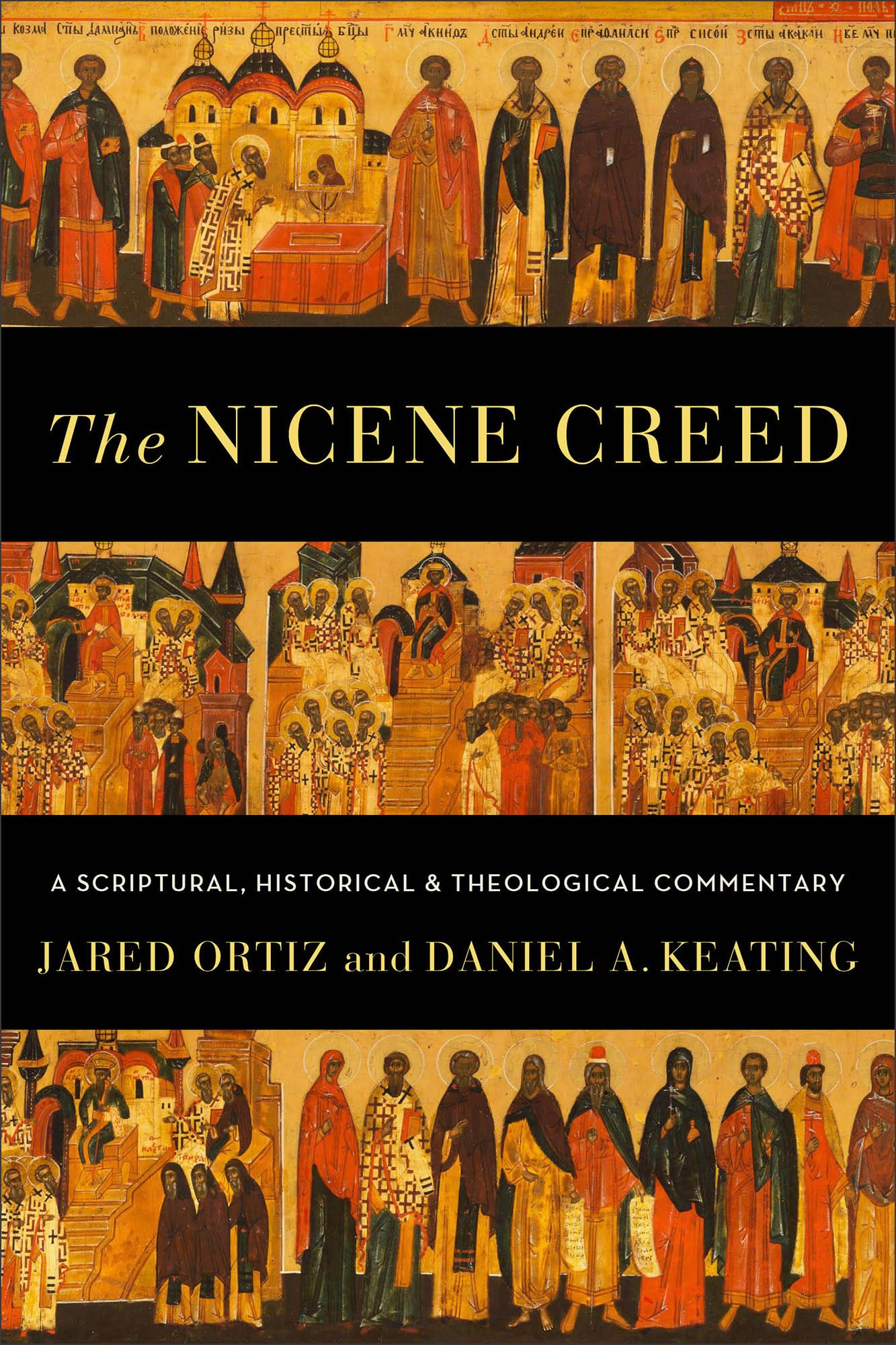
The Nicene Creed: A Scriptural, Historical, and Theological Commentary, by Jared Ortiz and Daniel Keating, a great introduction into the most influential Christian creed, celebrating the 1700th anniversary of its first draft.
Urban Legends of Nicaea
There is a lot of misinformation out there regarding the history and purpose of the Nicene Creed. One of the most popular misinformed stories is that the Emperor Constantine essentially bullied a group of Christian bishops, to get together and declare Jesus to be God, as part of a political tactic to exert his control as emperor over the Christian church.
That makes for a tantalizing conspiratorial tale of intrigue, but it is not good history. If anything, Constantine himself was eventually became more partial to the ideas of Arius, the arch-heretic associated with the Council of Nicaea. In reality, the story is more complex: Constantine at first accepted the decision of the bishops at Nicaea, opposing Arius. Nevertheless, within ten years after the council met, Constantine’s posture towards Arius changed. In becoming more sympathetic towards Arius, Constantine even ordered that one of Arius’ chief antagonists, bishop Athanasius of Alexandria, be exiled because of his enthusiastic support for the Nicene resolution against Arius.
A second popular misinformed story also makes Constantine into being the “bad guy,” by suggesting that he helped to pressure these bishops to come up with a list of books which would make up the New Testament, accepting books that he and certain bishops liked, and throwing out the rest. In other words, Constantine is “blamed” for trying to put all of the bishops together in a headlock, and forcing them to “fix” the New Testament. This second story is wildly wrong, in that the topic of the canon of the New Testament never once made it into any discussion at Nicaea. It would be several decades before a final list of books of the New Testament would be recognized, and the process was more organic and less autocratic, as purveyors of this story want to believe.
The rumor linking the formation of the New Testament canon with Council of Nicaea probably originated based on a comment made by Jerome, the late 4th and early 5th century translator of the Bible into Latin, the Vulgate, who stated that it was at Nicaea when someone acknowledged that the Book of Judith was an accepted part of Scripture. Jerome had his own doubts about the inclusion of the Book of Judith within the record of Scripture. There is not much more detail about Jerome’s comment, and furthermore, the Book of Judith belonged to the Old Testament Apocrypha, and was never a candidate to be accepted into the New Testament anyway.
Then there is the medieval legend that Saint Nicholas, whose cultural memory over the centuries gave us Santa Claus, stood up and punched Arius in the face for all of his heresies. That probably did not happen, but it is still a fun story to think about, old St. Nick throwing a right hook against a reviled heretic across the cheek. Ha! Ha!
Nevertheless, all of this misinformation about Nicaea does leave the question: What was the Nicene Creed really all about, anyway?
An Overview of The Council of Nicaea
The Nicene Creed in 325 initially addressed the controversy over the deity of Christ, describing the precise relationship between the Father and the Son. But the Creed was expanded at the 381 Council of Constantinople in order to flesh out the doctrine of the Trinity, to include more detail about the role of the Holy Spirit, within the divine Godhead. In other words, most Christians, who even know about the Nicene Creed, do not realize that what was agreed upon in 325 is not the exact creed many Christians recite today. It really took about 55 years for the exact formulation of the Nicene Creed to reach its fullest form, common to both the Western and Eastern churches.
However, the acceptance of the Nicene Creed in the church was not immediate. It took some time before the recitation of the Nicene Creed became a normalized part of Christian worship. Scholars say Paul’s letters in the New Testament included a variety of ancient creeds which preceded the Nicene Creed.
Contrary to what I had always thought, the Apostles Creed did not date back to the earliest apostles. Instead, it was derived from the Old Roman Creed, which Augustine used as late as the early 5th century to prepare catechumens for baptism. It was not until the seventh century (the 600s) when the Nicene Creed became a standard part of a Christian worship service.
Ortiz and Keating say with Saint Augustine that there are three basic concepts which undergird the Trinitarian theology of the Nicene Creed: (Ortiz & Keating, Introduction)
- There is only one God.
- The Father is God, the Son is God, and the Holy Spirit is God.
- The Father is not the Son, the Son is not the Father, and the Holy Spirit is neither the Father nor the Son
Ortiz and Keating go through the major parts of the Nicene Creed, namely about the Father, the Son, and the Holy Spirit, giving a Scriptural exposition regarding where each of these components of the Nicene Creed come from the Bible. Along the way, the authors have helpful sidebars with digressions that fill out the bigger story behind the Nicene Creed, such as various witnesses to the tradition, like Irenaeus and Augustine, and contemporary issues touching on the Nicene Creed, such as “Why is God called ‘Father’ and Not ‘Mother’.” An appendix displays a comparison between the original 325 creed at Nicaea, the finalized Nicene Creed ratified at the Council of Constantinople in 381, and the 7th century Apostles Creed, an abbreviated version of the longer Nicene Creed. A glossary helps the reader to navigate terms essential to the Nicaea debate, such as homoousios (“one in being”) and homoiousios (“like in being”).
Addressing The Arian Heresy
The primary issue at stake with the Nicene Creed was the controversy over the teachings of Arius, a presbyter from Alexandria in Egypt, probably the second largest city in the Roman Empire with one of the most vibrant Christian communities in the ancient world. While Christians worshiped Jesus as the Son of God, by the early 4th century, they had not clearly worked out how the Son of God related to the Father. Arius was not the first one with a commitment to monotheism, who suggested that while Jesus was divine in some sense, the Father was uniquely divine in a different way than the Son.
What stirred up controversy that precipitated the Council of Nicaea was Arius’ particular teaching that Jesus as the Son of God was a creature, whereas the Father was not. Or to put it succinctly, there was a time when the Son was not, according to Arius.
Arius appealed to bible passages like Proverbs 8:25, where divine Wisdom, by which God created the world, speaks and says, “Before the mountains were established, and before all the hills, he begot me.” Because Paul describes Jesus Christ as “the power of God and the wisdom of God” (1 Cor.1:24), Arius like many others saw Jesus as the Son of God described as the Wisdom of God in Proverbs 8, in that Christ was “begotten” by God. However, in that same passage, Wisdom is described in the Greek Septuagint translation as being “created” by God (Proverbs 8:22). As Ortiz and Keating put it, a great “exegetical contest” took place in the 4th century church to resolve the question: Is the divine Wisdom created by God or begotten from God? (Ortiz and Keating, p. 98).
There were some who were at least initially sympathetic towards Arius in saying that while the Father is “truly God,” the Son is also divine, but in a derived and subordinate way. The Fathers who championed Nicaea pushed back on this idea by insisting that the Son is “begotten, not made,” appealing to verses like Jude 25, that the Son existed before every and any age. They also crafted the language that the Son is indeed “God from God, Light from Light, true God from true God,” to emphasize the full divinity of the Son. An appeal was made from texts like “the Word was with God, and the Word was God” (John 1:1), Thomas’ confession of Jesus as “My Lord and My God” (John 20:28), Hebrews 1:3, Hebrews 1:8, Revelation 5:12–14, along with others.2
Using a Non-Biblical Word to Express a Biblical Concept
If Arius was indeed wrong, as the Council of Nicaea concluded, how then should Christians think of the relationship between the Father and the Son? The debate preoccupied the church for about 55 years, until the Council of Constantinople, where the Nicene Creed was reaffirmed and expanded to resolve ongoing disputes. For example, the 325 version of the creed said that the Son is “consubstantial with the Father.” But what does “consubstantial” actually mean here, which the Book of Common Prayer traditionally renders this as “being of one substance with the Father?”
It all came down to a single Greek word: homoousios.
The 325 version used the Greek word homoousios to mean “same substance” or “same essence,” though the word homoousios itself was not found in the Bible. Two Greek words make up the compound word: “homo” for “same,” and “ousia” for “substance” or “essence.” However, some critics argued that the concept of “same substance” did not adequately recognize a real distinction between the Father and the Son, a feature of modalism, the heretical notion the Son’s identity is not permanent, that at some point in the future the Son will “merge back into the Father.” (Ortiz & Keating, p. 107).
These critics, commonly called the “Homoeans,” proposed another word, homoiousios, meaning “like substance,” to reinforce the distinction between the Father and the Son. Nevertheless, those like Athanasius, the most vocal bishop and advocate for the original Nicene formulation, insisted on keeping the language of homoousios. Athanasius was concerned that homoiousios would pave the way back towards the heresy of Arius. The 380 version of the creed kept the word homoousios, as a result. The one letter, a little “i”, made all the difference.
How then should the distinction between the Father and the Son be made (along with the Holy Spirit)? The Greek word hypostasis was selected by some to designate the different persons of the Godhead: Father, Son, and Holy Spirit. Along with the Greek word ousia, meaning “essence” or “being,” the church at the time of the Council of Constantinople in 380/381 adopted the language of “one ousia and three hypostases” to describe the Triune Godhead (Ortiz & Keating, pp.110-111).
However, this brought some confusion as some considered the word hypostasis to be synonymous with the concept of “substance,” which emphasized the oneness of God. The concern was that it made the Christian Godhead into a union of three separate Gods, which was entirely misleading. Another word, prosōpon, was introduced instead, which is best rendered in English as “person.” However, the Greek prosōpon actually meant “face,” which to others seemed not to adequately signal the distinction between the Father, Son, and Holy Spirit. It was not until the Council of Chalcedon in 451 that the common language to describe the Trinity as “one God in three persons” was finally settled as the most suitable way to speak of the Godhead, the language most Christians use today (Ortiz & Keating, pp.110-111).
Despite the efforts at Nicaea to deal with the heresy of Arius, subsequent controversies led to more material being inserted into the creed at the second ecumenical council at Constantinople in 380/381. Marcellus of Ancyra, one of the bishops who attended the Nicene council and opposed Arius, was ultimately condemned at Constantinople for his own teachings. While Marcellus agreed that Son was divine and yet not created, as Arius claimed, Marcellus also championed an idiosyncratic interpretation of Paul’s writings in 1 Corinthians 15:24–28.
When Paul writes that at “the end , when he [the Son] delivers the kingdom to God the Father after destroying every rule and every authority and power,” Marcellus believed that this indicated that the distinction between the Son and the Father should only be understood as a temporary condition. For Marcellus, Paul was teaching that at the end of the age, after the return of Christ, the Son will merge back into the Father. In other words, the Triune nature of God ceases to exist once Christ’s work is complete. At least this is how Marcellus interpreted Paul: “When all things are subjected to him, then the Son himself will also be subjected to him who put all things in subjection under him, that God may be all in all.”
At Constantinople, a phrase at the end of the second stanza regarding the doctrine of the Son was added: “and his kingdom will have no end.” I had always thought this was a throwaway line added into the creed without much of a reason. Now I know that was because the fathers at Constantinople were condemning the heresy of Marcellus by including this insertion, thus affirming the eternal distinct identity of the Son from the Father (Ortiz and Keating, p. 140).
The Holy Spirit at the Second Ecumenical Council in Constantinople
At the 325 council meeting at Nicaea, only one line in the creed mentioned anything about the Holy Spirit: “We believe in the Holy Spirit.” However, in the years immediately prior to the council meeting at Constantinople, some of those who affirmed the full divinity of the Son, standing against Arius, were saying that the Holy Spirit was but a creature, and not fully divine in the same sense as the Son and the Father.
This group, known as the “Macedonians,”named after a former bishop of Constantinople, Macedonius, brought thirty bishops to the 380 council. They believed that the Holy Spirit was a kind of created “super-angel,” serving the purposes of the Father and the Son. But when Gregory of Nazianzus, a well-known orthodox bishop, preached in favor of the full divinity of the Holy Spirit, the Macedonian group left the council meeting. In their absence, the council of Constantinople drafted what would become the stanza that Christians recite today, including such statements affirming that the Holy Spirit is “the Lord, the giver of life” (Ortiz and Keating, p. 165-167).
No exposition of the Nicene Creed would be complete without commenting on the controversy that arose long after the final draft of the creed in 380/381, the so-called filioque controversy, whereby “filioque” is Latin for the phrase “and the Son.” Around the 6th century, various Latin churches altered the Nicene Creed, which describes the Holy Spirit as one “who proceeds from the Father [and the Son],” where the final phrase was added. Notably, it is commonly accepted that the 589 Third Council of Toledo codified the insertion of “and the Son” into the Nicene Creed, in an effort to try to stamp out another variation of the Arian heresy, which had persisted in some areas of the Christian West.
The practice in the Latin churches soon became uniform, but the alteration was made without any consultation with the Eastern church. The addition of the filioque eventually was cited as one of the major reasons for the split between the Eastern and Western churches during the Great Schism in 1054, when Greek-speaking and Latin-speaking Christians officially began anathematizing one another. The original phrasing found in the Nicene-Constantinople version of the creed was drawn from one of the few texts which discuss the origin of the Holy Spirit, John 15:26.
Ortiz and Keating explain the controversy this way: While the final draft of the creed was written at Constantinople in 380/381, it was not broadly known in the West until the Council of Chalcedon in 451, some 70 years later. By that time, the West was developing an understanding of the Holy Spirit’s procession being from both the Father and the Son (or through the Son). It was only a matter of time before the Latin Christians of the West would formally incorporate that theology into the Nicene Creed.
In addition, Ortiz and Keating contend that certain well-respected Eastern church leaders, namely Cyril of Alexandria, Maximus the Confessor, and John of Damascus, had written in favor of the Holy Spirit’s procession from both the Father and the Son (Ortiz and Keating, pp. 174ff). I am not aware of how Eastern Orthodox theologians would respond to these historical claims.3
Other Takeaways From The Nicene Creed
There are a number of other nugget-sized takeaways from The Nicene Creed that are worth noting:
– Saint Augustine is sometimes thought of in negative terms as emphasizing the wrath of God. Those who reject the doctrine of penal substitutionary atonement point to this as a flaw in Augustine’s thought, depicting God as an uncontrollable, angry deity, bent on punishing his human creatures. But Augustine has a rationale for why we see anthropomorphic language about God in the Bible:
“so those men through whom the Holy Spirit has spoken have not hesitated to employ in those books, as the occasion best demands, names of even those passions which our soul experiences and which the man who knows better already understands to be completely foreign to God. For example, because it is very difficult for a man to avenge something without experiencing anger, the authors of Scripture have decided to use the name wrath for God’s vengeance, although God’s vengeance is exercised with absolutely no such emotion.”4
– While the main controversy at Nicaea was over Arius’ failure to affirm the full divinity of the uncreated Son, there were those who failed to affirm the full humanity of the Son Incarnate as Jesus, such as Apollinaris of Laodicea, an eager opponent of Arius, but who unfortunately upheld the divinity of Jesus at the expense of the full humanity of Jesus, a doctrine which Gregory of Nazianzus strenuously opposed:
“For Apollinaris, the Christ we meet in the pages of the Gospels is a kind of ‘product’ of two parts: he is part Word (who runs things from the center) and part human (with the intellectual soul removed). As Gregory of Nazianzus famously stated in rejecting this model, ‘The unassumed is the unhealed.’If Christ did not assume a full human nature, including a human soul, then we have not been saved” (Ortiz and Keating, p. 131).5
Offering Some Pushback
Granted, both Ortiz and Keating are Roman Catholic scholars, a feature that will probably bother some readers. Various Roman Catholic distinctive doctrines are mentioned, including purgatory. At the very least, this might cause some confusion.
For example, take the word “catholic” from the creed. In the final version approved at the Council of Constantinople (380 CE), the Nicene Creed says that Christians believe “In one holy catholic and apostolic Church.” That word “catholic” has often been taken out of its historical context.
In the early church era there was only one church, the “catholic” church, as “catholic” simply meant the universal, one and only Christian church. The authors generally use the term “catholic” as an alternative to the Gnostics and other groups deemed heretical and out of step with the main body of historically orthodox Christians. Only occasionally do the authors conflate the term “Catholic” with the Roman Catholic tradition specifically (with an uppercase “C”). But since Roman Catholics, Eastern Orthodox, and evangelical Protestants all accept the Nicene Creed as biblically grounded and theologically true, the focus on the Nicene Creed itself will prove beneficial to anyone who wants to learn more about it.
There is at least one spot where Ortiz and Keating make a controversial claim that should be challenged, regarding how the doctrine of creation out of nothing developed in run-up to Nicaea. On page 79, the authors write:
“By the time of the Nicene Creed, “maker of heaven and earth” was firmly understood to mean that God created all things, without exception, from nothing. But, surprising to many of us, creatio ex nihilo was not a doctrine held by the earliest Christians nor by the Jews who preceded them. Indeed, along with many of their pagan neighbors, they held that God created all things from preexistent matter. The question of the origin of matter—and its implications for God’s being and power—did not arise in a clear way until the second century.”
This startling claim, while having some substance, is ultimately misleading. Admittedly, the authors go on and affirm the Nicene Creed’s teaching concerning God’s creation out of nothing; i.e. creation ex nihilo. However, to say that creation ex nihilo was not held by the earliest Christians and the Jews before them is not wholly accurate.
It is better to say that there was a diversity of views concerning creation ex nihilo in the first century among Christians and Jews. Some Scriptural passages suggested a creation ex nihilo interpretation, whereas others were more ambiguous, lending themselves towards other interpretations. Like concerns about the deity of Christ, and what that actually meant, the early church had to wrestle with what creation actually meant regarding the eternal existence of matter. By the time of the Nicaea era, the issue was resolved in that historical orthodox Christians accepted the idea that the material world had a specific beginning, where the existence of God came prior to that of the material world.6
Even the controversy regarding creation ex nihilo recognizes the need for accurate bible interpretation, in that simply having possession of the Scriptures does not necessarily guarantee that the Scriptures will be interpreted properly. Any controversial ambiguity within the biblical text concerning important doctrines needs to have creeds, such as the Nicene Creed, to act as guardrails, to prevent readers from taking certain passages of Scripture and going in the wrong direction with them.
Thankfully, even with some of the pushback offered, Jared Ortiz and Daniel Keating’s The Nicene Creed gives a high quality introduction to the creed, emphasizing its importance, and presenting the concepts articulated in the creed which remains accessible to the novice reader. Christians should take the opportunity of the 1700th anniversary of the Nicene Creed to study this formative summary of Christian belief.
So, why is it that so many Bible-believing, evangelical Christians tend to either ignore or downplay the Nicene Creed? Now, that is an intriguing question. Perhaps it is due to the uniquely American tradition of “No Creed But the Bible,” a slogan popularized during the Second Great Awakening of the 19th century. Frankly, the tragic lack of emphasis on the great creeds of the Christian church, as with the Nicene Creed, within many evangelical circles is something that those Protestants, who know little about the creeds, could learn a thing or two from our friends in the Roman Catholic and Eastern Orthodox traditions. At least, I hope so. The 1700th anniversary of the Nicene Creed may spark some interest!
For more on the Nicene Creed, honoring the 1700th anniversary of the Council of Nicaea, see this earlier blog post reviewing theologian’s Matthew Barrett’s book on the topic, offering an overview of the classic doctrine of the Trinity. For a helpful walk-thru of each word in the Nicene Creed, set aside an hour-and-a-half to watch this video by apologist Gavin Ortlund:
Notes:
1. Dr. Philip Cary wrote The Nicene Creed: An Introduction, in 2023, which offers a fairly easy read, explaining the creed line by line. Cary, a teacher in philosophy at Eastern University in Philadelphia, is an excellent teacher, someone I actually met and had dinner with at a wedding reception a few years ago, and that I have read and followed for years, so I would highly recommend him. From a Reformed Protestant perspective, Kevin DeYoung, a pastor and popular contributor at The Gospel Coalition, recently wrote The Nicene Creed: What You Need to Know about the Most Important Creed Ever Written. I heard an interview with DeYoung giving an overview of the book, and that sounds very promising. Those are just a couple of recommendations, from a list of several available. Later in the year, I will offer a review of a great academic book, The Cambridge Companion to the Council of Nicea, edited by Young Richard Kim, which takes a deep dive into the story of Nicea, with essays by several historians, covering a wide variety of topics, focused more on the history behind the council. The Ortiz and Keating book, being reviewed in this blog post, is more of a general introduction to the theology of the Nicene Creed, looking at each phrase of the creed to see how the church worked through the controversies to arrive at the most important theological statement and summary of Christian belief. In summary, if you are Protestant and would prefer not to wade through some of the finer points of Roman Catholic theology, stick with either the Philip Cary or Kevin DeYoung book on the Nicene Creed. Linked below are some lectures/interviews with Cary and DeYoung that might spur your interest in their books. But if you want a quick introduction, watch the first video below produced by Gospel Simplicity.↩
2. The concept of the eternal subordination of the Son, which stirred up tremendous online controversy in the middle of the second decade of the 21st century (about 10 years ago), harkens back to certain elements of the 4th century debate surrounding the Council of Nicaea. See earlier Veracity blog post regarding the doctrine of the Trinity from an author who vigorously opposes the idea of the eternal subordination of the Son. Defenders of the eternal subordination of the Son say that the Son is functionally subordinate to the Father, in eternity, while still being ontologically equal to the Father. I find the doctrine of the eternal subordination of the Son to be wholly unconvincing, though one critic who commented claims that I misrepresents his view. For another conservative critique of the “eternal subordination of the Son” doctrine, see this First Things article by Craig Carter. Readers should do their own research and draw their own conclusions. A helpful overview of the “eternal subordination of the the Son” controversy, and its relationship to the Nicene Creed, is covered by the following discussion on the White Horse Inn “Sola Media” podcast below. This is my biggest beef with Wayne Grudem’s theology affirming the “eternal subordination of the Son” . ↩
3. While these are helpful counterarguments which explain why the filioque was inserted into the creed by the West, this does not excuse the West for making a unilateral change to the creed without first consulting the Eastern church through an ecumenical council. But to the credit of the authors, perhaps there is a middle way forward that might lead to reconciliation. It might be possible for both the Western and Eastern churches to agree that the Holy Spirit proceeds from the Father through the Son. Interestingly, the Evangelical Lutheran Church of America recently decided to remove the offending filioque phrase from their liturgy. One wonders if the ELCA will backtrack on their revisionist statements regarding human sexuality, and return to a more historic orthodox view on that subject .↩
4. Augustine, Eighty-Three Different Questions, no. 52, trans. David L. Mosher, FOTC 70 (Washington, DC: Catholic University of America Press, 1982), 88–89., found in Ortiz and Keating, chapter. 2. See Veracity blog posts on the atonement for more (Michael Heiser on Leviticus, Stephen De Young on the atonement.↩
5. For a technical history but excellent theological reflection on the doctrine of the Trinity, see the work of the late Scottish theologian, Thomas Torrance. I read Torrance when I was in seminary in the 1990s. He goes pretty deep, but the reading investment is very rewarding. You can start with The Trinitarian Faith, but then go for his masterpiece, Christian Doctrine of God, One Being Three Persons.↩
6. Ortiz and Keating cite Gerhard May’s Creatio Ex Nihilo: The Doctrine of “Creation out of Nothing” in Early Christian Thought, trans.A.S. Worrall (London: T&T Clark, 2004) as evidence for their claim. Even some progressive Christian scholars, like Nazarene scholar Thomas Jay Oord, argue that the Bible does not teach creation ex nihilo. However, William Lane Craig and Paul Copan’s Creation out of nothing : a biblical, philosophical, and scientific exploration (Michigan: Baker Academic, 2004) refutes May’s argument that no one accepted the doctrine of creation ex nihilo until the second century. Copan has an online essay which summarizes the themes of his book.↩



 Veracity