Tag Archives: Easter

Was Easter Originally a Pagan Holiday?

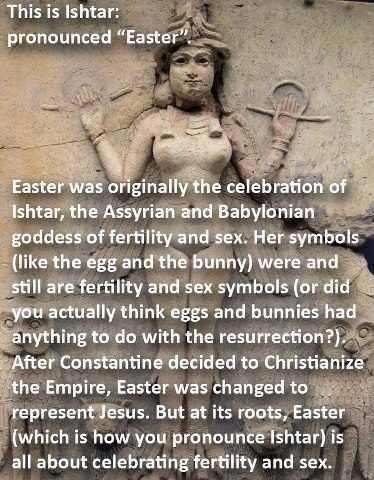
A few years ago, this image linking the celebration of Easter with the goddess Ishtar made its rounds on the Internet on various atheistic websites. Is there any truth to such claims? In short, this is complete nonsense. But sadly, some Christians propagate these ideas, too.

A few years ago, this image linking the celebration of Easter with the goddess Ishtar made its rounds on the Internet on various atheistic websites. Is there any truth to such claims? In short, this is complete nonsense. But sadly, some Christians propagate these ideas, too.

So, is the Christian celebration of Easter originally derived from a pagan holiday?

Just yesterday I overheard the idea that Christians are dishonoring Jesus by being involved in a celebration that involves the painting of eggs. This otherwise sincere believer understood that Easter eggs are associated with the pagan practices of child sacrifice.

I just about fell out of my chair.

Sadly, a lot of folks get their information these days from random Internet websites, rather than credible, researched resources. Much of the “free” content available on the Internet on these subjects today come from public domain sources where the copyright has expired, such as some scholarly works written in the 19th century. For example, a Scottish theologian, Alexander Hislop (1807–65) wrote a pamphlet in 1853, The Two Babylons, where Hislop lays out his theory of the connections between Easter, as celebrated traditionally among Roman Catholics, and Ishtar, an ancient goddess of fertility and sex.  But more modern research has shown that such theories are without historical foundation.  To make a long story short, Easter has its roots in the Jewish celebration of the Passover and Christ’s resurrection, not ancient fertility rites.

In his day, apologists like Hislop were very interesting in writing polemic works designed to criticize Roman Catholicism in an attempt to promote a more Protestant understanding of faith. But today, these same type of arguments are used by atheists to attack Christianity in general. To complicate matters even more, as traditional religions associated with European paganism are being revived in the West, you will find various groups, such as modern day Druids and Wiccans, who use the same type of pseudo-scholarship folklore to justify their practices as a polemic against Christianity!

Unfortunately, there are some evangelical Christians today, mainly associated with the Hebrew Roots movement, introduced briefly here on Veracity, that thrive on such supposedly convincing theories. It is true that many evangelical Christians are basically ignorant of the Old Testament and the Jewish roots of the Christian faith. So while the modern trend to have church-run Passover Seders in an attempt to make up for this deficiency could be a step in the right direction, mishandling of such practices might do more harm than good. In other words, if you think that a once a year church-run Seder is enough to ground the Christian believer in an understanding of authentic Jewish belief and Old Testament theology, then you are probably short changing yourself. If you really want to understand the Old Testament, there is simply no shortcut other than actually taking the time to read and study the Old Testament, or the “Hebrew Scriptures,” as many Jewish people would prefer to say. Furthermore, developing a friendship from an actively practicing Jewish person is probably the best education you can get!

The problem with much that goes on with the “Hebrew Roots” movement is that in their enthusiasm to get back to the Jewish roots of our faith, they inadvertently toss “the baby out with the bathwater,” all based in ignorance as they appeal to the conspiracy theory logic of those like Alexander Hislop.

Now, I am not much into painting Easter eggs, and if avoiding such practices help you to distinguish Christian faith from the revival of neopaganism, then that is perfectly understandable. But please do not take away my chocolate Easter bunny. Yum! Yum!

The main point here is that we should not allow atheists and pagans to hijack Easter. Our confidence in the Gospel is not grounded in conspiracy theories. Instead, it is about the celebration of our Risen Lord from the empty tomb!! Arm yourself with a knowledge of what the Bible teaches and credible scholarly research. Here are few recommended resources online for correcting some of the misconceptions about Easter:


The Case for Easter

April 6, 7:00-9:00pm, Williamsburg Community Chapel

April 6, 7:00-9:00pm, Williamsburg Community Chapel

Did Jesus of Nazareth really rise from the dead?

The Veracity community is really excited that our church, Williamsburg Community Chapel, along with other churches across the country, will be hosting The Case for Easter simulcast on Sunday, April 6th, 7:00pm-9:00pm. Featuring Christian apologists Lee Strobel, Mark Mittelberg, and Michael Licona, this will be a great opportunity to bring a friend, whether that be a skeptic or perhaps someone who just is not sure, to hear about the evidence for the cornerstone belief in the Christian faith: the Resurrection of Jesus of Nazareth.

Can an educated person in a scientific age take such a claim seriously? Muslims and some others say Jesus never died on the cross. Some say that contradictions in the Bible render the New Testament’s empty tomb claim suspect. Did the early disciples hallucinate over the post-crucifixion sightings of Jesus? Are there answers to these questions?

Following the 90-minute program, our very own, “Mr. Veracity” himself, John Paine, will be leading a panel discussion to respond to questions from the audience that do not get addressed on the simulcast.

It promises to be great event!


Ash Wednesday and Lent

As John mentioned yesterday, he and I have been invited to blog our way through the season of Lent, with a group of fellow believers in our local community of faith. I thought it might be nice to first reflect on where “Lent” came from. We hope you enjoy these posts….

lathamta's avatarLessons in Lent

Gregory the Great (540-604) dictating the Gregorian chant Gregory the Great (540-604)        dictating the Gregorian chant

The period of Lent, derived from a 14 century English word for “springtime”, has a long history within Christianity.  In the first few centuries of the Christian movement, believers would spend several days in fasting and preparation for the celebration of the Resurrection at Easter. The Lenten period was eventually extended to forty days, but it got its biggest boost from the sixth century bishop of Rome, Gregory the Great (540-604).  Gregory moved the beginning of Lent to what many Christians now call “Ash Wednesday”, establishing “Lent” as an important period in the yearly calendar of the Western Christian church.

The Chapel is a diverse community of faith, and so the idea of “Lent” for some may sound a little weird, or simply “a bit too Catholic”. So perhaps it might be some consolation to you to know…

View original post 307 more words


The Subtraction of Easter

The Final Days of Jesus

The Final Days of Jesus: The Archaeological Evidence

Every year at this time (Holy Week) there is a dramatic increase in documentaries about the ‘real’ Jesus and the meaning of Easter.

To believers, it is difficult to fully appreciate the depth of God’s love for us—his fallen creatures—that in his redemptive plan he allowed himself to be tortured on our behalf.  However we accept that Jesus’ crucifixion was an historical event, and that his resurrection from death is the cornerstone of our faith (as the Apostle Paul stated in 1 Corinthians 15).

To skeptics, it’s difficult or impossible to believe.

But there are those in between that have no particular biases (or at least are willing to investigate the claims of Christianity objectively).  They are interested in figuring it out—essentially adding up the evidence before making up their own mind.  Undoubtedly this can be a great pathway to a strong faith.  Ask Lee Strobel.  Ask Hugh Ross.  Ask Josh McDowell.

In prior posts, we looked at what happened when and where on Good Friday, and the importance of the Resurrection.  But what I most want to share today is an example of getting to the Resurrection by subtraction.

Shimon Gibson is an esteemed archaeologist, arguably one of the foremost authorities on the archaeology of Jerusalem.  In his book, The Final Days of Jesus: The Archaeological Evidence, Dr. Gibson documents his interpretation of the archaeology of Holy Week.  Theologically his title is a bit provocative, but he does a good job relating the environment and settings.

I read Dr. Gibson’s book more than six months ago, but what really sticks with me is what one of his colleagues wrote about the book in a blog post.  Dr. James Tabor praised the book for its scholarship stating,

“There is no doubt in my mind that the rich contents of this wonderful and engaging book will make it a standard in the field of Christian origins. It is an indispensable handbook for the scholar, and a thrilling investigative read for the non-specialist wanting to know more of those last critical days of Jesus.”

But Dr. Tabor also wrote in the same post,

“I find Gibson’s closing lines of his last chapter, “Who Moved the Stone,” somewhat counterproductive in terms of what we might be able to responsibly say as historians. He writes: “The reality is that there is no historical explanation for the empty tomb, other than if we adopt a theological one, i.e., the resurrection. I leave it up to the reader to make up his own mind.” I have to disagree here. Though I freely admit our sources might never allow us to definitely state what happened that Easter weekend, I think by definition the explanation “God took Jesus bodily to heaven,” is not one that historians can responsibly entertain, as historians.”

“The reality is that there is no historical explanation for the empty tomb, other than if we adopt a theological one, i.e., the resurrection. I leave it up to the reader to make up his own mind.”  There are a lot of theologians who make just that point as the bottom line for belief in Jesus Christ and the Resurrection—the tomb is empty.

Dr. Gibson concluded his book immediately after making the empty-tomb statement with this statement,

“Some readers might think it is presumptuous of me, an archaeologist, to write about the character, achievements, and goals of such an important figure as Jesus.  After all, billions of people across the planet worship him as Christ the Saviour, and the Son of God.  But my views are expressed here honestly based on an analysis of archaeological and historical data available to me; I have no personal or religious axe to grind, one way or another, and I definitely have no wish to offend anyone, even though some of the things I say may be radical and controversial.”

Thank you Dr. Gibson for your honest lesson in subtraction.

Once you do your own subtraction and come to the realization that the Resurrection really is an historical event, then the evidence does demand a verdict.  What was that all about?  Who is that all aboutTruth is a person and the tomb is empty.  Happy Easter!


Trial of Jesus Before Pilate

The Gospel accounts of Easter and the trial of Jesus before Pilate have considerable agreement, and some interestingly unique statements.  While all four accounts agree on the essential details of what happened early in the morning of Good Friday, April 3rd, 33 CE, only Luke records that Jesus was interrogated by Herod Antipas (see Luke’s Sources).  Only John—writing long after the three synoptic Gospel writers—adds the detail of the name of the location in Jerusalem where the trial took place (Gabbatha).  And in writing that one word, John left a great clue for modern archaeologists to find the location of the trial.

There is so much to be gleaned about the veracity of the Gospel accounts from reading about the trial of Jesus.  The accounts are not identical.  But they are not inconsistent.  An argument could be made that if this material was contrived, all four accounts would be more homogeneous in the narrative details.

Archaeologist Dr. Shimon Gibson (mentioned in an earlier post) conducted a dig of the Gabbatha site in Jerusalem, and reached some conclusions that even his critics concede are probably correct, rewickering the traditional Via Dolorosa (“Way of Suffering”) in the process.  This type of work, and online resources, can help us see the Bible in context.

Among all that occurred at His trial, Jesus mocked Pontius Pilate—the judge who had the power to set Him free—with sarcasm.  I don’t know why that detail is so important, but somehow it just is.  Consider the painting below, which may be one of the most correctly detailed paintings of Jesus ever crafted.

If you research the work of Dr. Gibson, be careful—there are high-profile misrepresentations of his work, as he himself is quick to point out.  Unfortunately there are those who seem to be motivated more by the need to entertain than a desire to get the facts right.  This topic keeps coming up, and we will address it in forthcoming posts.

Veracity