What is the “Divine Council?” Is it some strange heresy…. Or is it something grounded in the worldview of the New Testament and the earliest Christians?
The concept of the “Divine Council” often confuses people. It goes back to a Hebrew word “Elohim,” used for “god/gods”, occurring over 10,000 times in the Old Testament, found even in very first verse in the Bible, Genesis 1:1.
In the beginning, Elohim created the heavens and the earth.
The word itself is plural, and depending on the context of the verse this could be another name for God, as is the case in Genesis 1:1, or likewise, as in the singular “Yahweh,” or it could refer to a plurality of divine beings, as in a “Divine Council,” among other things.
Scholars have debated what “Elohim” means, but the language of a “Divine Council” is frequently discussed. Some see the “divine council” as something akin to polytheism (the worship of many gods) or henotheism (where there is a high god, with lower gods residing under the high god). But the use of these popular terms do not reflect how the earliest Christians thought of the “Divine Council,” as grounded in the thought of Second Temple Judaism, the next topic covered by Father Stephen De Young, Eastern Orthodox priest and author of The Religion of the Apostles: Orthodox Christianity in the First Century.
Readers unfamiliar with or suspicious of “Divine Council” theology might not be convinced as to what Stephen De Young teaches, but it is worth giving a hearing to the Scriptural evidence, and how it was received by the early church. A common idea in certain streams of historical critical scholarship today says that the “divine council” represents part of the evolutionary development of Israelite religion, beginning with polytheism, which then morphed into henotheism, and then finally arrived at monotheism. I got my first taste of this in my Religion 101 class back in college, and it was a shocker.
Yet when faced with the challenge of these strands of historical criticism, the Divine Council theology of the early church as described in De Young’s The Religion of the Apostles ironically provides the best apologetic for historic orthodox faith: Protestant, Roman Catholic, and Eastern Orthodox alike. As Stephen De Young impacts it, the story of Divine Council theology is profound.
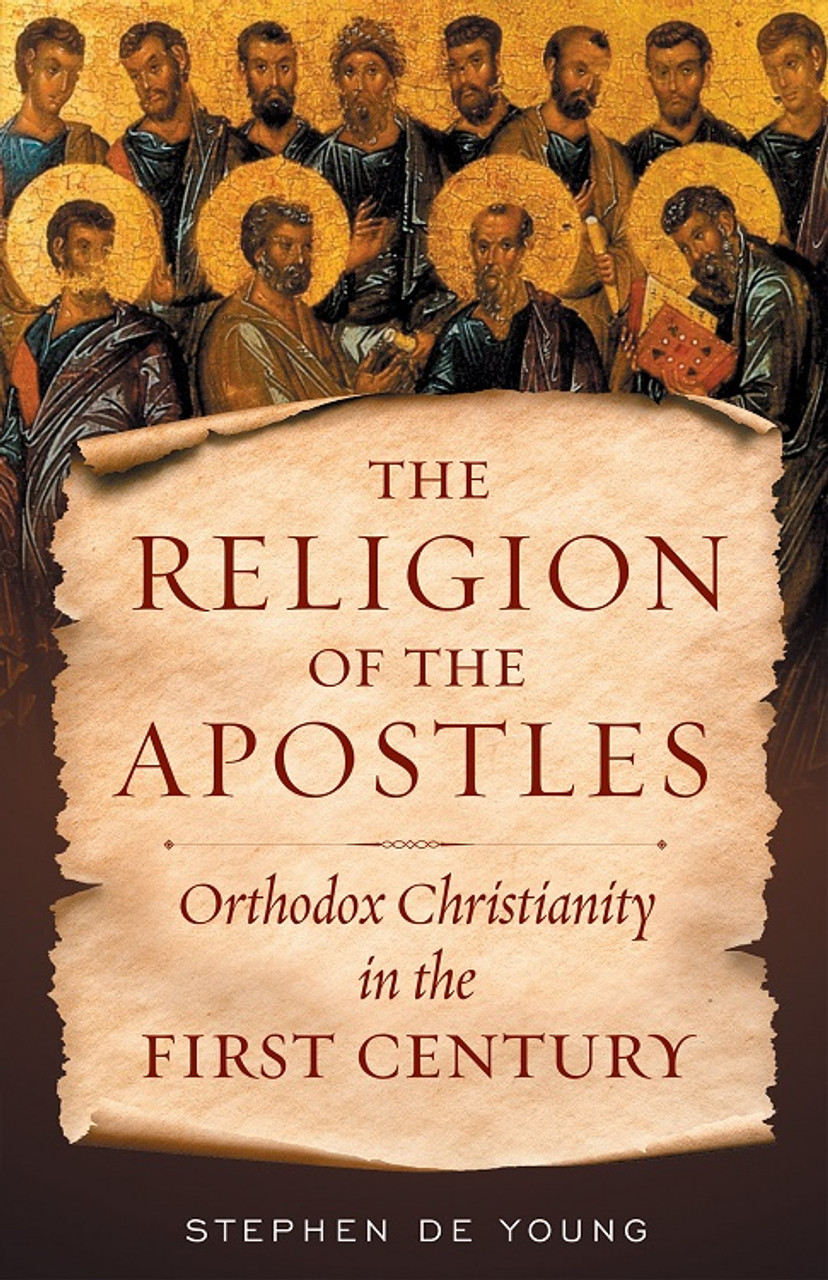
The Religion of the Apostles, by Stephen De Young, shows how the beliefs and practices of the early church connect with the world of Second Temple Judaism, the historical context for Jesus of Nazareth and the New Testament.
The Divine Council as Understood By the Early Church
Stephen De Young engages the biblical evidence for a divine council in the New Testament, a topic that will be readily familiar to readers of the late Michael Heiser’s works (see Veracity review of Heiser’s The Unseen Realm). We encounter such a divine council in the language of the “heavenly host,” like we read about in Revelation 4:1-11 and in the birth narrative of Jesus in Luke 2:13.
Throughout the New Testament, ideas like John’s “heavenly host,” or even Paul’s use of “powers” to be defeated (1 Corinthians 15:24-25) and those in “heaven” who will bow before Jesus (Philippians 2:10-11), indicate that the New Testament writers are not actually strict monotheists, believing that only one “God” even exists. Rather, there is a multiplicity of created divine beings, some in obedience to the uncreated God (Yahweh) and others in rebellion to that God.
In the Book of Revelation, as elsewhere in the Old Testament (like Isaiah 14:13), the “mountain of assembly” is not associated with any one particular mountain in Israel, but it is the place where Yahweh dwells, with his “divine council” surrounding him. In Hebrew, this “mountain of assembly” is known as “har moed,” which is transliterated into Greek in the Book of Revelation as “harmageddon,” known to most English readers as “armageddon.” ‘Saint John’s reference in Revelation 16:16 frames the final siege of God’s holy mountain in terms reminiscent of the first such siege, when the Amalekites assaulted Israel at the foot of Mount Sinai and dared lay “a hand on the throne of Yahweh”’ (Ex. 17:16; De Young, p, 83). This connection is often missed by those fascinated by so-called “End Times” prophecies.
The “Most High God” is another key term associated with the Divine Council, which identifies the uncreated Yahweh as presiding over other created “gods”. Isaiah 14 and Ezekiel 28 both show challenges to Yahweh as the “Most High God.” We see this language echoed in the New Testament where angels and demons refer to God as the “Most High God” (Mark 5:7; Luke 1:32, 35, 76; 8:28; Acts 16:17; De Young, p. 83).
Psalm 82 is cited as a central Old Testament passage showing how Yahweh presides over other divine beings, members of the Divine Council. The terminology of “gods” is used to reference these divine beings that make up these members of the Divine Council. De Young notes that “the final verse of this psalm is sung in the Orthodox Church on Holy Saturday to celebrate the victory of Christ over the dark powers and the beginning of God’s inheritance of all the nations” (De Young, pp. 86ff).
Correcting Misunderstandings About Satan, and the “Three Falls” of the Old Testament
De Young corrects a lot of misunderstanding about the identity of “Satan,” much as Michael Heiser has done, though Heiser and De Young differ on some of the details (De Young, pp. 113ff, and pp. 131ff). Like Heiser, De Young essentially follows the Enochian interpretation of Genesis 6:1-4, which describes a great rebellion among certain members of the Divine Council, leading to the progeny of the Nephilim. 1 Enoch and other documents recovered from the Dead Sea Scrolls identify these “Nephilim” as “giants,” overlapping with the Babylonian tradition of the apkallu. The Goliath of the famous “David and Goliath” story is known as one of these giants, as well as the stories about the “Anakim,” encountered during Israel’s desert wanderings and even into the period of the Israelites settlement in the land of Canaan (De Young, pp. 108ff).
Again, much as to what readers of Michael Heiser will know, there are not one, but rather three separate “falls” that have brought havoc among humans. In addition to Adam’s fall in Genesis 3, we have the “sons of God” having sexual relations with the “daughters of men” in Genesis 6, and finally the Tower of Babel incident in Genesis 10-11 (De Young, pp. 102ff).
It is important to note that while Christians believe that the Apostle Paul articulates the Christian understanding that the root of the human sin problem goes back to Adam (Romans 5), Paul was not the first nor the only Jewish thinker of his day to articulate this. Other authors associated with Second Temple Jewish tradition said pretty much the same thing:
O Adam, what have you done? For though it was you who sinned, the fall was not yours alone, but ours also who are your descendants. (4 Ezra 7.118).
For, although Adam sinned first and has brought death upon all who were not in his own time, yet each of them has been born from him has prepared for himself the coming torment. (2 Baruch 54.15).
De Young follows the Eastern Orthodox theological tradition which emphasizes that the sin of Adam is what led to human mortality, and thus enabling human corruption (De Young, p. 103). De Young summarizes that each of the three falls result in three different problematic consequences; namely, first death, secondly sin, and thirdly the dark principalities and powers, respectively (De Young, p. 104). In turn, the New Testament tells of how God dealt with each of these three problems, through the coming of the Messiah Jesus. First, Jesus conquered death (1 Corinthians 15). Secondly, Jesus purified and cleansed us from sin and corruption, applied through baptism (1 Peter 3:20-21). Thirdly, Jesus defeated the dark principalities and powers, the completion of Christ’s work (Acts 1:1; De Young, p. 106).
As a result, Stephen De Young argues that Saint Augustine led the Christian West to depart from this trifold schematic of Christ’s saving work, when he rejected the Enochian interpretation of Genesis 6:1-14 as being about an angelic rebellion. As a result, the Christian West has tended to front load all of humanity’s problems on the sin of Adam at its very root, thereby neglecting what Genesis also teaches in the stories of sons of God having children with the daughters of men, and the story of the Tower of Babel (De Young, p. 121).
De Young dedicates a chapter describing the “saints in glory,” essentially associating the Eastern Orthodox view of salvation, or “theosis,” with the Second Temple Jewish tradition of the Divine Council, arguing that redeemed humanity will be brought to participate in God’s Divine Council. This argument is grounded in the Old Testament examples of Enoch and Elijah:
‘Therefore the notion that Enoch “went to heaven without dying” is misleading, because those who died in the Old Covenant were not seen to “go to heaven” at all. Enoch, rather, was chosen by God to join the divine council as the Prophet Elijah (also known in the Orthodox Church as St. Elias) later would’ (De Young, p. 142)
As other scholars have argued, the traditional interpretation of New Testament believers in Christ as “saints” tends to obfuscate the real meaning of the Greek. Instead, the English “saints” should probably be better translated as “holy ones” (De Young, p. 145). This signifies that believers in Christ will be drawn into fellowship with the Triune God, along with the faithful members of God’s Divine Council.
Becoming Partakers of the Divine Nature: Sanctification in the Early Church
Reading The Religion of the Apostles will help evangelical Protestants who feel squeamish about the Eastern Orthodox view of sanctification, expressed in the language of “theosis.” The theological term “theosis” is often put in quotes as there is just a natural aversion to using the word “god” (in Greek, “theos”) to refer to anything other than Yahweh, the God of the Bible, when it comes to the English language. At one level, this is understandable, but it does not explain why many English-speaking Christians then have little difficulty with believing in “angels.” At its most simple level, a created “god” and an “angel” can in many cases be thought of as the same thing. Nevertheless, the language can easily trip people up, as “theosis,” simply means “divine state.”
In “theosis,” the Christian believer is gradually being made more into becoming one with God, or in union with God, sometimes called the process of “deification.” Before anyone freaks out about the terminology put in quotes as “deification,” the idea is drawn from 2 Peter 1:4, whereby Peter teaches that believers “may become partakers of the divine nature.”
But once one sees in the New Testament where “son/sons of God” language is associated with the “holy ones” (or “saints”), then it becomes easier to notice that God’s desire to bring humanity into fellowship within the Divine Council flows out of this strand of Second Temple Jewish thought. While this understanding of “deification” sounds alarming to at least some Protestants, it is not so controversial once someone carefully examines the Second Temple Judaic sources, which provides the ideas that feed into our New Testament. It is important to note that this has nothing to do with the Mormon theological fantasy invented by Joseph Smith in the 19th century of man somehow becoming a “god” to rule their own planet or universe, nor is it about ideas of “deification” found in New Age theology.
A passage like John 1:12-13 illustrates what this really is:
“But to all who did receive him, who believed in his name, he gave the right to become children of God, who were born, not of blood nor of the will of the flesh nor of the will of man, but of God” (ESV).
While the gender inclusive impulse in many contemporary Bible translations are well intended to show how “sons of God” should be understood as “children of God,” this can tend to obscure the connection between the “son of God” language of the New Testament and Divine Council theology found in the Old Testament. It would help to know that one of the primary differences between the understanding Jesus as “the” Son of God, versus Christian believers as “sons of God,” whereby Christians become partakers of the divine nature (2 Peter 1:4), is that “the” son of God, known through the incarnation of Jesus in his divinity is not a creature, whereas Christian believers are creatures, a distinction of utmost importance in the understanding of “theosis” which most Protestant critics typically miss.
In evangelical Protestant theology, the doctrine of the Christian believer’s union with Christ comes the closest to the Eastern Orthodox view of “theosis.” Stephen De Young effectively shows that this understanding of sanctification has its roots in the ancient Jewish tradition. Interestingly, even some Lutheran theologians acknowledge that Martin Luther’s ideas about sanctification mesh in well with a classic Eastern Orthodox understanding of “theosis,” though some differences between the Lutheran Protestant and Eastern Orthodox approaches to sanctification have not been fully resolved. In other words, Protestant and Eastern Orthodox understandings of sanctification are not as far apart from one another as commonly thought, but in theological discourse today some of those remaining differences are still a bridge too far to cross, at least among some.
As Saint Athanasius, the most vocal proponent of Nicene Trinitarian orthodoxy of the 4th century, put it: “For the Son of God became man so that we might become God,” in his classic work, On The Incarnation (chapter 54, sentence 3). Stripped out of its Second Temple Jewish and early church context, such a statement might come across as being Mormon in some way. Yet properly placed within its historical context, Athanasius’ statement is a good summarization of how the early apostolic leaders of the Christian movement understood sanctification, something that every Christian, whether they be evangelical Protestant, Roman Catholic, or Eastern Orthodox, would find worthy and Scripturally accurate to embrace.
The importance of this evidence from the early church, drawing on certain strands of Second Temple Judaism, can not be underemphasized. Many skeptics assume that Christianity is based on a modified form of Judaism, which itself was derived from an ancient form of pagan polytheism. In other words, the concept of a single “God” actually had its roots in a world of multiple gods, not one “God.” As noted earlier, much of modern historical criticism since the 19th century has argued that the story of the Bible is evolutionary regarding the doctrine of the divine, beginning with a kind of polytheism (many gods, all of equal status), which morphs into henotheism (one god, ruling over other gods), which then morphs into monotheism, which then in the centuries after the New Testament is transformed into trinitarianism. Much of this 19th century narrative assumes that the Old Testament Jews simply borrowed concepts of god/gods from their pagan neighbors, only to channel that theology through the sieve of Persian Zoroastrian monotheism to produce a unique brand of Jewish monotheism. Then the New Testament borrows a variety of pagan concepts to produce the doctrine of the Trinity.
In contrast, Stephen De Young’s argument is that we have Yahweh, the uncreated God, who created these other divine beings in the Divine Council, and this framework remains consistent throughout the whole Old Testament, from start to finish, and into the New Testament. In the previous blog post in this series, De Young’s argument suggests a kind of progressive revelation, an unfolding of our knowledge of God eventually leads to the disclosure of One God in Three Persons, which emerges in the early centuries of the church. The roots of the Bible are drawn from the soil of Ancient Near East Israel through Second Temple Judaism, and not some borrowing of pagan mythology. De Young’s narrative regarding the Divine Council and the doctrine of the Trinity stands in stark contrast with the evolutionary narrative which grew out of the liberal theology and historical criticism of the 19th century.
Contrary to what a number of critics today say, the theology of the Divine Council is not some invention of modern historical criticism, a Mormon theological fantasy, or even the supposed novel evangelical teaching of the late Michael Heiser. Rather the theology of the Divine Council is rooted in the religion of the apostles of the first century.
The next installment of this review of Stephen De Young’s The Religion of the Apostles will focus on the doctrine of the atonement




 Veracity