
Tag Archives: dispensationalism

Left Behind: A Good Thing or A Bad Thing?

Long before the popular Left Behind books and films by Tim LaHaye and Jerry Jenkins, a Christian filmaker, Russell S. Doughten, in 1972 produced the classic (though some say a bit cheesy) A Thief in the Night, a visual experience that haunted a great many youth groups in dispensationalist churches throughout the 1970s.

Long before the popular Left Behind books and films by Tim LaHaye and Jerry Jenkins, a Christian filmaker, Russell S. Doughten, in 1972 produced the classic (though some say a bit cheesy) A Thief in the Night, a visual experience that haunted a great many youth groups in dispensationalist churches throughout the 1970s.

Growing up in the late 1970’s and early 1980’s, things were not looking very good. The Cold War with the U.S.S.R., the Islamic Revolution in Iran with American embassy staff held as hostages, and runaway inflation were on everyone’s mind. So when I first heard Larry Norman’s song “I Wish We’d All Been Ready,” I really resonated with the message:

life was filled with guns and war
and everyone got trampled on the floor
i wish we’d all been ready

children died the days grew cold
a piece of bread could buy a bag of gold
i wish we’d all been ready

there’s no time to change your mind
the son has come and you’ve been left behind
a man and wife asleep in bed
she hears a noise and turns her head
he’s gone
i wish we’d all been ready

two men walking up a hill
one disappears and one’s left standing still
i wish we’d all been ready

Based on Matthew 24:36-44, Larry Norman was singing about the coming Rapture, where all living Christians would be taken up into the air to escape the approaching seven years of the Great Tribulation, prior to the Second Coming where Jesus Christ sits in judgment as the righteous King and to rule the earth for a one thousand year millennium (previous Veracity post). While most of my Christian friends were hesitant to guess any particular dates, the general sense was that Jesus would definitely come within my lifetime. I was so taken in by this message that for the first few working years out of college, I never bothered to participate in my company’s 401K plan to save for the future. Why should I plan for the future when Jesus is definitely coming back so soon?

Years later, I now wish I had given greater thought to how my view of the EndTimes had impacted my life as a young person. Even more so, I wish I had learned that the Rapture theology narrative I had so readily embraced as being identical with the very Word of God is actually a bit more complicated. Let us dig a little deeper into what the Bible teaches on the subject. Continue reading

Replacing Replacement Theology?

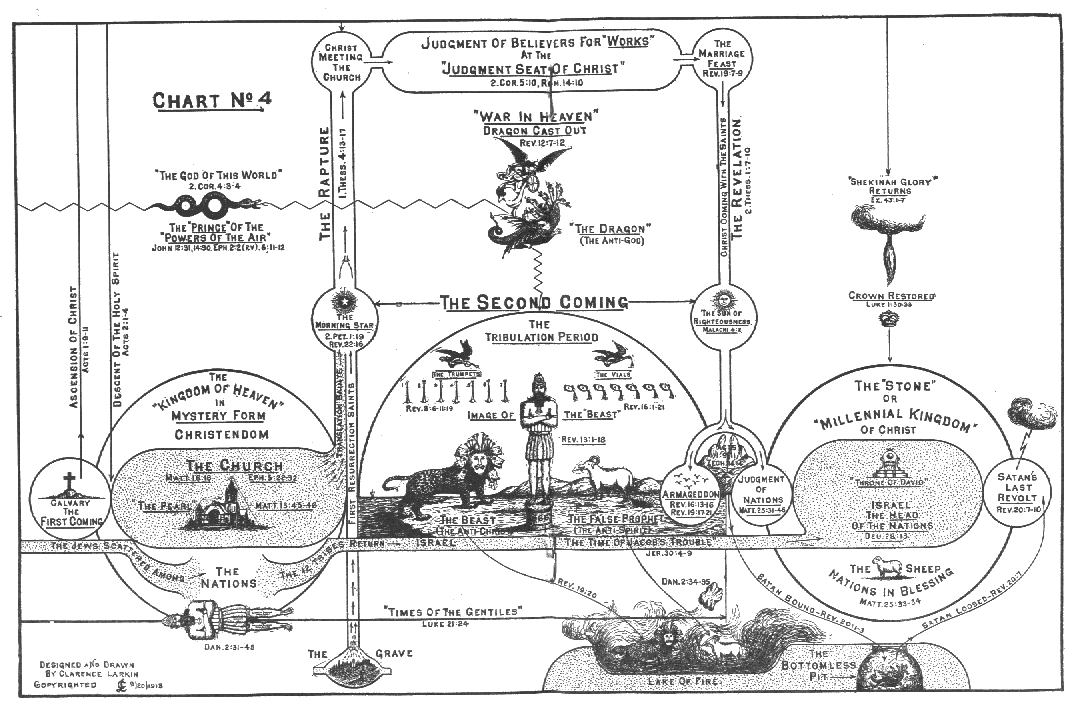
Clarence Larken (1850-1924) was an American Baptist pastor who developed charts like these that depict a dispensationalist view of the End Times. If you click on the image to expand the detail, you will see how Larkin divided the church on the left from Israel on the right. Contemporary followers of Larkin accuse "replacement theology" of wiping out Israel's place in Biblical prophecy.

Clarence Larkin (1850-1924) was an American Baptist pastor who developed charts like these that depict a dispensationalist view of the End Times, as popularized in the immensely influential Scofield Reference Bible. If you click on the image to expand the detail, you will see how Larkin divided the church on the left from Israel on the right. Contemporary followers of Larkin sometimes accuse “replacement theology” of wiping out Israel’s essential place in Biblical prophecy.

What is “replacement theology?”

About twenty years ago, I had the opportunity to visit the Holy Land. I looked out over the Sea of Galilee. I climbed part of the great mountain fortress of Masada. I witnessed orthodox Jews praying at the Western Wall. I walked the streets of Jerusalem down the Via Dolorosa, the Israeli flag flying high and proudly over several of these streets. It was a breathtaking experience.

However, the exhilaration was soberly offset by a conversation I had with the bus driver for our tour group. Like many other Palestinian Christians, his family had lived in the land for centuries with their Jewish and Muslim neighbors, mostly at peace. However, the events of the past 60+ years between the Israelis and their Arab neighbors have resulted in persecution for his family. He never went into the details, but I was always puzzled by what he meant by that.

Later on in the tour, when our group came to a stone gate in East Jerusalem, our bus driver nervously pointed out the bullet holes where Israeli and Jordanian fighters clashed with one another during the electrifying 1967 Six Day War. On the one hand, I felt then the thrill of the Israeli victory and reclamation of the ancient city that was discussed in this previous Veracity post.

But I had become also deeply troubled: what side was our Christian bus driver’s family on during that bitter conflict, or were they simply caught in the middle of the violence (like in this recent piece of news)? As I am writing this in July, 2014, Israel and Gaza’s Hamas have for weeks been involved in a deadly exchange, and Christians like this Baptist church in Gaza are vulnerable to the crossfire.

What is a Christian to think about the prophetic promises regarding national Israel, while also considering the challenges faced by Palestinian Christians living in the contested land in Middle East today, like my bus driver? What does the Bible have to say?

The study of Bible prophecy is a complicated subject and passions run very, very deep when people talk about “Israel.” Most evangelical Christians believe that “Israel” has a special place in God’s future plans, but there is a growing widespread confusion as to what this really means. So I must admit that I get conflicted when some Christians begin to talk about  the errors of “replacement theology.”  What is being meant when people speak of “replacement theology?” Granted, some criticisms are indeed valid, but a quick survey of what you find on YouTube can be rather troubling. Here is the ever colorful television personality Jack Van Impe:

Well,… uh, ok… now… what in the world is this guy talking about??????????
Continue reading