Tag Archives: complementarian

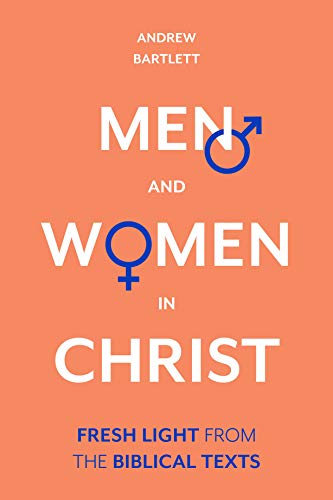
Andrew Bartlett Responds to My Review of His Men and Women in Christ

In May, 2023, I wrote an extended book review of Andrew Bartlett’s, Men and Women in Christ: Fresh Light from the Biblical Texts.  Andrew is an author from “across the pond,” with a background as a barrister in the U.K., with expertise in international arbitration. He has written perhaps one of the most thorough books on the complementarian/egalitarian controversy, a divisive issue among evangelical Protestants today. Andrew Bartlett is articulate, and has written a blog post on Scot McKnight’s Jesus Creed blog, hosted by Christianity Today magazine.

This is pretty rare, but Andrew discovered that I had written a pretty lengthy review of his book, and so he wrote a detailed rejoinder to address my criticisms. Let me tell you, Andrew is a really smart gentleman and a sharp writer. He presents some very good arguments. After all, he is a lawyer, so I confess to feel a bit intimidated.

But Andrew loves Jesus, and he is quite charitable as you will read. While we share a lot in common, we differ substantially on the topic of women serving as elders in a local church. In fairness, I also differ substantially with certain complementarians on the exact opposing side of Andrew’s position as well; that is, particularly those who tend to needlessly minimize the gifting and role of women in the life of the church.

Andrew Bartlett’s rejoinder is not a quick read, and I hope not to botch the formatting, but his attention to detail is important to engage for those who care about what the Bible teaches about men and women ministering together in the local church. I have offered to publish his critique of my review here on Veracity. I will refrain from commenting until the very end, after Andrew’s footnotes. So, if you see flames flying out of your phone or computer as you read this, just know that they are not harmful ( I am poking some fun here, though I know that this is an important issue for some).  

I am writing this just days after the October, 2023 horrific tragedy in Israel and Gaza unfolded. In the Israeli-Palestinian conflict, it would appear that we have peoples who are irreconcilable with one another. Most sadly still, much of the conflict has theologically-ideological roots underneath, bound up with different perspectives on history, that perpetuate the conflict. Hopefully, this engagement among fellow Christians, Andrew and myself, will model what healthy disagreement should look like in the wild, wild world of the Internet.

If Andrew wants to respond to me again, I will go ahead and include at the end of this post his rejoinder to my rejoinder of his rejoinder to my book review of his book , and allow him to have the last word. This post is already very long as it is, but I want Andrew to have a chance to clear up any leftover points, if he chooses. Otherwise, I plan on focusing away from this topic in future blog posts towards other issues that in my view need to receive more attention. Until then, it is my privilege to present to you, a guest blog post from Andrew Bartlett, author of Men and Women in Christ: Fresh Light from the Biblical Texts:

UPDATE: November 1, 2023.  Andrew sent to me some “concluding words” to our on-going discussion about his book, in response to my rejoinder posted towards the end of this blog post. Since this blog post is already long enough, I decided to post Andrew’s “last word” in a separate blog post.

Continue reading


Head Coverings: Applying 1 Corinthians 11:2-16 Today

The ninth and last post in a Veracity summer blog series….

Here is our passage which has perplexed many Bible readers over the centuries, from the English Standard Version (1 Corinthians 11:2-16):

2 Now I commend you because you remember me in everything and maintain the traditions even as I delivered them to you. 3 But I want you to understand that the head of every man is Christ, the head of a wife is her husband, and the head of Christ is God. 4 Every man who prays or prophesies with his head covered dishonors his head, 5 but every wife who prays or prophesies with her head uncovered dishonors her head, since it is the same as if her head were shaven. 6 For if a wife will not cover her head, then she should cut her hair short. But since it is disgraceful for a wife to cut off her hair or shave her head, let her cover her head. 7 For a man ought not to cover his head, since he is the image and glory of God, but woman is the glory of man. 8 For man was not made from woman, but woman from man. 9 Neither was man created for woman, but woman for man. 10 That is why a wife ought to have a symbol of authority on her head, because of the angels. 11 Nevertheless, in the Lord woman is not independent of man nor man of woman; 12 for as woman was made from man, so man is now born of woman. And all things are from God. 13 Judge for yourselves: is it proper for a wife to pray to God with her head uncovered? 14 Does not nature itself teach you that if a man wears long hair it is a disgrace for him, 15 but if a woman has long hair, it is her glory? For her hair is given to her for a covering. 16 If anyone is inclined to be contentious, we have no such practice, nor do the churches of God.

We have surveyed seven views held by scholars who have studied this (frankly) weird passage, which I have hyperlinked below to the previous blogs posts in this series:

As we conclude this blog post series on head coverings, it is worth coming back one more time to examine more closely the question of how all of this applies to the believer today. Is Paul instructing women to wear head coverings as a universal practice, applicable to all times and places, or is this applicable only in certain cultural settings?

Everything about head coverings in 1 Corinthians 11 (well, maybe not “everything,” but we try to hit the highlights here at Veracity)

Continue reading


Head Coverings: The Supernatural Sexual Modesty View

We finally get to what is probably the most unusual and yet most powerfully explanatory approach to 1 Corinthians 11:2-16: the “Supernatural Sexual Modesty” view.

However, in order to do this, a disclaimer needs to be made first: This should also be called the PG-13 view, because it is not suitable to share this perspective with young children. In other words, parents should not teach this view to their children until AFTER they have “the birds and the bees” conversation. It is that weird. But once you unravel the whole idea, you will be amazed by how much sense it makes of a passage that is already super-weird to begin with.

That being said, this Supernatural Sexual Modesty view of 1 Corinthians 11:2-16 does not convince everyone. For example, apologist Mike Winger, from the video in the first blog post in this blog series calls this view “annoying” and “problematic.” He even mistakenly calls this view “new,” which is a demonstrably false statement, but with this argument and a host of others he just pounces on this viewpoint in his video.1

Now, I LOVE Mike Winger. Mike has some incredibly helpful videos, including the one highlighted in the first blog post in this series. But I do not think Mike Winger understands the Supernatural Sexual Modesty view very well. A lot of egalitarian scholars, on the other side of the never-ending “women-in-ministry” debate from Mike Winger, do ridicule the Supernatural Sexual Modesty view, too. In fact, it took me a few times through it myself to get a feel for what is going on, so I will not be surprised if the majority of readers are not impressed, at least at first.

The truth is, the view I am going to summarize here is ….uh…. frankly…. well, yes…. WEIRD. At first, it will sound like something out of the X-Files…. or the Twilight Zone …. or perhaps in today’s world, Stranger Things. However, the explanatory power of this view is so strong that I would encourage folks to hang in there while I try to explain it.

Are you ready? Are the kids already in bed? Have the neighbors stopped watching what you are up to? Good. Now let us begin.

Everything about head coverings in 1 Corinthians 11 (well, maybe not “everything,” but we try to hit the highlights here at Veracity)

Continue reading


Head Coverings: The Interpolation View

Announcing the seventh in this Veracity summer blog post series….

Should 1 Corinthians 11:2-16 even be in our Bible? Are these verses in some sense completely foreign to the mind of Paul? This idea may sound really strange, but this proposition has actually been entertained by some competent scholars.

This hypothesis, the “Interpolation” view,  is fairly straightforward, even though the evidence for it is widely disputed. An “interpolation” is a fancy academic word to say that something was added into the text that really did not belong there in the first place. Most people, if they have ever heard of the concept of “interpolation,” recognize it as a mathematical term, but few know that there is a literary concept of “interpolation” as well. Essentially, the idea is that you have an original letter or document, where additional material was added either intentionally or unintentionally by a later copyist of that letter or document.

There are a couple of famous examples of interpolation that at least a few Christians know about, but I will mention only one here. In just about any modern Bible translation today, there will be a marginal note after Mark 16:8. The English Standard Version (ESV) inserts the following:

[Some of the earliest manuscripts do not include 16:9–20.]

What in the world is THAT all about?

Everything about head coverings in 1 Corinthians 11 (well, maybe not “everything,” but we try to hit the highlights here at Veracity)

Continue reading


Head Coverings: The Quotation/Refutation View

The sixth segment of a summer blog post series on 1 Corinthians 11:2-16

Most Christians have probably never heard of the “Quotation/Refutation View” of anything in the New Testament. There is an understandable reason for this.

The original Greek manuscripts of our New Testament contained no punctuation, particularly no quotation marks. In modern English today, we use quotation marks in general to show when someone else is speaking. In contrast, in ancient New Testament Greek, you have to look for contextual and grammatical clues to figure out when someone else is speaking. Sometimes picking up those clues is fairly straight-forward, if you pay attention. At other times, it is not so easy at all. But without some knowledge of what the author is doing, certain passages in the New Testament make no sense at all.

This is partly why, even though it is perhaps the most beautiful, elegant, and classic translation of the Bible, the King James Version (KJV) of the Bible is not to be recommended for a close, verse-by-verse analysis of what the Scriptures are teaching, without having some kind of help to go along with it. For the KJV includes no quotation marks anywhere in the text. Some KJV Bibles try to get around this limitation a little bit by printing out the words said by Jesus in red, so-called “Red Letter Bibles,” but these red letter Bible printings rely on a lot of guesswork that can easily mislead the reader.

Everything about head coverings in 1 Corinthians 11 (well, maybe not “everything,” but we try to hit the highlights here at Veracity)


Modern English Bible translations make more use of quotations, in order to help the reader to understand the text better. A classic case for this can be found in Paul’s first letter to the Corinthians. Many Christians do not realize that our two letters to the Corinthians are part of a multi-letter back-and-forth conversation between Paul and the Corinthian church, where only two of these letters have actually survived. We only see a small part and one side of that conversation!! In fact, our “1 Corinthians” might be the second letter Paul wrote to the Corinthians, where the first letter is now lost. Thankfully, Paul does quote and respond to certain Corinthian slogans, even refuting them when necessary, thus assuming that at least some of these slogans were probably in the letters written by the Corinthians addressed to Paul, letters that are now lost to us.

Continue reading