
Looking for a thoughtful, challenging book to read over the Christmas holidays? Here’s a suggestion.
Much of what we read in the Old Testament is about the contributions of men to the life of ancient Israel. We typically think of the big names, like Abraham, Moses, David, Isaiah, and Jeremiah. But what about the women?
Often the stories of women in the Old Testament are sidelined in favor of male figures. In some stories, women are even cast as villains. However, more recent scholarship suggests women stand out better in at least some of those cases, more so than previously thought.
A Cheating Wife? Or an Abusive Husband? What is the Real Story?
One often neglected story is about the Levite and his concubine of Judges 19:1-30. No matter what way you look at it, the story is tragically shocking, one of the more graphic episodes in the entire Bible.
Typically, a concubine served as a second wife for a man, in this case an Israelite Levite. The more traditional reading suggests that the Levite’s concubine was unfaithful to him, assuming that the concubine became a prostitute. In becoming a prostitute, the concubine had committed adultery, a capital offense. The concubine had fled the house of the Levite, and went back to her parents’ home. But eventually the Levite went out to pursue his concubine and bring her back to his home.
After several nights staying with the concubine’s family, he was able to retrieve his concubine from her parents’ home. On the way home, the Levite and his concubine managed to spend the night with an old man in the town of Gibeah. But during the night, men from the city came to threaten the Levite. The Levite saved himself by giving his concubine over to the men of Gibeah, who in turn sexually violated the Levite’s concubine to near the point of death. When the Levite finally returned home with the lifeless body of his concubine, he cut up her body into twelve pieces, and sent the remains throughout the land of Israel.
It is a pretty awful story. But the traditional reading has some serious problems. The traditional reading hinges on an ambiguous verse, Judges 19:2, at the outset of the story. The ESV translation reads:
And his concubine was unfaithful to him, and she went away from him to her father’s house at Bethlehem in Judah, and was there some four months.
The KJV is even more direct, implicating the adultery of the concubine:
And his concubine played the whore against him, and went away from him unto her father’s house to Bethlehemjudah, and was there four whole months.
However, some other translations read differently. Consider the NASB, revised in 2020 (as compared to the earlier 1995 revision, which was more like the KJV):
But his concubine found him repugnant, and she left him and went to her father’s house in Bethlehem in Judah, and remained there for a period of four months.
Or the NRSVUE:
But his concubine became angry with him, and she went away from him to her father’s house at Bethlehem in Judah and was there some four months.
It turns out that the Hebrew word, zana, can be translated in different ways. The traditional reading has the word meaning to be “unfaithful” (as with the ESV) or to “commit adultery.” However, the Septuagint, the ancient Greek translation of the Hebrew text, has zana to mean to be “angry” with (as with the NRSVUE). The second meaning does not imply any sexual infidelity on the part of the concubine. Instead, it suggests that the woman had some reason to be angry with the Levite, angry enough to leave him and return home to her parents, without any hint of prostitution or other infidelity, as the KJV states.
Dr. Claude F. Mariottini, Professor Emeritus at Northern Baptist Seminary, suggests that translations like the NASB and NRSVUE get it right. The text does not tell us why the concubine found her Levite husband to be “repugnant.” While the reason for the concubine’s “anger” is never stated, it easily implies that her husband was abusive, and that she sought to return to her parents to get away from an abusive man. In an age when spousal abuse is getting a lot of attention, as with the #metoo movement, this should spark our interest more in the 21st century. There are some good reasons to accept this alternative reading.
The following verse may contain some clues, as there is ambiguity in Judges 19:3 as well. The ESV follows the traditional reading:
Then her husband arose and went after her, to speak kindly to her and bring her back. He had with him his servant and a couple of donkeys. And she brought him into her father’s house. And when the girl’s father saw him, he came with joy to meet him.
You get the impression that the Levite wants to try to persuade his concubine to return back to him. Was the Levite offering his love and forgiveness towards her? Here it is the woman who took her husband, the Levite, into her father’s house. Why did she do this? It is possible that she felt obligated to do so, for if she was unfaithful to her husband, she may have felt it was her responsibility to seek reconciliation. But there is more to the story. The NLT translation reads differently:
…. her husband set out for Bethlehem to speak personally to her and persuade her to come back. He took with him a servant and a pair of donkeys. When he arrived at her father’s house, her father saw him and welcomed him.
In this translation, there is no mention of the woman bringing her Levite husband into her father’s house. Only the father-in-law receives the Levite. Furthermore, the NLT suggests that the Levite husband was on a mission to try to talk her back into coming home to his house, which is behavior consistent with an abusive husband. Curiously, the concubine and the Levite’s father-in-law tried some stall tactics for several nights which prevented the Levite from leaving with his concubine wife to take her back to his home. Were the concubine and her father hoping that the Levite would eventually just give up and go back home without her?
The incident in Gibeah raises other problems for the traditional view which casts the concubine as an adulterer. When the men of Gibeah threatened the Levite in Judges 19:25 , the ESV says that the Levite “seized” his concubine and sent her out to be sexually abused by the men of Gibeah. If the Levite truly loved his concubine, would he really “seize” her to be handed over to these violent men? The text purposely uses this word to convey a meaning which is certainly not a gentle way to treat a wife.
To make matters worse for the Levite, Judges 19:22, in a manner much like the story of the men in Sodom with Lot, these men of Gibeah declared their intentions to “know” the Levite, a euphemism for having sexual relations. But when the Levite relates his version of the story in Judges 20:5-6, the Levite says that the men were intent on killing him, which was not the case.
The story gets even worse. If the Levite really loved his concubine, and wanted her back, it seems really creepy and unloving for the Levite to chop her dead body up and send her body parts all across Israel. All of these pieces of evidence suggests that the standard portrayal of the concubine as a wayward woman hides the real story, namely that she was an innocent victim of a Levite husband who abused her, and in the process, she ultimately lost her life. What a tragic story!!
Mariottini’s interpretation of this difficult passage is compelling. It demonstrates that the Bible is quite aware of the problem of “toxic masculinity,” whereby men can abuse their power and destroy the women in their lives. The story of the Levite and his concubine serves as both a warning and a rebuke against such morally perverse behavior.
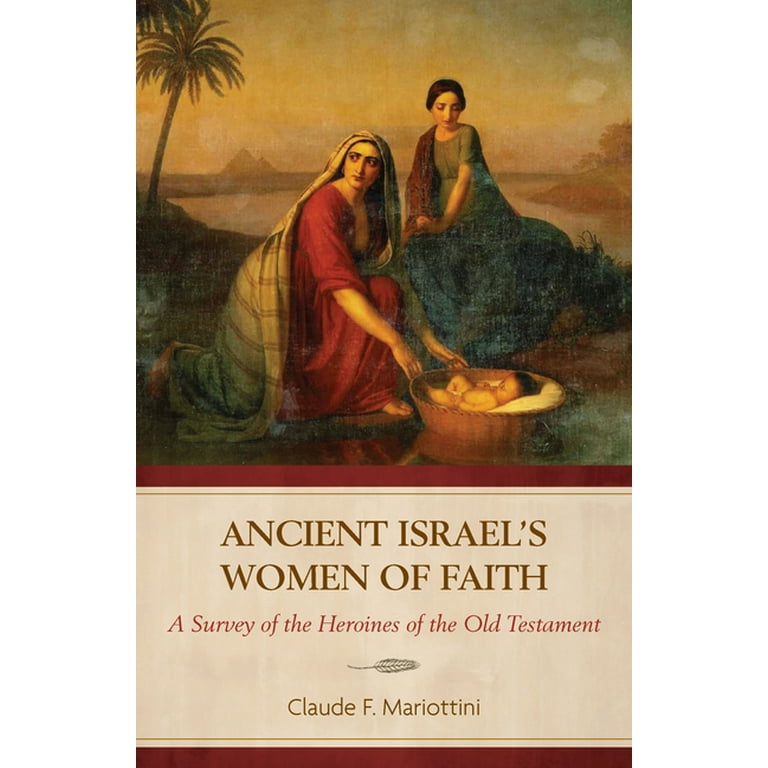
Claude Mariottini’s newest book, Ancient Israel’s Women of Faith: A Survey of the Heroines of the Old Testament, is collection of stories about many of the amazing women of the Old Testament, offering insights that will be helpful to many men and women today.
Women of Faith in Ancient Israel
Claude Mariottini has written a vitally helpful book: Ancient Israel’s Women of Faith: A Survey of the Heroines of the Old Testament, to highlight the often forgotten contributions of women in the story of the Old Testament, with a single chapter focused on the story of the Levite and his concubine. Thankfully, Professor Mariottini’s book has more positive stories to offer to highlight the valuable contributions made by women to the story of ancient Israel. Professor Mariottini has for years written a blog which focuses on the best of Old Testament scholarship, making the story of the Old Testament more accessible to lay persons and scholars alike. While a good deal of the material found in the book can be discovered on his blog, his new 250 page book brings the wealth of that material to one place in one text.
As Mariottini says, the influence of women in the Old Testament is often obscured by how our sources came to us, filtered through male perspectives and priorities. Make no doubt about it, ancient Israel was a patriarchal society, where women were subordinated at home, with limited autonomy, and even treated as property. Nevertheless, as the Old Testament narrative unfolds we read how women were given a greater voice and were at times vindicated in the face of injustice, which can serve as an inspiration to women today.
Mariottini does not sugar-coat the story. The men typically take center stage in Israel’s narrative.
But then certain women come at critical points in the Old Testament, to make a difference. There are fairly well-known women, like Sarah, Abraham’s wife; Deborah; a prophetess and a judge; and Rahab, who hid and rescued the Hebrew spies at Jericho. Then there are lesser known women, like Sheerah, who was a builder of cities (1 Chronicles 7:22-24). Jehosheba, the daughter of King Jehoram of Judah, protected the young Joash, the Davidic heir to become king, from being killed (2 Kings 11:20). Huldah, a prophetess, was consulted by King Josiah, who had rediscovered a book of the law found in the Temple, bringing it to Huldah to verify that the book was indeed authentic (2 Kings 22:15-20).
Professor Mariottini follows standard insights into the Old Testament held among nearly all evangelical scholars today, insights which are not always well understood by the average church-going Christian. He acknowledges the concept of Yahweh’s “Divine Council,” whereby the uncreated and supreme Yahweh presides over a fellowship of other created divine beings, often described as “gods” or “sons of god” in the Old Testament, a concept in the academic world popularized most recently by the late Dr. Michael Heiser (Mariottini, p. 25). Mariottini acknowledges that the Pentateuch, the first five books of the Bible, was written in stages, such that a text like Deuteronomy acts as an inspired revision to earlier material. Identifying Moses as the originator of the Pentatuech tradition need not rule out the activity of divinely inspired editors in later centuries, or even just Moses himself later in his life, working to keep the Mosaic law tradition up to date, in light of new challenges to the people of Israel over time.
Mariottini offers several examples, by showing how Deuteronomy provides more protections for women as compared to earlier texts in the Pentateuch. In the days of King Josiah, in the seventh century before Christ, Deuteronomy was cited to prescribe these protections.
In Exodus 20:17, the tenth commandment reads:
“You shall not covet your neighbor’s house; you shall not covet your neighbor’s wife, or his male servant, or his female servant, or his ox, or his donkey, or anything that is your neighbor’s.”
However, in Deuteronomy 5:21, the same commandment reads:
“And you shall not covet your neighbor’s wife. And you shall not desire your neighbor’s house, his field, or his male servant, or his female servant, his ox, or his donkey, or anything that is your neighbor’s.”
Even though the Exodus version does not relegate the position of the wife to that of a slave, it nevertheless is ambiguous enough to indicate that the wife belongs to the husband, as though the wife is the possession of her husband (Mariottini, p. 39).
Yet the Deuteronomy version rearranges the original Exodus version, splitting the command not-to-covet into two separate commands, first that of not coveting a neighbor’s wife, and the second, that of not to covet (or desire) anything which is a possession of the husband, like a house, a field, a servant, a domestic animal, or any other possession. This gives greater clarity and explicit force to suggest that a wife is not to be treated in this same way as a man’s piece of property (Mariottini, p. 42-43). Deuteronomy gives more explicit recognition of women having their own voice in the life of the Israelite community.
A similar pattern is observed when considering the Pentateuch’s code regarding the release of a Hebrew slave. In Exodus 21:2-6, a male Hebrew slave was to be released after six years of labor. But if that male slave enters the slave relationship as a single man, and the master gives him a wife, that woman will remain with the master even after the male slave is allowed to go free. However, in the Deuteronomy 15:12-18 version of the same rule, the woman is allowed to go free with the freed Hebrew slave, and remain the wife of that Hebrew slave (Mariottini, p. 44-47).
Perhaps the most important contribution Mariottini makes is in his highlighting of the Book of Deuteronomy, as giving us a clearer expression of addressing injustice against women in ancient Israel.

Some Critique of Mariottini
Ancient Israel’s Women of Faith is a great book, but a few criticisms are in order. There is at least one minor error whereby the NRSV’s translation of 1 Chronicles 25:5-6 is said to read: “God gave Heman fourteen sons and three daughters. All these men were under the supervision of their father for the music of the temple of the LORD.” Actually, this translation is what the NIV 2011 has for this passage. The NSRV actually substitutes the phrase “all these men” with “they were all,” a more gender accurate translation of the verse, acknowledging the inclusion of both Heman’s sons and daughters in helping to lead the worship music in the temple (Mariottini, p. 56-57).
A more serious problem arises when Mariottini expands his treatment on this passage later in the book. Here he corrects the earlier misquote of the NSRV translation of the passage, which suggests that both men and women participated in leading worship music in the temple (Mariottini, p. 83).
Mariottini describes this as the “egalitarian” reading, thus indicating that “although sin created a distortion of [this] mutuality [resulting from men and women being created equal], the gospel of Jesus Christ has abolished this distortion and that now both men and women are equally called to serve God” (Mariottini, p. 84) He contrasts that with the CSB (Christian Standard Bible) and NIV 1984 (despite the fact that the NIV 2011 keeps the same translation regarding gender), which reads “all these men.” This latter reading Mariottini says is exemplar for the “complementarian” position, that “God has set apart men to hold political and religious leadership in Israel.” This explains why the CSB and NIV suggest that the daughters of Heman were “not part of the music ministry of the temple” (Mariottini, p. 83).
However, this analysis is misleading as the complementarian position is not as monolithic as Mariottini assumes. While some complementarian churches do restrict women from leading music in a worship service, not all complementarians hold to such a broad restriction.
These other complementarians allow women to serve in such leadership roles, though these same churches nevertheless still hold that the office of elder specifically be held only by qualified men, according to what is found in 1 Timothy 2 & 3, and Titus 1. Other leadership functions in the church, like that of deacon, worship leader, etc. are open to both men and women. This reality is reflected in the fact that the ESV translation echoes in similarity the NRSV reading: “God had given Heman fourteen sons and three daughters. They were all under the direction of their father in the music in the house of the Lord with cymbals, harps, and lyres for the service of the house of God.” In other words, men and women participate in the leading of worship music.
The ESV (English Standard Version) is rarely described as an “egalitarian” Bible translation, and is instead popularly known as the most influential complementarian-leaning Bible translation today in the English speaking world. Nevertheless, Mariottini is right to conclude, along with the ESV and NRSV, that women were allowed to participate in the music ministry of the temple, and that should anticipate later Christian worship practice.
The question of whether or not women can serve as elders, much less other leadership positions in the church, is a contentious issue today in evangelical churches. As a moderate complementarian myself, the idea of having only qualified males to serve as elders is not a slight against women, as women clearly can exercise leadership in other ways in Christian ministry. Rather, the gender “restriction” regarding elders is more about encouraging men to act as spiritual leaders in the church, modeling what should be done in the home. Even in our supposedly morally-advanced 21st century culture in the West, typically men much more than women tend to abdicate in taking spiritual leadership in their families, relegating such a task to their wives, who are often already overburdened with other responsibilities. When husbands and fathers take more responsibility in a positive, supportive way to spiritually lead in the home, everyone in the family is enabled to benefit. (As a side note, I spent about four years writing on the complementarian/egalitarian controversy which is dividing evangelical churches today. You can read my research referenced here. Just this past year, yet another church in my town of Williamsburg, Virginia divided over this same issue. In my estimation, there are extremes on both sides of this issue which has tragically led to such church divisions).
It is curious how Mariottini cites some scholarship which challenges the traditional translation of Genesis 3:16 (Mariottini, p. 33). The ESV has controversially rendered this verse as: “Your desire shall be for your husband, and he shall rule over you.” In fairness, the ESV also includes a footnote which suggests an alternative translation: “Your desire shall be to (or toward, or even against) your husband, and he shall rule over you.” But Mariottini cites Allen H. Godbey’s translation: “Thy longing shall be toward thy husband; and he shall be likewise toward thee.” Godbey’s translation is completely new to me, and I am not familiar with other scholars commenting on Godbey’s view.
Some of the chapters in Ancient Israel’s Women of Faith tend to be repetitive at certain points. This is because a number of the stories highlighted by Mariottini tend to overlap, which indicates that the book is more of a reference book, where the chapters can be read in any order, whereby the reader can select what stories might interest them, while coming back to other stories later. This is probably fine for most readers, who want to read a short chapter that interests them, and then read some other short chapter elsewhere in the book. But for someone who wants to read the book from start to finish, the repetition might be bothersome.
Aside from a handful of problems like these, Claude Mariottini has given us a book which assists Christians to discover how many of the forgotten women of the Old Testament expressed their voices and have made significant contributions to the story of ancient Israel. Ancient Israel’s Women of Faith will be a helpful read for those who tend to think that the Old Testament has a purely negative view of women. May these stories continue to inspire us regarding the faith of these amazing women of the Old Testament.
One more thing: As I have read Claude Mariottini before, I am a bit partial to his work. However, there is another book out now which covers the same theme of women in the Old Testament, along with a brief look at women in the New Testament. Ingrid Faro’s Redeeming Eden: How Women in the Bible Advance the Story of Salvation has received some good reviews, too, so that might also be worth checking out.



 Veracity