Tag Archives: Christianity

Process of Suffering

Do you ever think about why God works by processes?  After all, why doesn’t God just ‘poof’ everything to be the way he wants it to be?  Why take 13.7 billion years to get to today?  Why take 4.6 billion years to build the earth and shape its climate?  Why did Jesus have to suffer?

Why do people have to suffer?

Countless theologians have taken aim at that question.  Most dissect it from the standpoint of purpose—as in “What is the purpose of suffering?”  The realities of suffering remain among the biggest stumbling blocks for atheists and believers alike.

When it comes to suffeDick Woodwardring, I have no credentials.  But I do know an expert.  Here are two messages Dick Woodward preached on the topic (from among many cataloged here) that get to the heart of suffering.
Some questions we just can’t answer.  Other questions we should never even try to answer.  Just like the difference between knowledge (knowing the answers to questions) and wisdom (knowing which questions count), it’s really important to know when to keep our mouth shut.

Here’s a short video that illustrates the value of “showing up and shutting up.”

It also highlights the processes by which God redeems us from suffering—not just for the care receiver, but the caregiver, the pastor, and everyone else.  Redemption is a process.  For whatever reasons, God followed his own rules, and suffered ultimately for our redemption.  There was no way to ‘poof’ the redemption of mankind—God had to prove it.

“For my thoughts are not your thoughts, neither are your ways my ways,” declares the LORD.  “As the heavens are higher than the earth, so are my ways higher than your ways and my thoughts than your thoughts.”
Isaiah 55:8,9 (NIV)

“The only thing that counts is faith expressing itself through love.”
Apostle Paul, Galatians 5:6b (NIV)

The above story has a happy ending.  All three men interviewed in that video are ministers—and very good ones at that.  All three will tell you when people are suffering the most important thing you can do is show up.  And don’t pretend to know the reason for their suffering.

Sometimes we see the happy ending.  Sometimes the ending is just too hard to bear.  It’s hard sometimes to understand that God makes the rules, knows what he is doing, has a plan for each of us, values sincerity, doesn’t need us to attempt to explain anything for him, and intends ultimately for us not to have an ending.  But let’s keep our mouths shut and just use our feet and ears and arms when people are suffering.  The process is important.

HT: Steve Flanary, John Green, Bill Warrick, Steve Hooge, Dick Woodward


Searching for God

Impact Wrench

An impact wrench is a fine tool for changing brake pads or tires.  But it’s completely useless when searching for scientific evidence of God.  For that job you need a Large Hadron Collider.  Right?  (The right tool for the job and all that.)

The recent experimental confirmation of the existence of the Higgs Boson and Higgs Field comprises a major milestone in mankind’s understanding of the universe.  After 50 years of mind-numbing, abstract theoretical research, theologians and scientists are lining up to interpret the data.  But not everyone is coming to the same conclusion.

Finding the Higgs Boson doesn’t prove the existence of God.  On that theologians and scientists are in complete agreement.  But some of them are as far apart on their interpretations as the tools they use. Continue reading


Lesson in Hermeneutics: Paris Reidhead

Paris Reidhead 1990

Paris Reidhead, 1990 (courtesy of Marjorie Reidhead)

When you get right down to it, most of us are timid about sharing our faith.

Among the thousands of people I’ve ever met, only a handful have had the character to put their faith out there without first running it through a popularity filter. The world is full of hard-edged egocentrics who feel it incumbent upon themselves to “tell it like it is,” but listening to most of them is painful.  I’m not referring to people like that.

Gary Carter and Paris Reidhead had the courage of their convictions.  One was a superstar athlete who, by the time I met him, didn’t have to prove anything. The other was a fire-and-brimstone preacher who could crush all distractions with his empowered delivery.

I had breakfast with Paris Reidhead 23 years ago at a men’s retreat.  I still remember much of what he said.  When he asked what I did for a living and I told him, he immediately asked if I could design a pump motor for use on a well that could “sustain 1,800 rpm when driven by oxen.”  As an engineer, this sort of question rarely comes up at breakfast.  Trust me.  (For the purposes of this blog I won’t go into why 1,800 rpm is important—let’s just say he knew what he was talking about.)

That weekend Paris Reidhead preached on the ‘S’ word.  A lot.  It helped me get over the idea that Christians are “holier than thou.”  Or that all our problems are solved when we come to faith.  He helped me understand how God has a plan to deal with ‘S’, and that he bankrupted heaven to pay for that plan.

In a world full of self centeredness, where prosperity theology is a ubiquitous salve, Paris Reidhead’s classic sermon Ten Shekels and a Shirt is a hard, cool rain on a scorched worldview. This teaching isn’t for beginners. He uses the ‘S’ word. He yells and slams the pulpit. He convicts every listener. And he reminds me of what Jesus said in John 8:32, “Then you will know the truth, and the truth will set you free.

So the next time you have 50 minutes to yourself, give a listen to this classic, masterful sermon. It ends up on the bottom line of why we are here. 

The transcript is available online at his family’s ministry site, and you can listen to many of his fine sermons here.

As an amateur mechanic, I appreciate when real mechanics talk about the “old school” way of doing things.  It’s a reverent term referring to doing things the tried and proven way—because it works.  The old school approach is based upon real craftsmanship, with an elegance that cannot be cheaply replicated. In the best sense of the term, Paris Reidhead’s hermeneutics were old school. And he was obvously a master of homiletics.

A very special thank you to Mrs. Marjorie Reidhead for providing the above photograph of her husband.  I hope I have framed his work in a way that honors his memory.


Higgs Boson, “What’s in the data?”

This week particle physicists announced the experimental discovery of the Higgs Boson, a scientific breakthrough certain to win the Nobel Prize. Here is an incredibly entertaining video posted nine weeks ago that explains the physics.  (Turn your iPad to portrait orientation and watch in full screen mode to fully appreciate the video.)

[vimeo 41038445 width=500]

So let’s contemplate the question at the end of this video, and think about “What’s in the data?” and why there is such a flap about this so-called “God Particle.”

Our friends at Reasons To Believe have posted 17 articles to date on the Higgs Boson.  Dr. Hugh Ross posted a four-part series on this topic in 2011, in which he explains the theological prize that’s in the data.

The Theological Prize

“From a theological perspective, the bigger trophy will be determining the degree to which the characteristics (especially the mass, average momentum, abundance, and location) of sterile neutrinos must be fine-tuned to explain why life, especially human life, is possible in the universe. … Sterile neutrinos would bolster the biblically predicted hot big bang creation model by resolving eight anomalies in the standard cosmology and particle physics creation model simultaneously. Even more than that, they would also significantly augment the evidence for the supernatural, super-intelligent design of the universe to make possible the existence of physical life, especially human beings and their global, high-technology civilization.

Axions, as well, contribute to the evidence for the design of the universe for humanity’s specific benefit. Like sterile neutrinos, the characteristic features, abundance, and geographical placement of axions must be fine-tuned. Thanks to the recent observational and theoretical discoveries concerning sterile neutrinos and axions, scientists now possess much more complete and much better integrated models of cosmic and particle creation. Such completeness and integration adds yet more proof for the biblical creation model and the attributes of the biblical Creator.”  — Dr. Hugh Ross, 2011

That’s just what I was thinking!  It’s all in how we interpret the data.  Or maybe, more to the point, it’s all in how we appreciate what God created.


Beyond Mortality

Oakfield Grave

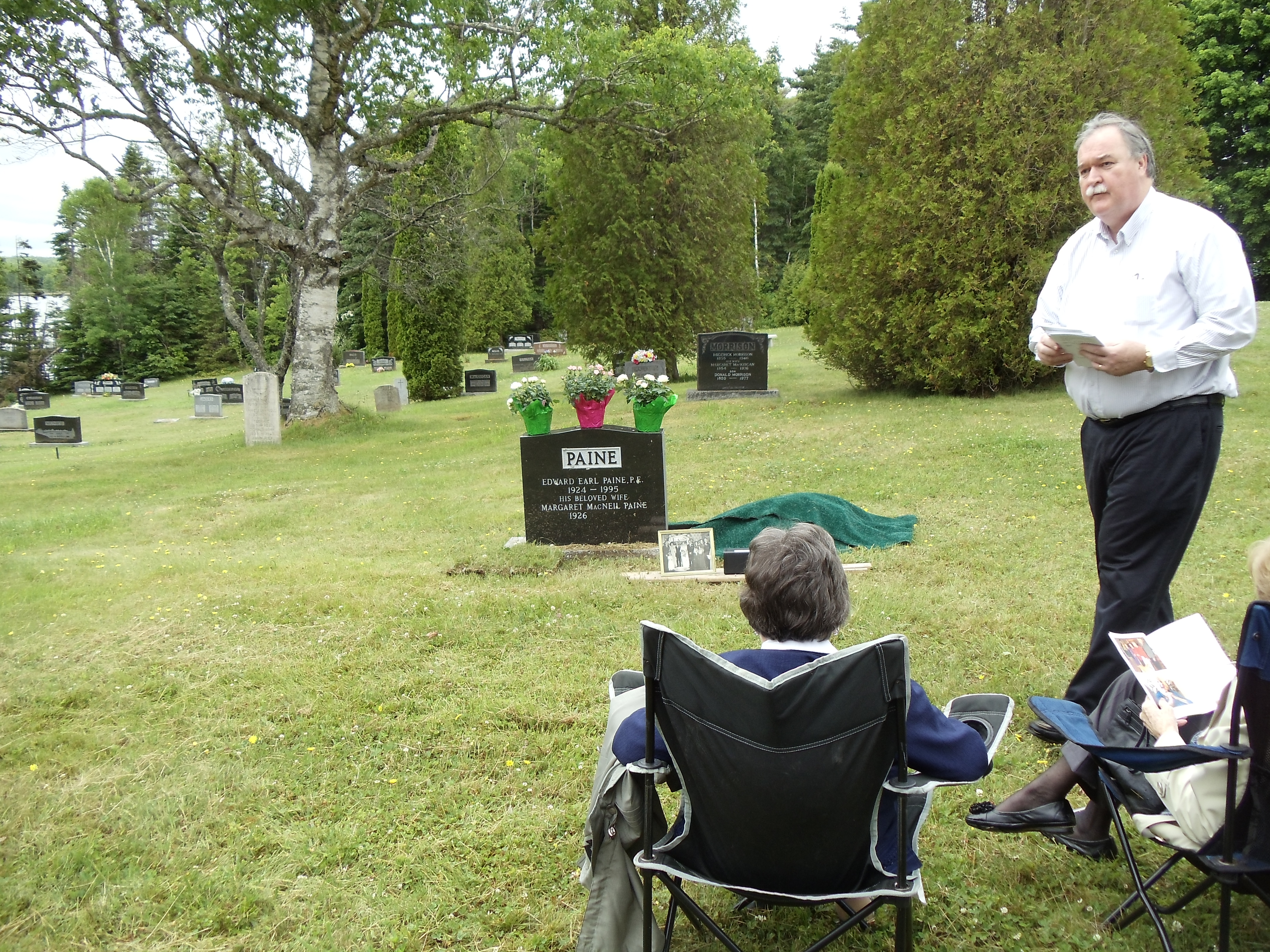
Last week our family interred my dear Mom’s ashes in a pastoral graveyard on the Mira River in Nova Scotia.  Friends and family asked me to post what I said at the graveside, so as best I can recall, here’s the gist of it.  (I’ll leave the personal remembrances to our family, and stick to the parts in which others may find peace when comfort is needed.)
_____________

We cannot help but contemplate our own mortality at a funeral.  In part, that’s why we are here today.  At Mom’s memorial service her grandsons read the Beatitudes, and verses from Paul’s letter to the Ephesians.

The Beatitudes
Now when he saw the crowds, he went up on a mountainside and sat down. His disciples came to him, and he began to teach them, saying:
Blessed are the poor in spirit, for theirs is the kingdom of heaven.
Blessed are those who mourn, for they will be comforted.
Blessed are the meek, for they will inherit the earth.
Blessed are those who hunger and thirst for righteousness, for they will be filled.
Blessed are the merciful, for they will be shown mercy.
Blessed are the pure in heart, for they will see God.
Blessed are the peacemakers, for they will be called sons of God.
Blessed are those who are persecuted because of righteousness, for theirs is the kingdom of heaven.
Blessed are you when people insult you, persecute you and falsely say all kinds of evil against you because of me.
Rejoice and be glad, because great is your reward in heaven, for in the same way they persecuted the prophets who were before you.

Matthew 5:1-12, NIV

Made Alive in Christ
As for you, you were dead in your transgressions and sins, in which you used to live when you followed the ways of this world and of the ruler of the kingdom of the air, the spirit who is now at work in those who are disobedient. All of us also lived among them at one time, gratifying the cravings of our sinful nature and following its desires and thoughts. Like the rest, we were by nature objects of wrath.  But because of his great love for us, God, who is rich in mercy, made us alive with Christ even when we were dead in transgressions—it is by grace you have been saved. And God raised us up with Christ and seated us with him in the heavenly realms in Christ Jesus, in order that in the coming ages he might show the incomparable riches of his grace, expressed in his kindness to us in Christ Jesus. For it is by grace you have been saved, through faith—and this not from yourselves, it is the gift of God—not by works, so that no one can boast.  For we are God’s workmanship, created in Christ Jesus to do good works, which God prepared in advance for us to do.
Ephesians 2:1-10, NIV

So, given the entire Bible to choose from, why did we read these two passages of Scripture?

First, in the Beatitudes Christ describes human attributes and attitudes that God values.  But they are not like we would write them, are they?  Jesus didn’t say blessed are the strong, blessed are the clever, blessed are the witty, blessed are the rich, blessed are the powerful, or blessed are the attractive.

Blessed are those who mourn, for they will be comforted.”  Think about that.  It’s a promise, but it also reveals God’s plan for each of us.  Specifically, we weren’t meant to remain here.  Our brief lives on earth are a prelude to our eternal state.

We don’t make the rules, and God doesn’t owe us a complete explanation.  But there are overwhelming reasons to believe.  Truth is a person—Jesus Christ.

Jesus said in John 16:33 “In this world you will have trouble.”  That’s all Jesus promised us on earth.  Nowhere in Scripture can you find a promise that things are going to get better here on earth.  God’s focus is on eternity, and this life is a testing place with serious consequences.  Pain and suffering are inevitable, but misery is optional.

But why should we believe Jesus Christ?  As C.S. Lewis wrote, you only have three options with Christ: he is a liar, a lunatic, or Lord.  How we, as morally responsible human beings, resolve this trilemma determines our fate in eternity.

Jesus’ purpose was to prepare us for an eternal relationship, outside of time with our creator.  A creator who loved us so much that he was willing to demonstrate that love by allowing himself to be tortured.  That is his ultimate gift to us—the proof of his love.  As Paul writes in Ephesians 2, we are saved into an eternal relationship with him by grace—we do not earn it.

Man’s political and corporate efforts—and indeed all of our best intentions and accomplishments—cannot change our earthly fate.  We are all going to die from life here on earth. Far too many people don’t think that through.  But the simple fact is that we did not evolve as the result of random, undirected chemical reactions.  We were created for a purpose, and that purpose does not involve having as smooth a ride through this world as we can craft from our circumstances.

We can see in nature the revelation and awesome power of God.  It is very easy to go online and search for deep space images from the Hubble telescope.  If you ever wonder what God can (or cannot) do, look at those images—they’re amazing.  And it’s only a small step to watch those planets and stars and galaxies for a short period of time and realize they are moving away from a common center.  The Big Bang is a scientifically acknowledged event that occurred 13.7 billion years ago.  Science confirms the creation event recorded in Genesis.  And a creation demands a creator.  If you take the time to study even a little bit, you’ll find incredible agreement between science and faith.

Secondly, Paul reminds us in Ephesians 2 that our focus should not be on this world.  He also wrote in Romans 12 that we should not conform to the pattern of this world, but be transformed by the renewing of our minds.  Paul’s message—the message that he died to deliver—was that Jesus Christ conquered death (1 Corinthians 15), and that he offers us salvation (eternal presence with our creator) as a gift.  While most of us struggle to think beyond the immediacy of our daily world, God invites us in the coming ages to enjoy the incomparable riches of his grace, expressed in his kindness to us in Christ Jesus.

We cannot earn our way into heaven.  We are saved by what Christ did for us, not what we do for Christ.  Christianity is unique in this respect.

As Jesus concluded his statement at the end of John 16:33, “In this world you will have trouble, but take heart, for I have overcome the world.”  We were never meant for this world.  God has a purpose and plan for each of us, and he proved it.

And by God’s grace we can have peace and joy beyond mortality.