Tag Archives: Chicago Statement of Biblical Inerrancy

Jesus, Contradicted, by Michael Licona. A Veracity Book Review.

Have you ever been troubled by what might appear to be contradictions between the four Gospel accounts? If so, then Dr. Michael Licona’s Jesus, Contradicted will help you to tame the doubts in your mind, and have a fresh look at the trustworthiness and reliability of the Bible.

I know because I have been there. Having not grown up in an evangelical church, I never heard of the concept of “biblical inerrancy” until my years in college in the 1980s. Growing up in a liberal mainline church instead, the Bible only had a secondary role in spiritual formation. As a teenager though, I read through all of the New Testament (except for Revelation), and I was wrestling through the things I read in the Bible. One of the first things I noticed is that there are differences between the four Gospels and how they report various speeches and events.

The idea that there were differences in the Gospels really did not bother me. If anything, the differences in the Gospels only intrigued me to look more closely at the New Testament. As Christian apologist and former cold-case detective J. Warner Wallace has said, the very fact that the Gospels DO have differences lends credibility to the authenticity of their accounts. For if all four Gospels said exactly the same thing, this would be evidence of collusion, which would raise suspicions about the integrity of the New Testament. Instead, because there were opportunities to smooth out the differences and the Gospel writers did not do so, this gives us greater confidence in the truthfulness of the Christian story.

But apparently, not every Christian is convinced that having differences in the Gospel is a good thing. Some argue that we should do whatever we can to harmonize the Gospels, even if some of those harmonizations come across as unconvincing, embarrassingly ad-hoc, otherwise severely strained.

Mike Licona, a New Testament scholar, is one of most able defenders of the bodily resurrection of Jesus, having debated Bart Ehrman, the world’s most well-known skeptic, on several occasions. Now, Michael Licona is arguing for a more robust view of biblical inerrancy, in Jesus, Contradicted: : Why the Gospels Tell the Same Story Differently


My Faith Crisis Over Inerrancy

Michael Licona, author of Jesus, Contradicted: Why the Gospels Tell the Same Story Differently, has struck a chord with me. But I need to set up the story a bit more before I offer a review of this new book.

In the mid-1970’s, Harold Lindsell, who had been a professor at Fuller Theological Seminary, had popularized an idea to try to resolve the apparent contradictions in the various accounts of Peter’s denials of Jesus, on the night Jesus was handed over to the authorities to face trial and eventually to be crucified. Mark 14:72 and Luke 22:61 has Jesus saying that a cock would crow twice after Peter denies Jesus three times. But in Matthew 26:74-75 and John 18:27, a cock crows once after Peter denied Jesus three times. Matthew has Jesus predicting one cock crow, while John says nothing about Jesus predicting anything about a cock crowing.

Lindsell’s solution was to say that Peter denied Jesus a total of six times: three times before the first cock crowed, and then three more times before the second cock crowed. Other strict inerrantists arrive at similar conclusions, arguing that Jesus’ differing prophecies in all four Gospels must align together in all incidental details.

While this type of harmonization sort of “works,” it still really confused me. After all, all four Gospels explicitly state that Peter denied Jesus three times, not six times as Lindsell’s “inerrantist” interpretation suggested. I reasoned that if this type of convoluted logic is required to make sense of “biblical inerrancy,” then I simply could not accept it. I really wanted the Bible to be “inerrant,” but as a mathematics major in college I just could not force my mind to accept the idea that 3 equals 6.

I pretty much shoved the idea off of my mind, visiting it every once in a while, but I just could not get past the problem. It was not until I read Five Views of Biblical Inerrancy ( introduced and reviewed here on Veracity,) a multi-views book highlighting the perspectives of five different biblical scholars holding separate and distinct definitions of what constituted “biblical inerrancy,” that I finally had some peace about the matter. Not every proponent of “biblical inerrancy” holds to the rather strict version championed by Harold Lindsell.

This was quite a relief. I could now hold to a version of “biblical inerrancy.” My problem was that I still was not sure what that version of “biblical inerrancy” really looked like.

A few years ago, I got a copy of Michael Licona’s book Why Are There Differences in the Gospels?, oriented towards scholars, to try to help me. So far, I have only gotten part of the way through it until Dr. Licona came out with a shorter, more accessible revision of the book this year, Jesus Contradicted: Why the Gospels Tell the Same Story Differently. I am so glad I read this new book!
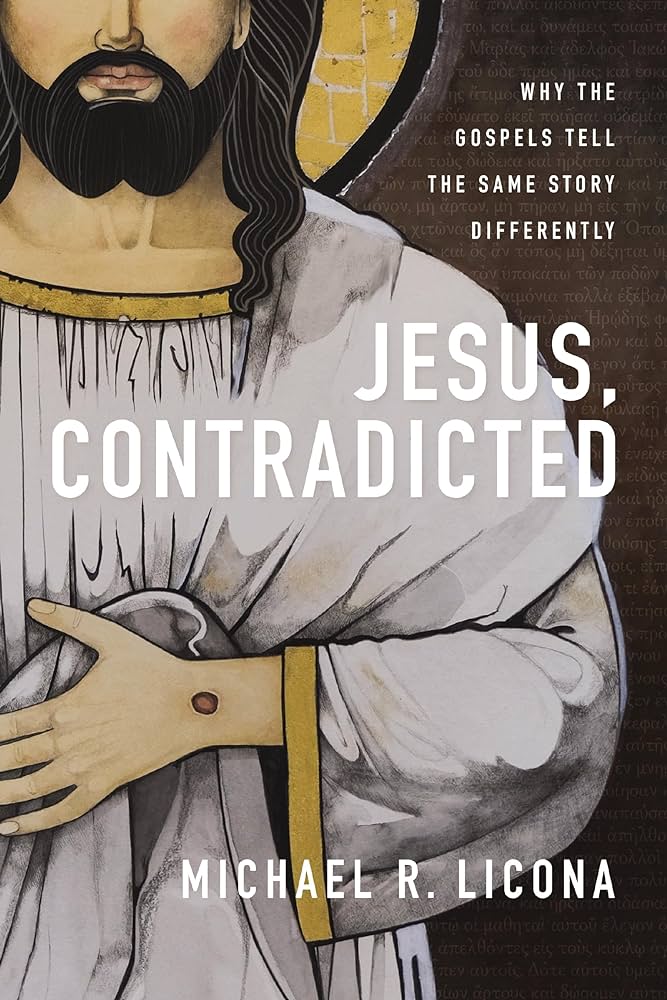
Jesus, Contradicted: Why The Gospels Tell The Same Story Differently, by Michael Licona, offers a more evidenced-based approach to handling differences in the Gospels, without resorting to tortured harmonization efforts concerning incidental details.

Continue reading


Inerrancy and Interpretation: An Extended Review of Five Views of Biblical Inerrancy

What is biblical inerrancy? At one level, it is pretty simple and straightforward. As Christian philosopher and apologist Norman Geisler says, “The Bible is the Word of God, and God cannot err; therefore, the Bible cannot err.” If the Bible cannot err, the Bible is inerrant. Broadly speaking, I support this logic.

Such logic, essentially means, that when we read the Bible, we can have the confidence that God is speaking truth to us, through the sacred text. A so called “Bible difficulty” is due to either an error with the translation, a faulty exposition being given about what the Bible says, or because of some misunderstanding on the part of the reader. The problem is never with God’s Word itself.

Pretty clear, right? Well, as they say, often the “devil is in the details.” Different Christians sometimes have different ideas of what they mean by “inerrancy,” and these differences can have diverse consequences in the details.  Digging into those details has led some people to be encouraged in their faith in times of doubt, while raising more doubts in the minds of others, and thereby providing fuel to the skeptics’ fire. How can this be?

It all depends on how “inerrancy” is defined and defended. Have you ever thought about how the four Gospels treat Peter’s “three” denials of Jesus?


Continue reading


Henry Morris and the Case of the Missing Signature

Henry M. Morris (1918-2006). Along with Grace Theological Seminary's John C. Whitcomb, this engineer was one of the fathers of the contemporary Young Earth Creationist movement.

Henry M. Morris (1918-2006). Along with Grace Theological Seminary’s John C. Whitcomb, this engineer was one of the pioneers of the contemporary Young Earth Creationist movement and a leading figure in the inerrancy crisis of the 1970s and early 1980s.

The pen lay undisturbed on the table. The document needed one more signature. Others had scribed their name in ink. But Dr. Henry Morris had left the room. The hope for having a unified front in defense of the inerrancy of the Bible were dashed at that moment.

The International Council on Biblical Inerrancy (ICBI) had accomplished so much. In 1977, this group of Bible scholars and teachers had drafted a document affirming a set of principles that sought to expound on the meaning of Biblical inspiration and authority. Christian leaders from across the widest denominational spectrum had agreed to put aside their relative doctrinal differences to stand on what Francis Schaeffer had understood to be the “watershed of the evangelical world“. Against the tide of a creeping liberalism in the churches that would compromise God’s Truth, these leaders had pinned their hopes on the banner of inerrancy to unite the evangelical church.

But it was now 1982, and despite how well things had gone, the unique opportunity for a consensus was gone. How did we get here, and what went wrong?
Continue reading


Inerrancy Summits and the Valleys of Interpretation

The saddle between Grays and Torreys Peaks in Colorado.

The saddle between Grays and Torreys Peaks in Colorado. I am the guy in the red jacket.

I love hiking in the Colorado Rockies. In 2006, a buddy of mine and I hiked two of Colorado’s famous “fourteeners,” mountains that rise above 14,000 feet, in one day. In the photo, I am walking up from the saddle connecting these two huge peaks, with Grays Peak to my back and the photo being taken from a few hundred feet below the summit of Torreys Peak. I love this picture because it eerily captures the pure desolation at such heights, with the clouds just crossing this “valley” between the two mountain summits. If you click on the photo for more detail, you can barely make out the dozens of other climbers that day as they made their way between these beautiful peaks.

This camera shot fits well with the topic at hand, the relationship between inerrancy “summits” and the “valleys” of biblical interpretation.
Continue reading


Five Views on Biblical Inerrancy

What does it mean to say that the Bible is without error? For a number of people, the answer is a no-brainer: either the Bible has errors (skeptics) or it does not (Bible-believer). But is it really that simple?

Back in the 1970s, a group of evangelical scholars got together and drafted The Chicago Statement on Biblical Inerrancy. It was an attempt by the best conservative evangelical minds at the time to articulate an understanding of the authority of Scripture that was faithful and consistent with what the Scriptures actually teach. The framers remarkably were able to come together with a unified understanding of what inerrancy means with respect to the Bible. For example, while English grammarians may dispute the correctness of using “regardless” or “irregardless” in a sentence, such similar issues of standardization for ancient Greek grammar do not apply to the concept of inerrancy according to the Chicago framers. In other words, the New Testament was never meant to be a textbook in Greek grammar. While the Chicago Statement was largely accepted within the evangelical faith community back then, there were some rough edges.

Those rough edges are still with us some thirty years later.

In Zondervan’s latest Counterpoint series book, Five Views on Biblical Inerrancy, we find Al Mohler, president of the Southern Baptist Theological Seminary. He is the intellectual leader of the largest Protestant evangelical denomination in North America. He enthusiastically supports and affirms the Chicago Statement on Biblical Inerrancy to be just as true for us today as it was back in the 1970s. Al Mohler is smart. He is articulate. He is well-read. He is passionate for the truth.

But according to Bible scholar and Ancient Near East literature expert Pete Enns, Al Mohler is also dead wrong. To those familiar with the compromises associated with liberal Protestantism, the complaint registered by Enns is nothing new, except that Pete Enns says that he is still speaking as an evangelical. Enns, formerly an Old Testament scholar at the Westminster Theological Seminary, says that the Chicago understanding of inerrancy advocated by Mohler is flawed and does not do proper justice to how the Bible truly presents itself to us.

In between the above polar opposite positions (further represented with excerpts from the book on the BibleGateway blog by Mohler and Enns) are other contributors, Kevin Vanhoozer, Michael Bird, and John Franke, each who in their own distinct way think that while inerrancy is still in some sense a useful term for understanding the authority of Scripture, its definition should be carefully reevaluated in view of new challenges to our understanding of the Biblical text.

When thinking about inerrancy, there is a certain sense of nuance involved and attention to what is meant by “inerrancy“. For those who look at the Bible from afar, this may not register too much, but for those who really dive into the Biblical text, as John Paine is encouraging us to do in his recent series on Who Wrote the Bible, it becomes really important.