Tag Archives: Belgium

Christmas in Europe: Ypres and Dunkirk

Time for another installment of looking back at a trip my wife and I took this past Christmas to Europe…. I know we are now in mid-April and spring is here, but I still have Christmas on my mind.

Ah, Belgium! Waffles and fries! Unfortunately, both my wife and I got sick within a few days after arriving in Belgium. At first, I was still in better shape than she was, and I was pretty determined to make the most out of our Christmas adventure in Europe. So, while she rested up, I went with our friends Andrew and Shannon to take a “World War 1 & 2” tour day.

Clarke with friends Andrew and Shannon, in front of Cloth Hall, in Ypres, Belgium, which was restored after WWI. A fantastic museum in the Cloth Hall chronicles the story of the Western front in WWI, and the town of Ypres was right on the front lines of the action.


It was only about an hour’s drive from where our friends were living (a bit southwest of Brussels) to get to Ypres, a town that dates back to Roman times, which has seen more than its fair share of battles over the centuries. But the worst of it was in World War I, where Allied (French, British, Canadian, and eventually American) forces exchanged machine gun fire with German forces, in an exhausting effort to move the front line, one way or the other.  When Belgium was attacked by Germany in 1914, it triggered a series of alliance treaties which catapulted France and the British Empire into the war, and within weeks Ypres became a highly contested piece of real estate, a situation which lasted pretty much the entire war lasting four long years.

Ypres was one of the first sites on “the Western front” where chemical weapons, such as chlorine and mustard gas, was first used as a weapon of war. April 22, 1915 marks the day when during the Second Battle of Ypres a war power (Germany, in this case) first successfully used chlorine gas to dislodge enemy troops.  While chemical weapons are technically outlawed by international law now, such was not the case during World War I.

Yet the most bloody battle was the Battle of Passchendaele, where Allied forces were able regain just a few miles of territory from the Germans, but at the cost of some half a million casualties.  Well over a million battle casualties happened among the Flanders Fields surrounding Ypres  during the course of the war, with dozens of cemeteries scattered across the area, where people still visit today. Ypres is once again a beautiful place now, but a little over a hundred years ago, it was devastation. The town was almost completely flattened, and the towering Cloth Hall, pictured above was almost all but obliterated (see below):

Cloth Hall Tower, Ypres, [ca. 1918], Photographer Unknown, Canadian Expeditionary Force albums, Reference Code: C 224-0-0-9-1, Archives of Ontario, I0004760

After touring the museum at the restored Cloth Hall in Ypres, we drove yet another hour west to the English Channel, at Dunkirk, a port and beach resort town in France, for a stop to think about World War II. The story of Dunkirk is most remembered as the last place the retreating British Expeditionary force stood on mainland Europe’s soil in 1940, in the face of encroaching and overwhelming German troops. The then new British Prime Minister, Winston Churchill, insisted that remaining French troops be rescued, along with British troops, and this whole story is associated with the call for private shipping vessels to assist in the miraculously successful evacuation of thousands of military personnel across the English Channel.

The beaches of Dunkirk, France. Thousands of British, and eventually French troops waited on these beaches to be evacuated across the English Channel, as they faced a superior German fighting force, in 1940, in the early years of WW2.


Standing on the beaches of Dunkirk, which in the typical summer months is still a popular resort location, it was hard for me to imagine the helpless feeling many of those soldiers felt, pinned down on these beaches, as occasional German fighter planes sought to strafe the beaches, with RAF fighters in pursuit.

You would think that the horrors of the great world wars of the 20th century would have convinced humanity that guns and bombs do not solve social problems, but the human rebellion against the ways of Christ demonstrate that we are all in need of a Savior. Followers of Jesus do not all agree on how to respond to the dilemmas which wars present, but to make an end of them should be our ultimate goal. While chemical weapons are still a concern, the even more terrible threat comes with nuclear weapons, and there are credible rumors that such weapons might be developed to be used in space, to knock out satellites and cause electromagnetic surges, that can wipe out sensitive electronics here on earth, putting the lives of those who depend upon such sensitive electronics at tremendous risk. With two other major wars happening across the globe right now; namely, the Israeli/Gaza war and the Ukraine/Russia war, there is much that Christians can do to pray for peace. We live in difficult, difficult times.

One more reflection about Ypres is in order….

Ypres was also one of the sites where the “Christmas Truce” of 1914 was celebrated, a brief respite from the atrocities of war, as French, British, and Germany soldiers put down their rifles and played soccer in “No Man’s Land.”  Folk singer John McCutcheon wrote a song about the “Christmas Truce,” which is one of my favorites.

I will have a few more posts looking back on our trip to Europe this past Christmas later in the spring.


Christmas in Europe: Bruges and Ghent, Belgium

My wife and I were able to spend the Christmas season in Europe in late 2023 and early 2024. The details only came together at the last minute, but we ended up staying with friends near Brussels, Belgium for Christmas for almost two weeks. Then just after New Years, we took the Eurostar train underneath the English Channel to eventually meet up with other friends in Cambridge, England for a few days.

Throughout 2024, I plan on posting a few photos and stories of our trip to Belgium and England for Christmas 2023. We did not cover as much territory as we did with our 2022 trip along the Danube, but we did get to experience what Christmas was like in Europe.

It was quite a crazy trip getting to Belgium: missed flights, lost luggage, you name it, all on Christmas Eve. The stress made us susceptible to getting sick while we were in Belgium, which made it difficult to enjoy everything, but we tried to make the best of it. We even flew through Iceland in between volcanic eruptions, only about 12 miles from the airport, which eventually damaged part of the fishing village, Grindavik. We also had to find a way to dodge the threat of a labor strike on the London Tube, which would have interfered with our return trip out of Gatwick Airport back to the United States. The whole trip seriously made me have second thoughts about ever traveling by air again!

Christmas markets in the central city square of Bruges, Belgium, around dusk. Belfort bell tower in the background.


Bruges, Belgium

The city of Bruges, Belgium is enjoyable to walk through as everything is mostly compact. We visited a few days after Christmas, and the streets were really crowded, which was not our type of thing. But it did give us a chance to see what it was like with Europe’s fabled Christmas markets, where vendors were out selling Christmas foods, and in Belgium, particularly waffles, fries, and especially chocolate!

As my contribution to the Veracity blog is mostly about church history and Christian apologetics, I can not resist saying something about those subjects here. A country like Belgium has become increasingly secularized during the modern period, but its church history is largely well preserved, so its Christian heritage is unavoidable. There are several beautiful churches to visit in Bruges, one of them being Saint Salvator’s Cathedral, which dates back to the 13th century.

Interior of Saint Salvator Cathedral in Bruges, Belgium. The church was greatly expanded after a roof collapse in the 19th century. Yet aside from that, Saint Salvator’s Cathedral largely escaped centuries of strife, particularly the destruction inflicted by the devastating wars of the 20th century in Belgium.

More so than in many other cities throughout Europe, Bruges has sustained its medieval character, and a walk through Saint Salvator’s Cathedral serves as a great reminder of the historical influence of Christianity that pervades Europe, with so many works of art displaying stories from the Bible and instances of conversion of various Christian persons during Europe’s long history.

On a trip like this, I like take along with me an audiobook that gives insights into the history. Tim Blanning’s massive and learned The Pursuit of Glory: The Five Revolutions That Made Modern Europe: 1648-1815, part of the Penguin History of Europe series was the perfect guide. It was during this period between the Thirty Years War and the end of the Napoleonic wars when Europe made the transition from being the locus of Western Christendom to the emergence of nationalism as the guiding ideology. Belgium was right in the center of this story, with Napoleon’s famous defeat at Waterloo chronicled at the ending chapter of Blanning’s book, and the site of the battle less than a hour’s drive from where we stayed with friends.

The emergence of a post-Christian Europe has had a long history behind it, as nations like Belgium and the United Kingdom continue to wrestle with this significant spiritual shift. Consider the British monarchy, where the late Queen Elizabeth was perhaps the last of the firmly evangelical, historically orthodox Christians to lead a European country. Her son, King Charles III, has a more progressive take on Christianity, who considers himself a “defender of faith” as opposed to being a “defender of the faith,” as his mother was. Now Charles’ son, William, the heir apparent, wants very little to do with the Church of England. A recent news story suggests that William would like to sever ties with the Church of England, but that is not quite as easy as it sounds. Pray for spiritual revival in Europe!!

Ghent, Belgium, and Its Famous Altarpiece

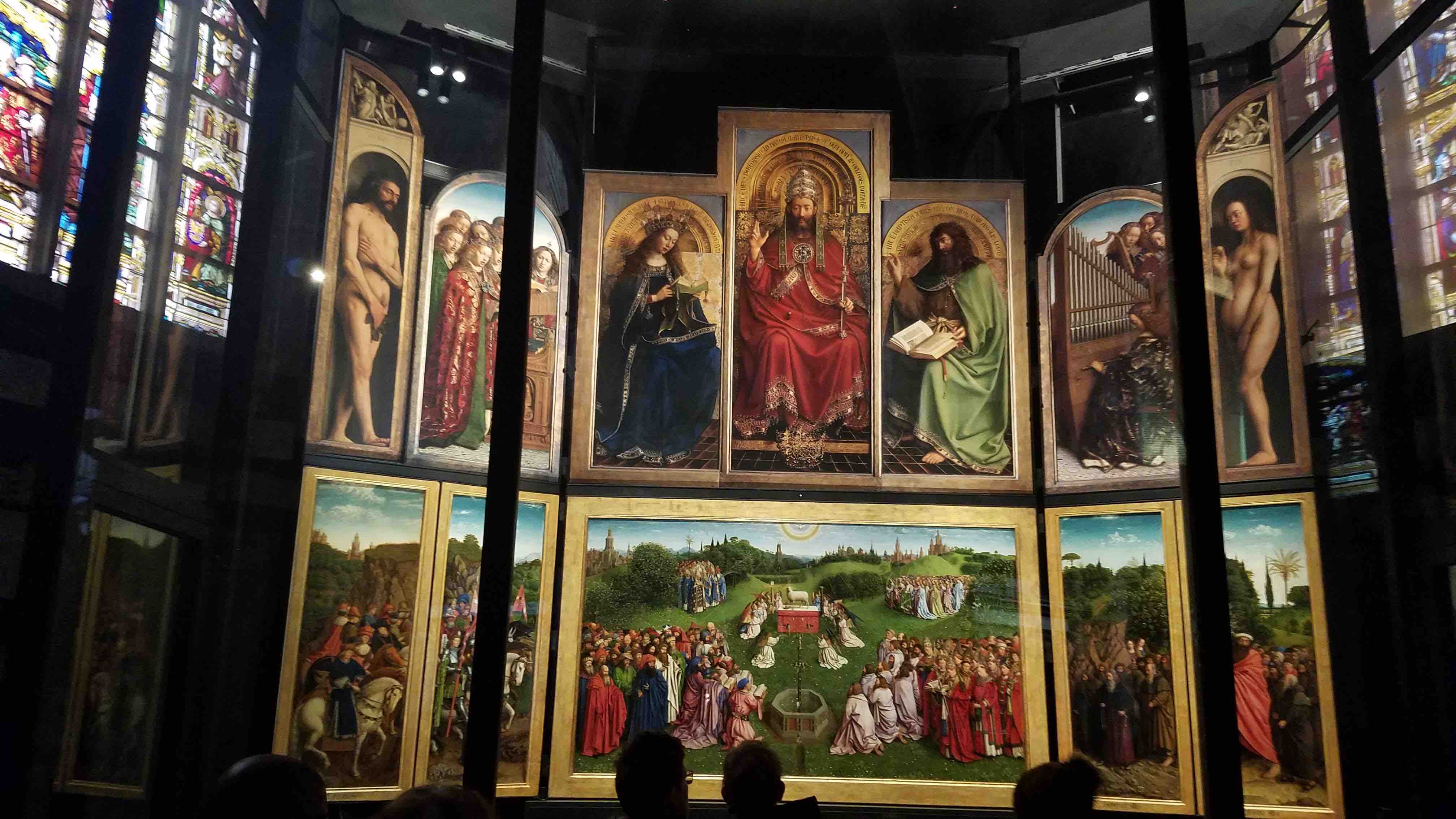
The same day we traveled by train to visit Bruges, we also stopped over in Ghent, a much bigger city than Bruges, where riding a bicycle is really the most efficient way of getting around. The highlight of Ghent was seeing the Mystic Adoration of the Lamb, at Saint Bavo’s Cathedral.

This altarpiece has been popularized the most in recent times by George Clooney’s 2014 movie, The Monuments Men. The Nazis during the World War II occupation of Belgium had stolen the Mystic Adoration of the Lamb, with the intent of installing this great work of art in one of Hitler’s planned museums after the war. But with the impending defeat of Germany, there was concern that great works of art might be destroyed by Hitler, so the Allies formed a special military unit that sought to safely recover the art works stolen by the Nazis. The Mystic Adoration of the Lamb was one of those pieces restored to its rightful place.

The Mystic Adoration of the Lamb dates back to the 15th century, a product of the Dutch painters, brothers Hubert and Jan van Eyck. Each panel stunningly displays a story or person from the Bible. If you ever go visit this yourself, I would recommend booking a time slot in advance, as this will help to avoid long lines of the many visitors who come to gaze at the altarpiece. My photo in no way captures its brilliance (but clicking on the photo to expand it might help). My only regret was in not seeing the altarpiece opening and closing, but there are some good videos out there that suffice.

Speaking of Waterloo and Napoleon above, the Ghent Altarpiece was captured by French Revolutionary troops in 1794, but the painting was returned to Saint Bavo’s Cathedral after Napoleon’s defeat at Waterloo in 1815. The thefts by Hitler and Napoleon only account for two of the thirteen times the Mystic Adoration of the Lamb has been stolen across the centuries.

The Mystic Adoration of the Lamb, in Saint Bavo’s Cathedral, in Ghent, Belgium. Stolen by the Nazis and recovered by “the Monuments Men.”

Look for more highlights of our Christmas in Europe trip in the coming weeks and months on the Veracity blog.
