
From the Christianity Along the Rhine blog series…
Lunatic conspiracy-like theories tend to run amuck at the most confusing times in the oddest places. You can spot these typically in the hands of self-promoting journalists and other thought leaders in the age of the “new media,” who have a misguided or otherwise inadequate grasp on human history.
Take for example statements made by popular conservative news commentator Candace Owens about the early Christian movement:
“And those Jews became Christians. Full stop. There is no hyphenated faith. You are either a Christian or you are a Jew. Christ fulfilled the law.”
Candace Owen apparently believes that the earliest Christ followers left their Judaism behind to follow Jesus. Such statements have given rise to a kind of “replacement theology,” which has infected Christian thinking in various quarters for centuries. Now, “replacement theology” can mean different things to different people, which does get confusing. But in this context, it suggests that God has somehow forgotten the Jews, and “replaced” the Jews with Christianity.
Has Ms. Owens never met a “messianic Jew?” A “messianic Jew” is a Jewish person who has become a Christian, believing that having faith in Jesus fulfills what Judaism is all about. The growth of messianic Judaism, particularly in the last generation or so, where thousands of Jews have come to know Jesus as their true Messiah, is one of the most remarkable stories of Christian missions in our day. In other words, contrary to what Ms. Owens thinks, you can be both a Jew and a Christian, and the trend is growing.
So, where do people get such bizarre ideas? Apparently, Ms. Owens has never learned that nearly all of Jesus’ earliest disciples were Jewish, and they never forsook their Jewish heritage. Even after the Apostle Paul became a Christian, he still acknowledged that he was both “a Hebrew of Hebrews“ (Philippians 3:4-5) and “I am a Jewish man” (Acts 21:39). If you read the text carefully, you will notice that Paul is speaking in the present tense, and not the past tense. Do we need a reminder that Jesus himself was Jewish?
Back in September, 2024, another popular conservative news commentator took a step in a similar direction. Tucker Carlson has been a television journalist, who after leaving the Fox television network, became perhaps the first Western journalist to score an in-person interview with Russian President Vladmir Putin, after the Ukraine-Russian war began in February, 2022. Since then, Mr. Carlson has been on an interesting journey, essentially re-discovering Christianity, as evidenced by several interviews he has given, which is very encouraging. Carlson’s interview with campus evangelist Cliff Knectle stands out as a positive example of engaging journalism, allowing a Christian evangelist to discuss the Gospel at length without being misconstrued.
That being said, Mr. Carlson crossed a line when he interviewed an American historian, Darryl Cooper, a man who Carlson describes as “may be the best and most honest popular historian in the United States.” In that interview, Cooper makes the claim that during World War 2 era, British Prime Minister Winston Churchill was a “warmonger” who was itching for a fight with Adolph Hitler, suggesting that Churchill became the “chief villain” of World War 2, making the war into something more than just the invasion of Poland. Sadly, Carlson did very little to challenge Cooper’s claims.
NOTE: This was all a year before THAT interview Tucker Carlson had with Nick Fuentes in October, 2025….. (And I need not go down the road of more recent conspiracy theories propagated by Ms. Owens, well documented by others …. which gets more and more bizarre by the day, wild claims which possess no evidence)…. But Tucker Carlson’s promotion of revisionist history by Darryl Cooper is the most troubling to me, partly because of the popular reach Tucker Carlson has, particularly among evangelical Christians.
It is troubling as Christians are often blamed for a good amount of antisemitism, needless antipathy towards ethnic Jews, which I have argued stems from a failure to interpret Scripture responsibly. So, when public figures who consider themselves as Christians, play into certain anti-Judaic falsehoods, whether intentionally or not, it nevertheless harms Christian witness.
Where do people get such nonsense?
Why do such voices get so many clicks on social media platforms?
Well, I decided to find out for myself.
One of the most highly respected biographies of Winston Churchill is by British historian Andrew Roberts, who responded to the Darryl Cooper interview by Tucker Carlson. Roberts’ articulate and evidence-based response from 2024 has been so stinging (and a follow-up piece just a year later, criticizing even the Heritage Foundation), that I knew I had to get a copy of Churchill: Walking With Destiny. On Audible, the audiobook is a whopping 50 hours long. But in my estimation, it was worth it!
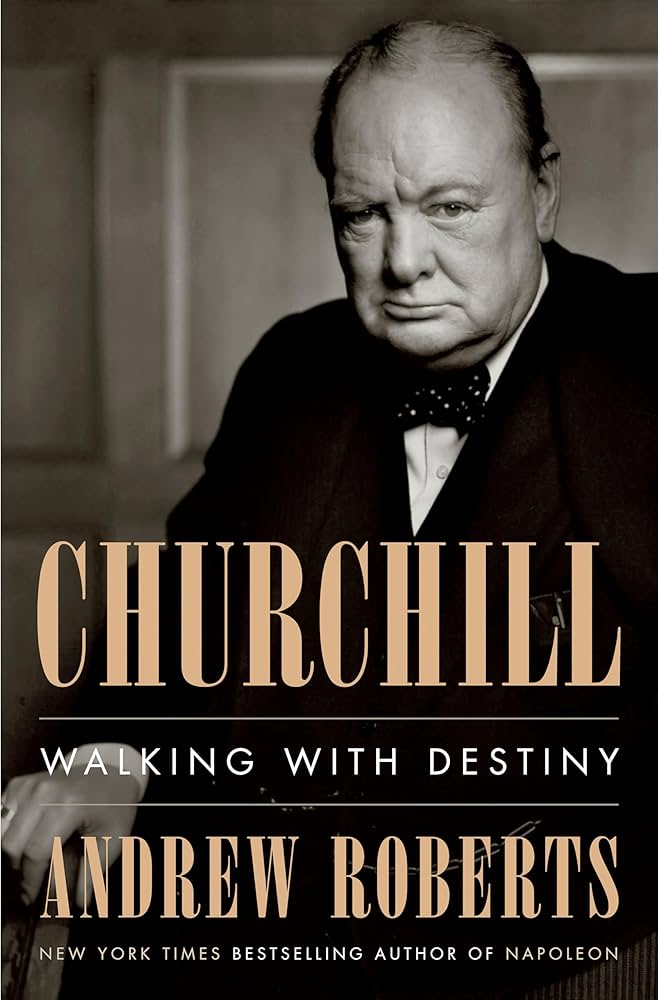
Churchill: Walking With Destiny, by the highly respected British historian, Andrew Roberts, dispels the false narratives being propagated in some supposedly Christian circles in our day. Read Roberts’ book to get the real truth about Winston Churchill.
Winston Churchill: Villain or Hero of the Second World War?
This past fall, in October, 2025, my wife and I were in Europe. After taking a cruise down the Rhine River, we visited the Luxembourg American Cemetery, where about 5,000 American war dead are buried, many of them who died in the Battle of the Bulge, in the ferociously cold winter of 1944-1945. As I walked around the cemetery, and spotted the grave of General George Patton, the U.S. Army leader who relieved the tired and surrounded troops of Bastogne, during that terrible battle, I wondered why so many young American men lost their lives in an effort to defeat Nazi Germany.
According to Darryl Cooper, Tucker Carlson’s most highly revered historian, much of the American involvement in the war was prompted by the “warmonger” rhetoric of Winston Churchill. This “warmonger” description of Churchill suggests that perhaps Adolph Hitler was not quite as bad as commonly believed, and that Churchill had become rather unhinged in his opposition to the Nazis. Is this claim really true? For if Darryl Cooper is correct about Winston Churchill, then it casts a lot of doubt regarding the moral reasoning which led to the deaths of so many Americans buried in Luxembourg.
Winston Churchill was a most complex and interesting figure, the son of another famous British politician. Winston Churchill idolized his father, though his parents often placed their own ambitions above spending time with their son. When his father, Randolph, died an early death, Winston Churchill knew that he was filled with ambition to exceed the political aspirations of his father. He even expected that he would become prime minister of the United Kingdom, some time in the future.
Churchill believed that his path of national leadership would be through a combination of military service and journalism. In some cases, he was able to serve in the military without pay, while receiving pay as a journalist. He served as a war correspondent in Cuba. He also served in the army in one of the last British cavalry clashes in Sudan. In South Africa, he was captured and imprisoned, but somehow managed to escape confinement. His imprisonment and escape from prison made Churchill a war hero.
Churchill’s military and journalism career took him far across the global British empire. While in the British army in India, Churchill began to read widely, influenced greatly by the writings of Edward Gibbon and Charles Darwin. Particularly due to Gibbon’s skeptical influence, Churchill, who had been raised a nominal Anglican, expressed doubts about the truth claims of Christianity. But as Roberts portrays him, Churchill was an agnostic, who embraced a kind of “cultural Christianity,” acknowledging the virtues of Christianity’s influence in British culture without believing the metaphysical truth-claims associated with the faith.
He finally made his way into Parliament in 1901, and eventually became First Lord of the Admiralty in 1911, overseeing the British Navy. It was during the “Great War” that Winston Churchill’s reputation suffered the most, when he was blamed for much of the failure of the Gallipoli campaign, an attempt by allied forces to try to knock the Ottoman Empire out of the war. Churchill sought to revive his reputation after that by saying that the campaign was mismanaged by other military leaders, when he advocated for a Naval attack on the Dardanelles, with insufficient Army support to back up Churchill’s efforts, thus leading to the quagmire, and ultimate failure of the campaign.
Churchill continued on in the military, and served in the trenches on the continent during the Great War, after Gallipoli, avoiding death on several occasions. Even after the war, Churchill continued to serve in public office, but was eventually forced out of office in 1929. Many historians called this period, where Churchill was in many ways a government outsider, his “wilderness years.” In the run up to World War 2, Churchill became a voice sounding the alarm about Hitler, but now largely as a journalist and popular historian.
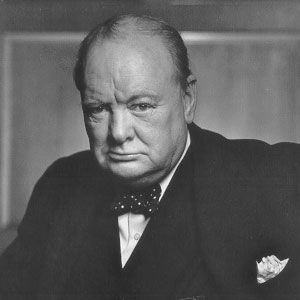
Sir Winston Churchill. Fiery debater. He had a reputation for respecting his opponent. Yet he never gave up on his belief that Nazi Germany was bent on perpetuating evil. In the end, history proved Churchill to be right. Is it possible for the evangelical apologist to have Churchill’s fortitude AND respectfulness when it comes to defending the Christian faith?
The Churchill “Warmonger” Thesis Challenged
As with any conspiracy or conspiracy-like theory, there is a grain of truth about Darryl Cooper’s fantastic claim that Churchill was a “warmonger.” The British Isles had suffered greatly during the “Great War,” and afterwards the economy was extremely sluggish. There was not much stomach for military conflict at the time, but Churchill did advocate for an accelerated development of the Royal Air Force, predicting that Hitler would eventually become a menace to Europe. Historian Andrew Roberts notes that many during the 1930’s considered Churchill to be a “warmonger,” stirring up trouble where none existed. Simply put, very few people considered Hitler to be the type of evil person, who in our day and age is now considered to be the very personification of evil.
Churchill opposed the appeasement policy of Prime Minister Neville Chamberlain, who proclaimed “peace in our time.’ When Chamberlain helped to broker a peace deal with Hilter with the 1938 Munich Agreement, allowing Hilter to occupy the Sudetenland, part of Czechoslovakia, with no consultation with the Czechs, Churchill was appalled. For Hilter merely broke the agreement and occupied the rest of Czechoslovakia in less than a year later.
It is true that Hilter called Churchill a “warmonger,” in view of Churchill’s reaction to Nazi German aggression. But it is completely false to claim that Churchill was somehow itching for a fight with Hitler, as though Churchill was the instigator, a point which Andrew Roberts makes clear in his biography of Churchill.
As war grew closer, so did Churchill’s popularity increase. Churchill’s predictions about Hitler’s aggression proved true over and over again. Churchill’s urging for beefing up the military was in reaction to Hitler’s provocations, not the other way around. As Hitler’s army invaded Belgium and made its way towards France, Churchill was selected to be Prime Minister, believing that the whole of his life thus far was preparation for this dire moment in Britain’s history.
Many still distrusted Churchill, recalling the failure of the Gallipoli campaign during the “Great War” a few decades earlier. As war with Germany became inevitable, before Churchill became prime minister, he made some major mistakes in trying to coordinate efforts to stop the Nazi takeover of Norway. But as Andrew Roberts describes the next few years, Churchill learned from his mistakes. Churchill’s skill as a an orator helped to unite the British people to resist the Nazi movement, as the island of Great Britain eventually became subject to withering attack by Hitler’s Luftwaffe.
As Andrew Roberts reveals in an interview, Cooper’s thesis that Churchill was the “chief villain” of World War 2 is simply “reheated, old David Irving stuff from twenty years ago.” David Irving has been known as a holocaust denier voice in the U.K., publicly claiming that the gas chambers at Auschwitz never existed. This need not imply Cooper as being a holocaust denier himself, but it does not better his case. Cooper’s thesis that Churchill was the “chief villain” falls flat when one realizes that Hilter’s blitzkrieg against the West happened before Churchill was selected as prime minister of Great Britain. Do journalists like Tucker Carlson need to be platforming such views as merely offering a different perspective having equal footing with many others?
Though admittedly not an historic orthodox Christian, Winston Churchill was nevertheless a lonely voice who saw the anti-Christian motivations behind Hitler, and who called out the evil nature of the Nazi regime. Churchill had his quirks, and like many of his day, uttered some frankly racist statements. He opposed national sovereignty for India, which has left him with many critics still today in India. He was slow to support the effort giving women the right to vote, only being persuaded to accept the cause after marrying Clementine, who fully supported female suffrage. Churchill made many mistakes, even somewhat silly ones, at one point suggesting that a curtain supported by balloons might be launched above the border of England, carrying explosives, as a deterrent against Hitler’s luftwaffe.
Churchill: Walking With Destiny is not hagiographic. Roberts does not shy away from telling about Churchill’s shortcomings. In many ways, Churchill had a lot of the same negative qualities that people despise so much about the U.S. President Donald Trump. Yet Churchill was also a great communicator, very witty, and brilliant, with an ability to connect with the British people during a time of great national and world crisis, which ultimately helped to stem the tide against Hitler’s aggressions.
One of my favorite lines from Churchill is this: “Stop interrupting me while I’m interrupting you.”
Churchill was a British patriot, who at times was blinded by his own nationalism, xenophobia, and other faults. Nevertheless, he spoke out against Hitler for years, when relatively few in Britain in the early and mid-1930s would do so. Churchill’s study of history convinced him that Adolph Hitler was up to no good and could not be trusted. Years before the Nazi implementation of “The Final Solution,” Churchill knew that Hitler’s antisemitism was a serious problem. Thankfully, people began to eventually listen to Churchill, and Hitler was finally challenged and his Nazi regime was stopped. As the British prime minister, Churchill took an active role in countering the anti-Jewish objectives of the Nazis. Churchill was perhaps the most influential person on the planet to persuade the Americans take the fight against Hitler. Winston Churchill was the right man for the right job at the right time.
One standout irony of Churchill’s life was in how self-prophetic it was. At age 16 or 17, Winston Churchill came to believe that one day, “I shall save London and England from disaster.” Many decades later, that prophecy would come true.
Unlike so many voices from the “new media” of YouTube and TikTok, studied and reputable historians, like Andrew Roberts, can help to dispel the nonsense. Grab a copy of Churchill: Walking With Destiny, and learn for yourself, just like I did.
We live in an age when credible authorities for discerning the truth are being distrusted by social media algorithms. As a Christian, we should be wary of these unfortunate trends, and look instead towards God’s standard for truth: beginning with the Holy Scriptures, under the Lordship of Jesus Christ.

Walking along the many rows in the Luxembourg American Cemetery was an incredibly sobering experience, realizing just how many American soldiers died for the cause of freedom and the defeat of the Nazi regime. My photo taken in October, 2025.
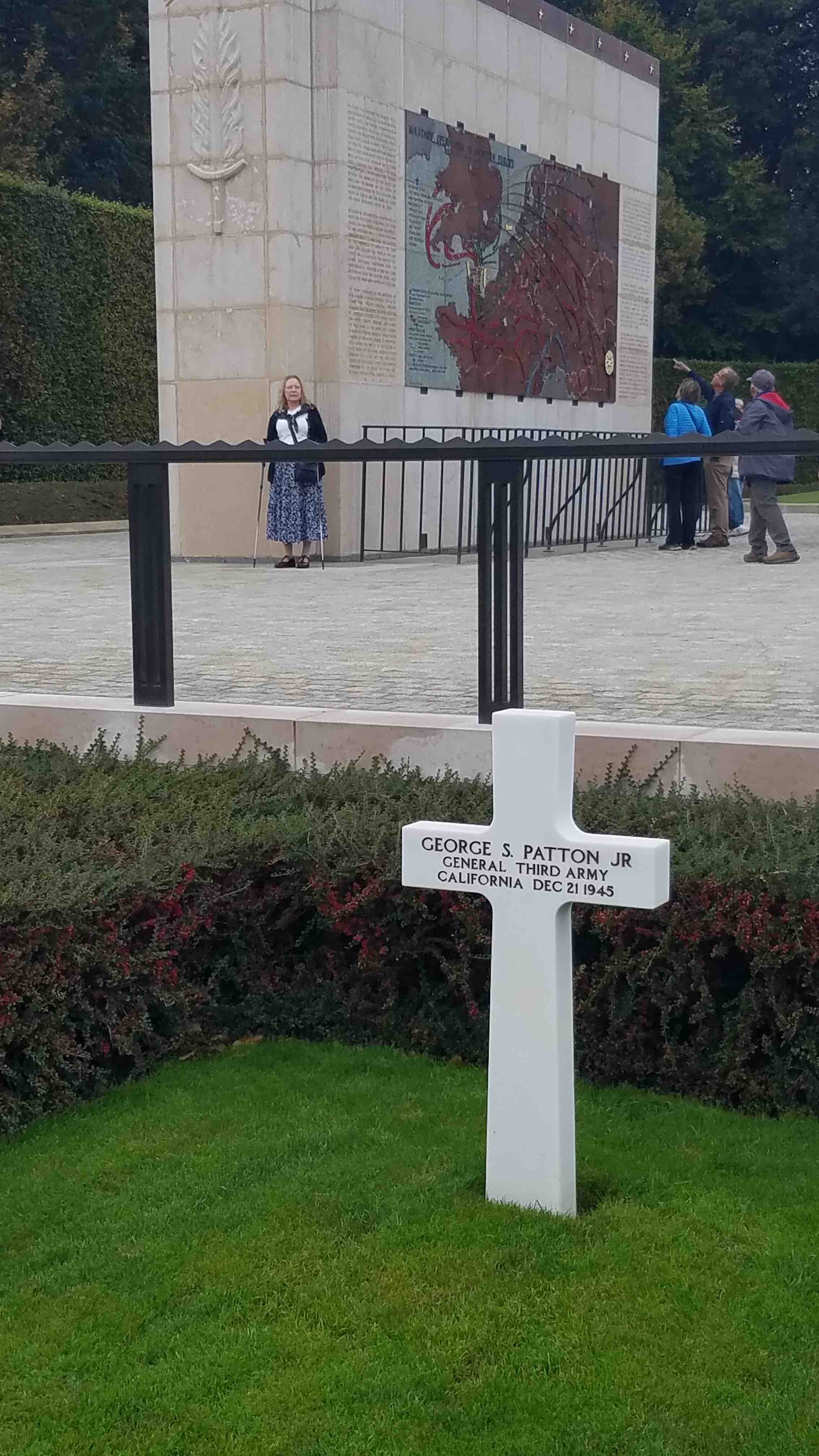
George S. Patton’s grave at the Luxembourg American Cemetery. My photo taken in October, 2025.
Be Careful What You Click!
I go back to the lunatic storylines promoted by figures like Candace Owens and Tucker Carlson. With the demise of the monopolies of traditional news organizations has come the “new media” of podcasts, which claim to get at the “real truth” being obscured or hidden by “mainstream media.” Much of this democratization of the newer media driven by advances in information technology has been fruitful. The stranglehold which legacy news organizations have had over the flow of information has been broken by the “new media.” Yet while trying to hold “mainstream media” accountable, these new forms of news media have their own accountability problems.
As Konstantin Kisin, co-host of the Trigonometry podcast, says in the following video, “what you reward with your clicks is what you create more of in the world. That is not a responsibility to be taken lightly.” Our consumption of media does not simply try to tell us the truth about our world, it also reveals a lot about ourselves. This is a good measure of wisdom to think through before you flip on the television or turn on your favorite YouTube channel:
As a double-bonus, the folks at the Trigonometry podcast have a two-hour interview with Andrew Roberts, about the book Churchill: Walking With Destiny . Following that, the historian dynamic duo of Tom Holland and Dominic Sandbrook on The Rest is History Podcast tackle the kind of rubbish revisionism being pedaled in certain corners of the “new media,” with another installment of their history of Nazism series, this time focused on Britain’s and France’s entry into the war against Germany, following Hitter’s invasion of Poland. Both are well worth the time. Enjoy!!



 Veracity