The courage and conviction of a Swiss radical reformer, Felix Manz, has inspired Christians who have since come after him for almost 500 years. But who was Felix Manz?
In October, 2025, my wife and I took a trip to Europe, visiting a few sites linked to the history of the Protestant Reformation. One of those sites was the city of Zurich, Switzerland, the home of Huldrych Zwingli, one of the leading lights of the Protestant Reformation, alongside more well-known figures like Germany’s Martin Luther and Geneva’s John Calvin. Check out the two-partblog series about Zwingli recently covered a few months ago on Veracity, which gives some background regarding Felix Manz.
Felix Manz was at one time a follower of Zwingli, the great Protestant reformer of Zurich. Desiderius Erasmus, one of the most widely read authors of the day and a theologian from the Netherlands, had shocked the medieval world with his new, authoritative Greek New Testament. Since the fall of Constantinople to the Turks in 1453, scholars from the Christian East had brought their copies of the Greek New Testament to the Christian West. In examining these copies of the New Testament, which was originally written in Greek, it became apparent that some traditional interpretations of the New Testament popularly received in the West were not accurate. In going back to the original sources, “ad fontes,” as humanists like Erasmus called it, a new effort was made to refresh medieval ideas about the New Testament. Feliz Manz had become familiar with Erasmus’ work, and it changed his life.
Zwingli and Manz were part of this effort in Zurich, Switzerland. Like Zwingli, Manz had been educated in the biblical languages of Hebrew and Greek. Zwingli was the fiery preacher who advocated for the reforms of Erasmus, but Zwingli went beyond Erasmus in challenging papal authority itself. At first, Felix Manz applauded Zwingli’s efforts for reform. However, later on, Manz did not believe that Zwingli went far enough.
Zwingli was convinced that the traditional Christian view affirming the practice of infant baptism was thoroughly biblical. But Manz was not convinced. Manz and his friends were persuaded that only the practice of “believer’s baptism,” whereby adults (or perhaps older children) who made a profession of Christian faith should be baptized.
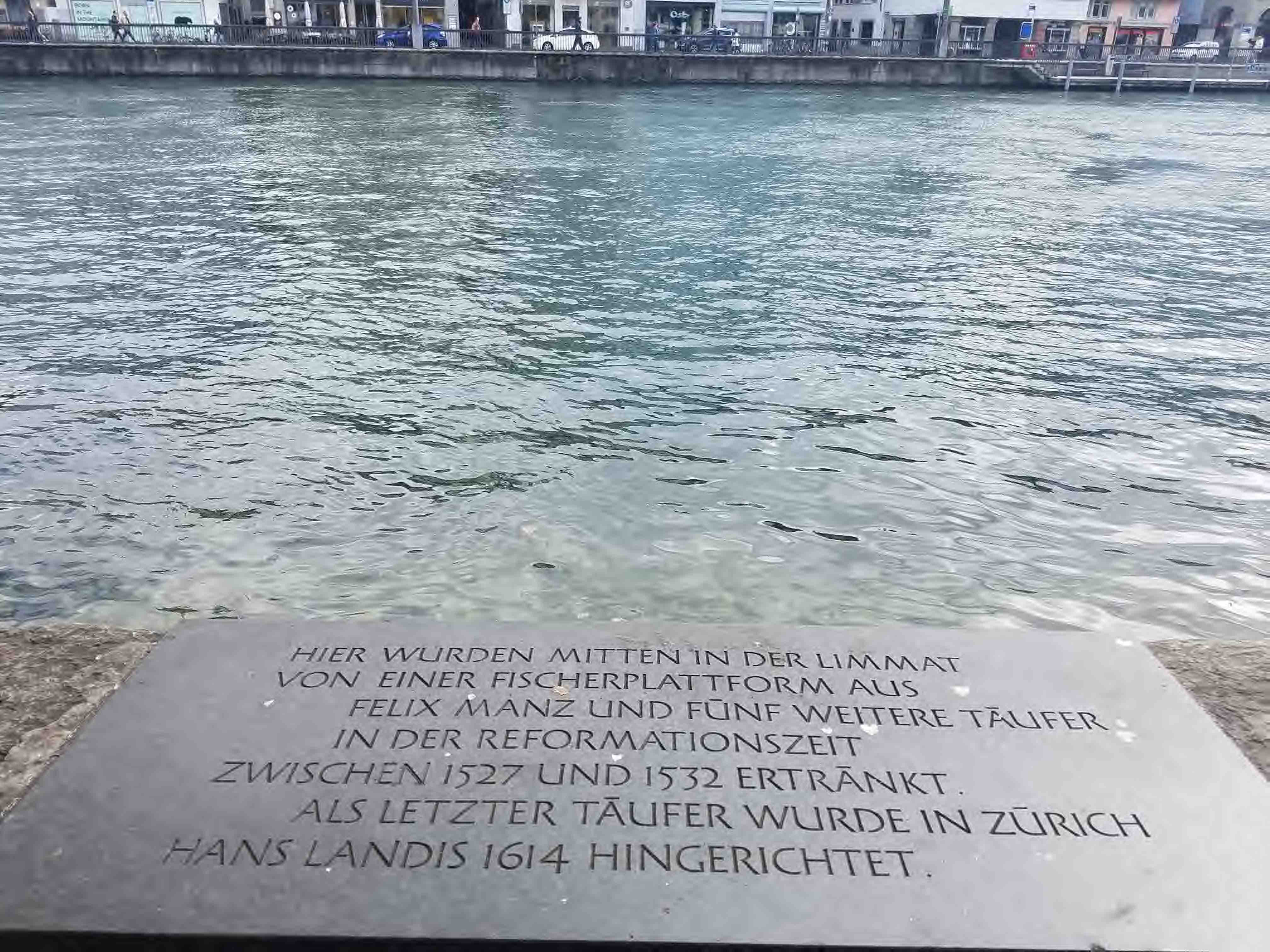
Felix Manz, who had been baptized as an infant, was baptized as an adult near this spot in Zurich, Switzerland, an act defiance and conviction, which cost him his life. Manz’ “believer’s baptism” happened just over 500 years ago, in January, 1525. Manz was executed two years later, 1527. My photo, October, 2025.
The Anabaptist Movement: Felix Manz, the First Anabaptist
A debate was held in the mid 1520’s, some five hundred years ago, presided by the Zurich city council, to determine who was right, Zwingli or Manz. In the end, the Zurich government authorities sided with Zwingli. Manz and his friends took the radical step of having themselves baptized by one another.
Imagine the shock to the medieval mind this type of thinking created. Felix Manz had already been baptized once as a baby. But now, as a believing adult, he became re-baptized, or baptized for a second time, having become convinced that his baptism as a baby was not grounded in Scriptural teaching. Ephesians 4:5 called for “one Lord, one faith, one baptism,” so Manz’ second baptism threw a wrench into the older, traditional theology. It was for this reason that Manz and his friends became founders of the Anabaptist movement, whereby the term meant to be “baptized again.”
Yet the authority of the church and the state were tightly intertwined at this time. The Zurich government decided that Manz should be punished, to set an example for others who dared to challenge the state’s authority to weigh in on religious matters.
What was Manz’ punishment? To be baptized yet a third time, but this time, it would be death by drowning in the Limmat River, which passes through the city of Zurich.
His former friend, Zwingli, did nothing to intervene. As the citizens of Zurich looked on, Felix Manz was tied up and bound, and then tossed into the freezing Limmat River in early January, 1527.
Felix Manz became the first martyr for the Anabaptist cause, inspiring groups today like the Mennonites and the Amish, who follow in that same theological tradition established in the early 16th century. The Anabaptists tended to pick up other radical teachings, associated with their readings of the New Testament, such as the rejection of military service and communal living with no private property, ideas which led to further persecution from both Roman Catholics and more mainline Protestant movements.
A little over a century later, Felix Manz’ specific teaching regarding believer’s baptism was embraced by another reform movement within the larger Protestant movement, which we now know as the Baptist faith. Those early Baptists were very much like their “Reformed” cousins in their theology, except for where they stood on infant baptism. In other words, while Felix Manz did not survive his “third” baptism, his teachings did survive and flourishes in both Anabaptist and Baptist circles all over the world today.
Thankfully, Christians today generally try not to use the force of the state to regulate theological opinions. Local churches will have their differences on whether or not infant baptism is permitted for their congregations. But it is quite common for infant baptism affirming churches to maintain some form of fellowship with infant baptism non-affirming churches, and vice-versa, despite differences in such practices. This is not wholly unlike how local churches may differ regarding whether or not women may serve as elders; part of the so-called complementarian-egalitarian controversy, or with differences regarding whether or not certain supernatural gifts of the Spirit; such as speaking in tongues and prophecy, are thought to be normative today.
For centuries, most Christians in the West from the era of the early church developed the habit of having their children baptized within a few weeks, if not days, after birth. Felix Manz broke the mold which had anchored Western Christianity, and he paid for that with his life.
Many evangelical churches today, of the so-called “interdenominational” or “non-denominational” variety, have replaced infant baptism with something called “baby dedications.” This practice is kind of a half-way approach to resolving the baptism controversy. A “baby dedication” looks like infant baptism (sort of), but it is not baptism. But at least it conveys to parents a means by which their infant children can have some type of meaningful connection to their local church.
The only problem with a “baby dedication” is that it only has vague support for it in the Bible, if any. But so-called “interdenominational” or “non-denominational” churches often go that route as it is an imperfect yet practical means of maintaining some type of peace in such churches.
Before Felix Manz, Christians never practiced “baby dedications,” for the first 1500 years of the Christian movement’s history, and scholars debate as to when the practice finally caught on. Some say that the Anabaptists themselves adopted the practice in the 16th century, looking to examples in the Bible like Hannah dedicating her child to the Lord (1 Samuel 1:11) and Mary and Joseph presenting their baby to the Lord in the Temple (Luke 2:22). But it has only really been in the modern era, with “interdenominational” or “non-denominational” churches, that “baby dedications” have become normative in at least certain parts of the Protestant evangelical world.
Basically, either you have infant baptism in a local church, or you do not. It is a binary choice. But “baby dedications” offer such local churches a means of adhering to the common ground held by all Christians affirming the validity of “believer’s baptism” for adults or older children, and not introducing a potentially divisive issue like infant baptism.
It has become standard practice in such churches to have their children, whether dedicated or not, wait until they have made a profession of faith, as they get older, before stepping forward to be baptized.
You can pretty much thank Felix Manz for setting that precedent.
In English, this marker on the Limmat River reads: “Here, Felix Manz and five other Anabaptists were drowned off a fishing platform in the middle of the River Limmat during the 1527-1532 Reformation. Hans Landis was the final Anabaptist executed (1614).” Memorial Plaque, Schipfe Quater, Zürich, CH. My photo, October 2025.
Manichaeism is the only world religion to have believed in the redemptive power of farts (Fox, p. 180).
Here is the second of a two-part blog series covering Robin Lane Fox’s book, which examines roughly the first half of Augustine’s remarkable life. We pick up the story after Augustine returns to North Africa. A few years earlier, Augustine had become a Christian, under the preaching of bishop Ambrose in Milan. In North Africa, Augustine’s career as a rhetorician had started to gain him an audience when he debated opponents of the historically orthodox Christian church. In this latter part of Fox’s work, we learn more about how Augustine read, and at times, misread, certain passages of the Bible…. and why…. glimpsing into how such readings/misreadings have reverberated throughout later Christian history, particularly in the West.
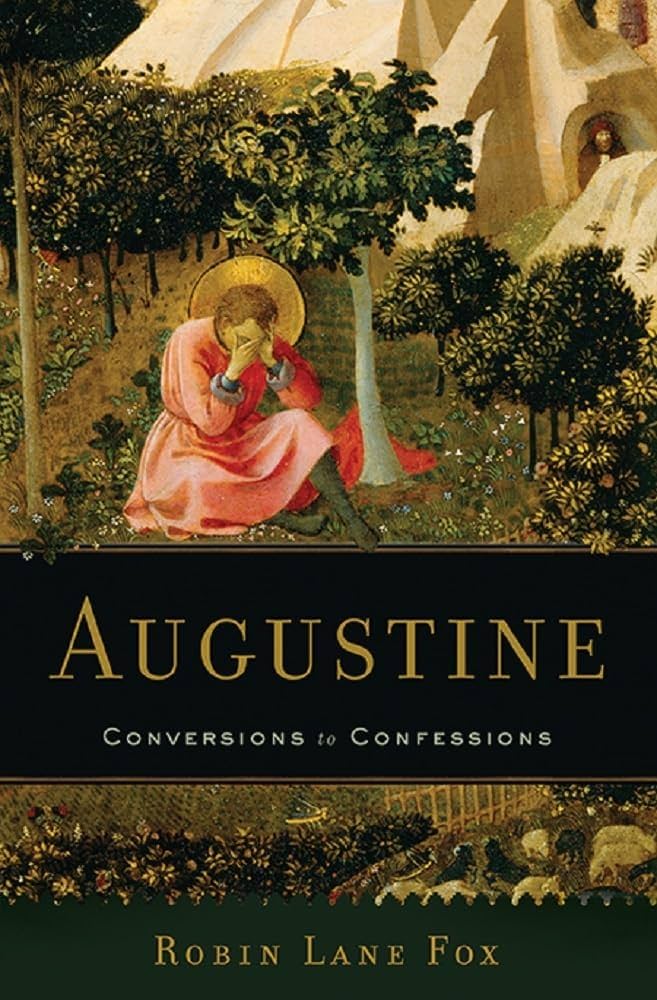
Robin Lane Fox’s Augustine: Conversion to Confessionsexamines roughly the first half of the great Christian saint’s life, leading up the Augustine’s most famous written work, Confessions.
Augustine as a Parish Priest
Augustine had survived becoming a priest in 391, after having only received baptism four years earlier. Augustine’s career as a churchman was now in full swing. This was ten years after the second great ecumenical council met, the Council of Constantinople (381), where the Nicene Creed, which was originally drafted in 325, was finally completed. By the end of the decade, Augustine is thought to have finished his most well-known work, the Confessions.
Among the other great church leaders Augustine corresponded with, Augustine wrote Jerome, the polyglot ascetic scholar a few years older than Augustine, who was working on a new translation of the Bible, the Vulgate, from the Hebrew where it was warranted, into Latin. Augustine quarreled with Jerome primarily over two subjects. First, Augustine was not in favor of Jerome’s efforts to translate the Old Testament directly from Hebrew, preferring the Greek Septuagint instead, the primary Old Testament translation used by Greek-speaking Christians. Augustine was concerned that various Latin translators had difficulty trying to render the Hebrew into Latin accurately, and Augustine wondered if Jerome would make the same kinds of errors. Jerome, who certainly knew the ancient languages much better, was not impressed with Augustine’s objection.
Augustine also was concerned with Jerome’s interpretation of Galatians 2:11-21, where Paul in his anger rebuked Peter. Peter had refused table fellowship with Gentile believers, preferring to eat only with Jewish Christians, an act which infuriated Paul.
Jerome was persuaded that Paul was merely pretending to be angry with Peter. Jerome did not find an “angry Paul” to be consistent with his image of a pious Paul at such odds with Peter. Jerome supposed that Paul employed a display of an “angry Paul” in order to teach to the Galatians a theological point. Augustine, on the other hand, believed that Jerome’s view suggested that Paul was being deceptive, and that this was unbecoming to think that this form of lying could be found within the text of God’s Word (Fox, p. 667ff).
Augustine’s engagement with Jerome on this helped to spark what would become Augustine’s last book he wrote as a priest, On Lying. The Bible has several incidents whereby people lie, but then are praised for their deception. Fox notes that in Exodus, the Egypt midwives told lies in order to protect newborn sons of the Hebrews, and yet God caused them to prosper (Fox, p. 653). Rahab in the Book of Joshua lies to her fellow Jericho people, telling them that the Hebrew spies left a long time ago, all while they hid in her house, and yet Rahab is praised as a hero of faith in Hebrews 11:31. In John 7:8-10, Jesus himself says to his brothers that he was not going up to the festival, but later on he went anyway in private.
Fox observes that Augustine believed that “if lies and pretence are once admitted in the scriptures, they will spread far and wide. Like destructive moths or worms, he now says, they will consume whole chests of clothing until nothing but shreds remain” (Fox, p. 757). But considering that Augustine acknowledged that even Jesus did not tell the whole truth to his disciples, Augustine reread his text and found it “thorny,” and so never published it with his other works (Fox, p. 653). Augustine was perhaps right to call out Jerome on his peculiar view of Paul’s dispute with Peter in Galatians, but even Augustine never felt completely satisfied with his own answer to Jerome on the question of deception in Scripture.
Augustine was continuously wrestling with other challenges he found within the text of Scripture. Until 395, Augustine had pretty much accepted the common view based on the Book of Revelation that a one thousand reign of Christ on earth will follow Christ’s return, prior to God’s final judgment. Christians today would call this view of the future “premillennialism,” that the return of Christ will precede an earthly millennial kingdom. However, Augustine changed his mind on this, believing that there would be no such earthly millennial period. This millennial period was more figurative, and that the peace and rest a believer would experience would be delayed until after God’s final judgment (Fox, p. 670). This gave birth to the idea that the reign of Christ, symbolized by the millennium, was actually the age of the church, a view typically known today as “amillennialism.”
Augustine also wrestled with how to interpret God’s hatred of Esau and love for Jacob in Romans 9. Originally, Augustine believed that God simply foreknew whether Esau and Jacob would freely choose faith. But Augustine came to reject this interpretation, thinking that this still made salvation dependent to a certain degree on human effort, something that went contrary to his understanding of the workings of God’s grace (Fox, p. 675). Yet Fox acknowledges that Paul’s treatment of Esau and Jacob in Romans 9 had to deal with the calling of Israel and the Gentiles. It had nothing to do with Esau and Jacob as individuals and their relationship to Adam and the fall. Fox believes that Augustine misread Paul in Romans 9, as Augustine was preoccupied with questions about grace and human freewill, in his wrestling with his Manichee past (Fox, p. 678). A number of believing Christian scholars today concur with Fox’s conclusion.
Augustine as the Bishop of Hippo
Bishop Valerius saw that Augustine was more than quite capable in his rhetorical skills, and Valerius had become quite elderly and needed someone to succeed him. So he had Augustine promoted to bishop as well there in Hippo in 396. Less than a year later, Augustine began working on his most famous and influential literary work, Confessions.
The Confessions of Saint Augustine serve as the terminus for Fox’s biographical narrative of Augustine’s life. In the Confessions, Augustine admits of his sins which had kept him from knowing God. Much of the Confessions is an exploration into the deeper meaning behind one of Augustine’s most memorable quotes:
“Great You are, O Lord, and greatly to be praised… You have made us so as to turn to You and our heart is restless until it finds rest in You” (Quoted in Fox, p, 710-711).
In the Confessions, Augustine finds deeper meanings found within the opening chapters of Genesis. For example, whereas the text of Scripture teaches that humans are to “be fruitful and multiply,” this was difficult for someone like Augustine who was now committed to his celibate ideals. Instead, he interprets Genesis on this point to command that one should “multiply” fruitful meanings while pondering on Scripture (Fox, p. 740). Instead of holding to the help of Mani, the “Paraclete,” his former mentor, to reveal the meaning of the Scriptures, he holds to “the true Holy Spirit,” in discerning the “allegorical meanings in the text” (Fox, p. 748).
Augustine continued to be troubled by Manichaean attempts to dismiss what was considered to be rather crude statements found in the Bible, particularly in the Old Testament. As a result, Augustine continued to accept Ambrose of Milan’s allegorical method of interpretation as a satisfying apologetic for Christianity. But such allegorical readings have had their downsides, as in Augustine’s belief that the closure of a gate in Jerusalem spoken of by the prophet Ezekiel symbolized the perpetual virginity of Mary.
Augustine as a Biblical Interpreter
Fox points out that Augustine had a habit of overreading certain allegorical interpretations into biblical texts in ways that strain at credulity. Augustine took the “tunics of skins” (Genesis 3:21) which Adam and Eve were given after the fall in the garden to symbolize human mortality. When Genesis 1:1 says that: “In the beginning, God made heaven and earth,” Augustine read this as saying that this “in the beginning” should be read as “in Christ” (Fox, p. 543).
But such allegorical and other misreadings were not entirely his fault. The Latin translations of the Bible Augustine were depending on were flawed at certain points. Psalm 4:8 reads like this in many modern translations:
“In peace I will both lie down and sleep; for you alone, O Lord, make me dwell in safety” (ESV).
Yet in Augustine’s Latin translation, it read as:
“In peace in ‘it itself‘ I will go to sleep and take my slumber. You, O lord, set me in hope.”
The phrase “it itself” was a Latin mistranslation of a Hebrew word often omitted in modern translations to simply mean “at once” (the Lexham English Bible being a notable exception which includes the phrase: “In peace I will lie down and sleep at once“). But Augustine took the Latin rendering to be a reference to God, to make it read as “In peace, in God I will go to sleep and take my slumber.” Augustine uses this interpretation of the Latin mistranslation to mean “God” some 1700 times in his writings.
This just goes to show you that simple, inconsequential misreadings of the Bible can have a ripple effect in how we read the Bible. Let that be lesson for all of us who read and take the Bible seriously!
Furthermore, the last word of the verse in Augustine’s Latin, “hope,” was yet another Latin mistranslation of a Hebrew word preserved in our modern translations as “safety.” “Hope” and “safety” can have overlapping meanings, but the two concepts are not identical. Fox comments that if Jerome, who undertook a major effort to produce an authoritative Latin version of the Bible, the Vulgate, had read Augustine’s commentary, “he would have acidly dismissed it as based on a Latin translator’s cluster of errors” (Fox, p. 458-459).
The three lusts, an important part of Augustine’s theology of sin, are described in 1 John 2:16:
“For all that is in the world, the lust of the flesh and the lust of the eyes and the boastful pride of life, is not from the Father, but is from the world.” (NASB).
The Greek word translated as “boastful,” in the third lust, was mistranslated in Augustine’s Latin Bible as “curiosity.” But Augustine’s Latin better fit the three lusts which delayed his own conversion: “the pleasure of the flesh, misplaced curiosity and worldly ambition.”
Augustine was certainly “curious” in his sinful misdeeds, but to be “curious” is not the same as to be “boastful.”
Another example of Augustine working with poor Latin translations of the Bible is found in Romans 7:24-25a. In an modern translation like the ESV, we read:
“Wretched man that I am! Who will deliver me from this body of death? Thanks be to God through Jesus Christ our Lord!”
However, in Augustine’s Latin translation, which Augustine never bothered to check in Greek because his knowledge of Greek was so poor, the “thanks” at the beginning of verse 25 was rendered “grace,” as in the “grace of God through Jesus Christ” would deliver him from this body of death (Fox, p. 557). This was a case of the right teaching derived from the wrong verse.
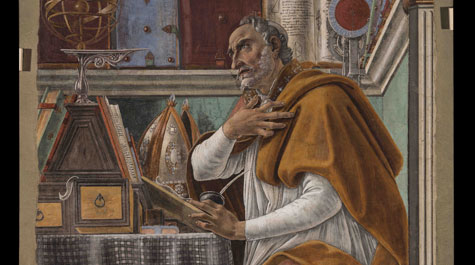
Sandro Botticelli, Sant’ Agostino nello studio (Saint Augustine in the studio), Fresco, Chiesa di San Salvatore in Ognissanti, Florence.
“Therefore, just as sin came into the world through one man, and death through sin, and so death spread to all men because all sinned—”
Correctly translated, “death” is the subject of the phrase “death spread to all men because all sinned.”
Augustine’s Latin version which he used mistook the “because” to be “in whom.” In this mistranslation, the subject is misplaced and thought to be a reference to the “one man,” namely Adam, “in whom all sinned“:
“Therefore, just as sin came into the world through one man, and death through sin, and so death spread to all men in whom all sinned—”
This gives the wrong impression that not only do we inherit a proclivity towards sin, due to Adam’s example, we are also declared guilty of Adam’s sin. Augustine’s dispute against Pelagius depended a lot on this notion of imputed guilt, not simply a proclivity towards sinful actions, being bestowed on all humans following Adam. Not only are we responsible for our own sin, we are also made responsible for Adam’s sin, a misinterpretation of the Bible which has been passed down through the ages (Fox, pp. 667, 677).
When coupled with Augustine’s belief about the sacraments, in his dispute with the Donatists, Augustine’s doctrine of original guilt has cast a shadow over the Western church. The Donatists had made it a habit to rebaptize orthodox Catholics who had received their original baptism from a discredited priest. Since the Bible taught that there is only one baptism (Ephesians 4:4-6), to be rebaptized by anyone was considered a grave sin.
Augustine’s response was that the moral disposition of the priest performing baptism could not invalidate the sacrament of baptism, assuming the baptism was done correctly: if it was administered by water, if it was performed in a Trinitarian matter of being baptized in the name of the Father, the Son, and the Holy Spirit, and if it was done with the intention of performing the sacrament.
So if a Donatist were to baptize someone, who had not been baptized before, and that person was received back into the orthodox Catholic church, that person need not undergo a rebaptism. It was the act of baptism that mattered, not the one administering the baptism, which corresponds to the Latin formula: ex opere operato. However, in conjunction with the doctrine of original sin/guilt, as Augustine understood it, this meant that any unbaptized child would effectively be damned if that child died before they received baptism. For Augustine, baptism was considered to be the means by which grace was given to the person, a fundamental idea in Augustine’s theology of sacraments, which eventually became a flashpoint in the 16th century dispute between Protestants and Roman Catholics.
Augustine developed much of his doctrine of grace in his later years with his dispute with Pelagius. However, since the dispute with Pelagius came after writing of the Confessions, Fox does not explore this in Augustine: Conversion to Confessions.
Critical Reflection on Fox’s Augustine: Conversion to Confessions
Lane Fox knows an enormous amount about the ancient world and brings his vast learning to bear in an eloquent and fascinating way. Digression is his strength, as whole chapters are taken up with studies of Manichaeism, Neo-Platonism, and the like. These descriptionsare worth the price of the book.
In reading Fox’s Augustine: Conversions to Confessions, you will discover a wealth of information about the ancient world, a treasure that has helped to get me hooked on learning more about ancient history. This is spectacular. Nevertheless, Bray concludes that Fox’s work on this first half of Augustine’s life is not without fault:
But it’s when we come to the heart of the matter that Lane Fox lets us down most. His account of Augustine’s conversion contains an extended examination of the possible meaning of“tolle lege,” which led Augustine to take up Paul’s letter to the Romans. This is followed by an equally lengthy examination of the possible meanings of the text that moved his heart to turn to Christ. In the end, he concludes Augustine got it all wrong but remained convinced God had spoken to him anyway. His life was turned around, but only by mistake!
I read that section of Fox’s narrative and walked away from it like Bray has done. Fox offers some cogent critiques of Augustine’s interpretations of the Bible, but not all of his critiques work as well. As a committed non-believer, Robin Lane Fox’s presentation of Christianity as articulated by Augustine in his Confessions is vulnerable to critique.
For example, Fox claims that Augustine “evades the word ‘all’” in 1 Timothy 2:3-4, which says that “God our Saviour… wills that all men should be saved.” For Augustine, this “all” means “many” or “all sorts,” as in “all kinds” of people will be saved (Fox, p. 674).
Presumably, Fox’s assertion that when Augustine “evades the word ‘all’,” Fox means that the plain reading of 1 Timothy 2:3-4 is teaching a doctrine of universal salvation, a doctrine that Augustine does not accept. After all, Augustine was one of the most influential of the church fathers to teach the doctrine of eternal conscious torment. In Augustine’s mind, the experience of an eternal hell was not simply a psychological or sociological kind of torment, but it was a physical one as well. As New Testament scholar Paula Fredriksen says in her epic work, Augustine and the Jews, reviewed elsewhere on Veracity, Augustine actually envisioned that the number of the saved within the whole of humanity would actually be very few.
But leaving aside those weightier concerns about the ultimate fate of non-believers, Augustine’s interpretation of 1 Timothy 2:3-4 is not necessarily an evasion as Fox argues, as other contemporary commentators suggest that Augustine might be at least somewhat correct here, even if the text itself is not entirely clear. Many translations today take the forceful edge off of God being the one who “wills” that all individuals be saved and indicate that it is God’s “desire” that all individuals be saved, a less deterministic posture. Here is how the ESV renders the passage:
This is good, and it is pleasing in the sight of God our Savior, who desires all people to be saved and to come to the knowledge of the truth.
Fox’s assumptions about what the Bible actually teaches does not end there. Fox dismisses the story of creation as told in Genesis is “untrue,” from the viewpoint of modern science (Fox, p. 224). Fox claims that the Old Testament “predicted nothing about Christianity” (Fox, p. 228). Fox adds that “critical readers nowadays recognize no such harmony in the Gospels,” which reconciles the differences between those Gospels (Fox, p. 270).
This should suffice to say, that not all biblical scholars engaged in historical criticism come to the same conclusions Fox finds so compelling, as readers of the Veracity blog will know (see particularly the review of Jesus Contradicted, by Michael Licona). Augustine sought to harmonize discrepancies which he acknowledged existed in the Bible. But as New Testament scholar Michael Licona has shown, Augustine saw some limits to common harmonization techniques. When Augustine ran into such difficulties, he would look for a deeper spiritual meaning found within the text of Scripture.
For example, according to Michael Licona, Augustine recognized a discrepancy between Mark’s version of Jesus’ baptism and Matthew’s version of Jesus’ baptism. When the voice from heaven speaks, Mark 1:11 reads:
And a voice came from heaven, “You are my beloved Son; with you I am well pleased.” (ESV)
Yet in Matthew, the same verse reads (Mathew 3:17):
And behold, a voice from heaven said, “This is my beloved Son, with whom I am well pleased.” (ESV)
It is as though in Mark the voice is speaking to Jesus himself, whereas in Matthew the voice is speaking to the crowd that was listening in.
A persistent harmonizer might conclude that the voice said both of these statements, once to Jesus and then once to the crowds, or vice-versa. But Augustine thought that this was a more improbable way to interpret the text, and taking harmonization way too far. For some might be tempted to say that the entire narrative about Jesus’ baptism happened multiple times. However, such a judgment would be far fetched, as the Gospels consistently portray Jesus’ baptism as a once in time event.
Instead, Augustine concluded that perhaps Mark is giving us a verbatim account of what was said, whereas Matthew is reframing the heavenly speech in order to instruct the crowds, suggesting a more spiritual dimension. The meaning of what the text is saying is preserved across the Gospels, regardless of how the Gospel author articulates the exact verbiage of the voice. Augustine’s approach to this text offers an improvement over his typical Ambrosian tendency to look for an allegorical interpretation, when faced with such difficulties.
As Augustine put it in his Harmony of the Gospels, the Gospel authors intentionally introduced such differences, while preserving the meaning:
…. At the same time, while preserving the sense intact, they use different modes of expression in reproducing the terms of the voice which came from heaven.
While Augustine at times shook off a strict kind of harmonization as unnecessary, he nevertheless found the Gospels to be compatible with one another, sharing the same essential message, even with a more nuanced understanding of what constitutes “harmony.” This would go against Fox’s inclination towards skepticism, which suggests that there is “no such harmony” between the Gospels.
While I do not share in Dr. Fox’s ultimate conclusions regarding Christianity, I still find him to be a compelling and fascinating writer. I have the Kindle version of Augustine: Conversions to Confessions, but I was primarily engaged in the Audible version, read by Michael Page. On a long road trip to Indiana last year, Augustine: Conversions to Confessions, clocking in at 25 1/2 hours, made for a good companion that kept me alert the whole way.
It remains to be seen whether or not Robin Lane Fox will continue with another book examining the life of Augustine following the Confessions. Augustine was roughly 43 years old when he worked on the Confessions. He would go on to live another 33 years of service as a Christian bishop in Hippo, until his death. After enjoying Augustine: Conversions to Confessions, I hope that Dr. Fox might continue on and complete this biography of this extraordinary and influential Christian leader and thinker of the early church.
For other Veracity blog posts about Augustine, see the following:
Saint Augustine of Hippo is the most influential early church father of the Western church. Numerous church doctrines, such as original sin, have the indelible stamp of the late 4th / early 5th century North African bishop imprinted upon the minds and hearts of millions of Christians down to the present day.
Roman Catholics look to Augustine for understanding the theology of sacraments, while all of the major magisterial Protestant leaders of the 16th century owe a debt to Augustine. Martin Luther himself was an Augustinian monk when he nailed his famous 95-theses to the Wittenberg church door. Even the Eastern Orthodox look to Augustine as one of the primary doctors of the church.
During his long tenure as the bishop of Hippo, Augustine was known to be a writing machine. At one point he employed two full time secretaries which allowed him to dictate the books he was writing. To date, there are still works by Augustine that have not been translated into English. The man was a towering intellect, impacting a great deal of Western thought that even non-Christian scholars and other readers come back generation after generation to study.
Pope Boniface VIII in the 13th century named him one of the four great Doctors of the Church, alongside Ambrose, Jerome, and Pope Gregory the Great. Augustine wrote what many believe is the first Western autobiography, the Confessions, chronicling his journey as a rebellious teenager and libertine, to become a stalwart defender of historic orthodoxy Christianity.
Much of what many Christians today take for granted as to “what the Bible says” stems back to the life and mind of this North African Christian. How did this former sex-addict turned bishop of the church become so influential?
Robin Lane Fox’s Augustine: Conversion to Confessions examines roughly the first half of the great Christian saint’s life, leading up the Augustine’s most famous written work, Confessions.
From the Christianity Along the Rhine blog series…
Zwingli was in a tight spot. With radical Anabaptists on the one side and Roman Catholic papist defenders on the other, Zwingli saw himself as a defender of true reformation. He rejected what he perceived to be the excesses of Rome, while pushing back against the dangerous foolishness perpetrated by the Anabaptists, like his former friends, Konrad Grebel and Felix Manz. In his mind, his way was a moderate path between two extremes. It was with this posture that Zwingli hoped to form an alliance with his contemporary Reformer from Germany, the former Augustinian monk, Martin Luther. But such a dream was not to be realized.
Following the first part of a two-part “travel blog” series, we now look a bit more at the story of Huldrych Zwingli of Zurich, and what led towards his tragic end.
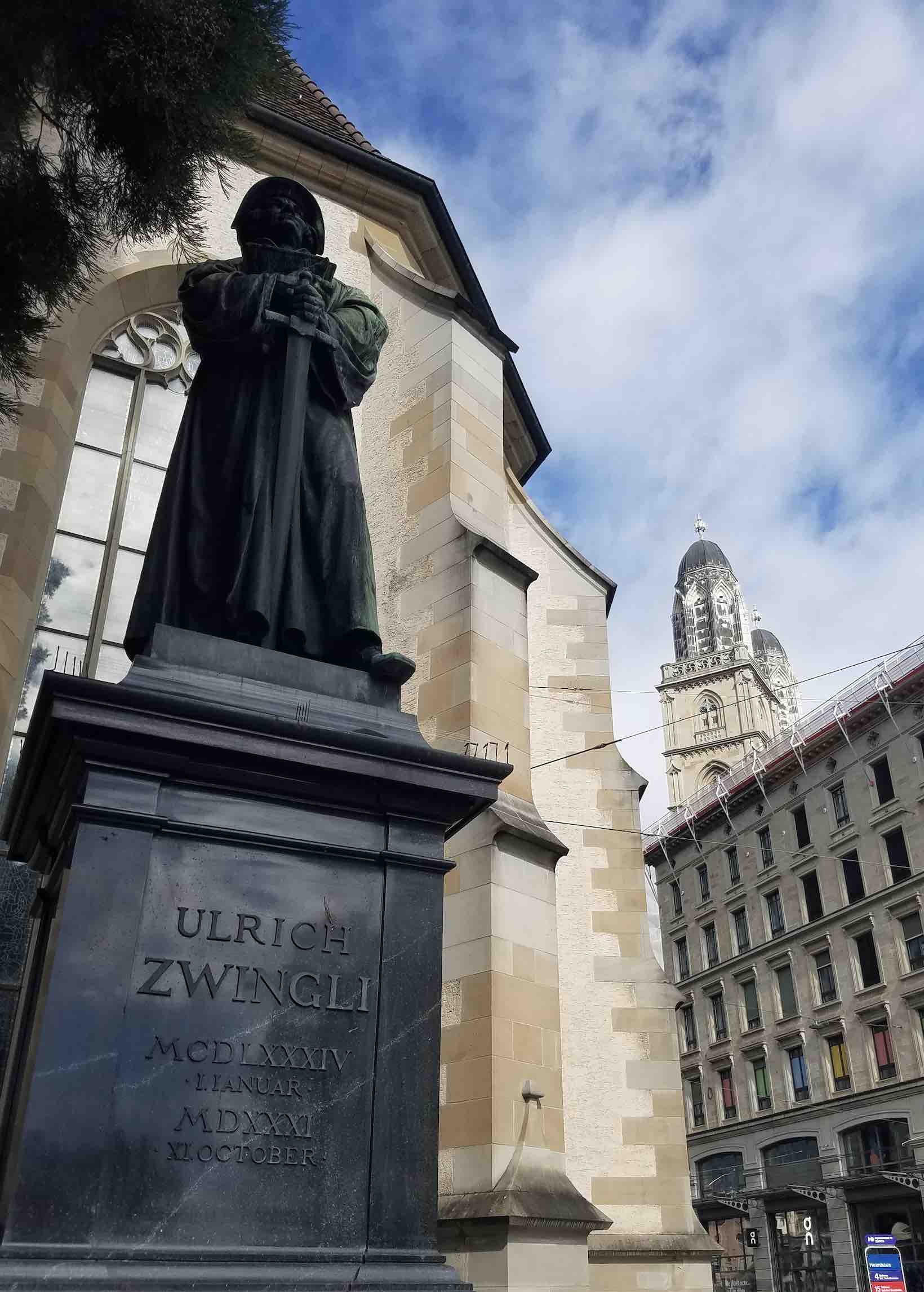
Zwingli’s statue in Zurich, with the Grossmünster Church where he preached, in the background, towering above on the right. My photo from October, 2025.
Clashing Visions of Reform: The Swiss Huldrych Zwingli and German Martin Luther
The Swiss Zwingli and the German Luther operated independently, while both were originally drawn into reformed thinking through the work of Desiderius Erasmus. Erasmus had published a new authoritative Greek New Testament. Both Zwingli and Luther devoured Erasmus’ writings, springing them into action, hoping to reform the Roman church. Both men reasoned that an appeal to Scripture, and Scripture alone, would guarantee the right path to genuine reform. But it soon became apparent that the two preachers would not be able to agree. There was no “we agree to disagree” sentiment at this stage of Protestantism, particularly on serious matters like the Lord’s Supper.
Yet some of the disagreements were relatively minor. According to Bruce Gordon, author of Zwingli: God’s Armed Prophet, there was to be no singing in Zurich’s churches, unlike what was taking place in Luther’s Wittenberg. Zwingli’s singing-free worship was based on his appeal to Amos 5:23:
“Take away from me the noise of your songs; to the melody of your harps I will not listen.” ‘What would the rustic Amos say in our day,’ asked Zwingli, ‘if he saw and heard the horrors that were being performed and the mass priests mumbling at the altar…Indeed, he would cry out so that the whole world could not bear his words.” (Cited by Gordon, p. 140).
Even more moderate Reformed churches sympathetic to Zurich, with contemporary colleagues like Martin Bucer in Strasbourg and Johannes Oecolampadius in Basel, would not go as far as Zwingli and ban all singing. Yet contrary to common opinion, Zwingli did not hate the arts. He was a fine musician himself, and he “had a deep conviction that music had a power over the soul like no other force” (Gordon, p. 140). Zwingli’s own music was composed for house gatherings, not congregational worship settings (Gordon, p. 141). Luther, on the hand, composed music for corporate worship, hymns which have endured to this day.
Luther’s engagement with Erasmus eventually turned sour, just as Zwingli’s relationship with Erasmus did, but over a different issue. Luther disputed Erasmus over the doctrine of election, articulated in Luther’s Bondage of the Will, leading Luther to have a strong view of predestination. Like Luther, Zwingli believed that “according to God’s pleasure and will, hidden from all humans, the election of some and not others was decreed before the moment of creation. Predestination therefore preceded faith, as only those whom God chose would come to believe” (Gordon, p. 158). However, Zwingli was not as strident as Luther, and from what can be gathered from his writings did not clash with Erasmus on election. Instead, Zwingli put an emphasis on divine providence.
“[Zwingli] was repeatedly optimistic: God is good and benevolent, inviting humanity into his revelation. Men and women can have absolute assurance in divine providence, which orders all things for the good and without doubt. God is absolutely provident or is not God” (Gordon, p. 180).
So, Zwingli and Luther had their differences. But could those differences be worked out?
Zwingli rarely left Zurich, mostly out of concern for his safety, as he was a wanted man in traditional Roman Catholic circles. But Zwingli wanted to find out if he and Luther could find common ground, in order to further the advance of genuine reform against what both saw as a corrupt papacy. Zwingli was hopeful that he and Luther would be able to get along well. Both parties agreed to travel at the invitation of Philip of Hesse in Marburg, in order to have a dialogue. However, both men were already aware of what the other thought about the Lord’s Supper, and the two differed substantially.
The story goes that Zwingli removed the organ from the Grossmünster Church, taking music out of the church, only to eventually return the organ years later. Ironically, Zwingli was a rather accomplished musician himself, writing songs for private use, but who believed that medieval church practices had warped the use of singing in worship.
Both Zwingli and Luther rejected the medieval doctrine of transubstantiation, but little common ground was found with respect to anything else regarding the Lord’s Supper. For Luther, Jesus’ own words “this is my body,” as in Luke 22:19, as Paul’s same language in 1 Corinthians 11:23–25, was to be taken at face value. This was no mere symbolism for Luther. “Christ had meant what he said” (Gordon, p. 175). Christ was and is indeed physically present in the sacred meal.
Zwingli appealed to John 6:63, “The flesh profits nothing,” to make the more symbolic argument:
“At heart was an unshakeable conviction that Christ could not be physically present in the bread and wine of the meal….after his resurrection the Son ascended to the right hand of the Father, as the creeds of the Church declared….The meal, Zwingli believed, was a memorial to Christ’s passion and resurrection, to the salvation of the faithful….For centuries, Christian theologians had rejected the Passover as having no place in the Church. For Zwingli, it was the key to understanding Christ’s meal” (Gordon, p. 170-171).
Luther dismissed Zwingli’s response as depending on a form of human reason that could not demonstrate any article of faith. To say that Christ could not be in the world, because he sat at the right hand of the Father was utterly false (Gordon, p,. 175). Luther’s rejection of Zwingli was harsh, describing the Swiss preacher as “perverted” and “lost to Christ“:
“I testify on my part that I regard Zwingli as un-Christian, with all his teachings, for he holds and teaches no part of the Christian faith rightly. He is seven times worse than when he was a papist” (Cited by Gordon, p. 176).
An impasse was reached. While other theological matters were largely agreed upon, the controversy over the Lord’s Supper could not be resolved. A statement was drafted that both Zwingli and Luther could agree that Christ is present at the Lord’s Supper, but that was only a tenuous matter that could not be held together for long. Full reconciliation was lost. Zwingli broke down in tears, wishing that both men could still find some common bond of friendship. Luther, on the other hand, could not see Zwingli as a fellow brother in Christ. Zwingli had willfully denied the teaching of Scripture, crossing a line for Luther in the mind of the preacher from Wittenberg (Gordon, p. 179-180).
The gap between Zwingli and Luther only widened after the Colloquy of Marburg. Zwingli had a more humanist background than Luther, believing that in some cases even pagans could be saved. In an effort to win over the King of France to the Zurich cause, Zwingli had listed the King of France, as well as pious pagans of history like Socrates and Cato, as being among God’s elect. Luther was scandalized by Zwingli’s willingness to believe that such “idolaters” were among the saved (Gordon, p. 238-239). Like his one-time mentor, Erasmus, Zwingli was enamored by the classical world, believing that the greatest thinkers of the Greco-Roman past, prior to the emergence of New Testament Christianity, were essentially in alignment with Christian values and mindset.
With hopes for reconciliation with Luther dashed at Marburg in 1528, Zwingli continued out on his own in his opposition to the papacy. Yet Zwingli had grown more strident in his resolve against his Protestant critics. In particular, his patience with the Anabaptists had run out. Just two years earlier in 1527, his former friend, Felix Manz, was publicly drowned in Zurich by city officials after being re-baptized. Zwingli made no effort to intercede on behalf of his old friend.
Shortly before his death, Manz wrote a letter with a stinging critique of Zwingli:
“Unfortunately, we find many people these days who exult in the gospel and teach, speak and preach much about it, yet are full of hatred and envy. They do not have the love of God in them, and their deceptions are known to everyone. For as we have experienced in these last days, there are those who have come to us in sheep’s clothing, yet are ravaging wolves who hate the pious ones of this world and thwart their way of life and the true fold. This is what the false prophets and hypocrites of this world do” (Cited in Gordon, p. 191-192).
To the Anabaptists, Zwingli embodied the worst form of self-righteous bigotry one could imagine. Zwingli’s concern was just the opposite.
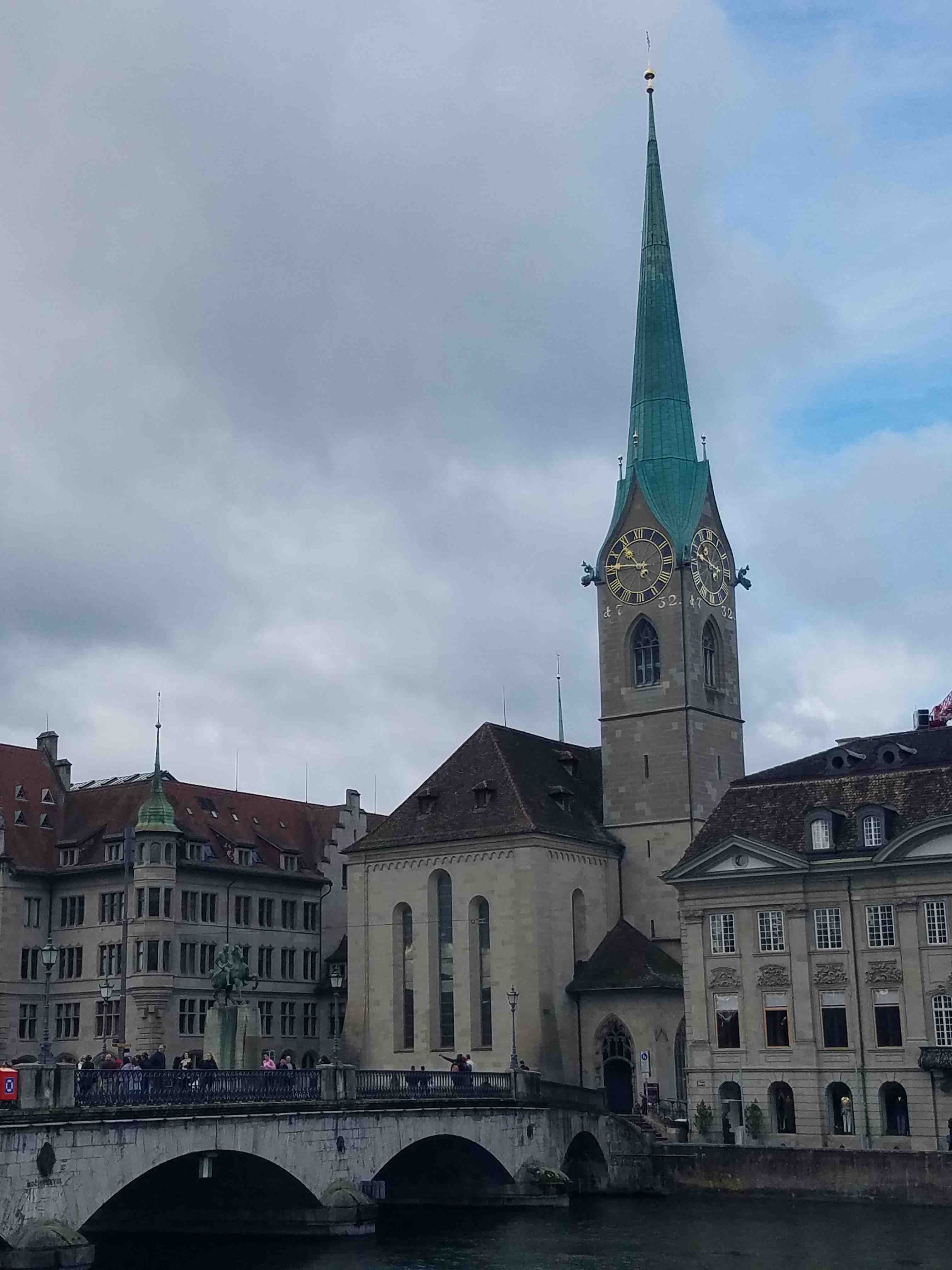
A female abbey was founded in Zurich in 853. But in the early 16th century, preaching from Zwingli ended up encouraging the abbess to dissolve the abbey, and the property became the Fraumünster Church.
Zwingli Against the Anabaptists
Zwingli’s response was just as caustic, casting the Anabaptists as having the spirit of antichrist, by citing 1 John 2:19: “They went out from us, but they were not of us” (Gordon, p. 192, wrongly cites this as being from the Gospel of John). Behind all of Zwingli’s polemic against the Anabaptist desire for a pure church was Zwingli’s maturing view of the church visible and invisible, somewhat like what we find in various forms of Christian Nationalism today.
Zwingli viewed Anabaptism as a cancer which was hindering the true reformation movement, a cancer which must be eradicated. The spread of the Gospel was paramount, but it required the existence of a state sponsored church where non-believers and believers freely existed. There was no room for Roman Catholics and Anabaptists to practice their understandings of Christianity in Zwingli’s Zurich. Monasteries and nunneries were shut down in Zurich, whose inhabitants were encouraged to get married or otherwise leave the city. Catholics lost their seats on the city council.
Yet his Anabaptist critics faired no much better. Civil authorities in Zurich persecuted Anabaptists wherever they were found, with Zwingli’s blessing. The concept of religious freedom, so central to modern democratic visions of state/church relations, was completely foreign to Zwingli’s thinking.
In the year following the colloquy of Marburg, 1529, the emperor Charles V held a meeting with the Protestants in Augsburg, in hopes of trying to heal the breaches ruptured by the Protestant movement. Charles was terribly concerned that a breakdown in Europe would weaken the defence against the Turks who were on the doorstep of Vienna. Charles was hoping for a united Christendom to face the menace of the Turks, but instead the German Protestants gave him the Augsburg Confession. Charles rejected the Augsburg Confession, which became the defining confession of Lutheranism. But then there was Zwingli.
Zwingli submitted his own “Account of the Faith” for the Diet of Augsburg, where he took on all opponents, not just the Roman Catholics. For those who held to purgatory, they had no Christ. His views regarding the sacraments remained unchanged. Yet even friends of Zwingli, like Martin Bucer, were appalled by the intransigence of the tone in which Zwingli wrote. The Lutherans there realized that Zwingli had simply dug in his heels against them. Whatever agreement had been reached at Marburg, however fragile it was, had been broken by Zwingli. The Anabaptists were treated even far worse. Zwingli along with his Zurich city-state had become increasingly isolated (Gordon, p. 226-231).
Zwingli’s theology of how the state and church relate to one another was not entirely unique. During the medieval era in Western Europe, it was practically assumed that to be a European was to be Christian and to be a Christian was to be European, even with the presence of groups like the Jews which upset such a neat formula. Yet what made a number of Zwingli’s friends increasingly wary of the Zurich Reformer was Zwingli’s willingness to use force in order to defend his understanding of the church visible and invisible.
Even in the summer prior to Zwingli’s meeting with Luther in Marburg in 1529, hostilities between various Swiss city-states had broken out between Protestant and Catholic alliances, the First Kappel War. A peace was reached at the end of the conflict, but Zwingli believed the terms of the conflict to be an impediment to the spread of the Gospel.
Zwingli’s house: The marker above the door in English reads: “From this house he left on October 11, 1531 with the Zurich army to Kappel, where he died for his faith.”
The Death of Zwingli
Zwingli’s translation of the entire Bible into German began to be printed in 1529, even though the Swiss dialect could not compete with the influence of Luther’s Bible which came out a few years later (Gordon, p. 243). Zwingli fully believed that the cause of the Gospel was at stake, but it would take a military alliance among the Protestants to push back against Catholic resistance to Zwingli’s proposed reforms. But such an alliance seemed remote, as other Swiss Protestants hoped instead for peace and stability.
Failure of the Swiss Protestants to effectively unite emboldened the Swiss Catholic city-states to strike against Zwingli’s Zurich. By October, 1531, war had become inevitable. What began as a theological crisis with high hopes for reform some fifteen years or so earlier devolved into open military warfare. The city of Zurich sent troops out to meet the Catholic war party, and Zwingli donned armor as well and joined the Zurich military effort. When the defeated Zurichers returned later from the battle of the Second Kappel War, Zwingli’s wife Anna learned that she had lost son, her brother, her brother-in-law, and ultimately her husband, Huldrych Zwingli.
Zurich was ordered to pay reparations to the Catholic war effort, and while Zwingli’s reforms were not completely rolled back, Zwingli himself was blamed for the calamity inflicted upon Zurich. The people in the rural areas under Zurich’s influence were particularly incensed. They drafted a resolution forbidding any clergyman from meddling in civic and secular affairs, a clear rebuke against Zwingli’s memory (Gordon, p. 251-252).
Zwingli’s friends, like Martin Bucer in Strasbourg, lamented Zwingli’s death. Nevertheless, even Bucer in a letter to another reformer wrote about his disappointment with Zwingli’s proclivity towards war:
“I feared for Zwingli. The gospel triumphs through the cross. One deceives oneself when one expects the salvation of Israel through external means with impetuosity, and triumph through weapons . . . It greatly unsettles me that our Zwingli not only recommended the war but did so incorrectly, as it appears to have been the case, and if we are rightly informed” (Cited by Gordon, p. 258).
Luther’s response in Wittenberg to Zwingli’s death was not at all conciliatory. He was convinced that Zwingli died in sin and great blasphemy, as he wrote in his Table Talk:
“I wish from my heart Zwingli could be saved, but I fear the contrary; for Christ has said that those who deny him shall be damned. God’s judgment is sure and certain, and we may safely pronounce it against all the ungodly, unless God reserve unto himself a peculiar privilege and dispensation. Even so, David from his heart wished that his son Absalom might be saved, when he said: ‘Absalom my son, Absalom my son’; yet he certainly believed that he was damned, and bewailed him, not only that he died corporally, but was also lost everlastingly; for he knew that he had died in rebellion, in incest, and that he had hunted his father out of the kingdom” (Cited by Gordon, p. 259).
Luther would not have been able to succeed in the reformation of the church without the assistance of the power of the state, that much is true. However, Luther was much more cautious in linking together the church and the state than was Zwingli. Unlike Zwingli, Luther championed a theory of two powers, a spiritual kingdom associated with the church, being exercised through faith and the Gospel, and a temporal kingdom governed by the state, being exercised through efforts to maintain order and restrain sin. For Luther, the church should not exercise secular power and the state should not interfere with matters of conscience, a type of distinction which Zwingli would not recognize.
Zwingli’s capable successor in Zurich, Heinrich Bullinger, was a friend of Zwingli, but wisely chose not to respond to Luther. Even when John Calvin eventually came along to Geneva, Calvin barely mentioned the name of Zwingli in his writings. Calvin sought to find common ground among Protestants without appealing to Zwingli’s controversial legacy.
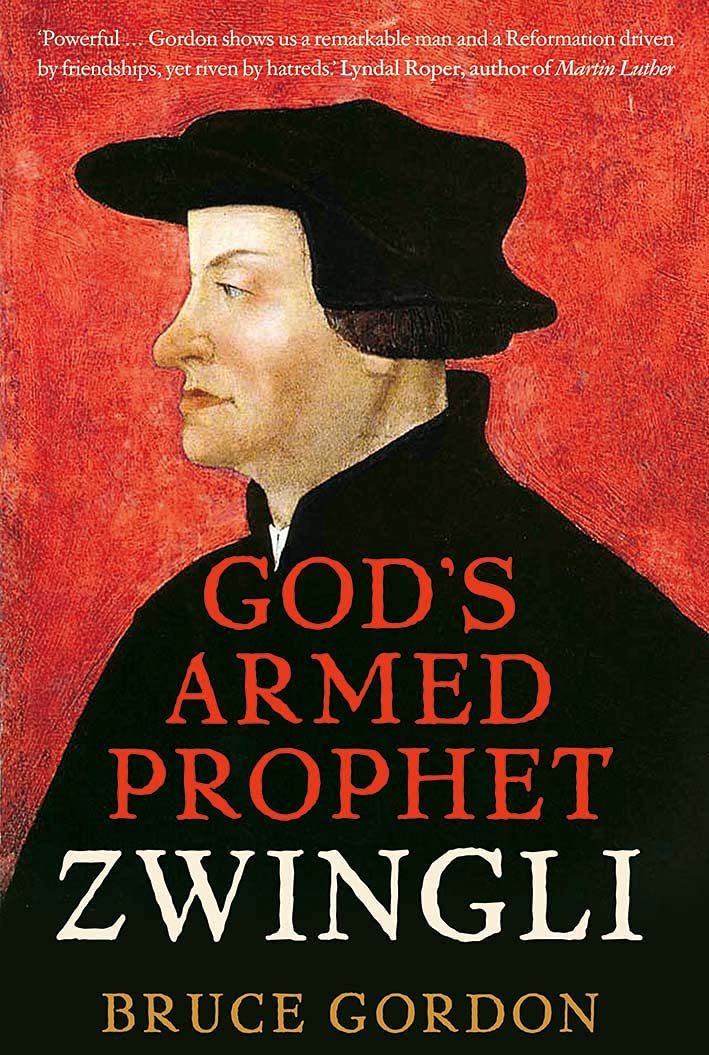
Zwingli: God’s Armed Prophet, by Bruce Gordon. I highly recommend this biography of the Swiss reformer of Zurich
Reflections on Zwingli, Particularly with Respect to Baptism and Church/State Relations
For me, Zwingli is in many ways a hero, a champion for preaching the Gospel, and an ardent supporter of verse-by-verse exposition of the Bible. He shocked his hearers when he set aside the standard medieval lectionary for preaching from certain texts of Scripture, and instead started with Matthew, chapter one, and worked his way verse-by-verse through the New Testament during his weekly Sunday sermons.
Zwingli did the right thing here. He did not skip over parts of the Bible that were uncomfortable. If the text mentioned something in his verse-by-verse analysis, he would address it straight from the pulpit. Today, many pastors stay away from verse-by-verse expository preaching, and stick to purely topical approaches to Scripture. Technically, there is nothing wrong with topic-oriented preaching, and topic-oriented preaching can offer a good change of pace. But the problem is that topic-oriented preaching often forces the preacher to skip over things in the text of Scripture that do not nicely fit in with the topic being focused upon. Zwingli, on the other hand, faced what was presented to him in his Bible head-on, with no skipping the hard stuff. Preaching from the text verse-by-verse leaves you with no other alternative. That, in and of itself, helped to spark the Reformation in his church in Zurich, creating the Protestant movement among the Swiss.
Yet Zwingli was a complex hero, with some serious rough edges. Zwingli remains a controversial and contradictory figure. I still puzzle over his views of the Lord’s Supper, preferring John Calvin’s third-way approach through the impasse between Zwingli and Luther. Luther overreached in his criticisms of Zwingli, but Zwingli could be just as stubborn.
Defenders of Zwingli say that the Zurich preacher was not a mere memorialist when it comes to the Lord’s Supper, and was willing to at least acknowledge the spiritual presence of Christ in the sacrament. Perhaps he was. But it is difficult to reconcile this with the tendency in certain Protestant circles, following Zwingli, to downplay the role of the Lord’s Supper in Christian worship, contrary to the historic emphasis on weekly celebration of the eucharist which has united the church for many, many centuries.
In my view, Erasmus was correct to be wary of Zwingli’s insistence on his own understanding of the perspicuity of Scripture. Scripture is indeed clear on the central articles of Christian faith. But Zwingli was naive to think that every Bible-believing person should simply be able to draw the exact same conclusions regarding the teaching of Scripture, which were in perfect alignment with Zwingli’s own interpretations of Scripture.
There is certainly a genuine interpretation of each and every passage of Scripture, based on the original intentions of the author, but every interpreter of the Bible must acknowledge their own fallibility when it comes to handling the text of the Bible. The Scriptures are indeed without error, but our human interpretations of the text are still prone to error, so each of us should approach the Bible with a sense of exegetical humility. If Zwingli had himself this kind of exegetical humility, it might have led him to live a much longer life and avoid the stain of controversy which still tarnishes his otherwise influential legacy to this very day.
Zwingli’s contradictions make him a fascinating figure to study. In many ways, I concur with much (though not all) of Zwingli’s understanding of baptism. Infant baptism does not save, but it does act as a New Testament parallel to the Old Testament understanding of circumcision.
Defenders of “credobaptism;” that is, “believer’s baptism,” who are critics of “paedobaptism;” that is, infant baptism, will often cite Colossians 2:12 in support of their view:
“….having been buried with him in baptism, in which you were also raised with him through faith in the powerful working of God, who raised him from the dead” (ESV).
As the argument goes, “baptism” is linked to the concept of having “faith,” therefore, baptism assumes that a candidate for baptism has exercised some form of believing faith, something which infants can not do. While there is substantial weight to this argument, it often ignores the verse prior to it which adds some important context, directly leading into verse 12:
“In him also you were circumcised with a circumcision made without hands, by putting off the body of the flesh, by the circumcision of Christ,….” (Colossians 2:11 ESV).
Paul is clearly linking the Jewish practice of circumcision with baptism in this passage. The Old Testament quite clearly shows that Jewish male infants were circumcised, so any opponent to paedobaptism must somehow wrestle with this, in how Paul is associating circumcision with baptism. But advocates of credobaptism have a good point to make in saying that we have no clear, undisputed New Testament example of infants being baptized.
I have good friends of mine who are pastors, who in good conscience, simply could not perform an infant baptism. I totally get that. In other words, different Christians standing in good faith hold to different positions regarding baptism.
Given the difficulty of resolving the debate over infant baptism, Zwingli’s unrelenting opposition to “believer’s baptism” comes off as most extreme. Zwingli’s efforts to stamp out the Anabaptists, standing aside as the state sought to violently punish these Anabaptists, was going way too far. Linking the power of the state with the enforcement of a contentious Christian doctrine clearly reveals the dangers of a Christian Nationalism, a lesson that Christians should be reminded of today.
Baptism is not a hill I am going to die on, and it should not have been for Zwingli either. Zwingli probably had the best of intentions. Perhaps Zwingli viewed the Anabaptists as a promoting a kind of “slippery slope” to spiritual anarchy, of some sort. Yet sadly, Zwingli weaponized baptism as a violent tool of the state, ultimately and utterly missing its Scriptural purpose.
The very nature of politics assumes that it is appropriate to use force to impose laws on people. Yet if people are not persuaded in their hearts and minds that a particular law is just, they will rise up in opposition to it. This is the very problem which Zwingli ran into, and which has since tarnished his otherwise remarkable legacy.
Far from squashing the belief in “believer’s baptism,” the opposite took place. The original Anabaptist impulse, which Zwingli tried to use the heavy-hand of the state to squelch, ended up unleashing a movement whereby “believer’s baptism” has become a very dominant feature of evangelical thought and practice in the 21st century.
—————————————————-
Charlie Kirk, outspoken Christian and political activist, in his last moments before being shot by an assassin. In my view, both Kirk and Zwingli had a lot in common.
Addendum: Is Zwingli A 16th Century Parallel to Charlie Kirk??
Zwingli’s fervent preaching of the Gospel, combined with his willingness to cozy up closely to the powers of the state, and even take up arms, should provide for us a cautionary tale. Within a month or so before our trip to Europe, walking the streets where Zwingli walked in Zurich, the Christian evangelist and conservative political activist, Charlie Kirk, was killed by an assassin. Videos of the shooting circulated for weeks on social media. The memorial service for Kirk held in Arizona featured speeches by both the American president and vice-president, with some 90,000 in attendance, while millions online viewed the service. The event was partly a Christian revival meeting, but also had the unmistakable tone of a political rally.
After my time in Zurich, upon reflection I think that Zwingli would have been right at home with Charlie Kirk’s blend of Christian revival and political conservatism. Zwingli, as a preacher, refused to stay in his lane, and combined his evangelical calling with political activism. Defenders of Zwingli celebrated his preaching of the Gospel. Zwingli’s message stirred up revival in a Switzerland living under centuries of medieval distortions of Christian faith. But his opposition to other sincere Christians who differed with him bred resentment from others.
A one-for-one correspondence between Zwingli and Charlie Kirk would be a misleading claim, as the circumstances of their respective deaths differ dramatically, and they lived in different cultural contexts. Nevertheless, the parallels between the two are striking. Both Zwingli and Kirk died as relatively young men. Both were evangelists. Both were strident in their beliefs, outspoken with their views, and were excellent communicators, organizers, and debaters. Both were known for their courage. Both lived with death threats issued against them. Both had close friends in high places. Both were fervent patriots. Both were misunderstood by many of their contemporaries.
Yet Zwingli’s wedding together of church and state proved to be an embarrassment for the great Reformer. Most people who think about the Reformation of the 16th century today immediately consider the names of John Calvin and Martin Luther. But Zwingli, who was just as influential, if not more so, has been a more controversial figure to grasp. Some 500 years later, Zwingli still remains relatively unknown.
Though separated by the centuries, the deaths of both Zwingli in the 16th century and Charlie Kirk in the 21st century have been tragic, even senseless losses.
The death of Charlie Kirk in September, 2025 ripped a hole in the American psyche. In many ways, the death of Huldrych Zwingli did the same thing for 16th century Europeans. It is extremely concerning when supposed Christians in response to Charlie Kirk’s death are acting out in ways that express violent rhetoric, as Christian apologist Jon McCray reported shortly after Kirk’s death:
I do wonder how many champions of Charlie Kirk today think about the complicated memory of Huldrych Zwingli, and what can be learned from the Protestant reformer of Zurich.
Some might think that my comments reflect a kind of wishy-washy, fake “third wayism,” which in some quarters gets a lot of harsh criticism today. If you want a helpful clarification as to what I am getting at, then take a few extra minutes and watch the following video by Christian apologist Gavin Ortlund, who makes a defense of the late Tim Keller, whose legacy has come under fire recently in the wake of Charlie Kirk’s death. Even if you come to the conclusion that a “third way” approach offered by a Tim Keller or Gavin Ortlund is inherently bad, at least make the step of acting in good faith and not misrepresent what a Tim Keller or Gavin Ortlund is saying:
Which is better: To be winsome and persuasive, or confrontational and combative? I favor the former over the latter.
Christians should be involved in the political process. But when Christians tend to elevate political concerns in such a way that the clear proclamation of the Gospel tends to get overshadowed and crowded out, great harm can be done. We can learn from church history, to avoid some of the terrible mistakes made in the past, a lesson we should not ignore. The story of Zwingli serves as a sobering example for us today.
Huldrych Zwingli is not as well known as the two leading lights of the 16th century Protestant Reformation, Martin Luther and John Calvin. But among the Swiss, Zwingli was the most influential of the Reformers … until he was killed in battle at age 47.
But if he was such an important historical figure, why do so few Christians know anything about Zwingli?
I think I know why: The irony of Zwingli’s death was that he was caught between his pride of the Swiss people and his hatred of the mercenary movement, whereby various European powers would offer pensions to Swiss men to go off and fight their wars. In the end, a combination of his Swiss pride and theology of the church overtook his rejection of military service, and he died at the end of the sword, all while preaching the Gospel. He was Zwingli: God’s Armed Prophet, the title of a fascinating biography of the Swiss Reformer by Yale historian Bruce Gordon.
Zwingli: God’s Armed Prophet, by Bruce Gordon, is the most recent biography of the great Swiss Reformer of Zurich.
A Visit to Zurich, Switzerland
My wife and I took a trip to Europe in 2025, spending a few days in Zurich, Switzerland, where I got to explore the city where this relatively unfamiliar giant of the Protestant Reformation preached his sermons, lambasted by both the Roman papacy and fellow Reformer Martin Luther. This is the first of two “travel blog” posts covering the often forgotten Huldrych Zwingli.
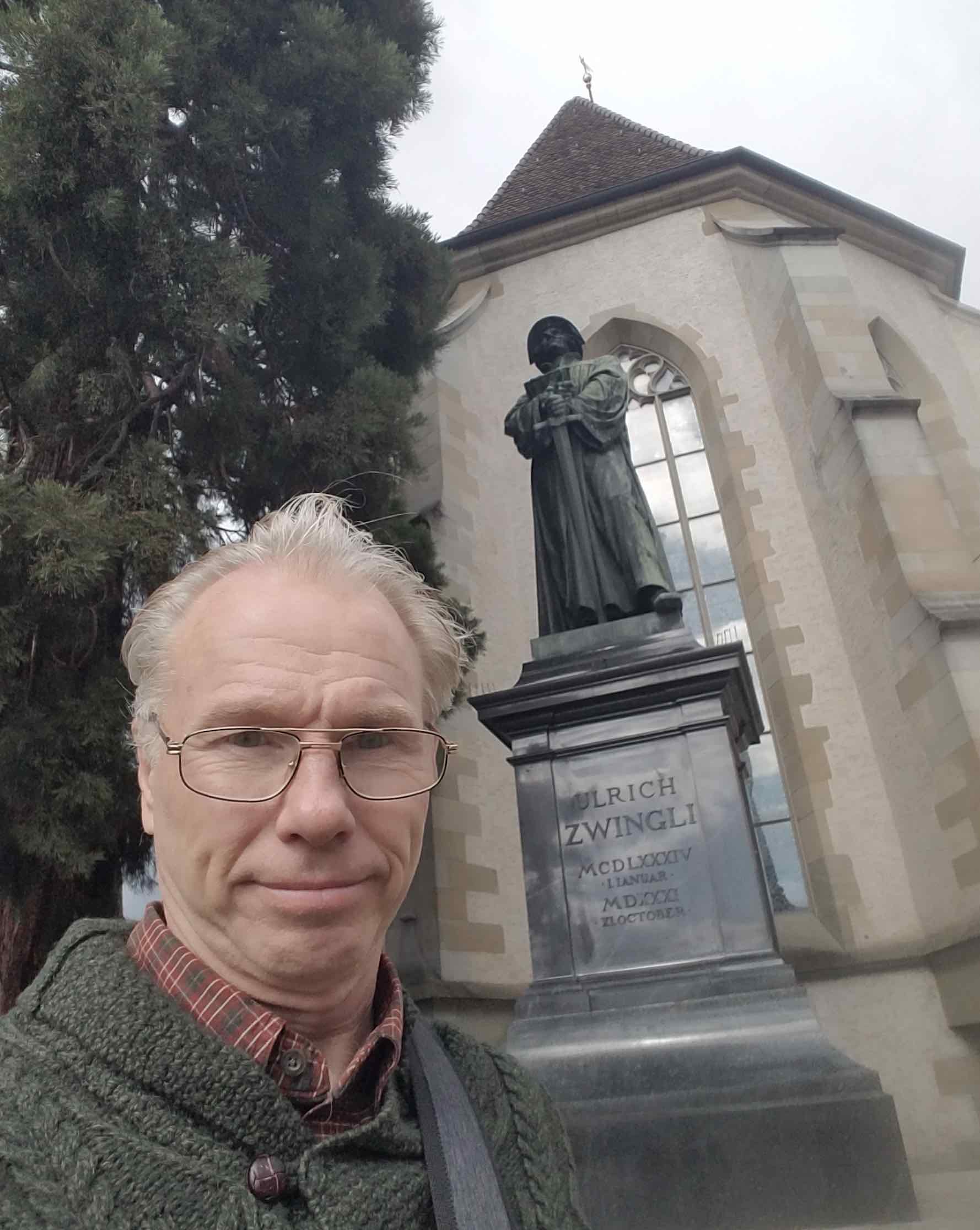
The church where Zwingli preached in the 16th century, the Grossmünster, still stands in the center of the city of Zurich. After taking a boat cruise on Lake Zurich, which feeds the Limmat River, I walked up the road just a block or so alongside the Limmat. There I found a statue of the Reformer, with both a Bible and a sword in hand, sculpted by the Austrian artist Heinrich Natter, and dedicated in 1885.
Many historians do not know quite what to do with Zwingli. The idea of a pacifist-leaning preacher, who ironically was killed in battle, proved to be just one of the many contradictions of Zwingli, sidelining his historical memory among the Protestant Reformers. He upheld the authority of Scripture, and Scripture alone, but when confronted by more radical reformers that infant baptism was not explicitly taught in Scripture, Zwingli felt compelled to support efforts by the civil magistrates to have such radical reformers put to death. Zwingli was known to be a proficient musician, and yet he banned singing in worship in his Zurich church. In his earlier years, he had a spiritual conversion experience all while engaging in multiple premarital sexual relationships as a priest, and being rather unrepentant about it.
As a result of such embarrassments, it is hard to find the bulk of Zwingli’s written works translated into English. Not so with Luther and Calvin, whose books are translated widely and are still read today. Nevertheless, it is difficult to imagine how the Protestant Reformation would have taken off as it did without the intellectual talents of Zwingli driving it along.
Unveiled in 1885, a statue of Zwingli stands in front of the Wasserkirche, or “Water Church,” in Zurich. The Reformer has both a Bible and a sword in his hands. I had the opportunity to explore the old city of Zwingli’s Zurich in October, 2025.
Zwingli’s Early Years
While Martin Luther taught in Wittenberg, Germany, Zwingli became the “people’s priest” in Zurich, Switzerland. Both Luther and Zwingli had become enamoured with Desiderius Erasmus’ Greek New Testament, marking a drastic change in each man’s outlook on the Bible at nearly the same time. But in many ways, Zwingli was ahead of Luther. Zwingli married Anna a year before Luther married Katie. Zwingli’s Swiss German translation of the Bible preceded Luther’s German translation by several years.
Born in a Swiss alpine village in 1484, Zwingli excelled as a student, going off to school at age 10 in Basel, and then attending university in Vienna at age 14, before returning to Basel to finish his college education. At age 22, he became a priest in the Swiss community of Glarus.
It was in Glarus that Zwingli experienced the cultural dilemma of the Swiss people. Though Zwingli had a fairly modest and financially stable upbringing, most Swiss had difficulties making ends meet. As a result, many took up military service for hire, as representatives of the papacy in Italy and their opponents in France would seek out Swiss men to serve as mercenaries, offering them pensions, though only half would live long enough to return home. It was the most practical way a Swiss man could provide for himself and his family, by effectively selling themselves for a period of time as a slave to fight wars for other people. As a priest, Zwingli accompanied his people into battle, and he became disillusioned with the whole mercenary system.
After returning from one military disaster, Zwingli went to Basel to meet Desiderius Erasmus, to learn more from the man who gave the Western world a new authoritative Greek New Testament. Zwingli’s meeting with Erasmus set the trajectory for the rest of his life. Later that year, Zwingli moved to a Benedictine Abbey in Einsiedeln. It was during these few years when he experienced spiritual upheaval.
On the one side was the reform of Zwingli’s own spirituality, inspired by Erasmus’ work on the Greek New Testament. On the other side, Zwingli was caught up by the tensions of trying to live a celibate life as required of all medieval Catholic priests. However, it was commonly accepted that while priests were expected not to marry, they nevertheless had discreet sexual relations along the side. This was true for Zwingli as well. While in Einsiedeln, Zwingli got a woman pregnant, and was known to have fathered at least one illegitimate child. Nevertheless, God was starting to take a hold of Zwingli’s life while in Einsiedeln. Zwingli’s years in Einsiedeln prompted him to make a bold change in his life. That change led him to Zurich, Switzerland.
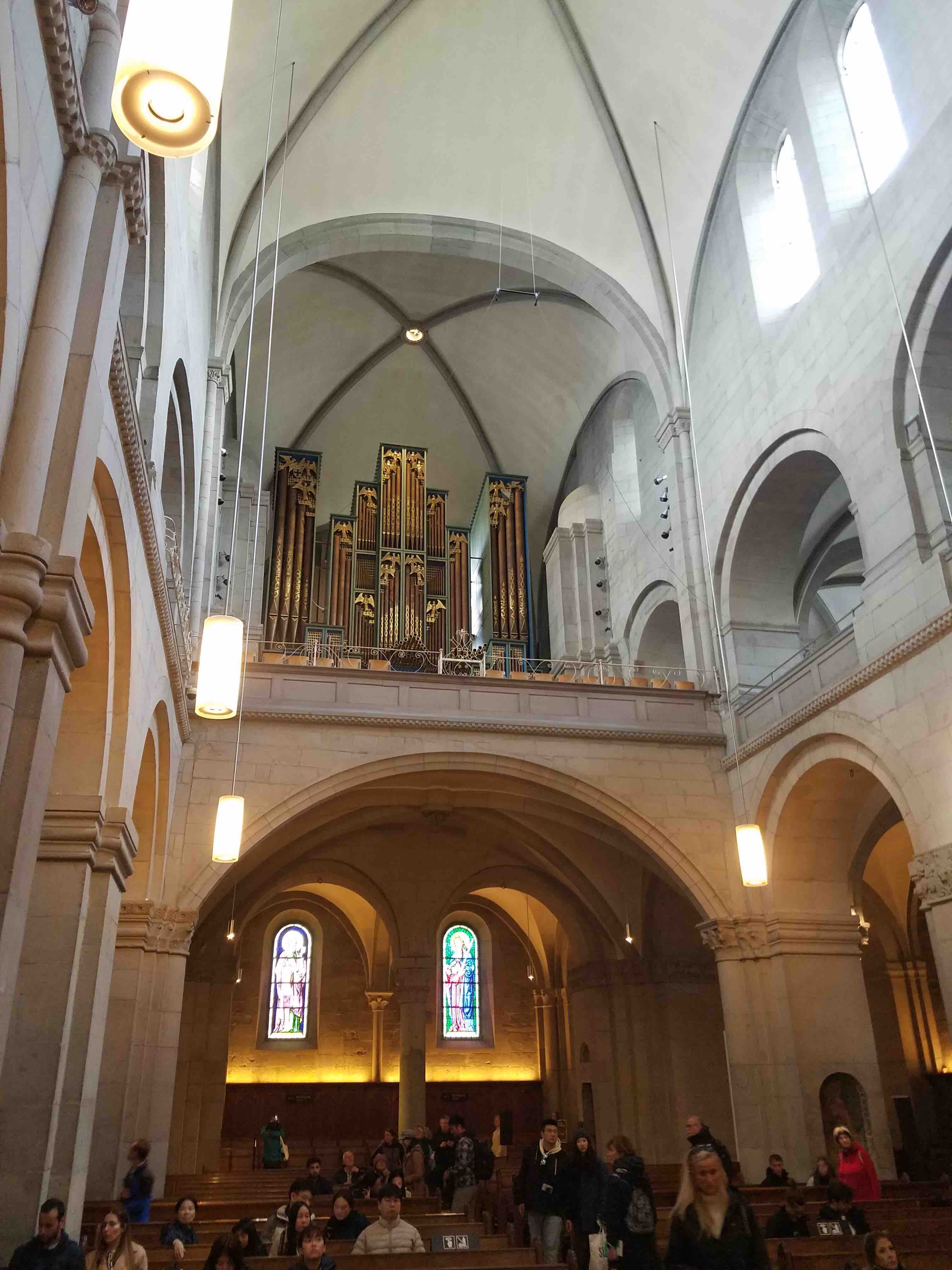
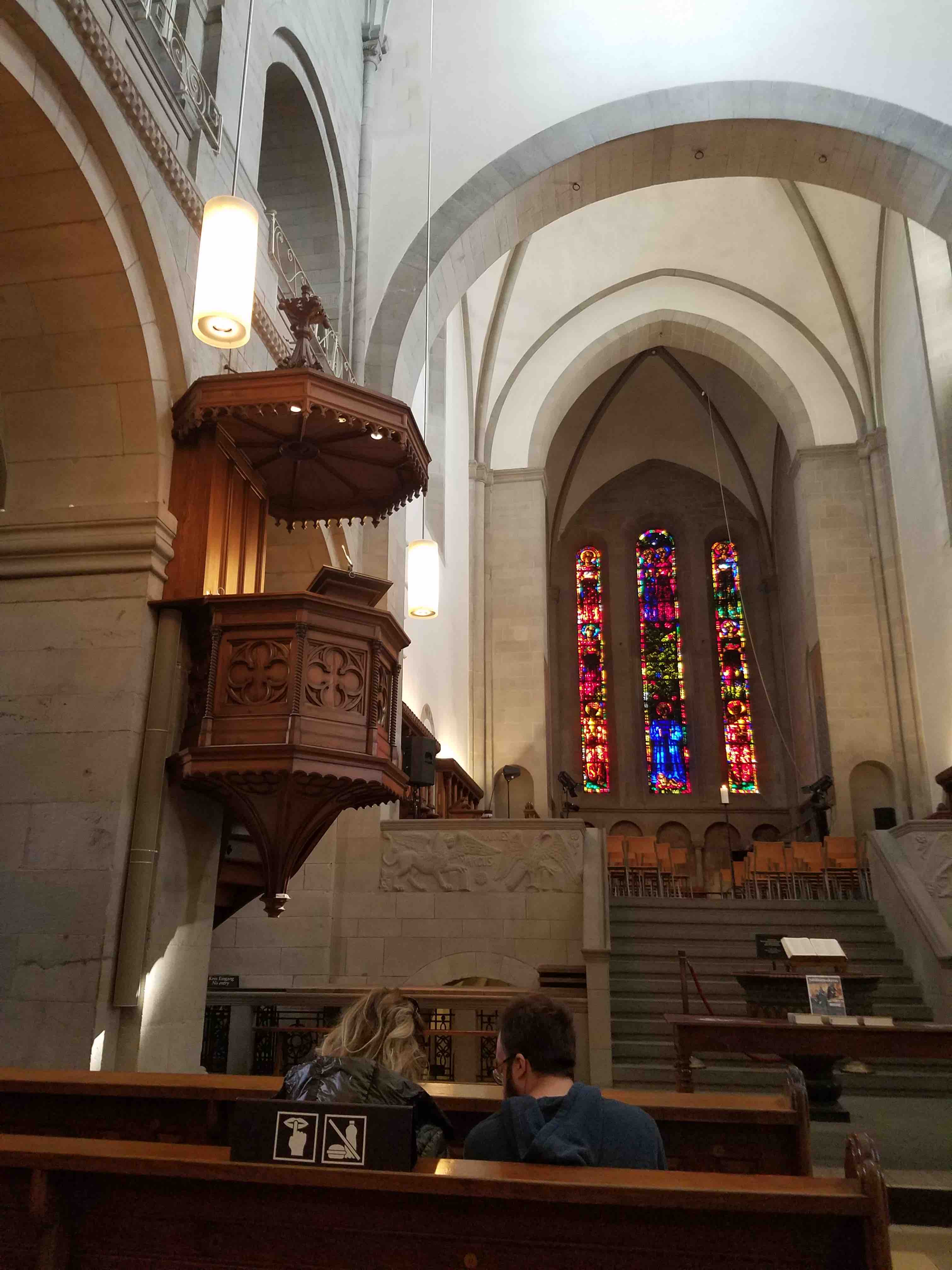
The pulpit from where Zwingli preached, at the main city church of Zurich, the Grossmünster.
Zwingli Goes to Zurich: The “People’s Priest”
The opportunity came for Zwingli to become the “people’s priest” at the Zurich church, Grossmünster in 1518. His election to the position was almost derailed by rumours of his sexual past. Furthermore, he had only been preaching for several months before the plague swept through Zurich, and nearly killing Zwingli himself. Zwingli survived, viewing his recovery from the plague as a sign of God’s blessing.
Zwingli’s preaching took up reformation themes. He rejected the intercessory powers of Mary and the saints, denied the existence of purgatory, and assured his parishioners that their unbaptized babies were not damned.
Zwingli was not afraid of challenging other preachers. During one sermon delivered by a Franciscan monk regarding the veneration of the saints, Zwingli himself shouted down the speaker, “Brother, you are in error!” Zwingli’s strategy was to force a public debate with detractors, with hopes of enlisting support from the Zurich city magistrates. The strategy worked.
But his most controversial preaching was in objecting to the Swiss mercenary practice, and the obtaining of pensions for such service, as offered through outside entities, including the papacy. Though once a loyal servant of the papacy, Zwingli had slowly been transformed into an irritant in the eyes of Rome.
By 1522, he even secretly married a young widow, who already had several children, Anna Reinhart, a woman who had assisted Zwingli to recover from the plague. Zwingli no longer could abide by the celibacy requirement for priests established by Rome.
Notable public controversy ensued when that year he met with a group of friends, where the others in the group ate a meal of sausages, in violation of the rules of the Lenten fast. Zwingli did not partake, but it was evident that he was the primary instigator. His pursuit of reforms even caused trouble with his friendly correspondence with his mentor Erasmus.
Zwingli wrote to Erasmus believing in the perspicuity (or clarity) of the Scriptures. Erasmus in turn regretted the radical nature of Zwingli’s thought. Erasmus had urged for reform, too, but he still thought that no one could read the Scriptures on their own without assistance from the magisterial teaching authority of the church to properly guide the reader. Their differences led to a falling out for their friendship.
Erasmus had good grounds for being wary of Zwingli’s radical leanings as signs of instability. In 1520, Zwingli believed at first that the tithe was not sanctioned by the Bible, and could be abolished. But when more radical reformers took him up on rejecting tithing, Zwingli shifted and commended that civil magistrates could collect tithes, just as long as the civil powers did not exploit the people (Gordon, p. 96-98). A similar situation developed when Zwingli urged that ornate artistry be removed from the churches, as such imagery violated the second of the Ten Commandments. But when more radical reformers took Zwingli’s teaching to the next level and destroyed altars, such that the wood could be sold to assist the poor, Zwingli rejected such iconoclastic activities as threatening the stability of the social order (Gordon, p. 102).
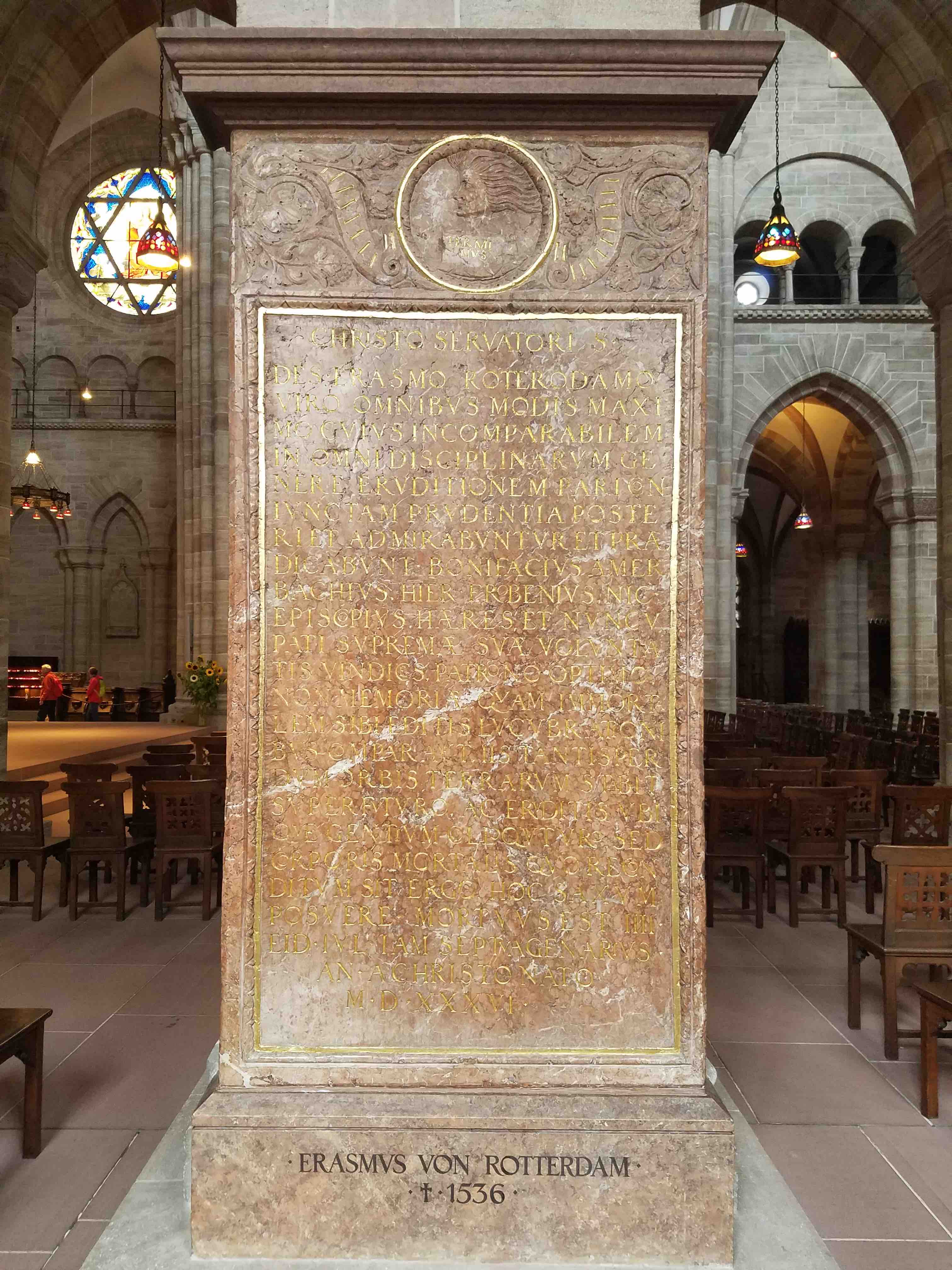
Desiderius Erasmus, the humanist who gave the Western world the first authoritative Greek New Testament in the 16th century, remained a Roman Catholic his whole life. Erasmus believed that Zwingli’s reforms had gone too radical, and broke his friendship with Zwingli. Nevertheless, when Erasmus died, he was buried in the city cathedral of Basel, Germany, a Protestant church, a remarkable gesture suggesting that Protestants and Roman Catholics are not as far apart as is commonly believed. … After two days in Zurich, my wife and I traveled to Basel, where I saw Erasmus’ grave here.
The Church Visible and the Church Invisible
Part of Zwingli’s shifting views on tithing and iconoclasm were a result of his developing views on the nature of the church. Zwingli believed in the church visible and the church invisible. The church visible was made up of people who attended church and participated in a Christian society. The church invisible were those genuine believers and followers of Jesus living among the church visible. Zwingli’s theory of how the state related to the church depended on this visible/invisible distinction. The more radical reformers, inspired by Zwingli, such as the Anabaptist leaders Konrad Grebel and Felix Manz, rejected infant baptism as being not taught in Scripture in their view, and urged true believers to take on adult baptism. These Anabaptists were rejecting their infant baptisms as valid, much to the consternation of Zwingli who saw the Anabaptist movement as a threat to his understanding of the visible church.
Zwingli saw the church as a parallel to the ancient Israelites. Just as circumcision was the primary identity marker for Old Testament Jews, so was baptism the primary identity marker for Christians. The Jews were God’s old covenant people, whereas the church was God’s new covenant people. For Zwingli, baptism was “a covenantal sign that does not in itself or as an act impart or even strengthen faith. Zwingli rejected what he saw as the pernicious Anabaptist argument that baptism was a pledge to live a sinless life, a position he claimed was a new form of legalism to bind the conscience. It would make God a liar, as such lives were not possible. ” (Gordon, p. 126-127).
Zwingli acknowledged that the New Testament nowhere explicitly mentions that infants were to be baptized. However, to use that as an argument against infant baptism was no different than saying that women could be denied the Lord’s Supper, since there were evidently no women present when Jesus celebrated the Last Supper with his male disciples (Gordon, p. 127)
“Baptism is the rite of initiation into the covenant of Christ, as circumcision was for the Israelites. Circumcision did not bring faith: it was a covenantal sign that those who trust in God will raise their children to know and love God. Instruction follows initiation, so children are baptized and then are taught the faith. Baptism cannot save, but it is a sign or pledge of the covenant God has made with humanity. It was instituted by Christ for all” (Gordon, p. 127).
On the other side, Zwingli continued to receive serious pushback from the Roman Catholic papal authorities, who viewed Zwingli as much of a dangerous rebel as were the Anabaptists. Zwingli got on the theological radar of Johann Eck, one of Martin Luther’s fiercest theological opponents. For Eck, Zwingli was infected with the same mind virus as Luther. Eck cited Paul’s letter to Titus in reference to Zwingli: ‘After a first and second admonition, have nothing more to do with anyone who causes divisions, since you know that such a person is perverted and sinful, being self-condemned’ (Titus 3:10–11; Gordon, p. 123).
Zwingli’s outspoken views eventually would lead to a crisis, which ended poorly with him and his family. In the next part of this two part look at Zwingli’s life, we will consider the last few years of the Protestant reformer of Zurich.
In the meantime, enjoy this video interview with the author of Zwingli: God’s Armed Prophet , Bruce Gordon, as he talks about his book:







 Veracity