Category Archives: Topics

The Incarnation in Three Minutes

Merry Christmas, from your friends at Veracity, and enjoy the following video. If you have a friend who is skeptical about the supernatural aspect of the Christmas miracle, and its implications, encourage them to read this exchange by pastor Tim Keller and an agnostic New York Times journalist, and discuss.


People Disagreed With Jesus About the Bible Too

I am in the middle of posting a five-part blog series on the interpretation of Daniel 9:24-27, the famous “Seventy Weeks” prophecy, one of the most controversial Old Testament prophecies predicting the coming of the Messiah. Some scholars call it the “Dismal Swamp” of Biblical interpretation. After digging into this for about two years, I can believe it really is a swamp.

The passage is really fascinating and amazing, but the pervasive interpretive pluralism among Christians, as to what the prophecy means, can be overwhelming. There have been times where I have been tempted to throw my hands up in the air and give up. Thankfully, I ran into the following re-post from Derek Rishmawy’s blog that serves as a healthy antidote to following such a temptation.

Derek Rishmawy is also a co-host of the MereFidelity podcast, that I sometimes listen to, that combines thoughtful theological reflection and conversation, with engagement in contemporary cultural issues impacting the English speaking world. These guys are smart, and just listening to the British accents of some of the other co-hosts makes you feel a little bit smarter yourself, too. If you need some intellectual stimulus that you are not getting elsewhere, you should check out the podcast sometime at the MereOrthodoxy website.

Derek Rishmawy's avatarReformedish

Jesus talking“Yeah, but there are so many interpretations of that text, so many denominations claiming Scripture for their own, you can’t really say there’s a wrong way of reading it.”

If you’ve been in a Bible study or spent more than about 10 minutes surfing pop theology writings, you have probably run across a claim of this sort. The idea is that with so many different readings of Scripture, it’s either arrogant or hopeless to think we can come to a determinate, or correct understanding of it. In other words, the mere fact of interpretive disagreement ought to put us off from claiming anything very strong for our interpretations of Scripture.

This sort can take a couple of different forms.

First, someone can go full-blown, radical skeptic and just say that the text has no inherent, determinate meanings, only uses. Or maybe that it’s a springboard for our own thoughts about…

View original post 880 more words


When Did Advent Celebrations Start?

Have you ever wondered where and when the season of Advent started? Reformed Theological Seminary history professor, Ryan Reeves, puts together some really helpful videos on church history related topics, and the following 5-minute video introducing Advent is really good.

My only quibble with the video is professor Reeves’ statement that “no one, by the way, believed that Jesus was actually born on December 25,” at the the 1:20 mark in the video.  Actually, there was quite a bit of speculation in the early church as to the correct date of Jesus’ birth, as I learned in researching an early Veracity post on the topic. In the early 200s, roughly 150 years before the Western church officially designated December 25, as the celebration feast for Jesus’ birth, the church father Hippolytus calculated December 25 as the correct date for Christ’s birth, from his Commentary on Daniel (Reeves is primarily an historian of the Reformation, and not the early church, so I will give him a pass). But Reeves’ larger point stands, centuries later, that we simply do not know when Jesus’ birthdate was with any firm degree of certainty, once you examine the Bible, and other arguments made by other commentators.

The celebration of Advent is not contingent on the exact date of Christmas. Rather, it is about encouraging the community of believers to dedicate some time to spiritually prepare for the coming of the Christ. Syncing the birth of Jesus with one of the shortest days of the year has great symbolic importance, in that as the days just begin to get longer (in the Northern Hemisphere, at least, where Christianity grew the most in the early centuries), it corresponds to the idea that Jesus is the light that has come into the world, and thus overturning the darkness of the present age.

Come, Lord Jesus!


Remembering My Dad on Veteran’s Day

USS Burton Island, Navy ice breaker, 1954.

USS Burton Island, Navy ice breaker, 1954.

Since my dad died earlier this year, I have corresponded several times with some of his old Navy buddies. My dad served as a Naval officer aboard the U.S.S. Burton Island, an ice breaker, along the Aleutian Island chain, during the Korean War. My dad formed some lifelong friendships with some of those men aboard that ship, a few of whom are still living strong.

Though my dad never saw combat, I am mindful on this Veteran’s Day of the contribution of those who have served in the military, like my dad. So many young people have sought to defend their country, whether it be the United States or some other nation, putting their lives on the line, honoring a sense of duty to their country, fighting for something they believed in.

Many have lived to tell about their experiences. Many others have not.

This is what I thought of today: I think of what happened 100 years ago this day, on November 11, 1916. It was just a few days before the end of the terrible Battle of the Somme, where British and German forces fought a battle of attrition over “No Man’s Land,” resulting in over one million casualties in this one battle alone, with no substantial gain from either side. The “Great War” was only about half-way over, with millions more dying, as it would be two more years exactly until Armistice Day, November, 11, 1918. The American version of Armistice Day was renamed “Veteran’s Day,” in 1954, the same year the above photo was taken of my dad’s ship.

I do not really understand what the whole point was concerning World War One. It is hard for me to grasp how all of that figured into the providence of God. But what I do know is that there were people on both sides who had stories to tell. These stories need to be told, and we need to hear them. This is true not just about World War One, but about any great human conflict, where different visions of morality, community identity, and faith come into dire conflict. Even if we do not understand why people were willing to risk their lives for something we do not “get,” we owe it to others to take the time to simply listen to their stories.

The week before my dad died, I read to him a letter from one of his Navy buddies. It was all about life aboard the ice breaker. My dad, who was suffering from dementia, brightened right up when I read to him these stories. My dad told me some of his own stories aboard the Burton Island. All my years growing up as a kid at home, my dad had never talked much about his Navy experience. But I frankly was not interested at the time, being more obsessed with getting along with the other kids in my school, worrying about my grades, and watching television. I only cared about what was in my “little world,” and never cared to know much about the stories of this man who raised me.

I am now glad that I took the time to listen… and to remember. I am so thankful now that in the last week of his life, my dad and I were able to share his experience of being a veteran, and what that meant to him. It made me realize that every veteran has a story to tell… a story that needs to be heard and remembered.

Thanks, Dad.


G. K. Chesterton on the 2016 American Presidential Election

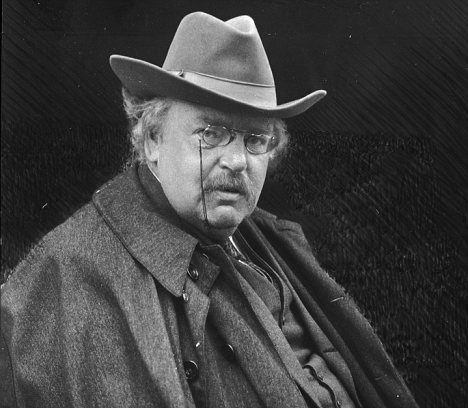
G. K. Chesterton (1874-1936)

G. K. Chesterton (1874-1936)

O God of earth and altar,
Come down and hear our cry,
Our earthly rulers falter,
Our people drift and die,
The walls of gold entomb us,
The sword of scorn divides,
Take not thy thunder from us,
But take away our pride.

From all that terror teaches
From lies of tongue and pen
From all the easy speeches
That comfort cruel men
From sale and profanation
Of honor and the sword
From sleep and from damnation
Deliver us Good Lord!

Tie in a living tether
The prince and priest and thrall,
Bind all our lives together.
Smite us and save us all,
In an ire an exultation
Aflame with faith and free,
Lift up a living nation,
A single sword to thee.

—- G.K. Chesterton, wrote these lyrics in 1906.

(HT: Asbury Seminary New Testament scholar, Ben Witherington)