When you read 1 Corinthians all the way through, you run into a big problem trying to reconcile 1 Corinthians 11:2-16 with a quirky, often overlooked passage in 1 Corinthians 14. In 1 Corinthians 11:2-16, Paul is saying that women are praying and prophesying in church. He wants to urge these women to have some type of head covering, but the point is “mostly” accepted that the women are not silent in church. They are active participants in the communal worship experience.
The problem is that 1 Corinthians 14:34-35 on the surface says the exact opposite: “the women should keep silent in church….” concluding with, “….For it is shameful for a woman to speak in church.”
It looks as though Paul is contradicting himself. Critics of the Bible easily jump on this to say that the Bible can not be trusted because of its internal contradictions. I wrote a blog post a few years ago that explores this “Corinthian Conundrum” in detail, that hopefully makes better sense of this difficult passage, so I will not repeat the discussion here, other than to conclude that most interpreters have discovered that a completely flat reading of 1 Corinthians 14:34-35 does not fit the evidence at hand.1
Everything about head coverings in 1 Corinthians 11 (well, maybe not “everything,” but we try to hit the highlights here at Veracity)
However, there is a school of thought that goes about reconciling 1 Corinthians 11:2-16 and 14:34-35 in a completely different direction. It might be called the “Hyper-Conservative” view of 1 Corinthians 11:2-16, or just simply the “John MacArthur View.” The reason why I call it the “John MacArthur View” is because I first saw this in John MacArthur’s Grace Community Church in Los Angeles about 25 years ago.
The Traditional view regarding the head coverings passage of 1 Corinthians 11:2-16 actually has a lot of parts to it. This blog series is not an exhaustive study, as there are bulky doctoral dissertations and commentaries that explore this passage in-depth. But here in this Veracity blog series, we will try to hit the highlights in bite-size pieces.
Everything about head coverings in 1 Corinthians 11 (well, maybe not “everything,” but we try to hit the highlights here at Veracity)
If you had to take a vote, what would you say is the weirdest passage in the New Testament? Some might raise their hand and immediately say “The Book of Revelation.” Ok, that is a whole book, so how about something shorter?
I mean, when I first tried to read the entire New Testament cover-to-cover back in high school, this one just jumped out at me: What in the world is Paul talking about? Here is the whole disputed passage from the English Standard Version:
2 Now I commend you because you remember me in everything and maintain the traditions even as I delivered them to you. 3 But I want you to understand that the head of every man is Christ, the head of a wife is her husband, and the head of Christ is God. 4 Every man who prays or prophesies with his head covered dishonors his head, 5 but every wife who prays or prophesies with her head uncovered dishonors her head, since it is the same as if her head were shaven. 6 For if a wife will not cover her head, then she should cut her hair short. But since it is disgraceful for a wife to cut off her hair or shave her head, let her cover her head. 7 For a man ought not to cover his head, since he is the image and glory of God, but woman is the glory of man. 8 For man was not made from woman, but woman from man. 9 Neither was man created for woman, but woman for man. 10 That is why a wife ought to have a symbol of authority on her head, because of the angels. 11 Nevertheless, in the Lord woman is not independent of man nor man of woman; 12 for as woman was made from man, so man is now born of woman. And all things are from God. 13 Judge for yourselves: is it proper for a wife to pray to God with her head uncovered? 14 Does not nature itself teach you that if a man wears long hair it is a disgrace for him, 15 but if a woman has long hair, it is her glory? For her hair is given to her for a covering. 16 If anyone is inclined to be contentious, we have no such practice, nor do the churches of God.
Some of the things that Paul says sound fairly straightforward, but certainly not all of it. Frankly, if you are like most Christians I know, you probably just gloss over this passage and move onto something else. Better to pretend that something this weird in the Bible did not exist, right?
Everything about head coverings in 1 Corinthians 11 (….. well, maybe not “everything,” but we try to hit the highlights here at Veracity)
Well, we probably know that if you really believe the New Testament to be God’s Word, then it might be important to try to make some attempt to understand this chunk of Paul’s letter to the Corinthian church. God’s self-disclosure in Holy Scripture is not just some random exercise where we can pick things we like and toss out the rest. For that would dishonor the Lord Jesus. Plus, every book of the Bible is its own literary unit. Simply picking out parts of the Bible and forgetting the rest is not a good recipe for really understanding the Bible. However, if most American Christians are honest, we would prefer to ignore this passage, and if you were even to ask Bible scholars about it, they might agree with you as to how difficult this passage is. It is one of the most hotly debated passages in New Testament scholarship.
In this series of blog posts, Veracity will attempt to make some sense about this passage. The significance of this passage is that it plays a vital role in the on-going debates regarding how men and women are to relate to one another in the church; in what sense are husbands to be “head” of the home, should women serve as elders in a local church, etc. This is part of the rather controversial discussion between so-called “complementarians” and “egalitarians” that has continued to divide believers from one another, resulting in church and denominational splits, particularly within the last sixty years, and more intensely within the last couple of decades. I have written about this debate at length on Veracity, in another blog series, but because 1 Corinthians 11:2-16 is just so weird, it really deserves special treatment all on its own.
This passage brings up a number of questions. Here is a sample:
What does “head” mean in this passage?
Is this passage about a physical head covering, or is it about the length of hair, comparing a man and a woman?
Is the teaching merely cultural, applicable only to Paul’s first century context, or does it have relevance to 21st century Christians?
Why does Paul bring up the topic of creation here?
Why does Paul talk about God’s relationship to Christ?
What does Paul mean by “image”, “glory,” and “nature” in this passage?
Does this passage contradict with what Paul says just a few chapters ahead, in 1 Corinthians 14, about women speaking (or not speaking) in church?
What is Paul’s mention about “no such practice” in verse 16 referring to?
Does this passage even belong in the Bible?
Is Paul refuting, instead of teaching, much of what we read here?
What is this whole thing about “because of the angels” in verse 10?
How do we apply this passage to us today?
As we head into the summer, over the next group of blog posts, I will write about different views that various scholars take regarding this passage, one by one. My wife often tells me that I typically just lay out different views about difficult parts of the Bible and I do not really land anywhere, and it frustrates her to no end! So, to try to make her a little happier, I will summarize each viewpoint in the successive blog posts, and then you can figure out where I might land in the final analysis. We can discuss different interpretations of the Bible, but in the end, there is a right and wrong way of understanding the text:
The Traditional View (well, at least it summarizes some of the main points that many Christians have agreed with for centuries).
The Hyper-Conservative View (otherwise known as the “John MacArthur” view)
The Symbol of Protection View (challenges the idea that head coverings signify something about authority)
The Hairstyle View (in other words, this is not about head coverings per se, but rather about male vs. female hairstyles)
The Quotation/Refutation View (Paul is refuting a Corinthian false teaching)
The Interpolation View (Someone stuck this passage in the Bible later on, or Paul himself put it in there, and then just ran away….. yeah, seriously)
The Supernatural Sexual Modesty View (otherwise known as the “PG-13” view…. that is, keep this away from young children)
Applying 1 Corinthians 11:2-16 Today (what do we do with all of this?)
It will take nearly the whole summer of 2023 to get through this, so I will try to make it more digestible in bite-size pieces. I will probably take a few breaks along the way, to spice things up.
However, his longest video is on this particular passage, 1 Corinthians 11:2-16. It comes in at a whopping 6 hours and 46 minutes. WOW!! I can not endorse everything Mike says in nearly 7 hours, but he is thorough. See the video below.
So, if you just want to read a much shorter summary of what Mike Winger says, in Veracity style, stick around for the following blog series. I land at a different place from Mike, but I do appreciate his work. Please feel free to follow on Veracity by clicking one of the “Follow” buttons on the right and/or enter your email address, then click “Follow.” Feel free to comment along the way, too.
Oh….and one more thing…. the reason why I am doing this series…. : About four years ago, my local church held a discussion about the complementarian/egalitarian controversy. The overall presentation was well done, but the discussion stirred up a lot of emotions that rippled through the entire church body, generating a lot of confusion and even frustration.
This particular passage on head coverings was mentioned in a period of just five minutes. Five minutes. That’s all.
I left the discussion having more questions than answers. Since then, not a single sermon, Bible study group, question and answer session, or anything else in our church has attempted to address this passage in a meaningful way. In defense of our church leaders, our church was not obligated to uncover every stone on this. But it still bothered me to have these questions and very few answers. So, since our church leadership decided to bypass this passage, I felt that I had no choice but to dig into this myself, if I was going to understand what Paul was teaching.
As an evangelical Christian, I believe that I have the opportunity and the obligation to share with others the Good News as presented in the Bible. But it is pretty difficult to share my confidence in what the Bible teaches to others who need to hear the Gospel when we effectively gloss over, or even skip, certain weird parts of the Bible, especially a passage that is partly responsible for dividing many, many churches and denominations in our current day. Here, I offer to you, my research into this vexing passage…. a passage that most Christians would rather ignore than talk about.
Veracity is different. Here at Veracity, we want to talk about it. We want to dig into the Scriptures. Why? So we can better handle God’s Word.
One final blog post about our trip to Europe last year, 2022. The adventure to Europe ended with an exciting finish: It was a whirlwind trip. Just three nights in Sicily, to visit with friends, and tour the best of Sicily. I even got to travel up a good part of Mount Etna, one of the world’s most active volcanoes (but visibility was poor due to rain that day).
Sicily has an incredibly grand and ancient history. Coming from my hometown of Williamsburg, Virginia, which prides itself in its rich colonial history going back 400 years, Williamsburg does not even begin to compare with a recorded history going back to the Sicilian and Punic wars.
I had started to listen to Robin Lane Fox’s The Classical World: An Epic History from Homer to Hadrian, while visiting Sicily. Fox’s immense survey of the history of the Greco-Roman world, finishing up with the reign of Emperor Hadrian, just as Christianity was emerging as a world changing movement in the early second century, clocks in at just under 24 hours as an audiobook. Though he is a secular British historian, whose rather aloof interest in the Christian faith is apparent, Fox is nevertheless a captivating story-teller, though the decadence and violence of the classical world that he chronicles made me yearn for more of the Christian story (I have Fox’s book on Saint Augustine queued up on my “to-be-read” list, but that is a long ways off from now!)
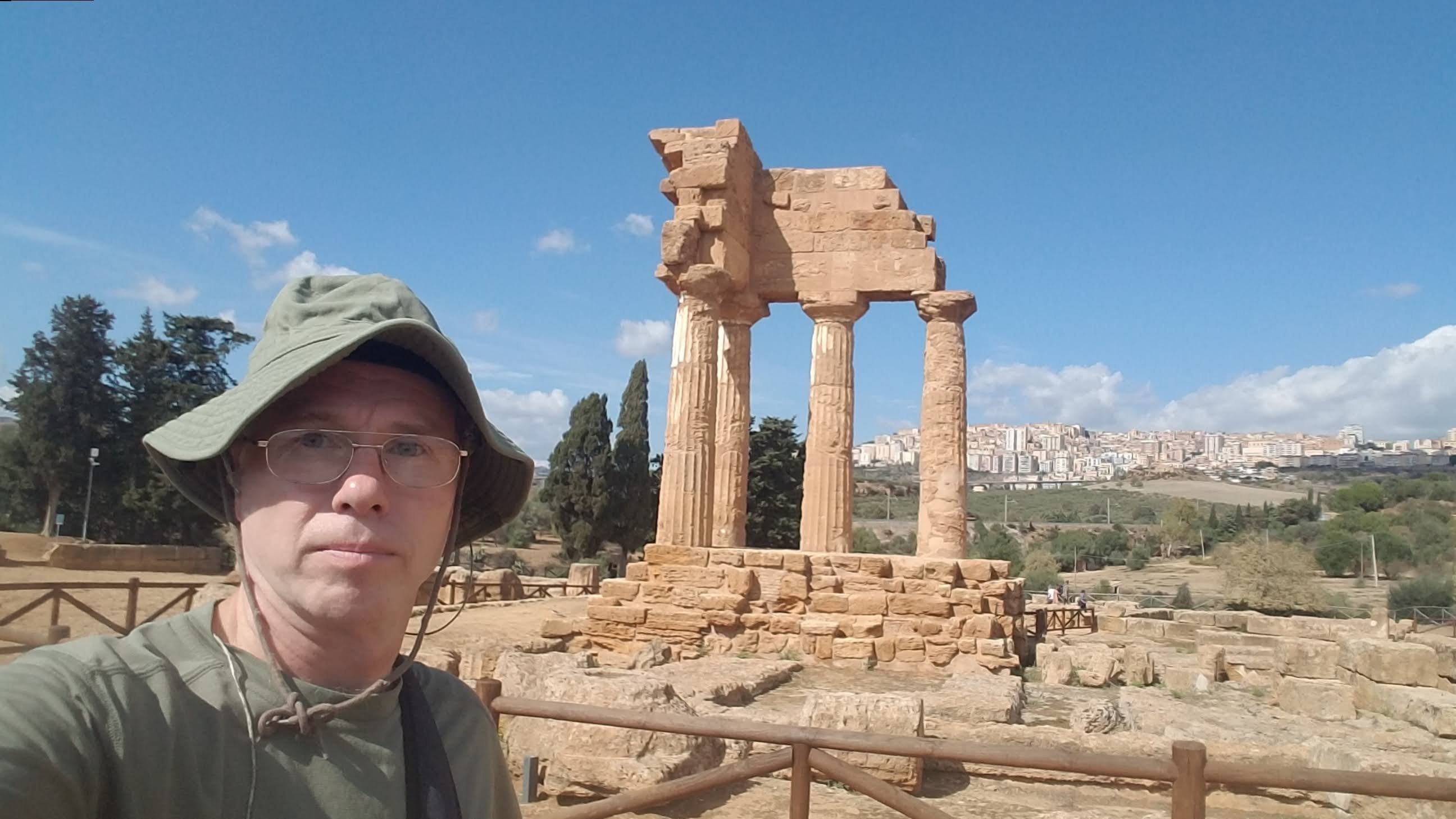
Having a book by a world-class historian at the ready makes for a more enjoyable visit to faraway places. The names of great places in Sicily were sprinkled throughout The Classical World, and I got a chance to see the highlights, and envision a bit of that remarkable ancient world. Take Agrigento for example. In southwest Sicily, the old city of Agrigento sits above an expansive historical park, the Valley of the Temples. On one end of the park stands the Temple of the Discouri.
Temple of the Dioscuri. Valley of the Temples Archaeological Park. Agrigento, Sicily, Italy. The city of Agrigento itself is up the hill in the background.
The transformation of the Greco-Roman world into a Christian society, less than 500 years after the birth of Jesus, is simply a fascinating thing to consider. In many ways, contemporary secular culture is drifting back to the advocated virtues and religious pluralism of the Greco-Roman classical world. It makes me wonder: How was it that a movement of ragtag Jewish peasants, following a singular figure, whom his followers believed had been risen from the dead, end up completely overcoming such a rich classical culture, with a new story that has since spread far and wide across planet earth, the world’s largest spiritual movement of all time, representing some one-third of the 21st century world population?
It is an astounding thought to ponder.
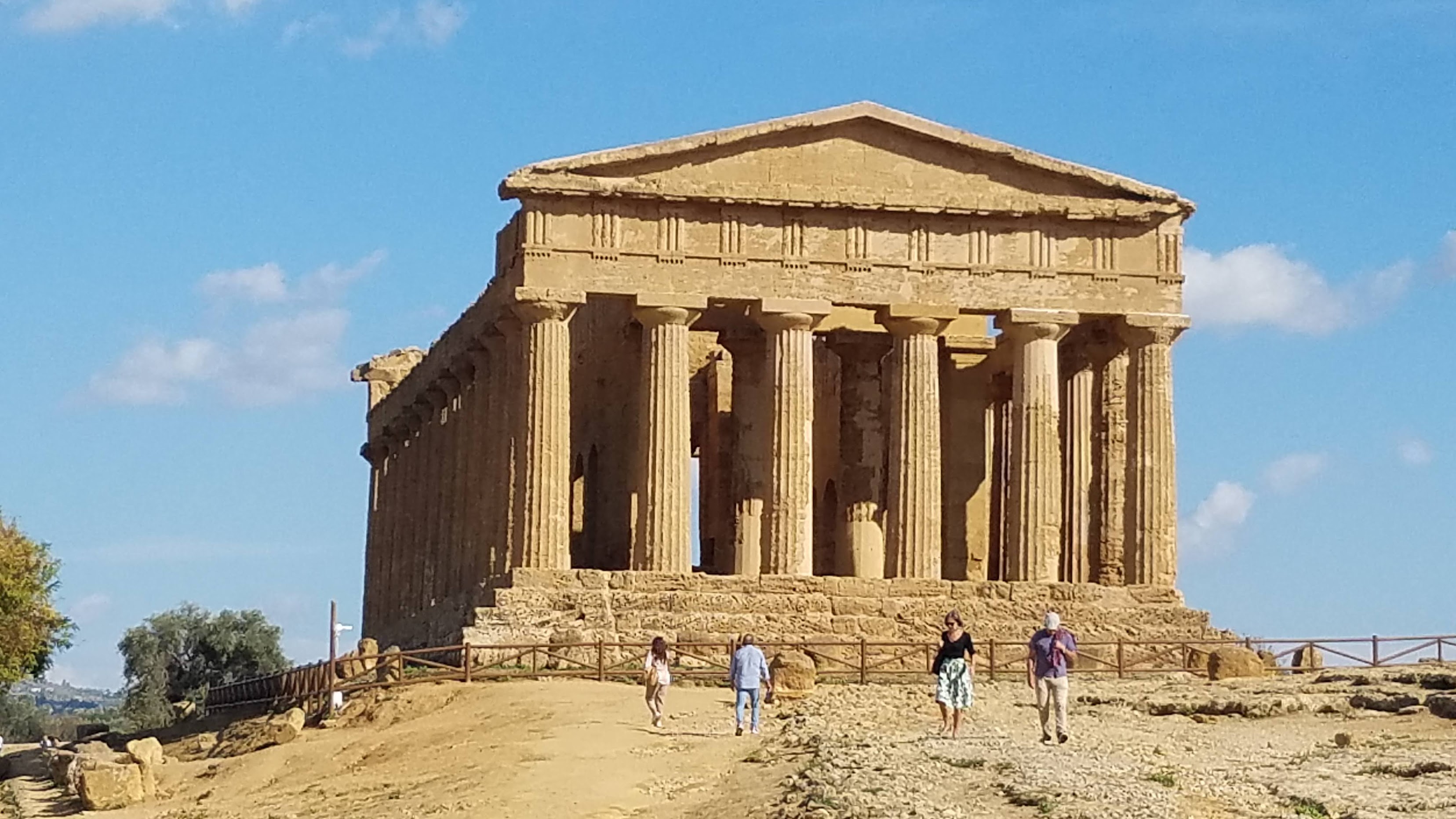
Temple of Concordia. Valley of the Temples. Agrigento, Sicily, Italy.
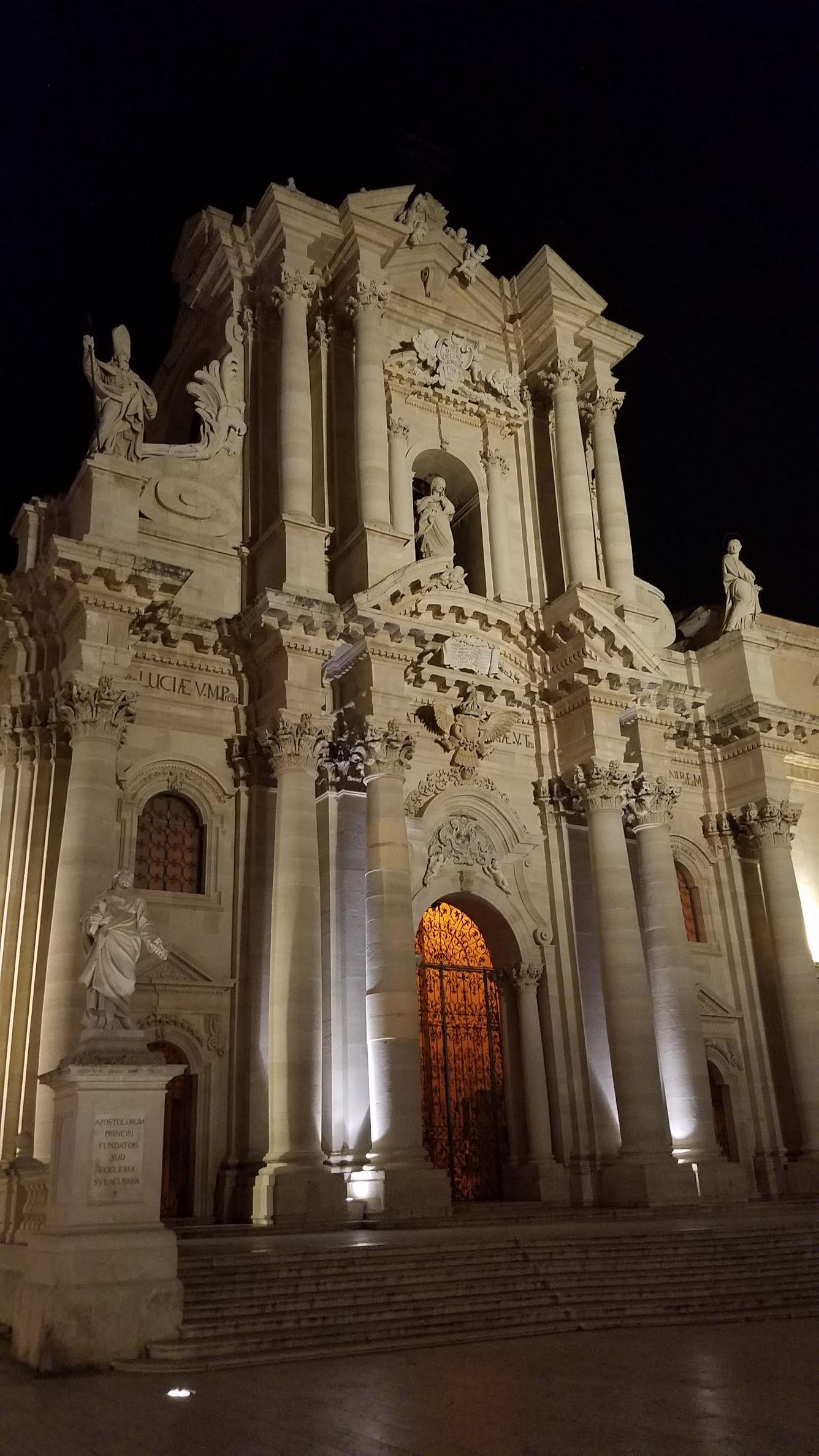
Another highlight for me was the city of Syracuse, specifically the island of Ortigia, one of the most incredibly beautiful places I saw while in Europe. While much of the classical ruins still lie beneath the city, awaiting archaeological investigation, the Baroque architecture of much of the town is impressive, even when walking around at night! …. Plus, the food was simply fantastic!!
Cathedral of Syracuse, on the island of Ortigia. One of Sicily’s many gorgeous churches.
These are last of my photos I plan on posting on Veracity about the trip my wife and I took to Europe in 2022…. while I was in Sicily towards the end of the adventure, she was off in Venice with a friend…where unfortunately, the food was NOT as good!…. Oh, and about Mount Etna….. While in Sicily, I never got to see the top of the volcano, due to the rain and cloud cover. But on the flight out, I managed to be sitting on left side of the plane, which gave me a breathtaking view of the legendary volcano, at its very top. Enjoy!
APPENDIX:
Found a fun link here on Twitter. A museum in Hamburg animates Caesar Augustus singing “California Dreaming.” Augustus visited Sicily in 22 BCE.
Engaging in an online discussion can lead to some interesting outcomes.
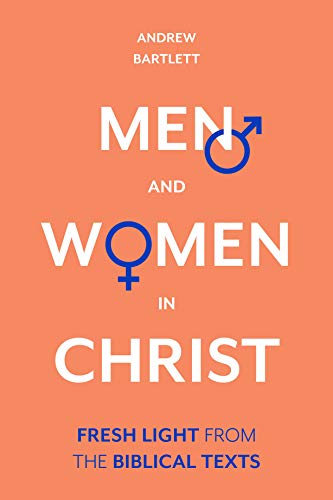
In early 2022, I corresponded with a Christian author from the U.K., Andrew Bartlett, about the complementarian/egalitarian debate. Earlier I had heard of a book written in 2019, Men and Women in Christ: Fresh Light from the Biblical Texts. Little did I know that my online interlocutor had written this thorough examination of the Bible’s teaching regarding men and women in the family and the church.1
I promised Andrew that I would read his book, only to discover that while 100 pages into his 648 page book (according to Kindle…. 430 pages in the hard copy version), that this really is a big book! Andrew is a lawyer and arbitrator, with a background in theology, so it really should not have been a surprise. I had to put the book down and try to come back to it, every now and then, over the past year and a half. Then an email from Andrew a few months ago convinced me that I should finish the book and offer a review. By the time I finished, I ended up with the following article that best summarizes my reflection on the men/women debate in the church to date, after four years of research and blogging. So, you might want to go grab a beverage, a nice chair to sit in, and perhaps even a Bible before I go on…
The length of the Men and Women in Christ: Fresh Light from the Biblical Texts will be a drawback to some readers, who simply will not have the patience to wade through many pages of detailed analysis and argumentation. This is unfortunate since there are many, many rewards the book has for the reader, filled with insights, and being exceptionally thorough, without getting overly technical. In other words, mere human beings without a PhD can read this book, and walk away with an understanding why this issue is so complex. Men and Women in Christ: Fresh Light from the Biblical Texts interacts with a vast array of literature on the topic, published over the last several decades, which makes it essential reading for anyone desiring to dig deep into the debate. Regardless of what one ultimately thinks of Andrew Bartlett’s thesis, Andrew is a great dialogue partner, and he has done the Christian church an invaluable service with his thorough and careful analysis. So, thank you, Andrew (assuming you read this)!!






 Veracity