Category Archives: Tools

Personal Discipleship Class

Personal Discipleship Class

Click on the images inside this file to link to the online resources. (You may need to adjust your browser settings to allow the links to work, or open it in iBooks, or save it to your desktop and open it with Acrobat Reader.)

Starting today (February 1st), I will be facilitating a new class on personal discipleship. For the next nine weeks, we will meet promptly at 10:45 a.m. in room 156 at the Williamsburg Community Chapel.

This class will build upon the apostle Paul’s instruction in (Philippians 2:12):

“Therefore, my beloved, as you have always obeyed, not as in my presence only, but now much more in my absence, work out your own salvation with fear and trembling;”

“Personal discipleship” is the process by which a believer or seeker accepts personal responsibility for exploring the claims and content of the Bible. The class will explore resources and topics, going beyond the sacred page to meet some of today’s most interesting and thought-provoking theologians, apologists, and philosophers. We will discuss historical evidence for the Resurrection, the dating of Easter, apologetics, textual criticism, the trustworthiness of Scripture, biblical inerrancy, science and faith, and current topics in theology.

The first session will focus on resources for personal discipleship. Click on the image above to download a PDF file containing hyperlinks to some of my favorite resources, which I will demonstrate in the class. If your personal studies are getting a little rote, try clicking on the images in this file to find some refreshing new tools and resources that you can use to reinvigorate your devotional life. The breadth and depth of high-quality resources available today is absolutely stunning.

Objective Truth As The Basis For Our Study

I posted the following video a couple of weeks ago. It presents an interesting, refreshing basis for studying the Christian faith—specifically that Christianity is founded on objective truth. The ideas in this video will frame our approach to studying during this class.


Review: James Bryan Smith’s, The Good and Beautiful God

Spiritual formation author James Bryan Smith has the right aims in mind, but he delivers a "so-so" message in a way that can confuse evangelical readers.

Spiritual formation author James Bryan Smith has the right aims in mind, but he delivers a “so-so” message in a way that can confuse some evangelical readers.

Our small group in our church recently completed a multi-week study on James Bryan Smith’s The Good and Beautiful God. To put it in a nutshell, we made the best of it. While having some excellent teaching points scattered here and there, along with some helpful practical examples regarding spiritual discipline, at best the book was rather “so-so” in its presentation, and at worst, for some, spiritually dangerous.

James Bryan Smith belongs to that class of writers focusing on the dynamics of spiritual formation, standing within the tradition of reviving lost spiritual practices that writers such as Dallas Willard and Richard Foster have sought to recover for the contemporary church. I remember reading Richard Foster’s classic A Celebration of Discipline in the 1980s, and I was encouraged by Foster’s desire to remind the church of the great wealth of spiritual disciplines throughout the history of the church that has helped believers down through the ages to draw nearer to God. Christians can learn much from the positive examples set by evangelical, charismatic, liturgical, contemplative, and socially-concerned expressions of faith within the Body of Christ. It was from this sense of taking the best of various approaches to Christian spirituality, instead of just having a narrow focus on one tradition alone, that has provided the impetus for the various Renováre conferences that have been held across the United States for years.

On the positive side, James Bryan Smith seeks to take some of the teachings laid down by Willard and Foster and make them available to readers in an even more accessible manner. The real treasure of The Good and Beautiful God are the various “soul training” exercises at the end of each chapter. Best done in a small group like ours, it really helped to go through different spiritual practices, such as silence, solitude, having an awareness of God’s creation, counting our blessings, praying through a passage of Scripture like Psalm 23, developing an approach to meditating on Scripture like the ancient practice of lectio divina, reading a book of the Bible straight without depending on commentaries and the notes of a study Bible, and creating space or “margin” in our lives and slowing down so that we can be receptive to the activity of God’s Holy Spirit working within believers.

Quite a lot of has been written on the Internet associating the “spiritual formation movement” with what are perceived to be the “dangerous” tendencies associated with the “Emerging Church” trend of the first decade of the 21st century. Just google for “spiritual formation movement,” and you will see what I am talking about. The critics cite, that in “spiritual formation” lingo, you will find suggestions towards mysticism, tinged with the worst of medieval Roman Catholic asceticism, or even more towards New Age spirituality, along with a “works-righteousness” approach to faith. Granted, you can find extremes like this, just like you can find extremes in just about any teaching within the church.

Folks, you simply can not trust everything you read on the Internet as being accurate. I have tried before to set the record straight here on Veracity (#1, #2, #3), showing that much of the negative attitude towards “spiritual formation” is based on well-intentioned, yet seriously misinformed theological analysis of various approaches to the biblical doctrine of sanctification. I need not go into that here. But if James Bryan Smith was hoping to “put things down on the bottom shelf” for people to easily grasp the great depths of Christian spirituality, while disarming the critics of “spiritual formation,” he did not succeed. Continue reading


Discipleship Candy

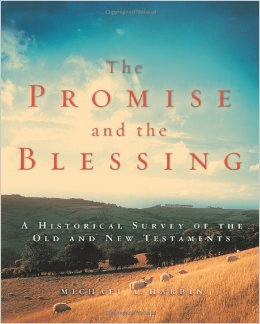
The Promise and the Blessing

The Promise and the Blessing: a Historical Survey of the Old and New Testaments, by Michael A. Harbin

One of the really cool benefits of writing a blog like Veracity is all the backdoor sharing. People are constantly bringing things to our attention or sharing some thought, question or resource from their devotional lives.

This week I feel like a kid in a candy store. One of Marion’s coworkers loaned me her copy of The Promise and the Blessing: A Historical Survey of the Old and New Testaments, by Dr. Michael A. Harbin. I haven’t been able to put it down.

Dr. Harbin’s text is used in Old and New Testament ‘survey’ courses in colleges and seminaries. What makes it special is that it ties all the biblical text to the timeline of Judeo-Christian history while maintaining a brisk flow from Genesis to Revelation. The pieces are thoroughly connected. It’s packed full of illustrations and references and has no qualms about taking the reader off on interesting tangents with sidebars. Theological topics are introduced and adequately summarized, with fair treatment given to opposing doctrinal views.

One of my litmus tests for any resource is how much fresh and useful information it contains. I can’t seem to turn anywhere in this text that I don’t get new information or have the parts of the Bible presented in a fresh light.

Normally I advocate electronic versions of books, particularly when they can be accessed in the cloud with tools like Kindle Cloud Reader. Kindle puts all of my books in a library that I can access with any device, including my iPad, iPhone, and computer. The upshot of reading this way is that you can highlight and bookmark the text, and search it electronically. It makes books very portable and eliminates the need to flip through pages manually trying to find some passage you barely remember.

However…The Promise and the Blessing is such a beautifully composited book I recommend buying the hardcopy version, which you can do for minimal expense by clicking here. If you’d like to preview the book before you buy it, here is a link to the Browse Inside page.

Enjoy!


HT: Liz Marshall


Lectio Divina: Spiritual Formation #3

Imagination. Is there such a thing as a godly imagination in the life of a believer in Christ?

Lectio divina: An ancient spiritual discipline of “divine reading” of Holy Scripture that is being revived among evangelicals today. Yet some Christians fear that such practices could be dangerous.

Over the course of my spiritual journey, I have often had trouble reading the Bible. Not only do I find some things difficult to understand from what the text is saying, I also have struggled with something closer to home. Does God still speak through the Bible to people today? Am I trying to read the Bible merely to gain information, or am I reading it to try to meet with God in a personal relationship?

It has been said that the ultimate objective of reading Scripture is not simply to know the Word of God. Instead, it is to get to know the God of the Word, to move beyond the Sacred Page to have an encounter with the supreme Author of the text.

Yet for some Christians, there is a danger associated with moving beyond the Sacred Page. There is a temptation, critics argue, even for Christians to view the reading of Scripture as some sort of talisman, a type of magic book where merely reading the words of the text will somehow subconsciously restore our soul. The imagination of the reader can easily get caught up in inventing one’s own private, personal interpretation, thereby introducing confusion between understanding our own thoughts and wishes and desires with God’s supreme and objective revelation that calls us to face reality.

The critics are right to have their concerns. I have sat through innumerable Bible studies where people have brought forward a cacophony of opinions of “what the Bible says and means to me.” I even have known people who simply opened up to some random page of the Bible, put their finger somewhere into the page, and then read that verse believing that God might speak to them through that verse. I remember opening up my Bible once to Genesis 41:46. There I read that “Joseph served in Pharoah’s court.” As I was struggling with my tennis game at the time, I could have easily mistaken the words of Scripture as God’s way of coaching me on my backhand, but I sincerely doubt that this would have been the proper use of Scripture!

These are some of the issues that we can encounter when we think about spiritual formation, particularly in terms of developing spiritual disciplines focusing around Scripture. One of the classic spiritual disciplines in this area is something called lectio divina. Some might even call lectio divina … dangerous…
Continue reading


The Right Tool for the Right Job: Spiritual Formation #2

Dewalt Impact Driver. You can drive some screws with this baby? Are you using the right tools to help you in your spiritual growth?

Dewalt Impact Driver. You can drive some screws with this baby!! Are you using the right tools to help you in your spiritual growth?

So, what does spiritual formation look like in the life of the Christian? I think of it as having the right tool for the right job.

I am in the process of making some repairs to our backyard deck. Over the years, a number of the nails holding the deck together have corroded. This time, I plan on using galvanized screws instead of nails. To do the job, I broke down and bought a Dewalt impact drill. It is like a screwdriver or a power drill, but it has a unique design. An impact drill increases the efficiency in driving screws into wood by applying a stronger rotational and downward force than a normal drill.

(Hey, I am engineer. An engineer likes his tools).

Here is the point: When you are trying to make home improvements, like repairing a deck, it is important to get the right tool for the right job. In much the same way, spiritual formation is about getting the right tool for doing the right job.
Continue reading