Category Archives: The Gospels

The Subtraction of Easter

The Final Days of Jesus

The Final Days of Jesus: The Archaeological Evidence

Every year at this time (Holy Week) there is a dramatic increase in documentaries about the ‘real’ Jesus and the meaning of Easter.

To believers, it is difficult to fully appreciate the depth of God’s love for us—his fallen creatures—that in his redemptive plan he allowed himself to be tortured on our behalf.  However we accept that Jesus’ crucifixion was an historical event, and that his resurrection from death is the cornerstone of our faith (as the Apostle Paul stated in 1 Corinthians 15).

To skeptics, it’s difficult or impossible to believe.

But there are those in between that have no particular biases (or at least are willing to investigate the claims of Christianity objectively).  They are interested in figuring it out—essentially adding up the evidence before making up their own mind.  Undoubtedly this can be a great pathway to a strong faith.  Ask Lee Strobel.  Ask Hugh Ross.  Ask Josh McDowell.

In prior posts, we looked at what happened when and where on Good Friday, and the importance of the Resurrection.  But what I most want to share today is an example of getting to the Resurrection by subtraction.

Shimon Gibson is an esteemed archaeologist, arguably one of the foremost authorities on the archaeology of Jerusalem.  In his book, The Final Days of Jesus: The Archaeological Evidence, Dr. Gibson documents his interpretation of the archaeology of Holy Week.  Theologically his title is a bit provocative, but he does a good job relating the environment and settings.

I read Dr. Gibson’s book more than six months ago, but what really sticks with me is what one of his colleagues wrote about the book in a blog post.  Dr. James Tabor praised the book for its scholarship stating,

“There is no doubt in my mind that the rich contents of this wonderful and engaging book will make it a standard in the field of Christian origins. It is an indispensable handbook for the scholar, and a thrilling investigative read for the non-specialist wanting to know more of those last critical days of Jesus.”

But Dr. Tabor also wrote in the same post,

“I find Gibson’s closing lines of his last chapter, “Who Moved the Stone,” somewhat counterproductive in terms of what we might be able to responsibly say as historians. He writes: “The reality is that there is no historical explanation for the empty tomb, other than if we adopt a theological one, i.e., the resurrection. I leave it up to the reader to make up his own mind.” I have to disagree here. Though I freely admit our sources might never allow us to definitely state what happened that Easter weekend, I think by definition the explanation “God took Jesus bodily to heaven,” is not one that historians can responsibly entertain, as historians.”

“The reality is that there is no historical explanation for the empty tomb, other than if we adopt a theological one, i.e., the resurrection. I leave it up to the reader to make up his own mind.”  There are a lot of theologians who make just that point as the bottom line for belief in Jesus Christ and the Resurrection—the tomb is empty.

Dr. Gibson concluded his book immediately after making the empty-tomb statement with this statement,

“Some readers might think it is presumptuous of me, an archaeologist, to write about the character, achievements, and goals of such an important figure as Jesus.  After all, billions of people across the planet worship him as Christ the Saviour, and the Son of God.  But my views are expressed here honestly based on an analysis of archaeological and historical data available to me; I have no personal or religious axe to grind, one way or another, and I definitely have no wish to offend anyone, even though some of the things I say may be radical and controversial.”

Thank you Dr. Gibson for your honest lesson in subtraction.

Once you do your own subtraction and come to the realization that the Resurrection really is an historical event, then the evidence does demand a verdict.  What was that all about?  Who is that all aboutTruth is a person and the tomb is empty.  Happy Easter!


New Manuscript Evidence

Several pieces of the New Testament have been discovered recently, that when properly vetted will comprise the oldest New Testament fragment of the Bible, and the earliest copies of several Pauline letters.  The discovery of these ancient documents is exciting enough for anyone interested in ancient artifacts and Bible history, but this particular story is shaping up to be the New Testament equivalent of the Dead Sea Scrolls, which broke the record of the oldest surviving copies of Old Testament manuscripts by 900 years.  In so doing they demonstrated very clearly the precision of ancient scribes in handing down the original text.  (The methods used by scribes, particularly the Masoretes, will be covered in a future post—suffice it to say these people were extremely meticulous in quality control, and the Dead Sea Scrolls proved just how effective their methods were.)

P52, The Rylands Papyrus

The Rylands Papyrus (P52): the ‘current’ oldest New Testament fragment

Paper deteriorates over time due to chemical reactions with the atmosphere.  This is particularly true of ancient papyrus, parchment and vellum, although there are tens of thousands of surviving specimens.  When it comes to the Bible, there are far more documented copies than for any other ancient text.  But the fact remains we do not have the original Biblical manuscripts—we only have copies.

Many skeptics have tried to prove that the Scriptures were changed—and therefore corrupted—as they were copied over time.  In fact, even Josh McDowell set out many years ago to make an “intellectual joke” of Christianity by undermining the authority of the Scriptures.  Working with this intention, Josh had two main questions on which he focused his research:

    1. Is what we have today in the Bible what was written down 2,000 years ago, and
    2. Was what was written down true?

Eventually Josh McDowell said, “I came to the conclusion that I can hold the Bible in my hand and say it is the word of God, it is true, and it is accurate historically.”  His research is documented in a foundational work entitled New Evidence That Demands a Verdict.

“Textual criticism” is the discipline that attempts to determine the original wording of any document whose original no longer exists.  Never heard of textual criticism?  Sounds pretty boring doesn’t it?  Turns out it is a big deal.  A very big deal.

There are those who purport that the Bible was so corrupted by changes during the copying process over time that we no longer have reliable copies of the original documents.  The implication is that if the text is corrupt, we can’t trust the Bible.  And it would be hard to argue that point if in fact the Bible had been substantively corrupted in its transcription.  We would then be left at best to make our own determinations about what parts are genuine and what parts we could or should overlook.  (Actually, there are a lot of people doing that anyway—without thinking about textual corruption—but that’s another matter.)

But a main contention of this blog is that the Bible can stand up to scrutiny, so bring it on.

Let’s start with the obvious: there are problems with our current Bibles.  Pick up a copy of the New International Version or English Standard Version, both meticulous translations, and you will find notes like these:

  • “The earliest manuscripts and some other ancient witnesses do not have verses 9–20” (Mark, Chapter 16), and
  • “The earliest manuscripts and many other ancient witnesses do not have John 7:53—8:11.  A few manuscripts include these verses, wholly or in part, after John 7:36, John 21:25, Luke 21:38 or Luke 24:53.”

In attempting to produce the most accurate text, the translating committees and publishers took the most reliable ancient (mostly Greek) texts to translate from among many copies, which did not settle the matter of the definitive text in these two instances.  But these are minor problems, and they don’t negate the original message of the entirety of Scripture.  You can argue that these passages should be cut from the Bible, but nothing would be changed or lost by such deletions.

But before taking liberties with scissors, meet Dr. Daniel B. Wallace and the Center for the Study of New Testament Manuscripts.  Dr. Wallace and his colleagues have spent decades studying ancient manuscripts.  They have developed intricate systems for comparing texts, and have some interesting conclusions about the accuracy of the Bibles we possess in the 21st century.  You might be very surprised at their take on textual criticism, and its value in defending the veracity of Scripture.  The Day of Discovery folks recently produced a three-part documentary on their work.

With that bit of introduction, read about Dr. Wallace’s exciting discoveries and all the press his work is generating.  He has a lot to say about the accuracy of the Bible.  He can quantify the textual variants, and you might be surprised to see how insignificant most of them are.  And how they resolve discrepancies between manuscripts.  Fortunately there’s a lot of evidence to work with in the thousands of manuscripts that are now catalogued.  You might also be interested to discover how the correct text can be determined from the volume of copies.  Don’t miss the radio interview in which he describes what is going on with the new discoveries and why he can’t rush to publish.  It’s important to get it right.  And that’s the point of this post.

Dan Wallace by Justin Taylor

Dan Wallace Interview


12 Apostles

The fate of the 12 Apostles is an interesting topic, and many arguments supporting the reliability of Scripture are built upon the martyrdom of the Apostles as described in extra-Biblical sources and apocryphal writings.  Many of these sources are wildly imaginative and unreliable, but we can learn from them nonetheless.

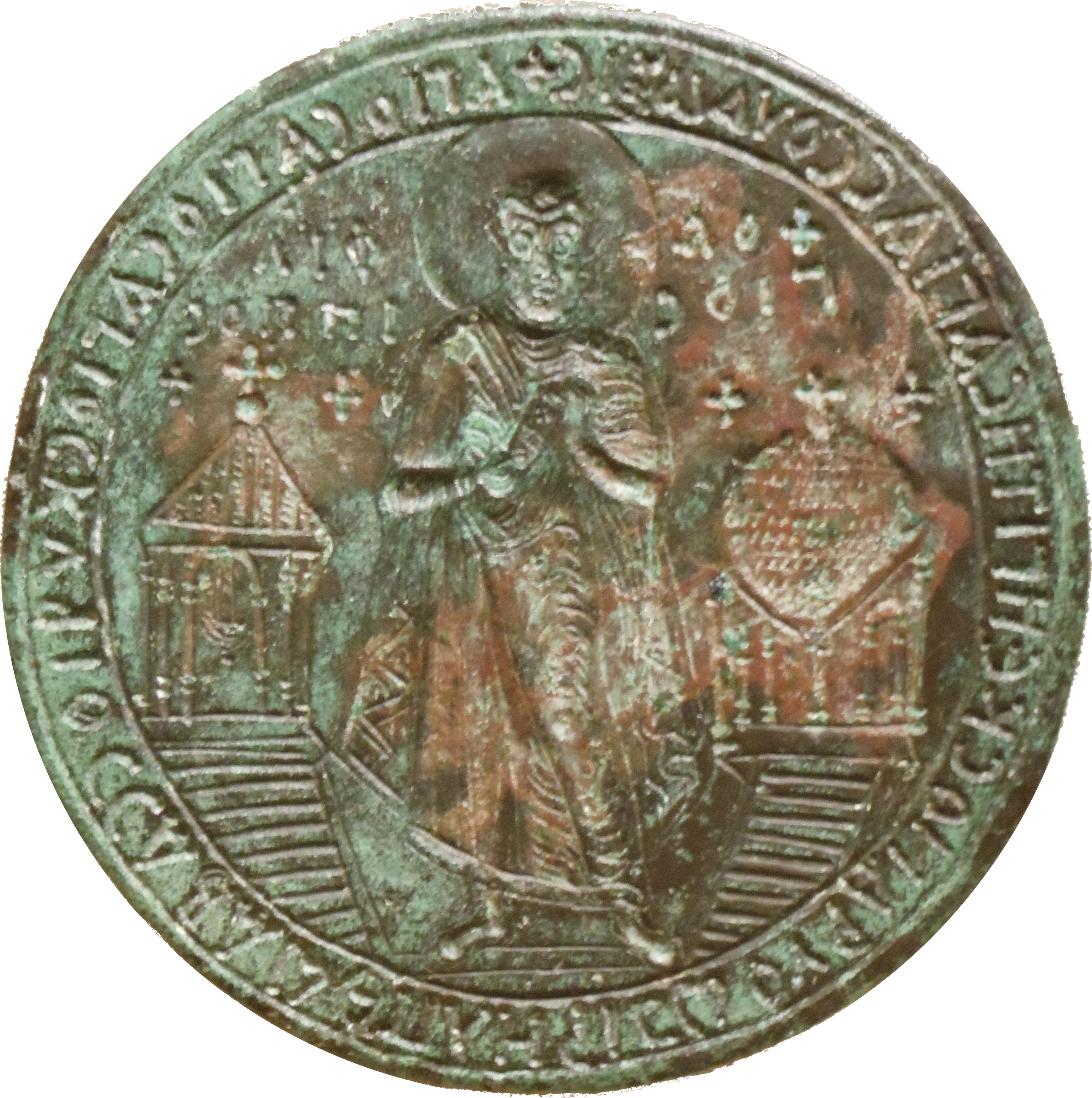
Sometimes you don’t have to go very far to check things out.  Several months ago, the Biblical Archaeology Review (BAR) ran a lead article about the recent discovery of the Tomb of the Apostle Philip in Hierapolis, Turkey, which was updated in this January 2012 Bible History Daily post. The original article mentioned that an interesting artifact depicting the recently uncovered site was on display in the Virginia Museum of Fine Arts.  This artifact is a sixth-century bronze bread stamp that was found at Hierapolis.  Details about the artifact are summarized in this Discovery News post.  This was too good to pass up, so several friends and I made a day trip to Richmond and came back with the following photograph (shot through the glass with my pocket camera).

Apostle Philip Bread Stamp

Sixth-century bronze bread stamp bearing the image of the Apostle Philip

The 4-inch bread stamp labels the figure in Greek as Hagios Philippos (St. Philip), and another Greek inscription around the edge quotes from Isaiah 6:3: “Holy, holy, holy, Lord of hosts; heaven and earth are full of Thy glory.”

You can chase down the fascinating details of this news story—which is still unfolding as the archaeologists continue to work and report their findings—by clicking on the hyperlinks above, and gain insight into what happened to the Apostle Philip (and Bartholomew) after he accepted his great commission.  But that’s not the point of this post.

The point is that Biblical archaeology is a vibrant, richly productive, and ever-changing field—full of ongoing discoveries that shed light on the Bible.  A little effort can go a long way to discovering new, rich insights to the veracity of Scripture.  And sometimes great discoveries are just a click or two on a hyperlink away.

Would you like to see more of these discoveries?  How many of them are there?  Lots!

Sometimes you can Google your way to great information, but sometimes there is more beneath the surface than any search engine can succinctly summarize in response to your search query.  This blog is all about sharing resources, so here are two that provide an ocean of archaeological discoveries for your consideration.  And they both happen to be actively sharing late-breaking information on the cutting edge of Biblical archaeology.

The first source packs great, professional teaching into a searchable, fascinating, contemporary catalog of discoveries.  It’s called (oddly enough) Ferrell’s Travel Blog and the name belies the wealth of top-drawer research that Professor Ferrell Jenkins has tied up in this site.  Spend some time here, and you will discover an indispensable addition to your Disciple’s toolbox.  Rather than just casually browsing through the posts, try jumping off on the side links, and use the Search box to investigate any topic you like.

The second site is also a blog (which I found from Ferrell’s Travel Blog).  It’s called the BiblePlaces.com Blog, and in addition to its energetic reporting of contemporary topics, their treatment and responses to ongoing controversies in the field of Biblical archaeology are impressive.  They are high integrity, and out in front of late-breaking events.  Another impressive addition to your toolbox.

Follow both of these blogs and you will be richly blessed.  Enjoy!


Trial of Jesus Before Pilate

The Gospel accounts of Easter and the trial of Jesus before Pilate have considerable agreement, and some interestingly unique statements.  While all four accounts agree on the essential details of what happened early in the morning of Good Friday, April 3rd, 33 CE, only Luke records that Jesus was interrogated by Herod Antipas (see Luke’s Sources).  Only John—writing long after the three synoptic Gospel writers—adds the detail of the name of the location in Jerusalem where the trial took place (Gabbatha).  And in writing that one word, John left a great clue for modern archaeologists to find the location of the trial.

There is so much to be gleaned about the veracity of the Gospel accounts from reading about the trial of Jesus.  The accounts are not identical.  But they are not inconsistent.  An argument could be made that if this material was contrived, all four accounts would be more homogeneous in the narrative details.

Archaeologist Dr. Shimon Gibson (mentioned in an earlier post) conducted a dig of the Gabbatha site in Jerusalem, and reached some conclusions that even his critics concede are probably correct, rewickering the traditional Via Dolorosa (“Way of Suffering”) in the process.  This type of work, and online resources, can help us see the Bible in context.

Among all that occurred at His trial, Jesus mocked Pontius Pilate—the judge who had the power to set Him free—with sarcasm.  I don’t know why that detail is so important, but somehow it just is.  Consider the painting below, which may be one of the most correctly detailed paintings of Jesus ever crafted.

If you research the work of Dr. Gibson, be careful—there are high-profile misrepresentations of his work, as he himself is quick to point out.  Unfortunately there are those who seem to be motivated more by the need to entertain than a desire to get the facts right.  This topic keeps coming up, and we will address it in forthcoming posts.

Veracity


The Golden Gate

This video ties archaeology and history to Matthew 17, and provides some context for the turmoil that surrounds Jerusalem—substantially predating the first century and continuing to this day.

Check out the links at the end of this post.  The Biblical Archaeology Review (BAR) is a fascinating resource that will engage your imagination and help you see the Bible.


Credits & Sources:

Day of Discovery More Than a Miracle
Gates of the Old City of Jerusalem
Golden Gate (Jerusalem)
Map of Jerusalem in the Time of Jesus
Biblical Archaeology Review
Where Jesus Walked DVD (Biblical Archaeology Review)
Matthew 17