Who was ultimately responsible for Jesus’ crucifixion? Theologically, all of us as humans have played a role in the death of Jesus, while believers in Christ mercifully receive its atoning benefits. But historically speaking, was it Pilate or the Jewish leaders who consigned Jesus to die on the cross? This is a thorny question which requires a careful answer.
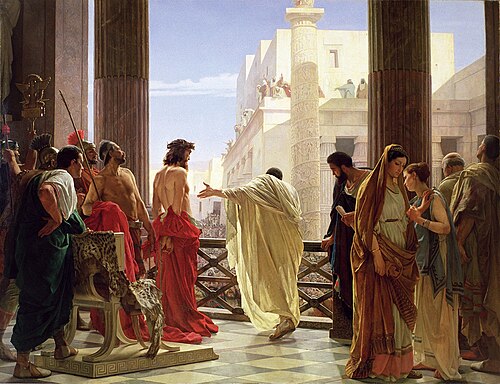
Ecce Homo (“Behold the Man”), Antonio Ciseri’s depiction of Pilate presenting a scourged Jesus to the people of Jerusalem. It took Ciseri twenty years, from 1871 to 1891, to complete the painting (from Wikipedia)
Pilate’s Hands Washing: From Mick Jagger to a Cathedral in Regensburg, Germany
The Rolling Stones lead singer, Mick Jagger, imprinted a passage from the Christian New Testament on the minds of a generation, when in 1968 he first sang “Sympathy For The Devil,” as a personification of Satan:
“And I was ’round when Jesus Christ Had his moment of doubt and pain Made (expletive) sure that Pilate Washed his hands and sealed his fate”
What was the washing of Pilate’s hands all about? In Matthew 27:1-2, the Jewish chief priests and elders judged that Jesus should be put to death, but they sent him to Pontius Pilate, the Roman governor of Judea anyway. Later in Matthew 27:24-26 we read of the aftermath of Pilate’s interview with Jesus:
So when Pilate saw that he was gaining nothing, but rather that a riot was beginning, he took water and washed his hands before the crowd, saying, “I am innocent of this man’s blood; see to it yourselves.” And all the people answered, “His blood be on us and on our children!” Then he released for them Barabbas, and having scourged Jesus, delivered him to be crucified.
All four of the Gospels note that Pilate had a role in Jesus’ crucifixion, but there are some differences in how Pilate is portrayed. What is peculiar about this passage in Matthew is that none of the other three Gospels record the incident of Pilate washing his hands. Neither do the other Gospels tell of the specific response of the people, “His blood be on us and on our children!”
Was Matthew putting the blame for Jesus’ crucifixion on the Jews? Or is something else going on here?
On a trip to Europe my wife and I took in 2022, I was stunned to see so much historical evidence of antisemitic sentiment preserved in what was once the very heart of Christendom, central Europe. In Regensburg, Germany stands a great cathedral, where one side looks over the remains of what once was the city’s only Jewish synagogue. Prior to becoming an Anabaptist in the early 16th century, Balthasar Hubmaier, who was then a firebrand medieval priest at that cathedral, preached a pogrom against Regensburg’s Jewish population, leading to the expulsion of Regensburg’s Jews and the destruction of their synagogue. Regensburg’s Jews had been labeled as “Christ-killers,” whereby the blame for Jesus’ death had shifted from Pilate to the Jews, and the label got stuck there.
Some have tried to have these Judensau engravings removed. But I am in a sense grateful that they are still around, as it helped to convince me that antisemitism is real, deeply embedded in the psyche of many, and we should leave reminders of the past around in order to educate younger generations.
That question haunted me as I wandered the streets of Regensburg.
When I reviewed two books on Veracity a few years ago, Augustine and the Jews, by Paula Fredriksen (a convert herself from Roman Catholicism to Judaism), and Future Israel: Why Christian Anti-Judaism Must Be Challenged, by Australian evangelical bible scholar, Barry E. Horner, I felt a lot of discomfort reading about the history of antisemitic acts perpetrated by so-called “Christians.” I got another taste of that discomfort in readingWhen A Jew Rules the World, by Bible prophecy teacher Joel Richardson, showing that some of my heroes in the early church voiced a kind of anti-Jewish sentiment at times in some sermons. But that visit to Europe two years ago convinced me that the history of antisemitism was worse than I had previously thought.
This blog post goes on multiple rabbit trails, but I want to address several issues:
Answering the charge by critics that the New Testament is antisemitic.
Thinking about why the Gospel of Matthew portrays Pontius Pilate the way Matthew does.
Showing how the Gospels use Greco-Roman compositional devices to frame their narratives.
Comparing modern compositional devices with the way first century literature like the Gospels were written.
Making the case that a nuanced understanding of biblical inerrancy increases our confidence in the Bible.
How Christian “Fan Fiction” has shaped the way we have thought about Pontius Pilate down through the ages.
Christians have been both “Bullies” and “Saints” in church history, and why it is important to wrestle with this.
Christians should be able to share the Gospel with our Jewish friends without stepping on mines filled with anti-Jewish prejudice. Journey with me on this exploration of Christian apologetics through the lens of church history!
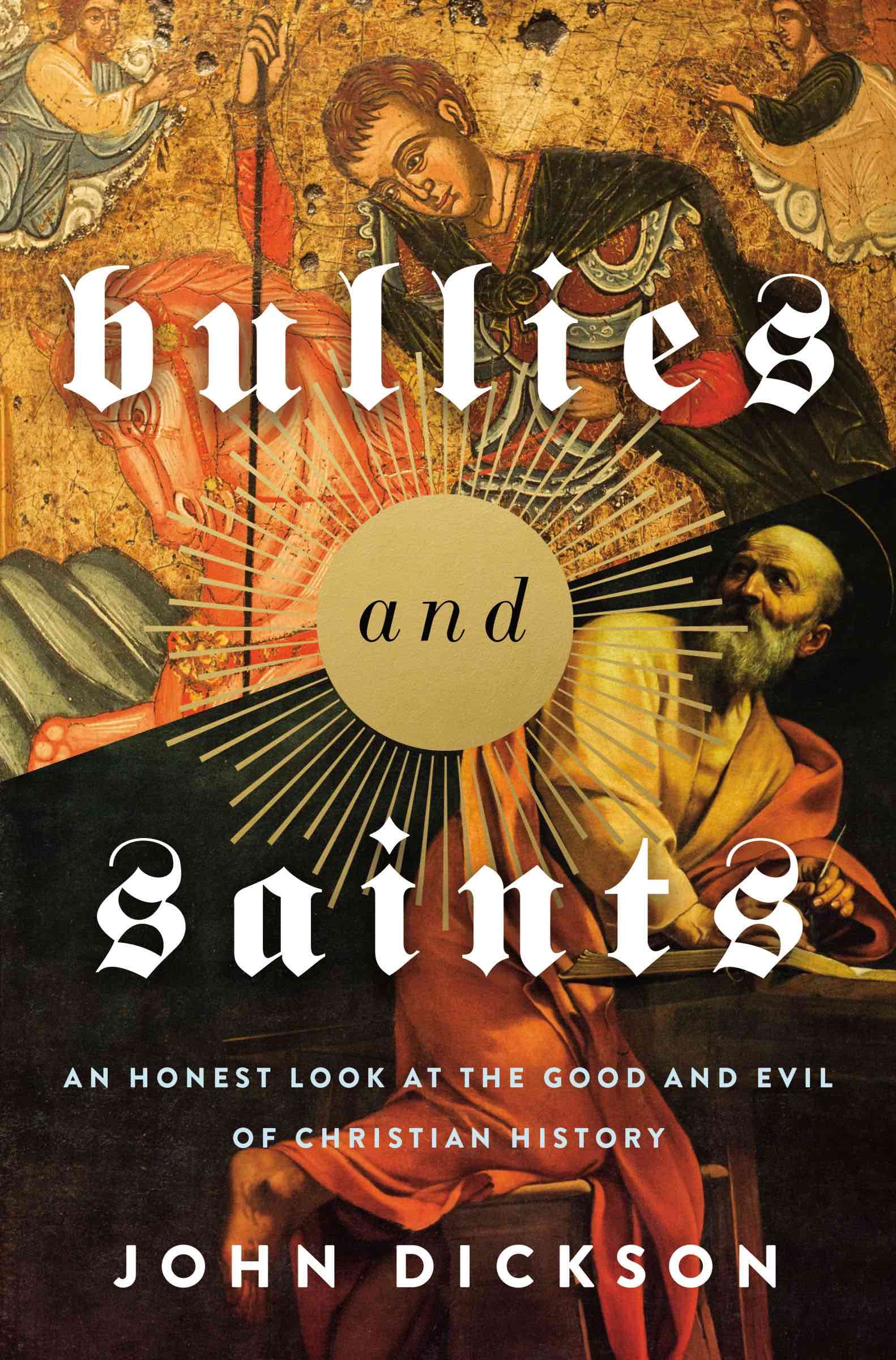
Bullies and Saints: An Honest Look at the Good and Evil of Christian History, by John Dickson, explores many of the good contributions of Christianity to the world, while also casting a light on a number of the more unsightly episodes of church history, that as a Christian I would rather forget. Celebrating the goodness of the Gospel’s impact on society while simultaneously acknowledging failures of the church along the way is vitally important, in a day when many in Western culture are skeptical about the value of organized Christianity.
I am taking a break from my two-part book review of Bart Ehrman’sArmageddon to address some significant news in the evangelical world. It involves biblical scholar Richard B. Hays on one side, and popular author Rosaria Butterfield on the other. This is probably the one blog post I have made this year, which I really did not want to write. But sadly I find it necessary.
As I wrote about late in the spring of this year, it was announced that a new book by a prominent New Testament scholar would come out this fall that would shake up a lot of people, particular evangelical thought leaders and teachers: “Most Christians probably have no clue who Richard B. Hays is. But when it comes to the Bible, Hays is big news. Think the Tim Tebow of the National League Football, or the Caitlin Clark of women’s basketball, or the Taylor Swift of pop-music, ….. or the John Piper of evangelical pastors. Richard B. Hays is THAT big when it comes to New Testament studies. He is a rock star.” I would urge you to go back and read that post for further context for this blog post.
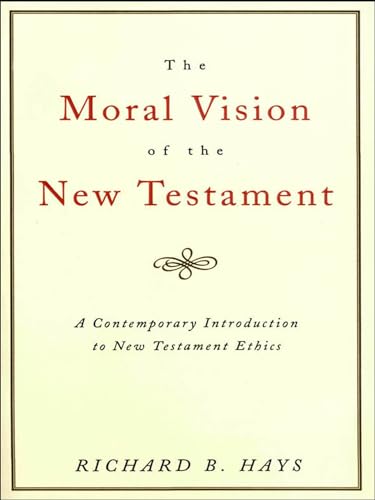
Richard B. Hays is the rough American equivalent to the British New Testament scholar, N.T. Wright. His son, Christopher, teaches Old Testament at my alma mater, Fuller Theological Seminary. Yesterday, the elder Hays and the younger Hays released The Widening of God’s Mercy: Sexuality Within the Biblical Story. What is remarkable about this book is that it marks a reversal in Richard B. Hays’ position in the 1990s, where he then concluded (at least tentatively) that the New Testament does not allow for any concept of affirming same-sex marriage as a legitimate option for the Christian. The elder Hay’s book, The Moral Vision of the New Testament: A Contemporary Introduction to New Testament Ethics, was the touchstone for many in what is often described as a “Side B” approach to same-sex attraction.
A definition at this point is vitally important.
At the risk of being too brief, a “Side B” approach to same-sex attraction is that it acknowledges that some people experience a kind of sexual attraction to members of the same-sex, in which at least some (if not many) who experience this same-sex attraction find it difficult to completely shake off. Though quite debatable in “Side B” circles, some, if not many, or perhaps even most in this category, live with this condition their entire lives. Understood this way, “same-sex attraction” is not an identity, as though “same-sex attraction” competes with one’s identity as a Christian. Neither is it equivalent to sexual lust, though it could lead to same-sex lust, which is described as sin in the Bible. Rather, “same-sex attraction” as an “identity” is simply an acknowledgment of one’s experience in contrast with heterosexuals who never experience same-sex attraction. It does not automatically imply that someone is actively involved in some kind of sexual activity with a member of the same sex.
Richard B. Hays. One of the top New Testament scholars on the planet. Has he changed his mind on what the Bible teaches about human sexuality?? A new book suggests he has, but his argument is complicated.
Richard B. Hays (Father) and Christopher Hays (Son) on Christian Sexual Ethics
Reviews are starting to come out taking a hard look at the new book, The Widening of God’s Mercy: Sexuality Within the Biblical Story. As many reviewers have indicated, Richard B. Hays has changed his mind regarding the legitimate, biblical boundaries for sexual behavior, a viewpoint which his son, Christopher, also supports. A couple of reviews favorable to the conclusions made by the Hays can be found here:
Rebecca McLaughlin, for The Gospel Coalition. McLaughlin acknowledges she experiences same-sex attraction, but that she is committed to upholding an historic Christian sexual ethic, which honors marriage as being between one man and one woman.
All five reviews are worth reading, particularly as preparation for someone who wishes to read the new Hays and Hays book. However, the most detailed and engaging review is the last one by Preston Sprinkle. The conclusion Sprinkle makes is worth quoting in full:
I have to admit, the scholarly side of me was excited when this book was first announced. Some Christians immediately trashed the book on social media—something no thoughtful Christian should ever do with books they haven’t read—but I was genuinely excited to read it. Richard is a brilliant scholar (I wasn’t familiar with Christopher’s work), and his article on Romans 1 in particular was one of the most thorough and exegetically responsible treatments of this tough passage. I was deeply curious how he was going to refute his previous argument. I also wondered if The Widening of God’s Mercy would tease out a fresh argument for same-sex marriage that hadn’t yet been made.
To my surprise, the book did neither. Instead, it simply repackaged an old trajectory argument to make a questionable logical leap: since God welcomes foreigners, eunuchs, tax collectors, and sinners, therefore sex difference is no longer part of what marriage is.
At the risk of oversimplifying, all of these reviews suggest that the exegetical work Richard B. Hays did in the 1980s and 1990s, which demonstrates that the New Testament does not affirm same-sex marriage, is interestingly still intact. In a nutshell, the New Testament affirms marriage as being between one man and one woman, thereby indicating that a marriage between two men, or between two women, can not qualify as within the boundaries of what constitutes a biblical marriage.
However, the message of the new book suggests that God can, and indeed, has changed his mind. While same-sex marriage has been rightly condemned as outside of accepted historic, orthodox Christian understanding for almost 2,000 years, God has in the 21st century moved through the action of the Holy Spirit to now affirm a broader perspective on marriage. This is equivalent to what is often known as a “Side A” approach to same-sex attraction and marriage.
The idea that God can and has changed his mind is provocative. It is also an argument that can act like a wild tiger which can not be tamed, or like the proverbial bull in a china shop.
How Do You Know When God Changes His Mind… After the New Testament Has Been Completed?
But the argument can easily go in directions which will surprise Christians and non-Christians alike. The rise of the Enlightenment in the late 18th century suggested that we can essentially dispense with the concept of the supernatural. Why? Because perhaps God has changed his mind.
Follow this thought experiment: Back in the New Testament era, people were naive enough to believe in things like miracles, so God used the belief in the resurrection as a way of convincing premodern people to accept the Christian message. However, now we live in the modern (even post-modern) era, where science tends to reign supreme. We can give up on the whole concept of the supernatural as essential because God has basically changed his mind. No one needs to make any decisions based on supernatural beliefs anymore because the secularization process of society has made those supernatural beliefs irrelevant.
This is effectively what the Hays father and son team have done. There is nothing new here.
One might then argue that both secularization and new understandings of marriage in the civil sphere are inevitable results of the trajectory of contemporary Western culture, and could have potential advantages. Perhaps there is some good after all if the ethical framework of Christendom takes a backseat culturally. But theologically, these new supposed “movements of the Holy Spirit” are a disaster for the church. Where can the justification that God has revealed a change of mind be found? In the writings of a pair of United Methodist biblical scholars?
Richard B. Hays has in the past, and even now, ultimately told us the truth about the what Bible says about same-sex attraction and marriage, but in this new book with his son Christopher it would appear that what the Bible says really does not matter. Because God has changed his mind.
The father and son Hays team would probably push back against this. They might say that the Christian ethic of love supersedes the ethical teachings of the New Testament written in the first century. They might say in the sovereignty of God, God has every right to change directions ethically in the 21st century, even at the expense of what we read in Scripture. But as an evangelical Protestant who looks at the Bible as the final authority for faith and practice, it is really difficult to square the contention made by the father and son Hays team that the Bible condemns all same-sex erotic relations as going against Scripture, while simultaneously saying that 2,000 years later this no longer applies, simply because God has since changed his mind.
On the one hand, I appreciate the efforts by Richard B. Hays and Christopher Hays to look for a compassionate way to accept LGBTQ people as people who are genuinely loved by God, thereby rejecting the ways that the church has condemned such persons in the past, simply because they experience some form of same-sex attraction, whether they act on it or not.
But the main problem is not simply their conclusion, but rather, it is the method by which they arrive at their conclusion. In the end, for the Hays, it is not Scripture which remains ultimately authoritative for determining Christian ethics. Instead, it is human experience which trumps Scripture. But in making this argument, Hays and Hays are adopting a kind of progressive Christianity that goes beyond simply affirming same-sex marriage. They are undermining the basis for determining what faithful Christian discipleship and theology has looked like for 2,000 years.
For if the Bible teaches that same-sex marriage is permissible, then that would be one thing. Instead, they argue that Paul and the rest of the New Testament writers got the doctrine of marriage wrong. In their argument, we need new revelation today to fix what Paul and the other apostles messed up.
I do not doubt the Christian commitment of either the senior or younger Hays. Yet as far as I am concerned, it just seems like it would be a whole lot more honest to say that Christianity got some stuff so fundamentally and horribly wrong, that it would be wiser to reject Christianity as purely wishful thinking and leave it at that. To think that the Christian church for nearly 20 centuries got the fundamental doctrine of marriage wrong is a really big “OOPSIE!!!”
Perhaps we could just preserve the supposedly good parts of what the Bible teaches, and safely discard the rest. Perhaps a kind of “cultural Christianity” is all we can really hope for. Perhaps we could set up a committee to try to negotiate through acceptable versus unacceptable moral claims in the Bible. But who gets the authority to carve those things out and make such decisions?
Is this really about telling the truth about same-sex attraction, marriage, and one another?
It would be better to be an atheist, an agnostic, or generic theist instead of trying to stuff the square peg of Richard B. and Christopher Hays version of Christianity into the round hole of 2,000 years of historic orthodox Christianity. But as I believe that the central core claim of Christianity, that Jesus rose from the dead, is indeed true, I am driven to conclude that there must be a better way to describe what Christianity looks like than what the father and son Hays team would have us believe. Even if the Bible teaches something I do not fully understand, I still need to learn to trust that God knows what he is doing, and not try to pretend that twenty centuries after the Incarnation, that I suddenly know better.
I hope to at some point read The Wideness of God’s Mercy, to make sure I have not misrepresented the authors, but for now I would suggest reading some of the reviews that have come out, to whet your appetite for wrestling with the arguments of the book. If you are not much of a reader, you should consider watching or listening to a YouTube video by Preston Sprinkle, where he goes into some detail into what he agrees with about the book and ultimately disagrees with about the book. In a world where the traditional Christian doctrine of marriage has come under relentless attack from the culture, it is refreshing when you have someone telling the truth about what Scripture is saying, and doing so in a respectful way that honors the best of intentions that others possess.
——————————————
An Addendum…. About Rosaria Butterfield’s Fives Lies of Our Anti-Christian Age….And A Plea for Speaking the Truth
This final part of the blog post addresses the other side of the conversation taking place in evangelical spaces in the church today.
I highlight Preston Sprinkle’s video because near the beginning of the video Preston urges Christians to do their best to accurately understand the arguments presented by someone who fundamentally disagrees with you. For if a Christian fails to faithfully represent what someone else believes or says, that Christian is breaking the Ninth Commandment not to bear false witness against one’s neighbor. Lying about what someone actually believes is an immoral act. Christians who lie about others in this way need to repent of such behavior.
For example, I was intrigued and interested to read Rosaria Butterfield’s recent book Five Lies of Our Anti-Christian Age. Rosaria Butterfield was involved in a lesbian relationship for years, and she was an extremely active anti-Christian activist before Jesus got hold of her life. Several of her earlier books are very good, including her phenomenal The Secret Thoughts of an Unlikely Convert, a book I reviewed 11 years ago briefly at Veracity. I only read parts of her next book Openness Unhindered, but that was helpful, too.
In The Secret Thoughts of an Unlikely Converttells of her “train wreck” conversion story, and how simple acts of Christian hospitality drew her to read the Bible slowly and carefully over a few years, assisted by caring, non-judgmental Christian friends, who welcomed her into their lives. Rosaria’s story is gripping and encouraging. I highly recommend learning about her testimony.
Rosaria Butterfield – An unlikely convert to Christian faith, touched by the art of hospitality…. What has happened to her since?
The Good Stuff in Rosaria Butterfield’s Five Lies of Our Anti-Christian Age
At first I found much to learn from in Five Lies of Our Anti-Christian Age. Rosaria effectively summarizes the five lies being aimed against Christianity today:
Lie #1: Homosexuality is normal.
Lie #2: Being a spiritual person is kinder than being a biblical Christian.
Lie #3: Feminism is good for the world and the church.
Lie #4: Transgenderism is normal.
Lie #5: Modesty is an outdated burden that serves male dominance and holds women back
She also has some excellent advice about distinguishing between sympathy and empathy, which encouraged me to keep reading. Rosaria even had a helpful critique of certain aspects of the “Side B” movement, where some have advocated a controversial idea of certain kinds of “spiritual friendships” where such relationships function a lot like marriage without the sex part. That does sound a bit fuzzy.
This has raised a number of questions in my mind, and in my earlier analysis of the Revoice movement, it was not clear as to who associated with Revoice supports that way of thinking and who does not, and what they actually mean by “spiritual friendship.”
I have come to see that Rosaria Butterfield is correct to call out a particular definition of “spiritual friendship” as unbiblical , when such “friendships” mimic marriage. At the very least, this is confusing and unhealthy. Friendship is one thing. Marriage is different. This appears to be her strongest objection to the Revoice movement (Butterfield, Five Lies, p. 59). In many ways, some of this critique is correct, at least in the early years of the Revoice conference.
We believe that all Christians have the capacity for both sinful (i.e., fleshly) and holy (i.e., Spiritual) desire for relationship with other people; that intimate friendship between believers can be a means of sanctification; and that the Holy Spirit can direct and shape affection for other image-bearers in ways that honor their dignity and celebrate their unique personhood. We believe that Christians should seek wisdom and prudence when entering any relationship marked by greater intimacy, and that believers must exercise care and resolve to avoid all forms of temptation. We believe that Christians must actively resist and turn away from every thought, action, desire, or behavior that does not align with God’s revealed intentions for human sexuality, since we are not our own, but belong—body and soul, both in life and in death—to our faithful Savior, Jesus Christ. (Rom. 8:12–13; Col. 3:5)
If someone has questions about “intimate friendship,” then the phrasing towards the end urging believers to “actively resist and turn away from” anything that “does not align with God’s revealed intentions for human sexuality,” sounds pretty orthodox to me. I do wonder if Rosaria has read this page from Revoice’s website.
The Not-So-Good in Five Lies
I agree that all five of the lies Rosaria outlines are indeed impacting the church in negative ways. The problem with Five Lies comes down to some of the details Rosaria articulates in her book, and how she interacts with other authors writing in this area.
First, it would appear that not everyone defines all “spiritual friendships” in the manner Rosaria puts it. People can live without sex, but they can not live without friends. Even early on in the book, Rosaria makes multiple statements that simply do not resonate with what I know about so-called “Side B” understandings of same-sex attraction:
“Side A rejects the Bible as inerrant, infallible, sufficient, and authoritative, while Side B rejects the biblical doctrines of sin, repentance, and sanctification” (Butterfield, p.67).
“Side B errs on its handling of matters of salvation and sin, forgetting that the first word of salvation is repent—“Repent,” declares Jesus, echoing John the Baptist, “for the kingdom of heaven is at hand” (Matt. 4:17). Side B redefines gay sin merely as sexual action and denies that sin acts with affections, feelings, attractions, and desire. Both Sides A and B believe that homosexuality is fixed and that the gospel might change people in smaller ways but never in the deep matters of sexual desire ” (Butterfield, p. 74)
The logic here resulting from a confusion of terminology and their definitions is difficult to follow: Rosaria rejects both “side A” and “side B” in favor of what might be called “side X,” but it could be instead that she is advocating “side Y,” supposedly somewhere in between “side B” and “side X.” As some define it, “side X” conflates “same-sex attraction” together with lust for the same sex, something which is sinful and needs to be repented from, as opposed to a temptation which is to be resisted, or otherwise something someone should flee from, as when Joseph ran away from Potiphar’s wife, when she propositioned him. Is what I define as “side B” really “side Y” instead? According to GotQuestions.org, perhaps my “side B” is really “side Y.” Are you confused yet?
Rosaria is correct to say that that “side A” believes homosexuality as an orientation to be “fixed,” but not everyone in the “side B” camp would agree with that. It would appear that Rosaria Butterfield defines “sexual attraction” as being equivalent with sexual lust, which is not at all what I have read is consistent with what advocates of a “Side B” approach take.
Even if Rosaria is correct, I do not see the evidence for her position demonstrated in her book. Rosaria Butterfield operates with her own definitions of terms like “sexual attraction,” “side B,” and “sexual orientation” that do not align with how other authors use that terminology. As a result, these different definitions of key terms and ideas distorts her readings of other writers.
For example, in Greg Johnson’s book, Still Time to Care, which I have reviewed on Veracity, he argues that both same-sex attraction and opposite-sex attraction have disordered elements to them, this side of Adam’s fall. Not only is same-sex attraction, in the most sexual sense, disordered, on the opposite-sex attraction side, polygamy is a sign of disorder as well. However, in her review of Johnson’s book, Rosaria Butterfield responds:
Because Johnson rejects the natural and good pattern of heterosexuality, he believes that there is no point or hope in striving for it. Johnson writes, “There is no reason to believe that the ordinary progress of spiritual growth would involve the replacement of sinful homosexual temptation with sinful heterosexual temptation.” (Butterfield, p. 71).
But this misrepresents the argument with Greg Johnson is making in his book. For one thing, for Johnson, the desire on the part of someone who experiences same-sex attraction to want to become opposite-sex attracted is quite natural (contra Rosaria), but it is not the same thing as sanctification; that is, “spiritual growth” from this quote. Johnson’s point is also to say that those who experience opposite-sex attraction can experience temptation and sin just as much as those who experience same-sex attraction, just in different ways.
Exchanging one form of temptation to sin for another form of temptation to sin is not a sign of progress in one’s sanctification. Regardless of the temptation, or the sin such temptation tries to move us towards, we are called to flee from all temptation and repent of all sin.
Rosaria’s argument as I read her implies that part of Christian sanctification is seeking the transfer of same-sex temptation in someone’s experience over to opposite-sex temptation in their experience. Does this really mean that a same-sex attracted person should strive after a different kind of temptation, that of heterosexual temptation? How about not striving after any kind of temptation at all? What ever happened to that phrase from the Lord’s Prayer, “lead us not into temptation?”
The irony is that in Rosaria’s own writings and interviews she has given acknowledges that she still experiences same-sex attraction at times. How this squares with her view of Christian sanctification is not made clear in her book. Rosaria also agrees with her fellow author, Christopher Yuan, that the object of Christian sanctification is holiness and not heterosexuality, which appears to be in complete contradiction with what she says about Greg Johnson’s book. Again, Greg Johnson’s book emphatically argues that the goal of Christian sanctification for a same-sex attracted person is holiness, not heterosexuality.
The logical disconnect here is incredibly frustrating. Rosaria’s misreading of Greg Johnson’s book is not the first time this happens in Five Lies. This happens several other times with other authors with whom she interacts. If I am wrong about this, I would like to be corrected.
Continually running into roadblocks like this in Five Lies of Our Anti-Christian Age, over and over again, has proved to be very discouraging, making the reading of Rosaria’s book to be more of a slog than a spiritually encouraging process, despite some of the genuinely helpful places in her book where I actually agree with her. The final straw for me came in how she treats author Preston Sprinkle.
Rosaria offers a review of one of Preston Sprinkle’s books, where Preston talks about the kind of close, intimate friendship that David and Jonathan had in the Old Testament. Many on “side A” of the discussion believe that David and Jonathan were in fact gay lovers in the most sexual sense. But Preston Sprinkle takes a different approach. Preston relates the story of David and Jonathan using the initials “K.D.” to refer to King David and using the name “John” to refer to Jonathan. Rosaria’s take on Preston’s reading of the story is odd to say the least:
Sprinkle is casting King David (“K.D.”) as an effeminate poet and Jonathan (“John”) as his unrequited love. In keeping with postmodernism, Sprinkle tips his hat to the false claim that David and Jonathan were probably gay. Playing with the Bible in this way is meant, I suppose, to make it friendlier to sexual minorities (Butterfield, p. 240).
However, if she had read Preston’s book more carefully, she would have read the explicit statement made by Preston Sprinkle on the previous page, “the Bible gives no evidence that David and Jonathan were in a sexual relationship.” (Preston Sprinkle, Embodied, p. 78). If she had bothered to read an earlier book or a later book by Preston Sprinkle, she would have read even more explicit statements as to the nature of David and Jonathan’s friendship:
David and Jonathan weren’t gay. But they did experience deep-seated, same-sex affection, and nonsexual intimacy toward each other. Same-sex oriented Christians experience similar desires only to a greater degree. (Sprinkle, People to Be Loved, p. 146).
David does say that Jonathan’s love was “more wonderful than that of women” (2 Sam. 1:26), but this doesn’t mean their relationship was sexual, since the ancients didn’t automatically equate “love” to “sex,” unlike many modern westerners. (Sprinkle, Does the Bible Support Same-Sex Marriage?: 21 Conversations from a Historically Christian View, p. 63).
For Preston Sprinkle, the kind of “same-sex affection” David and Jonathan had for one another is not identical with “same-sex attraction” in the erotic sense. David and Jonathan instead shared a deep, non-sexual friendship bond with one another. What possessed Rosaria Butterfield to read Preston Sprinkle so badly?
Yet the most alarming thing is that Rosaria has refused to engage with Preston in a conversation to sort out the matter. From Preston’s blog post:
I also wish I could be having this conversation directly with Butterfield. In fact, I reached out her via email to invite her to have a private, good-faith conversation about these matters. (Not a debate; just a clarifying conversation.) Her husband, Kent, who is also one of her pastors, responded with an email he and his co-pastor had written, declining on her behalf. When I asked for permission to quote publicly from their reply, Kent requested that I not do so and provided me with this public statement: “Rosaria’s pastors stated there is a difference in understanding of the gospel and therefore see no basis for discussion.”
The final public statement made by Rosaria’s elders is disturbing as it is inconsistent with the actual data. All of us make mistakes, get things wrong, misunderstand people, etc. I do it quite often, and try to do my best to repent of such sinful errors when I can. But when someone publicly makes a claim about what someone else believes or says, which turns out to be false, and then refuses to discuss or even acknowledge the error, then this is a violation of the Ninth Commandment, which forbids a follower of our Lord to bear false witness against one’s neighbor.
Perhaps what Rosaria is saying is true about her own experience. But when it comes to telling the truth about same-sex attraction, marriage, and one another more generally, something appears to be amiss.
I do hope and pray that Rosaria will rethink her posture, write a letter or email, and make some effort to clear up the matter. For the sake of honoring the Ninth Commandment, she should do so. But to date, Rosaria has done no such thing. This is all very troubling.
Ditching What I Was Hoping Would Be an Edifying Book
That pretty much did it for me.
I finally decided to give up on trying to finish Five Lies of Our Anti-Christian Age. The work required to try to constantly reframe how she defines terms like “sexual attraction,” “side B,” “sexual orientation”, and others and try to mesh them into how other authors uses those same terms was just exhausting. I really wanted to like this book, considering a number of positive reviews from others whom I respect, but I just got worn out by all of the mental gymnastics and contortions.
It made me long for wanting the “old” Rosaria of The Secret Thoughts of an Unlikely Convertback from 11 years ago. I miss that Rosaria. Back then, Rosaria was more the compassionate voice who prized hospitality as the gateway for allowing God to work and change lives, as opposed to the full-on culture warrior posture she now takes in Five Lies of Our Anti-Christian Age.
In her favor, I still marvel at the courage that Rosaria Butterfield had in giving up her lesbian relationship, and the very social world that supported her and simultaneously isolated her from Christian community, in order to give her all-in-all to follow Jesus, no matter what the cost. Rosaria is truly a model for radical, Christ-loving discipleship. But for some reason, her tendency towards radicalism has caused her to slip into yet another deadly sin, that of bearing false witness against one’s neighbor. I pray that the Lord will open her eyes so that she might do the right thing some day, and return to telling the truth about others.
The Unfortunate Tie Which Unites Richard B. and Christopher Hays with Rosaria Butterfield
Circling back around to the Richard B. Hays and Christopher Hays book The Wideness of God’s Mercy, it would appear that their book is meant to be kind of a strong pushback to the rather militant culture warrior posture of a Rosaria Butterfield’s Fives Lies of Our Anti-Christian Age. I pray that Hays and Hays would see the error of their posture, but I doubt that such a move will happen anytime soon.
The unfortunate tie which unites Richard B. and Christopher Hays with Rosaria Butterfield is the notion that same-sex attraction inevitably leads to the acceptance of same-sex marriage, forming a symbiotic relationship between the two. For the Hays, this notion is viewed positively. Same-sex attraction is a gift from God which paves the way for God to honor same-sex marriage. The trajectory that starts with same-sex attraction eventually works to redefine marriage. Why? Because God has changed his mind.
For Rosaria Butterfield, this notion is viewed negatively. Same-sex attraction is not merely a temptation, it is the embodiment of a kind of sin itself. There is no difference between temptation and the sin that might result from giving into that temptation. Same-sex attraction is just as much a morally-culpable sin as same-sex marriage is. For Rosaria, same-sex attraction does not merely entail a potential temptation to be resisted, but rather it is a sin to be repented from.
In Rosaria’s anthropology, the trajectory associated with the same-sex marriage movement in the wider culture works in the opposite direction. Because same-sex marriage is a sin that has been normalized, the only way to fight the trajectory is to fully assign same-sex attraction itself into the category of sin as well. Since same-sex marriage is sin, then anything that has the possibility of leading to that sin must be dealt with as sinful itself. Anything short of this radical categorization of same-sex attraction is a concession towards sin which can only be addressed through repentance. Any acknowledgment of a “same sexual orientation” that might never change in a person’s life is simply believing at least one of the “five lies.”
What we are witnessing in our current cultural moment is a “hardening of the categories,” as a top-of-the-line New Testament scholar moves against an historically orthodox Christian ethical position, while a heroic former-lesbian-activist turned evangelical Christian now issues takedowns of other fellow believers who do not follow her exact mindset. Like a “hardening of the arteries,” which endangers the health of the physical body, a “hardening of the categories” pits the timelessness of God’s moral standards against the call to love with compassion and mercy, which endangers the health of the Body of Christ.
Neither side appears to leave much room for a third-way mediating position that seeks to uphold the Christian virtues of hospitality, listening well, and not telling lies about other people, while also upholding an historic, orthodox Christian ethic regarding sexual ethics, and the doctrine of Christian marriage as being between one man and one woman. This is a sad state of affairs. There is a whole generation of LGBTQ+ folk who long to hear the Christian message of both love and truth expressed to them in a way that they can understand.
It is time that we as Christians learn to do a better job in telling the truth about same-sex attraction, marriage, and one another.
UPDATE Monday, September 23, 2024:
Less than two weeks after I published this blog post, Gavin Ortlund of Truth Unites sat down with Rebecca McLaughlin to discuss the controversy regarding the new Hays & Hays book on human sexuality.
About five years ago, I wrote a Veracity blog post about 2 Kings 2:23-25 , the weird episode of Elisha and the She-Bears. This passage ranks right up there as one of the strangest, if not the most disturbing stories in the Old Testament. To tell the story most bluntly, the prophet Elisha is ridiculed by a bunch of young, little “boys” for the prophet’s “baldness.” Elisha returns the insults by issuing a curse on the boys, and then a pair of she-bears emerge from the woods to maul forty-two of the boys. Pretty weird, right?
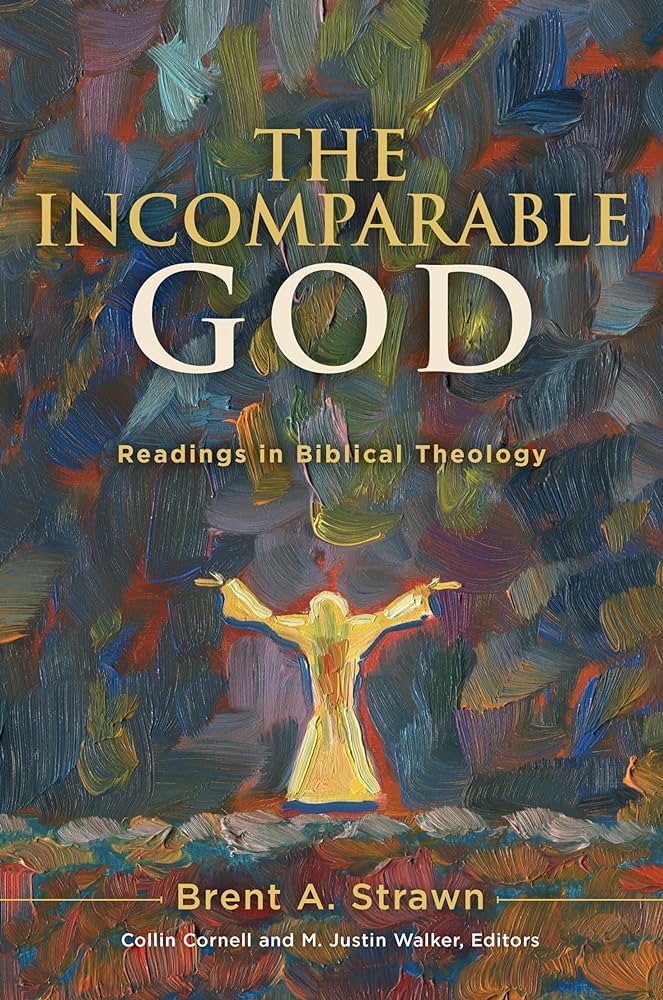
I recently ran across a volume of essays, The Incomparable God, by Brent Strawn, an Old Testament scholar at Duke Divinity School, covering various topics related to the Old Testament, including “Revisiting Elisha and the Bears: Can Modern Christians Read — That Is, Pray — the ‘Worst Texts’ of the Old Testament?” The Incomparable God is very helpful, scholarship of the highest caliber, but it is not for the faint of heart, as the reflections in these essays assume some working knowledge of the Hebrew language. While this is clearly in Brent Strawn’s wheelhouse, the average Christian might not be so well equipped to grasp the nuances of Hebrew waw-consecutive grammar.
If you are thinking, “Waw-what?,” then fear not. In this partial book review, I will do my best to put the cookies down on the lower shelf for you.
Nevertheless, when you try to make sense of something as crazy sounding as the Elisha and the She Bears story, it helps to go to the scholars for some assistance. Believe me, when I first focused my attention on this passage, I needed some help. Now with this new publication of Brent Strawn’s essays, it makes for a good opportunity to revisit this text. So please “bear” with me….. uh, pun intended!
A Very Difficult, Morally-Challenging Bible Passage
“23 He [Elisha] went up from there to Bethel, and while he was going up on the way, some small boys came out of the city and jeered at him, saying, “Go up, you baldhead! Go up, you baldhead!”24 And he turned around, and when he saw them, he cursed them in the name of the Lord. And two she-bears came out of the woods and tore forty-two of the boys. 25 From there he went on to Mount Carmel, and from there he returned to Samaria.“
Back when I was doing youth ministry several decades ago, a very bright female high school student asked me what I thought about this passage of the Bible. I was supposed to be the “Bible expert” but I was stumped.
I had to be honest with her that I had been a believing Christian for at least ten years and I had no clue as to what this was about. 1 and 2 Kings never caught my interest too much, books where Israelite king after Israelite king kept messing up and rebelling against God. Aside from some great stories about Elijah, like the big showdown in 1 Kings 18:16-45 between Elijah and the prophets of Baal at Mount Carmel, 2 Kings just seemed like a rehearsal of names of kings I could hardly pronounce.
I had read the Old Testament back in college for a religion class, but I did not remember reading that particular passage at the time. Perhaps I just skimmed over that part without paying much attention. What I do recall is that I had never heard a sermon preached about Elisha and the She-Bears in any evangelical church that I had been attending that entire ten year period. I read the passage more earnestly now, scratching my head all the way through it, thinking that I might have a good response to give to my high school student friend. But now that it was pointed out to me, I found it jarring. I was dumbfounded. I was stuck.
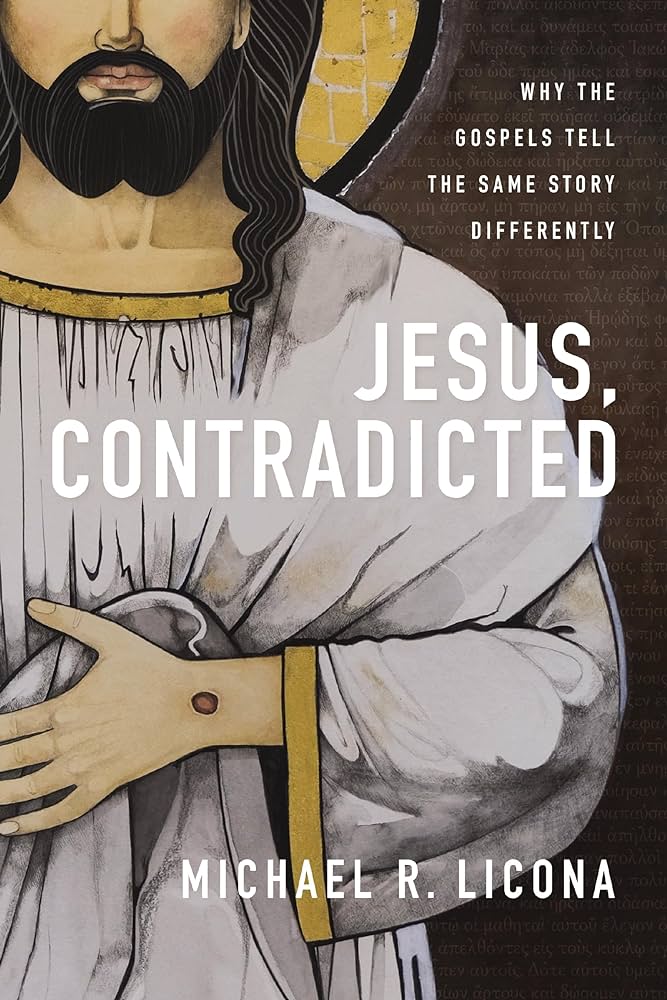
Have you ever been troubled by what might appear to be contradictions between the four Gospel accounts? If so, then Dr. Michael Licona’s Jesus, Contradicted will help you to tame the doubts in your mind, and have a fresh look at the trustworthiness and reliability of the Bible.
I know because I have been there. Having not grown up in an evangelical church, I never heard of the concept of “biblical inerrancy” until my years in college in the 1980s. Growing up in a liberal mainline church instead, the Bible only had a secondary role in spiritual formation. As a teenager though, I read through all of the New Testament (except for Revelation), and I was wrestling through the things I read in the Bible. One of the first things I noticed is that there are differences between the four Gospels and how they report various speeches and events.
But apparently, not every Christian is convinced that having differences in the Gospel is a good thing. Some argue that we should do whatever we can to harmonize the Gospels, even if some of those harmonizations come across as unconvincing, embarrassingly ad-hoc, otherwise severely strained.
Mike Licona, a New Testament scholar, is one of most able defenders of the bodily resurrection of Jesus, having debated Bart Ehrman, the world’s most well-known skeptic, on several occasions. Now, Michael Licona is arguing for a more robust view of biblical inerrancy, in Jesus, Contradicted: : Why the Gospels Tell the Same Story Differently
In the mid-1970’s, Harold Lindsell, who had been a professor at Fuller Theological Seminary, had popularized an idea to try to resolve the apparent contradictions in the various accounts of Peter’s denials of Jesus, on the night Jesus was handed over to the authorities to face trial and eventually to be crucified. Mark 14:72 and Luke 22:61 has Jesus saying that a cock would crow twice after Peter denies Jesus three times. But in Matthew 26:74-75 and John 18:27, a cock crows once after Peter denied Jesus three times. Matthew has Jesus predicting one cock crow, while John says nothing about Jesus predicting anything about a cock crowing.
While this type of harmonization sort of “works,” it still really confused me. After all, all four Gospels explicitly state that Peter denied Jesus three times, not six times as Lindsell’s “inerrantist” interpretation suggested. I reasoned that if this type of convoluted logic is required to make sense of “biblical inerrancy,” then I simply could not accept it. I really wanted the Bible to be “inerrant,” but as a mathematics major in college I just could not force my mind to accept the idea that 3 equals 6.
I pretty much shoved the idea off of my mind, visiting it every once in a while, but I just could not get past the problem. It was not until I read Five Views of Biblical Inerrancy ( introduced and reviewed here on Veracity,) a multi-views book highlighting the perspectives of five different biblical scholars holding separate and distinct definitions of what constituted “biblical inerrancy,” that I finally had some peace about the matter. Not every proponent of “biblical inerrancy” holds to the rather strict version championed by Harold Lindsell.
This was quite a relief. I could now hold to a version of “biblical inerrancy.” My problem was that I still was not sure what that version of “biblical inerrancy” really looked like.
Jesus, Contradicted: Why The Gospels Tell The Same Story Differently, by Michael Licona, offers a more evidenced-based approach to handling differences in the Gospels, without resorting to tortured harmonization efforts concerning incidental details.
If you think “progressive Christianity” has no relevant impact on evangelical churches, then you really need to pay attention to this blog post…. I hope you stay with me until I get to the Richard Dawkins point at the end…
Most Christians probably have no clue who Richard B. Hays is. But when it comes to the Bible, Hays is big news. Think the Tim Tebow of the National League Football, or the Caitlin Clark of women’s basketball, or the Taylor Swift of pop-music, ….. or the John Piper of evangelical pastors. Richard B. Hays is THAT big when it comes to New Testament studies. He is a rock star.
I read Richard B. Hays’ influential The Moral Vision of the New Testament back in the 1990s, when I was a seminary student. I had several dear Christian friends who were wrestling with same-sex attraction. I wanted to know how best to walk with them in their struggles, and help them navigate through a lot of the harmful messages being heard in some conservative evangelical churches, while still being faithful to Christ and Scripture.
To be honest, I was conflicted inside: What do you do and say when a friend tells you that they are “gay?” But in reading Hays’ book, it encouraged me that one could have compassion towards those who wrestle with same-sex attraction, while still embracing a traditional sexual ethic, with the time-honored doctrine of marriage between one man and one woman consistent with historic orthodox Christianity. Hays’ The Moral Vision of the New Testament: A Contemporary Introduction to New Testament Ethicsis still regarded as one of the seminal texts affirming what is now sometimes known as a “Side B” approach to human sexuality. In that book, Richard B. Hays recounts a moving conversation he had with a friend who was nearing death, who for years had wrestled with same-sex attraction while living a celibate life out of obedience to Christ. That conversation gripped me as I have had several conversations like this myself with friends over the years.
Richard B. Hays. One of the top New Testament scholars on the planet. Has he changed his mind on what the Bible teaches about human sexuality?? What type of impact might this have on evangelicalism?
Rethinking the Moral Vision of the New Testament?
The Moral Vision of the New Testament covers a number of topics, taking certain positions which might not sit well with some readers. For example, The Moral Vision of the New Testament takes a more pacifist approach to the question of non-violence and war. But this is not what the book is most known for. In The Moral Vision of the New Testament, Hays tackles a lot of the revisionist scholarship championed by John E. Boswell, a 1970’s graduate of the College of William and Mary. Boswell eventually became an influential scholar at Yale, advocating an ethical position in support of same-sex marriage in the church and society at large. Just a few years ago, William and Mary named a building in Boswell’s honor. In a previous essay which served as the impetus for much of what Hays wrote in The Moral Vision, Hays had this to say:
“John Boswell’s influential interpretation of Rom 1:26-27 is seriously misleading in several important particulars. A careful exegesis of the passage shows that Paul unambiguously describes homosexual behavior as a violation of God’s intention for humankind. Responsible interpretation must first recognize that Paul condemns homosexuality and then ask how that condemnation bears upon the formation of normative ethical judgments.”
Now, almost thirty years later, it appears that Richard B. Hays is now backtracking on what he wrote back in 1995/1996. Get the full story from Ian Paul’s Psephizo blog, but here is a summary: Advanced promotion from the publisher, Yale University Press, has announced a new book, co-authored with his son, Christopher Hays, The Widening of God’s Mercy: Sexuality Within the Biblical Story. The book is not even out yet, but as of April, 2024, it ranked as the “#1 New Release in Gender & Sexuality in Religious Studies” on Amazon’s website. If the news reports are accurate, a shift in the thought of the senior, Richard B. Hays, is nothing short of earth-shattering. Richard B. Hays is thought by many to be the American equivalent of the British New Testament powerhouse scholar, N.T. Wright. The fact that Richard B. Hays and N.T. Wright are not just colleagues but good friends is even more significant.
Generally, one should not comment about a book without reading it. But the following endorsement blurb from another scholar who has read an advanced copy of the book is both telling and astonishing:
“This book is an event of historic significance. Senior New Testament scholar Richard Hays here renounces his very widely-quoted (and exploited) non-inclusive treatment of human sexuality from thirty years ago. His son, Old Testament scholar Christopher Hays, of Fuller Theological Seminary (!), here clearly and boldly embraces LGBT+ inclusion, surely at the risk of his employment. Their case is made based on biblical materials, notably a trajectory-type vision emphasizing the ever-widening range of God’s mercy across the canon. Traditionalists will not be convinced by the exegesis. Those who have been wounded by the church’s rejection, and their allies, will see this book as occasion for celebration.”—David P. Gushee, Mercer University
Over the recent decades, David Gushee moved away from his conservative evangelical upbringing to embrace a more progressive Christianity. Today, he is one of the most outspoken ethicists to embrace the acceptance of same-sex marriage within the church. So, if Gushee is going to endorse a book, you can pretty much guarantee it is not going to endorse a traditional view of marriage as being between only one man and one woman.
Crisis in Mainline Protestantism…. Coming Towards More Towards Evangelical Spaces?
In one sense, despite the recognized stature of Richard B. Hays among conservative evangelical Christians, I am not surprised that Hays has rethought his earlier position. Hays is ordained in the United Methodist Church (UMC). Over the past couple of years, the United Methodist Church has gone through perhaps its worst split in its 200+ year history. Roughly one out of four churches left the United Methodist Church to join the Global Methodist Church, aligned more with the rapidly growing Methodist church outside of the United States, notably in Africa. There are still conservative United Methodist Churches out there, while others try to promote an “agree-to-disagree” posture, but the situation has dramatically changed within the last few years. At one time, the Methodist church was the largest denomination movement in the United States.
Now, the controversy over the doctrine of marriage has reduced the footprint of the UMC in the United States significantly. Miracles do happen, but if the UMC follows the well-worn path of other major denominations changing their doctrine of marriage, then it is simply a matter of time before the UMC ceases to exist as an American Christian institution. The current situation will raise a lot of questions about the future of the Methodist seminary system, with schools like Duke Divinity School in North Carolina and Candler School of Theology in Atlanta. Technically, the UMC bans their clergy from performing same-sex weddings (well, at least until this past week). But the ban has never been effectively enforced, which explains the exodus of churches out of the UMC towards the Global Methodist Church over the past few years.
If Hays desires to stay within the UMC, there will be a lot of pressure put on those like him to rethink their views on human sexuality. In contrast, colleges and seminaries either loosely or closely affiliated with the more conservative Global Methodist Church are seeing revivals (like Asbury College) and/or increased enrollments (like Wesley Biblical Seminary), situations which you do not even find in moderate interdenominational or non-denominational evangelical institutions, which are downsizing. The UMC is meeting in a General Conference in the current weeks to flesh a lot of these issues out. (UPDATE June 17, 2024: The UMC has within the past month reversed course on supporting traditional marriage between one man and one woman. Over a million Methodists in Africa have since left the UMC, and more across the globe are expected to leave. The fallout from the UMC change of direction is nothing short of catastrophic).
It is one thing to see issues like these raised in mainline Prortestant churches, which have tended to tilt in a progressive direction anyway, over the past half a century. It hits a bit closer to home for me when you see this in evangelical institutions like Fuller Seminary.
Perhaps David Gushee has not read his advanced copy of the new Hays and Hays book accurately. We must wait and see if this is the case. But if Gushee is right, then it is difficult to see how the Hays will be able to effectively backtrack from a statement like “Paul unambiguously describes homosexual behavior as a violation of God’s intention for humankind.” More likely, the “trajectory-type vision” ascribed to the new book means that somehow the Hays will acknowledge that Paul unambiguously rejects same-sex relationships of all kinds as permissible within the will of God. But then they must follow the “trajectory” somehow to say that Paul is hopelessly antiquated with out-dated moral values associated with the Bronze age, or just plain wrong, nevertheless. That would be the honest way to go about it.
But to say that the Apostle Paul got his doctrine of human sexuality and marriage wrong is quite an extraordinary claim. The ramifications of such a claim are significant.
The “trajectory-type vision” mode of interpretation has a lot of appeal among some. It assumes that just as God changed his mind regarding making circumcision a requirement for becoming a follower of Jesus, then God can easily change his mind regarding other matters that followers of the Judeo-Christian tradition have held for thousands of years. Here is a quick sketch of the “trajectory-type vision.”
Some have suggested that because Jesus never condemned slavery, that Jesus was in some sense wrong, but that the trajectory of the Bible message puts an end to slavery, indicating that God has changed his mind. Some have made arguments that the early church wrongly marginalized women in terms of restricting the office of elder to only qualified men, thus saying that the trajectory of the Bible message suggests that God has changed his mind for the future of the church, in our day and age. The same type of argument has been used to say that Paul did condemn certain types of same-sex relationships, but he remained silent about the concept of same-sex marriage. The latter idea never entered Paul’s mind. The trajectory argument is then employed to say that the “wind of the Holy Spirit” has been moving today to affirm same-sex marriage as being a legitimate expression of God’s purposes for human sexuality, despite how certain so-called “clobber passages” in the Bible against all same-sex relations have been used in previous generations of Bible-believing Christians.
The “wind of the Holy Spirit” is a “go-to” feature of a “trajectory-type vision” hermeneutic. However, it is a pretty bold claim to know how the Holy Spirit is moving in such an extraordinary way, 2000 years beyond the apostolic era of the first century.
The “Trajectory-Type Vison” Hermeneutic at Work
Some have looked for support for this “trajectory-type vision” in the Bible by appealing to the story of the daughters of Zelophehad in Numbers 27. In summary, Zelophehad had no sons, only five daughters. The inheritance law at the time made no provision for inheriting the estate of the father, when there were no sons in the picture. The five daughters of Zelophehad petitioned Moses and the other Israelite leaders to say that without a male heir, none of the five daughters would receive any of the father’s inheritance, and that this was not fair to the daughters. God then instructed Moses to say that the daughters of Zelophehad had a point to make, and provision was made for the inheritance of the father’s estate to be distributed among the daughters of Zelophehad.
An evangelical scholar, like Gordon J. Wenham, in his commentary on Numbers, says that the episode with the daughters of Zelophehad served the purpose of showing the Israelites how case law developed in the early Israelite period. However, other scholars see something more to the story. Such scholarly adherents to a “trajectory-type vision” of biblical morality suggest that the case of the daughters of Zelophehad establishes the idea that God can change his mind on moral matters. So while same-sex relations were forbidden not only in the era of the Old Testament, but also in the era of Paul and the New Testament, the situation has changed today. Perhaps God has changed his mind regarding the sanctity of same-sex marriage.
To be fair, this brief sketch of the “trajectory-type vision” is vastly over simplified. For example, there are certain evangelical scholars today who make no use of a “trajectory-type vision” to argue for having women serve as elders in local churches today. See my friendly (and in-depth) dialogue with Andrew Bartlett, author of Men and Women in Christ,hosted here on Veracity, in several parts. Bartlett refreshingly and wisely rejects the “trajectory-type vision” approach. I have difficulties with some of the argumentation Bartlett uses to arrive at his conclusions, which appear idiosyncratic to me. But thankfully at least he avoids the temptation to embrace a “trajectory-type vision” hermeneutic.
Those who favor same-sex marriage as permissible for the Christian, coming from this interpretation perspective, are typically making their appeal based on an argument from silence. You could say that while the New Testament does not endorse same-sex marriage, it is not necessarily condemning it either. For example, the evidence from early church history shows that the earliest Christian communities paid relatively little attention one way or the other to what we would today call “same-sex marriage.” This is a claim advanced by John Boswell in his influential Christianity, Social Tolerance, and Homosexuality.
Arguments from silence are difficult to sustain. Advancing such arguments where there is no long-standing tradition opposing the position being argued for is one thing. But advancing an argument from silence regarding a 2,000 year tradition upholding marriage as being only between one man and one woman is something different.
But in the case of Richard B. Hays, readers like me who have looked to Hays’ The Moral Vision of the New Testament have concluded that Paul makes no exegetical room for arguing for same-sex marriage as a valid Christian option. The argument from silence approach gains very little traction here. The only real alternative is some type of “trajectory-type vision” briefly mentioned by David Gushee in his endorsement of the upcoming book. It will be very, very interesting to see how the new book will be received.
The life of a single, gay Christian, who wants to honor Christ with his/her life, can be a lonely journey. More than anything else, people who struggle with same-sex desires need friendships, people who will simply listen to their stories (credit: image from Christianity Today‘s review of Single, Gay and Christian). Such is the ethical theme found in Richard B. Hays 1996 work, The Moral Vision of the New Testament.
Why the Situation with Richard B. Hays Matters
The debate over same-sex marriage within the church has been going on for several decades now. For most of the Protestant mainline churches, the debate has swung over into the favor of a progressive Christianity, though you still find holdouts in these once much-larger denominations. It is doubtful that this new book will have much of an impact in those circles. To many theological progressives in these circles, Richard B. Hays’ book on The Moral Vision of the New Testament has been thought to cause great harm within the LGBTQ circles. The Widening of God’s Mercy: Sexuality Within the Biblical Story probably will not change the suspicions many progressives have about Richard B. Hays.
Neither will this new book due to be released this fall have a big impact in more solidly theological-minded evangelical churches, which have worked to try to craft a vision of traditional marriage in their churches. Some of these churches support those who wrestle with same-sex attraction well, while many do not. Either way, the Hays book will unlikely sway these types of churches.
Where the impact might be felt the most is in those non-denominational or inter-denominational churches where LGBTQ concerns are often rarely discussed, at least publicly. Many of these churches have pastors and other church leaders who have looked up to the esteemed Richard B. Hays as a more moderate voice, upholding a traditional position on marriage while making a sincere effort to offer a compassionate voice and listening ear to those somewhere along the LGBTQ spectrum. For if someone as highly revered as Richard B. Hays backtracks on what he wrote nearly 30 years ago, it might prompt some within the evangelical fold to follow suit.
Most evangelical Christians will never bother to read Richard B. Hays, focusing more on trying to make ends meet, running a taxi service for their kids’ athletic programs, providing food in the refrigerator, and keeping the grass cut. But chances are, many of these evangelical Christians attend churches where Richard B. Hays has been a theological “North Star” for their pastors in their seminary education. A big shift in such a “North Star” scholar may cause some pastors and/or elders in a local church to rethink for themselves matters of sexuality.
Has the esteemed American New Testament scholar, Richard B. Hays backtracked on what he wrote in this book from some 30 years ago? What might the ramifications be?
A Reflection… With Some Help From Another Richard…. Richard Dawkins
There is a good reason to explain this phenomenon of churches in decline. As certain churches move away from historically orthodox theological and moral positions, people begin to realize that while the outside veneer of these churches still look Christian, what is going on underneath the hood of these churches is falling apart. Some people have no problem with this, as the “trajectory-type vision” which typically undergirds the theological shifts is fine with them. In other words, it is fine to say the Bible can be horribly wrong about something, and that is okay. We can still salvage some semblance of Christianity by saying that the trajectory of the Bible’s message gets rid of some of the supposed “crud” endorsed within its own pages in order to retain some worthwhile gem in its core. We can peel off what we think is rotten in the Bible in order to preserve a vital kernel, and say “hey, it is still all about Jesus.”
I get the motivation behind what attracts people to the “trajectory-type vision” in interpreting the Bible. Some people are trying hard to rebuild and retain their faith when a certain part of their theological construct crashes and burns. Yet I am convinced that much of what is behind this deconstruction process is from those who have grown up in some particular strand of Christianity, which has essentially butchered the interpretation of the Bible, passing itself off as orthodox when it is nothing of the sort. One easy example to cite are those “KJV-Only” movements which teach that all modern Bible translations, like the ESV and NIV, are “tools of the devil” bent on corrupting the pure truth supposedly found in the KJV alone. The message is this: “Only the KJV-Only people are right. Everyone else is wrong.” That is quite a head trip. My heart goes out to people like that. I had my own close brush with that in my teenage years.
But the “trajectory-type vision” hermeneutic can take a much deeper cut. Because once you adopt a “trajectory-type vision” hermeneutic, its application often knows no boundary. Try this on for a thought experiment: Perhaps the Bible does teach that Jesus is the only way of salvation. But we can rest easy to say that while the Bible has been wrong about that, the trajectory of the Bible’s message affirms that all expressions of religion outside of Christianity are perfectly acceptable to God. Perhaps the Bible does teach that there is a hell which can separate people eternally from God. But we can rest easy to say that while the Bible has been wrong about that, too, the trajectory of the Bible’s message affirms that universalism is true, and everyone will ultimately be saved in the end (Hitler and Stalin, too).
I could go on about the dangers of a “trajectory-type vision,” despite the appeal, but hopefully you get the point. A slippery-slope is a logical fallacy, for sure. But in the affairs of life, a lot of folks slide rather easily down a slipper-slope.
Almost Done… But Hang in There… This is The Most Important Part
OK. I am bound to get flack for saying this, but this really needs to be said and considered carefully. This pretty much nails where I am at on topics like these, though I am sure others are at different places. I welcome the conversation feedback 🙂
A more insidious way of applying the “trajectory-type vision” hermeneutic is to say that we really can not determine what the Bible says with much confidence about the uniqueness of Jesus regarding salvation, the existence of hell, the role of men and women in the church, God’s view on marriage, how we view our sexual identity, or a whole host of other significant issues. An approach like this is spiritually treacherous: It insists that the Bible just is not clear on such issues, the vocabulary is vague, the debates seem confusing and endless, and so we really can not come to an accurate understanding of what the original apostolic leaders who stood behind the New Testament were really saying. With that type of ambiguity, we can simply choose an interpretation which fits what we want to believe, and leave it at that.
Christians do indeed differ regarding how old the earth is, the exact timing and order of events associated with the Second Coming of Christ, or any number of these type of issues. We can hold to certain informed opinions, while grasping them loosely while we converse with one another. But these nitty gritty debates, while still important, do not always have immediate impact with how we live our lives as Christians. However, there are these other issues which do impact how we organize our churches, structure our family life, raise our kids, relate to our neighbor, etc. To simply throw up our hands and say, “The Bible is not clear on such matters. So just choose what you want to believe, and do that,” can be a recipe for confusion.
Frankly, in my view, when you get to that stage of thinking, which seems more and more common these days, you do not have much of a Christian faith left. I have more respect for people who ditch the faith altogether, whether they call themselves atheists or agnostics, than I have for people who persist in hanging onto some watered-down substance of Christianity, which is effectively no different than the secular world around them. While in principle the idea of being free to “agree to disagree” in the Christian church is not only correct but admirable as well, there are limits to that for holding congregations together. The million dollar question comes down to figuring out where those boundaries and limits can be drawn. What hills are you willing to die on, and why?
Deconstructing one’s faith need not lead to a full deconversion from Christianity. But at some point, deconstructing too far leaves not much ground to stand on in keeping one’s Christian faith. Faith then becomes more like fantasy, an escape from reality.
I would much rather embrace the truth, even if it could be shown that Christianity was false, instead of trying to convince myself that I could make Christianity into something I want it to be, sticking my head into the sand to keep from considering that I might be wrong, or at the very least succumbing to wishful thinking. There is nothing wrong with wanting Christianity to be true. But sticking one’s head into the sand to try to avoid one’s doubts is not very satisfactory for me… and not very healthy either.
In comparative terms, I have much more admiration for people who do not find Christian faith to be believable, but who appreciate the moral values traceable back to Christianity and/or the aesthetic value of Christian music, art, architecture, and Christmas carols. In many ways, I have more in common with them than I have for those who go to great lengths to pretend Christianity to be true, while trying to ignore elements of Christian faith that do not fit the narrative they want their Christian faith to have.
My response is to say that I seek to trust that what God says in Scripture, (rightfully interpreted, mind you), to be true, even when there are things in Scripture which I do not fully understand. I simply must trust in God and his goodness, that God knows what he is doing, and will ultimately do the right thing, even when from my time bound, 21st century American limited perspective, it looks like something is way off at the present time. If I was in charge of writing the Bible, I probably would have said certain things differently. But God did not put me in the position of writing inspired Scripture. I do not have that kind of authority. Neither do I think that famous 21st century New Testament scholars have that authority either. That takes a lot of chutzpah I simply do not have. Therefore instead, I must put my confidence in what the apostolic authors of the New Testament have given us, and go with that.
I am a believing evangelical Christian, who wrestles with big questions, but I very much still believe. Perhaps this is just the way I am wired, but I have more in common with the “cultural Christianity” of the scientist Richard Dawkins than I do with those progressive Christians who have effectively diluted faith to being something totally innocuous. By “believe” I mean that I take the witness of the early church regarding the Resurrection to be true. I “know” Christianity to be true in that I hold the evidence for the Resurrection to be the best explanation for what happened with Jesus on Easter morning, given all of the alternatives. Everything else regarding the truthfulness of the Christian faith flows from the reality of the Resurrection.
The following discussion between Richard Dawkins and a U.K. journalist has been on my mind for weeks. Richard Dawkins is naive to think you can really have “cultural Christianity” for long without having genuine Christianity undergirding it, but he makes more sense than the progressive Christianity which tries to pretend something is Christian when it really is not. While I do not hold to Richard Dawkins’ skepticism about Christianity, he seems a lot more authentically genuine than the vicar who could not answer the question posed by the 2-year-old son of the journalist:
So, if the endorsements behind the new Hays book turn out to be correct, it will be disappointing. Progressive Christian readers of Veracity will probably be ticked off at me for urging for a renewed look at the ethical vision of The Moral Vision of the New Testament, upholding marriage between one man and one woman, described by Richard B. Hays back in the 1990s. Others on the extreme conservative side will be ticked off at me for not being somehow “tougher” enough with LGBTQ. I guess that comes with the territory when you write a controversial blog post like this.
We just have to wait until The Widening of God’s Mercy: Sexuality Within the Biblical Story comes out in print in the fall to know how the father and son team of Hays and Hays approaches their topic.








 Veracity