
Does the Bible teach that women should serve as elders in a local church?
This is a question which has become one of the most divisive issues in evangelical churches today. It is also a question filled with assumptions which begs for other questions. What is an “elder” in a local church? What is the “local church?” Then there is the question which has plagued American society culturally for at least the last ten years: What is a “woman”?
Preston Sprinkle on the Complementarian/Egalitarian Debate
My journey in exploring this question parallels much of the same journey that New Testament scholar Preston Sprinkle took, which led to him to write From Genesis to Junia: An Honest Search for What the Bible Really Says about Women in Leadership. But you may ask, “Who is Preston Sprinkle?”
Preston Sprinkle taught New Testament at Eternity Bible College, at an extension campus in Boise, Idaho, before it downsized in 2016. As a New Testament scholar, with a PhD from the University of Aberdeen (Scotland), Preston Sprinkle has written about and spoken on a number of issues relevant to the study of the New Testament. Eternity Bible College was founded by popular Christian author and speaker, Francis Chan. Francis and Preston even wrote a book together, Erasing Hell, a response to the universalism-leanings of Rob Bell, a controversial former evangelical pastor, back in 2011. After leaving Eternity Bible, Preston founded the Center for Faith, Sexuality, and Gender, providing resources for churches, parents, and other individuals, in order to more effectively care for people who struggle with questions about sexuality and gender, while upholding a traditional view of human sexuality and marriage; that is, a one-man to one-woman covenantal relationship intended for life.
As one might expect, entering any conversation regarding sexuality and gender will probably generate controversy, and Preston is no stranger to it. Preston’s previous books on these topics, such as People To Be Loved: Why Homosexuality is Not Just an Issue (reviewed here on Veracity), and Embodied: Transgender Identities, the Church, and What the Bible Has to Say (reviewed here on Veracity), have sparked very lively discussion and criticism from all sides. I have not always agreed with every element Preston puts forward in his writings, but I appreciate his willingness to tackle tough questions, doing so with a commitment to follow the Scriptural text, wherever it leads, to find answers.
Preston has been criticized by those who argue that the Christian church needs to change its stance on marriage, in order to welcome same-sex marriage, and by those who believe that one can self-identify with a certain view of gender, which is contrary to one’s biological sex. On the other side, are those Christians who believe that Preston Sprinkle coddles or even excuses sin associated with homosexuality and transgender ideology. Or Preston’s critics simply do not like the definitions of words he uses regarding certain controversial topics within the LGBTQ conversation. It would appear that some Christian leaders think it is permissible to poison the well and misrepresent what someone like Preston Sprinkle has written, and not want to sit down and talk about perceived theological differences. Preston finds his way to step on minefields, not of his own making.
What other controversy could Preston address?? Well, Preston had put off doing a deep dive into the question of “women in Christian leadership” for years, knowing that he had other scholar friends whom he highly respected, who landed on different conclusions to the question. But Preston finally took the time to read a stack of books for several years in order to write his book, as a way of bridging the gap between ordinary Christians, without seminary training, and those in the academy.
Preston’s newest book was one of my best reads of 2025 (and early 2026), having received an advanced copy of the book. Though I do feel compelled to write this rather long, critical review, as I will explain below.

Preston Sprinkle offers a rigorous exegetical examination of the complementarian versus egalitarian debate, concerning the interpretation of Scripture in From Genesis to Junia: An Honest Search for What the Bible Really Says about Women in Leadership. Preston aims well to call out balls and strikes, but he misses a few calls.
A Personal Journey in the Complementarian/Egalitarian Debate
In my case, I started blogging about the question back in 2019. I read several really thick books, blogging my way through them, until I came to a conclusion, stopping to extensively write about the topic four years later in 2023, which pretty much exhausted me by then. The issue was being discussed in the church my wife and I were part of at the time, and the topic proved to be a highly divisive issue, with a number of people leaving the church, for a variety of reasons. This saddened me, as I was hoping for a solution where people could come together and find common ground. However, such a solution proved to be elusive.
There were arguments made by both sides of the issue, “egalitarians” who accepted the idea that the Bible was okay with women serving as elders in a local church, and “complementarians” who concluded that the Bible teaches that only qualified men should serve as elders. Some arguments on both sides were better than others, but I decided to dig through them all as best as I could.
I had put off this Scriptural study for several decades, having attended Fuller Theological Seminary, a decidedly egalitarian institution. To teach at Fuller, you must be egalitarian by conviction, and as a student at the seminary, I largely accepted the ideas I was taught. My years at Fuller proved to be a mind-stretching and faith-stretching experience for me, particular when I was recovering from several years of ministry burnout.
However, when it came to the complementarian/egalitarian controversy, some of those ideas that were institutionalized at Fuller from an egalitarian perspective, did not sit well in my mind. I wanted to be egalitarian, but there were nagging questions in my head when it came to reading certain passages of Scripture. Several of my friends who went to Fuller walked out of that seminary more unconvinced by Fuller’s standard approach to the controversy, being won over by more complementarian readings of Scripture instead. I also had female friends at Fuller who were trying to navigate the issue as best as they could. I was torn and pretty well confused on the topic, not knowing which path was correct.
Where Preston’s story differs from mine comes to our backgrounds. Preston grew up in a conservative evangelical and complementarian church, where only men served as elders. My story, on the other hand, began with growing up in a liberal mainline Protestant denomination. The denomination started ordaining women as “priests” in the mid-1970s, when I was too young to care much at all about the issue.
Unbeknownst to me, the controversy at the denominational level was at a fever high pitch. What was not talked about that much was what the Bible itself had to say about the issue…. at least, I never heard much talk about the Bible in my parents’ circles. Nevertheless, the ordination of women was framed as a step towards the liberation of women, and it was celebrated that way.
My mother was elated by the denomination’s decision, accepting the then common wisdom that if a woman can do the same job a man can do, then what should keep that woman from serving as a “priest?” For me, I could have cared less, as I was much more interested in playing tag football with my neighborhood teenage friends, than I was wading into the world of denominational politics.
However, within a few years, I had become a serious follower of Jesus late in my years in high school. I also became friends with an older couple in my childhood church, who had become greatly concerned with what was going on with what was being taught in that denomination at a national level. They owned a business refurbishing and selling colonial-style furniture from the 18th century, as that couple and my family both lived in Williamsburg, Virginia, the home to Colonial Williamsburg.
This couple were also conservative evangelical Christians, who read their Bible every day, unlike my parents. My parents, while very dedicated to going to church, showed little interest in the personal study of Scripture (though my mom showed more interest than my dad). This couple, who were friends with my parents, asked others in the church leadership as to what the denomination’s new stance meant for their commitment to the Bible.
This couple had concerns about a “slippery slope,” for if the denomination would loosen up regarding their stance on women serving as “priests,” or “elders” in the church now, would this inevitably mean that the denomination would start sanctioning same-sex marriage, and having openly practicing gay and lesbian clergy?
My new older friends received assurances from the church leadership that even with the changes regarding women’s ordination, the denomination would never, ever go along with the progressive view of sanctioning same-sex marriage in a Christian church. Not having that much familiarity with the Bible, as a fairly new follower of Jesus, I really did not know what to think about it, though I had a certain instinct which told me that it would be unfair to women to restrict the office of elder to men only.
Fast forward roughly twenty-five years later, the denomination began performing same-sex marriages. Even just a few years ago, not too long after this couple had died, that very church I grew up in performed a wedding ceremony for two lesbian priests. So much for those assurances given to my older friends that the denomination would never, ever move in a more progressive theological direction.
The cultural and theological landscape has shifted dramatically since the 1970s. The liberal mainline Protestant churches which dominated the American cultural scene in the 20th centuries have been pretty much in freefall decline, while more conservative evangelical churches, particularly with labels like “non-denominational” or “inter-denominational” have been on the rise. But a lot of issues that once were hot topics in the Protestant mainline have shifted over to the relatively newer evangelical churches.
Just a year ago, I learned of a growing evangelical church in nearby Norfolk, Virginia that took an unusual path through the complementarian/egalitarian debate. When that church was founded, it was egalitarian, having two women serving as elders in the church, serving alongside other male elders. But these two women ended up doing a deep dive study in Scripture on their own and came to the unexpected conclusion that only qualified men should be serving as elders in a local church. These two women agreed to serve out the remainder of their terms as elders, but they also agreed to step down from the office after that. Since then, that church has only had men serving as elders.
I say all of this as an introduction to argue that our experiences in life often color how we approach controversial theological issues. That is true for me just as it is for Preston Sprinkle. The advantage that Preston has had is that he is not a pastor or seminary professor (at least, not anymore!), so his job is not on the line as to where he would land on the issue. Furthermore, his wife “would rather stroll barefoot through a room filled with broken glass than be a pastor,” so family pressures are not a factor. As Preston argues in his introduction to From Genesis to Junia, he simply wants to assess the exegetical arguments from Scripture, and essentially call balls and strikes as to where he might land after doing this study.
How well does Preston do in going about this? Let us dig in and find out. Just one word of warning: This review is quite a bit on the long side. This is one of the most difficult issues in biblical interpretation in our day, which can be hard to sort out. If I had enough sense about me, I probably would just stop writing about this, and not return back to the topc. But I have a lot of respect for Preston Sprinkle, as a truth-seeking New Testament scholar, so I felt honored to read and review his book before it was officially released to the public. If you just want to jump to the conclusion, and skip most of the details, follow this footnote.0

People To Be Loved: Why Homosexuality is Not Just an Issue, by Preston Sprinkle. This book was my introduction to Preston’s work, published back in 2015. Preston’s book has been criticized by those on both the theological right and theological left of him. What could be more controversial than wade into other waters of controversy, as he dives into the debate over having women serve as elders in a local church, one of the topics in his latest book, From Genesis to Junia.
Preston Sprinkle’s Exegetical Investigation Into the Complementarian/Egalitarian Debate
As you read From Genesis to Junia, you get the sense that there is some serious exegetical work going on, and both sides of the debate have important contributions to make in the discussion. Preston does intend to make this work readable, for his evangelical Christian audience, without assuming knowledge of ancient New Testament Greek. However, there is just no way of avoiding some of the technical details which not only divides scholars, but also divides churches. There are proponents on various sides of the debate who make certain arguments, which lack sufficient evidence to make their case completely convincing. Much of the controversy comes down to how certain terms are defined, like “elder,” “local church,” “women,” and in Preston Sprinkle’s case, the term “leadership.”
It is impossible to get past the fact that one must dive into these exegetical matters, making sense of how such terms are to be defined, if one is to make an informative conclusion, one that avoids both a kind of knee-jerk conservatism that closes itself off to fresh ways of thinking, as well as a kind of an anything-goes hermeneutic of Scripture which simply follows along with the ebb and flow of the culture. Preston Sprinkle deserves credit for resisting the extremes, staying in his lane as a New Testament scholar, and sticking with the exegetical concerns, for the most part.
Nevertheless, part of the difficulty in writing a book like this is in how the debate is framed. The very title of Preston’s book seems like an odd way of framing the issues, unless one comes from a very conservative, complementarian background like Preston does. What does “the Bible really [say] about women in leadership?”
Preston is addressing “women in leadership” in the church as the question he tries to answer. However, the Bible never uses the term “leadership,” at least in the way most Westerners typically think about “leadership” today. In terms of church structure, we read about explicit offices like “elder” and “deacon,” but not ambiguous concepts like “leaders.” The closest the New Testament comes to addressing questions of “leadership” is in emphasizing the qualities of “servant leadership,” whereby the first shall be last and the last shall be first, etc.
Preston’s book title somehow implies a family or church background he grew up with where women were never or rarely seen as “leaders.” While this certainly applies to some churches where women are seen as mere ornaments around male “leaders,” where the only path to having influence in a local church for a woman is to be married to a male pastor, this certainly does not apply to all churches today, nor does it apply to secular groups and institutions shaped by the impulses of contemporary feminism.
While the Bible highlights the activities of men, there are numerous examples where women serve as “leaders.” In the Old Testament we have a judge like Deborah and a prophetess like Huldah. In the New Testament, we know that Jesus and his wandering band of mostly male disciples were primarily funded by wealthy women. The Apostle Paul names numerous female coworkers for the sake of the Gospel in Romans 16, and several women in the early church were leaders of house churches, like Lydia and Nympha. The real question which divides churches today is primarily focused on what characteristics Paul explicitly defines for “elders” and “deacons,” and not some nebulous concept of “women of leadership” as Preston frames it, which unfortunately muddies the waters right at the outset of the book.
The most controversial passage in the complementarian/egalitarian debate is found in 1 Timothy, particularly in chapters 2 and 3, along with a briefer statement made in Titus. The largest chunk of From Genesis to Junia concerns these passages, but Preston does not get to them until the latter half or third of the book. 1 Timothy is really important as it makes an appeal to Genesis 1-3 to make some kind of argument pertaining to creation. Preston is right to suggest that the question of having elders in a local church is related to the topic of order in marriage, between husband and wife, a central concern in Genesis 1-3, so this is where Preston starts his analysis.
Exegetical Analysis of the Old Testament Regarding Women as “Leaders”
Preston is right to demonstrate the fallacy of some complementarian writers’ observation, that Eve was created to be a “helper” for Adam, and so this necessarily implies that Eve was subordinate to Adam. Eve was surely a “helper” for Adam, but elsewhere in Scripture, God is described as a “helper” for man. Since God is not subordinate to man, it hardly makes sense to assume that a wife is subordinate to her husband, simply based on the Scriptural concept of “helper.”
Furthermore, Preston is right to highlight the oddly counter-cultural statement of Genesis 2:24, that in marriage the man leaves his parent’s home and joins his wife’s home. That simply was not how the system worked in the ancient world, whereby the bride’s family paid a dowry to the groom’s family, and whereby the wife would join the husband’s world, not the other way around (Sprinkle, p. 30).
However, while Preston acknowledges the unity of Genesis 1-3 as a “cohesive whole” (Sprinkle, p. 20), he does not adequately address the tension between Genesis 1, which emphasizes both male and female as being created in the image of God, and with Genesis 2, which emphasizes a certain priority that Adam has with respect to Eve. Genesis indicates two ideas which are unfortunately seen by some as being contradictory with one another, in that on the one hand, both male and female are equal before God, while on the other hand, the man has some kind of priority before the woman.
What this “priority” really means is a contentious debate. We must be wary of a heavy-handed authoritarian structure on the one hand, as well as treating this priority as having no practical consequence for how marriage is to be ordered, on the other. A fully-orbed theology of Christian marriage must somehow grapple with that tension, embracing both the Genesis 1 and Genesis 2 framing while not explaining one or the other away.
Preston rightly suspends judgment on the Genesis debate until passages like 1 Corinthians 11 and 1 Timothy 2 are discussed in more detail (Sprinkle, p. 37). He does examine the role of women in the Old Testament, and he correctly observes that the woman’s role for “making bread” and “making babies” in the ancient world should be taken on its own terms, and not filtered through a 21st century Western lense. Such activities in the ancient world were critical for survival, so the contribution of women should not be minimized. As Preston puts it, “in the Old Testament, men’s status as the legal heads of the household didn’t erase the agency of women” (Sprinkle, p. 44), and he goes on in offering several examples of women exercising agency in ancient Israel, from Rahab to Esther.1
Exegetical Analysis of the Gospels Regarding Women as “Leaders”
When it comes to the Gospels, Preston admits that he has “never been impressed with egalitarian arguments from the Gospels” (Sprinkle, p. 65). For example, Jesus’ selection of twelve men to be his apostles “seems to offer a strong argument for a complementarian point of view ” (Sprinkle, p. 66).
So, why were “the Twelve” of Jesus’ disciples all men? Preston probably has in mind the standard egalitarian response that Jesus was simply adhering to the cultural mores of the day, so as not to upset the apple cart of his Jewish world (Sprinkle, 88). Such a reading typically assumes that first century Judaism had a misogynistic character to it, marginalizing the agency of women.
But given the fact that Jesus had no problems offending Pharisees, challenging popular ideas about the Sabbath, and proclaiming the coming of the Kingdom of God, thus undermining the religious authorities in Israel, the idea of Jesus trying to be super-culturally sensitive about issues concerning women simply does not fly. Such readings reflect more of a kind of modernist eisegesis at play, reading things into the text that are foreign to its worldview, and even risking a kind of anti-Judaism that continues to haunt the Christian church in a post-Holocaust age. In other words, as Jewish Bible scholar, Amy-Jill Levine says, there is no need to try to make Jesus “look good,” by making Jews of the first century “look bad.”
Nevertheless, Preston finds examples of women as model disciples, more so than the men, particularly the Twelve who often failed miserably. Matthew’s highlighting of women serving exceptional purposes in the story of Israel as part of Jesus’ genealogy is striking. But how does all of this inform our understanding of women as potentially “leaders” in the Christian church?
Again, we run into the problem of Preston’s focus on the ambiguous question of “leadership” as opposed to the particularly explicit concern as to how “elders” and “deacons” are to be defined in the New Testament. For while exemplary women in the Gospels have the virtues of servanthood, which ties into the theme of “servant leadership” in the Gospels which Preston does very well to describe, it tells us very little as to how to answer the precise question of what an “elder” or “deacon” is. Again, it would be a mistake to think that the only way anyone can serve as a Christian “leader” is by being either an “elder” or “deacon.”
The primary reasoning Preston sees for Jesus selecting only men to be among the Twelve is in order to symbolize the twelve tribes of Israel. “If [this is] so, the absence of women among the Twelve isn’t designed to forever exclude women from church leadership” (Sprinkle, p. 89). Because the Twelve men were not exactly paragons of the type of virtues listed as qualifications for elder described in Titus 1:7-9, Preston is not completely convinced that Jesus’ selection of twelve males as his original apostles is enough to rule out women serving as elders in a local church (Sprinkle, p. 90). While Preston’s reasoning is sound enough, it still does not settle the controversy as laid out by Paul’s writings on the matter.

Elizabeth I of England (1533-1603). Elizabeth was the “leader” of the Church of England during the latter part of the 16th century, arguable the most influential Anglican of the 16th century, excluding King Henry VIII. However, technically, Elizabeth was not ordained as an “elder,” otherwise known from the Greek as a “presbyter.” But did she function as a “elder,” anyway, within her context of the church? It all depends on how one defines an “elder.”
Exegetical Analysis of Paul’s Letters Regarding Women as “Leaders”
Preston notes that in Paul’s writings, Paul never uses the Greek word “exousia,” most often translated as “authority,” to describe anyone, whether they be pastors, elders, or overseers, as having exousia; that is, “authority,” over others. The only exception regarding Paul’s use of “exousia” to describe anyone is when Paul states that wives as well as husbands have exousia over their marriage partner’s bodies (1 Cor. 7:14, Sprinkle, p. 98).
It is not until chapter 4 when Preston finally deals with the biblical terminology of Christian leadership in the New Testament, primarily discussing terms like “elder,” “overseer,” and “pastor.” Like most scholars, Preston sees the New Testament use of “elders” and “overseers” to be synonymous. He also observes that the characteristics of leadership are described throughout the New Testament, but these characteristics are not always connected to “elders/overseers.”2
Preston also sees that the term “pastor,” as in a “shepherd,” is used as a noun only once in Ephesians 4:11, it describes the work that an “elder” or “overseer” does. What Preston does not adequately address is how the term “pastor” fits in with the terms “elder/overseer.” In 1 Timothy and Titus, “elder/overseer” designates a form of leadership in terms of an office. However, in Ephesians, there is no mention of office, and in particular, a “pastor” is not designated as an office. Instead, a “pastor” is acknowledged as a person with a particular gift, as with “evangelists” and “teachers.” Like many others, Preston sees a “pastor” as being in the same class as an “elder,” despite the fact that “elder” is about an office and not strictly a gifting, though for someone to be an “elder” such a person is to have the gifts commonly associated with being a “pastor.” In other words, Preston does not address the possibility that while all elders are to be pastors, this does not necessarily imply that all pastors are elders. One could be a pastor and not an elder.3
Preston acknowledges that women often served as hosts for local church gatherings, which is a form of leadership, as the earliest Christians met in house churches. But there is no indication that such hosts were considered to be “elders” or “overseers” (Sprinkle, p. 115).
The story about “apostles” is more complicated, particularly when it comes to Junia (Romans 16:7) being described as either well-regarded by the apostles, or considered to be among the apostles. Preston sees the evidence leaning towards saying that Junia was indeed an “apostle,” but this does not answer the question as to what is an “apostle” (Sprinkle, p. 144).
An “apostle” could be, as Preston puts it, either (a) one of the Twelve, (b) part of a larger group including the Twelve, or (c) a “messenger” sent out from a particular church. Preston does not adequately explore the possibility of Junia being a “messenger” in the more generic sense of being a church planter or missionary, without necessarily being in the same class as the one of the Twelve. Preston sees Junia as a church leader, but it is not clear what that actually means (Sprinkle, pp. 148ff).
When it comes to the New Testament understanding of prophecy and who “prophets” were, Preston takes the position that indeed there were female prophets in the early church. Yet Preston disagrees with certain complementarian scholars, like Wayne Grudem, who argues that “prophets,” both men and women, did not have a functioning overlap with “teachers” during the New Testament period. In other words, “prophets” and “teachers” are distinctly different categories.
Instead, Preston implies that “prophets” and “teachers” in the New Testament, while being somewhat different from one another, nevertheless were both in the business of communicating and explaining God’s truth to people. In other words, we really can not make a hard and fast distinction between “prophets” and “teachers” in the New Testament.
Interestingly, and oddly, one of Grudem’s more technical arguments against women prophets as “teachers” in the early church is to argue that the Book of Revelation, which is itself described as “prophecy,” was written by the “apostle” John, one of the Twelve. However, Preston responds that there is nothing within the text of Revelation that indicates that the author of the book was an “apostle.” While the author could have been an “apostle,” a somewhat ambiguous term, the text does not require a man of such prominence to be the author of such “prophecy,” which also functioned as Scriptural “teaching.” (Sprinkle, p. 165).
It is quite clear that one needed not have been an “apostle” to be an author of any book of the New Testament; such as Luke or even Mark. Neither Luke nor Mark are designated as “apostles” in the New Testament. It is sufficient to say that an author of a New Testament book needed to be at least operating within the earliest apostolic circle, as were both Luke and Mark, who were associated with the apostles Paul and Peter, respectively.
Neither Luke nor Mark are generally thought to be “apostles, or even “prophets,” but they wrote texts right alongside other books of the Bible which are attributed to “prophets,” such as Isaiah and Jeremiah. Still, the books of the Bible are all about “teaching” the Word of God to readers. Therefore, it is difficult to maintain the idea of a strong line separating “prophets” from “teachers.”
In other words, “prophets” had a kind of “teaching” authority in the church. So, if there were indeed female “prophets” in the church, which no one really doubts, then they could have also had some kind of “teaching” authority.
This type of argument augments other arguments made by someone like British pastor and complementarian, Andrew Wilson, who contends that the New Testament makes a case for two different kinds of “teaching” functions in the early church. There were “Teachers,” with a capital “T”, who taught with the authority of elders, as well as other “teachers,” with a lowercase “t,” who were not elders, and therefore did not teach in such an authoritative way, but who nevertheless had a different type of “teaching” function in the church, which was still “teaching.” Ironically, however, Preston concludes his discussion about “prophets” to say:
“Could it be that women prophets were acting under the authority of male-only elders, as soft complementarians believe? I guess this is possible. But I don’t see anything in the nature of early church prophecy itself that suggests this. Perhaps it’s implied from other New Testament passages like 1 Corinthians 11 and 1 Timothy 2–3” (Sprinkle, p. 170).
When Headship is a Metaphor… For What?
It is quite evident that by reading halfway through From Genesis to Junia, that 1 Corinthians 11 and 1 Timothy 2-3 are the key passages to consider which will settle the debate (However, later, it is evident that Preston believes that 1 Corinthians 14:34-36 carries more weight than 1 Corinthians 11:3-16 (Sprinkle, p. 219)) . But before doing that, Preston takes the important step of considering Ephesians 5:21-6:9 and examining the language of “male headship” commonly associated with this passage. The Greek word, kephale, used in Ephesians 5:23, that “the husband is the head of the wife,” for the English word “head” is indeed one of the most contested words in all of New Testament scholarship today. Preston’s conclusion suggests that the common egalitarian translation of “head” as “source” is incorrect, and that the typical complementarian translation of “head” as having something to do with “authority” is correct. But “authority” in what sense?4
Preston suggests that this understanding of “head” as “authority” is best expressed in Ephesians 5 through the “lens of self-giving love” (Sprinkle, p. 180). The context of the passage indicates that Paul flips the usage of “head” as “authority” on its head (pardon the pun!) to mean that “the husband’s headship is his self-giving love and service to his wife” (Sprinkle, p. 181). For Preston, the idea that Paul begins the passage in Ephesians 5:21-6:9 with a statement of mutual submission is critical to understanding the passage, in terms of a husband’s relationship to his wife. Paul is using a way of talking about the relationship between husband and wife, which honors a typical Greco-Roman household code, but framing it through the lens of Christian self-giving love and service.
Nevertheless, what is inescapable here is that “male headship” implies a kind of prominence, which indicates a form of order, while also emphasizing the self-sacrificial love of husband for his wife, and not some top-down military style of “submit-or-else” logic. After all, Ephesians 5:25 has Paul saying that husbands ought to love their wives as Christ loved the church, a command not explicitly given to wives regarding their husbands. Christ’s love for the church offers the very definition for servant leadership.
A better way to describe “headship” is to say that instead of either “headship” as “top-down, unilateral authority,” on the one side, and “headship” as “source,” which lacks any semblance of authority, that a third way of expressing it would be better. Perhaps, it is better to say that male headship is about being at the “head of the line,” as in the first to voluntarily take a risk before the other follows. A good analogy might be that the head of the family is first to enter a dark room, with no lights on, to make sure that the room is safe for others to enter.

The head covering passage in 1 Corinthians 11 has a bearing on the complementarian versus egalitarian debate in the church.
Head Coverings: 1 Corinthians 11:3-22
By chapter 8, Preston finally gets to the problematic passage on head coverings, 1 Corinthians 11:3-22, which he describes as “the most difficult passage I’ve ever studied in my twenty years as a Pauline scholar” (Sprinkle, p. 193). I would tend to agree, as I spent an entire summer a few years ago researching and blogging through this passage. In the end, Preston believes that this passage is talking about women wearing a kind of head covering, like a veil, and not about long hair, per se. Furthermore, while Paul does not explicitly say that women are created in God’s image, along with men, this lack of an explicit statement regarding women is not a denial of Genesis 1:27.
This chapter is the most complex of the whole book as in the end, Preston does not land in a secure place. Preston leans towards the view which suggests that a husband has a particular priority with respect to the wife, but that hard-core complementarians can not use rightly use this passage to say that women can never act in a prophetic role in the local church, as the text explicitly affirms women praying and prophesying in a local church context. What is disappointing about Preston’s handling of this passage is that he does not really address verse 10, about angels, which in my view, is key to interpreting this passage as a whole, following the work of the late Dr. Michael Heiser.5

Are Women to be silent in the churches, according to 1 Corinthians 14:34-36?? Or was this a temporary cultural situation unique to something going on in Corinth? Or was it a Corinthian slogan that Paul was seeking to refute? Or was it somehow inserted into our text, after the letter was written, by a copyist? Or something else?
Women Are to Be Silent in the Churches: Paul’s Recommendation in This Situation, or a Corinthian Slogan to Be Refuted?
When it comes to women being silent in the churches in 1 Corinthians 14:34-36, I call it the “Corinthian Conundrum.” In 1 Corinthians 14:34-36, Preston rejects what I think is the best solution, namely that Paul is quoting a Corinthian saying, in order to then refute it, a practice which many scholars see at work elsewhere in 1 Corinthians. In other words, Paul is quoting a statement made by some Corinthians that women are to be silent in church, which Paul then goes on to refute.
…..the women should keep silent in the churches. For they are not permitted to speak, but should be in submission, as the Law also says. If there is anything they desire to learn, let them ask their husbands at home. For it is shameful for a woman to speak in church. Or was it from you that the word of God came? Or are you the only ones it has reached? (ESV)
Preston writes that ” this passage isn’t structured like Paul’s other interactions with Corinthian sayings. When Paul quotes other Corinthian phrases, he partially affirms them or seriously qualifies them. He does not just denounce them altogether” (Sprinkle, p. 225). I really wish Preston would have gone into some detail as to what he means by that, with some examples. This just seems like an assertion without evidence.
Contrary to what Preston argues, there is at least one case outside of 1 Corinthians 14:34-36 where Paul explicitly denounces a Corinthian saying, as long we understand exactly what Paul is quoting. In 1 Corinthians 8:4, we read:
‘Therefore, as to the eating of food offered to idols, we know that “an idol has no real existence,” and that “there is no God but one.” ‘ (ESV)
As the ESV renders it, the quoted material; that is, “an idol has no real existence,” and “there is no God but one,” are Corinthian slogans. However, Paul explicitly tells his readers that there are divine beings which are real, which do have real existence, which are not the God of the Bible, in 1 Corinthians 10:14-22.
“What do I imply then? That food offered to idols is anything, or that an idol is anything? No, I imply that what pagans sacrifice they offer to demons and not to God. I do not want you to be participants with demons” (1 Corinthians 10:19-20 ESV)
For why would Paul tell the Corinthians not to eat food offered as sacrifices to pagan idols (“demons,” as the ESV renders it), if he simultaneously believed that such divine beings, represented by the idols, are non-existent?
It might be more sensible to read 1 Corinthians 8:4, where the first quotation Paul is citing from the Corinthians is: “we know that an idol has no real existence,” instead of just the latter part “an idol has no real existence.” For it is quite plausible that Paul at first is simply listing the two Corinthian quotes, to introduce his concerns, as in:
‘Therefore, as to the eating of food offered to idols: “We know that an idol has no real existence,” and that “there is no God but one.” ‘ (ESV)
Then Paul explains his concern about these two Corinthian slogans/quotations in the next few verses:
‘For although there may be so-called gods in heaven or on earth—as indeed there are many “gods” and many “lords”— yet for us there is one God, the Father, from whom are all things and for whom we exist, and one Lord, Jesus Christ, through whom are all things and through whom we exist’ (1 Corinthians 8:5-6 ESV)
Paul wants his readers to know that the Father and Son are uncreated divinity, whereas there are indeed be other divine beings, which non-believers worship, as one step towards the argument he concludes with in 1 Corinthians 10. Assuming this correct, it is evident that in Paul in 1 Corinthians 10:19-20 is indeed “denouncing” what the Corinthians were saying 1 Corinthians 8:4.
In verse 36, Preston presents a technical argument that goes against the quotation/refutation hypothesis, which I am not qualified to comment on, as I am not in any way a Greek specialist. I can only say that there are other Greek scholars who do not agree with Preston here (Sprinkle, p. 224-226). Furthermore, according to Preston, when Paul uses the masculine form of “only people” in verse 36, this does not mean that only men are in view here (Sprinkle, p. 226). Yet why would a masculine reference to “only people” (or “only ones,” in the ESV, noted above) not be taken as being a reference to “men,” when the context warrants it? Again, I wish there was more discussion here to explain his position. Preston judges that the quotation/refutation hypothesis here rests on “sketchy evidence” (Sprinkle, p. 226). But in my view, his rejoinder is rather sketchy.6
Another view is best expressed by Philip Payne and the late Gordon Fee, in that this passage is a non-Pauline interpolation into the text inserted by later copyists. It could have been several centuries down the road when copyists might have put this passage into a marginal note in certain copies, only to be later incorporated into the main body of the text.
Preston’s solution, on the other hand, is to say that this passage is authentically Pauline. In Preston’s solution, Paul is prohibiting women from speaking in a disruptive manner in 1 Corinthians 14:34-36. Maybe. But it just seems like there are more plausible options to consider than the one Preston finds the most compelling. At least Preston admits that Paul’s unqualified statement that women are to be silent in this text is a strong argument against his position, an objection which I find compelling. I just do not think such an unqualified statement against women’s speech belongs in the mind of Paul, particularly given with Paul’s affirmation of women praying and prophesying in 1 Corinthians 11.
Preston seems to be particularly taken by the idea that the vocabulary found in 1 Corinthians 14:34-36 is very similar to vocabulary found in the passage which proceeds it. But if the vocabulary matches as well as Preston supposes, thereby indicating that 1 Corinthians 14:34-36 is expressing a Pauline view, closely following previous material in 1 Corinthians 14 prior to verse 34, then why did some early church scribes see fit to move verses 34-36 to a different place in Paul’s letter? It puzzles me as to why Preston puts as much weight as he does on this particular piece of evidence in order to arrive at his conclusion.
The quotation/refutation hypothesis, and the idea that the passage is actually a later interpolation, inserted into the text by copyists, are the two most plausible readings, according to a variety of scholars. But in fairness, Preston’s view probably ranks as the number three alternative reading, which does have some advocates.

Artemis of Ephesus, 1st century C.E. (credit: Wikipedia). A key historical/religious figure, which some scholars say has a significant bearing on how to read 1 Timothy.
The Biggest Exegetical Challenge: 1 Timothy 2-3
Finally, we get to the most in-depth and technical part of the book, whereby Preston looks at issues found in interpreting 1 Timothy 2-3. The most controversial aspect of the discussion centers around the translation of one word, a Greek verb, authentein, found in 1 Timothy 2:12:
“I do not permit a woman to teach or to exercise authority over a man; rather, she is to remain quiet” (ESV).
Here the ESV translation translates authentein to mean “to exercise authority.” The problem is that this word is only found once in our entire New Testament, and only rarely found in a handful of sources, near and around the time of Paul. The verb authentein has a variety of meanings in ancient Greek, but it is the root form of the word which gives us today’s English word “authentic.”7
Preston goes into a lengthy discussion that authentein, in its noun form, authentes, is found in these rare ancient sources, where one time it is with respect to someone exercising authority over someone else’s slave. In a few other astrology texts, authentein is found in comparing the positions of astronomical objects, like stars and planets in the sky (Sprinkle, pp.245-257).8
Yet does the evidence in these extra-biblical texts necessarily suggest this understanding of authentein is what Paul had in mind in 1 Timothy 2:12? While it is true that many ancients believed that astronomical objects in the night sky corresponded to divine beings, this does not necessarily imply that certain astronomical objects; i.e. stars and planets, are dominating other celestial bodies in a negative or domineering way, when the word authentein is being used. It could simply be that the arrangement of the celestial objects in the night sky holds to a kind of order of the universe, without needing to imply that there is anything negative about it.
Consider how we use the word “authentic” today, derived from the ancient Greek authentein. For something to be “authentic” can simply mean a sense of order, whereby an authentic source has a kind of “mastery” over copies of that authentic source. An example in information technology may suffice to demonstrate this. In our digital world, we rely on databases of information all of the time. But for those databases to have integrity, and for us to have confidence in those databases, we need to have copies or backups of those databases, just in case we lose one. Yet if you have multiple copies floating around, what do you do when you find differences in those copies? You would need some kind of master copy, or master source, in order to ensure the integrity of the data you have.
Furthermore, if you lose the master source, you could reconstruct a new master from a reliable copy. So, having a “copy” of a “master” in no way necessarily implies that the “copy” is somehow deficient or defective with respect to the “master,” nor does it suggest that the “copy” is somehow “less equal” to the “master.”
While it is possible for the master source to get corrupted, thereby wrongly “dominating” or being “domineering” over other copies, it is not necessary that this sense of “mastery” should be viewed as negative. If there is a good sense of order in determining the relationship between master source and its copies, then you can have confidence that your data is accurate. In other words, a corrupt master can abuse and/or corrupt a copy, and that would be bad, but this arrangement need not always be the case. Yet without some kind of master/copy relationship for the sake of establishing order, everything breaks down when pressures are applied to disrupt the integrity of the data.
Interestingly, Preston accepts this point by citing Al Wolters: “Authentein does not refer to abuse or to one person dominating another (necessarily)” (Sprinkle, p. 249). Preston goes on in analyzing the other intriguing term in 1 Timothy 2:12, that of “teaching,” from the Greek didaskein. He sees that the term is effectively neutral on its own, and that the context determines whether didaskein is positive, as in good teaching, or negative, as in false teaching. He notes that most of the time Paul thinks of “teaching” or “to teach” in a positive sense (Romans 2:21; 12:7; 1 Corinthians 4:17; 11:14; Galatians 1:12; Ephesians 4:21; Colossians 1:28; 2:7; 3:16; 2 Thessalonians 2:15; 1 Timothy 4:11; 6:2; 2 Timothy 2:2).
Aside from 1 Timothy 2:12, only once does Preston see the context indicating that “teaching” or “to teach” is negative, Titus 1:10-11. By associating authentein, in the negative sense, with didaskein, in 1 Timothy 2:12, this suggests a negative sense of teaching, as though Paul might be saying that “I do not permit a woman to lord their authority over a man with false teaching.”
But does the context really prove this interpretation? Is Preston simply assuming that a negative understanding of authentein is driving his understanding of didaskein as being negative as well? Why could it not be the other way around? Or why not say a positive understanding of didaskein might indicate a positive connotation of authentein?
Considering the Context of 1 Timothy 2:12
For one thing, consider the converse: Would Paul be okay with permitting a man to lord their authority over a woman with false teaching? Surely, he would not. It is more inline with Paul’s overall thought that whether someone is a man or a woman, that they should never lord their authority over anyone with false teaching. The sex designation of a person should have nothing to do with whether false teaching should be tolerated or not.
What Preston does not adequately consider is the possibility that what Paul is describing here is not a negative form of teaching generally, but only a particular kind or mode of teaching. Colossians 3:16 encourages both men and women to teach one another, as the context includes both men and women. 1 Corinthians 14:26 explicitly calls brothers and sisters to offer a word of instruction; that is, teaching, to one another when they gather for worship. In other words, Paul carefully encourages both men and women to teach one another, at least in a more general sense. But is there something in the context of these two passages which differs from the context of 1 Timothy?9
There is! In both 1 Corinthians and Colossians, the office of elder, much less the qualifications for elder, are never mentioned. In contrast, the context of 1 Timothy 2:11-12 is determined by the flow of Paul’s thinking which details the qualifications for elders in 1 Timothy 3. In other words, Paul more likely is thinking of 1 Timothy 2:11-12 as being a short-hand way to say that the office of elder is reserved for qualified men, something reinforced by the qualifications for elders found in Titus 1:6.
Furthermore, since there are much fewer elders with respect non-elders in the Christian community, the vast majority of believers, whether they be male or female, are called to teach one another. The way an elder teaches is different than the way someone who is not an elder teaches, as an elder possesses a kind of authority/mastery (or “authentic-ness”) that non-elders do not. While Preston is careful not to be dogmatic here, it is disappointing that he does not deal with this possibility. This is evident by the fact that Preston never really gets into any in-depth, distinct definition of what an “elder” is, as opposed to what is “leadership” in general, a topic which he does address (Sprinkle, p. 251).
Verses 13-15 are generally understood to be Paul’s explanation for what he says about women in verses 11-12. An appeal to the order of creation, based on the “for” of verse 13, might be what Paul has in mind in the sense of a universal, binding principle. But if the thinking here from Paul is that, from creation, Adam was formed prior to Eve, thus establishing a kind of priority with respect of male to female, and as an aspect of the fall, that Adam was not deceived but that Eve was deceived, then Preston sees a problem here.
Preston rightly addresses a common yet false interpretation of verse 14, which suggests, according to some, that women are more easily deceived than men, as a generality. However, this can not be true, since 2 Corinthians 11:3 sees that Eve’s deception is not something which belongs to women alone, for Paul in this passage identifies deception as being a problem for both men and women in the church.
However, what Preston does not address is a simpler way of interpreting 1 Timothy 2:13-14: Adam was first before Eve, in the sense of creation, which indicates a difference between men and women, though there does appear to be some sense of priority of the man with respect to the woman.10
Nevertheless, when it comes to the fall of humanity, the sins of Adam and Eve were different. While Eve was in conversation with the serpent, Paul would have surely known from Genesis that Adam was present with Eve, overhearing the conversation, while not participating in it. Eve was deceived, whereas Adam knew what the serpent was saying, but he never spoke up about it. Adam’s sin was his silence in the face of evil. But the silence of men more generally, as a result of Adam’s sin, is no more universal than to say that women are more easily deceived than men, due to Eve’s particular sin. Plenty of women are just as silent in the face of evil as men are. Likewise, men can be just as easily deceived as women can be deceived. A better understanding is to simply say that Adam and Eve sinned differently. Therefore, even in their sin, men and women are different. We need not read anything more into that than necessary.
Preston instead suggests that rather than giving a reason based on creational order, the “for” of 1 Timothy 2:13 suggests that Paul has in mind an example of where the church in Ephesus, specifically, had fallen into error, as opposed to some universal, binding rule for all churches at all times. What contextual evidence might there be in 1 Timothy to indicate that the issue which 1 Timothy 2:11-12 addresses is mainly an Ephesus-specific church issue?
Preston looks to the best of recent scholarship to argue that the cult of Artemis might have been in view with Paul’s instructions in 1 Timothy 2:11-12. Unlike older scholarship which suggested that Artemis was a mother goddess, Artemis of the Ephesians was a virgin, who had no desire for motherhood. Artemis was the firstborn of her parents, Zeus and Leto. Artemis watched on with trepidation and horror while her mother Leto gave birth to her twin brother, Apollos, as Leto suffered the pains of giving birth to a child.
Artemis was thought by at least some that she was the same as the female Egyptian goddess, Isis. In the Egyptian story, Isis usurped the authority of the male god Ra. Isis formed a serpent to bite Ra. In this story, Ra is the one who was deceived, and not the female goddess. For Preston, this maps perfectly into the kind of example of false teaching Paul might have had in mind of refuting in 1 Timothy 2:13-14. Adam came before Eve, not Artemis before Apollos. Eve was the one deceived, and not Ra. This might fully explain why Paul is not permitting the Christian women of Ephesus to “domineer” or “dominate” men with this kind of false teaching (Sprinkle, p. 275).
While Preston admits that he would not base his full interpretation of these texts on this observation, it sure seems like he is using the possible Artemis connection to carry a lot of freight to make his case (Sprinkle, p. 275). He furthermore suggests that the tradition of Artemis, whereby Artemis was believed to deliver women from the complications of childbirth, makes sense of Paul’s statement in verse 15:
“Yet she will be saved through childbearing—if they continue in faith and love and holiness, with self-control”.
The “they” in verse 15 might indeed refer to the church women of Ephesus. Instead of looking to Artemis to deliver women from the complications of childbirth, particularly when the leading cause of death for women in the Greco-Roman world of the first century was due to such complications, Paul was urging the women of the Ephesian church to look to Jesus for such deliverance, or “saving,” as in “she will be saved through childbearing” (Sprinkle, p. 276).
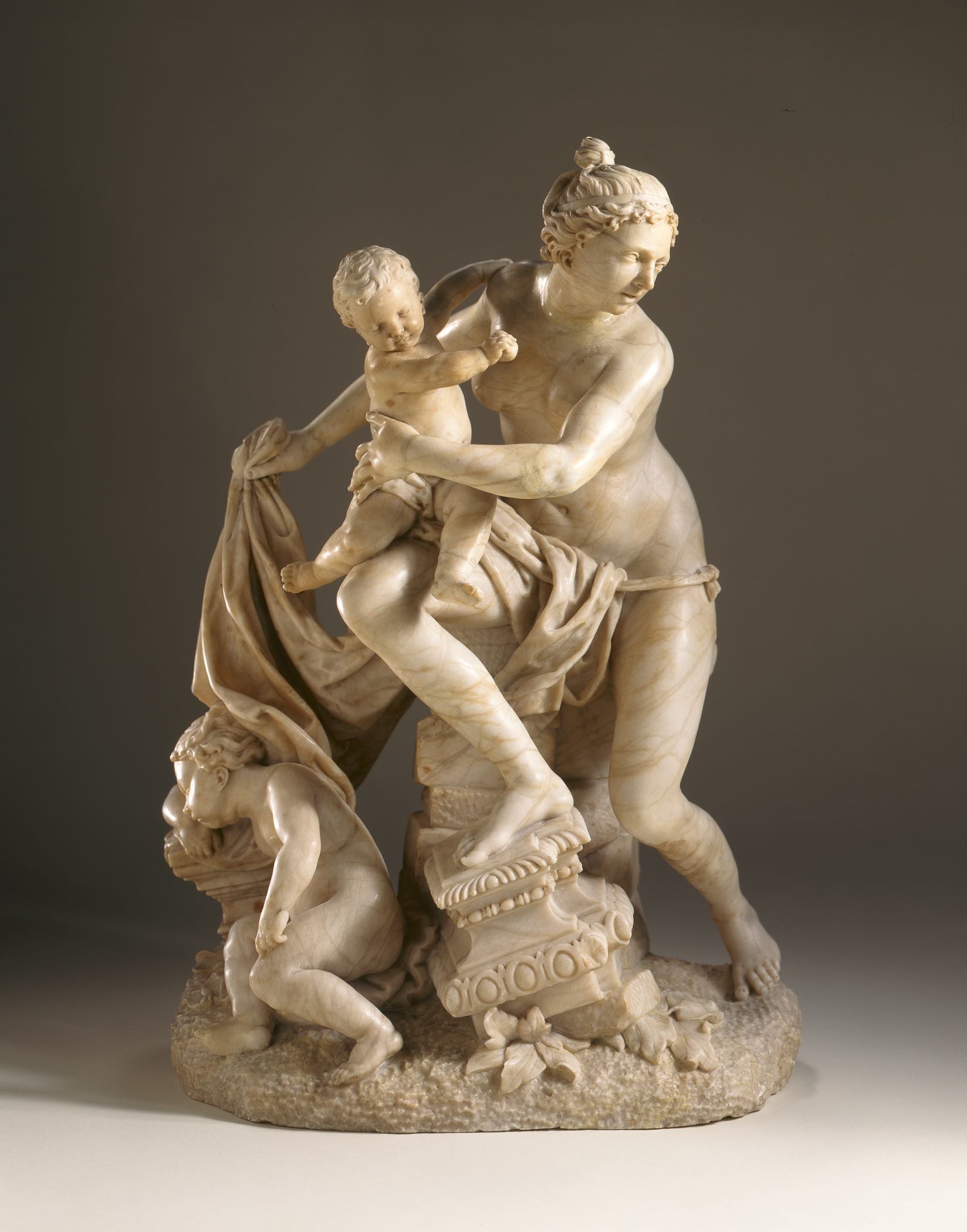
Leto with her children, Apollo (center) and Artemis (down to the left). In Ephesian mythology, Leto gave birth first to Artemis, and then spent nine days in labor to deliver Artemis’ twin brother, Apollo. What type of insight (if any) is gained from this to better inform how we read controversial passages in 1 Timothy? (Lazar Widmann, in Bohemia, 1699-1769. circa 1742 Sculpture Alabaster)
Appealing to the Cult of Artemis in Ephesus for Explaining the Context of 1 Timothy 2:12
What are we to make of the relevance of the Artemis cult to the Ephesus of 1 Timothy? This appeal to the cult of Artemis exerting a bad influence in the church of Ephesus is probably the strongest argument for the egalitarian view, but there are some serious difficulties to consider.
First, even Preston admits that Artemis is never named in 1 Timothy. Preston’s answer to this is to say that Paul never names any names of pagan deities in his letters, suggesting there is no need to insist that Artemis be named here in 1 Timothy (Sprinkle, p. 273). True, when Paul is speaking of other divine powers, he typically speaks in generalities. However, Paul does mention at least the name of one member of God’s divine council, who rebelled against God: “Belial,” in 2 Corinthians 6:15, another name for Satan. It would be odd that if Paul had Artemis specifically in mind in 1 Timothy, why he would shy away from naming Artemis here, but not shy away from naming Belial in 2 Corinthians 6:15. It certainly would be better if Paul did name Artemis in his letter, for the sake of clarity regarding such a contentious issue. While circumstantial evidence helps the case for the Artemis cult exerting a negative influence on the Christian women in Ephesus, there is no “smoking gun” here.
Secondly, the explanation that Paul had Artemis in mind regarding being “saved” from childbearing in 1 Timothy 2:15 is not really the best interpretation of this verse. For one thing, everywhere Paul speaks of being “saved” in 1 Timothy, he always associates it with salvation in the spiritual, eternal sense, and not some notion of preservation, in the temporal sense. It is more likely to see that the “childbearing” Paul has in mind is “the childbirth” associated with Eve’s offspring, the Protoevangelium of Genesis 3:15, which promises that a Redeemer will come from the womb of Eve, an allusion popular in the early church associated with Mary’s pregnancy and birth of Jesus, which is also drawn from Romans 16:20.11
Thirdly, it is difficult to see exactly why Paul would make such a big deal about comparing Adam and Eve to Artemis and Apollos, and then Adam and Eve to Ra and Isis. While such a comparison is possible, is there sufficient evidence to demonstrate that this was indeed in the mind of Paul? The glaring issue here is that Artemis, Apollos, Isis and Ra are all described as gods, whereas in the Bible, Adam and Eve are human beings, and not gods. Therefore, the Artemis story is about the birth of the gods, as opposed to the Bible’s story about the creation of humanity. It is difficult to see an exact connection as to how Paul’s understanding of the story of humanity related to creation is meant to correct an Artemisian teaching on the nature of the gods. It sort of works, but you have to giggle with the pieces a bit to make them fit the puzzle.12
Some older scholarship suggests that Paul might be refuting a kind of Christian Gnosticism, which in certain traditions taught that Eve was created before Adam, and that it was Adam who was deceived, and not Eve. That would be a better fit than the Artemis feature. For the second century Gnostics were contradicting more orthodox Christian interpretations of Genesis. However, most scholars today do not find the Gnosticism connection persuasive as we only have evidence for this kind of advanced Christian Gnosticism developing in the second century, which is too late for any first century authorship of the authentic Pauline letters.13
Concerns About the “Cult of Artemis Influence” Argument
We really should be wary of making appeals to arguments, like the cult of Artemis influence in Ephesus, where we have little to no evidence by way of inscriptions or writings from early Christian or Second Temple Jewish sources to substantiate such claims, particularly when what evidence we do possess from such sources actually points in a different direction. For example, in the early church, historically orthodox Christians often made appeals to only have qualified men serve as elders, based on their readings of 1 Timothy 2 and 3.
Yet to my knowledge, we do not have any early Christian or Second Temple Jewish sources which address the cult of Artemis within the context of Paul’s writings. Furthermore, there seems to be little discussion to indicate that anyone in the early church had doubts about standard, orthodox interpretations of these texts.
Alternatively, appeals to cult of Artemis-type influences like this, from the pagan world, can wreak havoc on how we interpret the Bible, if one is not careful. For years, various scholars have found parallels between various parts of the New Testament and certain aspects of Greco-Roman inscriptions and texts, where early Christian or even Second-Temple Jewish writers were silent upon the manner, in order to make some rather staggering claims.
For example, some scholars have looked at Luke’s description of the death of Jesus as a kind of retelling of the story of Socrates’ death. Just as Socrates was unjustly executed, so did Luke portray Jesus as unjustly executed. Just as Socrates had his friends around him when he died, so did Jesus’ disciples gather around him at the foot of the cross at Jesus’ death. Just as Socrates had full composure and calmness about himself before he took up the hemlock, so did Jesus appear to be in command of the full situation as he calmly succumbed to the excruciating pain of crucifixion. Just as Socrates told his friends before his death that he would enter a paradise where he would be treated more fairly, so did Jesus say to the thief on the cross that the repentant thief would soon be with Jesus in paradise. In other words, Jesus is the new Socrates.
But while one might appreciate certain parallels here in Luke to Socrates, and that Luke might have framed a part of his narrative to allude to the story of Socrates, does this mean that we should seriously revise a great deal of Luke’s historical description of the death of Jesus? Some have suggested that Luke’s Socratic framing indicates that what Luke is giving us is more myth as opposed to history, thus causing some to rethink the meaning and circumstances of the death of Jesus. Some even go as far as suggesting that what Luke is doing is nothing but pure fiction, and that Jesus never even existed!!14
Frankly, the supposed links between the story of Socrates’ death and Luke’s portrayal of Christ’s death seem more viable that the supposed associations of a kind of false teaching promoted by certain women in the Ephesian church, influenced by the cult of Artemis, as being in the mind of Paul in 1 Timothy 2. Yet it is remarkable that you hear more about the cult of Artemis coming to bear on our interpretation of 1 Timothy among a number of evangelical scholars than you hear about Jesus being the new Socrates.
Fundamentally, the issue here concerns that of method: How does one assess external evidence from the Greco-Roman world, as with the cult of Artemis in Ephesus, bringing it to bear on the meaning of a New Testament text, particularly when we have little to no hint from early Christian authors to suggest that something more is going on in a particular New Testament text, which would warrant calling upon such external evidence to settle the matter? This creates a concern when the normative witness of the early church points to an interpretation which goes against the implications suggested by such external evidence.
So while considering pagan influences may help us arrive at clarity on long disputed matters, it can also lead us down roads which are dead ends both exegetically and spiritually. Bringing the cult of Artemis into the discussion might actually be the right way to interpret the text, but an interpretive move like this needs to have a solid foundation of evidence to support it before one can arrive at a confident conclusion. The cult of Artemis issue at Ephesus deserves analysis, but we need to be careful as to how we draw conclusions from such analysis. Caution is in order when we consider such matters.

Can a “woman” be a “one-woman man?”
A Look at 1 Timothy 3:2 (and Titus 1:6): An Elder as a “One-Woman Man”
Interestingly, Preston admits that perhaps the strongest argument for the complementarian view of only having qualified men serve as elders comes down 1 Timothy 3:2 and Titus 1:6. These verses argue that an overseer/elder is to be a “husband of one wife,” or a “one-woman man.” Every time a “one-woman man” is mentioned by Paul it always means a male, and the only time a “one-man woman” is mentioned (1 Timothy 5:9), Paul is describing a woman.15
Preston acknowledges the qualifications list for an elder is not a “job description” but rather a “character description” (Sprinkle, p. 278). The emphasis is not on some particular status, as in expecting an elder to be currently married and/or having a certain number of children. Preston notes that Jesus was single, but that he was considered to be an overseer (1 Peter 2:25, Sprinkle, p. 281). Rather, the emphasis is on the character of a person, being faithful to one’s spouse and having the qualities of a good parent. Someone’s life status may change, in terms of being married, or having children living them at home. What does not change, at least in Paul’s estimation of what he hopes for, is whether or not a candidate for elder has the giftings associated with being a pastor, and if a person is male or female.16
A helpful way to consider this is to say that an elder is someone who can act like a “spiritual father,” in the life of a local church. This does not rule out a role for “spiritual mothers,” though one may ask why Paul never highlights this in the same way he highlights the role of male elders. Every local church needs both, spiritual fathers and spiritual mothers, essentially modeling for others in the community what a healthy marriage and family looks like for believers in Jesus. However, we should not neglect the role of widows in the church, which might be Paul’s way of highlighting “spiritual mothers,” as expressed in 1 Timothy 5, which Preston only briefly discusses.
So, what then prevents Preston from concluding that elders in a local church are to be qualified men, and not women? Preston takes the position that what Paul is doing in 1 Timothy 3 is not being prescriptive, but rather, Paul is being descriptive, as the social-norms of the first century assumed that typically only men would serve as elders. It would be wrong for us to take our modern cultural understandings and read that into a first-century context. The social norms found in 1 Timothy are different for us today (Sprinkle, p. 285-286).
There are several problems with Preston’s conclusion here. First, we can recognize that in general men were the heads of households in the Greco-Roman world of the first century. In other words, the Greco-Roman world was primarily patriarchal, as opposed to matriarchal. However, how does this square with the claim made by at least some egalitarian scholars that women associated with the cult of Artemis functioned as “priests,” having prominent positions in the worship of Artemis? This would suggest that Ephesus was an exception to the rule, indicating that Ephesus was more matriarchal, as opposed to being patriarchal, at least in terms of how religious authority worked in Ephesus.
So, which is it? What was the social norm in Ephesus? Was Ephesus dominated by women in terms of religious leadership, or did it follow the customs in other parts of the Greco-Roman world where men tended to dominate? For if the social norm in Ephesus was to have pagan women serving in a role roughly equivalent to a Christian overseer/elder, then how can someone make the claim that a “one-woman man” serving as a Christian elder was simply descriptive, following the established social norm?
This is contradictory. It does not make any sense. If you assume that Ephesus was patriarchal, in terms of religious leadership, then you could correctly assume that Paul’s use of a “one-woman man” to describe an elder was descriptive. But if you are going to make the argument for a feminized, matriarchal religious environment, instigated by the cult of Artemis, which was the norm in Ephesus, then Paul’s use of a “one-woman man” to describe an elder in Ephesus can not be merely descriptive. In that case, a prescriptive reading actually makes better sense of the passage.
Secondly, assuming Preston’s conclusion may somehow be made to fit the situation in Ephesus, where the cult of Artemis was prominent, it does not fit the situation in Crete, where Artemis was not a big influence. Titus 1:6 says that an elder is to be a “one-woman man,” as in 1 Timothy. Unless one relies on the problematic assumption that Paul’s requirements for being an elder in Crete are descriptive, then the prescriptive nature of Paul’s instruction would require an elder to be a qualified male, regardless of the culture. If we then assume that 1 Timothy 3 is being prescriptive, whereas Titus 1:6 is being descriptive, this is terribly confusing.
Thirdly, it appears that Preston is driving a kind of wedge between what we read in 1 Timothy 2:11-15, regarding instructions pertaining to Ephesian women in particular, and Paul’s instructions on the qualifications for elders in 1 Timothy 3. In 1 Timothy 2:11-15, Preston leans towards an egalitarian reading of the passage, whereas in 1 Timothy 3, Preston concedes that a complementarian-type of reading, whereby only men are serving as elders, makes sense if one assumes that Paul is merely being descriptive here, and not prescriptive for all times and all places.
But what if the key to understanding 1 Timothy 2:11-16 is to read this as part of a sustained argument which culminates in the qualifications for elders in 1 Timothy 3:1-7 (It is interesting to note Preston spends relatively little energy in addressing the qualifications for deacons, which under a strict complementarian reading disqualifies women from serving as deacons, whereas a “soft” complementarian reading allows women to to serve as deacons, according to 1 Timothy 3:8-13).
If Paul is actually trying to distinguish between two different kinds of teaching, “big T” teaching which is the responsibility of overseers/elders, and “little T” teaching is appropriate for non-elders, in 1 Timothy 2:11-15, then it would make sense for Paul to clarify his purposes by following this with the instructions for the qualifications for elders in 1 Timothy 3:1-7. Strangely, Preston dismisses this kind of “soft” complementarian reading of 1 Timothy in general, favoring first an egalitarian reading, followed second by a possible strict complementarian reading, and leaving a “soft” complementarian reading as the least convincing (Sprinkle, pp. 209ff). Preston probably comes to this conclusion because he does not see the flow of Paul’s thought from 1 Timothy 2:11-15 leading into 1 Timothy 3:1-7. A lot of other Christians do this, too, probably because of the chapter breaks that were added to the Bible in the 13th century, which did not exist in Paul’s day.
Fourthly, Preston rejects the claim that the affirmation of same-sex marriage and women in leadership is derived from recent cultural trends. He argues that the most traditional position of the church has been to say that because women are more easily deceived than men, women should not serve as leaders. He acknowledges that few today accept this logic, because even “soft” complementarians only accept men as serving as elders today, while rejecting the idea that all women are more easily deceived than men, and that they arrive at their position based on scriptural exegesis, and not by following cultural trends.17
In theory, and in actual practice today in certain quarters of the church, Preston Sprinkle is accurate in refuting such a claim. Many egalitarians today affirm women serving as elders, while still rejecting same-sex marriage. But two points of evidence demonstrate certain flaws in Preston’s thinking.
On the first point, the history of doctrinal change within churches, particularly since the 1960s has been dramatic. Nearly every Christian denomination, since about the 1960s, which started practicing the ordination of women, to the position of elders/presbyters, has within a generation or two eventually accepted same-sex marriage as permissible for Christians. So, while it is not a logical requirement for adopters of egalitarian theology to eventually fall down some slippery slope towards the acceptable on same-sex marriage, the fact is that some, if not many Christians, have gone down that slippery slope anyway.
On the second point, Preston’s claim regarding a “one-woman man” is simply descriptive language Paul was using, and not prescriptive, due to the social norms of the day, is a defeater for Preston’s argument, as it relates to the question of same-sex relations. One could easily make the case that one-man to one-woman marriage was the social norm of the first-century Greco-Roman world, and that Paul’s rejection of same-sex relations was simply following that social norm. This has drawn many to conclude that Paul’s understanding of marriage, as being between one man and one woman, was simply descriptive and not prescriptive. Such a hermeneutic is not a reliable guide for the interpretation of the Bible, particularly when it comes to Christian ethics.

Concluding Thoughts(Landing the Plane) ↩
If you have made it this far in this book review, you should get the idea that the issue of what the Bible says about women serving elders (or not), or as Preston Sprinkle, puts it “women in leadership,” is a complex issue. Christians of good faith land at different places on this issue. Different exegetical interpreters of Scripture will weigh the evidence differently, and pure objectivity can be hard to come by.
Some interpreters value a concern for fairness above other concerns, while other interpreters value a concern for fidelity to long-standing church tradition on the other. No interpreter is without a bias. Preston has his conclusion. I have mine. But the complexity of the issue should not deter Christians from diligently searching the Scriptures to discover what the truth is.
Perhaps the best feature of Preston’s book is its open-handed approach, where he starts off his journey not knowing where he will ultimately land on the topic. Very few books written by scholars today take such an approach, which is highly commendable for Preston to take a road less traveled. Nevertheless, do not be fooled, as Preston does arrive at a conclusion by the time he gets to the end of the book, and his conclusion is not wishy-washy. My concern though is that the way he gets to there is complicated by the methodology he uses to arrive at his conclusion.
As noted above, if I had to name only one problematic issue at the heart of Preston’s book, it would be the rather nebulous definitions he works with regarding key critical terms, such as women in “leadership” in the church. Granted, Preston does have a whole chapter dedicated to the difficulties we can encounter when we think about the concept of “leadership” when approaching what the Bible has to say. While Preston does present a working definition for church “leader” near the beginning of the book, it never seems clear to me how that correlates with the New Testament’s description of local church offices, which in my view, is really the heart of the debate today. The Bible never uses the term “leadership,” which makes it a challenge to try to map a modern term like “leadership” onto an ancient text like the Bible. Preston does do a fairly good job with defining some biblical terms, like “apostle,” but he left me hanging on how “elder” is to be best understood, and there was even less discussion about “deacon.” For if key terms like these come across as muddled, even if it is not intentional, it can still add to confusion.
It would have been much better if Preston had framed the whole book differently. But it is quite evident that the framing he used reflects the type of upbringing he had, where he was raised to think that women were not to be thought of as “leaders” in the church. This is a completely different framework than my own background, where it was generally thought that to deny the office of elder to a woman was inherently misogynistic and therefore morally wrong. But are the assumptions behind those two different type of upbringings the only ways one should approach this issue?
Aside from that, the cult of Artemis influence is perhaps the strongest factor in favor of an egalitarian reading of 1 Timothy 2-3, but we simply do not have sufficient evidence to demonstrate that this is what Paul had in mind. If we could find some early church author who commented on Artemis and its connection to 1 Timothy, that would probably prompt me to change my mind and accept something along the lines of Preston’s general conclusion, about Paul actually approving of women serving as elders in a local church, assuming such women were not holding to some kind of false teaching. It might even be worth a serious reconsideration if there was some debate in the early church as to what 1 Timothy 2-3 was saying regarding the qualifications for elders in a local church.
While I share a lot of commonality with Preston’s efforts, and that women can and should serve in certain “leadership” roles in the church, I am not convinced that he landed in the right place, and I want to show why. There are some important concerns which Preston does not address in his book.
In fairness to Preston, he admits that the conclusion to From Genesis to Junia: An Honest Search for What the Bible Really Says about Women in Leadership is a tentative one, and that he is open to changing his mind, as more research and new evidence might point him towards a different conclusion. However, it does leave the reader in a difficult situation, for if two equally qualified evangelical scholars, and Preston knows quite a few like this, who come to vastly different conclusions on the complementarian/egalitarian debate, how does the average church-goer, who knows next to nothing about New Testament, or fairly little, know what to do with this particularly divisive issue in the evangelical world today? Preston seems okay with this situation as he is not invested one way or another with the outcome of this debate, as he is not a pastor, and his current job is not on the line when it comes to where he lands on the issue. Yet to a typical lay person, the issue can be highly complex, as it requires at least some knowledge of New Testament Greek to parse through, which is beyond the grasp of most lay Christians.
The Exegetical Elephant in the Room
While I land on a rather “soft” complementarian position, I would argue that Preston’s fairly tentative egalitarian reading, as presented in From Genesis to Junia, sidesteps a rather glaring problem. Preston never addresses a particularly big elephant still in the room: the authenticity of certain letters attributed to Paul, and what that means for the debate. For when I am confronted with situations like this, where two very different conclusions are viable, I am drawn very much to seek out voices on a subject where they have little to no investment in what is finally concluded. While Preston is trying to be objective, it is difficult to ignore his situation, as he has scholars who are friends on both sides of the complementarian/egalitarian divide. While his tentative conclusion may not cost him his job, there is a motivation for him to merely come to a tentative conclusion, lest he cause unnecessary friction among certain of his various scholar friends.
But what about scholars who are not operating within the evangelical scholarship world which Preston Sprinkle inhabits? How do they view this issue?
Preston has come to a fairly firm conclusion that much of the New Testament affirms some kind of egalitarian posture, when it comes to women serving in positions of leadership. There are good reasons, for example, to say that passages like 1 Corinthians 11:3-12 and I Corinthians 14:34-35 should not be used to limit what kind of leadership functions women may have in Christian communities. The major difficulty comes in how to understand what Paul is saying in the Pastoral Letters, primarily 1 Timothy and Titus.
In other words, if we never had the Pastoral Letters in our New Testament canon, there is no sufficient reason to say that only qualified men should serve as elders in a local church. But because the Pastoral Letters, such as 1 Timothy and Titus, are in our canon, we must carefully exegete those texts, and submit to their authority.
However, most critical Bible scholars, who would not identify themselves as evangelical Christians, really have no investment in this intra-evangelical debate. Nevertheless, the vast majority of these critical scholars do not believe that Paul wrote the Pastoral Letters, which include 1 Timothy and Titus. Differences in vocabulary and writing style might be reconciled by an appeal to Paul’s use of different secretaries when producing his letters. But if the differences in the theological content of these letters stands in variance, if not outright contradiction with what we find in Paul’s recognized authentic letters, then we have a big problem. For if what Paul says in his letters to the Corinthians contradicts what “Paul” is saying in 1 Timothy and Titus, then it would be reasonable to conclude that 1 Timothy and Titus are not Pauline. Rather, they would be considered forgeries, and if we have forgeries in our New Testament, we have a much bigger problem than what the complementarian/egalitarian debate means for the church.
Some might wonder why the Pauline authorship question regarding the Pastoral Letters plays so much into the complementarian/egalitarian debate regarding women as “leaders” in the church. It is widely recognized that in church history that women played a vital role in the rapid growth of the Christian movement in the early centuries of the church. There were Christian women serving in certain capacities as “leaders.” The controversy was primarily over whether or not women should serve specifically as “elders,” since it was widely recognized that both men and women served as “deacons.”
The evidence in favor of women approvingly serving as elders in the historically orthodox communities of early Christianity is very slim, if there is anything at all. However, when it comes to heterodox groups, such as with Christian Gnosticism, there is a different story. A number of Gnostic groups approved of women serving as elders. But this should come as no surprise when one considers how such Gnostic groups tended to follow the “New Testament” canon first described by the 2nd century Christian heretic, Marcion. Marcion himself was technically not a Gnostic, but a number of Gnostics approved of much of what Marcion was teaching.
Marcion produced a list of what he considered to be books to form a canon of authorized Scripture. For example, Marcion completely ditched the entire Old Testament as unworthy for consideration as Christian Scripture, the primary reason why Marcion was dismissed as a heretic. However, he did include the letters of Paul in his list of authoritative “New Testament” texts. But interestingly, the only Pauline writings Marcion flat out rejected for his list, or otherwise neglected to include, are the three Pastoral Letters (1 Timothy, 2 Timothy, and Titus), which give us the only solid material arguing for a male-only qualification for the office of elder. For without 1 Timothy and Titus in their list of authorized New Testament writings, why would any supposedly Christian group not have women serving as “elders” in their churches?
Many critical scholars come to the conclusion that whoever wrote Titus and particularly 1 Timothy had a misogynistic mindset, by only allowing men to serve as elders. These scholars are generally dismissive of egalitarian efforts to bring the cult of Artemis to bear on what is said in 1 Timothy, as a kind of failed attempt to rescue an authentic Pauline authorship for 1 Timothy. Indeed, pretty much the only way that evangelical egalitarian scholars have tried to remove any supposed stain of misogyny from 1 Timothy, while still affirming Pauline authorship of the letter, requires one to find some kind of culturally specific contextual issue, unique to the church in Ephesus, to explain what is Paul is really up to in the letter.
In contrast to more skeptically-minded critical scholars, as an evangelical myself, I believe that the Pastoral Letters were ultimately derived from the mind of Paul. It is not necessary to come to such a conclusion which places the Pastoral Letters at such odds with the other letters of Paul. For if texts like 1 Timothy and Titus represent concerns which Paul had, towards the end of his life, which he did not have when he was younger, it might explain why some of what he wrote in those letters have a misogynistic appearance, at least at first glance. Towards the end of his life, Paul might have come to the realization that he might not witness the return of the Lord Jesus Christ during his lifetime. Therefore, it would be reasonable to conclude that some form of more formal organization of the church, with elders and deacons, was necessary in order to make sure that the teachings he imparted to his Christian communities which he developed would continue to remain faithful to that vision which Paul had for them.
Why Paul Might Have Wanted Local Church Elders to Be Qualified Men
Paul was particularly concerned that his churches needed a spiritual father figure, to nurture them in a particular manner. After founding a church in Corinth, and staying with these young believers in Jesus for about a year and a half, Paul left to start other churches. Yet it should spark our interest when he writes back to the church in Corinth:
“For though you have countless guides in Christ, you do not have many fathers. For I became your father in Christ Jesus through the gospel” (1 Corinthians 4:15 ESV).
There were “guides” or “leaders” to assist in the spiritual formation of the Corinthian Christians. But Paul emphasized the need that those Corinthians had for a “father,” a role which he considered to be essential to their spiritual well-being. For without a “father,” his spiritual children might wander away from what they had originally been taught.
It would therefore be reasonable to conclude that Paul should emphasize a need for “spiritual fathers” who could carry out that function at the local church level, in his other churches, without necessarily sidelining the contributions of women. There were a number of women, along with other men, acting as Paul’s co-workers, or “guides“, who were also assisting to establish these Christian communities. But Paul did not consider them as “fathers.”
So, instead of prohibiting women from any kind of leadership in the church, in the negative sense, Paul might have been concerned that certain men need to step up and take a role they otherwise would rather not pursue, that of making sure that the faith that was once delivered to them could be successfully passed onto the next generation. 1 Timothy and Titus can be read in this way, without requiring that we jettison these letters as forgeries, and without trying to come up with some type of reading the cult of Artemis into 1 Timothy, a thesis that, while certainly possible, is still rather speculative. Again, it would be different if we actually had voices in the early church who gave testimony that the Artemis cult was in the mind of Paul when writing 1 Timothy, but to my knowledge, we have no such evidence.
These difficulties aside, Preston Sprinkle has given readers of From Genesis to Junia plenty to think about when trying to discern the teaching of Scripture regarding the qualifications for elders in evangelical churches today. Preston should be commended for pushing back on egalitarians who “say that all complementarians are dehumanizing women or that the abuse of women is intrinsic to the complementarian view” (Sprinkle, p. 294). For if those particular egalitarians really believe that, then it is difficult to figure out what would stop such egalitarians from going down a fully “progressive Christian” route, if not outright unbelief. A purely top-down, military command and control relationship between male and female is not a necessary conclusion to draw from the Bible.
Preston’s focus on the exegesis of Scripture ironically pushes back on a typical reason why certain egalitarians hold to the views which they hold. Such egalitarians focus on the idea of competence, at the root of their views. That was certainly my view for years. For if a woman can do the same job as a man, then what should prohibit a woman from serving as an elder in a local church? Individuals may differ in terms of competence, to get the job done, but when it comes to differences between the sexes, women are just as competent as men.
But what if competence is not Paul’s concern? What if Paul is more concerned about linking his view of marriage and family, whereby the husband is head of the home household, with his view of the local church, as the local expression of God’s family, which is also a “household.” According to 1 Timothy 3:15, Paul is instructing Timothy that:
“you may know how one ought to behave in the household of God, which is the church of the living God, a pillar and buttress of the truth” (ESV).
Perhaps Paul believes that it is important to have men serving as elders of a local church, as a way of modeling what should happen in the home, honoring the difference between man and woman, by advocating a kind of “spiritual fatherhood” to bridge the gap between one generation of believers to the next. This is quite a different concern Paul elsewhere has in his letters, whereby he affirms the competency of women as leaders in the church, with an expectation that the return of Jesus was close at hand.
To Preston’s credit, while From Genesis to Junia does not fully convince me to change my view, Preston has encouraged me to rethink some things. I appreciate Preston’s focus on the text of Scripture, which is often lacking in such discussions, and at certain points Preston has challenged me in a good way. For example, I have been long convinced for a while that the quotation/refutation hypothesis regarding 1 Corinthains 14:34-36 is pretty much a slam dunk. But Preston’s analysis of that passage shows that perhaps such a position is not as secure as I have thought, though I am still largely persuaded that the quotation/refutation hypothesis is the most probable view.
Unfortunately, Preston also misses a certain sense of sacramental reality associated with the office of overseer/elder, that is often overlooked in these discussions. The New Testament honors the distinction between male and female, thus making the concept of “complementarity” a good thing, and not a negative thing. Men and women are different, and yet perhaps understanding the requirement of having only men serving as elders is Paul’s way of reminding believers of that reality, even if, according to modern sensibilities, that it might seem unfair for not permitting women to serve as elders. As London Bible teacher Andrew Wilson puts it, elders are like guardians of the church, as the household of God, and at every stage of redemptive history, those who have been “charged with guarding the people of God and protecting her from harm have been men.”
But it is no more unfair than saying that only men can be fathers and only women can be mothers. While there is a very lively debate today as to how to deal with a tender subject like gender dysphoria, the definition of “sex” biologically is pretty well established. Male and female are scientifically distinct biological categories, which chimes in with what the Bible has to say about differences between male and female. There is a deep mystery here we would do well to consider. Otherwise, Christians might lose a sense of what God originally created for our humanity, as creatures, both male and female, created in God’s image.
For those of you who feel intimidated by such long blog posts, fear not, as the next few blog posts about my trip to the Rhine River valley last year visiting various church history sites will be MUCH, MUCH shorter.
Notes:
1. See the Veracity book review for Claude Mariottini’s Ancient Israel’s Women of Faith, an excellent resource for understanding the Old Testament’s views on women↩
2. Preston cites the work of R. A. Campbell (Sprinkle, p. 100) to say that the term “elder” is “more of a way of speaking about leaders, than an office of leadership itself” (Sprinkle, p. 100). But he drops in a footnote that Campbell sees the use of “elder” in the pastoral letters (primarily 1 Timothy and Titus) to say in these texts that the term “elder” does refer to an office.↩
3. See work done by Sam Storms, a pastor and writer affiliated with the Gospel Coalition, on this topic of “elders” versus “pastors”: I recommend at least two of Storm’s blog posts, found here and here. Storms take the position that while only qualified men can serve as “elders,” women can serve as “pastors,” as long as the role of those “pastors” are not conflated with the role of “elders.” A critic of Storms’ position, Derek Brown, argues that the role of “pastor” and “elder” are interchangeable, claiming that Storms’ method of interpretation is flawed. However, as should be evident in reading this review of Preston Sprinkle’s book, I would argue that Derek Brown’s method is the one that is flawed, not Storms. Brown oddly sees no New Testament evidence to suggest that “evangelism” is a gift (charisma), nor that being an “apostle” is a gift, implying being a “pastor” (in its noun form) is a gift. Furthermore, Brown sees no progressive revelation at work, as Paul writes his letters to the Corinthians earlier than he wrote the Pastoral Letters. Brown’s theological method falls prey to the argument posed by revisionist scholars that the Pastoral Letters are forgeries written in the name of Paul. ↩
4. It would appear that Preston Sprinkle takes a middle position between Wayne Grudem, on the “hard” complementarian side, who understands “headship” in a more authoritarian kind of sense, and Philip Payne, on the egalitarian side, who understands “headship” as meaning something like “source,” without any notion of authority being associated with it. Preston seems to be most impressed by the work of Michelle Lee-Barnewall on the topic of “male headship.” In Lee-Barnewall’s thesis, the Apostle Paul takes the typical notion of “headship,” and flips it on its head (so to speak!), such that the one who is in the position of “head” is actually called to be a servant. ↩
5. See my multipart Veracity blog series on 1 Corinthians 11 and head coverings, which explores several different views of the passage, but ultimately lands in sync with Dr. Michael Heiser’s view, that Paul is advising Christian women when gathering for worship to wear head coverings, as well as asking men not to wear them, in order to demonstrate that the appropriate sexual partner for a woman is a man, and not an angelic power, as in the “sons of God” in Genesis 6. Paul is concerned that certain members of God’s Divine Council; that is, “angels,” could be tempted to disrupt the Christian community by entertaining having sexual relations with women, which was considered to be a kind of “fall” which brought humankind down in Genesis 6, according to the Enochian tradition of Second Temple Judaism. Paul does not want such a situation to happen again. Sure, it is weird, but as Heiser has said, if it is weird, it is important. For Heiser, the whole notion of head coverings denoted a sense of sexual modesty that made “scientific” sense in the Corinthian community. But since the passage is not trying to teach “science” in a universally binding way which transcends all time, the head coverings requirement is not binding on Christians today. Furthermore, a position similar to Heiser’s position was held by none other than the late 2nd century church father, Tertullian.↩
6. Joseph A. P. Wilson in his “Recasting Paul as a Chauvinist within the Western Text-Type Manuscript Tradition: Implications for the Authorship Debate on 1 Corinthians 14.34-35” acknowledges that the Greek word “eta” which leads off verse 36 is ambiguous. While it could be translated as Preston supposes here, like many modern translations, leading off verse 36 with an unpunctuated “or“, carrying a more passive sense, it could also be translated, following older translations, like the KJV, with a more punctuated expletive “what?,” which is more adversarial, thus fitting more neatly into the quotation/refutation hypothesis. Wilson says that positions like Preston’s tend to be “more susceptible to a complementarian misreading in English, because the target of Paul’s admonishment in verse 36 could easily be applied to women alone” (Wilson, p. 4).↩
7. Many complementarians opt to translate this word as the ESV has done, whereas others like author Andrew Bartlett translates this word in this verse to mean “to overpower,” translating the whole sentence roughly as: “I do not permit a woman to overpower a man with false teaching.” The difficulty with Bartlett’s position is that he assumes the “teaching” being prohibited by Paul here has a negative connotation to it, as in “false teaching.” But only rarely in Paul do we see this Greek word “didasko,” for “teaching,” being used in a pejorative sense. Paul normally (but not always) refers to didasko as good teaching, not false teaching. If Bartlett is correct, this would be an exception in Paul’s writings for his normal use of didasko. How can we be sure that Bartlett’s reading is correct? It is difficult to say without knowing more about the context of Paul’s thought. Andrew Bartlett is working on a follow-up work to his Men and Women in Christ: Fresh Light From The Biblical Texts , where he might go into his reasoning with greater depth. .↩
8. Preston cites Philip Payne’s commentary on the case with Tryphon exercising authority over someone else’s slave (Sprinkle, p. 247, see footnote 17), which suggests that Tryphon was wrongly exercising authority over someone else’s slave, which was the issue in the story. In other words, only a master of a slave can exercise authority over a slave. Someone else can not usurp such authority, and tell someone else’s slave what to do. Preston, on the other hand, takes the story to be more general, in that of exercising authority in a domineering way, which is not fitting for a Christian. But Payne’s explanation fits the context of the actual story itself better, as Preston is reading his Christian sensibilities into the text, presuming that this is what Paul has in mind with authentein in 1 Timothy 2:12. The story of Tryphon exercising a kind of authority which did not belong to him seems like a simpler reading of the text, rather than the exercise of authority in general, which Preston assumes is negative here. Paul would surely have condemned a dominating, or abusive use of authority. But when it comes to the specific use of authentein, Preston judges that authentein in these contexts is negative, in that it presumes a kind of “lording over” of someone’s authority in a secular ,non-servant like manner, which Jesus rebukes in Mark 10:43-44: “But it shall not be so among you. But whoever would be great among you must be your servant, and whoever would be first among you must be slave of all.”↩
9. Ironically, Preston’s interpretation of 1 Corinthians 14:34-36, which follows 1 Corinthians 14:26, makes it a little more precarious to say Paul believed that both men and women should offer a word of instruction to fellow believers.↩
10. This appears to explain why Bible scholar Bill Mounce says that if it were not for 1 Timothy 2:13, he probably would be an egalitarian.↩
11. G.K. Beale, in his “Contextualizing the Controversial Instructions in 1 Timothy 2:11–15: A Response to Sandra L. Glahn, Nobody’s Mother” (Themelios, 50.2, pp. 261-269) identifies this flaw in the work Sandra Glahn. ( For an alternate view, in favor of Glahn’s reading, see this video by Australian New Testament scholar, Michael Bird). In Beale’s critique of Glahn, Beale notes that Glahn relies heavily on the idea of “salvation” in 1 Timothy 2:15 as “physical salvation in this life.” Beale comments: “Glahn formulates the local slogan, “She shall be saved through childbearing,” as meaning that a woman would be delivered physically through childbirth and not die. But the problem with this is that Paul never uses σῴζω to refer to physical salvation in this life but to an end-time salvation from sin and death and to being consummated with physical, eternal, resurrection life (so 26x outside of 1 Tim 2:15)” (Beale, p. 265). Beale also refutes Glahn’s assertion that in 1 Timothy 2:15 that Paul may have been quoting an Artemis-derived saying, that Artemis can “save” a woman in childbirth, by offering a Christianized alternative. However, while one may argue for the concept, Beale notes that Glahn has no evidence for any specific inscription existing to demonstrate that her possible reading is the more probable (Beale, pp. 265-266)….. Even an egalitarian author, Andrew Bartlett, makes the case for a messianic interpretation of 1 Timothy 2:15, whereby the Greek’s use of a definite article in the verse, which is often omitted in English translations, corresponds to “the childbearing” of the Christ. It is quite common for a definite article (“the”) to refer to a noun in New Testament Greek, without requiring the sense of having a definite article in mind, when thinking in English. Nevertheless, there are cases where having the Greek use of the definite article does translate over to English, and in this instance in 1 Timothy 2:15, this is more likely the case.↩
12. Beale makes a similar observation in his review of Glahn’s work (Beale, p. 267). Beale notes that Glahn relies heavily on the idea that Artemis can save a woman through childbirth, despite the fact that the evidence from inscriptions in our sources to support this proposal are few and faint (Beale, p. 268).↩
13. See Catherine Clark Kroeger, I Suffer Not a Woman. Kroeger’s book in 1992 was pivotal in the founding of Christians for Biblical Equality. When I first read Kroeger in the 1990’s, her thesis sounded quite compelling. However, since then,, many of the arguments which Kroeger presented in that book have been shown to be weak and even misdirected. See Glahn’s critique of Kroeger in Glahn’s Nobody’s Mother, as well as Beale’s essay on Glahn. Also see Thomas Schreiner in Women in the Church (Third Edition): An Interpretation and Application of 1 Timothy 2:9-15, p. 168. For references to Gnostic teachings in the second century onwards which argue that Eve was created before Adam, see the citations noted by Marg Mowczko. Mowczko notes that specific references to Adam and Eve that reverse the creation order of Adam and Eve; that is, Eve came before Adam, can be found in second century heretical movements. A predecessor to such a belief suggests that a feminized Wisdom was created before Adam, thus anticipating later theological developments. Mowczko goes onto say that: “It is plausible, however, that some first-century Christian groups also had strange ideas about Adam and Eve.” It is indeed possible that such Gnostic teachings along these lines could have existed in the first century. Indeed, they very well could have. However, we have no evidence that they actually did in the first century, which is a serious problem for Kroeger’s and Mowcko’s position. Depending upon arguments from silence to support one’s position is a highly speculative procedure. Advocates for those who support an affirmation of same-sex marriage in the church today rely on arguments from silence as well to support their position, claiming that the Apostle Paul condemned certain types of same-sex relations, but that he knew nothing about covenant-style monogamous same-sex coupling which mirrors traditional heterosexual marriage. ↩
14. Appeals to the cult of Artemis to reverse a traditional reading of 1 Timothy 2 & 3 unfortunately carry relatively little weight when compared to attempts by other, generally more skeptical scholars, to find other Greco-Roman parallels in various New Testament texts, which challenge traditional readings. Critical Bible scholar Dennis R. MacDonald, though not a “Jesus mythicist,” suggests that Luke’s retelling of the story of Jesus’ death was meant to allude to Socrates death, thus betraying a certain agenda which most evangelical Christians would find unsettling. Others have speculated that the Gospels offer retellings of Homer’s Odyssey, thus suggesting that many of the events in the life of Jesus were purely fictionalized. While there might be some elements of truth regarding these parallels, these type of theses can invite unfounded speculation. ….. Richard Carrier and Dennis R. MacDonald propose that the Book of Acts is largely fictional in that it makes use of a kind of extensive parallelism between Homer’s Odyssey and the “we” passages in Acts, in order to invent a kind of supposedly historical narrative, which lacks any historical foundation. Among his other writings about Luke, Carrier concludes, suggesting that the “we” in Acts is not even a reference to the author himself: “Luke is thus aiming at an affective fallacy, to seduce his readers into believing the gospel is true because they feel they have shared in Paul’s adventures, travails, and triumphs. They have sailed the dangerous seas and been carried to safety on the ship of faith. The “we” thus means all Christians, inclusive of the reader. This explains also why this happens only in the second half of Acts: precisely when Paul begins to spread the faith to the whole world. For the first time Paul crosses a sea (a symbol of mortal danger; and a ship, a symbol of common purpose in facing it) to spread the Gospel.” Again, we have no supporting evidence (which I am aware of) from either Jewish or Christian authors to suggest that Homer’s Odyssey was used extensively to fashion Luke’s narrative in Acts. Rather, the traditional Christian position has argued that Luke’s work as a historian is respectable, even if there is some occasional allowance for Luke’s use of rhetorical devices to make theological points, or serving some other purposes (e.g. faithfully recording how others understood certain historical events, even though those recollections were flawed)….. Perhaps one of the wilder ideas floating around in some circles concerns Mark 14:51-52, when Jesus was arrested at Gethsemane, and a young boy who followed Jesus, covered in nothing but a linen cloth, ran from the scene, dropping the cloth, fleeing away naked. This might sound just as confusingly odd as does 1 Timothy 2:8-15 or 1 Corinthians 11:3-16. However, one classicist scholar, Ammon Hillman, finds certain parallels in this story with drug trafficking in the Greco-Roman world, suggesting that the naked boy was a child slave serving Jesus. However, there is not a hint of any evidence in our Jewish and Christian sources to substantiate this kind of interpretation, even if we have Greco-Roman sources to support certain parallels in Mark’s text. But this does not prevent classicists like Hillman from running with the drug trafficking proposal as far as it can get him.↩
15. Preston says about these verses is that this might be “the only argument” for the complementarian view (Sprinkle, p. 279). He also includes 1 Timothy 3:12 in this group, but this is about male deacons. But since we have Phoebe mentioned as a deacon in Romans 16:1, this helps us interpret the “women” of 1 Timothy 3:13 to indicate that Paul differentiates elders from deacons, partly by encouraging women to serve as deacons alongside male deacons, whereas only qualified men are to serve as elders. Preston does not address the claim made by Philip Payne that the use of a “one-woman man” is actually rather generic and not gender specific.↩
16. Preston is disagreeing with Gerry Breshears, who argues that 1 Timothy 3:1-7 is a “job description” for being an elder. Breshears argues that elders must be married men with children. This just seems odd that Breshears would disqualify people like Paul, Timothy, and even Jesus from that role, simply because of marital status. What happens if an elder’s wife dies, while he serves as elder? Does this disqualify him, too? Surely not. It is more sensible to read this passage as Preston does as a “character description” and not a “job description.” Nevertheless, the sex of a candidate for elder is something which does not change, whether they be male or female, whereas the status of being married, or having children living at home can and does change. But in Breshears’ favor, his proposal shows that being an elder is not about some strict hierarchical pattern of authority in the local church, as in Breshears’ reading, Paul and Timothy, as non-elders, would still possess authority over elders in the church. ↩
17. Preston cites William Webb’s book, Slaves, Women and Homosexuals, to say while a “trajectory” model of the Bible does point towards egalitarian theology it does not necessitate a move towards a gay marriage affirming theology. For more on this “trajectory”, or “redemptive” hermeneutic of the New Testament, see this Veracity review of Sarah Ruden’s Paul Among the People. The problem with so-called “trajectory” or “redemptive” hermeneutical paradigms is that there is a persistent tendency to be prone to a certain kind of “wishful thinking,” trying to portray historic Christian teaching as something other than it what it really is, because it does not look like what we want Christianity to look like. For example, we see the rise of Christian Universalism today in the church, as with David Bentley Hart, in part because the doctrine of hell, whether in its most traditional form in terms of eternal conscious torment, or its more benign form in terms of conditional immortality, does not sit well in a cultural milieu which despises any notion of eternal separation from God. We see the tendency to make the teachings of Jesus, particularly in the Gospels, into an abolitionist argument against slavery, despite the fact that Jesus in our “Red Letter Bibles” never has a negative word to say about slavery. Thankfully, we do have the Apostle Paul giving us at least an indirect, more subtle critique of slavery, but it simply is not honest to portray Jesus as presented in the Gospels as being “anti-slavery.” All of this is particularly ironic in that it is the Apostle Paul who is typically portrayed as the “bad guy” in comparison to the “good guy’; that is, Jesus. Yet it is Jesus who talks about hell way, way more than Paul. It is Paul who in 1 Corinthians 7:21 encourages a slave to pursue the opportunity to gain one’s freedom, if the such an opportunity becomes available, whereas Jesus appears to approve of a slave master who beats his disobedient slaves in Matthew 24:45-51. We do the Scriptures no favors by making the text say things we simply do not like. A more proper understanding of progressive revelation can help use better deal with such difficult texts in the Bible .↩




 Veracity
March 2nd, 2026 at 8:45 pm
Some early reviews of Preston Sprinkle’s book….
Thomas Schreiner offers his critique, which is a very careful scholarly one from a complementarian perspective (more careful than mine), though I would say Schreiner misses the point on 1 Corinthians 11
Schreiner does reference an interesting review from an egalitarian, Lyn Kidson, who finds flaws in Sandra Glahn’s work, which Preston tends to rely on. Kidson has her own interesting take on 1 Timothy 2 and 1 Timothy 3.
To clarify, my main difference between myself and Schreiner is that he believes that the terminology of “elder” and “pastor” is synonymous. While nearly every scholar agrees that “elder” and “overseer” are synonymous, I argue in my review of Preston’s book that all elders need to be gifted as pastors, but not all pastors are elders. Contrary to Schreiner, an “elder” denotes an office and a “pastor” denotes a gift, as the only time the noun for “pastor” is used for someone other than Jesus as the good shepherd is in Ephesians 4:7-16, where Paul is discussing spiritual gifts, where “pastor/shepherd” is explicitly described as a gift.
An office is not a gift, and a gift is not an office. Nowhere in the letter to the Ephesians is an “elder,” much less the qualifications for one, to be found. The only place in the New Testament where the qualifications for elders can be found is in 1 Timothy and Titus, arguably the last letters ascribed to Paul. This would make sense for Paul to be explicit for what he had in mind there, as he evidently realized that the likelihood of him witnessing the return of Christ in his lifetime was dwindling fast. Paul envisioned “elders” to be those guardians entrusted with passing the faith on from one generation to the next, in a local church.
Where Schreiner and I agree is that Paul wants qualified men to serve as “elders,” contrary to what egalitarians are saying.
LikeLike
March 3rd, 2026 at 11:05 am
From an egalitarian perspective, another review by Bobby Giles agrees with Preston Sprinkle’s conclusion, that the complementarian view is most probably wrong.
Giles concludes that this is a justice issue. My response is that if this really is a justice issue, as Giles frames it, he is better off siding with critical scholars who believe that 1 Timothy and Titus are forgeries; i.e. they were not written by Paul, and that therefore, these texts, while holding some historical value, are nevertheless not authoritative for Christians today.
However, I doubt that most evangelical Christians would stomach that kind of conclusion.
LikeLike
March 7th, 2026 at 10:43 pm
Here is an example of a brief, rather flat-footed take of Preston’s book, the kind of low-brow insult that makes complementarians look really bad. Christians, we can do better than this:
https://x.com/500yoChristian/status/2028543100952686640
“Sprinkle longs to be a cool kid who’s accepted by the pagan culture we exist in. Reject him.”
LikeLike
March 11th, 2026 at 4:19 pm
And on the other side of the coin, there are bad takes from an egalitarian perspective…..
Here is one criticism of Tom Schreiner’s review of Preston’s book by an X user that really gets my goat:
‘Tom, you claim “the other key text on men and women is 1 Tim 2”. Sorry, no. A personal letter written towards the end of Paul’s life is not a key text. I’d suggest a key text is 1 Cor 7:1-15 – the longest NT passage on men and women – which you barely discuss. (1)’
https://x.com/DaveSmith2019/status/2028793104703328740
Apparently, this user on X believes that a personal letter written by Paul has less authority than a letter Paul writes to a Christian community. I hope this X user does not really believe this, as this puts a modern day interpreter of Paul into a real pickle in trying to defend the New Testament against charges that the NT is a “pro-slavery” text.
Our best, most clearest text from the NT which challenges the system of slavery is found in Paul’s letter to Philemon, whereby Paul describes Onesimus, the runaway slave from Philemon, as being like a “son” and a “brother” to Paul, in an effort to encourage Philemon to release Onesimus (albeit indirectly) from his bonds as a slave.
We simply have no other clear text in the NT which can be used as an “anti-slavery” text, with the possible exception of 1 Corinthians 7:21, and maybe 1 Timothy 1:10. So, if you want to encourage critics of Christianity to dismiss the faith as being “pro-slavery,” then sure, go ahead and minimize the authority of Paul’s letters written to individuals.
The appeal of 1 Corinthians 7 as a text which can be used against 1 Timothy’s teaching against women serving as elders in the local church is a strange argument for several reasons:
(1) In 1 Corinthians 7, the issue is the relationship between men and women in marriage. There is nothing here about church leadership.
(2) 1 Corinthians never mentions “elders” anywhere in the letter.
The egalitarian X user gets a little more responsible in the thread as he engages an interlocutor, thankfully. I would agree that the gift of being a “pastor” is not tied to gender at all, as we read in Ephesians 4:11, which is the strongest argument I would appeal to in saying while all elders are to be pastors, not all pastors are elders, a position different from the one which Tom Schreiner holds.
But that initial shot across the bow, and the inherent weakness of the argument, has helped to push me back from my previous egalitarian leanings (which were just as weak) over to a more soft complementarian position.
This egalitarian would be much better served if he simply accepts the dominant scholarly consensus that the Apostle Paul never wrote 1 Timothy in the first place, and that we have forgeries stuck in our Bibles. But I seriously doubt that this egalitarian would be willing to bite that bullet.
All of this to say that egalitarians and complementarians (see comment above) can do better.
LikeLike
March 17th, 2026 at 3:45 pm
Several more reviews, coming from all sorts of angle about Preston’s book:
Beth Allison Barr is glad that Preston lands on the egalitarian side of the debate, but still a bit frustrated that as Preston is a male that he does not go egalitarian enough:
https://bethallisonbarr.substack.com/p/the-making-of-biblical-womanhood
Same with Sheila Wray Gregoire:
https://baremarriage.substack.com/p/the-egalitariancomplementarian-debate
But Anne Kennedy fires this back to Sheila Wray, noting that Sheila is claiming some sort of victimhood as an oppressed female in American society, which when you compare the rights which women have in the America, is miles and miles better than most other parts of the world:
https://annekennedy.substack.com/p/sheila-wray-gregoire-preston-sprinkle
I probably land somewhere in between, though it really bothers me to think that the only way one can really read the Bible correctly is by being a woman. This is a common feature of certain forms of extreme egalitarianism, which is no different that saying that the typical evangelical affirmation of traditional marriage between one man and one woman is simply a power play upholding the interests of white men.
Why is it that certain egalitarians are so convinced that a white man is unable to read the Bible correctly? Probably this is because so many extreme egalitarians have been bitten by the bug of secular critical theory.
Instead, a more responsible egalitarian reading of the relevant texts comes from Andrew Bartlett. While I am not won over by Bartlett’s arguments, I do appreciate that he focuses on doing good exegesis, as opposed to positing that Christians should bend the knee to postmodernism, with its emphasis on power as opposed to truth:
https://terranwilliams.com/schreiner-vs-sprinkle/
If a church is moving in an egalitarian direction, my question is this: What is driving the thinking? Is it sound principles of doing biblical exegesis, or is it chasing after intersectionality ideologies?
Alternatively, there is also another helpful and detailed, exegetically minded critique of Preston’s book, which comes close to the conclusions I have made in my review:
https://renew.org/review-from-genesis-to-junia/
I am not entirely familiar with John Whittaker, the author of the review, though he is the mind behind the Listener’s Commentary on the New Testament, and he has a better grasp on New Testament Greek than I do.
Like Whittaker, I think that Preston takes the argument “There are Women Leaders in the Bible…. Therefore” too far, relying on logic which assumes some rather slippery meanings of terms like “leadership” and “elder” which only muddle the issue. It is good to know that I am not the only one to be bothered by what Preston Sprinkle did here. Just because women served as leaders in the New Testament church does not automatically mean that women can serve specifically as “elders,” an issue in logic which Whittaker found problematic, just as I did.
Likewise, Whittaker sees problems with Preston’s handling of why Jesus chose twelve men to be in his inner circle of disciples, who after the resurrection served as the elders (functionally speaking) is the first church in Jerusalem. As Whittaker says:
“Based on Sprinkle’s logic, it seems like Jesus should’ve chosen twelve women to be apostles rather than twelve men. … But he didn’t.”
Whittaker says this better than I did!! Preston acknowledged that Jesus did select only twelve men as his inner leadership team, but that Preston does not present a very convincing case that this should not be a model for the New Testament church. As I pointed out in my review, it is quite plausible that the Apostle Paul sought to establish the office of elder in the NT, by following the precedent established by Jesus himself.
Whittaker also takes Preston to task in assuming that Junia’s designation as an “apostle” assumes certain types of leadership tasks which are never named in the text. It is peculiar that egalitarians can read so much out of one verse to make it so significant….. when it is just one verse with very little commentary associated with it.
But most importantly, Whittaker finds Preston’s analysis of 1 Timothy 2 weak and unconvincing, just as I did. The issues with how to deal with 1 Timothy 2-3 and Titus 1 are probably the weakest in Preston’s book.
Nevertheless, Whittaker is quite appreciative of Preston’s work, just as I am. Preston has labored hard to try to understand a difficult issue, with various texts. While Preston’s overall argument remains unconvincing, Preston still has important insights to help us appreciate the leadership giftings women do have in the church and how we should celebrate those giftings.
LikeLike