Monthly Archives: August 2025

“No Creed But the Bible” ….. A Visit to Cane Ridge, Kentucky

As the summer of 2025 has been drawing to a close, I ran across some old photos of a summer trip to the Midwest, about twelve years ago, that I would like to share. My wife’s family is from Evansville, Indiana, which is not far from Interstate 64, taking one highway west from where we live in Williamsburg, Virginia to get there. Just a little over halfway to Indiana, about an hour northeast of Lexington, Kentucky, is a little spot off the road called “Cane Ridge,” not too far from the small town of Paris, Kentucky, in horse country.

Most people have never heard of Cane Ridge, Kentucky. The ridge was named by the explorer Daniel Boone, during the early decades of the American republic. But if you are a student of American church history, you should probably know about it, because Cane Ridge, Kentucky was the site of one of the most remarkable events of Christian history.
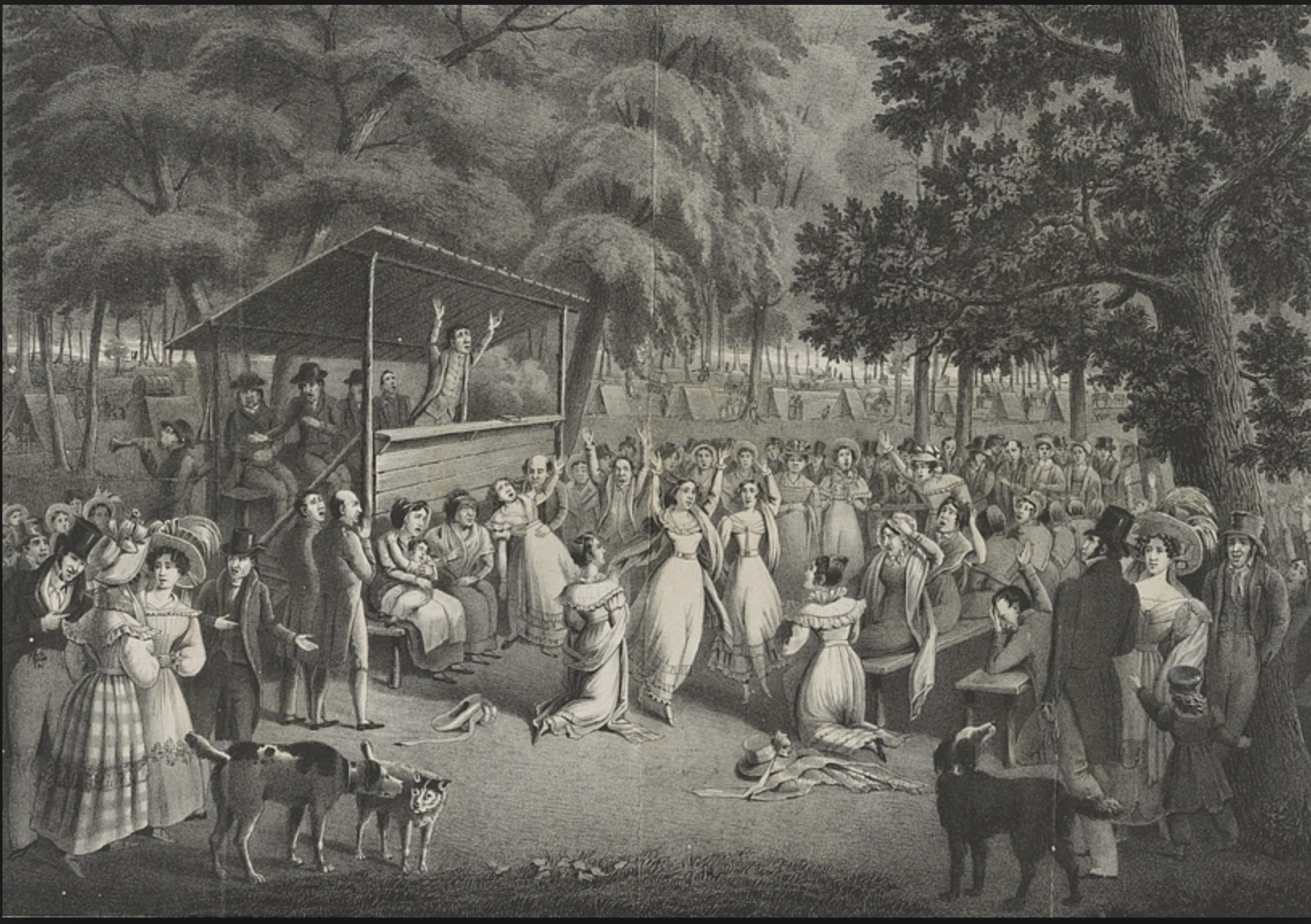
Sinners gathering on the “anxious bench,” during the American Second Great Awakening, in the early 19th century. The “anxious bench” was the forerunner to the modern “altar call.”  This portrait envisions what the camp meeting at the Cane Ridge Revival might have looked like.


The Woodstock of the 19th Century

In 1801, a group of ministers were hoping to host a camp revival meeting in what was then the frontier of the young nation of the United States. The two most prominent figures in the movement were originally a Presbyterian minister, Barton Stone, and later on, a Scottish minister, Alexander Campbell. During the heat of the summer, there was not that much to do while your crops were growing on the frontier before the fall harvest, so the idea of traveling to a camp meeting was a great way to accomplish spiritual and social goals for folks spread out in sparsely populated areas of the Midwest.

What was unique about the Cane Ridge Revival was the sheer size of the event, for that moment in history, out on the American frontier. Stone and his fellow ministers behind the revival had advertisements for the camp meeting posted in numerous newspapers across the country. Historians estimate that in August, 1801, somewhere between 10,000 to 20,000 people descended upon Cane Ridge. It was the 19th century cultural equivalent of the 1969 music festival, Woodstock, held in New York state, a defining moment for the counterculture movement of the 1960s.

So many people came to the camp meeting that the house used by the little Presbyterian church, which hosted the event, could not be used. Makeshift platforms were made across the various fields surrounding the church building, where singers sang, and most importantly, preachers preached. In front of some of these platforms there was an “anxious bench,” where various sinners could sit when the message being preached pricked their hearts, urging them on to repentance. The “anxious bench” was the forerunner to the “altar calls” held by 20th century preachers, like Billy Graham.

When I met up with the local historian who was on-site, he told me that there were reported manifestations of healings, speaking in tongues, and being “slain in the spirit.” He even told me that some additional, really bizarre stuff was reported, too, like people barking like dogs.

Barton Stone, who led the little Presbyterian church at Cane Ridge, reported on the meeting like this: “Many, very many fell down, as men slain in battle, and continued for hours together in an apparently breathless and motionless state — sometimes for a few moments reviving, and exhibiting symptoms of life by a deep groan, or piercing shriek, or by a prayer for mercy most fervently uttered.” Eventually, their condition would change, giving way first to smiles of hope and then of joy, they would finally rise “shouting deliverance” and would address the surrounding crowd “in language truly eloquent and impressive.” “With astonishment,” Stone exclaimed, “did I hear men, women and children declaring the wonderful works of God, and the glorious mysteries of the gospel.”

 

The original Cane Ridge meeting house, the Presbyterian church which hosted the 1801 revival. This photo was taken sometime in the early 20th century.  I saw it as part of the Cane Ridge museum exhibit.


Not Presbyterian, Not Baptist, Not Methodist….. Just “Christian”

Cane Ridge was a remarkably interdenominational event, where Presbyterians, Baptists, and Methodists all joined together, for the cause of calling people to give their lives to Jesus. At the end of the week-long or so meeting, those remaining at the camp all shared in the Lord’s Supper together. It was a potent experience of Christian unity and spiritual energy. In many ways, the Cane Ridge Revival ended up spinning off numerous other camp meetings across the Eastern United States for decades, prior to the advent of the American Civil War.

Barton Stone and subsequently Alexander Campbell became the leaders synonymous with the movement, which often is called by historians as the “Restoration” movement. The idea was that Stone and Campbell believed that these various camp meetings, starting with Cane Ridge, were about restoring the Christian church to its original New Testament foundations.

During the early 19th century, groups like the Presbyterians, Baptists and Methodists were all defined by their various creeds and confessions. Visionaries like Stone and Campbell believed that these creeds and confessions just got in the way of sticking with what “the Bible says,” and calling people to faith and repentance, and following Jesus.

This Restoration movement was often associated with the popular slogan: “No Creed But the Bible.”

However, despite its “non-denominational,” or perhaps “inter-denominational” focus, the Stone-Campbell Restoration movement ended up spawning several prominent American denominations:

  • Churches of Christ
  • Disciples of Christ
  • The Christian Church
  • … and several others

As the original Cane Ridge church building was starting to fall in disrepair, an effort was made to preserve the wooden structure, by building another stone structure around it, in 1930. If you can imagine that inside the stone building behind me, stands the preserved wooden church building (see prior photo) safe from the elements, then that is what you would see if you visit Cane Ridge, Kentucky. The wooden building inside is one of the oldest structures standing in Kentucky.


After Cane Ridge

Barton Stone himself left the Presbyterian church, there at Cane Ridge, just a few years after the Cane Ridge Revival meeting. Stone was not content to sign off on the Westminster Confession of Faith championed by the Presbyterians any more. Instead, Stone merely called his group “Christians.” Alexander Campbell’s father, Thomas, was originally a minister enthusiastic about the Restoration movement, during that period of the Cane Ridge Revival. But it was the son, Alexander Campbell, who became a prominent minister himself among the “Disciples of Christ,” in the decades following the Cane Ridge Revival.

Several features were common to all of these groups. They all acknowledged the importance of water baptism for believing adults and celebrating the Lord’s Supper on a weekly basis.

However, there were notable differences, too, among these various groups, fault lines spreading out in various directions. For example, some groups emphasized that baptism was not simply a sign of one’s profession of faith, but it was also essential to one’s salvation. Some in the Churches of Christ refused to have musical instruments in their worship services.

I asked the on-site historian about what was behind the dispute about musical instruments. At first he told me that different Stone-Campbell groups would cite their own Scripture passages, for and against musical instruments in church. But he then conceded that the primary issue was economical. Most of these small churches, mostly scattered across the Midwest, were poor. By the time a church grew large enough to afford something like a piano or an organ, the community was often faced with a crisis: Do you spend your limited church funds on something like an expensive piano or organ, or do you increase the pay of your minister, or even better yet, fund some missionaries to go out and start some new churches?

While idealistic in many ways, the Restoration movement pioneered by ministers like Barton W. Stone and Alexander Campbell got involved in various controversies.  Stone, for one, became outspoken in his opposition to slavery. Stone sought publicly to free several slaves that his wife had inherited from her parents. Kentucky law prohibited Stone from doing that in that state, as the slaves were legally connected to an estate. So, Stone moved his family to Illinois, where it was legal to free slaves connected to an estate.

However, at the same time, Stone became convinced that the classic doctrine of the Trinity was not biblical. Interestingly, he did not claim to be a unitarian, though he accepted a kind of subordinationism with respect to Jesus as the Son being subject to the Father.

Alexander Campbell was perhaps the more intellectually inclined of the two, emphasizing that Christian ministers should be college educated. Campbell founded the first institution of higher learning, Bethany College, in what is now West Virginia. In his earlier years, Campbell would engage in various debates, particularly in opposition to infant baptism. Yet he also engaged in a debate once where he defended the institution of slavery as being biblical (contra Stone).

Campbell’s relationship with the Mormons was complicated, as a number of Stone-Campbell movement adherents left the movement to become Mormons. Campbell wrote a critical review of the Book of Mormon, saying that the Mormons had added extra supposed Scripture to the Bible without warrant.

Today, the descendants of the Stone-Campbell are a very diverse lot. There are still conservative elements of those groups that still uphold many of the ideals that came out of the Cane Ridge Revival. However, the largest denomination, the United Churches of Christ (UCC), grew out of several Restorationist and other churches to form what has become one of the most prominent liberal mainline Protestant church bodies. The UCC at the denominational leadership level has been known for its support for abortion rights as well as support for same-sex marriage.


A Reflection on the Stone-Campbell Movement

Today’s adherents to the original principles of the Stone-Campbell Restoration movement often have a mixed view of creeds and confessions. On the one hand, the revivalist heritage of the Cane Ridge Revival put a rightful focus on the importance of conversion and having a personal encounter with Jesus Christ.

Nevertheless, while the famous adage No Creed But the Bible may sound great at first, it belies a problem that has surfaced throughout the history of the Restoration movement, and other similar attempts to transcend denominational differences. In an effort to get rid of the objectionable creeds, many Restoration groups ended up re-engaging the same debates that led to the historical creeds in the first place.

The fact that an effort to promote a “non-denominational” form of Christianity ended up spawning a whole host of denominations, anyway, should tell you something. Particularly in areas of the American Midwest, just about in any town, you are within a stone’s throw of hitting a “Christian Church, “Disciples of Christ Church,” or a “Church of Christ.” Furthermore, in a number of cases, particularly in the post World War 2 era, the “No Creed But the Bible” mantra has become a cloak for hiding a tendency towards embracing “progressive Christianity.”

While there are many the positive elements that sprang from the Cane Ridge Revival, and the subsequent Stone-Campbell Restoration movement, having an aversion to creeds does not bode well for the future of the church. True, some creeds and confessions can get really deep into the weeds, making too many demands on the conscience of the believer. But in the world of Protestant evangelicalism which I have immersed myself now for decades, the lack of any creed, or downplaying such a creed, can be a recipe for theological crisis, ironically leading to more church splits, and not less.

The base level creed for classic Protestant, Roman Catholic, and Eastern Orthodox churches is the Nicene Creed. In 2025, we celebrate 1700 years since the Council of Nicaea met to hammer out the first draft of this creed that unites all of Christendom.  If anything, the Nicene Creed should be something that all of us as Christians can start with.

The fact is “No Creed But the Bible” is a creed, in and of itself. Unfortunately, it is not a very good one.

 

Barton Stone Memorial obelisk, marking Stone’s grave at Cane Ridge, Kentucky. Though Stone died in 1844, his remains were interred at Cane Ridge in 1847.  My wife and I stopped by and visited Cane Ridge, Kentucky, in August, 2013, the same time of year the Cane Ridge Revival was held in the summer of 1801.



Family : James Dobson (1936-2025)

My first visit to Focus on the Family headquarters in Colorado Springs was in the early 1990s. Colorado Springs was essentially the evangelical “Mecca” of North America, where numerous Christian organizations had their headquarters. Focus on the Family was by far the largest Christian organization operating in Colorado Springs, home to the Focus on the Family radio program hosted by psychologist James Dobson, who died on Thursday, August 21, 2025.


Focus on the Family was originally known for Dr. Dobson’s books, aimed at helping Christian parents to more effectively parent their children. His 1970 Dare to Discipline gave practical tips to parents frustrated with how to best discipline their children, and raise them to become responsible young adults, and to hopefully pass their Christian faith to the next generation. Other popular Dobson books, like The Strong Willed Child and Bringing Up Boys, followed over the years. Dobson’s methods were seen to be a more traditional alternative to the popular, more secular-oriented approach to parenting advocated by another psychologist, Dr. Benjamin Spock, author of the 1946 best-seller Baby and Child Care, who opted for more permissive methods.

Focus on the Family was founded in 1977, becoming a media empire providing resources for Christian parents. In 1987, Adventures in Odyssey became the most well-known radio resource, aimed at instilling Christian values in kids, with over 1,000 recorded shows to date. The program has featured 30-minute comedy-drama episodes revolving around children in a small Midwest town, associated with an ice cream shop and emporium operated by a Mr. John Avery Whitaker.

While James Dobson was primarily known for integrating child psychology with Christian values, he became increasingly more involved in political causes, particularly through the 1990s. Dobson believed that there was a cultural collapse of “family values,” stemming from the rise of the counterculture movement of the 1960s. Dobson urged that Christians get more involved in political affairs, as a means defending against what he saw as attacks on the family.

In particular, James Dobson was opposed to the increasing public acceptance of same-sex marriage, and toleration for homosexuality in general across American society at large. He viewed same-sex attraction to be a result of environmental factors, and not something associated with birth. Dobson also opposed abortion and in more recent times spoke out against the transgender movement.

Despite being controversial in the wider culture, Dobson was controversial in certain Christian circles as well. In the early 2010’s, The Truth Project produced by Focus on the Family, narrated by Del Tackett, was a small-group curriculum program developed for churches, which aimed at developing a “Christian worldview.” Enthusiasts for The Truth Project appreciated the program’s “family values” orientation and encouraging Christian civic involvement, while critics of the program objected to what was seen as promoting a twisted view of science, with critics on one side claiming that The Truth Project was teaching anti-science propaganda, while those on another side objected to an attempt to smuggle in harmful, modernist psychotherapy into the church. Others were concerned about The Truth Project trying to politicize the Gospel, by hitching Christianity wrongly to right-wing politics.

There are countless stories of children growing up in the 1990’s in evangelical Christian homes, who recall long car trips with their parents, while their parents turned on the radio to listen to various Focus on the Family broadcasts. Some of these kids look back on those times in the car with fond memories. Other kids, not so much.

Dobson grew up in a home where his two parents were traveling evangelists in the Nazarene church. Despite James Dobson’s background growing up in a relatively egalitarian family, he became a stalwart advocate of complementarian theology, believing that men and women were equal in the sight of God, but that they occupied different roles in the home and in the family. Dobson believed that Christian husbands and fathers should be leaders in their homes, and that women should not serve as elders in their local churches.

James Dobson was a supporter of the Danvers Statement, which led to the creation of the Council for Biblical Manhood and Womanhood in 1987. In 1997, Dobson learned that the version of the Odyssey Bible which Focus on the Family published used gender-inclusive language. Dobson promptly discontinued use of this edition of the Odyssey Bible, offering refunds for purchases of the Bible.

The incident encouraged Dobson to call together Christian leaders to speak out against efforts by Zondervan’s New International Version of the Bible to produce any future gender-inclusive Bible versions.  What came out of that meeting was something called the Colorado Spring Guidelines, which argued for a “gender-accurate” as opposed to a “gender-neutral” approach to Bible translation.

The NIV Committee on Bible Translation still went ahead with publishing a toned-down “inclusive” version of the Bible, the TNIV (Today’s New International Version), which still had some gender-neutral language in it. The controversy with the TNIV in 2005 eventually led to the version being discontinued. In response, a new Bible translation, the English Standard Version (ESV) was developed independently from the work of the NIV, favoring a more complementarian theology, particularly in the Bible study notes. Furthermore, the NIV Committee on Bible Translation revamped and produced yet another revised version, the NIV 2011, which sought to find some kind of halfway meeting spot between complementarian and egalitarian Bible scholars, along the lines of conforming to the Colorado Springs Guidelines. So while James Dobson was not a Bible scholar himself, his pervasive influence in evangelical circles has had a significant impact on what today’s Bible translations among evangelicals look like today.

That year I was in Colorado Springs visiting Focus on the Family, I once spotted what I thought was a bumper sticker that said: “Keep Your Focus on Your Own &#%@*!! Family.”

While Dr. Dobson had many detractors, particularly among “ex-evangelicals,” his gentle demeanor won him many other admirers. Millions of listeners still tune into radio or Internet programs founded or inspired by the work of James Dobson.

In 2010, James Dobson left Focus on the Family, helping to pave the way for new leadership under Jim Daly. Dobson was now in his mid-70s, and he felt it best that a new leader take Focus on the Family towards having a softer, less-political message that would appeal more to young families. Dobson died at the age of 89. Tributes to Dr. Dobson’s legacy from a number of Christian and other cultural leaders can be found at Focus on the Family’s website.

Below is short interview by California pastor Greg Laurie with James Dobson:


Did God Kill Jesus? The Cross of Christ, by John R. W. Stott, A Review

All Christians believe that Jesus died for our sins. But what exactly does that mean? Christians disagree as to how Jesus died for our sin. Getting our theology right about the meaning of the cross tells us a lot about how we view the Gospel.

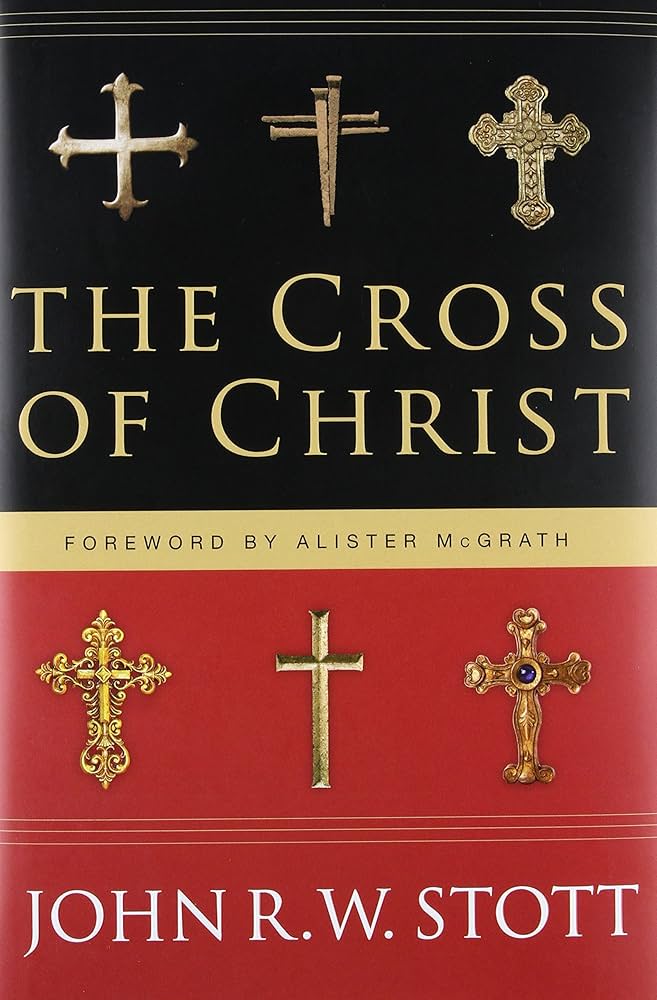
I first read John R. W. Stott’s The Cross of Christ some thirty years ago. Stott, one of the most respected evangelical leaders of the late 20th century, died fifteen years ago in 2010, having been one of the U.K.’s finest and most influential preachers. Stott teamed up to support evangelist Billy Graham for crusades across the United Kingdom in the 1950s, to pioneer the Lausanne movement which championed world missions. But Stott was also a prolific author, and in my view, The Cross of Christ stands as his finest book, giving us a mature, robust understanding of what it means to say that “Jesus died for our sins,” defending in irenic fashion the doctrine of penal substitutionary atonement against various critics.

The Cross of Christ has a message that is needed today. There are very good reasons why The Cross of Christ is a classic, and why Christians should continue to read it.


John R. W. Stott’s The Cross of Christ remains a classic defense of an evangelical view of the atoning work of Christ on the cross, offering a nuanced perspective on penal substitutionary atonement theory.


The Controversy Over Penal Substitutionary Atonement

The idea of “penal substitutionary atonement” is controversial today, even in evangelical circles. Google’s AI engine tells us that penal substitutionary atonement, abbreviated here as “PSA,”  is a “theological concept explaining Jesus Christ’s death on the cross as a substitutionary punishment for humanity’s sins. It posits that Christ bore the penalty (punishment) that humanity deserved for sin, satisfying God’s justice and allowing for forgiveness and reconciliation.” To talk about “penal substitutionary atonement” (PSA) is a mouthful, and as result, can be a bit confusing to figure out.

For example, Missouri pastor Brian Zahnd acknowledges the atonement work of Christ on the cross, but he rejects the concept of “penal substitution.”  Jesus died for our sins, but not in a PSA way. Zahnd believes that the concept of “penal substitution” makes God into a monster, a monster who would kill even his own Son:

Elsewhere, Zahnd has written:

“Some theories [of atonement] are merely inadequate, while others are repellent. Especially odious are those theories that ultimately portray God as sharing the petty attributes of the primitive and pagan deities who can only be placated by the barbarism of child sacrifice….. The cross is many things, but it is not a quid pro quo to mollify an angry God….

…. The cross is not a picture of payment — the cross is a picture of forgiveness. Good Friday is not about divine wrath — Good Friday is about divine love. Calvary is not where we see how violent God is — Calvary is where we see how violent our civilization is. The cross is not where God finds a whipping boy to vent his rage upon — the cross is where God saves the world through self-sacrificing love…

…. When the cross is viewed through the theological lens of punishment, God is seen as an inherently violent being who can only be appeased by a violent ritual sacrifice.”

Is PSA about finding a “whipping boy” to vent God’s rage upon? Zahnd rejects the penal language about atonement, such as  “the theological lens of punishment,” and the language of substitution does not fare much better. If all you heard or read about PSA was from Brian Zahnd, you might think that he is right, and that PSA is not a good way to think about the cross of Christ.


Christians Singing About Penal Substitutionary Atonement

And yet, Christians sing about it all the time. All of the buzzwords which Zahnd finds as “odious” are embedded in dozens of worship songs sung nearly every week in evangelical churches.

Consider the “wrath” of God in Stuart Townend’s and Keith Getty’s widely sung “In Christ Alone”:

“On that cross, as Jesus died, the wrath of God was satisfied.”

Or consider the language of “payment,” as in various contemporary versions of the 19th century hymn “Jesus Paid It All,” originally written by Elvina Marble Hall, in 1865:

“Jesus paid it all, all to Him I owe, sin had left a crimson stain, He washed it white as snow”

And this other line:

Oh, praise the One who paid my debt,  And raised this life up from the dead.

Or even a fairly recent song by Shane and Shane, “All Sufficient Merit”:

“It is done, it is finished, no more dеbt I owe
Paid in full, all-sufficient merit now my own”

Reach back into 18th century for this classic from Charles Wesley, “And Can It Be?

And can it be that I should gain
An int’rest in the Savior’s blood?
Died He for me, who caused His pain?
For me, who Him to death pursued?
Amazing love! how can it be
That Thou, my God, should die for me?

Lots of substitution language in Wesley’s famous hymn. Too much for Brian Zahnd?

You would have to purge hymnals and Powerpoint slides of projected screen lyrics of a lot of standard worship song phrases to remove the references which Zahnd finds objectionable.


Will The Real “Penal Substitutionary Atonement” Please Stand Up?

But is Zahnd somehow onto something? Much of the controversy comes down to how key terms like “penal” and “substitutionary” are defined which makes the difference.

Frankly, you can find evidence to support Zahnd’s critique by listening to various sermons given by some vigorous defenders of PSA. Minneapolis preacher John Piper has given the following explanation as to when Caiaphas, the high priest of the time of Jesus’ crucifixion, in John 11:50, said that was better to have Jesus killed than it was that the whole nation should perish:

“In the mind of Caiaphas, the substitution was this: We kill Jesus so the Romans won’t kill us. We substitute Jesus for ourselves. In the mind of God, the substitution was this: I will kill my Son so I don’t have to kill you. God substitutes Jesus for his enemies.”

Did God really kill Jesus? Did the Father really kill his Son? Zahnd would probably interpret Piper as saying yes, that God, the Father, killed the Son,  in order to satisfy the wrath of the Father against sinful humanity. For Zahnd, Piper’s explanation makes Jesus, as the Son, into “a whipping boy to vent [God’s, the Father’s]  rage upon,” the very idea which Zahnd rejects as being the core of PSA.

This is where Stott’s chapter on “The Self-Substitution of God” is alone worth the price of the book.  Take note of what John Stott says about certain well-intended defenders of PSA, who end up delivering a caricature of what the work of Christ is really about on the cross:

“In the one [caricatured] case Christ is pictured as intervening in order to pacify an angry God and wrest from him a grudging salvation. In the other [caricature], the intervention is ascribed to God, who proceeds to punish the innocent Jesus in place of us the guilty sinners who had deserved the punishment. In both cases God and Christ are sundered from one another: either Christ persuades God or God punishes Christ. What is characteristic of both presentations is they denigrate the Father. Reluctant to suffer himself, he victimizes Christ instead. Reluctant to forgive, he is prevailed on by Christ to do so. He is seen as a pitiless ogre whose wrath has to be assuaged, whose disinclination to act has to be overcome, by the loving self-sacrifice of Jesus.

Such crude interpretations of the cross still emerge in some of our evangelical illustrations, as when we describe Christ as coming to rescue us from the judgment of God, or when we portray him as a whipping-boy who is punished instead of the real culprit, or as the lightning conductor to which the lethal electrical charge is deflected.”  (Stott, The Cross of Christ, p. 149-50)

Ah, here we see Zahnd’s despised “whipping-boy” complaint against PSA. However, in contrast, Stott sees certain “whipping-boy” illustrations as indicative of caricatures which distorts a genuine understanding of PSA. It makes the casual observer wonder what PSA really is all about.


It Is Possible to Misread the Bible in Support of PSA

Furthermore, Stott is careful not to overstate his case. For example, it is quite common in evangelical circles to say that Jesus paid the debt for our sin in full on the cross, as many worship songs declare. In support of this view, Jesus’ last words on the cross as recorded in John 19:30, as “it is finished,” is translated from the single Greek word tetelestai.

Many bible teachers have been taught, and pass onto their congregations, particularly over the past hundred years, that this word tetelestai  in an economic context means “paid in full,” which fits in nicely with the motif of penal substitutionary atonement. In the early 20th century, it was commonly thought that tetelestai was found on ancient papyri receipts in Egypt denoting a paid off debt or taxes.

Unfortunately, newer research has shown that this identification for the word “tetelestai” is actually erroneous. Such papyri receipts have a word close to tetelestai  on them, but it is indeed different from what is cited as Jesus’ last word(s) in John 19:30. In other words, neither Jesus’ hearers nor John’s readers would have readily picked up on the idea that Jesus acknowledged paying off a sin debt by uttering these word(s).

Thankfully, John Stott does not lead the reader down that rabbit hole, which is actually a dead end. Stott goes along with the majority of English translations today of John 19:30 to argue that tetelestai  simply means “it has been and will for ever remain finished” (Stott, p. 82). Like previous interpreters such as Leo the Great in the 5th century and Martin Luther in the 16th has suggested, for Jesus to have said “it is finished” would sufficiently mean that the work of Christ, however it would be understood, was finished, and that Scripture was indeed fulfilled.

We may still conclude that Jesus paid off our sin debt in full, after deeper reflection. But it would be overstating the case to argue that Jesus’ last statement on the cross specifically says this.


Self-Substitution On God’s Part Regarding the Cross

The key to grasping how John Stott can defend penal substitutionary atonement, while rejecting well-intended yet misguided caricatures, is in Stott’s concept of self-substitution, whereby God the Father through his Son offers himself as the very substitute to satisfy his own wrath against human sin.  In Stott’s framework, there is no need to pit the wrath of the Father against the love and mercy of the Son. The Son and the Father are not working at cross purposes against one another. The Son shares in the wrath of the Father against sin. Likewise, the Father shares in the love and mercy of the Son on behalf of sinful humanity.

As Stott would go onto say:

“We must not, then, speak of God punishing Jesus or of Jesus persuading God, for to do so is to set them over against each other as if they acted independently of each other or were even in conflict with each other. We must never make Christ the object of God’s punishment or God the object of Christ’s persuasion, for both God and Christ were subjects not objects, taking the initiative together to save sinners. Whatever happened on the cross in terms of “God-forsakenness” was voluntarily accepted by both in the same holy love that made atonement necessary…There was no unwillingness in either. On the contrary, their wills coincided in the perfect self-sacrifice of love.”  (Stott, p. 151)

In a certain broad sense, John Piper might be correct to say that out of respect to God’s sovereignty and his providential activity in the world that “God killed Jesus.” But the saying is misleading. Saying that “God killed Jesus” is not that much different from saying that when your dear grandmother dies of cancer that “God killed your grandmother.” Really? With all due respect to John Piper, Piper’s comments are highly problematic.

The danger in making such an assessment is that it invites the kind of caricatures which critics of PSA, such as Brian Zahnd , will make against the PSA position as a whole.  Honoring the sovereignty of God as part of a theodicy, which says that even in the face of evil, God’s will remains supreme, arguably means well. But if it leaves the impression that God is somehow a capricious monster, whose anger must be placated in a manner no different than the pagan gods, then the assessment is counterproductive at best, a horrific scandal at worst.

Rumors of that scandal only encourages preachers like Brian Zahnd to double-down on their critique of PSA, as a corruption of pure Christian doctrine.

Thankfully, John Stott’s position avoids the pitfalls exposed by both misguided attempts to rescue the pure atoning work of Christ away from the supposedly painful grip of “penal substitution,” on the one hand, and overzealous apologetics which say that “God killed Jesus,” on the other.  I have had to re-read these sentences from John Stott several times to let it all sink in, as Stott sprinkles in quotes from P. T. Forsyth, the late 19th and 20th century Scottish theologian:

“[God] was unwilling to act in love at the expense of his holiness or in holiness at the expense of his love. So we may say that he satisfied his holy love by himself dying the death and so bearing the judgment which sinners deserved. He both exacted and accepted the penalty of human sin. And he did it ‘so as to be just and the one who justifies the man who has faith in Jesus’ (Rom. 3:26). There is no question now either of the Father inflicting punishment on the Son or of the Son intervening on our behalf with the Father, for it is the Father himself who takes the initiative in his love, bears the penalty of sin himself, and so dies. Thus the priority is neither ‘man’s demand on God’ nor ‘God’s demand on men’, but supremely ‘God’s demand on God, God’s meeting his own demand’ “(Stott, p. 152).

Does Stott’s characterization of God’s “self-substitution” regarding the cross of Christ go against any traditional sense of penal substitutionary theory? Is Stott redefining terms like “penal,”  “substitution,” or even “atonement” to make PSA as traditionally understood unrecognizable? To my knowledge, Stott stands firmly within the traditional camp while rightfully rejecting extreme, excessive expressions of the traditional PSA view. I find it curious that contemporary critics of PSA, including those acting in good faith who are not merely throwing stones at PSA with overworn tropes (like saying that Jesus’ death on the cross was an act of “cosmic child abuse”), rarely interact with Stott’s classic work on the topic.  If I am wrong about this, I would like to be corrected.


Applying the Doctrine of the Cross of Christ

While Stott’s careful discussion about God’s self-substitutionary act of atonement through the work of Christ on the cross is the most valuable contribution of Stott’s book, The Cross of Christ has many other benefits. Stott finds that the language of penal and substitutionary atonement is complemented by other biblical ideas that flesh out the doctrine in full.

Stott reminds Christians of the oft forgotten aspect of Christ’s defeat over the powers of sin, death, and evil, which was recovered for Western Christians by the early-to-mid 20th century Swedish theologian, Gustav Aulen, through his influential 1930 work Christus Victor. The Christus Victor motif puts emphasis on Christ’s victory over the powers of darkness, a feature long held prominent in Eastern Orthodoxy (Stott, p. 228ff).

Stott also finds value in certain aspects of Peter Abelard’s “moral influence” theory of the atonement. In the “moral influence” view, Christ’s death on the cross is an expression of the love of God, in which Christians are called to emulate that same kind of love, in our relationships with God and others. Jesus laid down his life for us out of love, therefore we are to lay down our lives for others. Abelard was reacting against his contemporary fellow 12th century theologian colleague Anselm, who pioneered the language of “satisfaction,” for describing the work of Christ, with respect to uphold God’s honor (Stott, p. 217ff). Stott finds some fault with Anselm, who “should have laid more emphasis on God’s love” (Stott, p. 221).

However, Stott finds some fault with those critics like Abelard and Aulen, for their focus on their respective efforts to emphasize the subjective aspect of atonement at the expense of the objective aspect of atonement, championed by Anselm. It is the objective character of the atonement that enables the subjective aspect. In other words, penal substitution is not at odds with either Christus Victor or moral influence motifs, but complement each other. Yet Stott suggests that penal substitution makes Christus Victor and moral influence possible. As Stott says, “the cross can be seen as a proof of God’s love [the subjective element] only when it is at the same time seen as a proof of his justice [the objective element]” (Stott, p. 220).

The last portion of The Cross of Christ focuses on the application of the doctrine of the cross for Christian practice. Because of the cross of Christ, Christians are called to sacrificially love others just as Christ has shown his love towards us. It is through meditation on the cross of Christ where we are enabled to love even our enemies. When we partake of the Lord’s Supper, we are reminded of the suffering of Christ which helps the believer to find support when we experience times of suffering for Christ’s sake.

Some have criticized that the doctrine of penal substitutionary atonement has led Christians to not “take up our cross and follow him.” A careful read of Stott’s pastorally rewarding last portion of the book should alleviate such concerns. A full appreciation of Christ’s work on the cross will lead the believer to follow in Christ’s footsteps, as opposed to walking the other way. A whole host of other practical nuggets show that the doctrine of atonement is not merely an abstract set of concepts.


Some Critique of Stott’s Exposition of the Cross of the Christ

Despite its strengths, The Cross of Christ has missteps in a few places. In analyzing the 1856 century Scottish work The Nature of the Atonement, by John McLeod Campbell, Stott acknowledges that Campbell upholds the substitutionary aspect of the cross while saying that Campbell dismisses the penal aspect of the cross. Stott claims that for Campbell, substitution dissolves “into vicarious penitence, instead of vicarious punishment.”  As a result, Stott dismisses Campbell’s effort to “retain the language of substitution and sin-bearing, while changing its meaning.” Such effort “must be pronounced a failure. It creates more confusion than clarity.” (Stott, pp. 141-143).

Stott’s critique is not entirely fair. While the substitutionary aspect of Campbell’s approach remains sound, the penal aspect of atonement we should admit is harder to defend, primarily because it is so easily misunderstood. Is God’s wrath concerning sinful humanity directed towards sinful humans or sin itself? While it might seem more pious to say that God’s wrath is directed towards sinful humans, this is only because sin has become so regretfully intertwined in humanity that it becomes exceedingly difficult to separate our sin from our core human identity.  Yet a more proper way is to say that God mainly focuses his wrath against sin itself, and not the people for whom Christ has died.

Stott also has very little discussion, if any, analyzing the difference between ritual purity and moral impurity, two fundamental concepts standing behind the sacrificial system described in the Book of Leviticus. Any genuine New Testament theology of cross is indebted to the Book of Leviticus. But the concept of atonement as described in Leviticus is quite complex and nuanced, and Stott only makes scattered references to it. More recent research shows that Christian interpreters have tended to overlook or minimize Jewish views regarding atonement and the Levitical ritual impurity system when articulating the doctrine of the cross. For example, numerous scholars today hail the work of the Jewish scholar Jacob Milgrom on Leviticus as transformative, most of Milgrom’s work on Leviticus having been published after Stott published The Cross of Christ in 1986. In other words, while Stott’s description of the atoning work of Christ is robust, it is still not as robust as it could have been.

Despite these few shortcomings, John R. W. Stott’s The Cross of Christ remains a trustworthy and helpful guide for understanding and applying the truths behind the death of Christ for our sins. The various motifs surrounding the work of Christ, including penal substitution, Christus Victor, and the moral influence of Christ, all contribute to a rich theology that can nourish the church down through the ages. If I could name one contemporary book, even though it was first written back in 1986, which adequately defends PSA thoroughly against a wide variety of critics, Stott’s The Cross of Christ would be my go-to recommended resource.


One Final Thought:

Christian opponents of penal substitutionary atonement (PSA) undoubtedly mean well. They are not all “woke,” progressive Christians, as some strict defenders of PSA over-enthusiastically claim, though undoubtedly  some very much are.

As evidenced by John Stott’s The Cross of Christ, much of the critique of PSA depends on all-too-common caricatures which Stott effectively dismantles. Just because someone props up a caricature of PSA as a defense of PSA does not mean that they understand what PSA really is.

Here is something to keep in mind: Some have suggested that the Eastern church never accepted any kind of doctrine of penal substitutionary atonement, and continues to reject penal substitution as a theological innovation of the Western church. But one should not be too hasty in drawing such a conclusion.

Saint Athanasius, surely a hero in Eastern Orthodoxy, wrote this in a letter to Marcellinus:

“He suffered for us, and bore in himself the wrath that was the penalty of our transgression, even as Isaiah says, Himself bore our weaknesses.”

Saint Cyril of Alexandria in his commentary on John’s Gospel wrote this:

“We were, then, accursed and condemned, by the sense of God, through Adam’s transgression, and through breach of the Law laid down after him; but the Savior wiped out the hand-writing against us, by nailing the title to his cross…For our sake he paid the penalty for our sins.”

More recently, Saint Philaret of Moscow, wrote in a catechism for Eastern Orthodoxy:

“Jesus Christ, the Son of God … endured all the penalties due to all the sins of men, and death itself, in order to deliver us from sin and death….. His voluntary suffering and death on the cross for us, being of infinite value and merit, as the death of one sinless, God and man in one Person, is…a perfect satisfaction to the justice of God, which had condemned us for sin to death…to give us sinners pardon of our sins…”

All of the typical theological trigger words which opponents of penal substitution find to be so odious find their affirmation in the writings of these Eastern Orthodox leaders: Athanasius wrote of “wrath” and “penalty.” Cyril wrote of Christ as the one who “paid” the “penalty” for our sins. Philaret approved of the language of “satisfaction” to describe the work of Christ on the cross. So, before someone wants to rewrite many of our worship songs, we should reckon with the words of these highly respected church fathers of the East.

We can preserve the best of the tradition that gave us a theology of penal substitutionary atonement, while also embracing other themes and motifs that fill in the colors of the portrait of Christ on the cross, such as Christus Victor and moral influence. John R. W. Stott’s The Cross of Christ helps us to do just that.


An Addendum:  A Timely Debate When I Post This Book Review!…..

Just a few weeks after I finished re-reading Stott’s The Cross of Christ, Christian evangelical Twitter (or X) blew up when popular bible teacher John Mark Comer came out to say that he recently read a book which delivers a “knock out blow to PSA.”  Into the flurry of comments, some more responsibly nuanced than others, with a lot of back and forth, Protestant apologist Gavin Ortlund gives a summary of classic understandings of penal substitutionary atonement in the following video, offering a modest Stott-like defense, while rejecting caricatures of PSA. John Mark Comer has since walked back some on his earlier statement, stating that he still believes in some form of substitutionary atonement, but the debate continues. Some even wonder if an evangelical can truly be an academic, or do doctrinal commitments prevent someone from rethinking a long cherished belief. Andrew Rillera’s Lamb of the Free is at the heart of the controversy. Even John Mark Comer, in a recent follow-up statement acknowledges that Rillera “completely denies all substitution, which seems untenable biblically to me.” Derek Rishmawy, a blogger whom I follow occasionally, has written a response to John Mark Comer’s concerns about PSA. Rillera’s book is on my “to-be-read” list. I am open to being challenged, but you have to make a pretty compelling case to dismiss a Christian doctrine that goes back hundreds of years to the early church:


Bullies and Saints, by John Dickson. A Review.

The Crusades. Racism. Slavery. Sexual abuse scandals….among Christian leaders, and even in contemporary Christian music (… the Newsboys???) .

The history of Christianity often gets a bad rap in the culture these days. Is it possible to be honest about Christians behaving badly over the centuries, without becoming cynical about it?

In recent decades, a lot of apologies have been coming forth about Christians not acting much like Christians.  Back in 1992, the Vatican apologized for the mistreatment of Galileo, admitting that Galileo was right and the church was wrong. In 2015, President Barack Obama acknowledged that during the Crusades, “people committed terrible deeds in the name of Christ.”  In the year 2020, we heard all about the horrific legacy of slavery and racism in America, and its links to Christianity, particularly of the fundamentalist variety.

Such apologies have been lauded for their honesty, but have cast serious doubt on the integrity of Christianity. This has led many to believe that the Christian church has done more harm than good in the world. So, is it time to ditch the Christian faith for something better? Or is there more to the story?


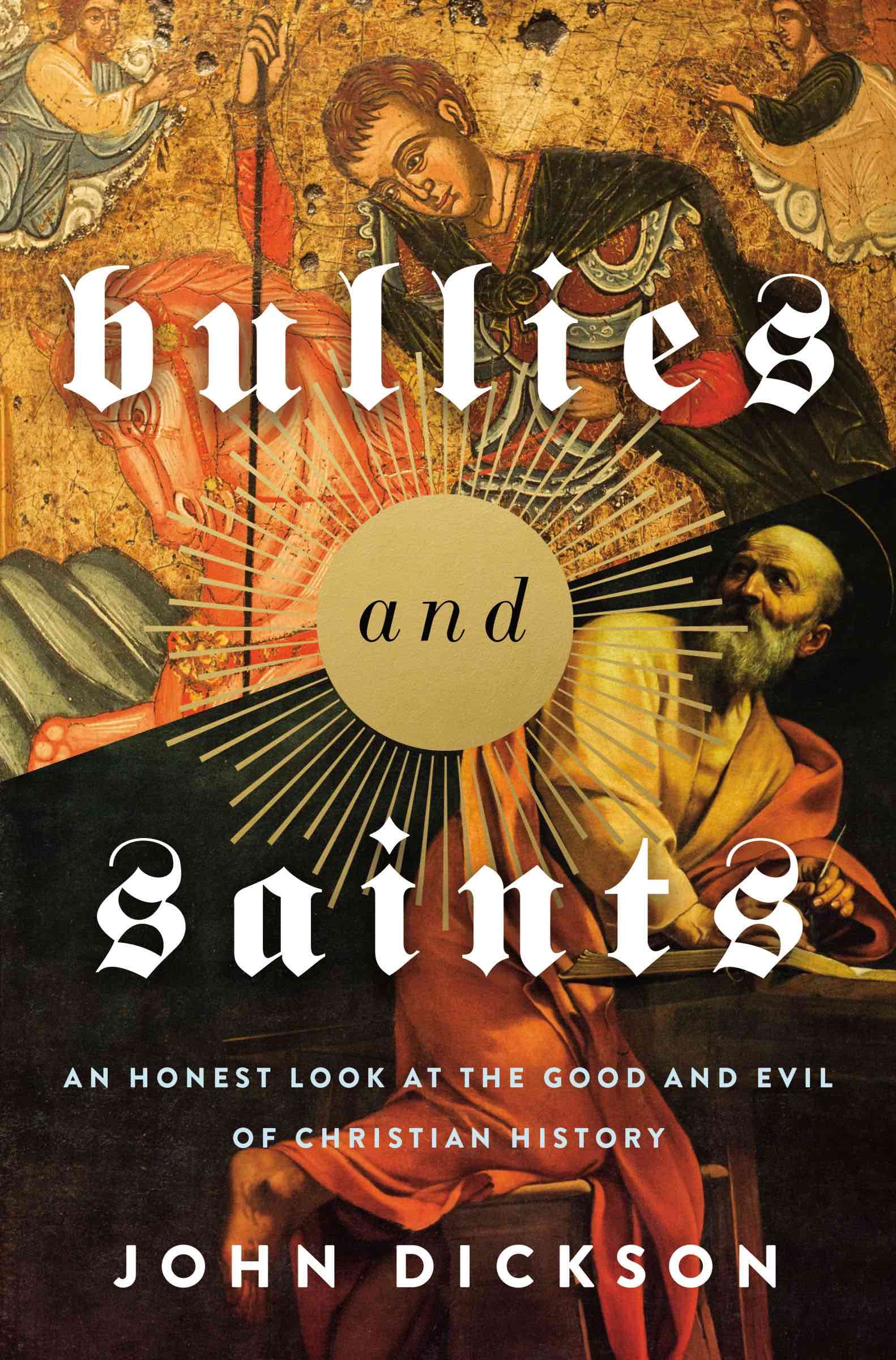
Bullies and Saints: An Honest Look at the Good and Evil of Christian History, by John Dickson, looks at both the good and bad side of church history.


Dealing with “Church Hurt”

I recently finished reading Bullies and Saints: An Honest Look at the Good and Evil of Christian History, by John Dickson, host of Australia’s number one religion podcast, Undeceptions.  Dickson has been known in Australia for producing several documentaries about church history, a lot of it about the darker side of Christian history.

In Bullies and Saints, Dickson takes a hard look about both the good side and the darker side of church history. Some have objected that the exposure of that darker side is like airing someone’s dirty laundry. How unpleasant can that be?

In response, John Dickson takes a balanced approach. Whenever Dickson faces the challenge that he is focused too much on the negative, his response is that one of the first things that Jesus taught his disciples is that “they should be willing to admit their own failure to love, their own moral bankruptcy” (Dickson, p. 37).  Citing Jesus’ sermon on the mount, we hear Jesus’ saying “Blessed are the poor in spirit.”

The vocation of the Christian is to be a prophetic voice, to call out the existence of injustice in our world. But as Jesus taught in that same sermon, “Why do you see the speck in your neighbor’s eye, but do not notice the log in your own eye?”  Christians really have no right to call out sin in the world around them until Christians are willing to call out sin in their own lives.

There is a lot of “church hurt,” experienced by people who have spent time in a Christian church, only to walk away from the experience with a bad taste in their mouth. But as John Dickson argues, an instrumentalist may play a musical piece written by Beethoven poorly, leaving the audience disappointed. But the fault for such a bad performance is not the fault of Beethoven. It is the fault of the poorly trained instrumentalist instead.

Likewise, simply because Christians fail to live up to standards set by Jesus Christ, this does not mean that Christianity as defined by Jesus is faulty, or untrue. Rather, it means that such Christians are at fault, either due to their own ignorance, or a failure to understand what being a Christian is all about. The wisdom of G.K. Chesterton is appropriate: “The Christian ideal has not been tried and found wanting. It has been found difficult; and left untried.”

Christians behaving badly need not require that Jesus himself and his message be rejected. In fact, the opposite is the case. The existence of bullies in the church confirms Jesus’ own teachings, and that what Jesus said and did was and indeed is still true. This is the bottomline message in John Dickson’s Bullies and Saints, and he makes an historically responsible case for it. Bullies and Saints is a fantastic, enjoyable, and learned book, a one-stop shop for a balanced look at the good and bad parts of church history across the centuries.

(As an aside, I also consulted John Dickson’s work a good bit in the Veracity complementarian/egalitarian controversy “women in ministry” series, particularly in my review of Kevin DeYoung’s Men and Women in the Church. Spoiler alert: I think John Dickson is mostly right, and has the better end of the argument than does Kevin DeYoung… but that is quite another topic)

A Balanced Approach to Bullies and Saints in Church History

In Bullies and Saints, we learn about the bullying tactics sadly on display by those who have taken up the name of Christ. A few anecdotes are worth reporting.

During the Crusades, church leaders, including one of the most revered and saintly, Bernard of Clairvaux, encouraged knights and others who marched off to defeat the Turks. Bernard wrote a letter around 1145 to some of his followers, promising that such military efforts were to be viewed as a kind of spiritual pilgrimage, an act of penance to blur out and erase one’s own sins: “…Where it is glory to conquer and gain to die. Take the sign of the cross, and you shall gain pardon for every sin that you confess with a contrite heart” (quoted in Dickson, p. 10).

On the other hand, in Bullies and Saints we also learn about some very positive contributions to society in church history. Emperor Constantine is often described as a villain who wedded the Christian church to state power, thereby corrupting the church in the process. Yet Constantine, the Roman emperor who first granted toleration to Christianity with the Edict of Milan in the early 4th century, also passed a legal ruling to make divorce more difficult, one of the first efforts in human history to promote women’s rights.

In Roman history before Constantine, divorce laws put women at a distinct disadvantage.  In that culture, a woman’s family was required to bring a dowry, whether that be a sum of money or other material wealth, to a marriage. But if the marriage was abruptly cut off by the husband, the wife would often be left in a state of significant financial loss. Based on Christian teaching that God created both man and woman in the image of God, Constantine ruled that if a husband divorced his wife on trivial grounds:

….he must restore her entire dowry, and he shall not marry another woman. But if he should do this [i.e., marry another woman after divorcing on trivial grounds], his former wife shall be given the right to enter and seize his home by force and to transfer to herself the entire dowry of his later wife in recompense for the outrage inflicted upon her” (quoted in Dickson, p. 75).

Think about it. A 4th century Roman emperor is saying stuff that mirrors the 21st century #MeToo movement. That surely made an unfaithful husband think twice before “shacking up” with another woman. Pagan Roman society before Christianity came along offered very little defensive support of women taken advantage of by undisciplined men.

Constantine also passed an early version of legal code outlawing the abandonment of infants. In pre-Christian Roman society, it was perfectly legal and moral to leave a baby abandoned if the family did not want the baby, subjecting the helpless child to certain death, unless someone else wandered along to either rescue the child, or to be picked up by a child trafficker (Dickson, p. 75).

Score yet again another point in favor of the influence of Christianity. It balances out the common negative narrative popularized on the Internet today.

Church History is a Complicated, Mixed Bag: A 5th Century Version of the 2020 “George Floyd” Riots

John Dickson corrects a number of misunderstandings about church history, such as the following example. This is a bit of a rabbit trail, but I found it all fascinating, and why you can not always trust popular revisionist history.

Similar to the George Floyd riots in the summer of 2020, Christians rioted in the city of Alexandria, Egypt,  in the early 5th century.  The 2020 death of George Floyd triggered riots across the United States, encouraging thousands to vent their frustrations after being subject for months to social-distancing restrictions in the wake of the COVID-19 pandemic.

Spurred on by social media algorithms designed to get more clicks, the riots spread across the world, leading to the dismantling of statues honoring leaders of the 19th century southern Confederacy, while also inspiring calls to take down statues of venerable modern heroes, like that of Jefferson and Washington in the U.S., and of Winston Churchill in London, the British statesman who stood up against Hitler’s Nazi Germany. Even a statue of Captain James Cook, the English sailor who “discovered” the eastern seaboard of Australia in the 18th century, needed a police guard established in John Dickson’s native Australia (Dickson, p. 118).

Likewise, when the Christians rioted in Alexandria, Egypt, less than a few decades after Christianity was declared the official religion of the Roman Empire, the violence that erupted left its mark upon history. Knowing at least something about church history, I had always thought of Cyril of Alexandria, the bishop in that city at the time, as a great Christian hero, despite some theological controversy along the way. Cyril was engaged in an important dispute with a bishop at Constantinople, Nestorius, that the average Protestant evangelical Christian knows nothing about. (If you do not know who Nestorius was, just consider the idea that the Christian movement that he led eventually brought the Christian faith into faraway places, like China, hundreds of years before the Protestant missionary movement. Supporters of Nestorius today say that Cyril of Alexandria misunderstood Nestorius). Though Cyril’s ideas received further tweaking, Cyril campaigned against his opponents in favor of the theological concept of Jesus having both a divine nature and a human nature, united together.

Jesus is both God and man, at the same time, though the details of this union of natures remain a mystery. Cyril’s campaign helped to pave the way to the Council of Chalcedon in 451, which affirmed the full divinity and the full humanity of Jesus Christ, which the vast majority of Christians continue to affirm to this day.

The history of Christianity would have been quite different without Cyril of Alexandria, especially regarding the Incarnation, a core Christian doctrine most believers in the 21st century take for granted. Cyril is regarded as a saint in both Roman Catholic and Eastern Orthodox communions. But Cyril’s legacy is actually quite complicated, something I knew very little about before reading Bullies and Saints.

Many critics of Christianity blame Cyril for inspiring a mob to attack and murder one of the greatest philosophers of the day, a woman named Hypatia, a leading advocate for reason and science. Such critics cast Cyril as an anti-intellectual zealot, who promoted hatred against science and against women. Unfortunately, such criticism has been mainstreamed into popular history story-telling in contemporary Western culture.

This narrative about Cyril of Alexandria has been promoted by both Edward Gibbons in his 1776 The Decline and Fall of the Roman Empire, and more recently, the world-renowned scientist Carl Sagan in his widely-acclaimed 1981 PBS documentary Cosmos. As a PBS fan back in the 1980s, I took in the message of Cosmos as pure “gospel truth,” though I remember little about the television program now. But there is more to the story, including details that Sagan failed to tell his television viewers, viewers like me.

Yes, a mob who looked up to Cyril did murder Hypatia.  But what is often overlooked is that the reason for the attack had little to do with hatred of philosophy, the fact that Hypatia was a woman, or even issues directly related to Christianity. Political and socio-economic factors played a much larger role.

John Dickson and the sources he uses fill in the gaps of the common narrative: Tensions between Jews and Christians in Alexandria had become very intense in Cyril’s Egypt. Relations between Jews and pagans in Alexandria were arguably just as bad, if not worse, and had been that way for several centuries before Cyril.

Pogroms led by Alexandrian pagans against the city’s Jewish population resulted in perhaps thousands of deaths, as early as a decade after Jesus’ death. The Christian movement had barely got off of the ground at that point. Mistrust of the pagan elites by the relatively poorer Jewish community was inevitable, in the intervening centuries. Yet as time moved on and Christianity eventually eclipsed paganism in political influence in Alexandria, with many former pagans becoming Christians, much of that same hostility from the Jewish community was now redirected towards the new Christian elite.

Bishop Cyril came to believe that the current governor of Alexandria, ironically a baptized Christian named Orestes, had sided against the Christians in favor of the Jews in that city. Orestes had ordered an outspoken Christian to be tortured, resulting from a public dispute this man had with the Jews.

The influential bishop Cyril resented Orestes’ actions. Orestes appealed to Hypatia, a pagan philosopher respected by both pagans and Christians, in order to find a peaceful solution to a crisis that was spiraling out of control. But some of Cyril’s supporters from the lower classes got out of hand and rioted, confronting Hypatia themselves. The confrontation escalated, and the philosopher was killed. The Christian rioters had thought that the pagan Hypatia was aligned with the Christian Orestes, in favor of the Jews against the Christians under Cyril’s influence.

Hypatia, whose family were members of the ruling class as well, had been caught up in a dispute between two professing Christians, the bishop Cyril and the governor Orestes. These elements of the story are never told in Carl Sagan’s Cosmos documentary. (Atheist YouTuber and history blogger Tim O’Neill sets the record straight, as does John Dickson in Bullies and Saints).

Did Cyril order his followers to have Hypatia killed, or did he simply turn a blind eye to enthusiasts who supported him? Historians debate this point. Either way, it would be easy to conclude that Hypatia’s death was a clear example of Christians behaving badly, even with the story’s complications.

However, what is also often neglected is that several of the most vocal supporters of Hypatia were Christians themselves, and these Christians strongly rebuked Cyril and his hot-headed enthusiastic followers, which included easily swayed monks. Much of the history about Hypatia was preserved by Christians sympathetic to her.

In reading Bullies and Saints, you get the picture that the controversy over Hypatia’s death was more of a class dispute as opposed to a religious dispute. Cyril of Alexandria is still in many ways a hero to me, but I can see his clay feet more clearly now. While Cyril’s behavior is certainly less than exemplary, the complex details of the story undermine Sagan’s oversimplified narrative of anti-intellectual, misogynistic Christians attacking a pagan, scientifically-learned female philosopher.

Recommended for a Fair Analysis of the Good and Bad of Church History

Stories like these are peppered throughout Bullies and Saints, offering a balanced analysis of Christians acting as saints as well as being bullies. I have only covered the highlights from the first third of the book.  Dickson goes on with stories beyond the era of the early church, from Augustine’s sophisticated rationale with “just war theory,” to the Inquisition of the medieval period, to the clerical abuse of children by clergy in the modern era. Dickson hits all of the highlights (and “lowlights”) of church history, correcting misinformation with good information along the way.

Dickson moves with ease, acknowledging on the one hand, the anomaly of Charlemagne’s forced conversions of the Saxons (followed by Charlemagne’s eventual relaxation of such a policy, due to the saintly influence of Alcuin of York). On the other hand, Dickson exposes the highly problematic arguments in Stephen Greenblatt’s The Swerve, a popular atheistic attempt to blame Christianity for the medieval “dark ages,” and the Christian church’s supposed rejection of science and the intellect.

C.S. Lewis has been known for criticizing “chronological snobbery,” the tendency to think that we as modern people are more morally upright than our ancient and medieval predecessors. Bullies and Saints has the receipts that demonstrate the truth of Lewis’ argument.

A few surprises met me along the way through Bullies and Saints.  For example, have you ever heard of the Prayer of Saint Francis? “Lord make me an instrument of your peace. Where there is hatred, let me bring love.

I have sung songs based on this prayer ever since I was a little kid. The theme of peace was certainly a mark of Francis of Assisi’s spirituality, but the words of the prayer itself do not originate with him. I did not know that. Instead they were first published in a Roman Catholic magazine in 1912 by an unknown author, a poem that was extremely popular during the years of and following World War I.

Bullies and Saints makes for an extraordinary engaging read.  I listened to it in Audible form, and John Dickson does a great job reading the text himself.

Tim O’Neill, an atheist blogger, gives Bullies and Saints a very fair, considerate, and ultimately positive review, as O’Neill is known for his integrity when he comes to assessing popular history writing.

I highly recommend John Dickson’s Bullies and Saints as a well-rounded, balanced tour through church history, showing that one can acknowledge the many positive contributions of Christianity to the world, while being honest about the failures of Christians over the past twenty centuries, without descending into cynicism.