
Did Jesus keep kosher? Did he hold to all of the food laws observed by orthodox Jews today, or did he use his authority to declare that kosher regulations were no longer binding on his followers?
I had not thought of this before, but it does raise a number of questions that most Christians (like myself) have never thought about. Those familiar with Acts 10:9-16 will know that after Jesus’ ascension, Peter received a vision instructing him that the Jewish food laws were no longer binding on followers of Jesus…. At least, that is the traditional view (More on that below).1
What is “kosher” about, anyway? In Judaism, the concept of kosher is known from the Hebrew term: kashrut. One “Judaism 101” website defines kosher like this:
Kashrut is the body of Jewish law dealing with what foods we can and cannot eat and how those foods must be prepared and eaten. “Kashrut” comes from the Hebrew root Kaf-Shin-Reish, meaning fit, proper or correct. It is the same root as the more commonly known word “kosher,” which describes food that meets these standards. The word “kosher” can also be used, and often is used, to describe ritual objects that are made in accordance with Jewish law and are fit for ritual use.
As a young Christian, with no Jewish background, I had been taught from Acts 10:9-16 to think it was okay now for a believer such as Peter to eat shellfish. I love shrimp, crab, lobster, and oysters, so I am glad that the New Testament teaches us that such food is permissible to eat! I say this a bit “tongue in cheek,” as the purpose of the Old Testament food regulations originally was less about prescribing a particular diet and more about reminding the Israelites that they are a separate people, called out by God to fulfill a particular purpose and mission.

If they had actually had something like a cheeseburger in the first century, would Jesus of Nazareth ever eaten one? Probably not. The Old Testament has three passages that teach that “You shall not boil a young goat in its mother’s milk,” the rationale for why even Orthodox Jews today do not eat cheeseburgers, the most common interpretation for these Jewish food regulations (Exodus 23:19, Exodus 34:26; Deuteronomy 14:21).
So How Jewish Was Jesus…. Really?
Nevertheless, Peter’s story creates a problem. Many Christians assume that Jesus dismissed kosher rules during his earthly ministry. Many of us just assume that if they had cheeseburgers back then, Jesus probably would have eaten them, even with a slice of bacon on top! (Eating meat products with dairy products is against kosher, and anything from a pig is strictly off the kosher list). After all, Jesus preached against the legalism of the scribes and the Pharisees, and the food laws sure sound legalistic, right? But if this is the case, and Peter was on-board with Jesus’ program, why did Peter initially resist the voice of the vision, after Jesus’ ascension?:
13 And there came a voice to him: “Rise, Peter; kill and eat.” 14 But Peter said, “By no means, Lord; for I have never eaten anything that is common or unclean.”
Wait a second. If Peter had never deviated from kosher until after this post-ascension vision, then what did he do with this claim that Jesus himself did not keep kosher during his earthly ministry? Was he not paying any attention to Jesus when our Lord gave Peter the new dietary instructions during Christ’s earthly ministry?
Some might push back and say that even though Jesus had abrogated the kosher food regulations, that he himself still kept to kosher food practices, as he did not want to upset the apple cart too much and cause any of his Jewish disciples to freak out over any blatant disregard for the food laws. But then this raises another problem: For Jesus was well known for creating controversy, so it would be difficult to explain why Jesus would blast away at the Pharisees for their legalism regarding the Law of Moses, while conforming to a “legalistic” practice regarding the food laws himself.
Furthermore, it is quite clear from Galatians 1-2, particularly in Galatians 2:11-24, that the conflict the Judaizers had with Paul was partly over the kosher food laws, which typically kept Jews from having table fellowship with non-Jews (Gentiles). Certain followers of Jesus insisted that Jewish believers in Jesus must continue to keep kosher, and not eat with Gentile believers in Jesus, well into the early church period. Where would these Judaizers get the idea that the kosher food regulations were still in force? They would have known this from either Jesus’ own example, or from what they had learned from Jesus’ earliest disciples.
Nevertheless, Paul was pretty annoyed with these Judaizers. Had they not heard of what Jesus said in Mark 7, long before Jesus’ crucifixion? Was this not being effectively taught among the earliest followers of Jesus?
In Mark 7, Jesus is challenging certain practices of the Pharisees, including how they interpreted the purity laws of the Old Testament. After having this confrontation with the Pharisees, we find a parenthetical statement, perhaps a commentary by Mark, summarizing Jesus’ teaching with respect to the cleanliness of food:
“(Thus he declared all foods clean.)” (Mark 7:19b)
At the surface, it would appear that Jesus is concluding that the kosher regulations are no longer applicable to his followers. This happens several years before Peter experiences his vision of reptiles, birds, and other forbidden foods being let down in front of him on a sheet, with a voice saying, “Get up, Peter. Kill and eat” (Acts 10:13), some time after Jesus’ ascension. This interpretation of Mark 7 is commonly taught in many evangelical churches.
But is this the right way to interpret this passage? A Jewish scholar, Daniel Boyarin, at the University of California Berkeley, takes a contrarian view in his The Jewish Gospels: The Story of the Jewish Christ. Boyarin contends that what Jesus is attacking in this passage is not the Jewish kosher food laws per se, but rather how the Pharisees had interpreted the application of the food laws.
Pardon the pun, but there is a lot of food for thought here.
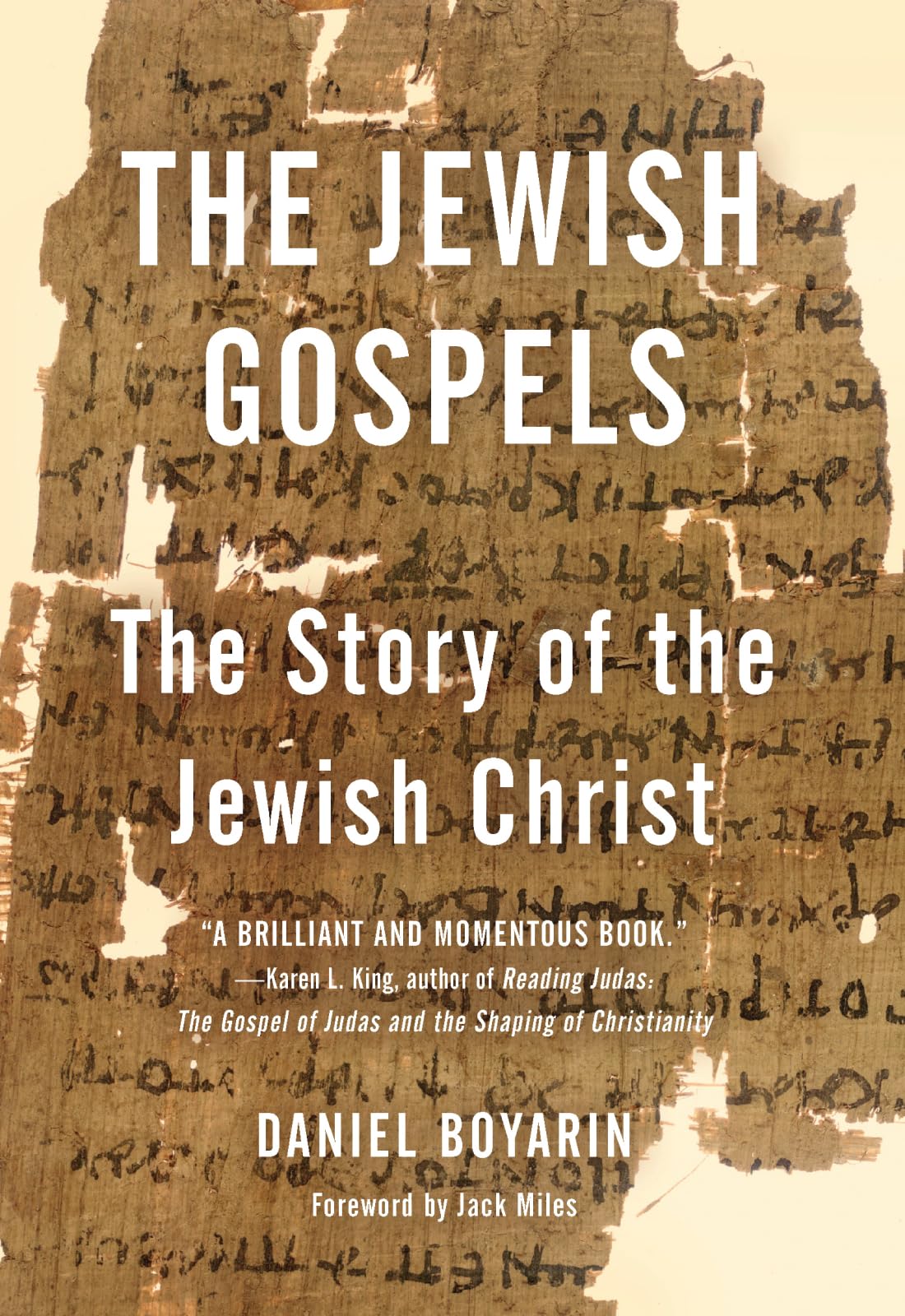
The Jewish Gospels: The Story of the Jewish Christ, by Jewish scholar Daniel Boyarin, helps us to better understand the New Testament’s development regarding the Jewish food laws. Under apostolic authority, Paul taught that Gentile Christians were not required to keep kosher as believers in Jesus. However, Jesus in his earthly ministry, kept kosher regarding the Jewish food laws. Veracity explores the controversy.
Did Jesus Eat Pork and/or Shellfish?
The passage from Mark 7 is worth quoting in full:
1 Now when the Pharisees gathered to him, with some of the scribes who had come from Jerusalem, 2 they saw that some of his disciples ate with hands that were defiled, that is, unwashed. 3 (For the Pharisees and all the Jews do not eat unless they wash their hands properly, holding to the tradition of the elders, 4 and when they come from the marketplace, they do not eat unless they wash. And there are many other traditions that they observe, such as the washing of cups and pots and copper vessels and dining couches.)5 And the Pharisees and the scribes asked him, “Why do your disciples not walk according to the tradition of the elders, but eat with defiled hands?” 6 And he said to them, “Well did Isaiah prophesy of you hypocrites, as it is written,
“‘This people honors me with their lips,
but their heart is far from me;
7 in vain do they worship me,
teaching as doctrines the commandments of men.’
8 You leave the commandment of God and hold to the tradition of men.”
9 And he said to them, “You have a fine way of rejecting the commandment of God in order to establish your tradition! 10 For Moses said, ‘Honor your father and your mother’; and, ‘Whoever reviles father or mother must surely die.’ 11 But you say, ‘If a man tells his father or his mother, “Whatever you would have gained from me is Corban”’ (that is, given to God)— 12 then you no longer permit him to do anything for his father or mother, 13 thus making void the word of God by your tradition that you have handed down. And many such things you do.”
14 And he called the people to him again and said to them, “Hear me, all of you, and understand: 15 There is nothing outside a person that by going into him can defile him, but the things that come out of a person are what defile him.” 17 And when he had entered the house and left the people, his disciples asked him about the parable. 18 And he said to them, “Then are you also without understanding? Do you not see that whatever goes into a person from outside cannot defile him, 19 since it enters not his heart but his stomach, and is expelled?” (Thus he declared all foods clean.)20 And he said, “What comes out of a person is what defiles him.
21 For from within, out of the heart of man, come evil thoughts, sexual immorality, theft, murder, adultery, 22 coveting, wickedness, deceit, sensuality, envy, slander, pride, foolishness. 23 All these evil things come from within, and they defile a person.”
We can see the context whereby verse 19 suggests that Jesus abrogated the food laws, indicating that kosher was no longer applicable….. or does it?
My ESV Study Bible has a note on verse 19, about the parenthetical phrase “(Thus he declared all foods clean)”:
“The ceremonial laws have fulfilled their purpose and are no longer required — though as seen in Acts 10-11, it took several years for the disciples to understand this.“
So, it “took several years ” for the disciples to get the picture? Well, it is true that we find in the Gospels numerous reports that the disciples who traveled with Jesus were often pretty clueless about what was going on with Jesus. But were they really this dense?
Jumping over to Acts 10:13-15:
13 And there came a voice to him: “Rise, Peter; kill and eat.” 14 But Peter said, “By no means, Lord; for I have never eaten anything that is common or unclean.” 15 And the voice came to him again a second time, “What God has made clean, do not call common.”
Here, my ESV Study Bible has the following note, reinforcing what is said at Mark 7:19:
“Verse 15 is the key: God was over turning the old clean/unclean distinctions and dietary laws in general, along with all other ‘ceremonial’ laws in the Mosaic covenant (including laws about sacrifices, festivals and special days, and circumcision). Nothing like this was to get in the way of fellowship with Gentiles, as Galatians 2 also shows.”
On one level, the delay in the eventual comprehension of the disciples as to what Jesus was teaching was understandable…. Or was it?
Nowhere in the Gospels do we find any instance where Jesus actually broke any kosher traditions. For if Jesus ever did snack on some bacon, the New Testament never mentions it! As far as we know, Jesus continued to stay away from shellfish, and the disciples did, too, even after what is taught in Mark 7. So, why the parenthetical conclusion offered in verse 19?
A standard, popular and scholarly interpretation suggests that Mark’s parenthetical comment, “(Thus he declared all foods clean),” was an observation made by Mark long after Jesus gave this teaching. It suggests that the light bulb lit up in Mark’s head years, or perhaps even decades later, after Jesus gave this teaching, illuminating what Jesus really had in mind to communicate. This sounds reasonable, right?
Well, Boyarin argues that most scholars have misunderstood this passage because it fails to distinguish between the forbidden and allowed paradigm and the clean and unclean paradigm. “Keeping kosher” is all about distinguishing between foods which are forbidden versus allowed. But the purity laws were different from “keeping kosher” (Boyarin, p.112ff). Nevertheless, the Pharisees had complicated the Torah tradition by inserting something from their oral tradition, which Jesus rejected.
Some background from the Book of Leviticus is essential here: Eating a forbidden food was an act of rebellion; that is, an immoral act. It was sin. However, becoming ritually impure was not necessarily a moral act at all. One could become ritually impure through no fault of their own, and therefore, not be guilty of sin. This is why Jesus teaches that what defiles someone in terms of sin is not what they put into their body, but what comes out from the inside; or from the “heart.”
Most readers take everything in this passage about what Jesus says metaphorically, based on verses 21-23, that Jesus is talking about some negative attitude of the “heart,” and contrasting that with the supposed legalism of the kosher food laws.
However, Boyarin contends that the complaint that the Pharisees had with Jesus and his disciples was not what kind of foods they were eating, but how they were eating them. A quick look back at Mark 7:1-2, which introduces the passage, sets the context for the reader.
Jesus assumes that the food being eaten is indeed kosher. The Pharisees had developed an oral tradition which emphasized the ritual washing of the hands before eating food (Mark 7:1-2), in order to prevent some external element from polluting the body. But Jesus rejected the tradition of the Pharisees, as this was an additional burden not found within the Torah (the first five books of the Bible, also commonly known as the Pentateuch).
Then in Mark 7:9-13, Jesus launches into the Pharisees, observing that they have twisted the command to honor one’s mother and father in order to completely nullify the Law of Moses. It would appear from just this alone that Jesus’ adherence to Torah was no joke. Jesus’ seriousness about the Law should inform our understanding of the kosher food regulations, and what the ceremonial hand washing ritual of the Pharisees had to do with it. In The following video shows Daniel Boyarin explaining his argument in greater detail (skip to about the 2-minute mark to avoid the introduction…. Boyarin speaks in English to a primarily Russian audience):
By saying that “all foods [are] clean” (Mark 7:19), Jesus is declaring that the food being eaten, without the ritual hand washing, does not make someone “unclean,” or more accurately, ritually impure. Therefore, there is no need to wash one’s hands, as the Pharisees had been doing. Jesus is about keeping to the original instructions of Torah, whereas the Pharisees are shown to be the innovators. In other words, while some foods are still forbidden to be eaten, the intake of food in and of itself does not lead to impurity, or ritual uncleanliness. This changes the common interpretation of the passage entirely!!.2
A better translation, as suggested by Australian theologian Michael Bird, for Mark 7:19 can be offered:
“Thus [Jesus] declared all foods are clean” would be “Jesus declared all kosher food clean and not requiring hand washing.”
Bird supports his translation by appealing to a similar statement in Matthew 15:20, “to eat with unwashed hands does not defile.”
Since I finished Daniel Boyarin’s book, The Jewish Christ, I learned more about why a number of scholars are attracted to this different reading. But I would need to nerd out a bit to explain, so check out the appendix to this blog post below for more…. APPENDIX A
Back to the Big Picture About the Food Laws……
Within the larger message of the New Testament, the Holy Spirit does teach the early Christian movement that the keeping of kosher is no longer required, at least among the Gentiles. This is why Peter’s vision in Acts 10 is so significant, which is echoed in Paul’s teaching on the inclusion of the Gentiles into the people of God, by not requiring Gentile Christians to observe all of the ceremonial laws associated with the Jews.
Assuming Acts 10 to be historical, and that it is indeed addressing Jewish food regulations, this does raise the question as to why Jesus would keep kosher prior to his crucifixion, and then through the work of the Holy Spirit revealed in Acts, God appears to abrogate these kosher restrictions. This is a good question. Boyarin unfortunately does not address this, but here is a reasonable answer (For the counter-argument against Acts 10 being about food, see appendix below):APPENDIX B
The one who clearly states the food laws have been abrogated, at least with respect to the Gentiles Christians, is the Apostle Paul. In Romans 14:20, Paul declares that “all food is clean,” while acknowledging such matters concerning are “disputable matters” (Romans 14:1), where believers should respect the consciences of fellow believers who share different convictions concerning food.
As the Apostle Paul would express it in his letters, this progressive revelation over time was to first announce the Gospel among the Jews BEFORE announcing the Gospel to the Gentiles. This was not about encouraging Jewish followers of Jesus to themselves give up on the Law of Moses, but rather, to pave the way in increments to bring the Gentiles into the people of God, in lowering the barrier to entry by bypassing Jewish food regulations. Jews could still keep kosher as followers of Jesus, while still bringing the Gentiles in through their faith in Christ, without requiring Gentile adherence to kosher.
Paul is quite aware of the importance of this order of events, that the Gospel first comes to the Jews, through Jesus’ pre-ascension ministry, and then extends out to include the Gentiles (Roman 1:16):
For I am not ashamed of the gospel, for it is the power of God for salvation to everyone who believes, to the Jew first and also to the Greek (Gentile).
Daniel Boyarin’s argument fits within his larger concern of The Jewish Christ, namely that Jesus of Nazareth was very much a practicing Jew, and that the redefinition of what constitutes being among the people of God does not happen until after the ascension of Jesus, early within the history of the early church, described in Acts. Jesus was indeed a Jewish Christ.
Boyarin’s thesis makes better sense of Jesus’ teaching at the Sermon on the Mount, that he came not to abolish the Law, but rather to fulfill the Law (Matthew 5:17-19). For if Jesus was nullifying the Jewish food regulations in his earthly ministry, it would be difficult not to conclude that Jesus was indeed abolishing the Law! This would be a contradiction. Instead, Jesus sees that in his earthly ministry that he kept to the Law of Moses, encouraging his Jewish followers to do the same.
Jesus even up’ed the ante by saying that his followers must exceed the righteousness of the Pharisees (Matthew 5:20). Is it no wonder Jesus’ disciples felt that his teaching was so impossible to keep? Yet Jesus teaches them that by man’s efforts, they can not exceed the righteousness of the Pharisees, as Jesus instructs. Rather, what is impossible for man is possible for God (Matthew 19:23-26). This is the ultimate lesson that Jesus wants to communicate to his disciples, that we can not save ourselves. Only the grace of God can do that.
We are indeed under grace and not under law. But the New Testament teaching about this unfolds in stages over time, first through the ministry of the earthly Jesus, and then continuing on through the ministry of those like Paul, whom Jesus designated as the “Apostle to the Gentiles.”
Other Gems In The Jewish Christ
Several other insights from Boyarin are found in The Jewish Christ, including the idea that Jesus’ self-designation of “son of man” is indeed a reference to the New Testament claim for the deity of Christ, stemming from a tradition in Second Temple Judaism which sees the “son of man” figure in Daniel 7 with being a kind of “second” Yahweh figure, associated with a two powers in heaven theology, which was eventually abandoned in the rabbinical Judaism tradition after the destruction of the Jerusalem Temple in 70 C.E.
Some contemporary translations of the Bible, like the Common English Bible, translate the term “son of man” as the “human one.” Non-metaphorically speaking, this is an accurate translation, but according to Boyarin it misses the point as to how certain strands of Second Temple Judaism understood the terminology of “son of man,” especially in how it is found within the Book of Enoch, an ancient Jewish text which ties the language of “son of man” to messianic understandings of divinity.
The other big idea in The Jewish Gospels is the claim that the “suffering messiah” teaching in the New Testament, aligned with the “Suffering Servant” of Isaiah 53, and the “son of man” tradition in Daniel 7 are tied together. In other words, Jesus as the messianic “son of man” is also the “Suffering Servant.” With respect to Isaiah 53, Boyarin writes:
It has been generally assumed by numerous modern scholars that Jews have always given the passage a metaphorical reading, understanding the suffering servant to refer to the People of Israel, and that it was the Christians who changed and distorted its meaning to make it refer to Jesus. Quite to the contrary, we now know that many Jewish authorities, maybe even most, until nearly the modern period have read Isaiah 53 as being about the Messiah; until the last few centuries, the allegorical reading was a minority position. (Boyarin, p. 152)
I am not yet convinced that Boyarin’s claim that a messianic interpretation of Isaiah 53 was the ascendant position throughout most of Jewish history, but the fact that there is evidence to say that a messianic interpretation of Isaiah 53 might be traced back to a Second Temple Judaic tradition is profound. Note again that Boyarin is a traditional Jew. He does not claim to be a Christian. Nevertheless, there are Jewish “counter-missionaries,” such as rabbi Tovia Singer, who claim that the complete absence of any messianic interpretation of Isaiah 53 in Second Temple Jewish thought demonstrates that the Christians invented this interpretation out of whole cloth. Boyarin’s research challenges that assertion.
The New Testament does associate messianic expectations with Isaiah 53’s “suffering servant.” But I have always heard that the Jews in Jesus’ day never expected a “suffering messiah.” YouTube Jewish apologist, Tovia Singer, will tell you about that! Critical scholars, like University of North Carolina’s Bart Ehrman, say the same.
Yet here is Daniel Boyarin, a prominent Jewish scholar, saying that at least in rabbinical Judaism after the destruction of the Jerusalem Temple, that the notion of a “suffering messiah” was embraced in certain Talmudic sources. The “suffering messiah” idea also had precedence before Jesus arrived on the scene, perhaps even in certain Septuagint translations of Isaiah prior to the New Testament period! (See Zechariah 12:9-13:1; 13:7-9 as having language in certain pre-Christian texts which overlap Isaiah 53). Perhaps it is safe to conclude that the “suffering messiah” tradition was indeed absent in many strands of Second Temple Judaism, just not all of them.
In other words, most Second Temple Jews in Jesus’ day would have believed that a dead Messiah was no Messiah at all. But that does not rule out the idea that at least some Jews might have believed that a “suffering Messiah” was not an oxymoron, at least at some level. As long as the Messiah does not die, particularly a death on a Roman cross, it should not surprise a Second Temple Jew (at least some of them) that the Messiah could still experience suffering.
Daniel Boyarin’s work serves as a helpful reminder that when we think of “Judaism” during the time of Jesus, it is better to think of “Judaisms” in the plural. The old saying, that wherever you find two Jews you are going to find three different interpretations of the Bible, is not just a funny joke, it is an observation that extends throughout Jewish history. When Jewish counter-missionaries, like the popular YouTuber Tovia Singer, pit Christian interpretations of a text against “the Jewish” interpretation of the text, it is best to keep in mind that the actual situation is more complicated than that.
Boyarin’s work will continue to be debated, no doubt. Boyarin’s specific argument for Jesus keeping kosher remains controversial, even in Christian circles. But assuming Boyarin is right, and I am inclined to think he is, then this does change how we should think about Jesus and his earthly ministry. If anything, it completely flips the narrative common in many circles of a “progressive” Jesus trying to loosen up the stiffness of “hyper-conservative” Pharisees. Instead, it is the “conservative” Jesus rebuking the innovative “liberal” Pharisees, who have moved away from strict adherence to the Mosaic Law.
Think about that one for a moment.
In terms of application, for the Gentile Christian, it does not make that much of a difference today regarding whether or not Jesus in his earthly ministry kept kosher or not. It can be argued that Jesus’ earthly ministry was primarily (though not exclusively) targeted towards the Jews, but that Jesus’ post-ascension ministry through the Holy Spirit expanded to include the Gentiles. Progressive revelation as found in other parts of the New Testament do show that the Jewish dietary laws became no longer binding on the Christian community as a whole, given what Acts and Paul’s letters tell us, while not necessarily condemning the practice of kosher by Jewish Christians. Many messianic Christians today continue to keep kosher for the reason that this is consistent with Jesus’ practice during his earthly ministry.
Nevertheless, the idea of Jesus keeping kosher should cause us to think a bit harder about the message of the New Testament. Too many Christians tend to favor the “Red Letters” of Jesus, words spoken by Jesus, as being some kind of ultimate authority superseding other aspects in the New Testament. Most often, I hear this when people say that they really like Jesus, but that they are not very crazy about Paul. I wish such Christians would read their New Testament a little more carefully!
Are Gentile Christians in general really that willing to follow the example of Jesus and keep kosher themselves? I sincerely doubt that “Red Letter Christians” would be all that disciplined to do that! As for me, I am glad that the post-ascension teachings of the New Testament allow me as a Gentile Christian to eat a juicy cheeseburger, with a slice of bacon on top!
In all seriousness, however, the thought of Jesus keeping kosher should cause us to read the Gospels in particular with a more sympathetic portrait of Judaism. The tendency to rip Jesus out of his first century Jewish context is something that Christians need to do better to resist. The Gospels, like that of Mark, are sensitive to accurately portray how Jews in Jesus’ day practiced the Torah tradition.3
The most important lesson to learn in all of this is that Jesus really was Jewish. That may sound like a no-brainer, but Christians often pay lip service to the Judaism of Jesus while having him act pretty much like a Gentile. Sadly, if there was one definite fault in the dominant theology of the early church, it was the tendency to promote a kind of anti-Judaism which still haunts us today.
In this sense, Daniel Boyarin offers a gentle yet important rebuke to Christians. To borrow from a popular American political phrase, we need to “Make Jesus Jewish Again.”
NOTES:
1. The appendices below address more closely exegeted analysis of the primary texts examined in this blog post. I read Daniel Boyarin’s book The Jewish Christ, before I discovered the work by Logan Williams on Mark 7, for APPENDIX A, and the work by Jason Staples on Acts 10, for APPENDIX B. Wiliams’ paper is “The Stomach Purifies All Foods: Jesus’ Anatomical Argument in Mark 7.18–19,” Cambridge University Press, New Testament Studies, Volume 70, Issue 3, published September, 2024. Staples’ paper is “‘Rise, Kill, and Eat’: Animals as Nations in Early Jewish Visionary Literature and Acts 10“, Sage Journals, Journal for the Study of the New Testament, Volume 42, Issue 1, published June 2019. Staples is interviewed on a YouTube channel, by David Wilber.
.↩
2. Something needs to be said about the first few minutes of Boyarin’s video presentation: The omission of verse 16 in the passage, given to us in the King James Version translation, is not found in the oldest manuscripts, which is why the ESV translation here omits it. However, in my view, when Dr. Boyarin highlights in the above video that this omission is part of some “conspiracy.” This is not a necessary conclusion to make, and muddies the case for his view. The larger argument that Boyarin is making does not depend on such an odd assertion. ↩
3. Boyarin states that Mark’s careful attention to Levitical food laws and Jesus’ conflict with the Pharisees means that the author of Mark’s Gospel was thoroughly rooted “within the Jewish world—nearly the opposite of what has been usually said of Mark” (Boyarin, p. 117). Many critical scholars contend that author of Mark was not Jewish, but rather was a Gentile. This critical view implies that Mark was not the actual author of this Gospel. Boyarin’s observation strengthens the case against this critical view, in favor of the traditional authorship claim in support of the historical Mark, as Mark as the author of this Gospel has been traditionally understood to be Jewish, and not a Gentile.↩
4. While the Gospels were written in Greek, Jesus most probably taught this in the Aramaic language, as most of his hearers would have been Aramaic speakers. Mark evidently translated Jesus’ saying into Greek in such a way that he preserved the meaning of what Jesus was teaching, without quoting the exact words Jesus says in Aramaic. In other words, there is a difference between the Gospels preserving the exact words of Jesus, what scholars call in Latin ipsissima verba, or “the very words”, and the message of Jesus, what scholars call in Latin ipsissima vox, or the “the very voice” of Jesus. Sadly, the concept of “red letter” Christianity, which elevates the supposed exact words of Jesus found in some Bibles, printed in red, actually distorts the message of the New Testament. The tendency to focus on the “red letters” of Jesus, at the expense of the rest of the teaching of the New Testament, and its negative consequences has been explored previously on Veracity in-depth. ↩
5. There are some in the Seventh Day Adventist movement, the Hebrew Roots movement, and even some in the Messianic Jewish movement who will insist that the food laws, and other Jewish distinctive practices are still binding even among Gentile Christians. They would argue that Paul is only talking about the Jewish requirement for circumcision being applied to Gentile believers in Jesus, as something Paul is rejecting. Further they would argue that Paul still thinks that Gentile believers are to continue the Jewish practice of kosher regulation observance, Saturday Sabbath observance, etc., but without circumcision. They would say that passages like Colossians 2:16-17 are about distorted interpretations of the Sabbath observance, food regulations, etc., and not the Levitical requirements themselves established in Torah. A response to this would require an additional blog post that is too long to go into here. But in short, it is sufficient to say that kosher food laws, the Saturday Sabbath observance, etc. were given specifically to the Jewish community; to those who submit to circumcision, and not to all peoples at all times and places. Circumcision was not the only Jewish identity marker Paul had in mind that was off-limits to the Gentiles he was trying to reach. To try to separate circumcision from the other Jewish identity markers; like kosher food laws, Saturday Sabbath keeping, etc. is not something that the proponents of this view can successfully establish. They fail to properly understand how progressive revelation works in the New Testament; namely, that Jesus first established his ministry with the Jews of Israel, while telegraphing in a veiled way some of what he was going to do with the Gentiles, but that the fulfillment of the Gospel work would be revealed later, primarily in Paul’s ministry to the Gentiles, which comes after the ascension of Jesus. Specifically, when it comes to Colossians 2:16-17, verse 17 answers the “pro-nominan” assertion made by those like David Wilbur: “These are a shadow of the things to come, but the substance belongs to Christ.” Abusive interpretations of the Law of Moses are not the shadow of things to come, according to Paul. The whole of the Jewish specific identity markers is what is in view here, where “the substance belongs to Christ,” according to the revelation Paul received from Jesus. ↩
APPENDIX A: ↩
Jesus Keeping Kosher According to Mark 7?
Logan Williams, a New Testament scholar at the University of Aberdeen, has picked up on the same idea, in line with Daniel Boyarin’s research. Williams takes a slightly different approach by arguing that the parenthetical comment in Mark 7:19 in most modern translations is founded on a weak understanding of Greek grammar. Williams wants to emphasize that Jesus is using an appeal to human biology, in terms of how the digestive system works, to say that food processed by eating and digestion is purified when it is expelled. Without going into his whole argument here (read about it elsewhere), Williams concludes that Mark 7:18-19 should read something like this instead:
“Do you not understand that whatever goes into a person from outside cannot defile, since it enters not their heart but the stomach, and goes out into the latrine from the (person), thus purifying all foods?”
Compare this with the reading of this passage from the ESV translation:
“Do you not see that whatever goes into a person from outside cannot defile him, since it enters not his heart but his stomach, and is expelled?” (Thus he declared all foods clean.)
The idea from Williams’ translation is that most contemporary translations suggest that the subject of the parenthetical phrase, as in “(Thus he declared all foods clean),” from the ESV, is Jesus. That is, Jesus is the “he” who declared all foods clean, as Jesus was the speaker, hence the reference of “he” being Jesus. But Williams’ translation argues that the subject of the phrase is neuter and not masculine, which indicates that the subject must be “the person,” which is neuter, as in “(the person) thus purifying all foods.” Logan Williams’ point argues that the lack of gender designation was intentional on the part of Mark. In other words, the human person purifies foods as the eaten foods pass through the human digestive system.
Furthermore, Williams suggests that the phrase from the ESV, “(Thus he declared all foods clean),” is not some parenthetical observation or conclusion noted by Mark, some decades later after the fact, but rather that phrase was genuinely part of Jesus’ original speech.4
Therefore, this is not about Jesus declaring foods to be clean, or Jesus getting rid of any Jewish purification regulations. Rather, Jesus is rebuking the Pharisees for adding something to the Mosaic law which Moses did not teach. Jesus, at least in terms of his earthly ministry, is still a keeper of kosher.
The obvious pushback to this revisionist reading is that it bucks a tradition still found in most modern Bible translations. But as Williams argues, this “traditional” reading really is not so traditional after all, as it has only been around about 150 years. Ironically, even the venerable King James Version, back in 1611, aligns more with a revisionist reading of Mark 7:19:
‘[the food] entereth not into his heart, but into the belly, and goeth out into the draught, purging all meats.’
Thus the KJV affirms that food is purged of impurities as it goes through the digestive system. The KJV is not about suggesting that Jesus is doing away with any purity legislation.
What a surprising conclusion! It turns out that the actual “revisionist” reading comes from our modern translations, long after the KJV translation was produced. Sometimes the venerable KJV preserves a better reading of the original text than does our modern translations…… If you have KJV-Only friends, this might impress them!!
Nevertheless, Williams argument has not convinced everyone. One apologist, R. L. Solberg, walks through his critique of Williams’ argument on YouTube. Some have responded to Solberg.
My own take is that Solberg is concerned that some Christians, like some Seventh Day Adventist and/or Hebrew Roots Movement advocates might take this revisionist reading as a rationale for why all Christians today, including Gentiles, should continue to hold to practices such as the Jewish food laws, Saturday Sabbath, etc. This is a genuine concern as I know personally of Hebrew Roots Movement advocates who have gone down this rabbit hole, and in extreme cases have made a serious mess of their lives!! Some Hebrew Roots Movement advocates celebrate Jewish festivals, like Hanukkah, while abstaining from traditional Christian holidays, like Christmas, coming across with a kind of “holier-than-thou” attitude towards those outside of the Hebrew Roots Movement. Such over-enthusiasm for Jewish customs, while coming from Gentile backgrounds, is not spiritually healthy, so Solberg does have a point here.
However, this counter-argument does not take into serious consideration the role of progressive revelation, as we see with Paul’s apostolic ministry to the Gentiles, which after Christ’s resurrection, specifically lowers the bar for entry into the people of God for the Gentiles. Acts 15, which is post-Christ’s-resurrection, spells out what requirements are necessary for the Gentiles, and the Jewish food laws and Saturday-Sabbath keeping are not among them. In Colossians 2:16-17, Paul is urging believers not get hung up on kosher food laws or Saturday-Sabbath observance, presumably as he is writing to Gentiles:
Therefore let no one pass judgment on you in questions of food and drink, or with regard to a festival or a new moon or a Sabbath.These are a shadow of the things to come, but the substance belongs to Christ.
Yet he acknowledges that there are some, most probably Jewish Christians who still maintain kosher, and Paul does not seem bothered by that at all. In fact, he respects the practice, as Romans 14:14:
I know and am persuaded in the Lord Jesus that nothing is unclean in itself, but it is unclean for anyone who thinks it unclean.
A Jewish Christian who knew that the earthly Jesus kept kosher would most probably still consider certain foods to be unclean, and therefore should stay away from such foods.5
Does the revisionist reading of Mark 7:19 meet the high bar challenge posed by the “traditional” reading of this verse? I lean towards saying “yes.”
The following YouTube video is a short yet technical deep dive into this topic with Dr. Williams (Or follow the link here)
APPENDIX B:↩
Peter Keeping Kosher According to Acts 10?
Some will object that Acts 10:9-16 is about an abrogation of the Jewish food regulations. They would argue that this passage serves as an introduction to the conversion of Cornelius, a God-fearer, and not a Jew, where Peter is encouraged in Acts 10:17-48 to meet with Cornelius, proclaim the Gospel to Cornelius, and then baptize what appears to be his entire household. The presence of unclean food in the vision is meant to metaphorically represent the inclusion of the Gentiles in the preaching of the Gospel message. This explains Peter’s response to Cornelius in verse 28:
You yourselves know how unlawful it is for a Jew to associate with or to visit anyone of another nation, but God has shown me that I should not call any person common or unclean.
Note that Peter does not mention anything about foods here. How come I never noticed this before?
You would think that if Peter sees a vision where he is ordered to eat non-kosher foods that he would have responded to Cornelius with something like, “Cornelius, God has shown me in a vision that it is okay for me share a cheeseburger with you.”
But this is not what happens. Instead, Peter’s response is that the meaning of the vision was to go to Cornelius’ home, a Gentile home, and share with him the Gospel. There was not one word uttered about what is on the menu.
In other words, Peter concludes that the vision is about allowing for table fellowship with Gentiles who become believers in Christ, and therefore is not about abrogating the Jewish food regulations. To put it another way, both Acts 10 and Mark 7 have nothing to do with abrogating Jewish food regulations, contrary to popular and even scholarly opinion.
There is much to be commended with this reading. One scholar, Jason Staples, has written and spoken up for this view on several occasions. However, there are several problems with it that cause some difficulty when reading Acts 10 that do not arise when reading Mark 7. While this reading might indeed suggest that the Jewish food regulations are still applicable even today, there is nothing in this passage which suggests that the Jewish food regulations are declared to be normative for Gentile believers in Jesus, and therefore applicable to Gentile believers in Jesus even today. In other words, Jewish believers in Jesus can and probably should still observe kosher, but that Gentile believers in Jesus are not under the same obligation. This is a message which is consistent with what we find in Paul’s letters.
Furthermore, in verse 48, members of Cornelius’ group ask Peter to stay with them for several days. It is difficult, though not impossible, to imagine how Peter would remain a guest in Cornelius’ home and still maintain kosher eating practice. It is more likely to say that Peter would have been able to relax kosher eating practices while with Gentile believers, while upon returning to his Jewish Christian friends he would remain steadfast in keeping kosher with his fellow Jewish Christian brothers and sisters. In other words, it is plausible to think that a metaphorical reading of Peter’s vision in Acts 10 would have been consistent with early Christian teaching that at least Gentile believers were not under any obligation to keep kosher food regulations.
Nevertheless, some maintain that Peter and even Paul continued to maintain kosher food eating practices throughout their lives. Yet even if this was true, which it might have well could have been, it does not in any way impact Daniel Boyarin’s thesis that Jesus kept kosher during his earthly ministry. While this plausible commitment to keeping kosher for Peter and Paul as believers certainly makes sense when one thinks of the two in fellowship with fellow Jewish Christians, when Peter and Paul were with Gentile believers it is difficult to figure out how they would maintain kosher in such settings. The difficulty is compounded by Paul’s strident condemnation of Peter’s shrinking away from eating with Gentile believers in Jesus in Galatians 2:11-12. As noted in Appendix A above, there is no need to say that Paul is abrogating Jewish food regulations for Jewish believers in Jesus, but he is allowing for Gentile believers to continue their food eating practices without having to conform to Jewish standards.
In Daniel Boyarin’s video featured in this blog post, Boyarin suggests that the early church used Mark 7 to try to settle the question of whether or not Gentiles were still required to keep kosher as followers of Jesus. This might indeed explain the misreading, but the logic presented here, along with Paul’s explicit acknowledgement of the abrogation of the Jewish food regulations for Gentile believers in Jesus should be sufficient to conclude that Christians today, at least Gentile ones, are not required to keep kosher.
It is therefore plausible to argue that the Jewish food regulations are still normative for messianic Jews; i.e. Jewish followers of Jesus, while they are simultaneously not applicable to Gentile followers of Jesus, which is an important element of Paul’s message, and perhaps Peter’s as well (though this is not as clear from the New Testament passages discussed here).
Nevertheless, this openness to Gentile inclusion is not something which Jesus in his earthly ministry ever clearly addresses. Jesus had dealings with Gentiles on occasion prior to his crucifixion, and you could argue that Jesus at least telegraphed to his audience that the inclusion of the Gentiles was part and parcel of Jesus’ Gospel message. So, if you were among Jesus’ Jewish listeners, what would this exactly look like to you?
That question aside, the focus of his earthly ministry was on his fellow Jews, with whom he kept kosher with, among other distinctively Jewish practices. We must wait until the story of Acts unfolds in the post-resurrection period to see how the progressive revelation of Jesus is worked out in the rest of the New Testament story, to see how the Gentiles would be specifically included in Jesus ultimate mission post-ascension, through Paul’s calling to be the apostle to the Gentiles.




 Veracity
March 8th, 2025 at 12:33 pm
Fascinating! Thanks
LikeLike
September 29th, 2025 at 11:10 am
Candace Owens goes full-on anti-semitic against a messianic Jewish rabbi. She apparently believes that you can not simultaneously be Jewish and Christian at the same time:
LikeLike