
How did the earliest apostles of the church understand the content of their faith and live it out?
Much of contemporary scholarship focuses on the idea of an evolutionary model for the development of Christian doctrine. Some critical scholars suggest that Christianity in the first century was a cacophony of conflicting voices, whereby what might be considered “historic orthodox Christianity” was but one voice among many, that eventually conquered and vanquished other contenders. As this story goes, what eventually became “historic orthodox Christianity” did so through a series of doctrinal developments, including a move from a pure Jewish unitarian monotheism to the Nicene Trinitarian concept of God articulated in the 4th century, incorporating bits and pieces of Greco-Roman thought along the way. This “evolutionary” model of doctrinal development presumes that the doctrinal features of Nicene orthodoxy had no precedent in Judaism.
Even in some conservative Christian circles, this “evolutionary” model is often uncritically assumed. For example, Mark is often considered to be our earliest gospel, and having a rather “low christology;” that is, a rather primitive view of Christ’s divine nature, if any at all. But by the time you get to the Gospel of John, our latest gospel, we see a “high christology,” having a full-blown doctrine of Christ’s divinity
Stephen De Young, in his The Religion of the Apostles: Orthodox Christianity in the First Century, aims to demolish this “evolutionary” model of Christian doctrinal development. Instead, De Young proposes that the earliest instantiation of Christianity draws from theological ideas and practices found in Second Temple Judaism. In other words, what we know as “historic orthodox” Christianity, most fully articulated by the great Council of Nicea in the 4th century, has its fundamental roots stretching back into the world of Judaism during the time of Jesus, before the Second Temple of Jerusalem was destroyed in the year 70 C.E. The Religion of the Apostles is a comprehensive look at what the early church believed and sought to practice. On paper, the book is still sizable at 320 pages, but it is jam packed with material, making it seem even bigger, a theological treat of treasures. As a result, I am breaking up the content over multiple posts (four total), in hopes of making this book review more easily digestible.
- This post will consider how the early church drew upon the Old Testament to develop the doctrine of the Trinity, as a contrast to the typical “evolutionary” view of Christian doctrinal development.
- The second blog post will look at how the early church thought about the “divine council,” a key idea found in the Old Testament, an idea often ignored by many conservative Christians, which then gets unfortunately (and wrongly) weaponized by some critical scholars to discredit historically orthodox Christianity.
- The third blog post explores the doctrine of the atonement, in how the early church thought about what it meant for Jesus to die for our sins, and contrasts how a certain popular view grounded in historical critical scholarship conflicts with what the early church actually believed and taught.
- The fourth blog post surveys some concluding topics; such as how the Ten Lost Tribes are connected to the Gentiles, how the Law of Moses pertains to the Christian life, and how the ordination of presbyters was drawn from the Old Testament, with some extended discussion as to why the early church only selected qualified men to serve as elders/overseers of the local churches, and not women. I offer some critical evaluation of the book in this final blog post, too.
This series is a deep-dive into how the early church appropriated Scripture in defining the beliefs and practices of a movement, which eventually shapes much of the world we live in today, even in the modern West.
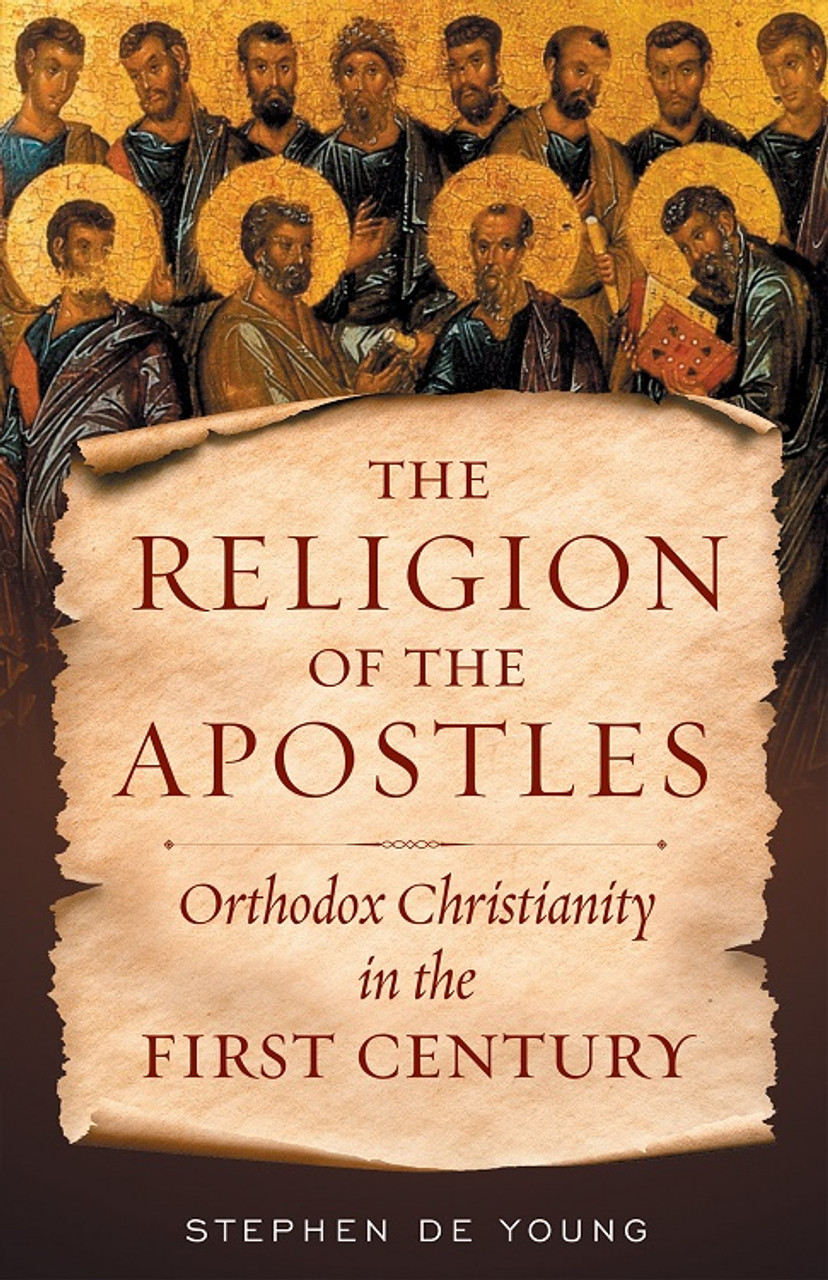
The Religion of the Apostles, by Stephen De Young, shows how the beliefs and practices of the early church connect with the world of Second Temple Judaism, the historical context for Jesus of Nazareth and the New Testament.
The Doctrine of the Trinity as Not an Evolutionary Invention of the Early Church
Stephen De Young is an Eastern Orthodox priest in Louisiana, and co-host of the Lord of Spirits podcast, a favorite among my Eastern Orthodox friends. In many ways, The Religion of the Apostles is an apologetic for Eastern Orthodoxy. Some of my Protestant evangelical friends might be uncomfortable with this, but I would urge for an open mind. I am not dedicated listener of the Lord of Spirits podcast, but I listen to it enough to appreciate that Stephen De Young, and his co-host Fr. Andrew Stephen Damick, challenge a number of blindspots that Protestant evangelicals typically have concerning what the earliest Christians believed and taught. De Young is also a known as a public figure, holding discussions with intellectuals like Jordan Peterson.
Such hesitancy about the Eastern Orthodox apologetic in this book is unwarranted when considering the larger concerns articulated in The Religion of the Apostles. This is also a book that should have a broad appeal to other Christians as well, as it is also an apologetic for Christian faith more broadly, as I hope readers of this book review might discover. A lot of the ideas presented in The Religion of the Apostles echoes the work of the late Dr. Michael Heiser, articulated in Heiser’s several books, the most important one being The Unseen Realm (See the Veracity review of this book). As an evangelical Protestant, I learned a lot from what this Eastern Orthodox priest had to say.
For those interested, Father De Young also has in own podcast doing verse-by-verse exposition through the Bible, the Whole Counsel of God. So far, Father De Young has gone verse-by-verse through the whole New Testament, and now he is mid-way through Exodus in the Old Testament. Who would think that the Eastern Orthodox study the Scriptures so intently??
The Religion of the Apostles begins with a brief examination of the Apostle Paul, as this is where the “evolutionary” model of Christian origins is at its weakest. For those unfamiliar, many scholars acknowledge that Paul has a rather relatively “high christology,” which does not fit in well with the evolutionary model, since Paul’s letters are our earliest writings within the New Testament. It makes very little sense to propose that Paul’s “high christology” would have preceded the “low christology” of Mark’s Gospel, which came years later after Paul’s earliest correspondence.
Paul’s faith practice is consistent with the early beginnings of Merkabah (“chariot”) mysticism, a brand of Jewish spirituality which eventually died out in the 10th century. 2 Corinthians 12:2-6 tells us of Paul’s experience with the “third heaven” and then into “Paradise,” which has roots in the literature of Second Temple Judaism (De Young, pp, 21ff).
De Young then dives in with several chapters showing how the historically orthodox doctrine of the Trinity has its roots in the Old Testament and world of Second Temple Judaism. As Michael Heiser also argues in his books, De Young examines several passages of Scripture that considers the “Angel of the Lord,” one who is simultaneously Yahweh and as a person distinct from Yahweh. This “Angel of the Lord” relates to both Yahweh and humans, and is sometimes also called “the Word of the Lord.” Exodus 3:2-4 is the “burning bush” episode, whereby the Angel of the Lord appears first in the burning bush, and then Yahweh does. In the centuries leading up to Jesus of Nazareth, Jewish thinkers wrestled with understanding this mystery (De Young, p. 31).
Again, in Exodus 33:11 we are told that Moses will see God “face to face,” and yet in Exodus 33:18 we are told that no one can see God’s face and live (De Young, p. 48). Instead of viewing this as a contradiction, this was understood as a way of thinking of God in the sense of being two “persons,” one who can be seen by humans and one who can not. The language of “person/persons” today goes back to the Greek language of “hypostasis/hypostases” of the early church debates which have given us the Nicene Creed (De Young, p. 48).
Most Christians (at least Protestant ones) today think of the “Word of the Lord” as being a reference to the Scriptures. Yet the “Word of the Lord” appears to Abram in a vision in Genesis 15:1-2, whereby Abram acknowledges that this is an encounter with Yahweh himself (De Young, p. 34-35). This suggests a personal encounter, as opposed to reading a text or hearing a disembodied voice.
This insight alone should be enough to make a Protestant evangelical pause momentarily when they speak of the “Word of the Lord” in their worship services.
Then there is the language of the “Son of Man,” which shows up on the lips of Jesus frequently in the Gospels. In Daniel 7, we read of a description of someone coming “like a son of man,” which is a reference to one who comes as a human being. However, in that same passage this same figure is “riding on the clouds,” an ancient reference to divinity (De Young, p. 44). All of these references to the “Angel of the Lord,” the “Word of the Lord,” and the “Son of Man” forced at least some Jews to consider a more complex picture of God.
As Michael Heiser has said, this all goes back to the concept of the “Two Powers” associated with Yahweh, which was seriously studied and discussed during the Second Temple period among Jewish thinkers. These theological prospects eventually find their expression in the pages of the New Testament, most notably the relationship between the Father and the Son. Nevertheless, these ideas were ultimately rejected by the Rabbinical Jewish tradition that redefined Judaism after the destruction of the Second Temple.
As Stephen De Young explains:
‘Far from being unitarian in their monotheism, followers of the Old Covenant believed the God of Israel existed in multiple hypostases, the term that would be translated as “persons” in later doctrinal statements. The Greek term hypostasis rather literally means “substance.” It is, however, used to indicate a concrete being, such as a particular human person. This term was enshrined in the Nicene Creed, which describes three hypostases of the Christian God. ….. For ancient Israelites and Second Temple Judeans, there was only one Yahweh, but He existed as multiple Persons. Despite a lack of clarity about this in the Hebrew Scriptures, it was believed, discussed, and debated throughout the history of the Second Temple period’ (De Young, p. 29ff).
This paints quite a different picture from the evolutionary model of how Trinitarian doctrine became formulated, as somehow being borrowed from Greco-Roman pagan sources. Furthermore it also challenges the notion that Rabbinic Judaism after the destruction of the Second Temple has been wholly consistent with what preceded it. It was the rise of Christianity which forced Judaism after the destruction of the Jerusalem Temple in 70 C.E. to emphasize a kind of unitarian monotheism. By around the 6th century C.E., this Rabbinical Judaism effectively disassociated itself from certain key elements of the earlier Second Temple Judaism. De Young offers a succinct conclusion which goes against the grain of certain modern reassessments as to where Trinitarian theology came from:
“And so, the unitarian monotheism of Rabbinic Judaism, not the doctrine of the Holy Trinity, was the innovation in the centuries after Christ “(De Young, p. 50)
De Young offers a less vigorous defense, but a defense nonetheless that this debate over the hypostases of God included references to what would later be known as the third person of the Trinity, the Holy Spirit. Exodus 23:20 speaks of “the Name” of the Lord. De Young sees this reference to “the name” as associated with the “presence” of the Lord, as when the presence of the Lord is in the Temple built by Solomon, where God has put his “name” there forever (1 Kings 9:3). The “name” and “presence” of the Lord point towards this third hypostasis of the God of Israel (De Young, p. 73).
The case for a binitarian view of God, that of Father and the Son, is stronger than it is for the inclusion of the Holy Spirit within that same Godhead, so it would be difficult to think that trinitarian language was common among Second Temple Jews in the time of Jesus. However, De Young does cite Philo, the Jewish philosopher and contemporary of Jesus, who did use trinitarian language to speak of God (De Young, footnote 17, p. 79). It could be inferred that due to the more elusive references to the Spirit and Presence of Yahweh in the Old Testament might explain why we have less to work with regarding the Holy Spirit’s participation within the Godhead, in comparison to the Jesus as the Son, and his participation in the Godhead.
The New Testament does speak much more about the Son, and the Son’s relation to the Father, than the Holy Spirit, but the New Testament writers are far from silent about the Holy Spirit. The Gospel of John ties in “the name” theology with the coming of the Holy Spirit. Towards the end of John 16 (verse 13), Jesus announces the coming of the “Spirit,” whereby the next chapter “the name” is invoked as to what Jesus has made known to his disciples (John 17:6, 12, 26; De Young, p. 76).
Paul writes about grieving the Holy Spirit (Ephesians 4:30; De Young, p. 76), thereby at least hinting at the personal identity of the Holy Spirit. Paul takes the Greek form of the Jewish “shema” to associate the “Lord” with Jesus. The shema reads as: “Hear O Israel, the Lord is our God; He is one Lord.” In 1 Corinthians 8:6, Paul writes “yet for us, there is one God, the Father, from whom are all things, and for whom we exist, and one Lord, Jesus Christ, through whom are all things and through whom we exist.” 1 Corinthians 12:4-6 has a type of Trinitarian pattern of “one Spirit, one Lord, and one God” which anticipates the Nicene formulation of the 4th century. The benediction in 2 Corinthians 13:14, “The grace of the Lord Jesus Christ, the love of God, and the communion of the Holy Spirit be with all of you,” echoes that same type of Trinitarian pattern (De Young, p. 58).
However, De Young notes that just as we can find the roots for Nicene Trinitarian orthodoxy in certain strands of Second Temple Judaism, the same could be said regarding the roots of other Christian heresies. For example, the Arian heresy, which denied that Jesus as the Son was just as divine as the Father (along with the similar Eunomian heresy), can be found in certain other strands of Second Temple Judaism which identified the second person of Yahweh as the ArchAngel Michael (De Young, note 5, p. 68). The modern successors to this tradition are the Jehovah Witnesses.
The heresy of adoptionism can be traced back to other Second Temple writings which associated the second hypostasis with an elevated human person, like David or Enoch (De Young, note 5, p. 68). The tradition of historical orthodoxy, associated with Nicea, rejected these alternatives as being insufficiently grounded in the “rule of faith” associated with the New Testament.
Stephen De Young vs. David Bentley Hart’s Account of “Tradition”
Here is my takeaway so far: Reading Stephen De Young is quite refreshing as compared to the erudite yet puzzling work from another Eastern Orthodox scholar, the more well-known David Bentley Hart in his book Tradition and Apocalypse (see Veracity review of Hart’s book). In contrast to De Young, David Bentley Hart’s take on the development of Nicene theology can be read in statements like this from chapter 5 of Hart’s book: “The Arians and Eunomians and their religious kith were, when all is said and done, the theological conservatives of their time and place; the members of the Nicene party were the daring innovators, willing to break with the past in order to preserve its spiritual force.” In Stephen De Young’s narrative, both traditions like Nicene orthodoxy as well as Arianism have their roots in Second Temple Jewish thought. But it took the theological crisis of the 4th century to sort those issues out, rejecting the Arian thesis in the process.
While Hart’s historical analysis of early church tradition (to his credit) affirms a kind of fluidity and flexibility found more in both Roman Catholicism and Eastern Orthodoxy, than in rigid forms of Protestantism, Stephen De Young’s critique of the “evolutionary” model of doctrinal development, along the lines of Hart, has greater explanatory power as to how the Triune doctrine of God connects back through the long history of Scripture.
It should be quite clear from Stephen De Young’s The Religion of the Apostles that Nicea was right in line with certain themes in the Second Temple Jewish tradition, preserving the theological contours, while admittedly expressing those contours within the framework of the fourth century Greco-Roman language and thought of its day. Contrary to David Bentley Hart, the Nicene orthodoxy which is recited in thousands and thousands of churches across the world today is no theological innovation. Instead it is grounded in the religion of the apostles.
In the next installment of this review, I examine what Stephen De Young has to say about the early church and the “divine council.” Stay tuned.




 Veracity
What do you think?