
Did Jesus want a woman raped and her children killed in the Book of Revelation?
To start off this post with such a question is shocking. But it was just as shocking to me when I heard this claim made in Bart Ehrman’s 2023 best seller, Armageddon: What the Bible Really Says About the End. What follows is a PG-13 rated Veracity book review.
The Book of Revelation is one of the most difficult books of the Bible to understand. It is also one of the most fascinating books of the Bible. Over the past ten years, a number of Christian bible studies in my town across multiple churches have tried to tackle this last book of the Bible, in order to figure out its enigmatic teachings. From the blowing of trumpets, to the bowls of God’s wrath, to the mark of the beast, etc., the images we read of in Revelation have both disturbed and inspired Christians down through the ages. Revelation is of particular interest in the cultural moment of our day, when political controversies in the United States have been tearing people and families apart, cultural change sparked by social media ripples across society, and reports of civil unrest and horrific wars across the world come across daily in our news feeds.
Are we living in the end times? It sometimes feels like it. People look to the Book of Revelation to try to find the answer.
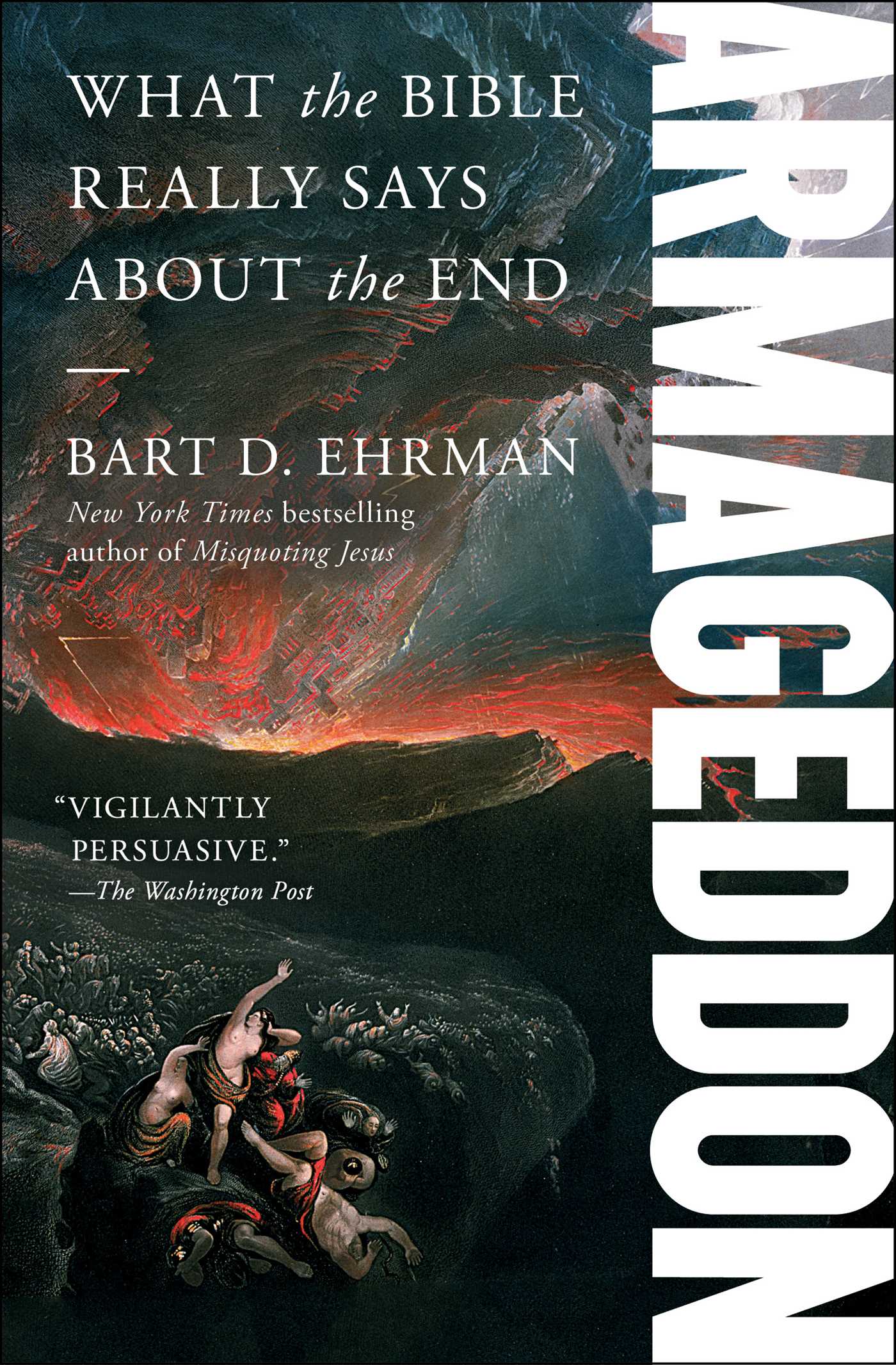
Armageddon: What the Bible Really Says about the End, by Bart Ehrman.
The Influence of Bart Ehrman: The “Gateway Drug” for the Deconstruction of Evangelical Faith
Bart Ehrman, a professor of New Testament at the University of North Carolina, Chapel Hill, is probably the worlds’ best known skeptic of evangelical Christianity. Many atheists and progressive Christians love him. He is interviewed quite often on National Public Radio and on popular podcasts. He is a frequent lecturer for “The Great Courses” at The Teaching Company. He is also the author of many best selling books, six of them New York Times bestsellers. Among his many books include the 2023 edition of Armageddon: What the Bible Really Says About the End. As the title suggests, Ehrman has written a book analyzing how to think about the Book of Revelation.
A lot of historically orthodox Christians shy away from reading Ehrman, but he probably represents the most cogent type of thinking which opposes historic Christian orthodoxy. Many young people growing up in the evangelical church these days, having deconverted away from their faith, look to Bart Ehrman as a guide along their deconstruction process. Just recently, evangelical New Testament scholar Michael Licona has said that the writings of Bart Ehrman have led more people away from the Christian faith than any other well-known skeptic, even more than Richard Dawkins or Sam Harris, of the “New Atheists” persuasion. Dr. Licona has debated Bart Ehrman on multiple occasions, so Licona personally knows that Ehrman is a highly skilled communicator. So, if you want to try to understand the most typical view held by a skeptical, well-educated person about Christianity, having a massive influence on young people growing up in the church, you should read a book by Bart Ehrman.
Ehrman had grown up, particularly in high school and in college, as an evangelical Christian, only to reject that faith gradually in his years in graduate school and later as a university professor. In an age when many people growing up in the church are deconstructing their faith, I think it appropriate to better understand what the critics are saying in order to have healthy, productive conversations with those who find Christianity unpalatable, or otherwise suspect.
In offering this two-part book review of Armageddon, I want to be as fair as I can, acknowledging certain strengths of Ehrman’s arguments while also offering some critical pushback to his thesis. I have reviewed several Ehrman books on Veracity before, notably Heaven and Hell: A History of the Afterlife and Forgery and Counterforgery: The Use of Literary Deceit in Early Christian Polemics. No matter what one thinks about Ehrman’s agnostic/atheism, he is quite a skilled and engaging writer. While I have found much to disagree and agree with various aspects of Heaven and Hell and Forgery and Counterforgery, due to their scholarly tone (though Heaven and Hell has had a more popular bent to it), Armageddon comes across with more of an odd mix of genuinely scholarly considerations, along with a bit of an axe to grind every now and then. Some of the axe wielding is legitimate. Some of it is highly suspect. So let us dive into some of Bart Ehrman’s axe wielding.
Jezebel: A False Teacher from Thyatira… And a Very Disturbing Image Concerning Jesus
A case in point is the shocking claim made at the outset of this blog post: Did Jesus really want a woman raped and her children killed, according to the Book of Revelation?
It helps to read the passage Ehrman has in mind to illustrate his point (Revelation 2:18-29 ESV):
18 “And to the angel of the church in Thyatira write: ‘The words of the Son of God, who has eyes like a flame of fire, and whose feet are like burnished bronze.
19 “‘I know your works, your love and faith and service and patient endurance, and that your latter works exceed the first. 20 But I have this against you, that you tolerate that woman Jezebel, who calls herself a prophetess and is teaching and seducing my servants to practice sexual immorality and to eat food sacrificed to idols. 21 I gave her time to repent, but she refuses to repent of her sexual immorality. 22 Behold, I will throw her onto a sickbed, and those who commit adultery with her I will throw into great tribulation, unless they repent of her works, 23 and I will strike her children dead. And all the churches will know that I am he who searches mind and heart, and I will give to each of you according to your works. 24 But to the rest of you in Thyatira, who do not hold this teaching, who have not learned what some call the deep things of Satan, to you I say, I do not lay on you any other burden. 25 Only hold fast what you have until I come. 26 The one who conquers and who keeps my works until the end, to him I will give authority over the nations, 27 and he will rule them with a rod of iron, as when earthen pots are broken in pieces, even as I myself have received authority from my Father. 28 And I will give him the morning star. 29 He who has an ear, let him hear what the Spirit says to the churches.’
Here is how Ehrman comments on this passage (Ehrman, Armageddon, p.40):
In a letter to the church of Thyatira, Christ attacks a woman prophet he calls “Jezebel,” an allusion to the notorious queen of Israel who led the people of God astray (1 Kings 16:31; 2 Kings 9: 22). This Jezebel is said to be a church leader who “teaches and deceives my slaves to commit sexual immorality and to eat food offered to idols” (2:20). That is, she has taken the position on idol meat found among some of the prominent members of Paul’s church in Corinth: Paul advises against the practice but does not roundly condemn it. In Revelation 2, Christ indicates he has already given Jezebel a chance to repent—in other words, to stop condoning the practice of eating meat purchased from a pagan temple—but she has refused. And so he indicates her judgment:
See, I will throw her onto a bed, and those who commit adultery with her I will throw into a great affliction, if they do not repent from her deeds. And I will kill her children. (2:22)
Now, that’s a verse I never learned in Sunday school. Some translators translate “bed” as “sickbed” (that is, Christ will make her ill), but that is reading something into the verse that isn’t there. It is just the Greek word for “bed.” And what happens on the bed is not that Jezebel gets sick. She has illicit sex with others. After Christ has thrown her there. This is not a pretty image, but it gets worse. Those who fornicate with her will be greatly afflicted (we don’t know how—is it connected with the sex?). And most startling of all, Christ will kill her children.
The passage is obviously symbolic, but it is not pleasant symbolism. And it is worth remembering: the passage is referring to a leading prophetess in a Christian church. John presumably calls her Jezebel because in his judgment she is the female embodiment of evil who leads others into grotesque sin. Those who get into bed with her are those who join her in rank immorality (eating meat sacrificed to an idol). And her children are the fruit she bears—the people she convinces to join in as well. Christ will kill them. That probably means that they will be condemned in the coming judgment, but John may mean it literally as a threat in the present. We do have examples of God killing those among his followers he is not pleased with, not just in the Old Testament (for example, Numbers 16:1–35), but also in the book of Acts (5:1–11) and the writings of Paul (1 Corinthians 11: 27–30). The latter instance, interestingly, also involves a case of inappropriate dining practices (misconduct at the Lord’s supper).
In short, the letters of chapters 2 and 3 set the context for the entire Apocalypse. Christ is in charge. He considers Jews to be Satan-worshipping enemies of his people. Christians must avoid pagan associations…
Wow. That is a humzinger of a quote!
There is a lot in this quote from Ehrman’s Armageddon to make a conservative evangelical Christian like me animated in different ways, enough to want to throw the book across the room. Alas, I read this on Kindle, so I did not want to do that.
The problems to address in this quote are simply too much for this book review. But I will just reference a few of the most problematic statements. First, Ehrman judges that the translation in Revelation 2:22 of the word “bed” to mean “sickbed” is unwarranted. The ESV translation has this as “sickbed,” and the NIV translation has this as a “bed of suffering.” According to Ehrman, this is all wrong.
As Ehrman tends to provocatively suggest, there is a false teacher that the book’s author, John, knows who is leading people astray with her teachings. As a result, Jesus threatens to throw this woman onto a bed where she will have sexual relations with other adulterous men, which might even insinuate rape. Then to make matters worse, this woman’s children will be murdered by Jesus, as punishment for her sins.
Is Jesus endorsing infanticide? Yikes. Make that double-yikes!
To his credit, Ehrman does indicate that the passage is symbolic in nature. But the hyper-literal violent imagery is still stuck in my mind.
However, what is wrong with this image portrayed by Bart Ehrman is that he treats this text in a rather uncharitable way. For starters, Ehrman is ignoring the evidence which indicates that the translation of “sickbed” actually has a firm root within the literature of Second Temple Judaism, the literary context of which the author of the Apocalypse is readily familiar. Consider the evidence in these vital texts, the first coming from the Old Testament, and then two more coming from what Protestants call the “Apocrypha”:
When individuals quarrel and one strikes the other with a stone or fist so that the injured party, though not dead, is confined to bed (Exodus 21:18 NRSVue)
But eventually Alexander fell sick and was confined to bed. He knew that he was dying (1 Maccabees 1:5 CEB).
For as he stood overseeing those who were binding sheaves in the field, he was overcome by the burning heat and took to his bed and died in his town Bethulia. So they buried him with his ancestors in the field between Dothan and Balamon (Judith 8:3 NRSVue)
Anyone who has studied Revelation in-depth would know, the Book of Revelation is steeped within the world of the Hebrew Bible, and the thought life of Jews living in the period of the Second Temple in Jerusalem. In his Word Biblical Commentary for the Book of Revelation, David Aune (p. 205) comments that “I will throw her into a sickbed” is a Hebrew idiom indicating that someone would be punished with various forms of sickness. We see this demonstrated in the three previous quotes. Grant Osborn in his Revelation commentary (p. 158ff) argues that the adultery theme is more closely linked to the sin of idolatry, a recurring theme in the Old Testament.
In other words, it would be fairer to say that Jesus is horrified by the false teaching of the female Thyatira prophetess, in that she is promoting the sin of idolatry among her followers. By leading her followers astray, Jesus hopes to punish her with some sort of sickness in order to keep the sin of idolatry from spreading.
Jesus, the Baby Killer?
A second point is that the reference to “Christ will kill” her children could also easily be seen as a metaphor for Jesus’ desire that the movement be stopped and the heresy be kept from spreading. This passage is not a hyper-literal justification for Jesus promoting abortion or infanticide, an interpretation which some have taken, while others prefer not to think about it. Instead, the prophetess would be kept from “reproducing” her folly in the minds of those who have been deceived by her. We have no specific record of any particular heretical teaching from an unnamed woman from Thyatira surviving past the first century, so it would appear that this “Jezebel’s” “children” were metaphorically “killed” with the death of the heresy, a fulfillment of the prophecy.
Lest anyone think that such a less sexually violent use of rhetoric is some reactionary, fundamentalist attempt to rescue the Book of Revelation from scandal, it should be noted that the “sickbed” interpretation and less sexually violent reading is commented on in the Jewish Annotated New Testament, a product of Jewish scholarship highly regarded among many critical scholars. So, while the sexually charged violent rhetoric that Ehrman’s sees in this passage is troubling, a more generous interpretation of this passage is warranted, contra Ehrman.
Nevertheless, even without an overly sexually violent interpretation in mind, the image is still striking. Many Christians are content to think of Jesus in the Gospels in terms of promoting an ethic of non-violence. However much I would like this to be true, such a pacifism is hard to square with the imagery of Jesus in Revelation. The idea of Jesus in Revelation 19:15 with a double-edge sword, punishing non-believers and even wayward believers alike does not chime in easily with the Jesus of the Gospels who welcomes little children in his midst. There is no “turning the other cheek” from Jesus’ Sermon on the Mount in the Book of Revelation.
The tension between the Jesus of the Gospels and the Jesus of Revelation is palpable. But somehow we as Christians are called to live somewhere within the midst of that tension. Dick Woodward, the late Bible teacher who has most influenced me, would often quote a statement made by Robertson McQuilkin, a former Bible college president:
“It seems easier to go to a consistent extreme than to stay at the center of biblical tension.”
Reading Revelation offers someone the opportunity to put that principle of living in the “center of biblical tension” into practice.
It might be tempting to push all of this kind of judgment off to the Second Coming of Jesus, but the judgment associated with Thyatira is prior to that. Whether we like it or not, Jesus has the right to take life in order to fulfill God’s purposes, even prior to the Final Judgment. We see this even in the early history of the church, in Acts 5:1-11, with the deaths of Ananias and Sapphira. Unfortunately, many think of Jesus as simply kind and loving, with no reference to Jesus’ holiness, thereby avoiding the Jesus in Revelation who exacts terrifying justice against those who perpetrate evil. Instead, God’s people need reminders at times that God means business when it comes to acting as judge of all the world.
A non-violent ethic ideally would be better, as Martin Luther King, Jr. did with the civil rights movement of the 1960s, or what Mohandas Gandhi did in India with the British in the 1940s. But a non-violent ethic would not have spared the lives of Jews murdered by the Nazis at Auschwitz. I am thankful that Allied forces stormed the beaches of Normandy, pushing their way towards Germany, in order to stop Hitler’s madness. True, it is tragic that innocents were killed along the way. But it seems plausible to say that God intervened in judgment against Hitler by sending the Allied armies towards Berlin.
With all due respect to my Anabaptist friends, who reject military service, I am with Saint Augustine’s “just war theory.” The survivors of Auschwitz might probably agree with Augustine as well, as without the Allied advance across Europe, we might not have had any survivors of Auschwitz to tell the story. Hitler would have probably murdered a million more Jews, if Allied troops had not intervened. Allowing evil to flourish when something can be done about it to limit the spread of evil is a good thing, knowing full well that war is indeed a terrible, terrible thing.

John of Patmos, receiving the Revelation, by Gasparde Crayer. Saint Augustine pondered the meaning of John’s vision.
The Book of Revelation as Apocalyptic Literature
With any responsible approach to the Bible, context matters. The Book of Revelation is apocalyptic literature, using hyperbolic and highly symbolic language to get its message across. It does not mean that everything we read about in Revelation is a metaphor. But we should not read apocalyptic literature the same we read something like Paul’s letters, or even any of the four Gospels, which are more historical in character. When it gets to chapters 5 and 6 of Armageddon, Ehrman explains this to the reader.
“Apocalypses are first-person narratives of highly symbolic visionary experiences that reveal heavenly secrets to explain earthly realities”(Ehrman, p. 98).
When he gets to a lot of the nuts and bolts of how Revelation functions as an apocalyptic text, Ehrman summarizes the broad scholarly consensus quite well. For example, the two-edged sword is an image found in Christian literature to represent the Word of God (Ehrman, p.34, etc., Hebrews 4:12).
There are details in Revelation which make no sense without some symbolism in mind. The two-edge sword which Jesus wields in John’s heavenly vision is not an actual piece of hammered steel (Revelation 2:12 ESV), growing out of Jesus’ mouth. So, when Revelation 1:16 says that “from his mouth came a sharp two-edged sword,” this is clearly a metaphor about Jesus proclaiming God’s Word.
Yet ironically, many Christians are taught the opposite, and to read Revelation as “literally” as possible. This becomes a recipe for confusion, a source for contentious debates in small group Bible studies, and in the worst cases, cynicism about the integrity of the Bible.
Even such a stalwart conservative as Tom Schreiner, a New Testament scholar at the Southern Baptist Seminary in Louisville, Kentucky, acknowledges that much of the symbolism expressed in Revelation defies even our best understanding. Even the early church fathers debated one another as to what many of the symbols mean! But it does not mean that interpreting certain important symbols in Revelation is a hopeless task.
The imagery of Jesus as the Warrior King in Revelation is consistent with the theme of God’s judgment. Even with the woman of Thyatira we have God’s warning to stay away from false teaching. The highly charged, hyperbolic, and symbolic language is meant to caution us not to take God’s Word so lightly, and not to be easily swayed by lies and false teachings. For if we fail to heed God’s warnings, we risk facing God’s judgment ourselves. It is a stern warning for sure, but it is meant to grab attention. It clearly grabs mine!!
Unfortunately, it is all too easy to miss the purpose of Revelation, which stands squarely within the Jewish apocalyptic tradition. Ehrman’s analysis of the woman of Thyatira passage serves as a warning for well-meaning Christians who want to insist on the most hyper-literal interpretation of the Book of Revelation as possible, as a means of affirming a particular rigid understanding of biblical inerrancy. While this posture is intended to affirm the integrity of the witness of the Bible, it actually can backfire on the Christian. For if you go that route of interpretation, you risk the danger of saying that Jesus is perfectly fine with encouraging the sexual exploitation of women and the killing of children, including babies.
Frankly, that does not sound very woman-affirming or pro-life to me. It is not very Christian at all.
The Millennium, Inerrancy, and Augustine
One does not need to abandon a belief in the inerrancy of the Bible in order to embrace the heavy dose of symbolism found in the Book of Revelation, unless your personal definition of inerrancy prevents you from doing that. The controversy over the millennium, as found in Revelation, is the most well-known example from the book.
Saint Augustine of Hippo, one of the greatest defenders of the integrity of the Bible, changed his mind concerning the meaning of the millennium, as taught in Revelation 20. For years, Augustine subscribed to the belief that the millennium was to last for exactly 1,000 years, following the return of Jesus. But after careful study, Augustine concluded that the millennium was a symbolic reference to the age of the church, whereby the “1,000” years was simply thought of as as metaphor, a deeper meaning yet to be fully determined, as the church awaits the final return of Jesus (Read more about Augustine’s change of mind at Veracity).
Still, a lot of Christians tend to be rather suspicious about those sympathetic towards Augustine’s conclusions, as though he was a 5th century version of a “progressive Christian,” which is a complete absurdity. This had been characterized in such a negative way in certain fundamentalist corners of the church in the mid-20th century, but this was really more of an historical anomaly rather than anything else. More careful Christian readers of Revelation realize that there are difficulties with practically every view of the millennium. Not everyone in the early church agreed with Augustine’s change of views regarding the millennium, and many faithful Christians today are not persuaded by Augustine’s ultimate rejection of a 1,000 year earthly reign of Jesus following his Final Return.
The First and Second Resurrections of the Millennium
For example, many who are not persuaded by Augustine’s theological shift contend that a millennium after Christ’s Second Coming more adequately fulfills prophecy. Furthermore, those who reject Augustine’s adoption of the millennium as the age of the church stumble over Revelation 20:4, which says that the beheaded martyrs of the church will be raised first, at the start of the millennium. Only later will the rest of the dead be raised, after the millennium is concluded (Revelation 20:5). If Jesus’ Second Coming is prior to the millennium, the earlier interpretation adopted by the younger Augustine avoids some of the complications with the older Augustine’s interpretation.
Advocates of Augustine’s earlier view have some problems as to the identity of the beheaded martyrs: Did these martyrs only become martyrs at a particular time in history? What about martyrs who were not beheaded? Other problems emerge: Why only martyrs? What about those saints who have died before the return Jesus dying natural deaths? These are tricky problems to think through.
Premillennialists believe that Christ will return prior (pre) to the millennium. Yet here is another problem that premillennialists often point out against the amillennial view: If we are living currently in the age of the church, which some assume is equivalent to the millennium, then where are those raised martyrs right now?
That raises other good questions to consider: Is this “first resurrection” a reference to the intermediate state, between this earthly life and the final resurrection? Or is it a metaphor for the spirit of the resurrection dwelling in the hearts of believers, a spiritual resurrection as Augustine himself argued? (Ehrman, p. 55)
Some have suggested that Augustine’s spiritual resurrection, as the “first resurrection,” does not work since the resurrection of beheaded martyrs assumes that these saints indeed had physically died. If Augustine’s spiritual resurrection is meant to describe becoming a believer, being born again, as passages like Colossians 3:1 teach that we as believers have been “raised with Christ,” why does the Book of Revelation not come out directly and say that?
The Greek word for resurrection, “anastasis,” is used in Revelation and elsewhere, and it always means physical bodily resurrection. Colossians uses a different word for “raised with Christ.”
However, critics of Augustine’s later view are not without their own difficulties. For what is the difference between the first resurrection and the second resurrection? Is the first resurrection simply talking about the bodily resurrection of believers and the second resurrection the bodily resurrection of non-believers? It is really plausible to say that no one else living among the glorified, resurrected believers during a future millennium ever becomes a believer, not to be included in the second resurrection?
It is a complicated scenario. Would it not be better to say that the “thousand years” is a not a chronological referent? Rather, is it a symbol or metaphor representing something else, drawn from the sequence of events that John saw in his vision in the first century? Just because certain details in John’s vision were presented to him in a specific order does not necessarily mean that each of these visionary details in Revelation 20 specify an exact chronology of things to come at least 2,000 years later. Much of this debate concerns whether the “thousand years” and other elements in Revelation 20 are to be understood metaphorically or non-metaphorically.
Nevertheless, premillennialists find the above suggested “amillenial” proposals to be unconvincing. Many interpreters of Revelation 20 who see the millennium as a 1,000 year reign of Christ on earth after his Second Coming argue that Isaiah 65 is one of the most profound passages of the Old Testament teaching the same idea. Premillennialists who appeal to Isaiah in this manner believe such passages in Isaiah apply to this 1,000 year period after the return of the Christ, but before the final eschaton. But Isaiah 65:20 in this interpretation suggests that there will be unglorified humans living on earth during this 1,000 year period.
No more shall there be in it
an infant who lives but a few days,
or an old man who does not fill out his days,
for the young man shall die a hundred years old,
and the sinner a hundred years old shall be accursed.
The “young man” represents one of the unglorified saints, who will wait for the “second resurrection,” whereas the “sinner” is not counted among them. So, who are these unglorified humans? Where do they come from?
If the Second Coming of Christ signals the end of sin and death, then why would sin and death then continue on in a future 1,000 year reign of Christ on earth? Why an additional delay of 1,000 years to get the job completely done? Is not the continued presence of sin and death in the church age sufficient to explain the millennial age?
If the premillennial view is correct, not only does this view have a difficulty in explaining why there will be unglorified humans in a future millennial age, it also has a difficulty in explaining how the glorified humans, from the “first resurrection” (Revelation 20:4-5), will live among the unglorified humans.
Defenders of Augustine’s later view say that the Apostle Paul groups Christ’s Second Coming together with the final judgment, the elimination of sin and death, and the final resurrection, as part of one single event, with no mention of a millennium (1 Corinthians 15:23-24 ESV). However, critics of Augustine’s later view say the truth of a future millennial reign had not yet been revealed to Paul. John wrote the Revelation after Paul wrote his letters, so it is possible to find a gap in Paul’s future-oriented chronology, where through the process of progressive revelation, a future exact 1,000 year period of Christ’s earthly rule could be inserted into the prophetic sequence of events.
(Some have suggested that there is an alternative to both the amillennial and premillennial positions called the “new creation millennialism.” The details on this view is outside the scope of this book review, but a prominent advocate is Webb Mealy, who has two videos on YouTube on this alternative viewpoint. Baptist theologian Tom Schreiner advocates this alternative view as well).
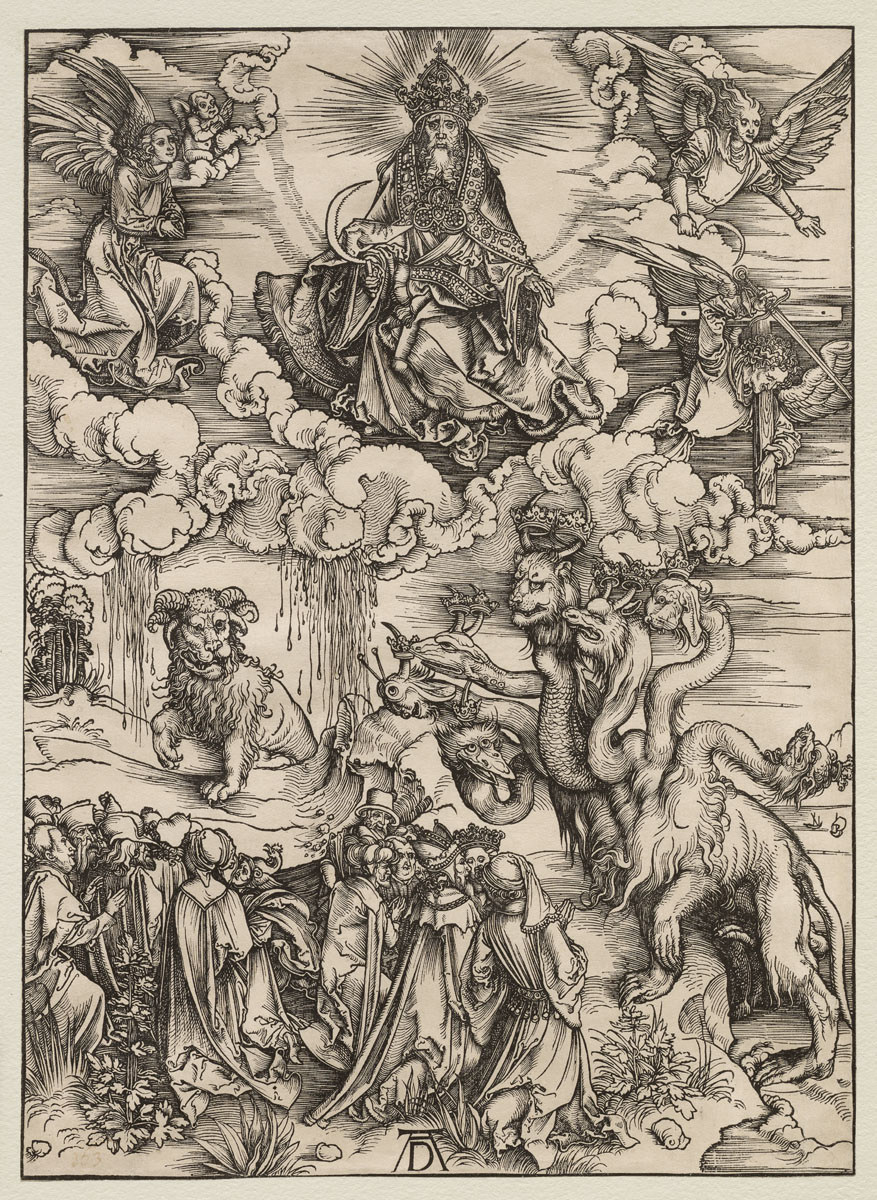
Albrecht Dürer 1498 woodcut, “The Beast with Two Horns Like a Lamb”, based on Revelation 13:11. Apocalyptic language in the Bible presents challenges to the evangelical lay person and scholar alike. How do we go about interpreting such strange and difficult texts?
The Millennium Controversy in the Book of Revelation Remains Unresolved
The debate will surely continue, emphasizing certain details at the expense of others, as to what the millennium in Revelation 20 is all about. Christians of various theological traditions can have good-faith disagreements on the matter. But Augustine’s respected conservative stature within the church is evidenced by the fact that Augustine’s amillennialism became the de facto interpretation of Revelation for over a 1,000 years in the Western church (pun intended!).
While I certainly could be wrong here, I lean towards saying that Augustine was right. Some think that standing of the fence on this issue is a “cop out.” But there is a good deal of truth with the old joke of being a “pan-millennialist.” A “pan-millennialist” is a Christian who believes that it will all “pan-out” in the end.
Augustine might have been wrong about the millennium, but he was no theological liberal. That is an anachronism which belongs to the recent centuries and not an adequate description of the leading Christian thinker from 1600 years ago. Strangely, in the preface to Armageddon, Ehrman tends to associate certain views of Revelation more along the lines of Augustine’s thought as “liberal,” which is perhaps a leftover sentiment from his earlier days as a Christian fundamentalist.
Granted, there are Christians who insist that the Book of Revelation must be interpreted “literally,” whatever they mean by “literal.” Is the Beast of Revelation 17:7 a “literal” animal with seven heads and ten horns, or is the Beast a metaphor symbolizing something else, like a nation? Is Satan “literally” a dragon with a tail which “literally” knocks down a third of the stars of heaven in Revelation 12:3-9, or this dragon a metaphorical symbol representing Satan? Is Jesus a man who “literally” rides on a white horse in Revelation 19:11-16, while simultaneously being a “literal” lamb with seven heads and seven eyes in Revelation 5:6?
These are clearly extreme examples, and most premillennialists today do not go to such extremes. Nevertheless, there are a lot of other Christians who shy away from more popular, futuristic, early-young-Augustinian readings of Revelation, such as partial preterists and postmillennialists, who are quite conservative, a point which Bart Ehrman neglects to tell the reader.
The Book of Revelation Can Be Hard to Understand
Aside from the violent imagery, and the conundrum of the millennium, there are other aspects of the Book of Revelation which can make it difficult to understand. Bart Ehrman’s Armageddon tries to untangle these difficulties. But his own solutions to such difficulties raises another set of problems. In particular, Ehrman’s solution to the enigma of the millennium is an unnerving head-scratcher, which deserves a thoughtful response. We will explore such problems in a follow-up post (the next and last one in this series), as we continue our review of Armageddon: What the Bible Really Says About the End.
Stay tuned for the next installment of this book review, coming in a week or two!




 Veracity
What do you think?